

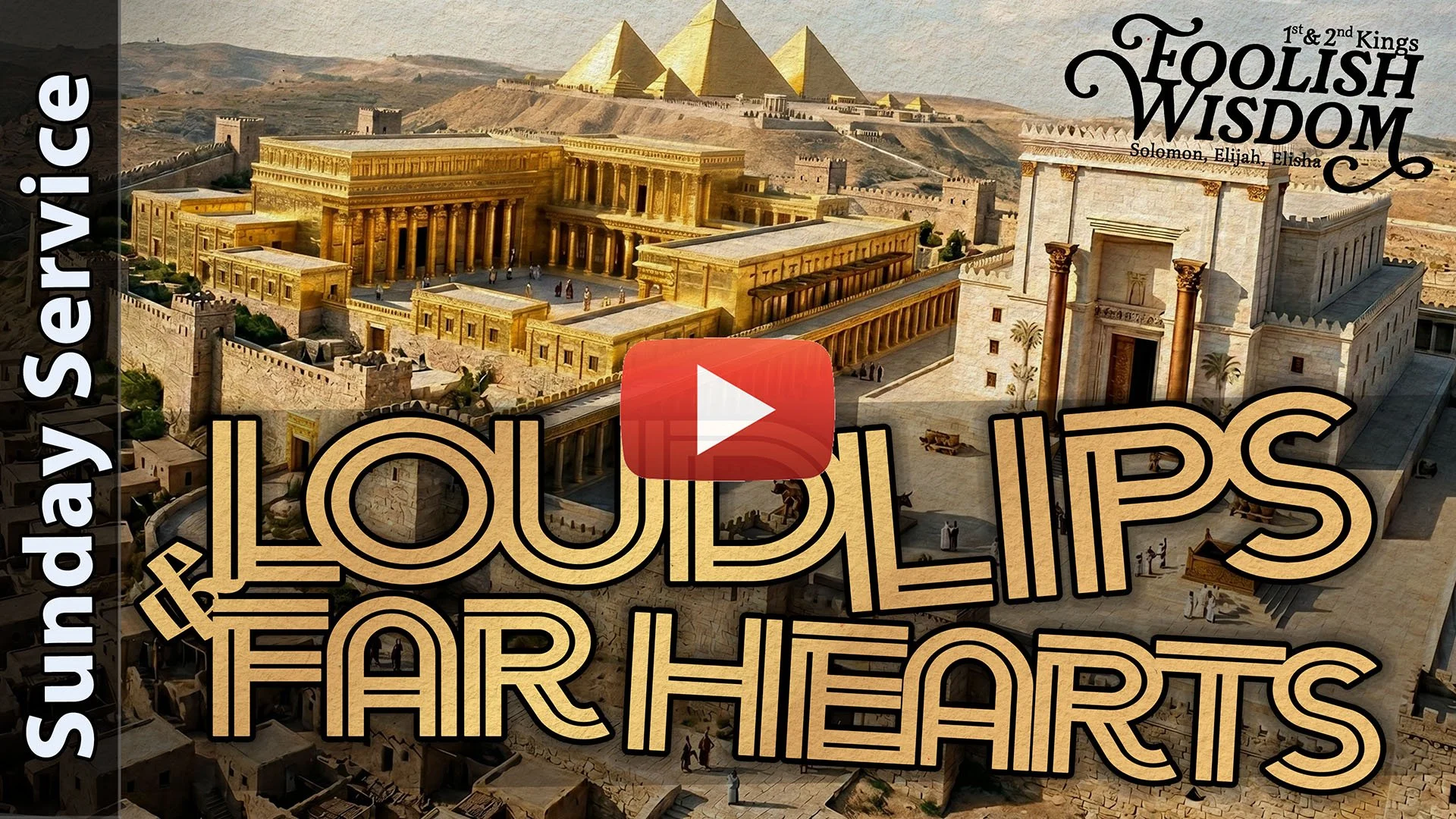
![[Sunday] Loud Lips & Far Hearts - Foolish Wisdom](https://images.squarespace-cdn.com/content/v1/5852f18a20099e30cd2c01dc/1777585193440-H27BJHBXN2C272DK4Q5Z/FW2a.jpg)
[Sunday] Loud Lips & Far Hearts - Foolish Wisdom
We look at Solomon's tragic fall into pride and power, reminding us that true wisdom isn't found in building our own empires, but in the self-emptying love of Jesus.
-
Series Context
Sermon series: “Foolish Wisdom,” walking through First and Second Kings by focusing on Solomon, Elijah, and Elisha.
Narrative arc:
Solomon: precipitates the kingdom’s downfall.
Elijah: ministers as the kingdom collapses.
Elisha: serves among the ashes after the fall.
Aim: To expose “foolish wisdom”—the contrast between human displays of power and God’s way of humble service.
Opening Illustration: LCMS History and Power
LCMS congregational identity noted; origin story used as a parallel to Solomon’s trajectory.
Martin Stephan:
Charismatic leader in Germany amid 19th-century nationalization.
Organized migration to America in 1838 on five ships; declared himself bishop en route.
Settled in St. Louis, then directed many settlers to Perry County, MO, to maintain control.
Reports of exploitation emerged—“honoring with lips while heart is far”—used as a modern example of the temptation to power.
Theme introduced: When leaders seek control, honor God outwardly but their hearts drift toward self-glory and domination.
Main Texts and Biblical Context
Focus: Solomon’s fall as the pattern of choosing empire power over covenant faithfulness.
1. Solomon’s Forced Labor
Scripture: First Kings 9:14 (NIV paraphrase noted)
“Here is the account of the forced labor Solomon conscripted to build the Lord’s temple…”
Context and emphasis:
“Forced labor” exposes slavery-like practices reminiscent of Egypt.
God’s identity statement to Israel: “I am the God who brought you out of Egypt”—don’t return to Egypt’s ways.
The author subtly critiques Solomon’s “Egypt-like” rule even while praising his grandeur.
2. Solomon’s Wealth and Throne
Scripture: First Kings 10:14
“The weight of the gold that Solomon received yearly was six hundred and sixty-six talents…”
Number significance:
“6” symbolizes incompleteness; “666” evokes anti-God patterns of power (cf. Revelation).
Scripture: First Kings 10:18–20
Solomon’s throne: ivory and gold, six steps, twelve lions—hyperbolic claims of unmatched greatness.
Historical illustration:
King Tut’s throne (c. 300 years earlier) shows Solomon is emulating Egyptian grandeur; the “nothing like it” boast mirrors despot rhetoric.
Scripture: First Kings 10:27–29
“Silver as common as stones… Solomon’s horses were imported from Egypt… chariots from Egypt for six hundred shekels…”
Application:
The repeated “Egypt” connection highlights Solomon’s desire to be Pharaoh—a pursuit of power antithetical to God’s covenant call.
3. Solomon’s Loves and Idolatry
Scripture: First Kings 11:1–2
“King Solomon… loved many foreign women… [from nations] about which the Lord told the Israelites ‘You must not intermarry with them, because they will surely turn your hearts after their gods.’”
Correction of common misreading:
The sermon challenges the tendency to blame the women.
Deeper cause: Solomon’s heart already set on empire power—wives were a symptom, not the core problem.
Pastoral application:
We scapegoat “weak” or obvious targets to avoid confronting our own worship of power.
Lip-service to God can mask a heart enthralled by glory, dominance, and self-justification.
4. God’s Judgment on Solomon
Scripture: First Kings 11:9–11
“The Lord became angry with Solomon because his heart had turned away… ‘Since this is your attitude… I will most certainly tear the kingdom away from you and give it to one of your subordinates.’”
Theological point:
God judges covenant unfaithfulness, especially when leaders reinstate bondage God already broke.
Solomon’s attempt to be Pharaoh leads to loss—God resists proud rulers and defends the oppressed.
LCMS Case Study Continued: Accountability over Personality
St. Louis pastors feared confronting Stephan; chose the youngest pastor, C. F. W. Walther, to investigate.
Walther:
Rode to Perry County, verified abuses.
Removed Stephan, sent him across the Mississippi.
Established lasting accountability: “No bishops”; authority in the Word and local congregations; pastors accountable to congregation and district president.
Became first LCMS president, seminary professor, and championed “sola deo gloria” (Glory to God alone).
Fruit of humble leadership:
LCMS helped found a historically Black university during Reconstruction to uplift those oppressed by “pharaohs.”
Note of lament: the university closed five years ago; a call to recover mission focus.
Jesus: The Greater-than-Solomon Way
Scripture: Matthew 12 (Queen of the South/Sheba and judgment)
“The queen of the south… will rise at the judgment… for she came from the ends of the earth to listen to all of Solomon’s wisdom; and now one greater than Solomon is here.”
Interpretation:
Jesus contrasts with Solomon’s power model.
Pharisees with long robes and devouring of widows exemplify self-glorification; Jesus confronts them.
Temptation narrative:
The devil offered Jesus “all power, gold, wisdom, greatness”; Jesus refused, embracing humility.
Pastoral assurance:
If salvation were based on our daily performance, we’d be lost.
Jesus “went to the bottom”—His cross and self-emptying place salvation under us, sustaining us amid doubt and failure.
Christ’s Humble Exaltation
Scripture: Philippians 2:5–11 (paraphrased in sermon)
Jesus emptied Himself, became a servant unto death on a cross; therefore God exalted Him, so every knee bows and every tongue confesses Jesus Christ is Lord—to the glory of God the Father.
Revelation image:
In the throne room, John hears glory and power—but when he looks, he sees “a Lamb that is slain.”
God’s throne is the crucified Lamb—power expressed as sacrificial love so God is never out of our grasp.
Who God Is, Who You Are, and How to Live
Who God is:
The Redeemer who brings His people out of Egypt; He opposes oppressive power and judges idolatry.
He exalts the humble Christ, whose throne is the slain Lamb—power as self-giving love.
Who God says you are:
Beloved, upheld by Christ’s salvation “underneath” you; not defined by performance but by grace.
Called away from empire-seeking identity to servant-hearted, covenant faithfulness.
How to live:
Renounce pursuits of power and self-glory; embrace accountability and humble service.
Guard against honoring God with lips while hearts chase influence and status.
Refuse scapegoating; examine the heart’s idols—especially the idol of power.
Live “sola deo gloria”—direct all glory to God alone; organize church life around the Word, communal accountability, and care for the marginalized.
Application and Examples
Biblical application:
Resist building “Egypt” in our homes, churches, and institutions: avoid systems that exploit or dehumanize.
Read First and Second Kings with an eye for the authors’ “truth bombs”—praise of grandeur paired with subtle critiques.
LCMS application:
Build structures that check charismatic personality power.
Recover missional commitments to uplift those historically oppressed.
Personal spiritual practice:
Regularly ask: Are my fruits revealing a heart seeking power?
In seasons of doubt and failure, remember Christ’s salvation is beneath you, ready to lift you.
Pursue servant leadership; seek accountability; give glory to God alone.
Key Points
God rescued Israel from Egypt so His people would not imitate empire power; Solomon tragically re-imported “Egypt” through slavery, wealth, and military alliances.
Blaming “foreign wives” misses the deeper issue: Solomon’s heart loved power and self-glory, turning from God.
God resists proud rulers and tears down oppressive structures; He calls His people to humble accountability.
Jesus is greater than Solomon: He rejected worldly power, embraced the cross, and reigns as the slain Lamb—God’s true throne of love.
Our identity and endurance rest in Christ’s self-emptying grace, not in our performance; therefore, we live “sola deo gloria,” serving rather than dominating.
Scriptures Referenced
First Kings 9:14
First Kings 10:14, 18–20, 27–29
First Kings 11:1–2, 9–11
Matthew 12 (Queen of the South/Sheba and judgment)
Philippians 2:5–11
Revelation (Lamb that is slain in the throne room)
Closing Exhortation
Pursuits of power are frivolous; Christ alone brings you near.
Embrace “foolish wisdom”: humble service, accountability, and glory to God alone.
We look at Solomon's tragic fall into pride and power, reminding us that true wisdom isn't found in building our own empires, but in the self-emptying love of Jesus.


What Had happened at Grace this week.
![Genesis [Tuesday Bible Study] 10:00am](https://images.squarespace-cdn.com/content/v1/5852f18a20099e30cd2c01dc/a502215c-0fa5-4f83-9cbd-7605b5239368/Bible+Study+2+%2848%29.png)
![[Sunday] Treasure In The Pit - Uproot & Plant - The Book of Jeremiah Ch38](https://images.squarespace-cdn.com/content/v1/5852f18a20099e30cd2c01dc/1791510365268-D3ZBJES5THWDRRFX642V/uproot+5a.jpg)
![Grace At The FLGA President’s Equip Conference [Photos]](https://images.squarespace-cdn.com/content/v1/5852f18a20099e30cd2c01dc/1791512993810-VGZR7F6BTGBK49JQXAJP/PXL_20260930_231025258.jpg)
![[Sunday] I Will - Uproot & Plant - The Book of Jeremiah Ch31](https://images.squarespace-cdn.com/content/v1/5852f18a20099e30cd2c01dc/1790717808062-CSTXC8PAW44RX5SEXPHA/uproot+4a.jpg)
![[Sunday] Day of Infamy - Uproot & Plant - The Book of Jeremiah Ch25](https://images.squarespace-cdn.com/content/v1/5852f18a20099e30cd2c01dc/1790271043490-QRFTFU8K15UYNHMZ98NY/uproot+3a.jpg)

![[Sunday] Den of Robbers - Uproot & Plant - The Book of Jeremiah Ch7](https://images.squarespace-cdn.com/content/v1/5852f18a20099e30cd2c01dc/1789739183593-XLA06FKIUDVQKTY4AYZ9/uproot+2a.jpg)

The Rise and Fall of Martin Stephan
Even though Martin Stephan had many troubles in this life, and more than likely committed grievous sin, which caused his expulsion from the colony and the church, God nevertheless used him to achieve His purpose here on earth.
Taken from https://leben.us/rise-fall-martin-stephan/
The Lutheran religion did not get off to a fast start in America. None of the early explorers were Lutheran. Most of them were Roman Catholic or Anglican. None of the early settlers were Lutheran. In fact, Lutheranism did not come to America until Gustavus Adolphus, king of Sweden mentioned a planting of a Lutheran colony in 1624, about 125 years after the new land was discovered. His daughter Christina fulfilled this dream by sending over a colony of Lutheran Swedes to settle in Delaware in 1639. While this colony did not last, Lutherans by name have been in the country ever since.
Yet these so-called Lutherans were not always Lutheran. Calvinism, Piet-ism and Rationalism all had an effect on these people. Pastors were uneducated. They fell into trying to reform the rough life of the new land. They would preach both in Reformed and Lutheran pulpits. Even Muhlenburg, the father of Lutheranism in America, was not necessarily always a confessional pastor. This does not mean that there were not any confessional pastors in America. Men, like John Campanius, the Falckners, the Henkels and others stood firmly in their beliefs. On a whole, however, Lutheranism in America suffered.
Then in the early 1800s more and more confessional Lutherans began to come over to this country to escape Rationalism, especially from Germany. Most notably was a Saxon pastor, named Martin Stephan, who brought over a group of immigrants to St. Louis. This group would start what was the most confessional synod in America at that time, the Lutheran Church— Missouri Synod. This synod established confessional Lutheranism in America. Yet when the synod started, they were without their leader. Only a few months after Stephan led this confessional group to America, he was deposed and cast out of the colony for sinful actions. How could this happen? How could a confessional Lutheran pastor, who held so firmly to God’s Word, fall into such evil sins? How could he be disposed so quickly by a people who loved him and had just followed him to the new colony? Were they jealous of him? Were they looking for power? Or was Stephan deserving of this expulsion? These are the questions that we must examine if we are to understand the rise and fall of Martin Stephan.
Martin Stephan was born on August 13, 1777 in Stramberg, Moravia, which is now in the Czech Republic. His parents were originally Roman Catholic but had been converted to Protestantism before Mart-in was born. They raised Martin with a strict training in God’s Word and were teaching him the family trade, as a linen weaver. However Martin’s parents died when he was still young. His pastor, Johann Ephraim Scheibel saw promise in Stephan to be a pastor. So he gave him free access to the church’s library. This reading en-couraged him to become a pastor and gave him his conservative standpoint, which he held throughout his life.1 With the financial help of some Pietists, he was able to go to St. Elizabeth’s Gymnasium in Breslau before attending both the University of Halle and the University of Leipzig.
Stephan, however, did not graduate from either of these universities. Although he was gifted in many ways, Stephan seemed to have little interest in reading the classics, which were required for graduation from a university. Instead he spent much of the time reading the Pietists’s publications.2 He seemed only to be interested in religious affairs.
Upon leaving Leipzig, he served as a pastor in Bohemia for a year. Then in 1810, something happened to Stephan that would change his life forever. He was called to be a pastor at the unique congregation of St. John’s in Dresden.
St. John’s was formed by Bohemian refugees during the Thirty Years’ War. After the war ended, they were granted special rights by the government, even though they were considered part of the state church, because of their nationality. They could have irregular gatherings, which the state church normally prohibited, choose their own elders and pastors, and exercise their own church discipline. All of these privileges are important to understand when examining the rise of Martin Stephan.
Even though Stephan was not qualified to be called as a pastor in the state church because he had not graduated from a university, St. John’s could exercise its freedom and call the Bohemian to be their pastor. They did this at the recommendation of Court Preacher Doring. At first, Stephan did not stir up much interest. However, soon, Stephan’s fame would spread throughout all of Saxony.
Forster reports that in the first ten years that Stephan was there, membership increased six fold. At the end of 1819, St. John’s had over a thousand members.3 There are a couple of reasons for this increase. First, Stephan’s conservative approach to Scripture was in stark contrast to the rationalistic state church of Saxony. People came to see this man, who was preaching something different, and the Holy Spirit was at work through his preaching. Secondly, Stephan had a strong personality and great communication skills. This, humanly speaking, drew people to Stephan and to his church and soon he had many strong supporters.
Thus the fame and power of Stephan spread throughout all of Saxony. “More and more people looked to him for spiritual leadership. When people in trouble came to him for aid and found it, they went away not only, perhaps not even primarily, as converts to orthodoxy, but as personal champions of Stephan.”4 These champions would then in turn tell others about Stephan and soon people would come from all over Germany, from all walks of life to meet this man. He was famous.
One of the men who sought comfort from Stephan was a troubled student named C.F.W. Walther. Walther had sought help from a group of Pietists, but found no comfort. Instead “he was afflicted with serious doubt and suffered the most excruciating pains of spiritual diseases.”5 One of his friends suggested that he write to Pastor Stephan who had a reputation for helping those who could find an-swers to their troubles nowhere else. Walther took this advice and it changed his life.
When Pastor Stephan wrote a letter back to Walther, Walther was so scared that he fervently prayed to God that this letter would not be filled with what he deemed the false comfort of the Pietists.6 Fortunately it was not. Instead of pointing him to his own good works, Stephan pointed Walther to the atoning and universal work of Christ. He set him free from the burden of the law. Through this letter, and many others that were exchanged between these two men, Walther became a convinced Lutheran and an admired follower of Stephan because he had explained the gospel to him.
Despite his growing fame and power, Pastor Stephan’s Bohemian congregation was not completely happy with him. With all the new members that were coming in, they were feeling left out. They did not always welcome the new people that were from a different heritage than they. They liked their little Bohemian congregation with their special privileges and Stephan seemed to be ruining it. They did not think that he was fulfilling his pastoral duties to those who were actually his members.7 He was spending too much time counseling other people.
This led fellow pastors in the area to not be pleased with Stephan as well. It seems as if Stephan had no regard for the so-called “sheep stealing”, meaning taking members from other local congregations without their permission. To accommodate the growing crowds, Stephan had to hold six services every Sunday in both Bohemian (Czech) and German.8
The greatest opposition to Stephan came from his superiors in both the state church and the government. Stephan did not teach the rationalistic beliefs that his superiors in the state church taught. Instead, he held firmly to the truths confessed in the Lutheran confessions. The state church, however, could not depose Stephan because of the right, granted to the Bohemian congregation of St. John’s, that they could choose their own pastor. Instead of removing him, they attacked him in the press.
They attacked Stephan constantly, accusing him of running a sect. They said he was a separatist, who was causing criminal acts by his false, extreme teachings. They made these charges for many years and for the most part Stephan remained silent, letting his followers defend him. A few times, especially before 1823, he responded.
On one occasion in 1821, Stephan decided to defend himself. Writing back to those accusing him, he said, “I am not a member of any sect, old or new;…I am an evangelical Lutheran preacher and I preach the Word of God as recorded in the Bible…I preach the apostolic religion, which Luther preached in its purity with such courage.”9
Yet his accusers continued their attacks. Some would say that they had good reason to do so, not on the basis of what he taught, but on the basis of his actions. Stephan was known for his irregular meetings, especially late at night. These types of meetings were outlawed in Saxony for all people, even for churches, because they feared social riots. However, Stephan was allowed to do them because of the special rights given to his unique congregation. This made the legal authorities suspicious of Stephan.
Stephan claimed that these meetings were open forums, a question and answer session dealing with such things as the Formula of Concord.10 He claimed that he was doing nothing wrong at these meetings. Not everyone believed him. Many people thought that evil sins were being committed during these meetings. These suspicions rose higher and higher throughout the 1830s. No longer was Stephan just meeting with members of his church but he also began going on long walks, late at night with females.
After 1830, Stephan became extremely secretive about what was going on. Often these walks or meetings would be very late at night, going until two or three in the morning and would involve married or unmarried women. Stephan claimed that he needed these long walks to fall asleep and the women were free to come as they chose.11 Coupled with the fact that Stephan and his wife did not have the best marriage and he seemed to give little attention to his eight children, rumors about these meetings arose.
Accusations of sexual misconduct arose, but no matter how hard they tried, the authorities could not prove anything. They had a lot of wild accusations against him but they could not find substantial proof. Newspapers ran stories and cartoons depicting Stephan as a man acting immorally. People began to develop strong feelings and to take sides. Because of this, the authorities tried to dispose him from office. They feared that some sort of a riot would happen.
In November of 1837, the authorities planned a raid on Stephan’s private lodge, where many of these late night meetings took place to try and catch him in the act, but when the police raided the lodge at midnight, they did not find him there. Instead they found only five of his companions deep in conversation. Stephan himself was on a walk with a female companion. When he returned, both he and his companion were questioned for a long time but they would admit to doing nothing wrong.
On the very next day, however, the state was able to gather enough accusations and enough support to suspend Stephan from office. Previously Stephan had been arrested but had always been cleared of accusations. This time, however, was different. This suspension caught both Stephan and his close followers by surprise. They were not prepared for it. They thought that Stephan’s popularity, connected with his unique position at the Bohemian congregation, would save him from suspension. They were wrong. Because of this suspension, Stephan hastened his plans of coming to America.
Already in 1830, Stephan had thrown around the idea of coming to America with some of his closest friends. He had good reason to do so. The state of religious affairs was not very good. There were very few confessional pastors in Saxony. When Stephan tried to unite these pastors around 1830 nothing happened. Plus, the Prussian Union was influencing all those around him. He thought that soon he would be either under their control or under something similar. This led Stephan to say, “Will it not soon come to this that we must leave Babylon and Egypt and emigrate? Where will we turn? In the German states we can find no refuge. Everywhere there is great hatred for the pure Lutheran doctrine…So my eyes are being directed to North America.”12
These plans for emigration really picked up speed after 1836, when more and more accusations were brought against Stephan. Yet this was not the main reason that Stephan gave for his plans. Stephan always blamed the false religions of his day, which were persecuting him. He claimed that these enemies were the ones who were bringing up these false accusations of sexual misconduct so that they could prevent people from flocking to Stephan. There probably was some truth to this. Stephan was being persecuted by his enemies for his sound beliefs. He would never back down from his firm stance on Holy Scripture. By blaming his enemies instead of the accusations, Stephan managed to turn the attention from his actions to his strong confessional stance.13
Stephan was well known throughout the community, and everyone had an opinion on him, either good or ill. All knew of the accusations and his plans to sail to America. Stephan could say, “When my emigration became known, a company of 700 people willingly joined me, even though I had asked no one.”14 This is probably embellished a little by Stephan because it is known that he did ask those close to him in his church to join him.
Those who were close to him, believed that Stephan was such a good man that he would admit it if he did anything wrong.15 They wholeheartedly believed that they were emigrating to America for religious reasons, not to escape allegations of criminal behavior. They believed their pastor when he said, “No hope remains for maintaining the Lutheran Church in our land.”16
It is clear that this is the way that those who went with him to America thought of him. They had no problem subjecting themselves to any of his demands, whether they agreed with them or not. One demand was that Stephan required all people to be confessional. He required that they subject themselves to God’s Word and to the Augsburg Confession.17 He wanted everyone in his colony to have the same beliefs. He also demanded that everyone pay 100 thalers as a fee for the journey to the new colony, no matter what their income. Although most of the notable people were professional, a good number of farmers came over on the trip, as well, who were not as rich. Of course, it was necessary that there be some sort of a fee to pay for the journey across the ocean but it hardly seems fair to charge everyone the same price. Plus, although he denied it,18 Stephan had access to the money and Forster claims that Stephan used this to his advantage by buying stuff to make his journey a little more comfortable,19 both before and during the trip. Later on, when he would be expelled from the colony, the colonists charged Stephan with falsely taking their property. But for now they trusted him and paid the money without question.
Finally in October of 1838, all the preparations had been made and Stephan and his group were ready to set sail for St. Louis in America. Stephan chose St. Louis over other Midwest cities because it was safer. The Native Americans were not as hostile there as they were in Wisconsin or the Dakotas. Plus, St. Louis was a developing town and they could buy land for the colony at a good price.
From November 3rd to November 18th, five ships set sail at different times to America carrying Stephan and his followers. Stephan was the unquestionable leader of this group. He was the one who came up with the idea of moving to America, promoted it and organized it. He decided who would go on what ship and who would be in charge of each ship. Of course, all the important people sailed with Stephan on the Olbers. Stephan probably put all these important people on his ship so that he could keep an eye on them just in case they would try and usurp control.
This seemed to have happened. Stephan became very domineering on the ship. His companions noticed that his attitude had changed once he had boarded the ship. No longer were all wholly devoted to him but some leaders were questioning his authority, most notably Marbach and Dr. Vehse, two lay leaders.20 This led Stephan to become stricter, hoping to squash these subtle attacks. On the ship, he was successful. Stephan was able to convince both Marbach and Dr. Vehse that these actions of theirs were sinful because he had been appointed the leader of this colony.
A few days later, after squashing these attacks, Stephan’s leadership was made official. On January 14th, a day after the first colonists reached St. Louis, as the Olbers was in the Gulf of Mexico, the men on Stephan’s ship elected him bishop of the colony, in charge of both the civil and religious affairs. The four prominent pastors, O.H. Walther, G.H. Lober, E.G.W. Keyl and C.F.W. Walther, signed a document which asked Stephan to accept this position of bishop. The document said,
Your reverence has, according to the gracious council of God, remained standing as the last, unshakable pillar on the ruins of the now devastated Lutheran Church in Germany…accordingly you have already for a long time occupied the position of a bishop and performed Episcopal functions among us…we have been instructed by you in many things in accordance with the Word of God…In consequence of all this, therefore we approach you with the reverent urgent plea: Accept Reverend Father the office of bishop among us bestowed on you by God and grant that we may now express our unqualified confidence in your fatherly love and pastoral faithfulness towards us.21
It is amazing to see the power that Stephan still had over these men. Even though they were now sensing that something could be wrong, he was still elected bishop and given complete control over all things in the new colony. In fact, a month later, as they were on the steamboat close to St. Louis, these men confirmed Stephan as bishop. They pledged their complete loyalty to him on February 16th22 saying,
We affirm and testify before the countenance of the omniscient God, in agreement with the truth, that we have complete and firm confidence in the wisdom and fatherly love of our Reverend Bishop; and we abhor all distrustful, suspicious statements and thoughts, in which he is accused of injustice, harshness, selfishness, carelessness in the administration of our temporal goods…Further we pledge ourselves to submit with Christian willingness and sincerity to the decrees and measures of His Reverence in respect to both ecclesiastical and community affairs.23
News about these documents spread rapidly to St. Louis, where the other members of Stephan’s party had already gathered. In fact, this news spread to all who were living in St. Louis so that many people were waiting for Stephan when his steamboat arrived on the shores of the Mississippi. However they were disappointed.
When the ship arrived in the middle of February, Stephan stayed in his luxury cabin, complaining of a sickness rather than going out. Finally in the middle of the night, he made his way into the city, where a room was prepared for him. Stephan would spend most of his time in St. Louis in this room, distant from all his fellow colonists. He would not let anyone come in to visit him without an appointment, except for those who were really close to him and came out mostly to maintain control.24 Truly Stephan’s attitude had changed from the man who would counsel and talk with all who came to him in Dresden. He had become a different man. His fellow colonists would see this soon.
No one knows for sure what had caused this change in Stephan. He was no longer the man with the engaging personality, standing up for the true Word of God, counseling all who came to him. Instead he had become distant. Maybe the years of accusations had finally taken its toll on him. Maybe his ego had been built up by the constant years of praise that he thought of himself so highly. Maybe he was covering up some sins and his conscience was burdening him. Or maybe it was a combination of a couple of these. No one may ever know what caused this change in Stephan. It quickly became apparent in the new land.
On March 3rd, the first service of this new colony was held at Christ’s Church25 in St. Louis. Stephan, of course, was the preacher. There were a large number of people in attendance at this first service, waiting anxiously to hear Stephan. All, who had made the trip over to America, came. Plus many people from the city of St. Louis attended because the newspapers were constantly running stories, updating people on the actions of this famous Bohemian migrating to America. At this service, however, Stephan did not impress anyone. Apparently Stephan, who was preaching in a church for the first time in about a year because of the suspension and the long boat ride over, did not give an engaging sermon. Two days later, the newspaper stories of this service were kind to these new colonists, calling them intelligent and dignified but they made no mention of Stephan.26 Most of his own people, who had followed him to America, were disappointed in his efforts. Stephan, of course, blamed the people for their lack of faith and their doubting. It was not his fault that the people were not impressed with his sermon but theirs. While he had never been the most engaging preacher, his sermons were now lacking substance. From then on Stephan rarely preached.27
Part of the reason was that Stephan was bishop over both ecclesiastical and civil affairs. He had control over all things in the colony and this took up a lot of his time, especially in the beginning. Stephan had very specific ways in which he wanted his colony run. It took him a month to enforce these demands.28 Plus the colonists had purchased land in Perry County, about one hundred miles south of St. Louis, where they would establish their colony. Before they could move down there, many preparations had to be made. Stephan oversaw most of these preparations.
During this time, from February to April, Stephan was ruling with an iron fist. This once again caused his close followers to question his authority, especially Marbach.29 Marbach wanted a separation of a church and state. He thought that Stephan had too much power and later on this turned out to be true. Whenever these small uprisings would occur, he was able to put them down. As long as he was on the scene, the majority of the people would back their bishop.30 By May of 1839, Stephan thought that he had established enough control over his colonists that he could leave them in St. Louis and make preparations in their new land of Perry County. He went to Perry County with about 200 men, leaving 400 still in St. Louis.
Therefore Stephan was in Perry County on May 5th, trying to get things ready so that the colonists could move down there, when Pastor Lober preached a sermon to the colonists in St. Louis that would change Stephan’s life forever. Lober’s sermon was on the 6th Commandment. In it, he must have mentioned some piercing law that had an effect on a couple of women in the congregation. Two women, independently of each other, without each other’s knowledge, came to Lober that afternoon and confessed that Stephan had seduced them. This shocked Lober and he quickly told C.F.W. Walther. Within a few days, all the prominent clergy had been informed of this heinous crime.
This accusation was the straw that broke the camel’s back. These men, who had been shown the great comfort of the gospel by Stephan, who had defended him against all the accusations in Dresden, who had willingly followed him to a new colony in North America, who had a deep love and admiration for their leader, finally realized that Stephan had been living in open sin. They finally had the proof to make charges against Stephan and take away his power as bishop.
It is amazing the change that took place in these men. Only a year earlier, they had defended their beloved bishop against numerous attacks in Dresden, asserting that Stephan had to be innocent because if he was guilty, he would have confessed.31 Only three months earlier they had elected him bishop over ecclesiastical and civil affairs and affirmed their subjection to him. Now they were making plans to depose him from office. The clergy thought even if he was innocent of these charges, he should resign for the good of the colony.32 Truly these men had seen a change in Stephan.
The clergy set into motion a plan that would depose Stephan from his office of bishop. They concluded since they called him to that position on the boat, surely they had the power to remove him from office. Therefore they leaked out the information to the people. When they did, a few other women came forward with similar accusations of sexual misconduct.33 The clergy even decided to send Walther34 to Perry County to inform the people, who were working on this new place with Stephan, of the accusations.35
Since Walther had gone here without Stephan’s authority, he was not welcomed by Stephan. The people, however, readily accepted him and believed the accusations. They quickly turned against their leader. This shows that they too had seen a change in Stephan and were feeling oppressed by his new domineering personality. They even went into the woods to hear Walther preach on Pentecost instead of listening to Stephan’s sermon.36 The people had been turned against their bishop. Stephan’s fate was sealed. Brought before the Council, and refused the opportunity to defend himself, Stephan was quickly found guilty of adultery, misuse of property and false doctrine, and excommunicated.
They wished to forcefully remove him from his house and send him across the Mississippi River to Illinois as punishment. However there were many logs being floated down the river at this time, which made it impossible to cross. Therefore they put him up in a tent for the night, not allowing him the comfort of his own home. Stephan, recounting this miserable night says, “I was very thirsty and begged only for a glass of water but no one gave me anything nor did anyone care about my health.”37
On the next day, May 31st, before they sent him across the Mississippi, they forced Stephan to sign a document, in which he gave up his rights as bishop. The document says, “I, Martin Stephan…do certify by the discussions that took place on this day…to voluntarily cede and give up control of the above mentioned congregation to her trustees.”38 Then Stephan promises never again to come back to the colony. The document says, “I promise never to come back to the territory of the said company and to the state of Missouri.”39
Even though Stephan signed this document, it did not mean that he confessed to any of the accusations. In fact, he maintained his innocence until the day he died. When he boarded the ferry, which would take him across the River to Illinois, he was still protesting his expulsion but to no avail. When he left, they gave him “the necessary clothing, a cloak, linen, 2 beds, 2 chairs, 1 clock, 1 sofa cushion and its frame, books of meditation and 100 dollars in money.”40 Plus they gave him an axe and a spade so that he could do work.41 At 10:30 AM on May 31st, two days after they formally accused him, Stephan left the colony.
Reverend Stephan never admitted to doing anything wrong, yet the constant attacks on him during the latter years of his life, coupled with multiple women on separate occasions accusing him of adultery were enough to convince the colonists and most people. After the Saxons had disposed of Stephan, his maid, Louise Guenther, confessed to having an affair with him, as well.42 Before they could punish her, however, she fled the colony to join Stephan and lived with him until he died.
Reverend Stephan would be called to serve in several congregations, ending his career at Trinity Church in Horse Prairie, Illinois. He died quietly on February 26, 1845. He is buried in Trinity Cemetery. A picket fence surrounds his grave and a ten-foot cross serves as its marker. According to tradition, his casket was carried around the church three times before he was buried, showing the respect they had for this man.43
Even though Martin Stephan had many troubles in this life, and more than likely committed grievous sin, which caused his expulsion from the colony and the church, God nevertheless used him to achieve His purpose here on earth. Though estranged from C.F.W. Walther, Stephan’s influence on the man most associated with the founding of the Lutheran Church—Missouri Synod was, in retrospect, almost entirely positive. For the broader church, the message is Paul’s message to the Corinthians, “That your faith should not stand in the wisdom of men, but in the power of God.” (I Cor. 2:5)
Bibliography
Bekenntis der Louis Guenther. June 3, 1839. Manuscript from Concordia Historical Institute.
Forster, Walter O., Zion on the Mississippi, Concordia Publishing House. St. Louis, MO. 1953.
Pastor Stephan Stephan, Manuscript from Trinity Lutheran Church in Horse Prairie, IL.
Pledge of Subjection to Stephan Feb. 16, 1839. Manuscript from Concordia Historical Institute
Rast, Lawrence R. Jr., Demagoguery or Democracy? The Saxon Emigration and American Culture. Concordia Theological Quarterly 63.4 (1999), 247-268. Available from http://www.ctsfw.edu/library/files/pb/1767
Sentence of Disposition Pronounced Upon Stephan. May 30, 1839. Manuscript from Concordia Historical Institute
Spitz, Lewis The Life of Dr. C.F.W. Walther. Concordia Publishing House. St. Louis, MO. 1961.
Stephan’s Investiture, January 14, 1839. Manuscript from Concordia Historical Institute
Stephan to Flugal. Oct. 12, 1841. Manuscript from Concordia Historical Institute
Stephan’s Renunciation of the Claims on the Gesellschaft. May 31, 1839. Manuscript from Concordia Historical Institute
ENDNOTES
1 Forster, Walter Zion on the Mississippi. Concordia Publishing House. St. Louis MO 1953. p. 27
2 Ibid., 28
3 Forster, 33
4 Forster, 61
5 Spitz, Lewis. The Life of C.F.W. Walther. Concordia Publishing House. St. Louis MO. 1961. p. 17
6 Ibid., 21
7 Ibid., 32
8 Ibid., 33
9 This is a letter to the paper that is quoted in Forster p. 35
10 Forster, 69
11 Forster, 73
12 Stephan to Kurtz in March of 1833. Quoted by Forster, 87
13 Forster, 107-112
14 Stephan to Flugal. Oct 12, 1841 CHI MSS
15 A quote from Keyl quoted by Forster, 70
16 Protocol of the emigration, May 18, 1838. Quoted by Forester, 137
17 Forster states this on both p. 90 and p. 151
18 Stephan to Flugel 1841. Stephan says, “I had nothing to do with this cash. I did not know, even today, the cash flow or their gifts.”
19 Forster, 167
20 Forster, 282
21 Stephan’s Investiture. January 14, 1839. CHI
22 This is only three months before they would expel him from the colony.
23 Pledge of Subjection to Stephan Feb. 16, 1839. CHI
24 Forster, 325, 353
25 Christ’s Church was an Episcopal Church, which served as the colonist’s church for the first three and a half years they were in the new land, until they could afford to build a place of their own. The colonists would worship either on Sat afternoon or most of the time on Sunday afternoons.
26 Daily Evening Gazette ran an article on March 5th two days after this sermon expressing this. This article is found in Forster, 322-323
27 Forster, 323. Forster references a couple of first hand accounts in support of these statements. He references Winter to Guericke on April 28, 1841 and Hohne to his brother on Sept. 26, 1840.
28 Ibid., 355
29 Stephan to Flugal, 1841
30 Forster, 390
31 Keyl said this quoted by Forster, 70 (see footnote 17)
32 Forster, 394-395
33 Forster, 395-398
34 This was really the first time that Walther is seen as a leader of the colonists. By stepping up during this controversy, Walther was now perceived by the people as the leader.
35 Forster, 403-405
36 Ibid., 409
37 Stephan to Flugal, 1841
38 Stephan’s Renunciation of the Claims on the Gesellschaft CHI MSS Also in Forester, 421
39 Ibid.
40 Ibid.
41 Ephan to Flugal, 1841
42 Bekenntnis der Louise Guenther. MS CHI
43 Pastor Stephan Stephan. MSS from Trinity Lutheran Church in Horse Prairie, IL

The Great Divorce Intro + Chapter 1 - Thursday Bible Study
In our Bible study on April 29, 2026, we began our journey into C.S. Lewis's "The Great Divorce," exploring the book's themes of Hell as self-imposed isolation, the choice between Heaven and Hell, and how the story serves as a mirror for our own spiritual lives.
Great Divorce Prologue & Chapter 1
This is our 1st class on The Book
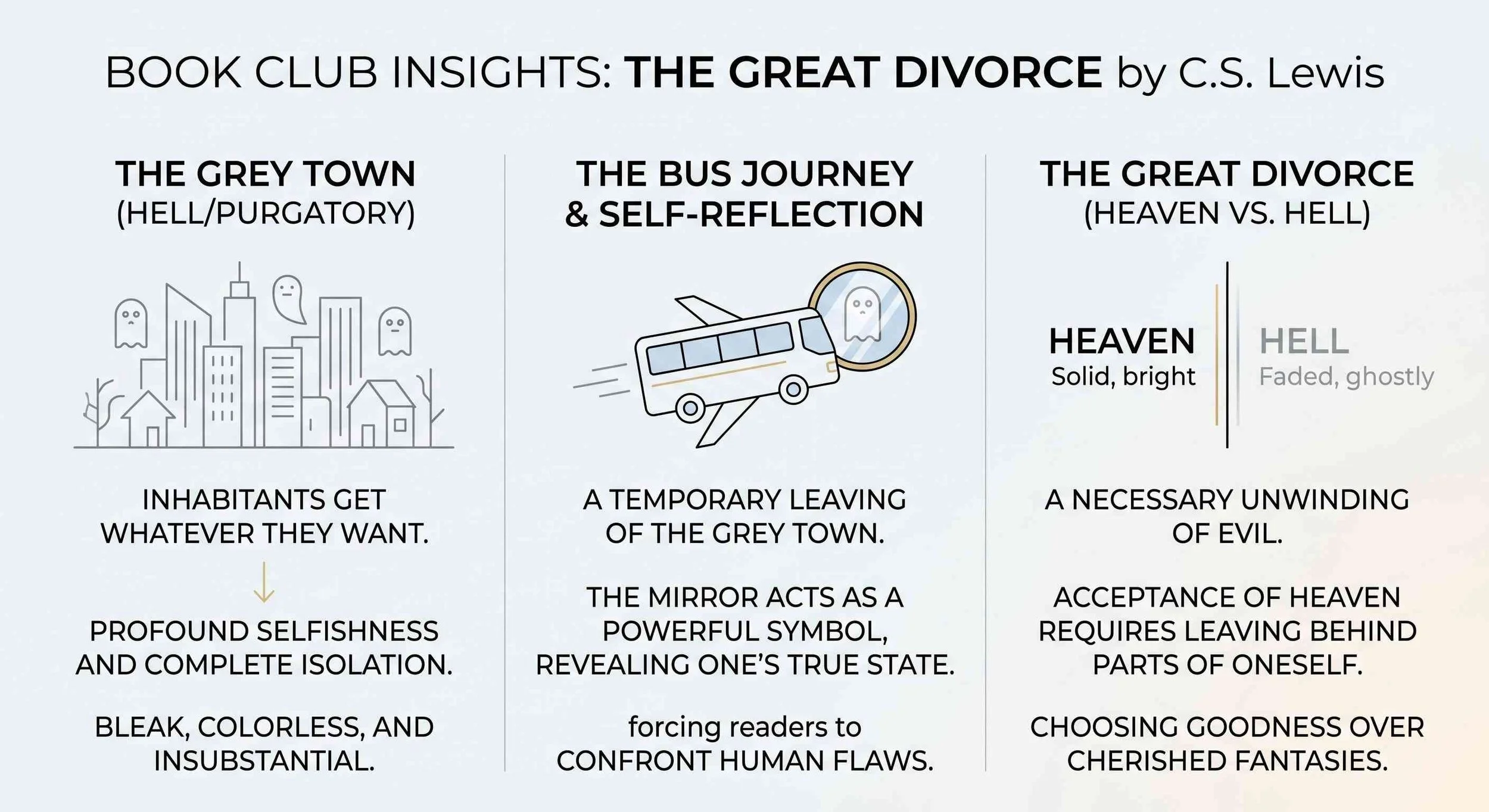
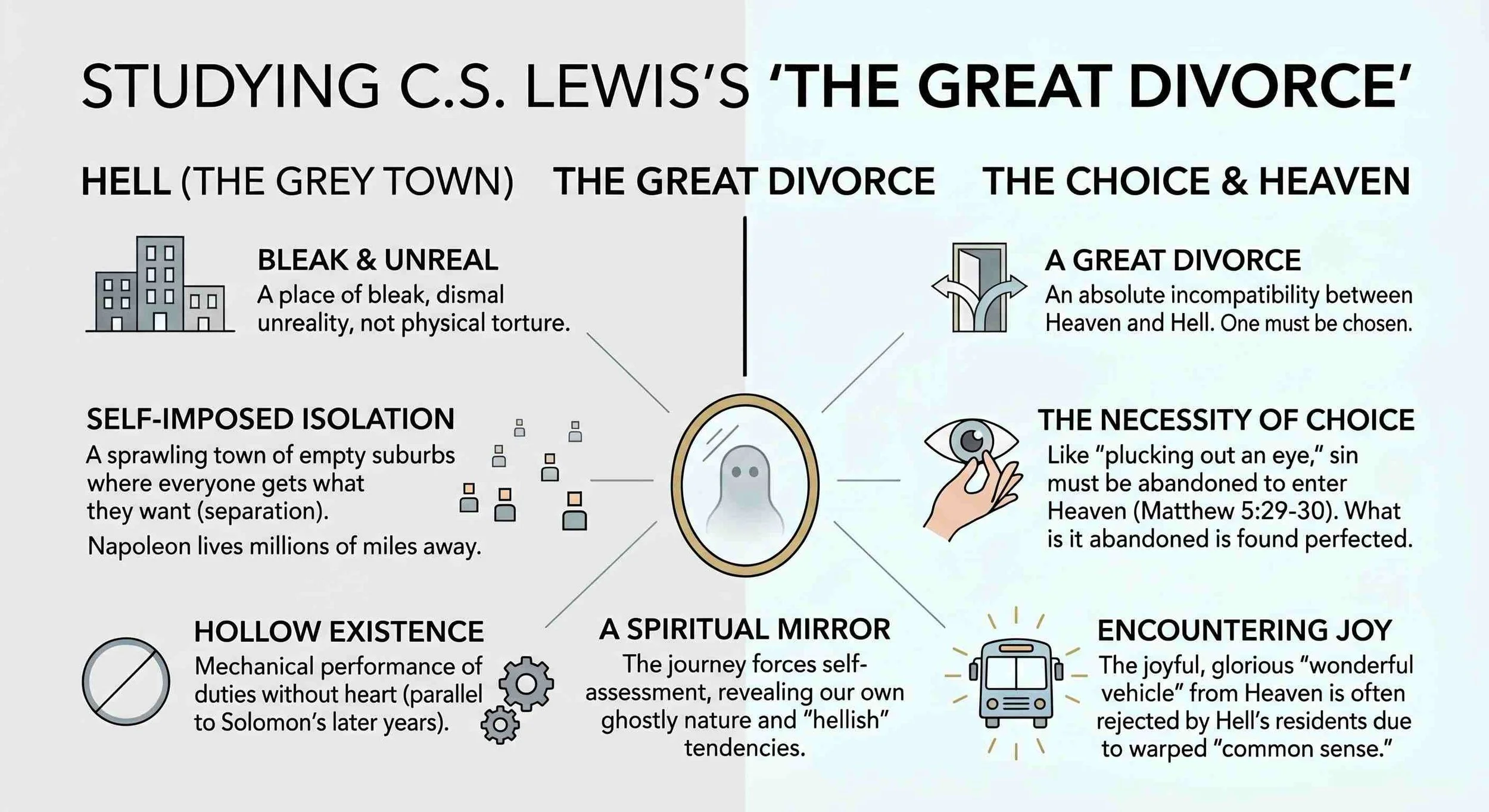
This is an AI Recap of the class.
Some things may be incorrect.
Short Summary of the Class
On April 29, 2026, our group started a new study on C.S. Lewis's classic allegory, "The Great Divorce." We began by discussing Lewis's life and his conversion from atheism, framing the book as his response to the idea that Heaven and Hell can coexist. We explored the setting of the "grey town," a depiction of Hell as a bleak, unreal place of self-imposed isolation where everyone gets what they want, leading to endless separation. The discussion highlighted the residents' petty, self-absorbed nature, which is on full display as they wait for a bus. Their negative reaction to the glorious, light-filled bus from Heaven reveals how their "common sense" has been warped by misery, making them reject goodness itself. The book challenges us to confront the parts of ourselves we must leave behind—like plucking out an eye—to draw closer to God.
Detailed Class Summary
Here is a summary of what we talked about as we went through the class on April 29, 2026.
Introduction to C.S. Lewis and "The Great Divorce"
We kicked off our new study by introducing C.S. Lewis's "The Great Divorce." For some, it was a revisit, and for others, a brand new read, with the acknowledgment that the book reveals new insights depending on one's life experiences. We then discussed the author, C.S. Lewis, noting he was an Oxford professor and a friend of J.R.R. Tolkien. It was highlighted that Lewis was once a committed atheist, and his conversion to Christianity was significantly influenced by friends like Tolkien and by reading George MacDonald.
The central theme of the book's preface was established: the impossibility of merging Heaven and Hell. The book's title is a direct response to William Blake’s "The Marriage of Heaven and Hell." Lewis argues that you must choose one or the other, a concept he connects to Jesus's teaching about being willing to "pluck out your right eye" if it causes you to sin. He uses this imagery to explain that what we abandon for Heaven is not truly lost but is found perfected.
Bible Verses: The teaching about plucking out your right eye or cutting off your right hand if it causes you to sin (Matthew 5:29-30, Mark 9:43-48).
Section Summary: We introduced the book "The Great Divorce" and its author, C.S. Lewis, discussing his background as an Oxford scholar, a former atheist, and his friendship with J.R.R. Tolkien. We established the book's core argument from its preface: that one must make a "great divorce" from sin, a painful but necessary choice likened to the biblical call to "pluck out an eye" to enter Heaven.
The Grey Town: A Picture of Hell
We began our analysis of the story by identifying the setting of the first chapter: the "grey town." We agreed it represents Hell, a place characterized not by fire, but by a bleak, dismal, and unreal atmosphere. A key feature of this Hell is that everyone gets what they want. This desire for isolation, stemming from petty arguments and selfishness, causes the inhabitants to move farther and farther apart, creating endless, empty suburbs. This concept was illustrated by the story of a man who can only see Napoleon, who lives millions of miles away, through a telescope. This self-imposed distance raised the question of whether someone can be "too far" for redemption. We concluded that while the distance is a choice and the journey back is always possible, the tragedy is that many lose the desire to be reached.
We also discussed a parallel to the story of King Solomon. Despite his wisdom, Solomon fell into performing his religious duties mechanically, merely to "complete his duty" without heart. This was likened to the hollow, self-serving existence of the ghosts, who are stuck in destructive patterns without awareness of the damage they are doing.
Bible Scriptures: 1 Kings, 2 Kings
Stories Mentioned:
The story of Napoleon living millions of miles away in the grey town.
King Solomon's later years, where he performed temple duties mechanically.
Section Summary: The opening setting is a bleak, grey town representing Hell as a place of unreality and self-imposed isolation. Its core rule—that everyone gets what they want—paradoxically leads to infinite separation. This was compared to King Solomon's heartless religious duties, illustrating a life lived without genuine spiritual connection.
The Bus Stop and the Journey
Our focus then shifted to the contentious crowd waiting at a bus stop. Their behavior is marked by fault-finding and selfishness, as seen in the character who was pleased when someone else was pushed out of line. Their motivation for boarding the bus seems to be more about conformity and competition than a genuine desire for Heaven. The arrival of the bus—a "wonderful vehicle, blazing with golden light"—provides a stark contrast. The residents, however, react with disdain, criticizing the radiant driver for not behaving "naturally." This led to a discussion on how one's environment defines "common sense." For the people in Hell, misery and cynicism are natural, making the joy and goodness of Heaven alien and offensive.
We analyzed the characters on the bus, such as the "tousle-haired poet" who seeks validation for his cynical worldview. A bizarre fight breaks out with knives and pistols, yet it is "strangely innocuous," highlighting that even conflict in this place is illusory and meaningless. The session ended by looking at the pivotal moment when the "cruel light" on the bus reveals the passengers, including the narrator, as ghostly, insubstantial figures. Catching his own reflection forces the narrator into a moment of honest self-assessment.
Section Summary: The scene at the bus stop reveals the inhabitants' selfish and competitive nature. Their contempt for the beautiful, light-filled bus shows how their perception of reality has been warped, making them reject goodness. The journey itself, including an illusory fight, emphasizes the unreality of this state, culminating in the narrator's shocking realization of his own ghostly nature, which serves as a mirror for the reader.
Overall Summary
In our Bible study on April 29, 2026, we embarked on C.S. Lewis's "The Great Divorce." We began by discussing the author's life, including his conversion from atheism, and the book's central thesis: the absolute incompatibility of Heaven and Hell. The title itself is a rebuttal to the idea that the two can be married, arguing instead for a "great divorce" from sin, a concept Lewis ties to the biblical command to "pluck out your eye."
Our discussion then moved into the book's allegorical world, characterizing Hell as a dismal "grey town." We explored its unique nature not as a place of external torture, but of self-imposed isolation where getting everything one wants leads to endless, empty separation. The inhabitants are portrayed as petty, self-absorbed "ghosts," a nature revealed in their behavior at a bus stop where they jockey for position out of mindless conformity. A powerful biblical parallel was drawn to King Solomon, whose later life of performing religious duties without heart mirrored the empty existence of the ghosts.
The climax of our discussion focused on the residents' reaction to the glorious, light-filled bus from Heaven. Their contempt for its goodness highlighted a key theme: their sense of "normal" has been so warped by misery that they reject the light. This showed that they are not trapped in Hell but have condemned themselves to it through a consistent rejection of joy. The book's role as a spiritual mirror became clear, especially in the final moment where the narrator sees his own ghostly reflection, forcing him (and us) to confront our own failings and the choice we all face.
Main Points
We are starting a new study of C.S. Lewis's "The Great Divorce."
C.S. Lewis was an Oxford scholar who converted from atheism to Christianity, influenced by friends like J.R.R. Tolkien.
The book's central argument is that Heaven and Hell are incompatible; you must choose one over the other.
Hell is portrayed as a "grey town" of self-imposed isolation, where everyone getting what they want leads to endless separation and unreality.
The necessity of abandoning sin is likened to the biblical command to "pluck out an eye."
The characters ("ghosts") are self-absorbed and act out of conformity and petty competition rather than a genuine desire for good.
The actions of the ghosts were compared to the heartless, mechanical religious duties of King Solomon in his later years.
The book serves as a mirror, challenging readers to recognize and confront their own "hellish" tendencies.
Scriptures and Stories Mentioned
Bible Scriptures
Matthew 5:29-30, Mark 9:43-48: Jesus's teaching about cutting off a hand or plucking out an eye if it causes you to sin.
1 Kings & 2 Kings: The story of King Solomon.
Stories
C.S. Lewis's Conversion: His journey from atheism to Christianity, influenced by friends and authors.
The Bus Ride from Hell to Heaven: The book's main allegorical plot where ghosts travel to the outskirts of Heaven.
The Big Ghost: The story of a self-righteous man who would rather be "correct" in Hell than forgive someone in Heaven.
Napoleon in the Grey Town: The story illustrating extreme self-isolation, where a character lives millions of miles away and can only be seen with a telescope.
King Solomon's later years: His story was used as a parallel for performing religious duties mechanically and without heart.
Mark Chapter 1:1-20 Class 2 - Wednesday Bible Study
On April 29, 2026 at 6:36 PM, our class explored how reading the Gospel of Mark by recognizing patterns and echoes—especially in Mark 1:1–20—deepens understanding, highlighting John the Baptist, Jesus’ baptism and wilderness testing, the “at hand” kingdom, the call of fishermen, and the upside‑down kingship of Jesus.
Gospel of Mark Chapter 1:1-20
This is our 2nd class on Mark
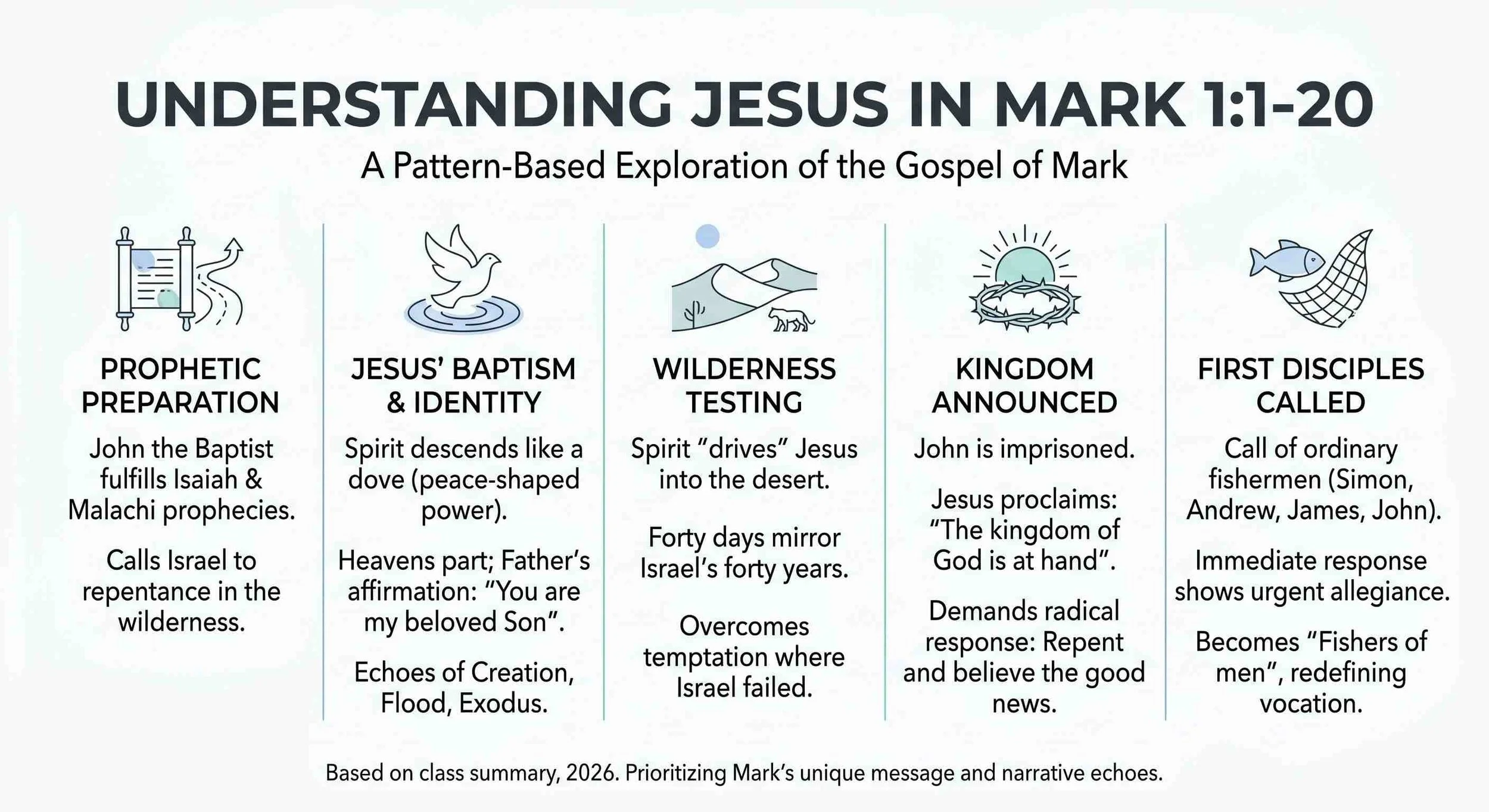
This is an AI Recap of the class.
Some things may be incorrect.
Short Summary of the Whole Class
We learned to read Scripture by noticing patterns and connections, using the Gospel of Mark as our training ground. We read Mark 1:1–20 (NKJV), discussed authorship and Mark’s three‑act design, traced Old Testament echoes (Isaiah, Malachi, Exodus, wilderness), examined Jesus’ baptism and the Spirit’s descent like a dove, considered why Mark streamlines the temptation narrative, unpacked Jesus’ kingdom announcement and the immediate call of ordinary fishermen, and reflected on how Mark communicates through urgency and “felt” experience. We also noted community insights (e.g., Revelation’s “woman” and Roman parallels) and agreed to frame our study with an overview video of Mark. Throughout, we aimed to let Mark speak on his own terms while testing ideas together.
Section-by-Section Summary with Verses, Stories, and Short Wrap-ups
1) Purpose and Approach: Training to Read by Patterns
What we discussed:
The goal is to read the Bible well by recognizing patterns, repeated themes, and familiar echoes (“this sounds like that” moments).
Connections help Scripture “open up,” strengthening memory and understanding.
Students bring prior knowledge that can illuminate the text as connections “click.”
Key ideas:
Begin with Mark; expect recognition of echoes across the biblical storyline.
Let Mark speak on his own terms, resisting cross‑gospel harmonization unless necessary.
Bible verses/stories mentioned:
Focus on the Gospel of Mark broadly; no specific verses cited in this section.
Short summary:
We set the foundation for pattern-based reading in Mark, expecting clearer, more memorable insights as echoes emerge.
2) Collaborative Insight Example: Revelation and Roman History
What we discussed:
From a prior Thursday study, commentaries gave one read on a “woman” in Revelation, but Mick’s love of Roman history surfaced a compelling Roman parallel.
Insight: Commentaries are helpful but not exhaustive; community contributions matter.
Key ideas:
Test ideas together; even tentative connections can be fruitful.
Bible verses/stories mentioned:
Revelation’s “woman” imagery (likely Revelation 12 or 17; chapter not specified).
Stories mentioned:
Class anecdote: Mick’s Roman-history parallel provided fresh perspective.
Short summary:
Community knowledge can reveal helpful contextual links that enrich understanding beyond commentary notes.
3) Plan for Today: Overview Video of Mark
What we discussed:
We decided to watch an overview video of Mark to frame our study (screen share planned on Zoom).
Key ideas:
A high-level overview sets a trajectory for recognizing patterns throughout Mark.
Bible verses/stories mentioned:
No specific verses; the focus was the whole of Mark’s narrative.
Short summary:
We chose to begin with a big-picture overview to guide our pattern-based reading of Mark.
4) Authorship, Sources, and Mark’s Design
What we discussed:
Mark (John Mark) as coworker of Paul and close to Peter; Papias reports Mark compiled Peter’s memories.
Mark states his thesis (Mark 1:1) and shows identity through actions and reactions.
Three‑act structure: Galilee (Who is Jesus?), on the way (What does Messiah mean?), Jerusalem (kingship through suffering).
Themes:
Kingdom proclamation, confronting evil, healing, forgiveness, redefined power and kingship.
Bible verses/stories mentioned:
Mark 1:1; allusions to Isaiah and Malachi prophecies.
Stories mentioned:
Papias’ testimony; Mark’s three‑act narrative framework.
Short summary:
Mark likely shapes Peter’s eyewitness testimony into a three‑act drama unveiling Jesus as Messiah and Son of God through deeds and the path of suffering service.
5) Staying within Mark’s Narrative
What we discussed:
Read Mark as Mark; avoid importing details from Luke/John (e.g., Mary and Elizabeth, cousins; foot‑washing).
Aim to hear Mark’s unique theological emphasis.
Bible verses/stories mentioned:
Mark 1:1–8 implicitly (John’s proclamation).
Noted but set aside: Luke’s infancy narratives; John 13 foot‑washing.
Stories mentioned:
Brief references to non‑Mark details as examples of what to avoid harmonizing.
Short summary:
We committed to Mark’s own voice to preserve his message and patterns.
6) Prophetic Preparation: Isaiah, Malachi, and John the Baptist
What we discussed:
Mark cites prophets about the forerunner; John appears in wilderness garb calling for repentance.
Prophetic imagery and types; light humor about a “John the Baptist diet,” while underscoring his serious call.
Bible verses/stories mentioned:
Mark 1:2–6; quotations of Isaiah/Malachi in Mark 1:2–3.
Stories mentioned:
Crowds from Judea and Jerusalem; John’s wilderness ministry.
Short summary:
John fulfills prophetic expectation, preparing Israel for God’s approaching reign.
7) Jesus’ Baptism: Sonship, the Dove, and Humble Origins
What we discussed:
Jesus comes “from Nazareth of Galilee”; heavens part; Spirit descends like a dove; the Father affirms the Son.
Peace-shaped power: the dove contrasts with conquest expectations.
Echoes of creation (Genesis 1) and the flood’s dove (Genesis 8); “parting” evokes Exodus.
Bible verses/stories mentioned:
Mark 1:9–11; Genesis 1; Genesis 8; Exodus 14 (typological echo).
Stories mentioned:
Creation and flood imagery; Red Sea parting as baptismal type.
Short summary:
Jesus’ baptism reveals his identity and inaugurates a Spirit-empowered mission marked by peace, not domination, amid rich creation‑Exodus echoes.
8) Exodus Motifs and the Wilderness Testing
What we discussed:
Spirit “drives” Jesus into the wilderness; forty days mirror Israel’s forty years.
Mark’s brevity evokes the larger story rather than listing three temptations (as in Matthew/Luke).
Bible verses/stories mentioned:
Mark 1:12–13; allusions to Numbers/Deuteronomy (Israel’s wilderness testing).
Stories mentioned:
Israel’s post‑Exodus journey; angels ministering; wild beasts motif.
Short summary:
Mark compresses the temptation narrative to signal Jesus reenacting Israel’s story and overcoming where Israel failed.
9) “The Kingdom Is at Hand”: Repent and Believe
What we discussed:
After John is imprisoned, Jesus proclaims the nearness of God’s kingdom and calls for repentance and faith.
“At hand” means near, accessible; turn from power-seeking to trust in the Son of God.
Mark 1:1–15 functions as a preamble: identity, fulfillment, announcement.
Bible verses/stories mentioned:
Mark 1:14–15; Isaiah 11:1 alluded (root/shoot of David).
Stories mentioned:
Nazareth as “the sticks”; fulfillment of Israel’s story in Jesus.
Short summary:
The long-awaited moment arrives: God’s reign draws near, demanding a decisive personal response.
10) Calling the First Disciples: Ordinary Fishermen, Urgent Allegiance
What we discussed:
Jesus calls Simon (Peter) and Andrew, then James and John; they immediately leave nets, boats, even father and hired hands.
Let the text stay “weird”: ordinary workers instantly follow an uncredentialed rabbi.
Emphasis on radical allegiance and redefined vocation (“fishers of men”).
Bible verses/stories mentioned:
Mark 1:16–20.
Stories mentioned:
Contrast between families’ resources; rabbinic disciple‑gathering versus Jesus’ surprising choices.
Short summary:
The kingdom advances through ordinary people responding with urgent, costly obedience.
11) Peter’s Confession and the Suffering Messiah (Q&A Preview of Later Mark)
What we discussed:
Differences across Gospels in Peter’s confession; in Mark, “You are the Messiah.”
Immediate clash with Jesus’ teaching on suffering; “Get behind me, Satan.”
Expectations of a political/military Messiah versus the suffering Servant (Isaiah 53).
Bible verses/stories mentioned:
Mark 8:27–33; Isaiah 53.
Stories mentioned:
Anticipation of Mark’s later arc: Transfiguration, passion, centurion’s confession, empty tomb (references).
Short summary:
Mark reveals messiahship through suffering and service, overturning triumphalist expectations.
12) Humility and Service: Sandal Straps and Servant Leadership
What we discussed:
John’s statement about not being worthy to untie Jesus’ sandals underscores humility.
A participant connected this to foot‑washing (John 13), noted as outside Mark but thematically aligned with servant authority.
Bible verses/stories mentioned:
Mark 1:7; John 13 referenced in discussion (acknowledged not in Mark).
Stories mentioned:
Everyday imagery of untying sandals; rabbinic training and memorization; echoes of Micah’s prophetic themes (justice, humility).
Short summary:
John’s humility anticipates Jesus’ servant‑king identity central to Mark’s message.
Medium-Length Overall Summary (April 29, 2026, 18:36:15)
On April 29, 2026 at 6:36 PM, our class set out to read Mark by recognizing patterns and echoes that make Scripture come alive. We framed Mark’s authorship and three‑act design (drawing on Papias’ note about Peter’s memories) and committed to letting Mark speak without cross‑gospel blending. In Mark 1:1–20 (NKJV), John the Baptist fulfills prophetic promises (Isaiah/Malachi), calling Israel to repent as Jesus arrives from humble Nazareth. At Jesus’ baptism, the heavens part, the Spirit descends like a dove, and the Father affirms the Son—imagery echoing creation, the flood’s dove, and a new Exodus. Mark compresses the wilderness temptation to evoke Israel’s story: forty days for forty years, signaling Jesus’ faithful obedience. With John imprisoned, Jesus declares the kingdom “at hand,” summoning repentance and trust. He calls ordinary fishermen, who immediately follow, modeling urgent, costly allegiance. We noted how Mark’s pace and “felt” atmosphere communicate the gospel’s movement. Along the way, we highlighted community learning (e.g., a Revelation/Roman parallel), previewed Peter’s confession and the suffering‑Messiah theme in Mark 8, and planned to watch an overview video to guide our study. The session emphasized pattern recognition, collaborative discovery, and Mark’s portrayal of Jesus’ upside‑down kingship expressed through service and suffering.
Main Points
Read Scripture by recognizing patterns, echoes, and thematic connections.
Let Mark speak on his own terms; avoid unnecessary cross‑gospel harmonization.
Mark likely shapes Peter’s eyewitness memories into a three‑act narrative revealing Jesus as Messiah and Son of God.
John the Baptist fulfills prophetic preparation, calling Israel to repentance (Mark 1:2–6).
Jesus’ baptism reveals divine Sonship and peace‑shaped power, with creation, flood, and Exodus echoes (Mark 1:9–11).
The wilderness testing compresses details to evoke Israel’s story and highlight Jesus’ faithfulness (Mark 1:12–13).
The kingdom is “at hand”: repent and believe the good news (Mark 1:14–15).
Jesus calls ordinary fishermen to radical, immediate discipleship (Mark 1:16–20).
Mark communicates through urgency and atmosphere to draw readers into the gospel’s movement.
Community insights can complement commentaries, enriching interpretation (Revelation “woman” example).
In Mark, messianic authority is revealed through suffering and service (previewed in Mark 8:27–33; Isaiah 53).
Bible Scriptures Mentioned
Mark 1:1–20 (thesis; prophetic citations; John’s ministry; Jesus’ baptism; wilderness testing; proclamation; calling disciples)
Mark 1:1–8 (John’s proclamation)
Mark 1:2–6 (Isaiah/Malachi quotations; John’s description)
Mark 1:7 (John’s humility; sandal‑strap remark)
Mark 1:9–11 (baptism; Spirit as a dove; heavenly voice)
Mark 1:12–13 (wilderness testing; angels; wild beasts)
Mark 1:14–15 (imprisonment of John; kingdom “at hand”; repent and believe)
Mark 1:16–20 (calling Simon Peter, Andrew, James, John)
Mark 6:17–29 (John the Baptist’s beheading; referenced)
Mark 8:27–33 (Peter’s confession; Jesus’ rebuke; previewed)
Isaiah 11:1 (root/shoot imagery; alluded)
Isaiah 53 (suffering servant; discussed)
Malachi (quoted in Mark 1:2–3)
Genesis 1 (creation Spirit imagery; alluded)
Genesis 8 (flood’s dove; alluded)
Exodus 14 (Red Sea parting; typological echo)
Numbers/Deuteronomy (Israel’s forty years; alluded)
Revelation 12 or 17 (the “woman”; exact chapter not specified; referenced)
John 13 (foot‑washing; referenced but noted as outside Mark)
Stories Talked About
John the Baptist’s wilderness ministry and call to repentance
Jesus’ baptism, divine Sonship, and the Spirit descending like a dove
Jesus’ forty days in the wilderness mirroring Israel’s forty years
Jesus’ proclamation of the kingdom’s nearness and call to repent and believe
Calling of Simon (Peter), Andrew, James, and John—ordinary fishermen—who follow immediately
Papias’ testimony about Mark drawing on Peter’s memories
Revelation study anecdote: class member connected the “woman” to Roman history
Creation and flood (dove) imagery; Exodus and the Red Sea as baptismal type
John the Baptist’s imprisonment and later beheading by Herod (referenced)
Peter’s confession and the suffering‑Messiah theme (previewed), plus later Mark arc references (Transfiguration, passion, centurion’s confession, empty tomb)
![[Sunday] Temple Traps - Foolish Wisdom](https://images.squarespace-cdn.com/content/v1/5852f18a20099e30cd2c01dc/1777044373355-XL9DK44J8X46BSP6Z03N/FW1a.jpg)
[Sunday] Temple Traps - Foolish Wisdom
It’s easy to get distracted by building grand things, forgetting that God's true work is simply rescuing broken people right where they are.
It’s easy to get distracted by building grand things, forgetting that God's true work is simply rescuing broken people right where they are.
What Had happened at Grace this week.
![[Sunday] The Seed Sprouts - Uproot & Plant - The Book of Jeremiah Ch52](https://images.squarespace-cdn.com/content/v1/5852f18a20099e30cd2c01dc/1792092642677-KD8F9NU9SFMPONI6LCG4/uproot+6a.jpg)
![The Great Divorce [Thursday Bible Study]](https://images.squarespace-cdn.com/content/v1/5852f18a20099e30cd2c01dc/ec755559-0a12-48d7-a2e8-1ccec8e2fca7/Great+divorce.png)
The Great Divorce [Thursday Bible Study]
The Great Divorce is my favorite C.S. Lewis book. It truly forces us to look in the mirror and decide if we are actually willing to lay down our demons and walk toward the light.
The Great Divorce is my favorite C.S. Lewis book. It truly forces us to look in the mirror and decide if we are actually willing to lay down our demons and walk toward the light.







![St Lucie Mets Game in April [Photos]](https://images.squarespace-cdn.com/content/v1/5852f18a20099e30cd2c01dc/1777093305840-I0RWVD8ZHGWQ488Z8XZ3/IMG_1965.jpeg)
St Lucie Mets Game in April [Photos]
Great time at the St Luice Mets game

It was a great night out at the St. Lucie Mets game. The real winner, though, was the little one. She spent the end of the night happily counting her cash after an absolute masterclass in Moundball. Join us next time!












Foolish Wisdom | Teaching Series
Exploring the stories of Solomon, Elijah, and Elisha in 1st and 2nd Kings, our new "Foolish Wisdom" series reveals that God's truest wisdom is found not in human achievements but in rescuing everyday people right where they are.
Exploring the stories of Solomon, Elijah, and Elisha in 1st and 2nd Kings, our new "Foolish Wisdom" series reveals that God's truest wisdom is found not in human achievements but in rescuing everyday people right where they are.
Reading Plan
Read around the readings for Sunday
2/14/26/26 - Soloman and the Temple
1 Kings 8:12-21
1 Kings 9:1-9
Mark 13:1-10
5/3/26 - Soloman's Downfal
1 Kings 11:1-10
Romans 5:12-19
Mark 12:38-44
5/10/26 - Drought/Fed by Ravens-- Jeroboam and Rehoboam 1 Kings 11-15
1 Kings 17:1-7
1 Corinthains 10:1-13
Matthew 4:1-11
5/17/26 - Widow of Zarepath Call to repentance Evil Ahab
1 Kings 17:8-24
Galatians 3:6-9
Luke 4:16-26
5/24/26 - Mt Carmel and showdown with Prophets of Baal
1 Kings 18:20-39
Galatians 1:6-10
Luke 7:1-10
5/31/26 - Elijah flees running from Jezebel
1 Kings 19:2-3, 9-18
Romans 10:5-15
Matthew 14:22-33
6/7/26 - Elisha takes over as Elijah goes to heaven
2 Kings 2:1-15
2 Corinthians 4:3-6
Mark 9:2-9
6/14/26 - Naaman
2 Kings 5:1-14
2 Timothy 2:8-15
Luke 17:11-19
6/21/26 - Elisha annoints Jehu, yet Jehu still does Evil
(2 Kings 9-10)2 Kings 9:1-7
Romans 7:14-20
Matthew 11:1-19
![[Sunday] All things Good - 2 Kings 9-10 & Romans 8:28 - Foolish Wisdom](https://images.squarespace-cdn.com/content/v1/5852f18a20099e30cd2c01dc/1782425800701-ZKA0ZIGTYXT03KWDYE7E/FW10a.jpg)
![[Sunday] Naaman, The Mighty Leper - 2 Kings 5 - Foolish Wisdom](https://images.squarespace-cdn.com/content/v1/5852f18a20099e30cd2c01dc/1781838581516-H86L5TX0CZW62SNK9OIL/FW9a.jpg)
![[Sunday] The Lord is My Shepherd - Psalm 23 - Foolish Wisdom](https://images.squarespace-cdn.com/content/v1/5852f18a20099e30cd2c01dc/1781221669135-RXD6QONVXVWRHXC34MS0/FW8a.jpg)
![[Sunday] Through The Water - 2 Kings 2 - Foolish Wisdom](https://images.squarespace-cdn.com/content/v1/5852f18a20099e30cd2c01dc/1780667663134-EX5V86ZA8ERAX8JAYMIS/FW7a.jpg)
![[Sunday] Why Are You Here - 1 Kings 19 - Foolish Wisdom](https://images.squarespace-cdn.com/content/v1/5852f18a20099e30cd2c01dc/1780022833293-0FAQMDQIQKRA7MFIU3HC/FW6a.jpg)
![[Sunday] Battle of Baal Bluff - 1 Kings 18 - Foolish Wisdom](https://images.squarespace-cdn.com/content/v1/5852f18a20099e30cd2c01dc/1779384414021-PFBH69DRFJOGBE0TKDTC/FW5a.jpg)
![[Sunday] Blockbuster - 1 Kings 17 - Foolish Wisdom](https://images.squarespace-cdn.com/content/v1/5852f18a20099e30cd2c01dc/1778782728451-F5ZMPPUUSQ6TLUTWLFCC/FW4a.jpg)
![[Sunday] Rey and Jerry 1 Kings 11-13 - Foolish Wisdom](https://images.squarespace-cdn.com/content/v1/5852f18a20099e30cd2c01dc/1778183687256-MPOFXGYMB60MTLI79AU0/FW3a.jpg)
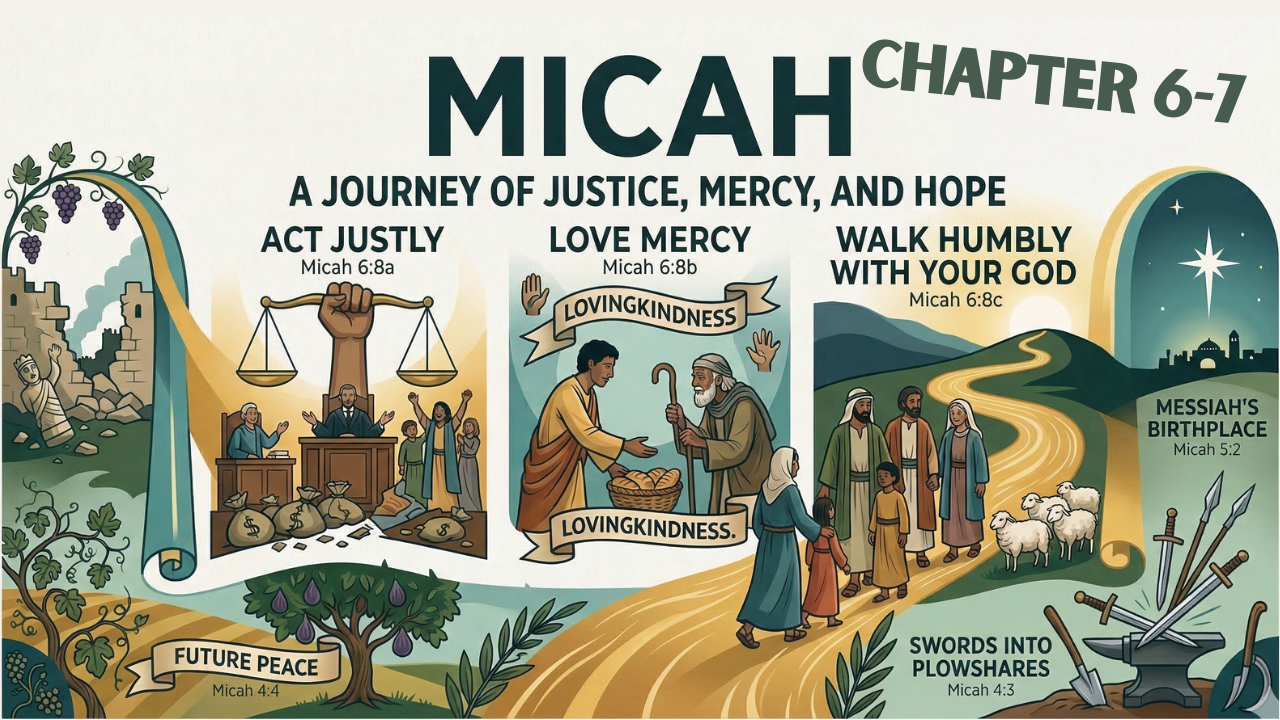
Micah Chapter 6-7 Class 4 - Bible Study
On April 23, 2026, our class explored Micah 6–7, God’s deliverance from Egypt, the legacies of Omri/Ahab/Jezebel, Balaam and Balak, Elijah’s gentle whisper, and Jesus’ teaching on allegiance and endurance—emphasizing justice, mercy, humility, and trust in God’s protecting purposes.
Micah Intro and Chapter 6-7
This is our 4th class on Micah
This is an AI Recap of the class.
Some things may be incorrect.
Short Summary of the Whole Class
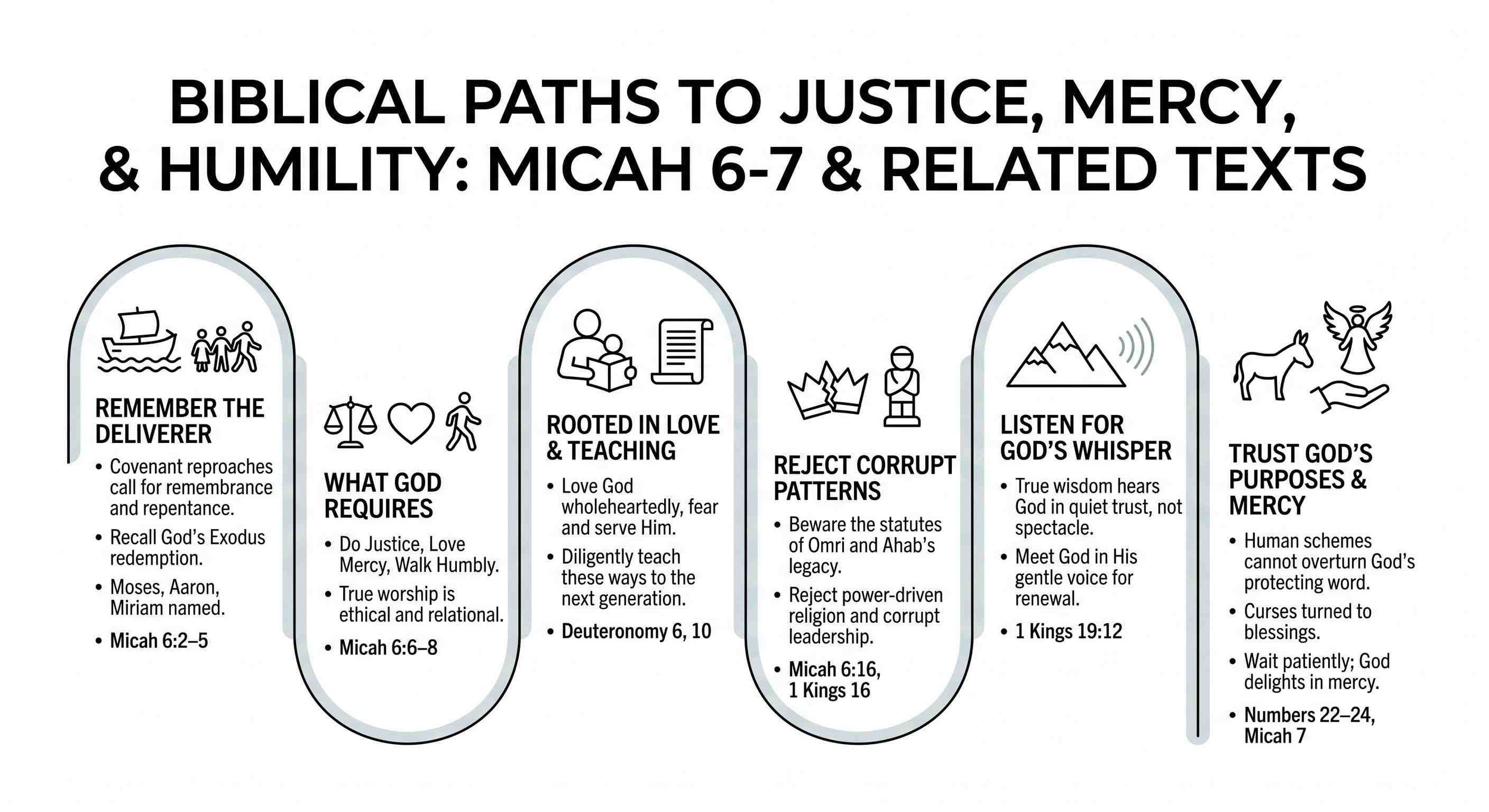
On April 23, 2026, we traced a biblical thread from Micah 6–7 through Numbers, 1–2 Kings, Deuteronomy, and the Gospels. We reflected on God’s covenant complaint and Exodus deliverance (Micah 6), the warning of Omri/Ahab/Jezebel’s corrupt statutes, Balaam and Balak’s failed cursing scheme, and Elijah’s renewal in God’s gentle whisper. We connected Micah’s call—do justice, love mercy, walk humbly—to Deuteronomy’s love-and-teach foundation and Jesus’ words about allegiance and endurance amid familial and societal conflict (Matthew 10; Mark 13). We concluded that true wisdom remembers God the Deliverer, rejects power-driven corruption, listens for God’s quiet voice, and lives justice and mercy in faithful trust.
Walk-through Summary with Section-by-Section Notes
1) Micah’s “Reproaches” and God’s Complaint
Discussion:
We opened with Micah’s covenant lawsuit: “Hear, O you mountains, the Lord’s complaint” (Micah 6:2), evoking Good Friday-style “reproaches” (“O my people… what have I done to you?”).
God identifies Himself as the Deliverer who brought Israel out of Egypt, naming Moses, Aaron, and Miriam (Micah 6:4), and recalling Balak and Balaam (Micah 6:5).
Theme:
Remembering God’s faithful deliverance exposes our forgetfulness and calls us to return to covenant obedience.
Verses:
Micah 6:2–5.
Stories:
Exodus remembrance (Moses, Aaron, Miriam).
Short summary of this section:
God summons His people to remember the Exodus and His faithfulness, grounding repentance in the memory of deliverance.
2) What God Requires: Justice, Mercy, and Humility
Discussion:
We wrestled with “What’s enough for God?” and landed on Micah 6:8—do justice, love mercy, walk humbly—over performative religion.
We noted how Scripture itself demands justice and mercy, not mere ritual.
Theme:
True worship is ethical and relational; it shows up in how we treat others made in God’s image.
Verses:
Micah 6:6–8.
Stories:
Ethical living illustrations; contrast with empty ritual (no single narrative focus).
Short summary of this section:
God desires hearts and lives of justice, mercy, and humble walking with Him, not outward show.
3) Deuteronomy’s Foundation: Love God and Teach Diligently
Discussion:
We linked Micah’s call to Deuteronomy’s heart: fear, love, and serve the Lord (Deut 10:12), and the Shema’s call to teach children diligently (Deut 6:4–7).
Emphasis on shaping the next generation amid modern distractions.
Theme:
Wholehearted love for God and diligent discipleship at home form the backbone of faithful living.
Verses:
Deuteronomy 10:12; Deuteronomy 6:4–7.
Stories:
Family discipleship practices (conceptual, not narrative).
Short summary of this section:
From the beginning, God called His people to wholehearted love and to teach these ways diligently to the next generation.
4) Omri, Ahab, and Jezebel: Foundations of Decline
Discussion:
We examined how Omri’s political strategies led into Ahab and Jezebel’s Baal worship (1 Kings 16), illuminating Micah 6:16’s “statutes of Omri” and “works of Ahab’s house.”
Highlight: Ahab “did more evil than all before him” (1 Kings 16:30–33).
Theme:
Societal decline follows when leaders and people embrace idolatrous counsel and corrupt patterns.
Verses:
1 Kings 16:25–33; Micah 6:16.
Stories:
Ahab and Jezebel’s marriage alliance and the national turn to Baal.
Short summary of this section:
Micah condemns both corrupt leadership and complicit people, warning that shared compromise invites desolation.
5) Elijah’s Encounter with God’s Gentle Voice
Discussion:
We previewed Elijah’s conflict with Ahab and Jezebel and focused on his renewal: God was not in wind, earthquake, or fire but in a gentle whisper (1 Kings 19:12).
Application: Listen attentively for God’s quiet guidance amid turmoil.
Theme:
True wisdom hears God in quiet trust rather than in spectacle.
Verses:
1 Kings 19:12 (with context).
Stories:
Elijah’s flight, discouragement, and renewal at Horeb.
Short summary of this section:
Elijah’s story shows faithful resilience arises from meeting God in His gentle voice.
6) Balaam and Balak: Attempts to Curse God’s People
Discussion:
We revisited Numbers 22–24: Balak summons Balaam at Moab to curse Israel; the angel blocks Balaam; the talking donkey episode; Balaam can only speak what God gives—resulting in blessing, not curse.
Micah 6:5 recalls this event to underscore God’s protecting purposes.
Theme:
God’s word and purposes stand; He turns intended curses into blessing.
Verses:
Numbers 22–24 (esp. 22:21–35); Micah 6:5.
Stories:
Balak’s summons; Balaam’s donkey and angel; Balaam’s oracles of blessing.
Short summary of this section:
Human schemes cannot overturn God’s purposes; He protects His people and transforms curses into blessings.
7) Micah 7: Corruption, Lament, and Hope in Mercy
Discussion:
Micah 7:1–7 depicts societal breakdown—bribes, betrayal—even within households; counsel: trust God, not human alliances.
Micah 7:7–9: like Job, wait on the Lord, confess, and trust God to plead our case and bring light.
Micah 7:18–20: God delights in mercy, subdues iniquity, and casts sins into the sea.
Theme:
In pervasive injustice, the faithful posture is repentance, patience, and confident hope in God’s mercy and vindication.
Verses:
Micah 7:1–7; 7:7–9; 7:18–20; (also 7:13, 7:16 noted in discussion of consequences and humbled nations).
Stories:
Job’s posture (thematic reference).
Short summary of this section:
Micah moves from stark lament to radiant hope—God’s final word is mercy and restoration.
8) Jesus on Allegiance and Endurance: Echoes of Micah
Discussion:
Matthew 10:26–36: Jesus prepares disciples for public allegiance and division within families (echoing Micah 7:6), not as a call to violence but a sober cost of discipleship.
Mark 13:10–13: the gospel to all nations, Spirit-given words in trials, endurance to the end; connected with our anticipation of Mark 13:1–10’s challenge to temple-centered confidence.
Theme:
Discipleship may divide loyalties and invite opposition; rely on the Spirit and endure in faithful witness.
Verses:
Matthew 10:26–36; Mark 13:10–13; preview connection to Mark 13:1–10.
Stories:
Jesus sending the disciples; early Christian witness under pressure (conceptual).
Short summary of this section:
Jesus reframes power and peace: allegiance to Him brings conflict, but the Spirit sustains endurance and faithful testimony.
9) Application: Remember the Deliverer and Reject Corrupt Patterns
Discussion:
We tied Micah’s call—remember the Exodus and Balaam/Balak—to our context: reject the “statutes of Omri,” avoid baptizing power with religious language, and live justice, mercy, and humility.
Question: Are we building bigger temples—or building obedient hearts that remember and reflect God’s deliverance?
Theme:
Identity and allegiance—live as a people formed by the Deliverer’s mercy rather than by cultural or political idols.
Verses:
Micah 6:4–5; 6:16; Numbers 22–24; 1 Kings 16; 1 Kings 19:12; Micah 7 selections; Matthew 10; Mark 13.
Stories:
Exodus memory; Omri/Ahab decline; Elijah’s whisper; Balaam’s thwarted curse; disciples sent amid conflict.
Short summary of this section:
True wisdom is lived remembrance—reject corrupt counsels and embody God’s justice, mercy, and humble trust.
Medium-Length Summary of the Class
On April 23, 2026, we centered on Micah 6–7, where God summons creation to hear His complaint and calls His people to remember the Exodus. We linked Micah’s “reproaches” to the warning against the “statutes of Omri” and the corrupt legacy of Ahab and Jezebel (1 Kings 16). We saw Elijah’s renewal in God’s gentle whisper (1 Kings 19:12) as a model for quiet, attentive faith. Returning to Numbers 22–24, we recalled how Balaam could only bless what Balak sought to curse, underscoring God’s protecting word (Micah 6:5). Deuteronomy 6 and 10 anchored this in love for God and diligent teaching of the next generation. Reading Jesus’ words in Matthew 10 and Mark 13, we recognized that allegiance to Christ may divide families and invite persecution, yet the Spirit sustains enduring witness. Across these texts, the class emphasized that God the Deliverer defines His people, His mercy triumphs over sin (Micah 7:18–20), and His purposes outlast human schemes—calling us to reject corrupt patterns, listen for His gentle voice, and live justice, mercy, and humility.
Main Points
God’s covenant “reproaches” call us to remember His Exodus deliverance and repentant return (Micah 6:2–5).
What God requires is clear: do justice, love mercy, walk humbly (Micah 6:8).
Deuteronomy roots faith in wholehearted love for God and diligent teaching of children (Deut 6; 10).
The “statutes of Omri” and Ahab/Jezebel’s legacy warn against adopting corrupt counsel (Micah 6:16; 1 Kings 16).
Elijah’s renewal came through God’s gentle whisper—wisdom listens in quiet trust (1 Kings 19:12).
Balaam and Balak show that God protects His people and turns curses into blessing (Numbers 22–24; Micah 6:5).
Jesus prepares disciples for allegiance amid division and persecution; rely on the Spirit and endure (Matthew 10; Mark 13).
Application: Reject power-driven religion and live as a people shaped by God’s saving acts—justice, mercy, humility.
Bible Scriptures Mentioned
Micah 6:2–5; Micah 6:6–8; Micah 6:16
Micah 7:1–7; Micah 7:7–9; Micah 7:18–20 (with 7:13, 7:16 noted)
Numbers 22–24 (esp. 22:21–35)
1 Kings 16:25–33
1 Kings 19:12 (with context)
Deuteronomy 6:4–7
Deuteronomy 10:12
Matthew 10:26–36
Mark 13:10–13 (and preview of 13:1–10)
Stories Discussed
Exodus remembrance: God bringing Israel out of Egypt; leadership of Moses, Aaron, and Miriam.
Omri’s political legacy and Ahab/Jezebel’s turn to Baal worship (1 Kings 16).
Elijah’s encounter with God’s gentle whisper (1 Kings 19).
Balaam and Balak: the talking donkey, the angel’s intervention, and blessing over cursing (Numbers 22–24).
Jesus sending the disciples and teaching on allegiance, conflict, and endurance (Matthew 10; Mark 13).
Content creation date: 2026-04-23 14:43:13
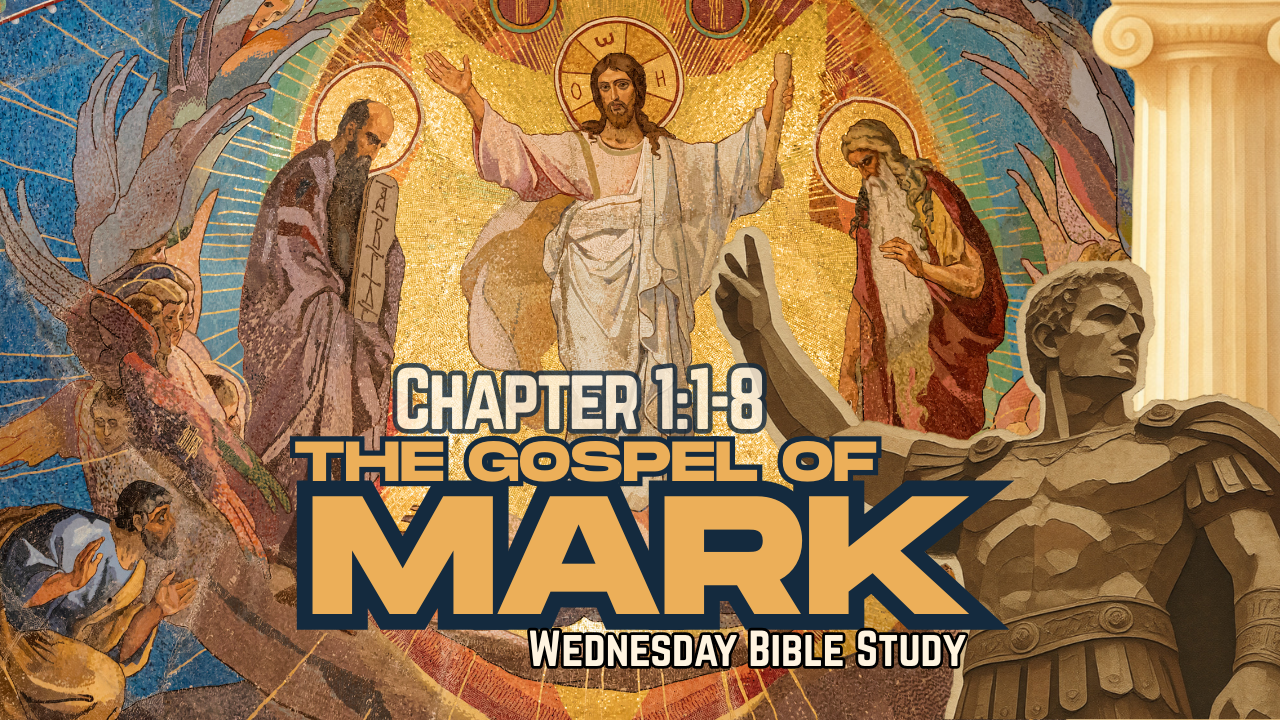
Mark Chapter 1:1-8 Class 1 - Wednesday Bible Study
A fast-moving, beginner-friendly study launched our journey through Mark 1:1–28—framing the Bible as literature from an oral tradition, exploring John the Baptist, Jesus’ baptism and temptation, the first disciples’ call, and Jesus’ authoritative teaching and exorcism.
Gospel of Mark Intro and Chapter 1:1-8
This is our 1st class on Mark
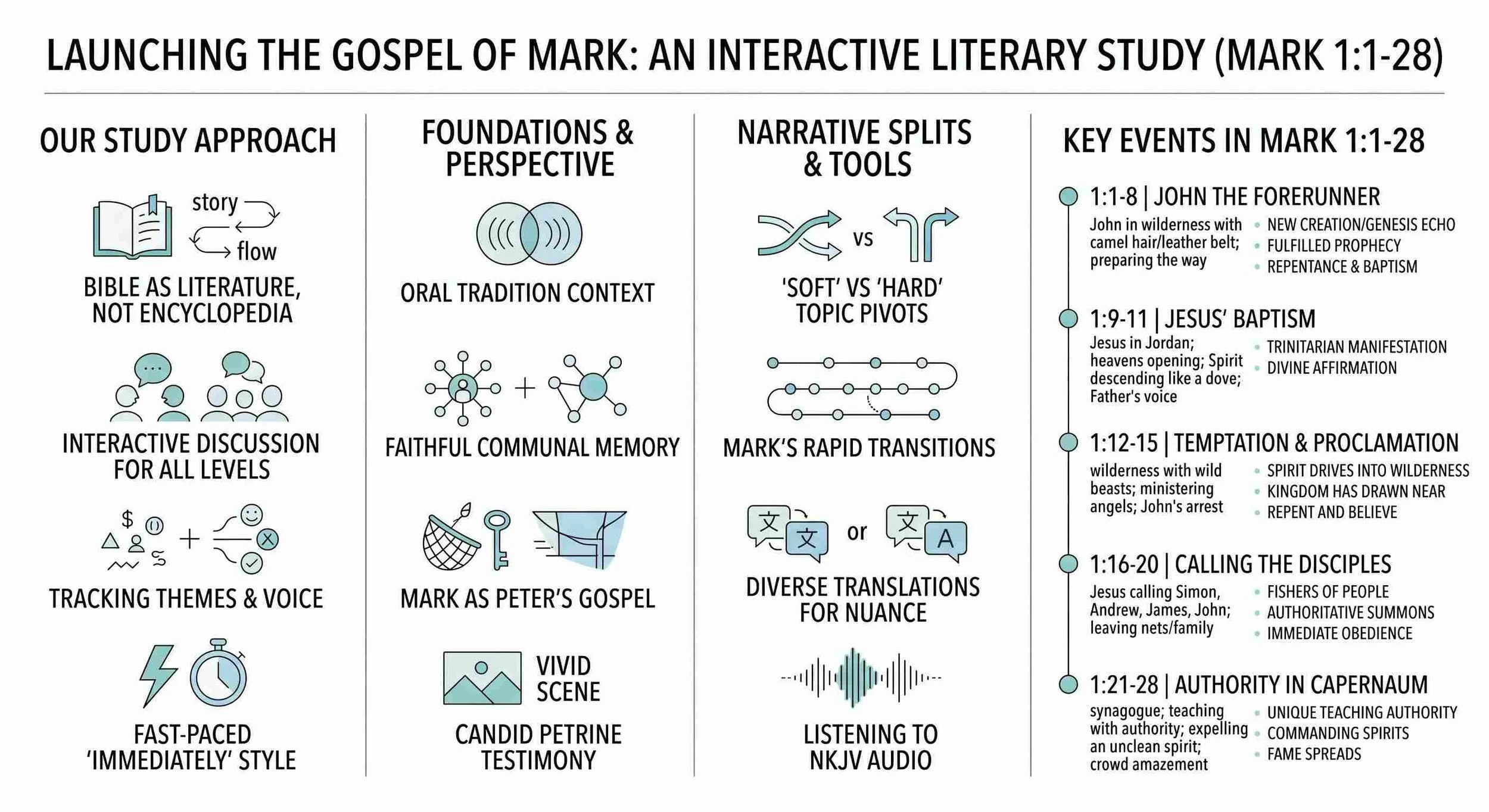
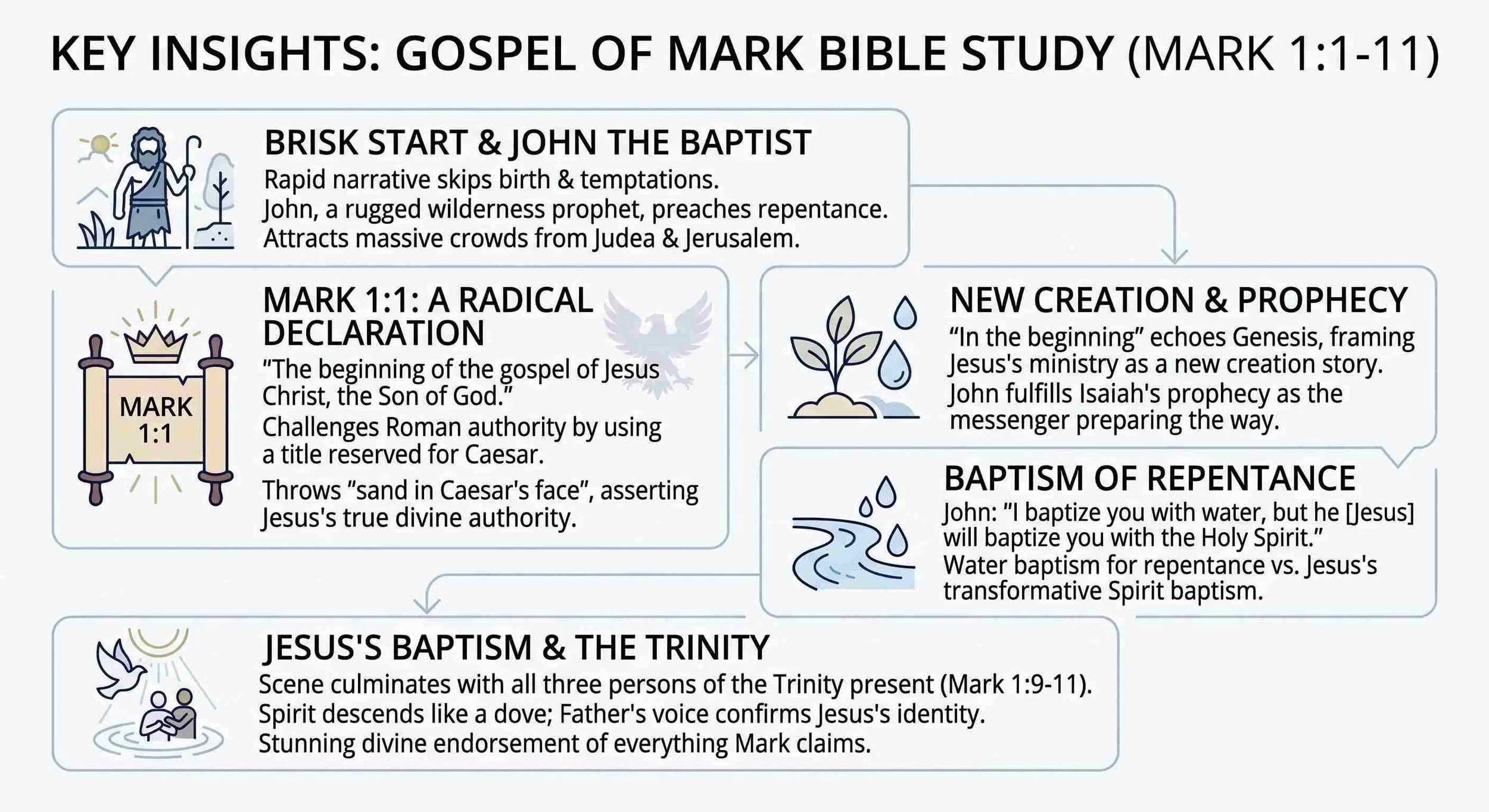
This is an AI Recap of the class.
Some things may be incorrect.
Short summary of the whole class
On 2026-04-22 at 18:32:01, we opened an interactive Gospel of Mark study that treats Scripture as inspired literature shaped by human voices within an oral tradition. We then read Mark 1:1–28, noting fulfilled prophecy in John the Baptist’s wilderness ministry, the Trinitarian revelation at Jesus’ baptism, the brief but urgent temptation account, the immediate call of the first disciples, and Jesus’ authoritative teaching and deliverance in Capernaum. Along the way we tracked Mark’s rapid “immediately” pace, soft and hard narrative splits, translation nuances, and themes of authority, repentance, and the Kingdom’s nearness.
Class walkthrough with section-by-section summaries, verses, and stories
1) Welcome, ground rules, and study approach
What we discussed:
Questions are encouraged; discussion is for newcomers and experienced readers alike.
Read the Bible as literature, not an encyclopedia; learn a practical framework for reading.
Mark is fast-paced; we’ll watch for themes and narrative breaks (“soft” vs “hard” splits).
Stories/examples:
Class context and Chris’s prior experience leading Mark.
Bible scriptures mentioned:
None directly cited.
Short section summary:
We set an interactive, theme-driven approach to reading Mark that welcomes all levels of experience.
2) What is the Bible? Literature, not an encyclopedia
What we discussed:
The Bible is a diverse, inspired library shaped by human authors and contexts.
Expect authorial voice; we’ll learn to “hear” Mark and later assess whether Mark’s traditional ending fits his voice.
Stories/examples:
Literary analogy: loaded phrases gain meaning from the whole story.
Bible scriptures mentioned:
None directly cited.
Short section summary:
We will read Scripture as narrative literature where context and authorial voice shape meaning.
3) Literary themes and the “Boy Who Lived” analogy
What we discussed:
Themes accumulate significance across a narrative; single phrases carry weight because of the whole.
Our study lets themes—not isolated proof texts—drive interpretation.
Stories/examples:
Harry Potter’s “the boy who lived” as a motif analogy.
Bible scriptures mentioned:
None directly cited.
Short section summary:
Meaning in Mark emerges from recurring themes and the unfolding story rather than isolated verses.
4) The Bible in an oral tradition versus our written (and changing) culture
What we discussed:
Gospels arose in communal oral tradition; variations reflect faithful memory, not error.
Our era is shifting again (digital/AI) from purely written conventions.
Stories/examples:
Player piano donation that caught fire (community memory/retelling).
Joke-telling as a living oral tradition.
Bible scriptures mentioned:
None directly cited.
Short section summary:
Understanding oral tradition helps us read Gospel differences as faithful communal memory.
5) Reading Mark with “soft splits” and “hard splits”
What we discussed:
Soft split: same topic with shifting anecdotes; hard split: pivot to a new topic.
Mark’s hallmark pace (“immediately”) requires attention to transitions.
Stories/examples:
Roller coaster marathon (82 rides) and pivot to hotels—illustrating split types.
Bible scriptures mentioned:
None directly cited (preparing to read Mark).
Short section summary:
We will track Mark’s rapid transitions to see how scenes connect or pivot to new themes.
6) Authorship and perspective: Mark as Peter’s gospel
What we discussed:
Traditional view: Mark (John Mark) captures Peter’s preaching.
Mark’s tough portrayal of Peter may reflect Peter’s own self-critical testimony.
Stories/examples:
Broad references to Peter’s denials.
Bible scriptures mentioned:
Anticipation of Peter narratives in Mark; no verses read yet.
Short section summary:
Expect a Petrine flavor: vivid, urgent storytelling and candid treatment of Peter.
7) Translations, versions, and why we’ll listen to NKJV
What we discussed:
Plan: hear dramatized NKJV while participants follow in various translations (NIV, ESV, NRSV, NASB, Complete Jewish Study Bible).
Interlinear demo shows why translation isn’t one-to-one; wording choices matter.
Stories/examples:
Panama “caliente” nuance—language differences can mislead.
Bible scriptures mentioned:
Interlinear preview for Mark 1:1.
Short section summary:
Diverse translations and NKJV audio will sharpen attention to wording, flow, and nuance.
8) Housekeeping and launch into Mark 1
What we discussed:
Flag significant translation differences.
Light humor about tests and AI notes; begin reading Mark 1:1–(TBD).
Stories/examples:
Class logistics and humor.
Bible scriptures mentioned:
Plan to read Mark 1:1–(TBD).
Short section summary:
With expectations set, we launched into reading Mark 1 together.
9) Mark’s opening and prologue themes (Mark 1:1–8)
What we discussed:
Mark 1:1 echoes Genesis 1 (“beginning”), framing Jesus’ story as new creation.
“Gospel” (euangelion) as real good news; subverts Roman imperial “good news” of Caesar, the so‑called “son of god.”
Textual note: some manuscripts omit “Son of God,” but the tradition is strong.
Prophetic setup (Isaiah/Malachi): a forerunner prepares the Lord’s way; John appears in the wilderness preaching repentance and baptizing.
John’s attire and diet (camel’s hair, leather belt, locusts, wild honey) evoke Elijah and prophetic austerity.
“Baptize” as “plunge/immerse”; John contrasts his water baptism with Jesus’ Spirit baptism.
Stories/examples:
Roman imperial announcements (“good news” of Caesar).
Dead Sea Scrolls reference (textual reliability).
Jokes about honey-dipped locusts; John’s rugged lifestyle.
Bible scriptures mentioned:
Mark 1:1–8; Isaiah 40:3; Malachi 3:1; Genesis 1:1 (echo); Isaiah 44:3 (Spirit poured out).
Short section summary:
Mark inaugurates a new-creation good news centered on Jesus, fulfills prophecy through John’s wilderness call, and anticipates Jesus’ Spirit baptism.
10) Jesus’ baptism and Trinitarian manifestation (Mark 1:9–11)
What we discussed:
Jesus is baptized; heavens open; Spirit descends like a dove; Father declares, “You are my beloved Son.”
All three Persons of the Trinity are present.
Stories/examples:
The baptism scene and divine affirmation.
Bible scriptures mentioned:
Mark 1:9–11.
Short section summary:
The Father and Spirit publicly affirm Jesus’ identity at the launch of His ministry.
11) Temptation and Kingdom proclamation (Mark 1:12–15)
What we discussed:
“Immediately” the Spirit drives Jesus into the wilderness for forty days; tempted by Satan; wild beasts; angels minister.
After John’s arrest, Jesus proclaims: “The time is fulfilled… repent and believe in the gospel.”
Contrast between Jesus’ hopeful call and Pharisaic condemnations.
Stories/examples:
Wilderness testing and ministering angels.
Bible scriptures mentioned:
Mark 1:12–15.
Short section summary:
Tested yet sustained, Jesus begins with an urgent call to repentance and faith because God’s Kingdom has drawn near.
12) Calling the first disciples (Mark 1:16–20)
What we discussed:
Jesus calls Simon (Peter) and Andrew; then James and John; they immediately leave nets and family business.
“Fishers of men/people”: inclusive sense (anthrōpōn).
Mark’s repeated “immediately” underscores Jesus’ authority and their decisive obedience.
Stories/examples:
Fishermen abandoning their work to follow Jesus.
Bible scriptures mentioned:
Mark 1:16–20; Mark 1:17 (inclusive “people” note).
Short section summary:
Ordinary workers respond at once to Jesus’ authoritative summons, reoriented toward gathering people.
13) Teaching with authority and casting out an unclean spirit (Mark 1:21–28)
What we discussed:
In Capernaum’s synagogue, Jesus teaches with authority—unlike the scribes.
An unclean spirit recognizes Him; Jesus rebukes and expels the demon.
Crowd marvels: a new teaching with authority; fame spreads quickly.
Stories/examples:
Synagogue exorcism; public amazement at Jesus’ words and works.
Bible scriptures mentioned:
Mark 1:21–28.
Short section summary:
Jesus’ authority appears in both word and deed, confronting evil and signaling the inbreaking Kingdom.
Medium-length final summary of the class
On 2026-04-22 at 18:32:01, we launched an interactive study of the Gospel of Mark built on reading Scripture as inspired literature emerging from an oral tradition. We introduced tools for tracking Mark’s rapid pace, including “soft” and “hard” narrative splits, and discussed authorship with a likely Petrine voice. After previewing translation nuances and listening to NKJV audio alongside various translations, we read Mark 1:1–28. Mark’s opening echoed Genesis and subverted Roman “good news,” proclaiming Jesus as the true Son of God. Prophecy set the stage for John the Baptist’s wilderness ministry of repentance, whose ascetic profile evoked Elijah. Jesus’ baptism revealed the Trinity together, followed by His brief but urgent temptation account and His inaugural proclamation that the Kingdom has drawn near, calling for repentance and belief. Jesus’ authority compelled immediate obedience from the first disciples and astonished crowds in Capernaum as His teaching and exorcism demonstrated power over unclean spirits. Throughout, we emphasized themes of authority, urgency, repentance, fulfillment, and Spirit outpouring, preparing to continue reading Mark with careful attention to voice, themes, and transitions.
Main points
The Bible is an inspired, humanly authored library to be read as literature within its oral-tradition context.
Mark’s Gospel moves with urgency (“immediately”) and requires attention to soft/hard narrative splits.
Mark 1:1 echoes Genesis and subverts Roman imperial “good news,” proclaiming Jesus as the true Son of God.
Prophetic promises (Isaiah/Malachi) frame John the Baptist as the wilderness forerunner calling Israel to repent.
Jesus’ baptism publicly reveals the Trinity; His identity is affirmed by the Father and Spirit.
The temptation account is brief but shows testing and God’s care; Jesus begins with a concise Kingdom proclamation.
Jesus’ authoritative call reorients ordinary people into mission (“fishers of people”).
Jesus teaches with unique authority and commands unclean spirits, signaling the inbreaking Kingdom.
Translation nuances matter; hearing NKJV dramatized while reading various translations clarifies wording and flow.
We will later evaluate whether Mark’s traditional ending aligns with his established voice.
Bible scriptures mentioned
Mark 1:1–28 (primary passage)
Mark 1:1 (interlinear preview; textual variant “Son of God”)
Mark 1:2–3 (prophetic citation)
Mark 1:4–8 (John’s ministry; baptism of repentance)
Mark 1:9–11 (Jesus’ baptism; Trinitarian manifestation)
Mark 1:12–13 (temptation; wilderness; angels)
Mark 1:14–15 (Kingdom proclamation)
Mark 1:16–20 (call of the first disciples; “fishers of people”)
Mark 1:21–28 (teaching with authority; exorcism in Capernaum)
Genesis 1:1 (echoed in Mark’s opening)
Isaiah 40:3 (voice in the wilderness; prepare the way)
Malachi 3:1 (messenger prepares the Lord’s way)
Isaiah 44:3 (Spirit poured out)
Stories and illustrations mentioned
Harry Potter’s “the boy who lived” (theme analogy)
Player piano donation that caught fire (oral memory/retelling)
Joke-telling as an example of oral tradition
Roller coaster marathon (82 rides) and hotel pivot (soft vs hard splits)
Panama “caliente” translation mishap (language nuance)
Roman imperial “good news” of Caesar, the “son of god”
John the Baptist’s wilderness lifestyle (camel’s hair, leather belt, locusts, wild honey)
Jesus’ baptism in the Jordan and divine affirmation
Jesus’ temptation with wild beasts and ministering angels
Fishermen leaving nets and family business to follow Jesus
Synagogue exorcism in Capernaum; crowd astonishment at Jesus’ authority
Content creation date for this summary: 2026-04-22 18:32:01
![[Sunday] Psalm 1 - The Man](https://images.squarespace-cdn.com/content/v1/5852f18a20099e30cd2c01dc/1776218185595-D4UW9T40IGG1I78K2UR4/The+Week+9a.jpg)
[Sunday] Psalm 1 - The Man
The Bible is full of opposites: light/dark, good/evil, life/death, and on and on. To that list we can add saint/sinner. Psalm 1 deals with both the saint and the sinner in each of us while also laying a solid foundation for the entire Psalter. It also introduces us to our Savior.
The Bible is full of opposites: light/dark, good/evil, life/death, and on and on. To that list we can add saint/sinner. Psalm 1 deals with both the saint and the sinner in each of us while also laying a solid foundation for the entire Psalter. It also introduces us to our Savior.
What Had happened at Grace this week.
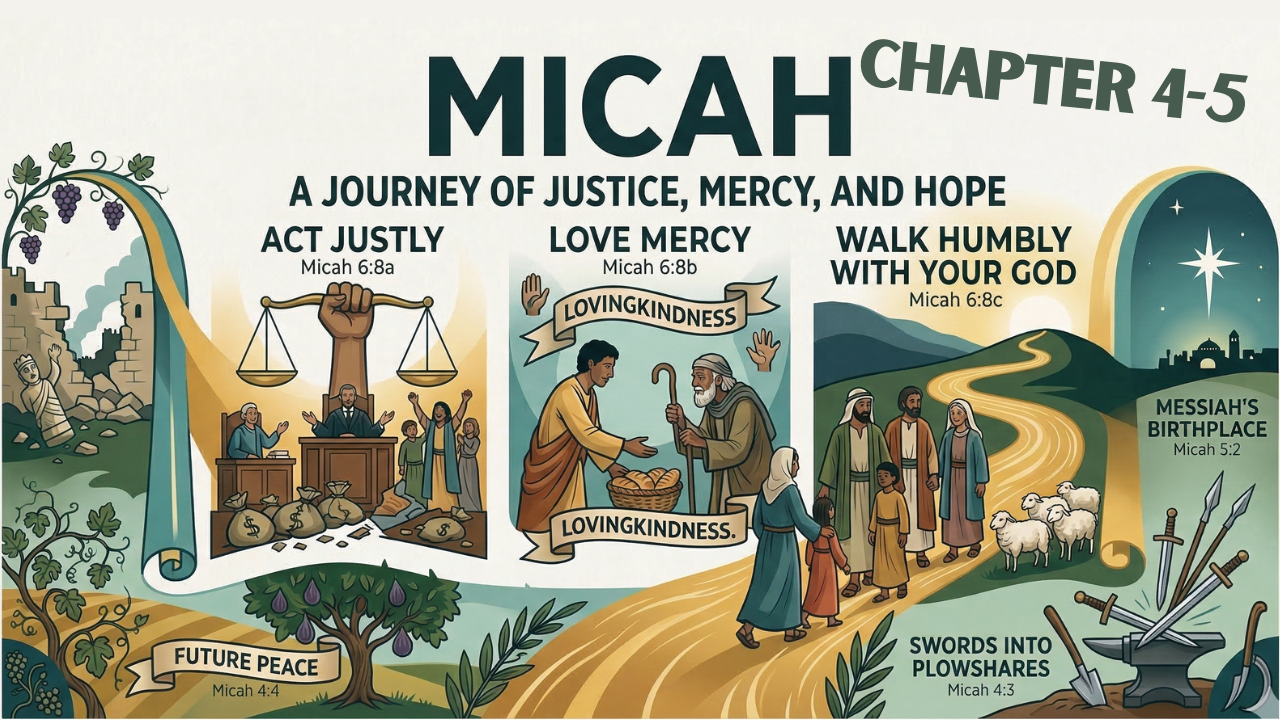
Micah Chapter 4-5 Class 3 - Bible Study
A lively study of Micah 4–5 connected the Minor Prophets to Isaiah, Revelation, and Jesus’ ministry, highlighting God’s consistent character, peace over violence, care for the outcast, and the Bethlehem shepherd-king whose reign blesses all nations.
Micah Intro and Chapter 4-5
This is our 3rd class on Micah
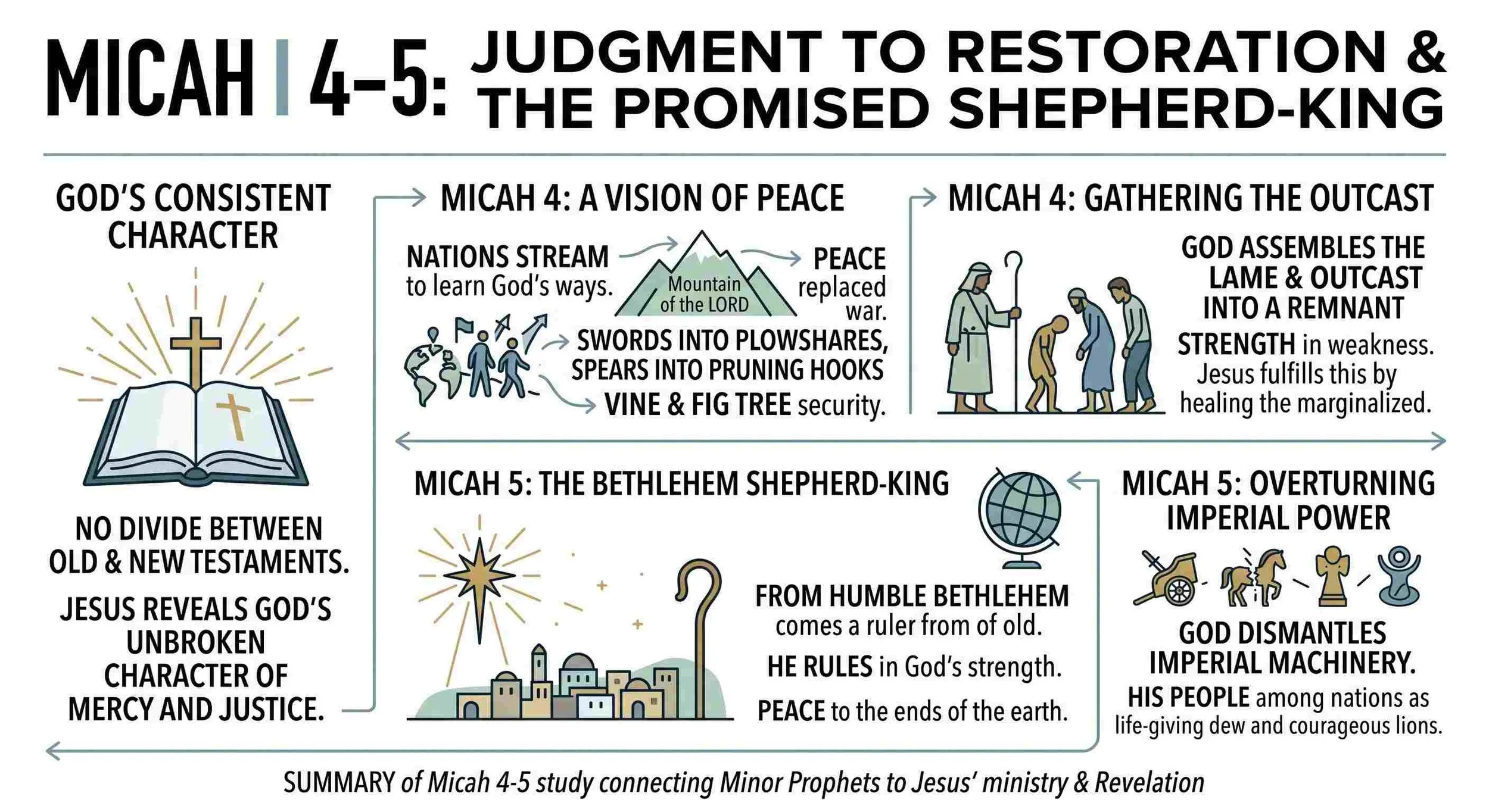
This is an AI Recap of the class.
Some things may be incorrect.
Short summary of the whole class
We read Micah 4–5 and traced a law-and-gospel rhythm from judgment to restoration. We explored God’s unbroken character across the Old and New Testaments; the mountain of the LORD and nations streaming; swords into plowshares; vine-and-fig-tree peace; exile and redemption; gathering the lame and outcast into a remnant; and the promised ruler from Bethlehem who shepherds in God’s strength and brings peace to the ends of the earth. We connected Micah to Isaiah 2, Revelation’s New Jerusalem and witness theme, Jesus’ ministry (including the temple cleansing and fig tree), Eden echoes, Jacob’s limp, Exodus’ overthrow of empire, and Luke’s census framing Jesus as David’s faithful heir.
Walkthrough and discussion highlights, with section summaries
Opening recap and theme-setting
We noted our prior stopping point (Micah 2–3) and began Micah 4, with some discussion reaching into Micah 5.
Observation that Micah (with Amos and Joel) “sounds like Revelation,” suggesting intertextual prophetic echoes.
Core conviction: no divide between the God of the Old and New Testaments; Jesus reveals God’s consistent character.
The Minor Prophets’ cadence mirrors law-and-gospel: exposing injustice, then promising restoration.
Short summary of this section:
We framed Micah 4 within Scripture’s larger arc, emphasizing God’s continuity, Revelation echoes, and a law-and-gospel approach.
Bible verses and stories:
Micah 2–3 (context)
Revelation (prophetic echoes)
Reading Micah 4:1–8 aloud
“Latter days,” exalted mountain of the LORD; nations streaming to learn God’s ways.
Signature imagery: swords into plowshares, spears into pruning hooks; no more learning war; everyone under vine and fig tree.
God gathers the lame and outcast as a strong remnant; the LORD reigns from Zion; “Tower of the Flock” and restoration to Daughter of Jerusalem.
Short summary of this section:
Micah 4 paints a peace-filled future where God’s teaching spreads, empires disarm, people flourish, and the marginalized are gathered and strengthened.
Bible verses and stories:
Micah 4:1–8
Exile, deliverance, and threshing (Micah 4:9–13)
Zion in labor pains; going to Babylon yet promised redemption.
Enemies misread God’s counsel; Zion told, “Arise and thresh” with iron horns/bronze hooves; gains consecrated to the LORD.
Short summary of this section:
Exile is a painful prelude, not the end; God redeems and repurposes His people’s struggle toward His consecrated victory.
Bible verses and stories:
Micah 4:9–13
Immediate reactions: battle and peace
Tension noted between God sending to battle and the broader vision of peace.
Reframing: Micah juxtaposes human conflict with God’s ultimate peace.
Short summary of this section:
Conflict appears in the storyline, but God’s horizon is transformative peace that turns weapons into tools for cultivation.
Bible verses and stories:
Micah 4 themes (peace, transformation)
“Daughter of Zion” and city-as-feminine language
“Daughter of Zion” personifies Jerusalem in feminine terms—a poetic address signaling care and restoration.
Short summary of this section:
“Daughter of Zion” is Scripture’s tender, corrective way of speaking to Jerusalem as a people God loves and will restore.
Bible verses and stories:
Micah 4 (usage of “Daughter of Zion”)
“Nations” and “Gentiles,” “LORD” and “Adonai”
“Nations/Gentiles” highlights inclusion beyond Israel.
“LORD” (small caps) renders the divine name YHWH; Jewish tradition reads “Adonai.”
How “Jehovah” arose via vowel-pointing.
Short summary of this section:
Translation choices shape meaning: the global scope of salvation and the reverent handling of God’s name.
Bible verses and stories:
Micah 4:1–3 (nations/Gentiles)
Notes on divine name usage
“Torah” vs. “Law,” and gospel as “good news”
“Torah” conveys covenantal instruction and saving story, not merely rules.
“Gospel” means good news (euangelion), not another law.
Torah includes God’s saving acts (Abraham, Exodus).
Short summary of this section:
God’s “law/Torah” is a way to walk shaped by His saving story, complemented by the gospel’s good news.
Bible verses and stories:
Micah 4:2 (“law/Torah” goes forth)
Allusions to Abraham’s call and the Exodus
Jesus present in the Old Testament and the continuity of God
Affirmation of the Son’s presence before the Incarnation; a Christ-centered reading of Micah.
Short summary of this section:
Micah’s voice aligns with Jesus’ revelation of God, grounding a Christological reading across Scripture.
Bible verses and stories:
Creation/Trinity allusion (Genesis)
Cross, temple, and Revelation echoes
Micah 3’s critique of corrupt leadership sets up Micah 4’s hope.
Jesus as true temple; Revelation’s descent of God’s dwelling.
Strong parallels to Isaiah 2’s mountain and plowshares imagery; intertextual, not derivative.
Short summary of this section:
From judgment on corruption to God’s restored dwelling, Micah 4 mirrors Isaiah 2 and foreshadows Revelation, centered on Jesus’ temple-fulfillment.
Bible verses and stories:
Micah 3; Micah 4:1–4
Isaiah 2:1–4
Revelation (New Jerusalem)
Walking God’s paths: peace, fruitfulness, and fig tree imagery
“Teach us His ways; walk in His paths” reframes law as lived wisdom.
Peace: tools of war become tools for cultivation; vine and fig tree rest.
Eden echoes of shade and fruit; Jesus’ fig tree sign warns against fruitlessness.
Short summary of this section:
God’s way leads to peace and true fruitfulness from Eden to the Gospels, contrasting performative power with Spirit-born fruit.
Bible verses and stories:
Micah 4:2–4
Matthew 21:18–22; Mark 11:12–14, 20–25 (fig tree)
Genesis 2–3 (Eden)
Gathering the lame and the remnant; witness and martyr
God assembles the lame/outcast into a strong remnant (Micah 4:6–7).
Revelation’s “witness” (martys) theme: faithful testimony often through weakness.
Warning against triumphalist “remnant” rhetoric.
Short summary of this section:
God perfects strength in weakness, forming a humble remnant whose witness aligns with the Lamb’s people in Revelation.
Bible verses and stories:
Micah 4:6–7
Revelation (witness/martyr motif)
Micah 4:6–8 — God gathers the lame and outcast (focus)
Hebrew tie between “lame” and Jacob’s limp (Genesis 32), dignifying weakness.
Contrast of ways: nations walk in their gods’ names, God’s people in the LORD’s name.
Short summary of this section:
God regathers the weak as His remnant under His reign, calling His people to walk His distinct path.
Bible verses and stories:
Micah 4:6–8; Micah 4:5
Genesis 32 (Jacob’s limp)
Jesus and the temple — cleansing as inclusion, not mere outrage
Jesus’ cleansing removes corruption and welcomes the blind and lame for healing, embodying Micah’s remnant vision.
Short summary of this section:
Jesus turns the temple into a house of healing, enacting the prophetic hope for the marginalized.
Bible verses and stories:
Matthew 21:12–14; Mark 11; Luke 19; John 2
Micah 4:9–13 — Birth pains, Babylon, and recycled imagery (focus)
Birth pains language echoed by Jesus and Paul; threshing imagery anticipates wheat/chaff themes.
“Careful what you wish for”: adopting Babylon’s ways leads to Babylon’s fate—yet redemption remains.
Short summary of this section:
Pain precedes deliverance; God warns against imperial imitation and promises final redemption.
Bible verses and stories:
Micah 4:9–13
Matthew 3:12 (wheat/chaff)
Matthew 24:8; Romans 8:22; 1 Thessalonians 5:3 (birth pains)
Micah 5:1–5a — Bethlehem and the Shepherd-Ruler
From little Bethlehem comes a ruler “from of old.”
Davidic expectations fulfilled in Jesus; Nazareth’s humble connotations noted.
Luke’s census read theologically against David’s failed census; Jesus as faithful heir.
“This one shall be peace”; global scope of reign.
Short summary of this section:
God raises a humble shepherd-king from Bethlehem whose peace reaches the ends of the earth, fulfilling and surpassing David’s line.
Bible verses and stories:
Micah 5:1–5a
2 Samuel 24 (David’s census)
Luke 2:1–7; Luke 3; Matthew 1
Micah 5:5b–15 — Remnant among the nations; God overturns imperial power
Assyrian threat met by God’s provision (seven shepherds/eight princes).
Remnant “like dew” (quiet life-giving) and “like a lion” (protective strength).
Violent-sounding verses reframed from the vantage of the weak: God dismantles horses, chariots, strongholds, sorceries, idols.
Exodus parallel: “horse and rider” thrown into the sea; God unmakes oppressive power.
Short summary of this section:
God protects His weak remnant, topples imperial idols, and plants His people among the nations as refreshing and courageous witnesses.
Bible verses and stories:
Micah 5:5b–15
Exodus 14–15 (horse and rider)
Isaiah 31:1; Psalm 20:7
Matthew 2 (magi as a class reframed in redemption)
Medium-length final summary (content creation date: 2026-04-16 11:07:13)
In our study of Micah 4–5, we followed Scripture’s law-and-gospel rhythm from judgment on corrupt power to God’s surprising restoration. We saw the exalted mountain of the LORD, nations streaming to learn His ways, and the transformation of weapons into tools for cultivation as people rest under their vines and fig trees. We clarified key terms and translations, underlining the Bible’s inclusive vision and reverent handling of God’s name, and reframed “law/Torah” as God’s covenantal instruction and saving story. Reading Micah through a Christ-centered lens, we linked its images with Isaiah 2 and Revelation’s New Jerusalem and witness, with Eden’s fruitfulness and Jesus’ fig tree sign. Micah 4 promised that God gathers the lame and outcast into a strong remnant, a theme we saw Jesus enact as He cleansed the temple and healed the marginalized. Micah 4:9–13 framed exile as birth pains before redemption, warning that imitating Babylon invites its fate. Micah 5 then spotlighted a humble ruler from Bethlehem whose shepherding strength and peace extend to the ends of the earth, echoing Luke’s census as a theological counter to David’s failed census. Finally, Micah 5:5b–15 presented God’s overthrow of imperial machinery—horses, chariots, strongholds, sorceries, idols—planting His remnant among the nations as both refreshing dew and courageous lion. Throughout, we emphasized that God’s kingdom overturns worldly power by lifting the lowly, purifying His people, and extending blessing to all nations.
Main points
God’s character is consistent across Old and New Testaments; Jesus reveals this continuity.
Micah 4 parallels Isaiah 2 and echoes Revelation: nations streaming, peace replacing war.
Law-and-gospel rhythm: exposure of injustice followed by restoration and hope.
Translation matters: nations/Gentiles, LORD/Adonai, and Torah/law shape inclusion, reverence, and instruction.
Peace and fruitfulness: swords into plowshares; vine and fig tree rest with Eden echoes and Jesus’ fig tree sign.
Christological reading: Jesus as true temple; cross and restoration themes align with Micah’s hope.
Remnant redefined: God gathers the lame and outcast; strength perfected in weakness and faithful witness (martys).
Bethlehem’s ruler: the shepherd-king brings peace to the ends of the earth and fulfills David’s line.
God overturns imperial power and idolatry, planting a purified people among the nations as dew and lion.
Bible Scriptures mentioned
Micah 2–5 (focus on 4:1–13; 5:1–15)
Isaiah 2:1–4
Revelation (New Jerusalem; faithful witnesses)
Genesis 2–3; Genesis 32
Exodus 14–15
Psalm 20:7
Isaiah 31:1
2 Samuel 24
Matthew 1–2; Matthew 3:12; Matthew 21:12–14; Matthew 21:18–22
Mark 11:12–14, 20–25; Mark 11 (temple cleansing)
Luke 2:1–7; Luke 19; Luke 3
John 2
Romans 8:22
1 Thessalonians 5:3
Matthew 24:8
Stories discussed
Nations streaming to God’s mountain; swords into plowshares; vine and fig tree peace
Daughter of Zion personification; exile to Babylon and promised redemption
Jacob wrestling and limping
Eden’s fruitfulness and shade
Jesus and the fig tree
Jesus cleansing the temple and healing the blind and lame
David’s census and consequences; Luke’s census framing Jesus’ birth
Exodus: horse and rider thrown into the sea
Magi as ancient court sages (reframed in Matthew’s nativity)
Remnant as dew and lion among the nations
Generated by gpt-5 on 2026-04-16 11:07:13 (content creation date).
![Tokas Family Baptism [Photos]](https://images.squarespace-cdn.com/content/v1/5852f18a20099e30cd2c01dc/1775827002242-SVB29FA6R0KMXZUR3IRV/Tokas+Baptism.jpg)
Tokas Family Baptism [Photos]
we’d love to have you join us at Grace Lutheran PSL, or you can catch the live stream at the link above.
Saturday April 11th 4pm


It is will great joy that we will baptizing the Tokas family in to God’s on Saturday at 4pm.
We’d love to have you join us at Grace Lutheran PSL, or you can catch the live stream at the link above.
We’re having a reception with food right after the service. You’re more than welcome to bring a dish if you want, but honestly, just come as you are—we’d love to see you!

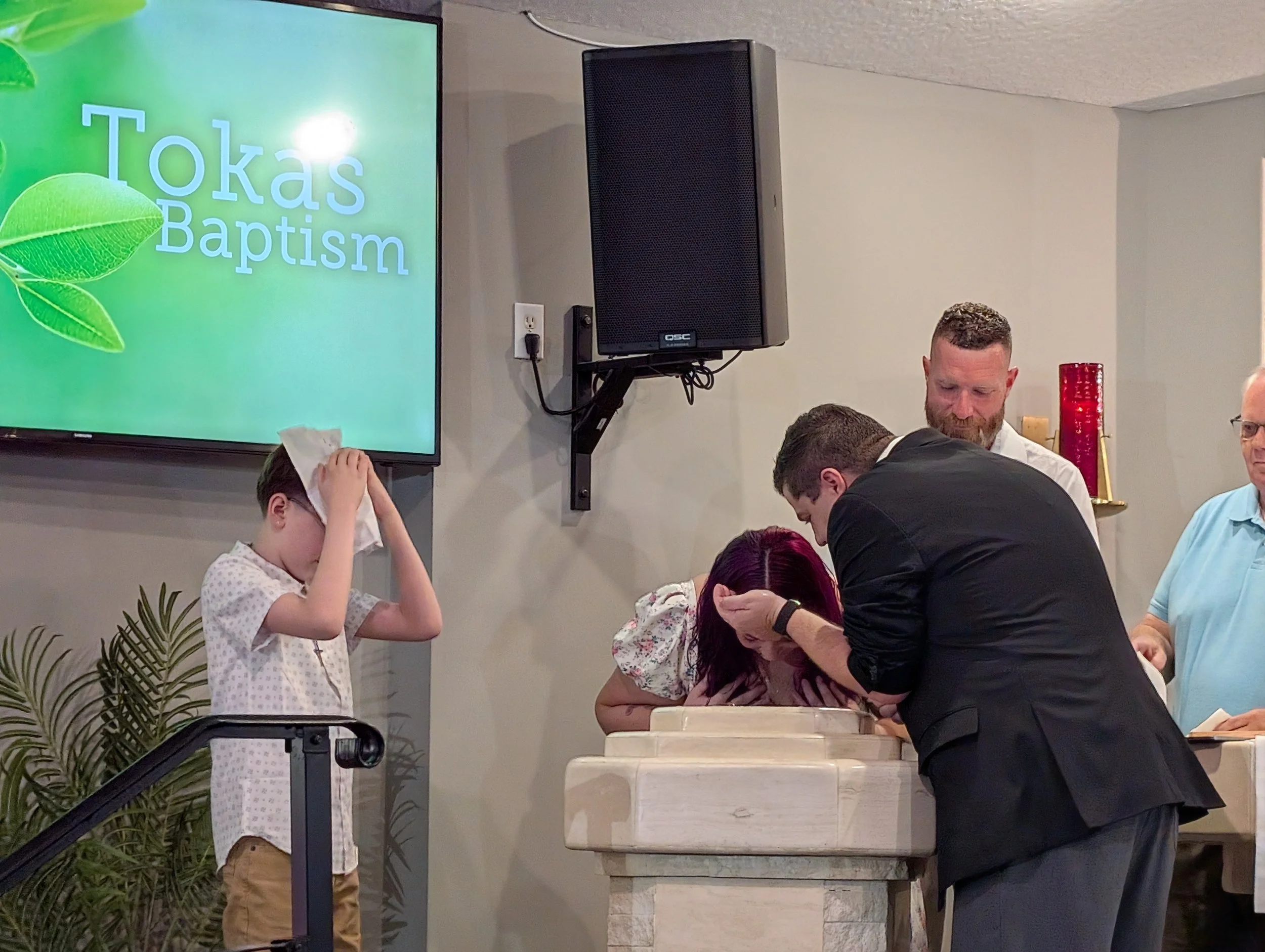
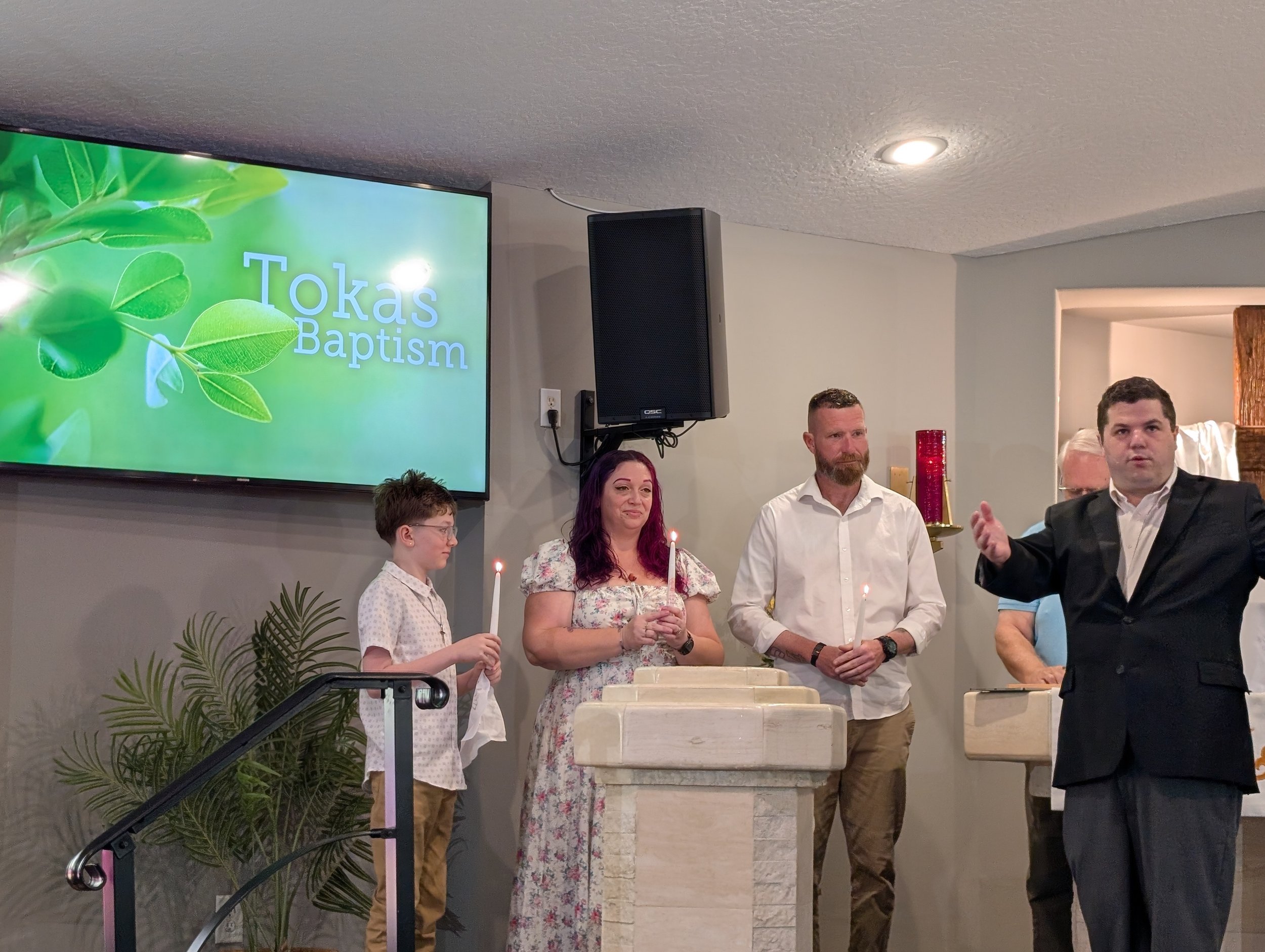













![April 2nd Sunday School [Photos]](https://images.squarespace-cdn.com/content/v1/5852f18a20099e30cd2c01dc/1776271392998-YAGF7CEMVFWZKPE93W7G/PXL_20260412_162844632.jpg)
April 2nd Sunday School [Photos]
Great time at 2nd Sunday school.
Every 2nd Sunday the kids meet after the 10:15 service for Second Sunday School. They had a great time playing superheroes and remembering the resurrection of our Lord.






















![[Sunday] Creation Day 8 - Rest The Week](https://images.squarespace-cdn.com/content/v1/5852f18a20099e30cd2c01dc/1775766340384-5MXXACTZNMYUEFDELPA9/The+Week+8a.jpg)
[Sunday] Creation Day 8 - Rest The Week
When the joy of Easter meets the chaos of daily life, we don't need to panic. Jesus, the true Creator-Gardener, has secured our future, which frees us to plant seeds of hope right in the middle of the mess.

When the joy of Easter meets the chaos of daily life, we don't need to panic. Jesus, the true Creator-Gardener, has secured our future, which frees us to plant seeds of hope right in the middle of the mess.
Questions for the Week: Creation Day 8: Plant
Read John 20:11-18. Where in your life is it currently difficult to see Jesus at work, and how does remembering He is the "Gardener" (gently cultivating and bringing life back to His creation) change your perspective?
Read Revelation 21:1-6. When the "sea" is raging (stress, illness, conflict), we are sometimes tempted to try and save ourselves by taking control, which only creates more chaos. Jesus has handled the sea and saved you by his grace. How does resting in this grace give you peace?
Read Jeremeiah 29:4-14. It’s been said by the church, sometimes attributed to Martin Luther, “Even if I knew that tomorrow the world would go to pieces, I would still plant my apple tree.” What is one specific “apple tree” you can plant for someone this week?
What Had happened at Grace this week.
![A Fancy Italian Guys Night [Photos]](https://images.squarespace-cdn.com/content/v1/5852f18a20099e30cd2c01dc/1775863536448-YJCSVI1EF7KHMSYMYMUN/664304659_1694581178369850_83058891898210950_n.jpg)
A Fancy Italian Guys Night [Photos]
There’s nothing like the 'Italian feistiness' of a big group dinner to feed the soul.
"They say Italians do it better, but this crew at Roma gives them a run for their money! What started as a casual dinner for nine turned into a full-on masterclass. Mick literally held court, menu in hand, making sure we didn't butcher the beautiful language of pasta.
Between Mick’s pronunciation drills and our favorite Thrivent rep, Rob, stopping by to join the fun, the energy was through the roof. The food was a total sleeper hit, absolutely stellar, and the conversation was exactly how it should be: loud, lively, and a little feisty. You definitely want a seat at this table next time!"







Easter 26’ Photos
Easter was amazing time for us at Grace.
Big Thanks to Everyone
Thank you to all who helped set up.
Thanks to all who came to the services.
Thanks to all who participated.
This year’s attendance was higher than in a long time.
247 total in person attendance
50 people on the livestream




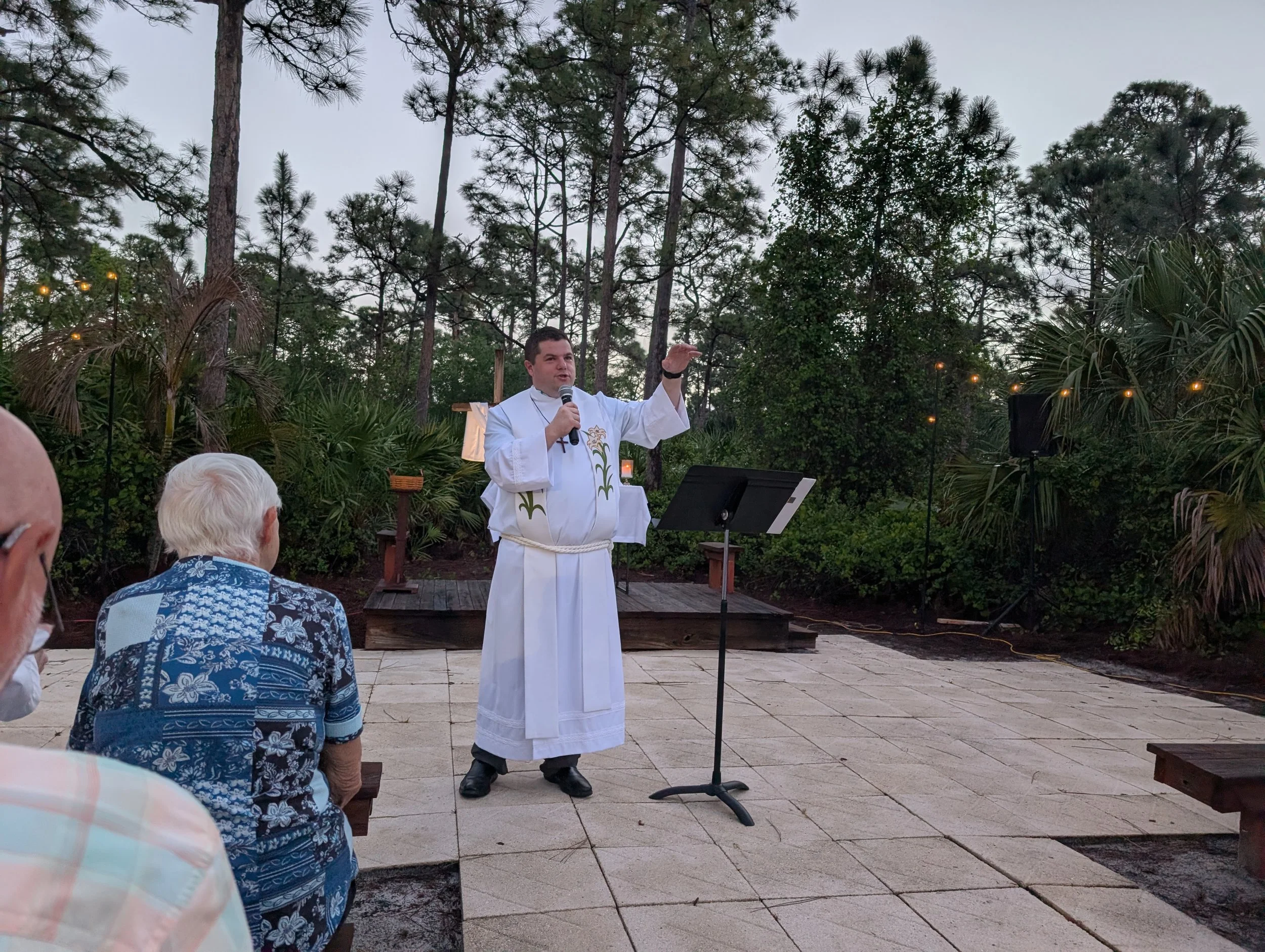


































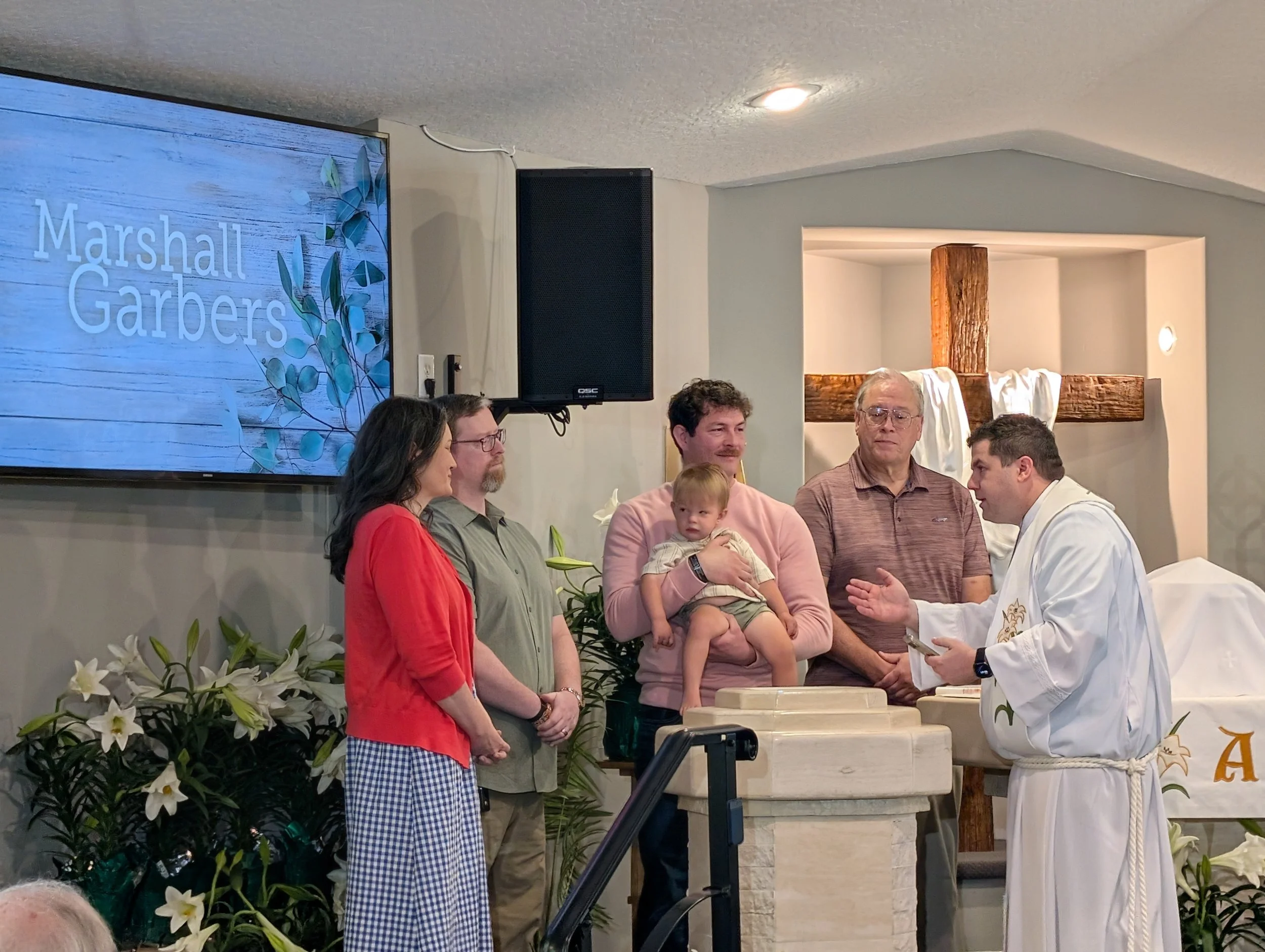
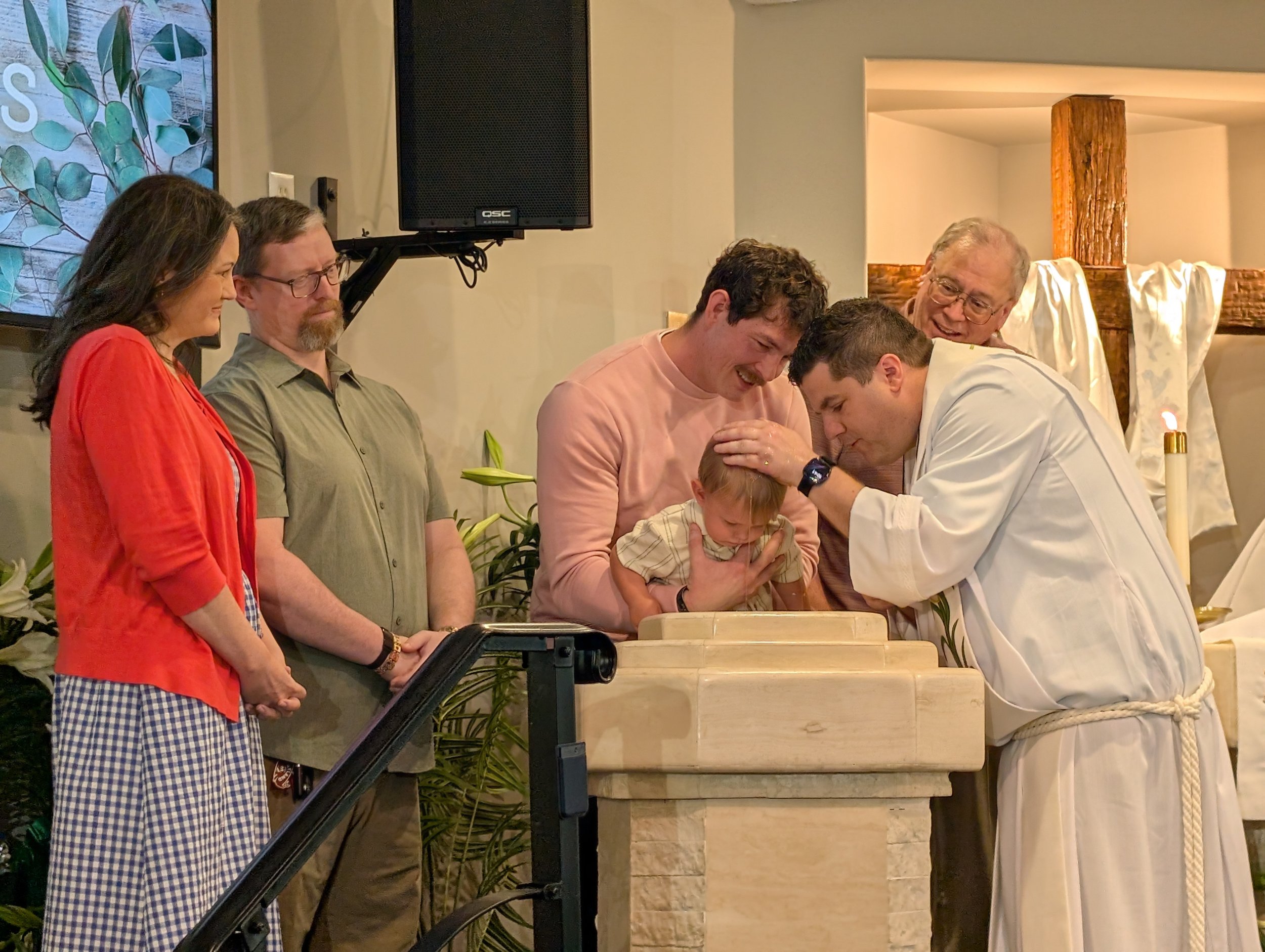













































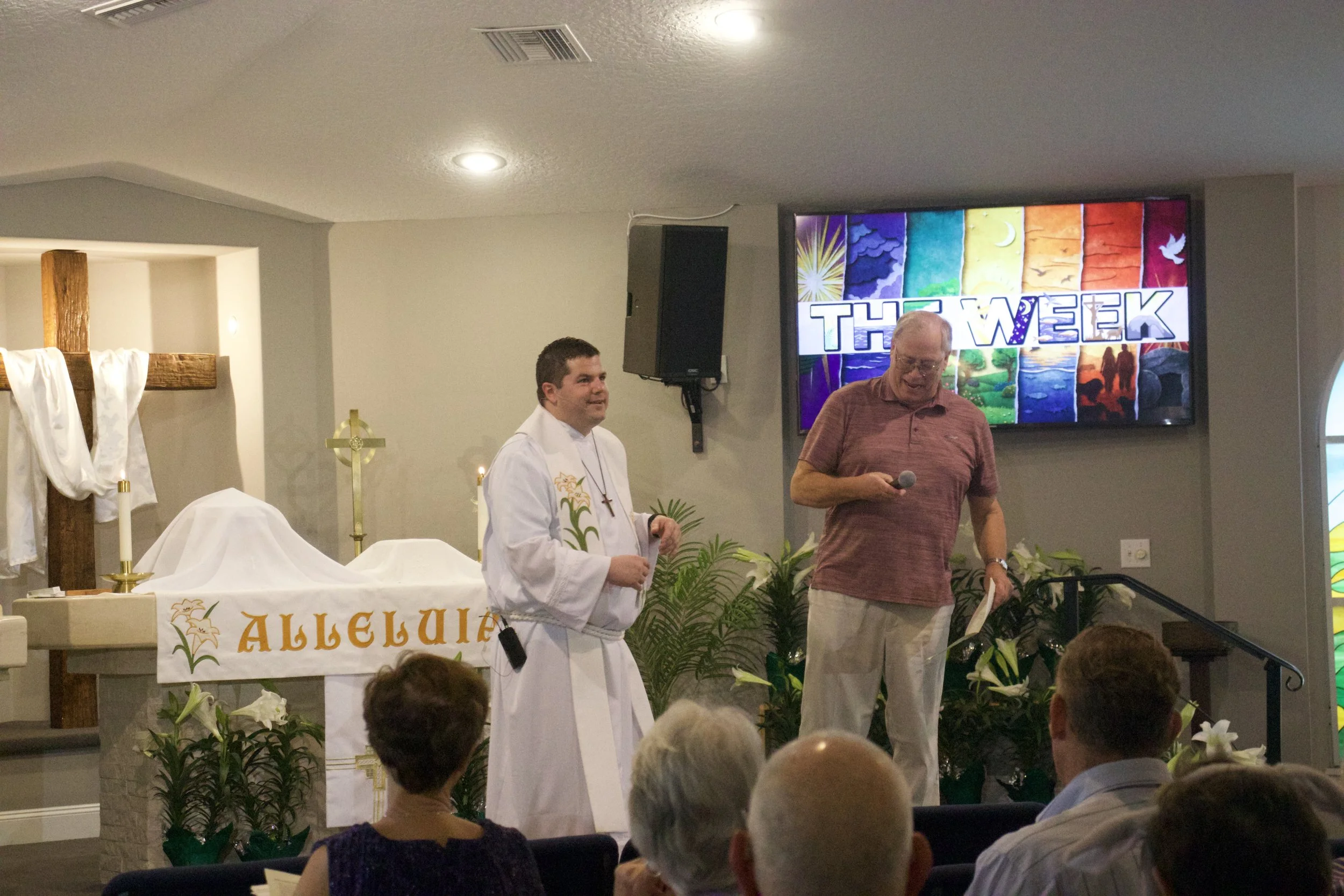




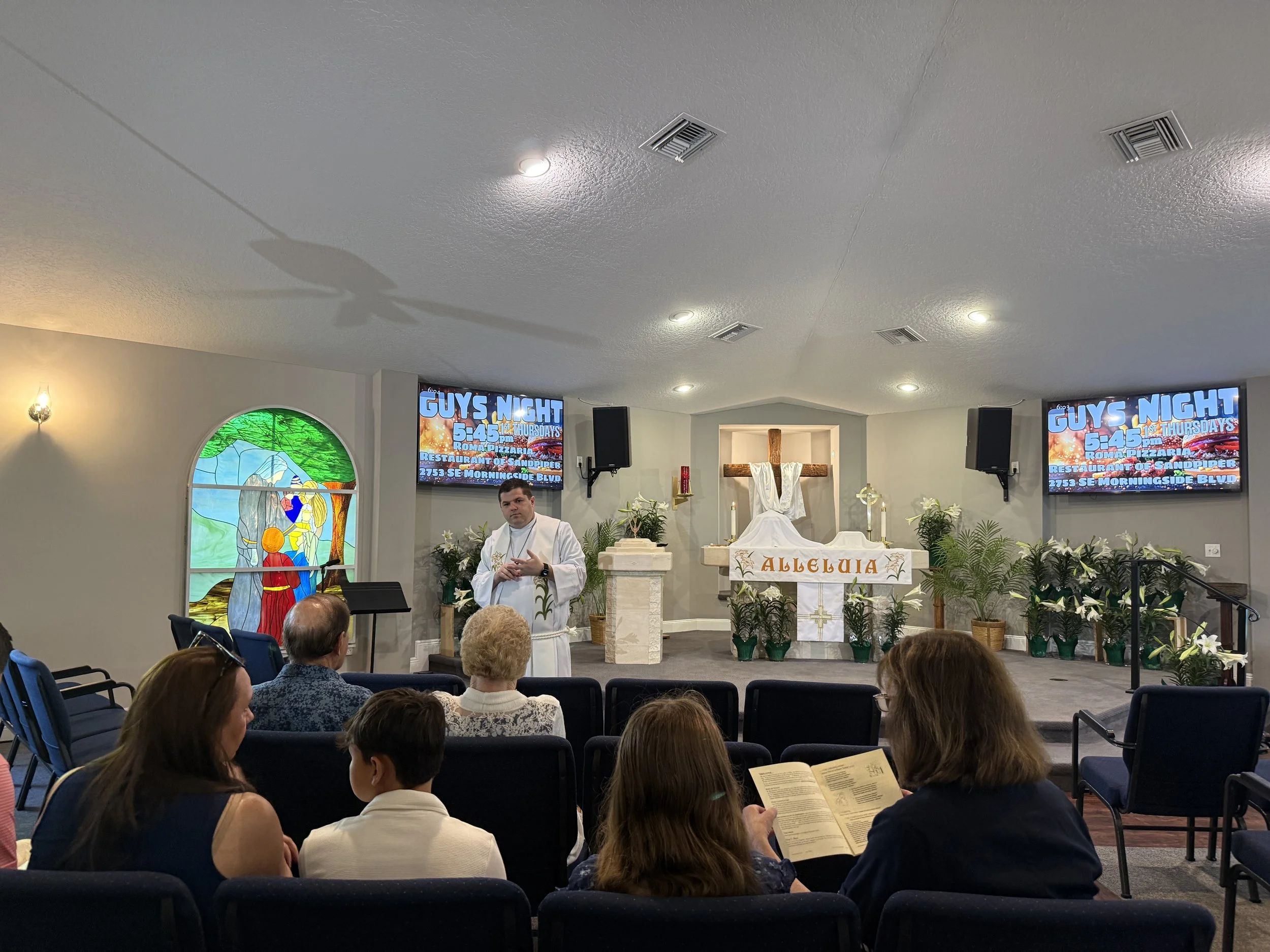
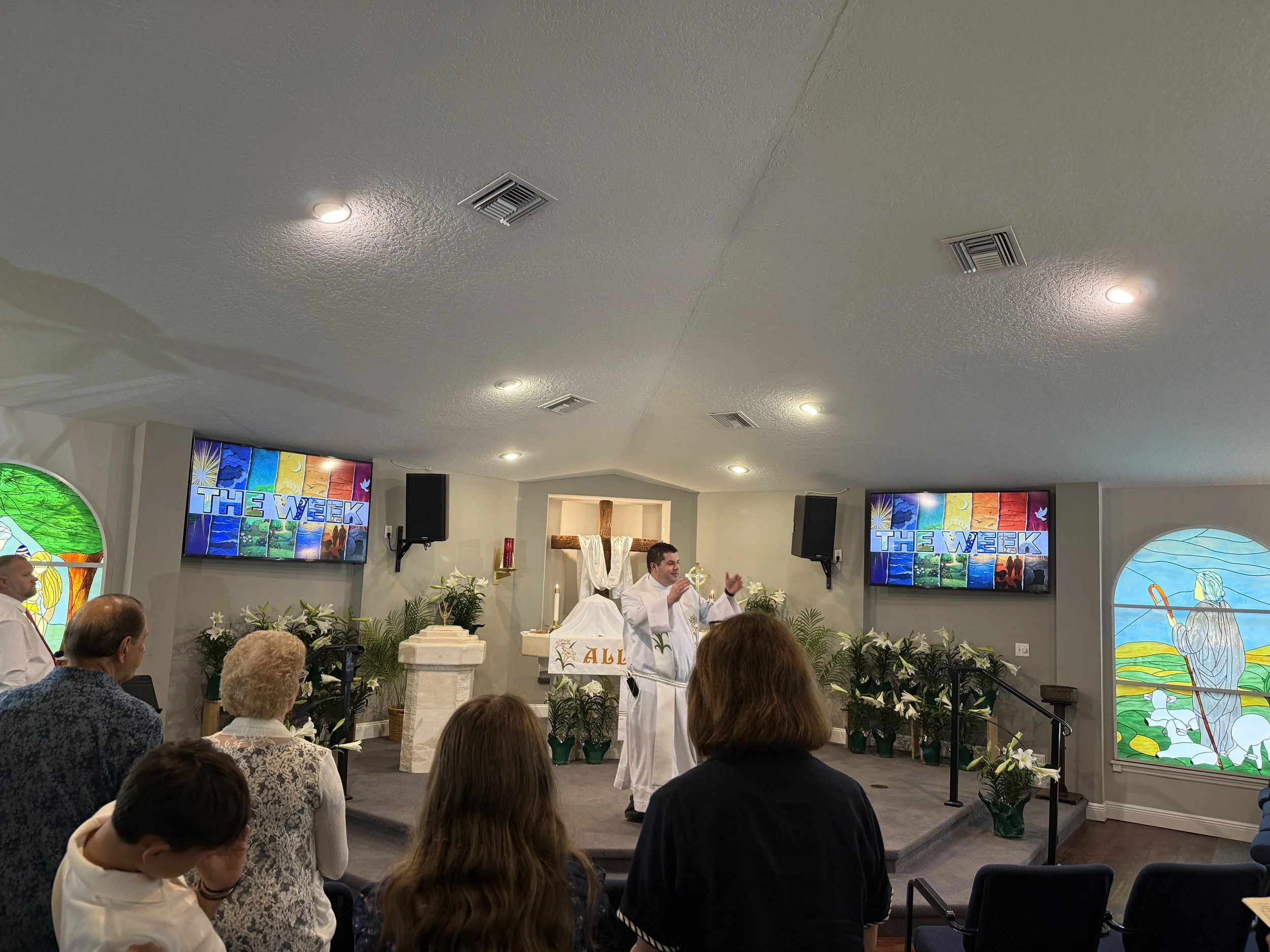
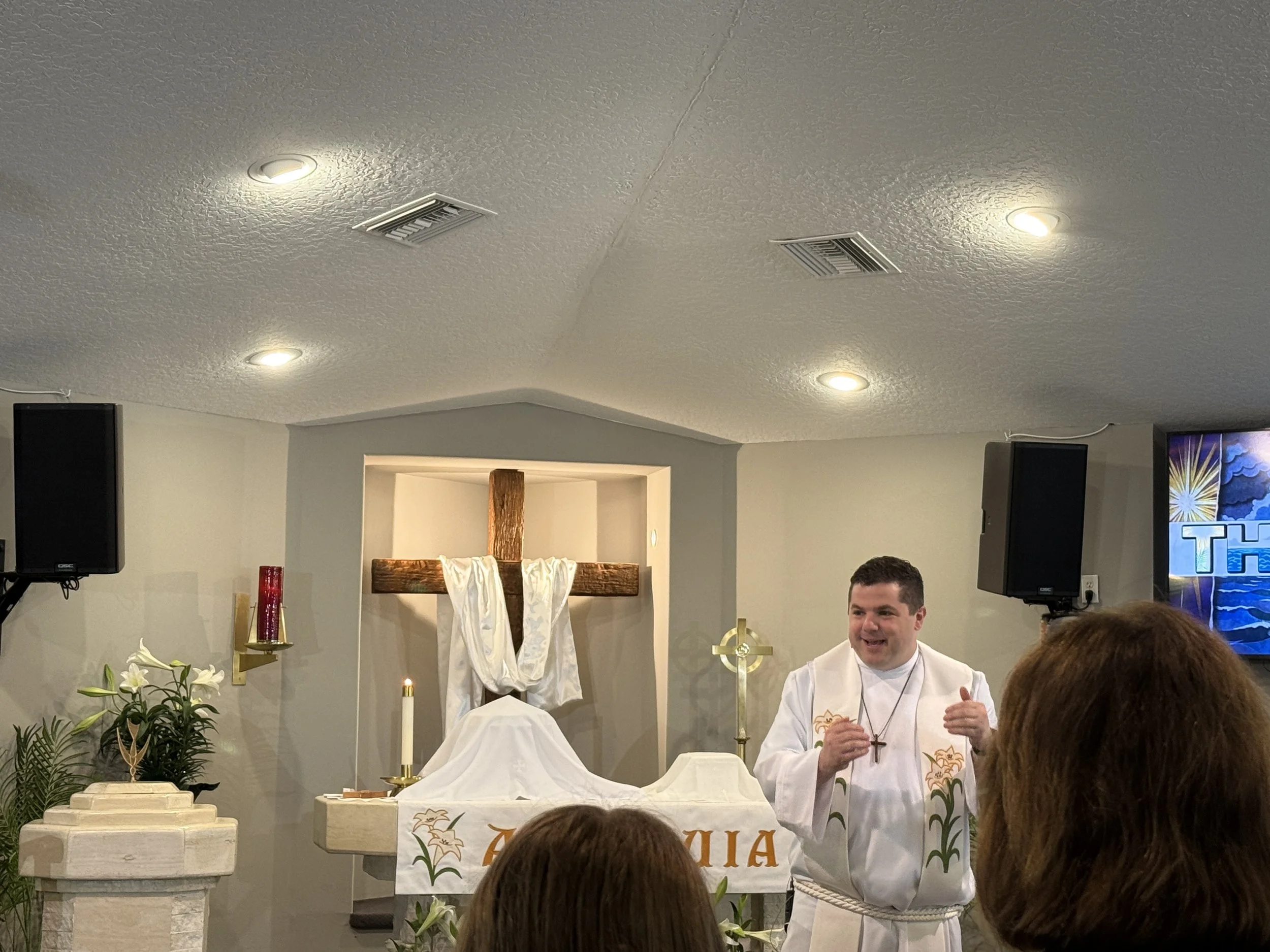
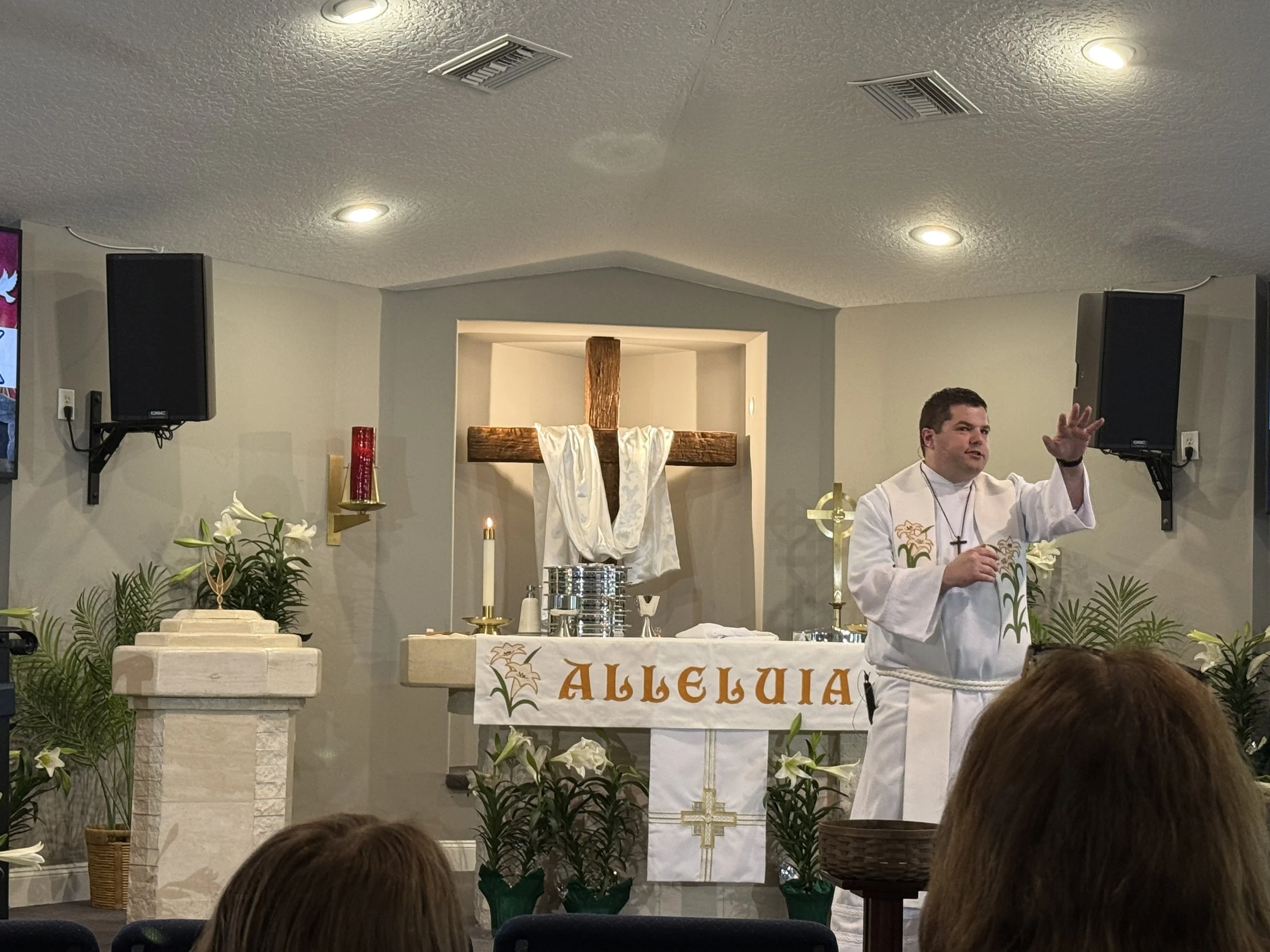






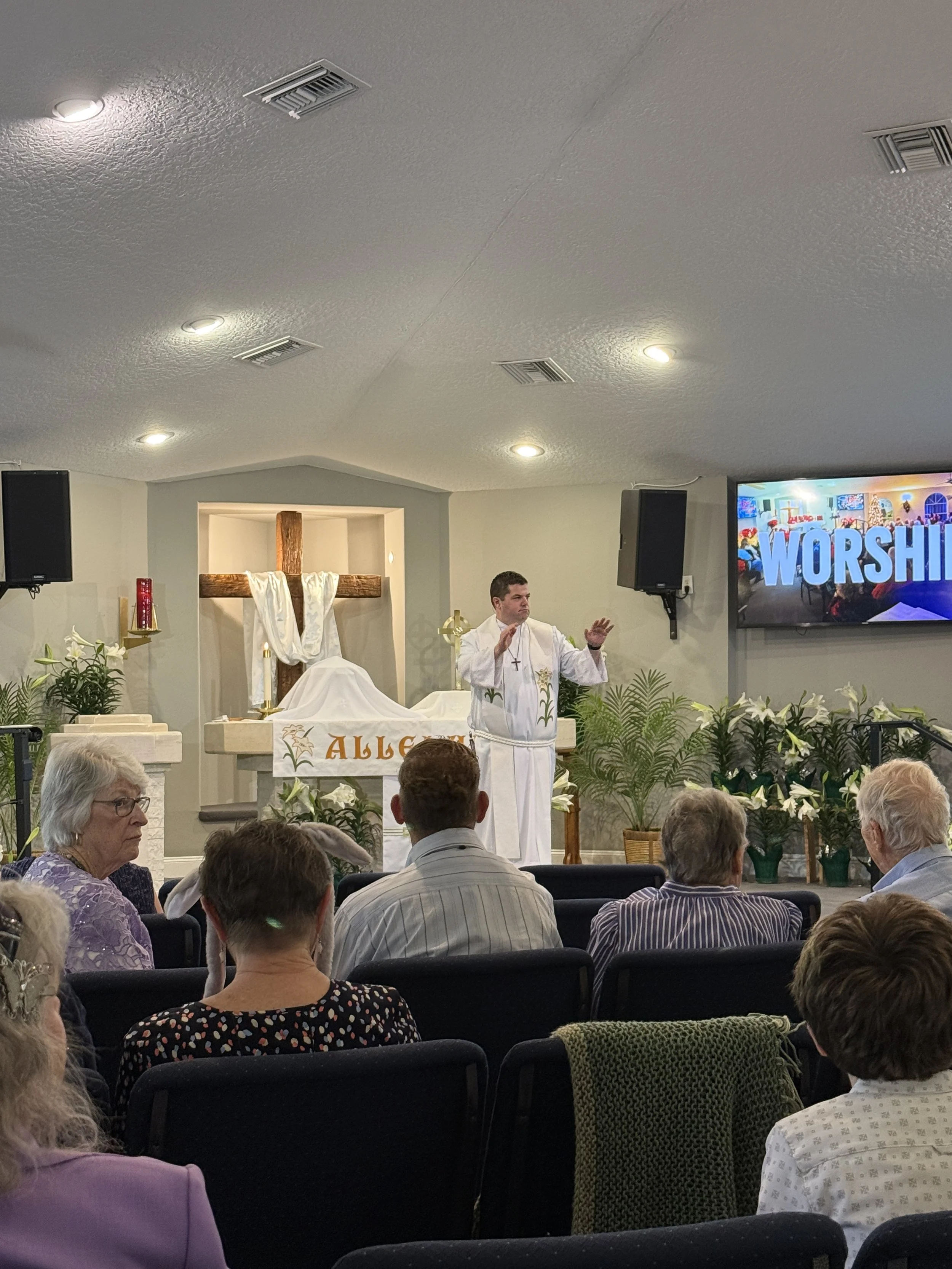




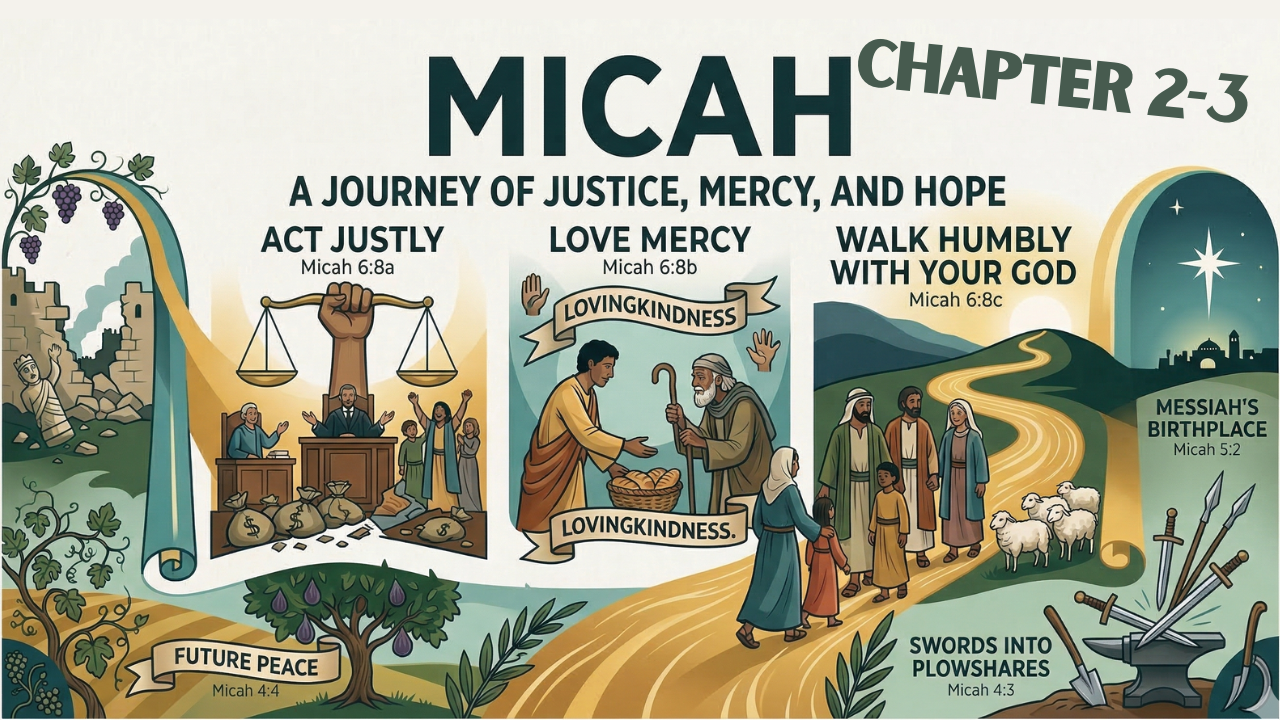
Micah Chapter 2-3 Class 2 - Bible Study
In our Bible study on April 9, 2026, we reviewed key themes from the book of Micah, focusing on God's judgment against corrupt leaders, His call for justice and mercy over power, and the recurring pattern of judgment followed by redemption.
Micah Intro and Chapter 2-3
This is our 2nd class on Micah
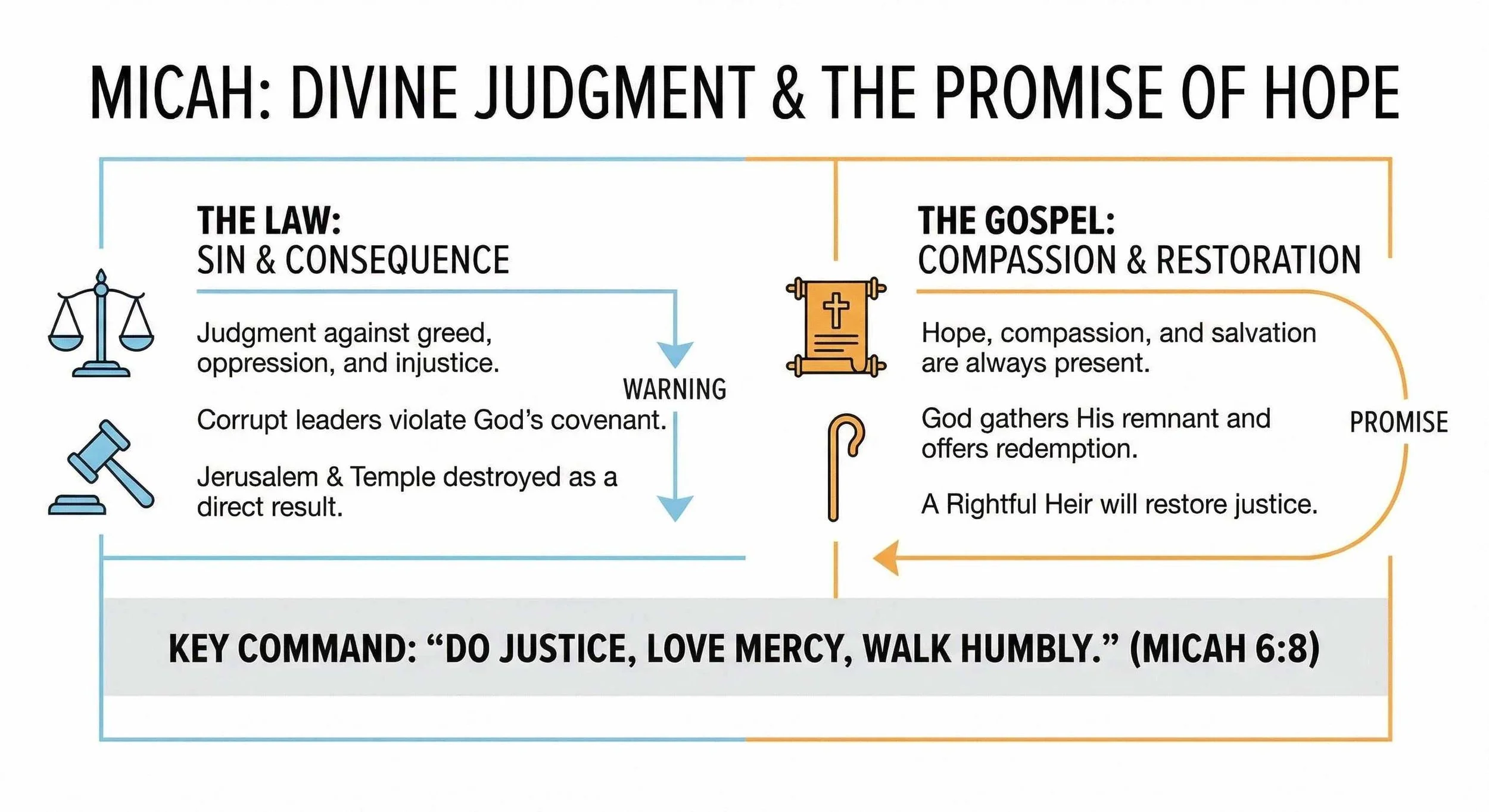
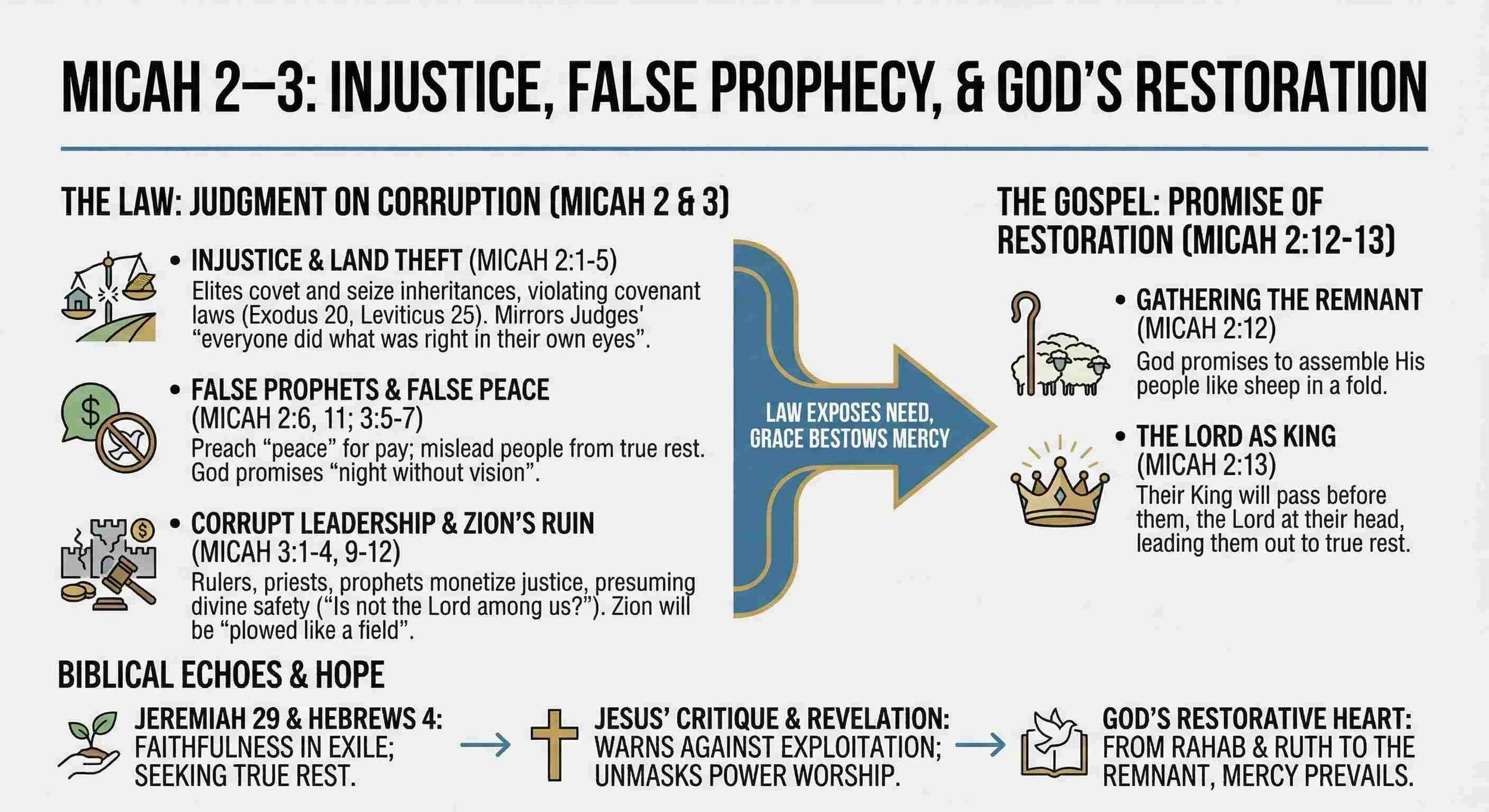
This is an AI Recap of the class.
Some things may be incorrect.
Short Summary of the Class
On Thursday, April 9, 2026, our group dove into chapters 2 and 3 of the book of Micah. We began by reading the text, which details God's pronouncement of "woe" upon the powerful in Israel who were oppressing the poor by seizing their land and inheritance, a direct violation of how God had established their society. We discussed how these actions broke several commandments and how this theme of "might makes right" was leading them to self-destruction. The discussion highlighted the contrast between the first eleven verses of chapter 2, filled with judgment, and the final two verses, which offer a glimpse of hope and restoration. We then moved into chapter 3, which continues the condemnation of Israel's corrupt leaders, priests, and prophets who exploit their positions for money while falsely claiming God's favor. We explored the stark imagery of their destruction and the recurring biblical theme of law and gospel, where the law reveals our sin and points to our need for the grace found in the gospel.
Detailed Class Summary
Review of Previous Micah Study and Prophetic Themes
We then transitioned to the Bible study portion by reviewing our last discussion on the minor prophets, specifically Micah. Two primary themes were revisited. The first was the structure of the prophetic messages, which often present a strong word of judgment followed by a promise of God's salvation. This pattern was compared to the "law and gospel" preaching model.
The second major theme was the consistent message across prophets calling Israel back to God’s core requirements: "to do justice, love mercy, and walk humbly with your God" (Micah 6:8). The prophets condemned Israel for becoming obsessed with power and wealth while neglecting the poor, a theme echoed in the New Testament book of Revelation. We also recalled the clever "prophetic wordplay" in Micah chapter 1, where the Hebrew names of cities reinforce the prophecy of judgment.
Section Summary: We reviewed how Micah and other minor prophets follow a "law-gospel" pattern of judgment then salvation. We also discussed their unified message condemning the pursuit of power over God's call to practice justice and mercy, and the literary device of prophetic wordplay.
Bible Verses: Micah 6:8, Micah 1:8-15
Bible Stories/Concepts: Parallels with the book of Revelation.
Section 1: Micah Chapter 2 - Judgment and the Consequences of Greed
Our class on April 9, 2026, began with a reading of Micah, chapter 2. The chapter opens with a "woe" to those who plot evil and, because of their power, violently seize fields and houses, oppressing their own people. We noted that this greed and theft were direct violations of God's commandments, specifically those against coveting and stealing. It was pointed out that this practice of seizing land went against the redemption plan God had established for Israelite inheritances, as illustrated in the book of Ruth with the story of the kinsman-redeemer.
The phrase "careful what you wish for" was used to describe the consequences foretold in verses 4 and 5. The very people who were seizing land would have their own heritage taken from them, with no one left to even "determine boundaries by lot in the assembly of the Lord." This pursuit of wealth was a form of self-destruction, echoing the theme from the book of Judges where "they did what was right in their own eyes." The discussion also touched on the false prophets mentioned in verse 11, who would tell the people what they wanted to hear—prophecies of "wine and drink"—rather than God's truth. This was compared to the false prophets in Jeremiah's time who promised peace while the people were being led into captivity. The chapter ends, however, with a shift in tone. After eleven verses of judgment, the final two verses promise that God will surely gather the "remnant of Israel" like a flock, with their King and the Lord leading them.
Summary of Section 1: We discussed how the wealthy in Israel were ignoring God's laws by violently taking land from the poor. This greed, encouraged by false prophets promising good times, was leading the nation toward its own destruction, a judgment from which God promised He would ultimately rescue a remnant of His people.
Bible Verses and Stories Mentioned:
Micah 2: The primary text for this section.
Book of Ruth: The story of Naomi, Ruth, and Boaz (the kinsman-redeemer) was mentioned to illustrate God's original plan for land inheritance.
Book of Judges: Referenced for its recurring theme of "they did what was right in their own eyes."
Jeremiah 29:11: Discussed in the context of false prophets promising peace and prosperity, noting that this verse was originally spoken to people already in exile.
Revelation 21: Mentioned in passing regarding a sermon on the "Eighth Day of Creation."
Section 2: Micah Chapter 3 - Corrupt Leadership and the Call for Justice
We then proceeded to read and discuss Micah, chapter 3. This chapter continues the strong condemnation, this time aimed directly at the "heads of Jacob and you rulers of the house of Israel." They are accused of hating good, loving evil, and metaphorically cannibalizing their own people. The prophets are again called out for chanting "peace" for profit while preparing "war against him who puts nothing into their mouths."
A key point of discussion was the theme of "might makes right." The leaders, priests, and prophets were all corrupt, judging for bribes, teaching for pay, and divining for money. Yet, in their hypocrisy, they would "lean on the Lord and say, 'Is not the Lord among us? No harm can come upon us.'" They used their status as God's chosen people as a license to sin. Micah's response is a devastating prophecy: because of their actions, "Zion shall be plowed like a field, Jerusalem shall become heaps of ruins." We also explored the poetic use of "Jacob" and "Israel" in the same verses, concluding it was likely for emphasis, to encompass the entire nation from its past to its present. The theme of "Law and Gospel" was brought up, explaining that the law (like Micah's harsh words) reveals our sin and demonstrates our desperate need for the gospel (God's grace).
Summary of Section 2: This section focused on the corruption of Israel's entire leadership structure—rulers, priests, and prophets—who exploited the people for financial gain while hypocritically claiming God's protection. Micah prophesies complete destruction for Jerusalem and the temple as a direct result of their twisting of justice and perversion of faith.
Bible Verses and Stories Mentioned:
Micah 3: The primary text for this section.
John 8:44: Referenced when discussing how the rulers "twist everything that is straight," connecting it to Jesus calling Satan the "father of lies."
2 Corinthians 1:3: Contrasted with the harsh judgment, highlighting God as the "Father of mercies and God of all comfort."
Story of Jonah: Jonah was presented as an example of a prophet who, unlike Micah, did not want God's mercy to extend to others and embodied the selfish attitude Micah preached against.
Story of Rahab and Ruth: Mentioned as examples of Gentiles included in Jesus' lineage, showing God's plan of redemption was always for all people.
Final Summary
In our Bible study on Thursday, April 9, 2026, we examined the powerful prophecies of Micah in chapters 2 and 3. Our discussion centered on God's indictment against the people of Israel, particularly its wealthy and powerful leaders, for their systemic injustice and greed. We observed how they violated God's commands by violently seizing land, oppressing the poor, and creating a society where "might makes right." This behavior was enabled by corrupt priests and false prophets who offered messages of peace and prosperity in exchange for money, lulling the people into a false sense of security.
We discussed how this path of doing "what was right in their own eyes" was leading them to self-destruction, a stark warning that what they were doing to others would be done to them. Micah prophesies that their inheritance would become desolation, with Jerusalem and the temple itself being turned into a heap of ruins. A significant part of our conversation highlighted the hypocrisy of the leaders who sinned while claiming, "Is not the Lord among us?" using their chosen status as an excuse for evil. We connected these themes to other scriptures, such as the stories of Ruth and Jonah, and the teachings of Jesus against the Pharisees. Despite the heavy judgment, we also noted the glimmers of hope and the "gospel" promise at the end of chapter 2, where God pledges to gather the remnant of His people and lead them as their King, reminding us that even in His righteous anger, God's ultimate plan is one of redemption.
Main Points
The wealthy and powerful in Israel were using their power to oppress the poor and seize their land, directly violating God's laws.
This societal greed was a form of self-destruction; the very ruin they brought on others would be visited upon them.
False prophets were complicit, telling the people what they wanted to hear ("peace," "wine and drink") for personal gain.
Israel's leaders—rulers, priests, and prophets—were corrupt, commercializing justice and religious teaching.
The leaders hypocritically believed they were immune from harm because they were God's people, using their faith as a license to sin.
Micah's prophecy foretells the complete destruction of Jerusalem and the temple as a consequence of their injustice.
Despite the overwhelming message of judgment ("the Law"), there is a promise of future restoration and salvation ("the Gospel").
Scriptures and Stories Mentioned
Bible Chapters:
Micah 2
Micah 3
Bible Verses:
Jeremiah 29:11
John 8:44
2 Corinthians 1:3
Revelation 21
Stories/Concepts:
The commandments against coveting and stealing
The kinsman-redeemer and land inheritance (Book of Ruth)
"They did what was right in their own eyes" (Book of Judges)
Jesus's condemnation of the Pharisees "devouring widows' homes"
The concept of Law and Gospel
The story of Jonah pouting over God's mercy to Nineveh
The inclusion of Gentiles (Rahab, Ruth) in the lineage of Jesus
Jesus as Prophet, Priest, and King
The Pax Romana ("Roman Peace") as a form of peace through coercion
Solomon's Temple
![[Easter] Creation Day 7 - Rest The Week](https://images.squarespace-cdn.com/content/v1/5852f18a20099e30cd2c01dc/1775074168095-82WENI1I4DA222SDE8UE/The+Week+7a.jpg)
[Easter] Creation Day 7 - Rest The Week
Jesus' cry of "It is finished" echoes God's seventh-day rest. Because the tomb is empty, the work of putting the world back together is complete. You can stop trying to fix your own brokenness and finally just breathe and rest.
Jesus' cry of "It is finished" echoes God's seventh-day rest. Because the tomb is empty, the work of putting the world back together is complete. You can stop trying to fix your own brokenness and rest.
Questions for the Week: The Week: Day 7 Rest
What is an "unfinished project" (literal or figurative) in your life right now that is robbing you of your peace and rest?
Read Luke 23:50-24:12. The women at the tomb were so focused on their grief and their incomplete tasks that they initially missed the miracle in front of them. The angel asked, "Why do you seek the living among the dead?" How do we sometimes act like those women, focusing only on the dark, broken parts of life instead of the hope of Jesus?
It is powerful to realize that Jesus' final cry on the cross uses the same word as God finishing the six days of creation. How does knowing that the work of your salvation is 100% "finished" change the way you view your own daily striving and spiritual performance?
The world says we can only rest when everything is fixed, but the resurrection means we can rest right in the middle of our mess. How can you practically "breathe and rest" this week, even with unresolved circumstances?
What Had happened at Grace this week.
![[Good Friday] Tohu Vavohu The Week](https://images.squarespace-cdn.com/content/v1/5852f18a20099e30cd2c01dc/1774905300678-2BEG2XM429JZK7ZSGKCI/The+Week+GFa.jpg)
[Good Friday] Tohu Vavohu The Week
in the crucifixion of our lord its as if the creation itself is rolled back to the beginning.
Good Friday
Noon & 7PM
Noon Live Stream

in the crucifixion of our lord its as if the creation itself is rolled back to the beginning.
What Had happened at Grace this week.
There is always hope when a buried seed begins to sprout.