
-
Overview
The sermon, part of an ongoing “Foolish Wisdom” series, confronts the widespread human impulse to equate God’s power with “bigness”—grand narratives, worldly prestige, and visible dominance. Through an arc spanning Solomon, the divided kingdom, Ahab and Jezebel, and the episode of Elijah with the widow of Zarephath, the speaker argues that God’s saving work often appears in humble places among outsiders. The message culminates in Jesus’s ministry and the cross, where divine victory arrives through what the world calls weakness. The sermon maintains a strong emphasis on faithfulness to biblical texts, careful preservation of historical details, and a clear call to resist idolatry of power and status in modern life.
The Pitfall of Pursuing Greatness
The sermon situates itself in the “Foolish Wisdom” series, continuing a multi-year trajectory of biblical exploration. About four years ago, the community studied “Rise and Fall” (First and Second Samuel, focusing on King Saul and David). A year later, they examined Judges, noted humorously for having “nothing but cheerful stories.” This year’s focus is First and Second Kings through the lives of Solomon, Elijah, and Elisha.
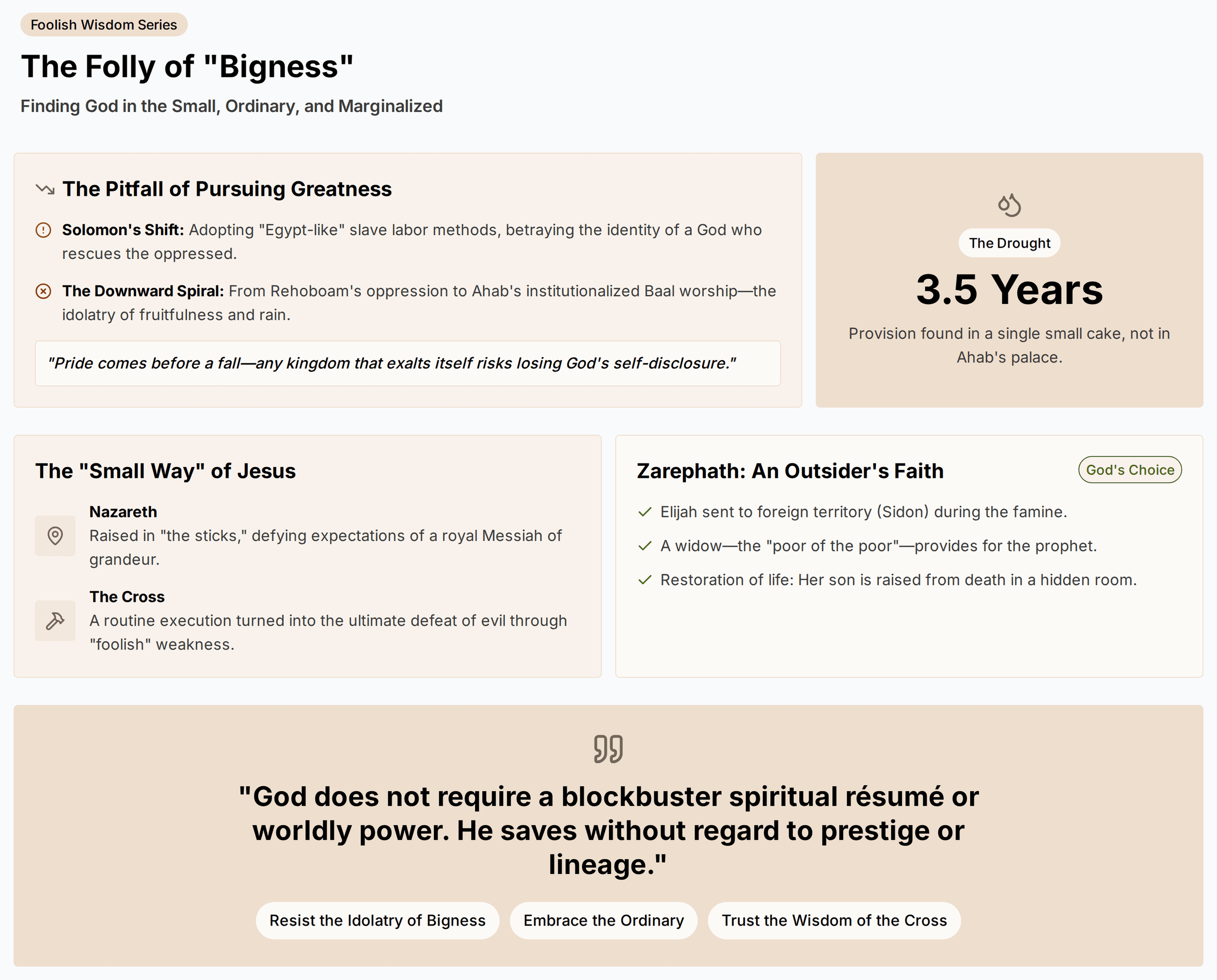
Solomon’s reign serves as the initial cautionary tale. Although he sought to honor God by building the temple, he adopted methods that mirrored Egypt—using slave labor—thereby betraying the founding identity of Israel’s God, who rescued His people out of Egypt. The speaker stresses that Solomon’s pursuit of ever-greater power marked a departure from God’s self-disclosure and intent, which prioritizes service to those under a king’s authority. The principle “Pride comes before a fall” is applied to Solomon’s trajectory and to any kingdom that exalts itself.
The narrative proceeds to Solomon’s death and the ascent of Rehoboam, who is offered the chance to be a servant king. He refuses, choosing deeper oppression, triggering the split of the kingdom—likened to the social backlash epitomized by the “let them eat cake” moment in the French Revolution. Following the split, the nation endures “nothing but warfare at bad times.” This downward spiral sets the stage for King Ahab, a ruler described in Scripture as doing “more evil than all of the kings before him,” notably through instituting the worship of Baal.
The speaker observes that stories of Elijah (including the widow of Zarephath) function like “blockbuster stories” in the biblical imagination—well-known and grand—yet emphasizes that their true weight lies not in spectacle but in the people through whom God works. Ahab, married to Jezebel of Sidon, aligns Israel with Baal worship. Baal—correctly pronounced “Baal”—was a fertility deity associated with fruitfulness and rain, not the devil as sometimes assumed. Elijah’s announcement that the God of Abraham, Isaac, and Jacob would halt the rain directly confronts Ahab’s reliance on Baal. Against this backdrop of murderous royal power, God’s action begins to reposition the story away from “bigness.”
God’s Counterintuitive Salvation for Outsiders
After Elijah confronts Ahab, God instructs him to hide. Provision comes first through a small brook and ravens delivering food; when the brook dries up, the word of the Lord sends Elijah “at once” to Zarephath in Sidon—Jezebel’s homeland. The speaker notes that a Jewish reader would “clutch their pearls” at this instruction, because Zarephath sits at the heart of foreign, Baal-oriented territory and outside of Israel’s covenant community.
There Elijah meets a widow—the “poor of the poor”—who, amid the drought and famine, has only enough flour and oil to make one small cake for herself and her son before expecting death. Elijah asks for water and bread and declares God’s promise that the flour and oil will not run out. The famine continues, yet her supplies never fail, day after day, by God’s provision.
Tragedy strikes when the widow’s son falls ill and dies. In anguish, she confronts Elijah, asking, “What do you have against me, man of God?”—a phrase the speaker interprets as possibly sarcastic in her grief. Elijah carries the child to his room, prays, and stretches himself upon the boy three times. God hears the prayer: the child breathes again; his life is restored. This miracle—occurring in an outsider’s home, far from Israel’s centers of power—confirms God’s pattern of working where human expectations least anticipate it. The sermon underscores that during the famine God did not turn to Ahab’s palace and power, but to a foreign widow in Jezebel’s town, providing both food and life.
This narrative establishes the sermon's thesis: God does not require anyone to be a “big blockbuster Christian” with a massive spiritual résumé, perfect family, or worldly power. He loves and saves without regard to prestige or lineage. Evil manipulates anxieties and imperfections, tempting people to believe that being part of a “grand story” or the “right family” is necessary for divine notice. The widow’s story refutes that lie.
Jesus’s Affirmation of the “Small Way”
The sermon connects Elijah’s episode to Jesus’s ministry. In the gospel reading, Jesus references the widow of Zarephath while in his hometown (described colloquially as “the sticks”), where familiarity breeds skepticism. He reads from Isaiah: “I’ve come to proclaim liberty to the captives, the recovery of sight to the blind,” identifying himself as the fulfillment—“Today all of this has been fulfilled in your ears.” The hometown crowd, who knew his family and upbringing, struggle with his claim, expecting a Messiah of royal grandeur, triumph, and conspicuous power through the line of David.
Jesus underscores God’s counterintuitive pattern: “There were many widows in Israel during Elijah’s time when the sky was shut… for three and a half years… yet Elijah was not sent to any of them but to the widow in Zarephath”—Jezebel’s region. This statement challenges local expectations, signaling that God’s salvation reaches outsiders and the marginalized rather than confirming human ambitions for civic or national glory. The sermon emphasizes that this moment exposes the crowd’s bias toward “big” messianic acts while Jesus claims the small way—bringing good news in humility, not domination.
Embracing “Foolish Wisdom” in Modern Faith
Applying these truths today, the sermon warns against “worshipping bigness”—substituting money, power, prestige, and greatness for trust in God. The modern idolatry of control promises that if we achieve enough, the drought of the soul will end. Yet this fixation enslaves us to anxieties and imperfections, rendering hidden struggles controlling forces rather than places where grace meets us. God does not save because we belong to the right people group, hail from the right land, or bear an impeccable pedigree. He saves.
The pattern of Jesus’s life displays this truth. He enters the world through humble circumstances—born to a young woman under social suspicion, announced among shepherds (outcasts at that time), raised in Nazareth (“the stick”). When the time came to save, he did not summon a grand army; he allowed himself to be stripped, beaten, and nailed to wood. For Rome, the cross functioned like the guillotine of the French Revolution—an instrument of routine execution, a small, ignominious end for “getting rid of somebody.” In the “foolish” smallness of the cross, God crushed the head of Satan, defeated evil, paid the price for everyone, and brought people from death to life—echoing the resurrection of the widow’s son.
The sermon invites believers to discern God’s glory in the ordinary—a grass blade, even unwanted weeds among flowers—the Creator bringing unexpected life where we assumed only death. It urges the community to renounce the search for worldly greatness and serve the people God saves, near and far, through humble means that reflect the wisdom of the cross.
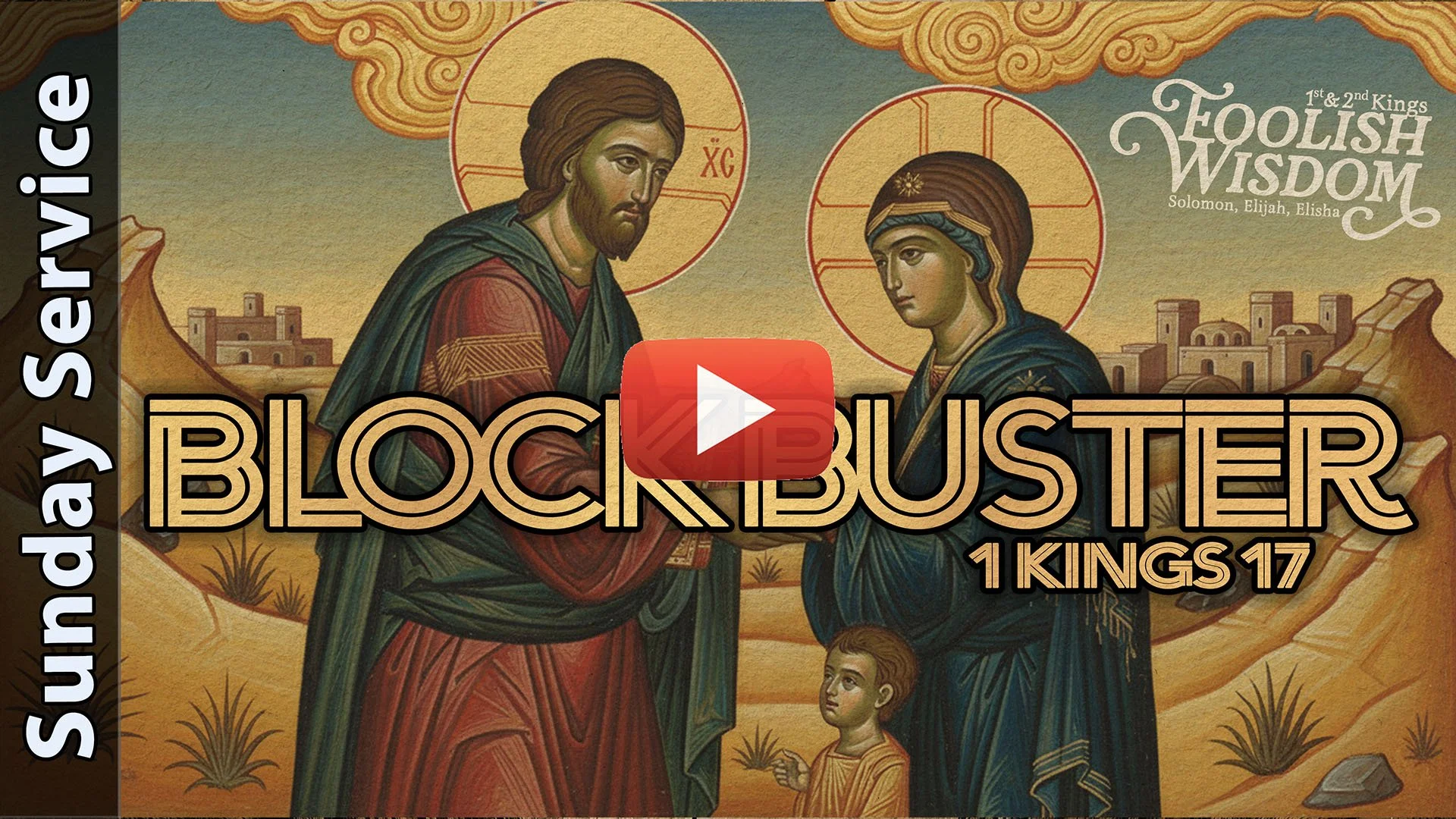
God doesn’t need you to be a blockbuster Christian. The big story of Elijah and the Widow of Zarephath shows we don't need a massive spiritual resume for God to love and rescue us.



What Had happened at Grace this week.







The Gospel overturns our anxiety about wealth and shows how God's grace transforms us from anxious hoarders into hilaron givers.