
Mark Chapter 1:1-20 Class 2 - Wednesday Bible Study
Gospel of Mark Chapter 1:1-20
This is our 2nd class on Mark
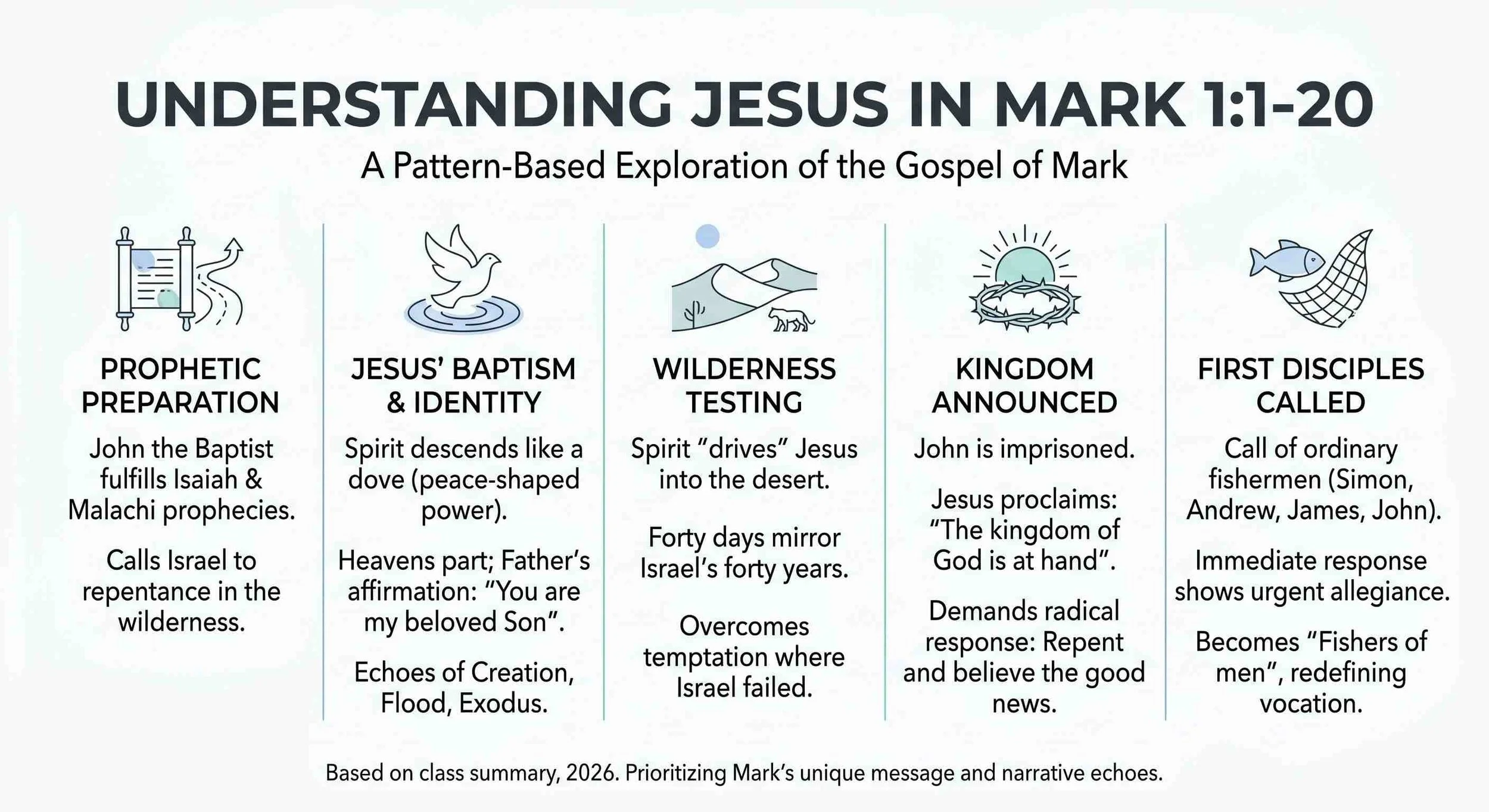
This is an AI Recap of the class.
Some things may be incorrect.
Short Summary of the Whole Class
We learned to read Scripture by noticing patterns and connections, using the Gospel of Mark as our training ground. We read Mark 1:1–20 (NKJV), discussed authorship and Mark’s three‑act design, traced Old Testament echoes (Isaiah, Malachi, Exodus, wilderness), examined Jesus’ baptism and the Spirit’s descent like a dove, considered why Mark streamlines the temptation narrative, unpacked Jesus’ kingdom announcement and the immediate call of ordinary fishermen, and reflected on how Mark communicates through urgency and “felt” experience. We also noted community insights (e.g., Revelation’s “woman” and Roman parallels) and agreed to frame our study with an overview video of Mark. Throughout, we aimed to let Mark speak on his own terms while testing ideas together.
Section-by-Section Summary with Verses, Stories, and Short Wrap-ups
1) Purpose and Approach: Training to Read by Patterns
What we discussed:
The goal is to read the Bible well by recognizing patterns, repeated themes, and familiar echoes (“this sounds like that” moments).
Connections help Scripture “open up,” strengthening memory and understanding.
Students bring prior knowledge that can illuminate the text as connections “click.”
Key ideas:
Begin with Mark; expect recognition of echoes across the biblical storyline.
Let Mark speak on his own terms, resisting cross‑gospel harmonization unless necessary.
Bible verses/stories mentioned:
Focus on the Gospel of Mark broadly; no specific verses cited in this section.
Short summary:
We set the foundation for pattern-based reading in Mark, expecting clearer, more memorable insights as echoes emerge.
2) Collaborative Insight Example: Revelation and Roman History
What we discussed:
From a prior Thursday study, commentaries gave one read on a “woman” in Revelation, but Mick’s love of Roman history surfaced a compelling Roman parallel.
Insight: Commentaries are helpful but not exhaustive; community contributions matter.
Key ideas:
Test ideas together; even tentative connections can be fruitful.
Bible verses/stories mentioned:
Revelation’s “woman” imagery (likely Revelation 12 or 17; chapter not specified).
Stories mentioned:
Class anecdote: Mick’s Roman-history parallel provided fresh perspective.
Short summary:
Community knowledge can reveal helpful contextual links that enrich understanding beyond commentary notes.
3) Plan for Today: Overview Video of Mark
What we discussed:
We decided to watch an overview video of Mark to frame our study (screen share planned on Zoom).
Key ideas:
A high-level overview sets a trajectory for recognizing patterns throughout Mark.
Bible verses/stories mentioned:
No specific verses; the focus was the whole of Mark’s narrative.
Short summary:
We chose to begin with a big-picture overview to guide our pattern-based reading of Mark.
4) Authorship, Sources, and Mark’s Design
What we discussed:
Mark (John Mark) as coworker of Paul and close to Peter; Papias reports Mark compiled Peter’s memories.
Mark states his thesis (Mark 1:1) and shows identity through actions and reactions.
Three‑act structure: Galilee (Who is Jesus?), on the way (What does Messiah mean?), Jerusalem (kingship through suffering).
Themes:
Kingdom proclamation, confronting evil, healing, forgiveness, redefined power and kingship.
Bible verses/stories mentioned:
Mark 1:1; allusions to Isaiah and Malachi prophecies.
Stories mentioned:
Papias’ testimony; Mark’s three‑act narrative framework.
Short summary:
Mark likely shapes Peter’s eyewitness testimony into a three‑act drama unveiling Jesus as Messiah and Son of God through deeds and the path of suffering service.
5) Staying within Mark’s Narrative
What we discussed:
Read Mark as Mark; avoid importing details from Luke/John (e.g., Mary and Elizabeth, cousins; foot‑washing).
Aim to hear Mark’s unique theological emphasis.
Bible verses/stories mentioned:
Mark 1:1–8 implicitly (John’s proclamation).
Noted but set aside: Luke’s infancy narratives; John 13 foot‑washing.
Stories mentioned:
Brief references to non‑Mark details as examples of what to avoid harmonizing.
Short summary:
We committed to Mark’s own voice to preserve his message and patterns.
6) Prophetic Preparation: Isaiah, Malachi, and John the Baptist
What we discussed:
Mark cites prophets about the forerunner; John appears in wilderness garb calling for repentance.
Prophetic imagery and types; light humor about a “John the Baptist diet,” while underscoring his serious call.
Bible verses/stories mentioned:
Mark 1:2–6; quotations of Isaiah/Malachi in Mark 1:2–3.
Stories mentioned:
Crowds from Judea and Jerusalem; John’s wilderness ministry.
Short summary:
John fulfills prophetic expectation, preparing Israel for God’s approaching reign.
7) Jesus’ Baptism: Sonship, the Dove, and Humble Origins
What we discussed:
Jesus comes “from Nazareth of Galilee”; heavens part; Spirit descends like a dove; the Father affirms the Son.
Peace-shaped power: the dove contrasts with conquest expectations.
Echoes of creation (Genesis 1) and the flood’s dove (Genesis 8); “parting” evokes Exodus.
Bible verses/stories mentioned:
Mark 1:9–11; Genesis 1; Genesis 8; Exodus 14 (typological echo).
Stories mentioned:
Creation and flood imagery; Red Sea parting as baptismal type.
Short summary:
Jesus’ baptism reveals his identity and inaugurates a Spirit-empowered mission marked by peace, not domination, amid rich creation‑Exodus echoes.
8) Exodus Motifs and the Wilderness Testing
What we discussed:
Spirit “drives” Jesus into the wilderness; forty days mirror Israel’s forty years.
Mark’s brevity evokes the larger story rather than listing three temptations (as in Matthew/Luke).
Bible verses/stories mentioned:
Mark 1:12–13; allusions to Numbers/Deuteronomy (Israel’s wilderness testing).
Stories mentioned:
Israel’s post‑Exodus journey; angels ministering; wild beasts motif.
Short summary:
Mark compresses the temptation narrative to signal Jesus reenacting Israel’s story and overcoming where Israel failed.
9) “The Kingdom Is at Hand”: Repent and Believe
What we discussed:
After John is imprisoned, Jesus proclaims the nearness of God’s kingdom and calls for repentance and faith.
“At hand” means near, accessible; turn from power-seeking to trust in the Son of God.
Mark 1:1–15 functions as a preamble: identity, fulfillment, announcement.
Bible verses/stories mentioned:
Mark 1:14–15; Isaiah 11:1 alluded (root/shoot of David).
Stories mentioned:
Nazareth as “the sticks”; fulfillment of Israel’s story in Jesus.
Short summary:
The long-awaited moment arrives: God’s reign draws near, demanding a decisive personal response.
10) Calling the First Disciples: Ordinary Fishermen, Urgent Allegiance
What we discussed:
Jesus calls Simon (Peter) and Andrew, then James and John; they immediately leave nets, boats, even father and hired hands.
Let the text stay “weird”: ordinary workers instantly follow an uncredentialed rabbi.
Emphasis on radical allegiance and redefined vocation (“fishers of men”).
Bible verses/stories mentioned:
Mark 1:16–20.
Stories mentioned:
Contrast between families’ resources; rabbinic disciple‑gathering versus Jesus’ surprising choices.
Short summary:
The kingdom advances through ordinary people responding with urgent, costly obedience.
11) Peter’s Confession and the Suffering Messiah (Q&A Preview of Later Mark)
What we discussed:
Differences across Gospels in Peter’s confession; in Mark, “You are the Messiah.”
Immediate clash with Jesus’ teaching on suffering; “Get behind me, Satan.”
Expectations of a political/military Messiah versus the suffering Servant (Isaiah 53).
Bible verses/stories mentioned:
Mark 8:27–33; Isaiah 53.
Stories mentioned:
Anticipation of Mark’s later arc: Transfiguration, passion, centurion’s confession, empty tomb (references).
Short summary:
Mark reveals messiahship through suffering and service, overturning triumphalist expectations.
12) Humility and Service: Sandal Straps and Servant Leadership
What we discussed:
John’s statement about not being worthy to untie Jesus’ sandals underscores humility.
A participant connected this to foot‑washing (John 13), noted as outside Mark but thematically aligned with servant authority.
Bible verses/stories mentioned:
Mark 1:7; John 13 referenced in discussion (acknowledged not in Mark).
Stories mentioned:
Everyday imagery of untying sandals; rabbinic training and memorization; echoes of Micah’s prophetic themes (justice, humility).
Short summary:
John’s humility anticipates Jesus’ servant‑king identity central to Mark’s message.
Medium-Length Overall Summary (April 29, 2026, 18:36:15)
On April 29, 2026 at 6:36 PM, our class set out to read Mark by recognizing patterns and echoes that make Scripture come alive. We framed Mark’s authorship and three‑act design (drawing on Papias’ note about Peter’s memories) and committed to letting Mark speak without cross‑gospel blending. In Mark 1:1–20 (NKJV), John the Baptist fulfills prophetic promises (Isaiah/Malachi), calling Israel to repent as Jesus arrives from humble Nazareth. At Jesus’ baptism, the heavens part, the Spirit descends like a dove, and the Father affirms the Son—imagery echoing creation, the flood’s dove, and a new Exodus. Mark compresses the wilderness temptation to evoke Israel’s story: forty days for forty years, signaling Jesus’ faithful obedience. With John imprisoned, Jesus declares the kingdom “at hand,” summoning repentance and trust. He calls ordinary fishermen, who immediately follow, modeling urgent, costly allegiance. We noted how Mark’s pace and “felt” atmosphere communicate the gospel’s movement. Along the way, we highlighted community learning (e.g., a Revelation/Roman parallel), previewed Peter’s confession and the suffering‑Messiah theme in Mark 8, and planned to watch an overview video to guide our study. The session emphasized pattern recognition, collaborative discovery, and Mark’s portrayal of Jesus’ upside‑down kingship expressed through service and suffering.
Main Points
Read Scripture by recognizing patterns, echoes, and thematic connections.
Let Mark speak on his own terms; avoid unnecessary cross‑gospel harmonization.
Mark likely shapes Peter’s eyewitness memories into a three‑act narrative revealing Jesus as Messiah and Son of God.
John the Baptist fulfills prophetic preparation, calling Israel to repentance (Mark 1:2–6).
Jesus’ baptism reveals divine Sonship and peace‑shaped power, with creation, flood, and Exodus echoes (Mark 1:9–11).
The wilderness testing compresses details to evoke Israel’s story and highlight Jesus’ faithfulness (Mark 1:12–13).
The kingdom is “at hand”: repent and believe the good news (Mark 1:14–15).
Jesus calls ordinary fishermen to radical, immediate discipleship (Mark 1:16–20).
Mark communicates through urgency and atmosphere to draw readers into the gospel’s movement.
Community insights can complement commentaries, enriching interpretation (Revelation “woman” example).
In Mark, messianic authority is revealed through suffering and service (previewed in Mark 8:27–33; Isaiah 53).
Bible Scriptures Mentioned
Mark 1:1–20 (thesis; prophetic citations; John’s ministry; Jesus’ baptism; wilderness testing; proclamation; calling disciples)
Mark 1:1–8 (John’s proclamation)
Mark 1:2–6 (Isaiah/Malachi quotations; John’s description)
Mark 1:7 (John’s humility; sandal‑strap remark)
Mark 1:9–11 (baptism; Spirit as a dove; heavenly voice)
Mark 1:12–13 (wilderness testing; angels; wild beasts)
Mark 1:14–15 (imprisonment of John; kingdom “at hand”; repent and believe)
Mark 1:16–20 (calling Simon Peter, Andrew, James, John)
Mark 6:17–29 (John the Baptist’s beheading; referenced)
Mark 8:27–33 (Peter’s confession; Jesus’ rebuke; previewed)
Isaiah 11:1 (root/shoot imagery; alluded)
Isaiah 53 (suffering servant; discussed)
Malachi (quoted in Mark 1:2–3)
Genesis 1 (creation Spirit imagery; alluded)
Genesis 8 (flood’s dove; alluded)
Exodus 14 (Red Sea parting; typological echo)
Numbers/Deuteronomy (Israel’s forty years; alluded)
Revelation 12 or 17 (the “woman”; exact chapter not specified; referenced)
John 13 (foot‑washing; referenced but noted as outside Mark)
Stories Talked About
John the Baptist’s wilderness ministry and call to repentance
Jesus’ baptism, divine Sonship, and the Spirit descending like a dove
Jesus’ forty days in the wilderness mirroring Israel’s forty years
Jesus’ proclamation of the kingdom’s nearness and call to repent and believe
Calling of Simon (Peter), Andrew, James, and John—ordinary fishermen—who follow immediately
Papias’ testimony about Mark drawing on Peter’s memories
Revelation study anecdote: class member connected the “woman” to Roman history
Creation and flood (dove) imagery; Exodus and the Red Sea as baptismal type
John the Baptist’s imprisonment and later beheading by Herod (referenced)
Peter’s confession and the suffering‑Messiah theme (previewed), plus later Mark arc references (Transfiguration, passion, centurion’s confession, empty tomb)