
The Great Divorce Conclusion Overview - Thursday Bible Study
Great Divorce Conclusion overview
This is our 9th class on The Book
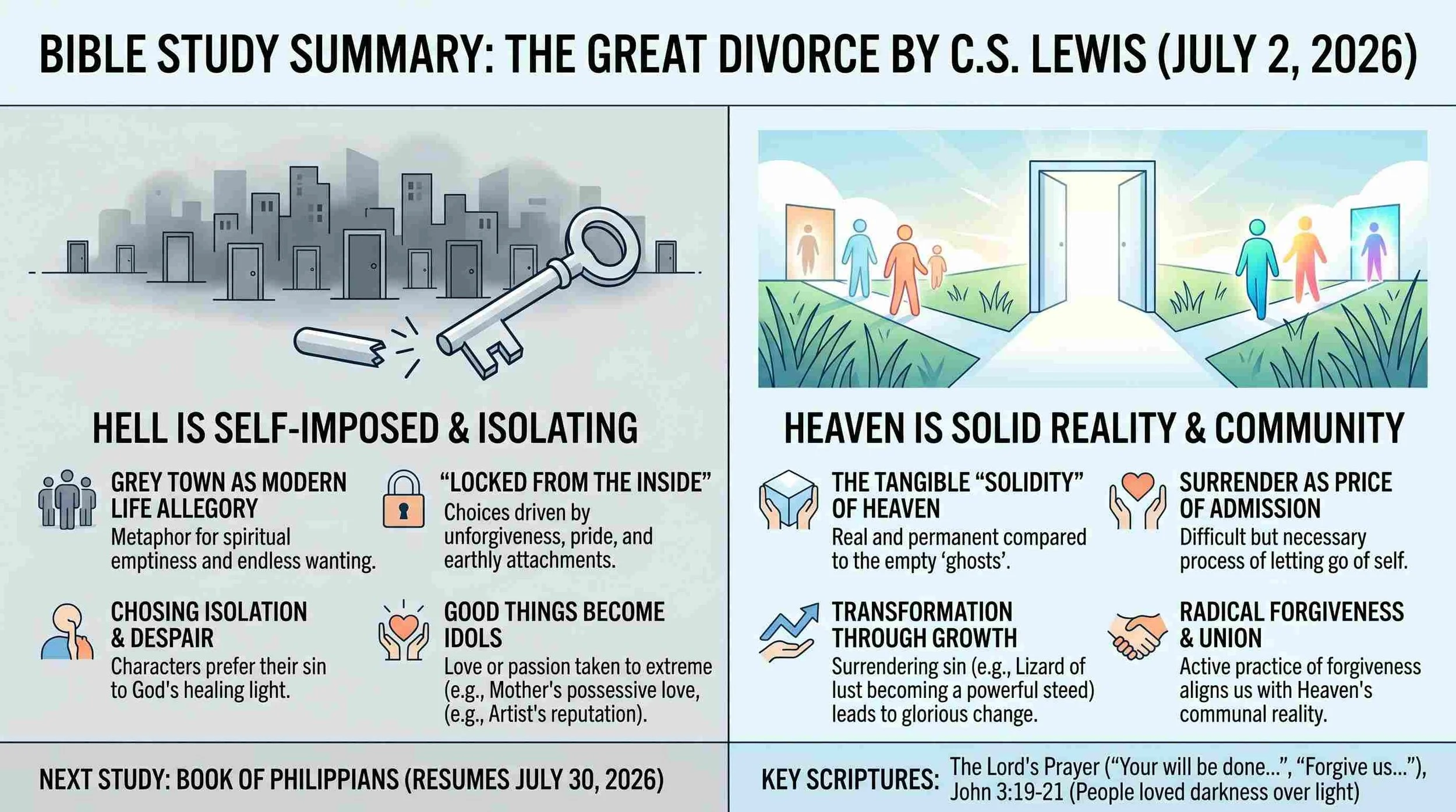
This is an AI Recap of the class.
Some things may be incorrect.
Short Summary of the Whole Class
On July 2, 2026, the class held its final discussion on C.S. Lewis's The Great Divorce before a summer break, with plans to reconvene on July 30, 2026, to study the book of Philippians. The session was dedicated to reflecting on the book’s major themes, interpreting the "Grey Town" as a metaphor for our current world, filled with loneliness and unforgiveness. We discussed how free will, earthly attachments, and preconceived notions can prevent us from embracing God's kingdom. Participants shared that the book served as a mirror for recognizing personal flaws and the necessity of radical forgiveness, as taught in the Lord's Prayer. The group concluded that true spiritual growth is a process, found in tangible community and the difficult but freeing surrender of sin, which transforms us from isolated "ghosts" into "solid" citizens of Heaven.
Detailed Class Summary
Here is a breakdown of the topics we discussed during our class on July 2, 2026.
Housekeeping and Future Plans
The class began with some housekeeping announcements. It was noted that this would be the last Thursday class until July 30, 2026, when the group will reconvene. The instructor, Cris, mentioned he would be traveling to Phoenix and Las Vegas during the break. After some discussion, the group decided that upon their return, they would begin a new study on the book of Philippians.
Section Summary: The class announced a summer hiatus, with the final meeting being on July 2, 2026. The group will resume on July 30, 2026, and will begin studying the book of Philippians.
Opening Reflections: The Book as a Modern Parable
Cris opened the main discussion by framing it as a final reflection on C.S. Lewis's The Great Divorce. He shared that the book reinforced a key concept for him, rooted in the Lord’s Prayer: "Your will be done on earth as it is in heaven." He explained that Christianity isn’t just about securing a spot in a "good place" after death, but about actively participating in making our current world reflect the values and reality of heaven.
This led to the perspective that the "Grey Town" in the book isn't just a depiction of Hell, but a powerful allegory for our current world. In our society, there is a relentless pressure to always want more and achieve more, which can drive people away from God, creating a spiritual "Grey Town" characterized by dissatisfaction. The choices the characters, or "ghosts," make are symbolic of decisions we make in our daily lives—whether we choose to live in the fullness of God’s forgiveness or cling to our own brokenness.
Section Summary: The discussion began by linking the book's core message to the Lord's Prayer, emphasizing that our faith is about bringing Heaven's reality to Earth now. The book's "Grey Town" was interpreted as a metaphor for modern life, where societal pressures for constant improvement create a spiritual emptiness that distances people from God.
Bible Scripture: The Lord's Prayer, specifically "Your will be done on earth as it is in heaven."
Free Will, Sin, and Recognizing Our Flaws
A class member pointed out that a major focus of the book is free will. The ghosts from the grey town consistently had the choice to stay in heaven or return to their misery. They could choose to let go of their defining sin or remain attached to it. Cris expanded on this, noting that many of the sins depicted were good things taken to an extreme. For example, a mother’s love for her son or an artist’s passion for his craft became idols that blocked them from God.
This discussion highlighted how the book makes us aware of our own faults, as we can see parts of ourselves in the "ghosts." This self-recognition is the first step toward change. Stories were shared illustrating how people are often trapped by negative labels and past experiences. For instance, a man from Jamaica whose negative perception of white people was changed by a single act of kindness, and a "Little Brother" who believed he was "stupid" because his father constantly told him so, becoming a self-fulfilling prophecy.
Section Summary: The group discussed the central theme of free will, where each character's destiny is their own choice. Sin is often a good thing elevated above God, becoming an idol. The book acts as a mirror, helping us recognize our own flaws, and personal stories were shared about how ingrained prejudices and negative self-perceptions can be overcome.
Stories Mentioned:
* The mother's possessive love for her son.
* The artist more concerned with his reputation than with experiencing the light.
* A man from Jamaica whose prejudice was overcome by a tourist's kindness.
* A boy in the Big Brothers program who internalized his father's negative label of being "stupid."
The Tangible Reality of Heaven vs. The "Easy" Emptiness of Hell
One participant expressed a concern that the book makes Heaven seem unappealingly difficult, with imagery of grass too hard to walk on. This might discourage a reader, making the journey seem like "a mess."
Other members countered that this difficulty is purposeful. The "grey town" was deceptively easy—a place where you could have anything you imagined, leading to isolation and emptiness. In contrast, Heaven is "solid" and has a "price of admission": the difficult but necessary act of surrendering one's self. The journey towards spiritual maturity was compared to a new Christian's walk, moving from the "milk" to the "meat" of the word. Faith isn't instant perfection but a continuous process. This journey of self-confrontation was compared to literary works like Charles Dickens’s A Christmas Carol, John Bunyan’s Pilgrim’s Progress, and Alice in Wonderland—all dream-like journeys forcing a choice upon "waking up." This was connected to John 3:19-21, which states that people love darkness because their deeds are evil and they fear exposure by the light.
Section Summary: A critique was raised that Heaven seems harsh, but the response was that its "solidity" contrasts with the easy emptiness of Hell. This difficulty represents the real, sometimes painful, process of spiritual growth, moving from "milk" to "meat." The story was compared to allegorical works like A Christmas Carol and linked to the biblical idea that people who love darkness avoid the light.
Bible Scriptures:
* **John 3:19-21**: "People loved darkness instead of light because their deeds were evil..."
* The concept of needing "milk of the word" before "meat," alluding to **1 Corinthians 3:2** and **Hebrews 5:12-14**.
Stories Mentioned:
* ***A Christmas Carol*** by Charles Dickens
* ***Pilgrim’s Progress*** by John Bunyan
* ***Alice in Wonderland*** by Lewis Carroll
Hell Locked from the Inside and the Power of Community
The discussion shifted to the idea that Hell is a place "locked from the inside." Cris explained that people choose Hell because they love their darkness—their grudges, pride, and self-pity—more than the light of God, which would expose and heal them. This led to a conversation about the necessity of forgiveness and community. If Heaven includes people we despise, our inability to forgive them now reveals an unwillingness to accept Heaven's reality.
The danger of demanding strict adherence and creating division was described as the fastest way to kill a church, mirroring how the residents of Grey Town move farther apart into deeper loneliness. To illustrate the power of community, the "Rat Park" experiment was mentioned, where rats in a vibrant community chose plain water over morphine-laced water, suggesting connection is an antidote to self-destructive habits. Our church aims to foster this community to combat loneliness.
Section Summary: The group explored the concept of Hell as a self-imposed prison chosen by those who refuse God's light. This highlighted the importance of forgiveness and community, as unforgiveness is incompatible with Heaven. Demanding perfection leads to isolation, the essence of the Grey Town. In contrast, a healthy community, like in the "Rat Park" experiment, can help people overcome destructive behaviors.
Stories Mentioned:
* The "Rat Park" experiment from the 1970s.
* ***Dante's Inferno*** was contrasted with Lewis's idea of Heaven.
* The character of Scrooge from *A Christmas Carol* and his isolating house.
Transformation and Encouraging Growth
A key difference between Heaven's "solid people" and the "ghosts" is how they handle misery. The solid people are compassionate but are not blackmailed by the ghosts' self-pity. They sit with them and gently encourage them to let go of what holds them back. This is exemplified by the ghost with the lizard of lust on his shoulder. He is encouraged to let an angel kill it. The act is painful, but the lizard is transformed into a magnificent steed, and the man becomes solid. This shows that surrendering sin, though difficult, brings sudden and glorious transformation.
This imagery of transformation led to a brief discussion of different faith traditions, such as the Baptist declaration of being "saved" and the Lutheran balance of law and gospel. The ultimate call is to practice forgiveness in all aspects of life—from minor annoyances like a neighbor mowing late to deep hurts. By forgiving, we align with God's will, move out of the "Grey Town," and experience a more heavenly life now.
Section Summary: The "solid people" model compassionate encouragement without enabling self-pity. The story of the man with the lizard illustrates that surrendering sin, though hard, leads to glorious transformation. This call to change connects to our need to practice radical forgiveness in daily life, fulfilling the Lord's Prayer and moving from the "Grey Town" to a heavenly reality.
Bible Scripture: The Lord’s Prayer, specifically "Forgive us our sins, as we forgive others."
Stories Mentioned:
* The man with the lizard on his shoulder.
* Hypothetical examples of forgiving daily frustrations (late-night mowing, slow self-checkout lines).
Final Medium-Length Summary
In our final session on C.S. Lewis's The Great Divorce on July 2, 2026, our church group engaged in a deep reflection on the book's allegorical portrayal of Heaven, Hell, and the human condition. We saw the "Grey Town" not just as an afterlife, but as a metaphor for our modern world, defined by loneliness, constant striving, and unforgiveness. The discussion heavily emphasized that Hell is "locked from the inside"—a state of being chosen by those who, as described in John 3, love darkness more than light because they refuse to let go of earthly attachments and sins.
We affirmed that true faith is found not in demanding perfection, which leads to isolation, but in building a supportive community that helps us overcome our self-destructive tendencies. The central theme of free will was a major point of discussion, alongside the necessity of practicing radical forgiveness, as taught in the Lord's Prayer. While the "hardness" of Heaven represents the challenging but necessary surrender of self, the book's ultimate message is one of hope. As modeled by the "bright spirits" and the story of the man with the lizard, letting go of our sins leads to a glorious and liberating transformation, allowing us to move from being an isolated "ghost" to a "solid" citizen of God's kingdom, here and now.
Main Points
The class will take a summer break and resume on July 30, 2026, to study the Book of Philippians.
The Great Divorce is an allegory for our present spiritual choices and our modern world, not just the afterlife.
The "Grey Town" represents a state of loneliness, dissatisfaction, and unforgiveness driven by worldly pressures.
Free will is central: characters choose their own eternal destiny by either clinging to or surrendering their sins.
Sin is often a good thing (like love or art) that has been distorted into an "ultimate thing."
Heaven is depicted as "hard" or "solid" because it is more real, requiring us to become more real through surrender and growth (moving from "milk" to "meat").
Hell is "locked from the inside"; it is a choice made by those who refuse to let go of their darkness.
Community is a powerful tool against loneliness and self-destructive behaviors.
A forgiving heart is essential, as holding grudges is incompatible with the communal reality of Heaven.
Surrendering our sins to God, though difficult, leads to glorious and immediate transformation.
Scriptures and Stories Mentioned
Bible Scriptures:
The Lord's Prayer: Specifically the lines, "Your will be done on earth as it is in heaven" and "Forgive us our sins, as we forgive others."
John 3:19-21: "This is the verdict: Light has come into the world, but people loved darkness instead of light because their deeds were evil..."
1 Corinthians 3:2 and Hebrews 5:12-14: Alluded to in the discussion of moving from the "milk" to the "meat" of the word.
Stories and Analogies:
The Man with the Lizard: The character with a lizard of lust on his shoulder who must allow an angel to kill it, after which it is transformed into a magnificent horse.
The Mother's Love: The story of the mother whose possessive love for her son becomes an idol.
The Artist: The artist who is more concerned with his reputation and painting the light than in experiencing it.
A man from Jamaica: His prejudice against white people was changed by a tourist giving him a dollar.
A boy in the Big Brothers program: He believed he was stupid because his father constantly told him so.
The "Rat Park" experiment: Rats in a community setting overcame morphine addiction, highlighting the power of connection.
A Christmas Carol by Charles Dickens: Compared to The Great Divorce as a story of redemption from a "Greytown" of despair to light and joy.
Pilgrim's Progress by John Bunyan: Mentioned as another allegorical journey of spiritual struggle and redemption.
Alice in Wonderland by Lewis Carroll: Used as an example of a dream-like journey that leads to self-discovery.
Dante's Inferno: The sign "Abandon all hope, ye who enter here" was contrasted with Lewis's ideas.
Hypothetical modern-day stories: Practicing forgiveness for a neighbor mowing late or for a person slow at self-checkout.