
The Great Divorce Intro + Chapter 1 - Thursday Bible Study
Great Divorce Prologue & Chapter 1
This is our 1st class on The Book
This is an AI Recap of the class.
Some things may be incorrect.
Short Summary of the Class
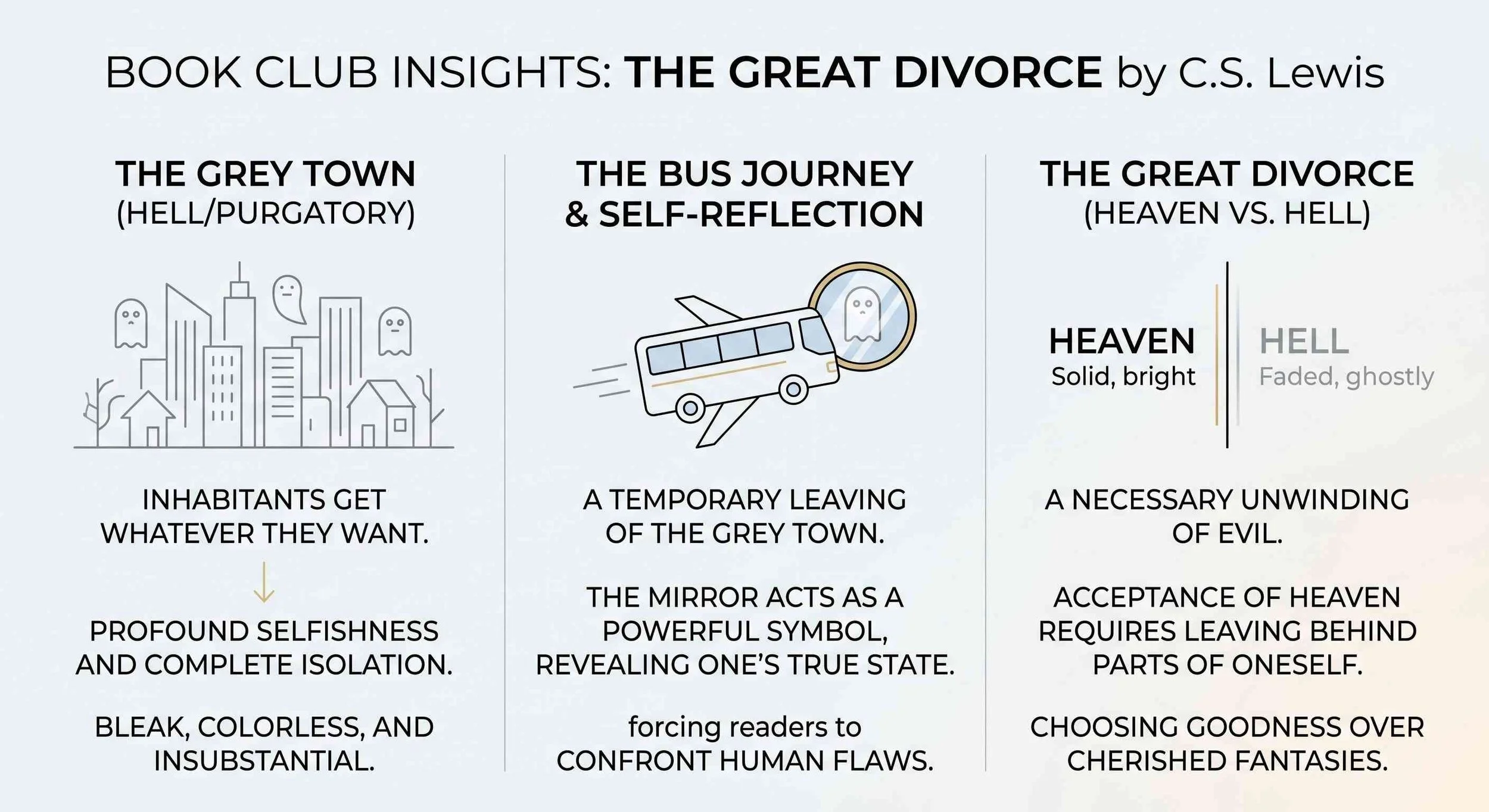
On April 29, 2026, our group started a new study on C.S. Lewis's classic allegory, "The Great Divorce." We began by discussing Lewis's life and his conversion from atheism, framing the book as his response to the idea that Heaven and Hell can coexist. We explored the setting of the "grey town," a depiction of Hell as a bleak, unreal place of self-imposed isolation where everyone gets what they want, leading to endless separation. The discussion highlighted the residents' petty, self-absorbed nature, which is on full display as they wait for a bus. Their negative reaction to the glorious, light-filled bus from Heaven reveals how their "common sense" has been warped by misery, making them reject goodness itself. The book challenges us to confront the parts of ourselves we must leave behind—like plucking out an eye—to draw closer to God.
Detailed Class Summary
Here is a summary of what we talked about as we went through the class on April 29, 2026.
Introduction to C.S. Lewis and "The Great Divorce"
We kicked off our new study by introducing C.S. Lewis's "The Great Divorce." For some, it was a revisit, and for others, a brand new read, with the acknowledgment that the book reveals new insights depending on one's life experiences. We then discussed the author, C.S. Lewis, noting he was an Oxford professor and a friend of J.R.R. Tolkien. It was highlighted that Lewis was once a committed atheist, and his conversion to Christianity was significantly influenced by friends like Tolkien and by reading George MacDonald.
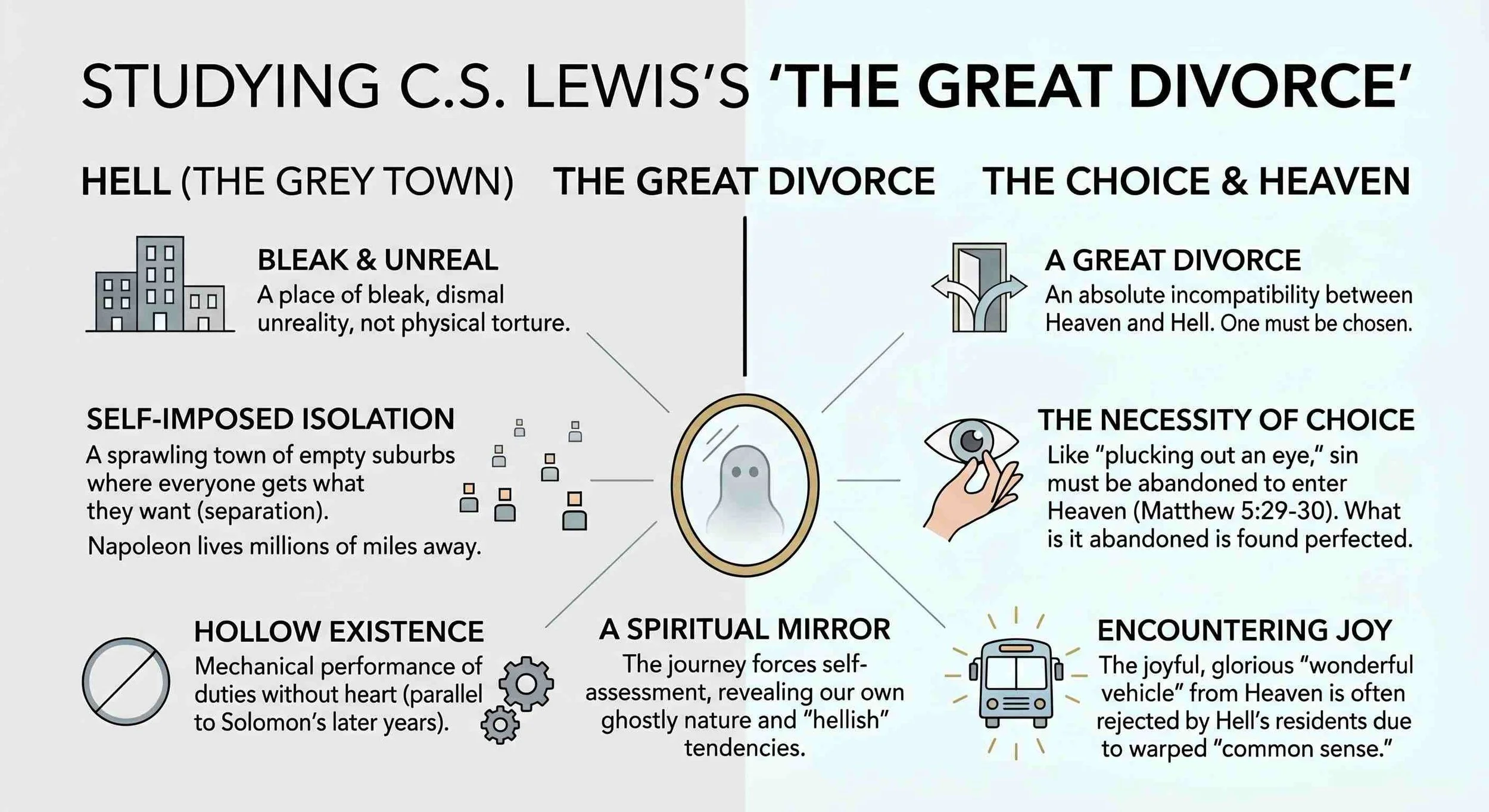
The central theme of the book's preface was established: the impossibility of merging Heaven and Hell. The book's title is a direct response to William Blake’s "The Marriage of Heaven and Hell." Lewis argues that you must choose one or the other, a concept he connects to Jesus's teaching about being willing to "pluck out your right eye" if it causes you to sin. He uses this imagery to explain that what we abandon for Heaven is not truly lost but is found perfected.
Bible Verses: The teaching about plucking out your right eye or cutting off your right hand if it causes you to sin (Matthew 5:29-30, Mark 9:43-48).
Section Summary: We introduced the book "The Great Divorce" and its author, C.S. Lewis, discussing his background as an Oxford scholar, a former atheist, and his friendship with J.R.R. Tolkien. We established the book's core argument from its preface: that one must make a "great divorce" from sin, a painful but necessary choice likened to the biblical call to "pluck out an eye" to enter Heaven.
The Grey Town: A Picture of Hell
We began our analysis of the story by identifying the setting of the first chapter: the "grey town." We agreed it represents Hell, a place characterized not by fire, but by a bleak, dismal, and unreal atmosphere. A key feature of this Hell is that everyone gets what they want. This desire for isolation, stemming from petty arguments and selfishness, causes the inhabitants to move farther and farther apart, creating endless, empty suburbs. This concept was illustrated by the story of a man who can only see Napoleon, who lives millions of miles away, through a telescope. This self-imposed distance raised the question of whether someone can be "too far" for redemption. We concluded that while the distance is a choice and the journey back is always possible, the tragedy is that many lose the desire to be reached.
We also discussed a parallel to the story of King Solomon. Despite his wisdom, Solomon fell into performing his religious duties mechanically, merely to "complete his duty" without heart. This was likened to the hollow, self-serving existence of the ghosts, who are stuck in destructive patterns without awareness of the damage they are doing.
Bible Scriptures: 1 Kings, 2 Kings
Stories Mentioned:
The story of Napoleon living millions of miles away in the grey town.
King Solomon's later years, where he performed temple duties mechanically.
Section Summary: The opening setting is a bleak, grey town representing Hell as a place of unreality and self-imposed isolation. Its core rule—that everyone gets what they want—paradoxically leads to infinite separation. This was compared to King Solomon's heartless religious duties, illustrating a life lived without genuine spiritual connection.
The Bus Stop and the Journey
Our focus then shifted to the contentious crowd waiting at a bus stop. Their behavior is marked by fault-finding and selfishness, as seen in the character who was pleased when someone else was pushed out of line. Their motivation for boarding the bus seems to be more about conformity and competition than a genuine desire for Heaven. The arrival of the bus—a "wonderful vehicle, blazing with golden light"—provides a stark contrast. The residents, however, react with disdain, criticizing the radiant driver for not behaving "naturally." This led to a discussion on how one's environment defines "common sense." For the people in Hell, misery and cynicism are natural, making the joy and goodness of Heaven alien and offensive.
We analyzed the characters on the bus, such as the "tousle-haired poet" who seeks validation for his cynical worldview. A bizarre fight breaks out with knives and pistols, yet it is "strangely innocuous," highlighting that even conflict in this place is illusory and meaningless. The session ended by looking at the pivotal moment when the "cruel light" on the bus reveals the passengers, including the narrator, as ghostly, insubstantial figures. Catching his own reflection forces the narrator into a moment of honest self-assessment.
Section Summary: The scene at the bus stop reveals the inhabitants' selfish and competitive nature. Their contempt for the beautiful, light-filled bus shows how their perception of reality has been warped, making them reject goodness. The journey itself, including an illusory fight, emphasizes the unreality of this state, culminating in the narrator's shocking realization of his own ghostly nature, which serves as a mirror for the reader.
Overall Summary
In our Bible study on April 29, 2026, we embarked on C.S. Lewis's "The Great Divorce." We began by discussing the author's life, including his conversion from atheism, and the book's central thesis: the absolute incompatibility of Heaven and Hell. The title itself is a rebuttal to the idea that the two can be married, arguing instead for a "great divorce" from sin, a concept Lewis ties to the biblical command to "pluck out your eye."
Our discussion then moved into the book's allegorical world, characterizing Hell as a dismal "grey town." We explored its unique nature not as a place of external torture, but of self-imposed isolation where getting everything one wants leads to endless, empty separation. The inhabitants are portrayed as petty, self-absorbed "ghosts," a nature revealed in their behavior at a bus stop where they jockey for position out of mindless conformity. A powerful biblical parallel was drawn to King Solomon, whose later life of performing religious duties without heart mirrored the empty existence of the ghosts.
The climax of our discussion focused on the residents' reaction to the glorious, light-filled bus from Heaven. Their contempt for its goodness highlighted a key theme: their sense of "normal" has been so warped by misery that they reject the light. This showed that they are not trapped in Hell but have condemned themselves to it through a consistent rejection of joy. The book's role as a spiritual mirror became clear, especially in the final moment where the narrator sees his own ghostly reflection, forcing him (and us) to confront our own failings and the choice we all face.
Main Points
We are starting a new study of C.S. Lewis's "The Great Divorce."
C.S. Lewis was an Oxford scholar who converted from atheism to Christianity, influenced by friends like J.R.R. Tolkien.
The book's central argument is that Heaven and Hell are incompatible; you must choose one over the other.
Hell is portrayed as a "grey town" of self-imposed isolation, where everyone getting what they want leads to endless separation and unreality.
The necessity of abandoning sin is likened to the biblical command to "pluck out an eye."
The characters ("ghosts") are self-absorbed and act out of conformity and petty competition rather than a genuine desire for good.
The actions of the ghosts were compared to the heartless, mechanical religious duties of King Solomon in his later years.
The book serves as a mirror, challenging readers to recognize and confront their own "hellish" tendencies.
Scriptures and Stories Mentioned
Bible Scriptures
Matthew 5:29-30, Mark 9:43-48: Jesus's teaching about cutting off a hand or plucking out an eye if it causes you to sin.
1 Kings & 2 Kings: The story of King Solomon.
Stories
C.S. Lewis's Conversion: His journey from atheism to Christianity, influenced by friends and authors.
The Bus Ride from Hell to Heaven: The book's main allegorical plot where ghosts travel to the outskirts of Heaven.
The Big Ghost: The story of a self-righteous man who would rather be "correct" in Hell than forgive someone in Heaven.
Napoleon in the Grey Town: The story illustrating extreme self-isolation, where a character lives millions of miles away and can only be seen with a telescope.
King Solomon's later years: His story was used as a parallel for performing religious duties mechanically and without heart.