
The Great Divorce Chapters 5-6 - Thursday Bible Study
Great Divorce Chapters 5-6
This is our 3rd class on The Book
This is an AI Recap of the class.
Some things may be incorrect.
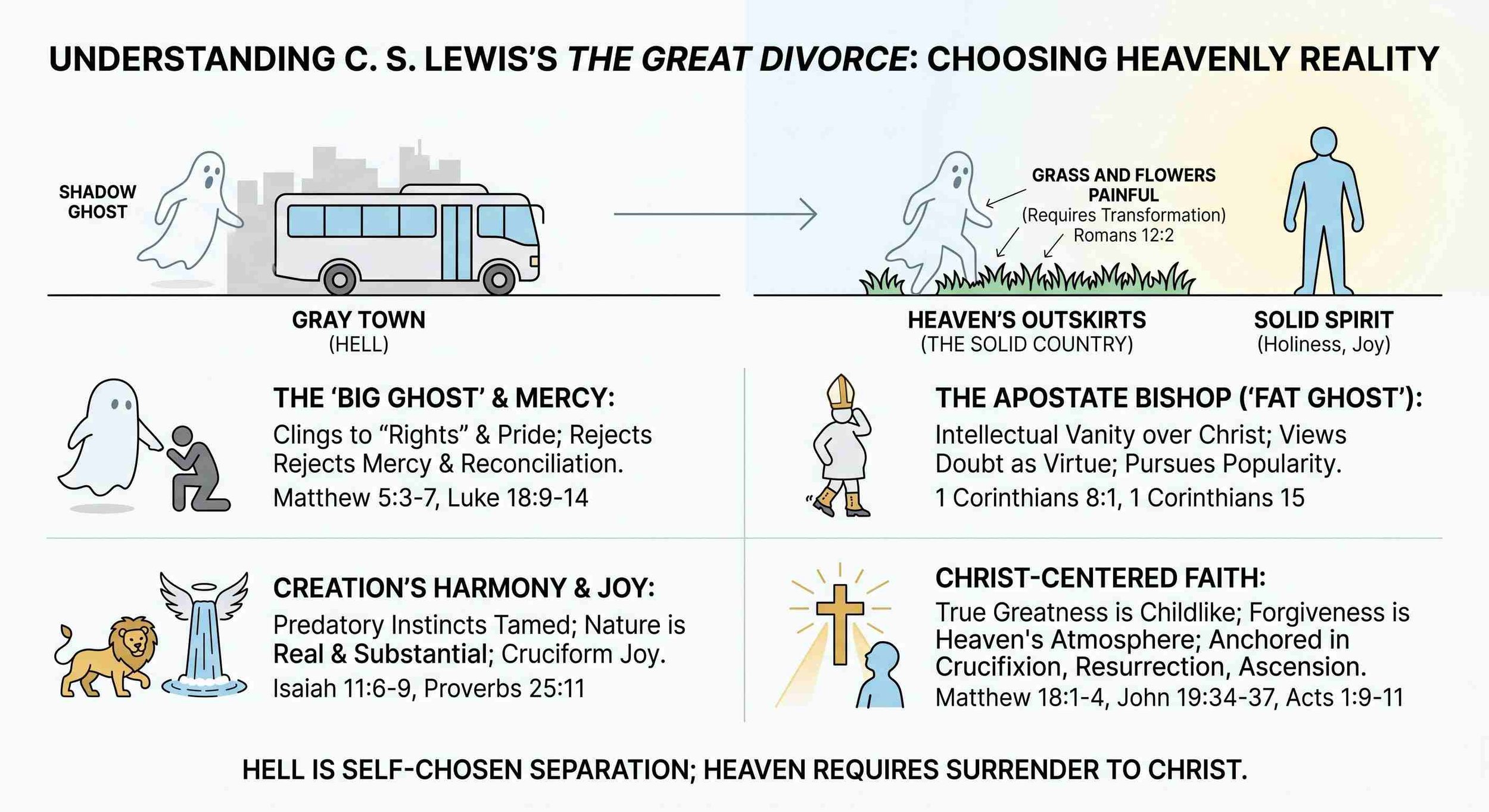
Short Summary of the Whole Class
On May 14, 2026, we surveyed key scenes from The Great Divorce—ghosts traveling from the gray town to the outskirts of heaven—highlighting heaven’s greater “solid” reality and the choice to receive grace or return to self. We revisited the “big ghost” who clings to his rights instead of mercy and the “fat ghost” (an apostate bishop) whose intellectual vanity and popularity eclipse the cross. We connected Lewis’s imagery (playful lions, lilies, golden apples, and the waterfall-angel “like one crucified”) to Scripture, contrasted a theology of glory with the theology of the cross, and emphasized forgiveness, humility, discernment, and Christ-centered reality—timely on Ascension Day.
Walkthrough and Section Summaries
1) Introduction: C. S. Lewis, The Great Divorce, and Our Aim
What we discussed:
C. S. Lewis’s background as an apologist and storyteller and the premise of The Great Divorce: a bus ride from the gray town (a hell-like state) to the outskirts of heaven.
The book’s purpose: an allegory that invites introspection rather than delivering rigid doctrinal formulas.
Stories mentioned:
The bus ride from the gray town to heaven’s outskirts (The Great Divorce).
Bible verses discussed:
None explicitly cited in this segment.
Short summary of section:
We framed The Great Divorce as an introspective allegory calling readers to self-examination before God’s reality.
2) The Bus and the “Solid” Country: Reality That Hurts (at First)
What we discussed:
Heaven’s “solidness” makes grass and flowers painful to the ghosts’ feet, signaling that heaven is more real than their current state and requires transformation.
The existential choice: move toward solidity (holiness, joy) or return to the bus.
Stories mentioned:
A ghost trying to pick a daisy that tears his fingers due to heaven’s solidity (The Great Divorce).
Bible verses discussed (thematic echoes):
Romans 12:2 (transformation into God’s reality).
Short summary of section:
Heaven’s greater reality invites transformation; ghosts must become solid or retreat to familiar shadowlands.
3) Chapter 4: The “Big Ghost”—Rights vs. Mercy
What we discussed:
The “big ghost,” focused on his rights, meets a redeemed murderer who humbly offers lifelong service; grace is offered, but pride refuses it.
The emotional tone: grumbling, self-pity, and the tragic turning away from mercy.
Stories mentioned:
The encounter between the big ghost and the redeemed murderer who offers reconciliation (The Great Divorce).
Bible verses discussed (echoed themes):
Matthew 5:3–7 (humility and mercy).
Luke 18:9–14 (Pharisee vs. tax collector—pride vs. humble repentance).
Ephesians 4:32; Colossians 3:13 (forgiveness and reconciliation).
Short summary of section:
Prideful insistence on “rights” can block mercy; grace is offered, but self-assertion turns away.
4) Chapter 5: The Apostate Bishop (“Fat Ghost”)—Intellectual Vanity and a Theology of Glory
What we discussed:
The “fat ghost,” a cultured bishop with spats/gaiters, personifies intellectual pride, popularity, and self-importance.
He reframes the gray town as “hopeful” progress, calls denial of the resurrection “honest opinion,” and treats doubt as virtue.
Contrast: theology of glory (chasing modern acclaim) vs. theology of the cross (Christ crucified and risen).
Stories mentioned:
The bishop’s cultured conversation with a bright spirit; his vanity signaled by spats/gaiters (The Great Divorce).
Bible verses discussed (themes and references):
1 Corinthians 8:1 (“Knowledge puffs up, but love builds up”).
1 Corinthians 15 (centrality of the resurrection).
Genesis 3:1–5 (the serpent’s “Did God really say?”—roots of deceptive doubt).
Acts 1:9–11 (Ascension—mentioned conceptually).
Short summary of section:
Sincerity and popularity cannot sanctify error; true faith clings to Christ crucified and risen, not intellectual vanity or cultural applause.
5) Lions at the Edge of Heaven: Harmony of New Creation vs. Fear
What we discussed:
Two playful, velvet-footed lions signal creation’s restored harmony; the ghost’s fear contrasts with faith’s calm.
Echoes of Narnia and biblical promises of peace in creation.
Stories mentioned:
The playful lions under cedar trees (The Great Divorce).
Bible verses discussed (echoes):
Isaiah 11:6–9; Isaiah 65:25 (predator and prey at peace).
Short summary of section:
The lions picture heaven’s harmonious creation; pride’s fear shrinks before the gentle strength of redeemed reality.
6) From Speculation to Eternal Fact: Christ-Centered Reality
What we discussed:
“We know nothing of religion here. We think only of Christ.” The solid spirit invites the ghost to “eternal fact.”
The ghost prefers to return and finish a paper—speculation over surrender—calling the crucifixion a “tragic waste.”
Stories mentioned:
The ghost declining the invitation to the mountains to pursue academic work (The Great Divorce).
Bible verses discussed:
1 Corinthians 15 (the crucifixion and resurrection as non-negotiable gospel facts).
Short summary of section:
Speculative religion can eclipse Christ himself; heaven calls us to the embodied, eternal fact of the crucified and risen Lord.
7) Chapter 6: Creation’s Joy—Lilies, Golden Apples, and the Waterfall-Angel “Like One Crucified”
What we discussed:
Heaven’s substance: lilies and water more solid than ghosts; a colossal waterfall revealed as a bright angel “like one crucified,” pouring joy into creation.
The ghost tries to carry a golden apple back to hell but learns there’s “no room” for heaven’s substance in hell.
Stories mentioned:
Walking on water that resists the ghost; lilies that cannot be bent; the basket of golden apples dwindling to one; the waterfall-angel proclaiming, “You cannot take it back” (The Great Divorce).
Bible verses discussed (motifs and echoes):
Proverbs 25:11 (“apples of gold in pictures of silver”).
Baptismal overtones and cruciform imagery tied to Christ’s self-giving (no single verse cited).
Short summary of section:
Heaven overflows with cruciform joy and substance; it cannot be smuggled into hell or bent to self-centered ends.
8) Misplaced Zeal, Ambition, and Childlike Greatness
What we discussed:
The danger of zeal untethered from Christ; the ghost seeks guarantees and recognition rather than repentance and forgiveness.
Jesus redefines greatness through childlike humility and servant leadership.
Stories mentioned:
The ghost insisting on “scope for talents” versus the guide offering forgiveness (The Great Divorce).
Bible verses discussed:
Matthew 18:1–4 (childlike greatness).
Mark 10:35–45; Matthew 20:20–28 (ambition vs. servant leadership).
Short summary of section:
True greatness is humble and Christ-centered; zeal must serve repentance and mercy, not self-importance.
9) Discernment in Teaching: Influence, Trends, and Responsibility
What we discussed:
Teachers’ influence can amplify error; popularity and fashionable currents can sideline the cross.
Modern parallels: feel-good or prosperity-style messages contrasted with cross-centered proclamation.
Two ditches: progressive skepticism that dissolves doctrine and rigid literalism that misses a text’s purpose; Scripture is read to know Christ.
Stories mentioned:
References to Communion debates (Zwingli’s symbolic view vs. “This is my body”); Jonah debates as a case of missing purpose (contextual discussion).
Bible verses discussed (themes):
Warnings about false teaching (conceptual).
Short summary of section:
Discernment resists trends and extremes; Scripture’s aim is to reveal Christ, not to feed skepticism or win literalist contests.
10) Forgiveness as Heaven’s Atmosphere and Rethinking Hell
What we discussed:
“There is nothing but forgiveness in heaven.” Jesus calls us to forgive without limit; we asked whether resenters could be happy in such a realm.
Lewis’s hell: a vast gray sprawl that is finally only a tiny crack outside heaven—self-chosen separation rather than overt flames.
Stories mentioned:
The gray town as self-chosen isolation; book cover fire imagery vs. Lewis’s subtler depiction (The Great Divorce).
Bible verses discussed:
Matthew 18:21–22 (forgiveness “seventy times seven”).
Short summary of section:
Heaven’s life is unending forgiveness; hell is the end of self-absorption—insubstantial, joyless, and chosen against grace.
11) Crucifixion, Resurrection, Witness, and Ascension Day
What we discussed:
We affirmed the historic crucifixion and resurrection over speculative alternatives; mentioned traditional stories about the centurion and the spear.
Marked Ascension Day (May 14, 2026), centering hope on the risen and reigning Christ.
Stories mentioned:
The centurion and the spear at Jesus’ crucifixion (John 19:34–37; traditional repentance story discussed).
Bible verses discussed:
John 19:34–37 (spear in Christ’s side—conceptual reference).
Acts 1:9–11 (Ascension—conceptual reference).
Short summary of section:
Christian hope rests on the apostolic witness to Christ’s death, resurrection, and ascension; our zeal is rightly ordered to him.
Medium-Length Summary of the Class (May 14, 2026, 11:04:08)
Our Bible study on May 14, 2026, used C. S. Lewis’s The Great Divorce to probe the contrast between heaven’s “solid” reality and hell’s insubstantial self-focus, the call to repentance and forgiveness, and the danger of intellectual pride that talks about religion while avoiding surrender to Christ. We revisited the “big ghost” who clings to rights rather than receive mercy and the “fat ghost” (apostate bishop) who mistakes doubt and popularity for virtue, even reframing the gray town as hopeful progress and treating denial of the resurrection as “honest.” We connected Lewis’s scenes—playful lions, lilies tougher than ghosts, golden apples that cannot be smuggled into hell, and the waterfall-angel “like one crucified”—to Scripture: creation’s peace (Isaiah 11; 65), humility and mercy (Matthew 5; Matthew 18; Mark 10), forgiveness without limit (Matthew 18), the perils of puffed-up knowledge (1 Corinthians 8:1), and the centrality of Christ’s crucifixion, resurrection, and ascension (1 Corinthians 15; John 19:34–37; Acts 1:9–11). We emphasized discernment against both fashionable skepticism and rigid literalism, insisting that Scripture’s aim is to reveal Christ. Marking Ascension Day, we concluded that true zeal is Christ-centered, that heaven’s atmosphere is forgiveness, and that hell is a self-chosen, joyless separation that cannot contain the substance of heaven.
Main Points
The Great Divorce depicts a choice between heaven’s solid reality and hell’s self-absorption.
Pride—whether “rights”-driven or intellectual—blocks mercy; humility receives grace.
The “bishop” caricature warns against a theology of glory, popularity, and doubt that eclipses the cross and resurrection.
Heaven’s creation is harmonious and substantial; its joy is cruciform and cannot be smuggled into hell.
True greatness is childlike humility; zeal must be Christ-centered, not trend-driven.
Discernment resists both progressive skepticism and rigid literalism; Scripture’s purpose is to reveal Christ.
Heaven’s atmosphere is unending forgiveness; hell is self-chosen separation from joy.
The apostolic witness to Christ’s crucifixion, resurrection, and ascension anchors Christian hope.
Bible Scriptures Mentioned or Echoed
Isaiah 11:6–9; Isaiah 65:25 (peace in creation)
Matthew 5:3–7 (humility and mercy)
Matthew 18:1–4 (childlike greatness)
Matthew 18:21–22 (forgiveness “seventy times seven”)
Mark 10:35–45; Matthew 20:20–28 (servant leadership vs. ambition)
Luke 18:9–14 (Pharisee and tax collector)
Romans 12:2 (transformation)
1 Corinthians 8:1 (“Knowledge puffs up, love builds up”)
1 Corinthians 15 (centrality of the resurrection)
Genesis 3:1–5 (the serpent’s question—doubt)
John 19:34–37 (spear in Christ’s side; crucifixion detail)
Acts 1:9–11 (Ascension)
Stories and Scenes Discussed
The bus ride from the gray town to the outskirts of heaven (The Great Divorce)
The “solid” grass and the daisy that hurts a ghost’s fingers (The Great Divorce)
Chapter 4: the “big ghost” vs. the redeemed murderer who offers service and reconciliation (The Great Divorce)
Chapter 5: the apostate bishop (“fat ghost”) in conversation with a bright spirit; vanity signaled by spats/gaiters (The Great Divorce)
The playful lions under cedar trees, signaling creation’s harmony (The Great Divorce)
The ghost preferring academic papers to repentance—“eternal fact” vs. speculation (The Great Divorce)
Chapter 6: lilies, walking on resistant water, the golden apples that cannot be taken to hell, and the waterfall revealed as an angel “like one crucified” (The Great Divorce)
Background references: Narnia echoes; Communion debates (Zwingli vs. “This is my body”); Jonah debates about interpretation; the centurion and the spear at the crucifixion (traditional repentance story noted)