The Great Divorce Chapters 11 - Thursday Bible Study
Great Divorce Chapters 11
This is our 7th class on The Book
This is an AI Recap of the class.
Some things may be incorrect.
Short Summary of the Whole Class
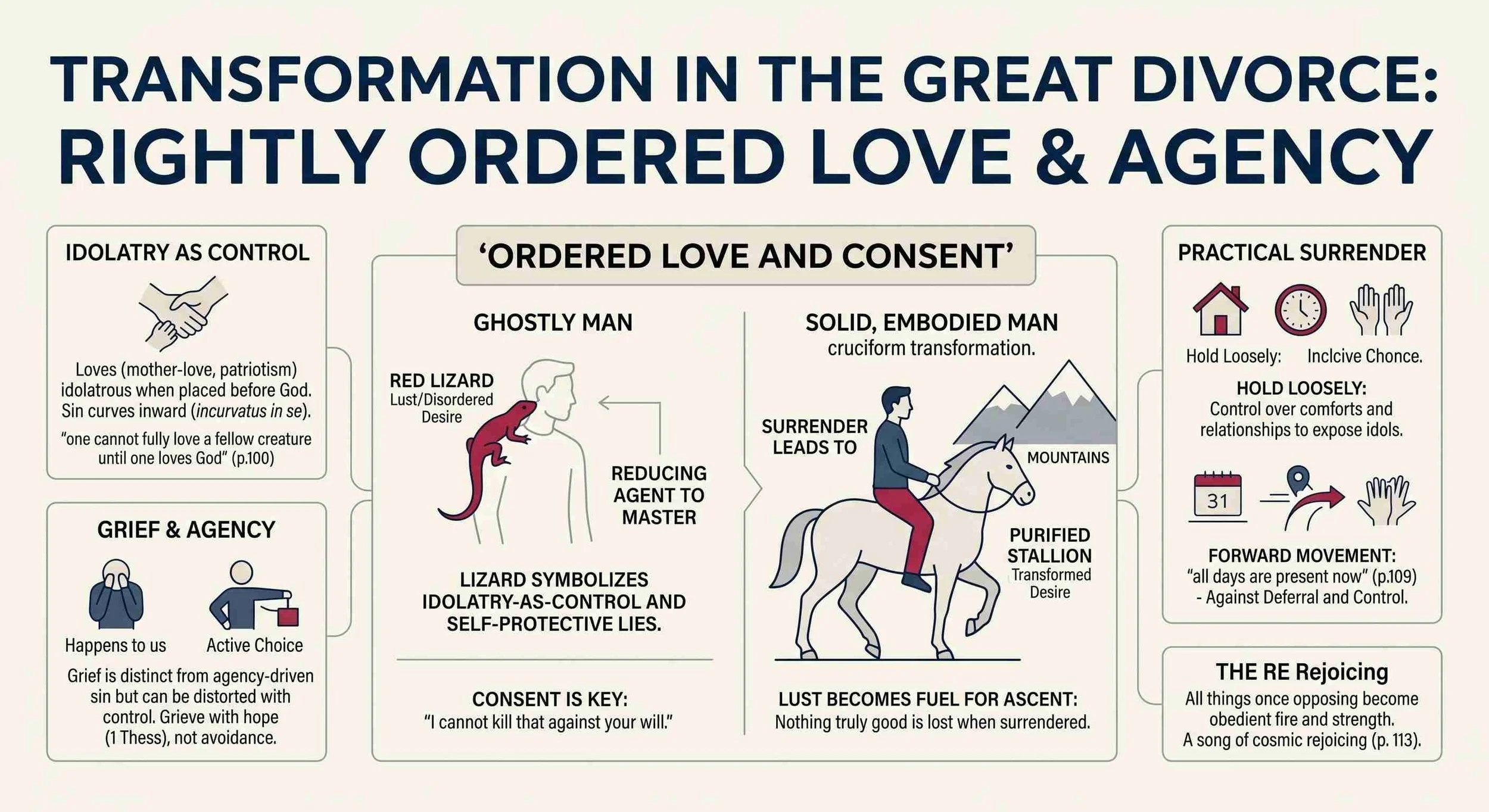
During our Bible study session on June 18, 2026, we delved into the latter half of chapter 11 of C. S. Lewis’s The Great Divorce. The conversation centered on the difficult themes of grief, lust, and idolatry, connecting the story of a grieving mother with a man carrying a red lizard on his shoulder. We discussed Martin Luther's concept of sin as "curving inward" and how this self-absorption creates isolation. The central idea was the necessity of "letting go" and surrendering our controlling desires to God, as symbolized by the painful but liberating killing of the lizard, which ultimately transforms into a magnificent stallion. We reflected on how redeemed desire is not erased but made new and powerful, why we must hold earthly loves loosely, and how creation itself rejoices in God's redemptive work.
Section-by-Section Walkthrough
Here is a breakdown of the discussion from our class on June 18, 2026.
1. The Dangers of Misguided Love and Grief
We began by revisiting the story of the mother whose love for her deceased son has become an all-consuming, controlling force. The key quote framing our discussion was, "You cannot love a fellow creature, fully until you love God." This led to a debate about the nature of her grief. It was argued that the issue was not the grief itself, but that it had become misguided and possessive, a "deficit" of true love that would drag a loved one into misery. Her sorrow stemmed from a loss of control over her son’s life rather than simply his absence. She wanted him back to satisfy her own need to possess and manage him, turning her love into a form of idolatry. This was contrasted with the upward call of discipleship, where love relinquishes control and trusts Christ’s transforming work. We noted the Christian call is to grieve, but to do so "with hope."
Section Summary: The mother’s story illustrates that even a powerful, natural love can become corrupt when it isn’t centered on God. Her grief was less about her son’s well-being and more about her loss of control, highlighting the danger of allowing our attachments to become idols that consume us.
Bible Verses Mentioned: 1 Thessalonians 4:13, Colossians 3:1-3, Matthew 10:37-39.
Stories Mentioned: The story of the grieving mother in The Great Divorce.
2. Sin as Curving Inward: Agency, Grief, and Idolatry
A significant portion of our discussion revolved around the concept of sin as "curving inward," a theme from Luther and Augustine that creates isolation and self-focus. This was linked to the "gray town" image where people, by grasping for themselves, breed loneliness. We questioned whether grief, which often feels passive, has "agency" like active sins such as lust. The conversation shifted to how grief can become a sin when we refuse to move forward and instead use it as a tool, turning it into our entire identity. Lewis’s point is that any good thing—a mother's love, patriotism, art—can become demonic if it turns away from God. The root of all these struggles is the fundamental human sin: the desire to be God, controlling our own lives and those of others. This desire is a violation of the first commandment. We also touched on the intellectual idolatry of making certainty itself an idol, rather than trusting in Jesus.
Section Summary: Sin curves us inward, creating isolation. While grief is a natural response, it becomes sinful when we actively choose to let it define us, placing our sorrow and desire for control above God. This rebellion, making something other than God our ultimate focus, is where sin's agency lies, stemming from a desire to be our own god.
Bible Verses Mentioned: Exodus 20:3 (The Ten Commandments), Luke 14:26-27, Philippians 3:7-8, Romans 7 (thematic connection).
Stories Mentioned: The "gray town" imagery; Pete Enns's "The Sin of Certainty."
3. Letting Go: The Story of the Man and the Lizard
The discussion then moved to the second story in the chapter: the man with the chattering red lizard on his shoulder, which represents lust. This serves as a powerful metaphor for surrendering sin. The man is hesitant to let the angel kill the lizard, fearing the pain and loss of his identity. This echoes Christian discipleship: taking up the cross and dying to self to follow Jesus. The angel's statement, "I cannot kill that against your will," emphasizes that our transformation requires consent. We drew a parallel to addiction recovery, where confession—like AA’s “I am an alcoholic”—is the honest naming that opens the door to change, and the lizard’s lie, “It’ll be different this time,” mirrors the cycle of addiction.
Section Summary: The man and the lizard illustrate that sanctification requires our willing participation. True freedom begins with honest confession and courageous surrender, echoing the gospel call to die to self rather than live enslaved by sin.
Bible Verses Mentioned: Genesis 3, Luke 9:23, Romans 6:6-11, Galatians 2:20.
Stories Mentioned: The man with the red lizard; addiction and recovery narratives (AA).
4. The Crimson Grip and Transformed Desire
We explored the imagery of the angel seizing the lizard with a "crimson grip." We discussed whether "crimson" evokes Christ’s blood, cleansing, and sacrificial love, connecting it to hymns about the "crimson flow" and scriptural imagery of the Lamb who was slain. The man’s eventual permission leads to a painful "death" of the lizard, which is then resurrected into a magnificent, white stallion. The man becomes a "new-made man"—solid and whole. This symbolizes that when we surrender our twisted desires, they are not merely destroyed but are transformed into something powerful and glorious that carries us closer to Him. We noted Lewis’s contrast: lust is a “poor, weak, whispering thing” compared to the richness of true desire that arises when lust is killed and raised.
Section Summary: The "crimson" language points to Christ’s costly, purifying work. When we surrender our sin to God, it is not just destroyed but is redeemed and transformed—lizard to stallion—into a strength that propels us toward holiness.
Bible Verses Mentioned: Revelation 5:6, Revelation 19:13, Hebrews 9:14, Romans 12:1-2, 1 Corinthians 6:19-20, 2 Corinthians 5:17.
Stories Mentioned: The "crimson grip" imagery; Mary Magdalene’s line from The Chosen: “I was one thing, but now I am another.”
5. Death, Resurrection, and Creation's Song
The lizard-to-horse image illustrates the principle of death and resurrection. Cris read a passage describing how "nothing—not even the lowest—will not be raised if it submits to death." We clarified that choosing "death" (separation from God) can be final, but death in Christ leads to resurrection. This connects to Paul’s teaching: "It is sown a natural body; it is raised a spiritual body." This transformation is not just personal; Cris also read a passage describing creation itself rejoicing with a song "too large to hear," shaking with praise. This echoes the biblical theme that all creation celebrates God. The "song" speaks of mastery and rest, where what once opposed becomes "obedient fire," tying to the biblical promise to "the one who overcomes."
Section Summary: True spiritual strength emerges through death and resurrection. When disordered desires die, they are raised into powerful, holy desires. This redemptive pattern is celebrated by all of creation, which joins in a song of praise, echoing the biblical promise that those who overcome share in Christ's reign.
Bible Verses Mentioned: 1 Corinthians 15:42-44, 1 Corinthians 15:50, Luke 19:40, Revelation 2-3.
Stories Mentioned: Lewis’s lizard-to-horse transformation; Lewis’s descriptive scene of creation singing; mentions of the Narnia series.
6. Holding Gifts Loosely and Closing
We turned to practical application: hold blessings—people, possessions, ministries—loosely. We referenced Luther’s hymn "A Mighty Fortress" ("should they take our house, goods, honor, child, or spouse… they cannot win the day"), emphasizing that Christ’s victory stands even when earthly things are lost. A seminary professor’s illustration of hurricanes as "mighty winds" reframes fear, reminding us that not all loss is ultimate defeat. This applies to parenting ("If you love someone, set them free") and avoiding the temptation to clutch our homes or ministries too tightly. The call to repentance is always in the present moment. We concluded by acknowledging the chapter's depth and planned to continue with the "Sarah Smith" episode next time.
Section Summary: We applied Lewis’s insights to daily discipleship: trusting Christ’s victory, releasing our grip on people and possessions, and practicing vigilant, non-possessive love. We must act in the "now" and prepare to continue our study next session.
Bible Verses Mentioned: Psalm 46 (themes in "A Mighty Fortress").
Stories Mentioned: Luther’s hymn "A Mighty Fortress"; a seminary professor’s "mighty wind" metaphor; anecdotes about parenting and ministry; anticipation of the "Sarah Smith" episode.
Medium-Length Summary of the Class
On June 18, 2026, our Bible study traced the spiritual arc in C. S. Lewis's The Great Divorce from sin’s self-curving isolation to liberating surrender. Beginning with Luther’s insight, we connected inward-turning sin to loneliness and the “gray town” of grasping selves. We examined how even a noble emotion like a mother's love can become a "false religion" when it turns into a selfish desire for control. Reading Lewis’s vivid scene of the angel and the lizard, we confronted the fear that killing our lusts will kill us, recognizing the gospel truth that it is better to die to sin than live enslaved. The "crimson grip" led us into Scripture’s blood imagery, seeing Christ’s costly purification at the heart of transformation. We rejoiced that redeemed desire doesn’t vanish but is transfigured—lizard to stallion—carrying the new-made person toward the mountains. Practically, we emphasized holding blessings and relationships loosely, trusting Christ’s victory even when earthly things are shaken, echoing themes from Luther’s “A Mighty Fortress.” The class closed by noting the chapter’s intensity and preparing to study the “Sarah Smith” episode next.
Main Points
Sin curves us inward, producing isolation and self-absorption.
Any created thing or natural love can become a source of evil if not centered on God.
True transformation and freedom from sin require our active consent and willingness to "let go."
Discipleship involves death to self; surrender may feel like death but leads to true life.
Christ’s “crimson” work (His blood) purifies and empowers transformation.
Desire is redeemed, not erased—transformed from a weak lust into a powerful strength for the journey toward God.
Good loves become idols when absolutized; we must trust Christ over certainty and control.
True love follows Christ upward, relinquishing possessive demands and embracing transformation.
The call to repentance is always in the present moment.
Bible Scriptures Mentioned
Genesis 3: The serpent’s temptation in the Garden of Eden.
Exodus 20:3: The first commandment: no other gods before Me.
Psalm 46: Themes reflected in “A Mighty Fortress.”
1 Thessalonians 4:13: Grieving with hope.
Matthew 10:37-39: Lose your life for Christ to find it.
Luke 9:23: Take up the cross and follow Jesus.
Luke 14:26-27: Allegiance to Christ above all.
Luke 19:40: "The stones will cry out."
Romans 6:6-11: Die to sin, live to God in Christ.
Romans 12:1-2: Be transformed by the renewing of the mind.
1 Corinthians 6:19-20: Glorify God in your body.
1 Corinthians 15:42-44: "Sown a natural body, raised a spiritual body."
1 Corinthians 15:50: "Flesh and blood cannot inherit the kingdom of God."
2 Corinthians 5:17: New creation in Christ.
Galatians 2:20: Crucified with Christ; Christ lives in me.
Philippians 3:7-8: Counting all as loss for the sake of Christ.
Colossians 3:1-3: Seek the things that are above.
Hebrews 9:14: The blood of Christ purifies our conscience.
Revelation 2-3: Promises to "the one who overcomes."
Revelation 5:6: The Lamb who was slain.
Revelation 19:13: Christ’s robe dipped in blood.
Stories and References Discussed
C. S. Lewis Imagery: The grieving mother, the man with the red lizard, the "gray town," the "crimson grip," and the lizard’s transformation into a stallion.
Narnia series: Mentioned as an example of Lewis’s creativity.
The Chosen: Mary Magdalene’s testimony, “I was one thing, but now I am another.”
AA/Recovery narratives: The role of confession (“I am an alcoholic”) and long-term sobriety.
Martin Luther's hymn "A Mighty Fortress": Referenced for its theme of trusting God amid loss.
Pete Enns’s “The Sin of Certainty”: A warning against making certainty an idol.
A seminary professor's "mighty wind" illustration: A metaphor for reframing fear and loss.
Westerns and Far Side humor: Playful images of riding into the sunset.
Anticipation of the "Sarah Smith" episode: For the next class session.