
The Great Divorce Chapters 9b - Thursday Bible Study
Great Divorce Chapters 9b
This is our 5th class on The Book
This is an AI Recap of the class.
Some things may be incorrect.
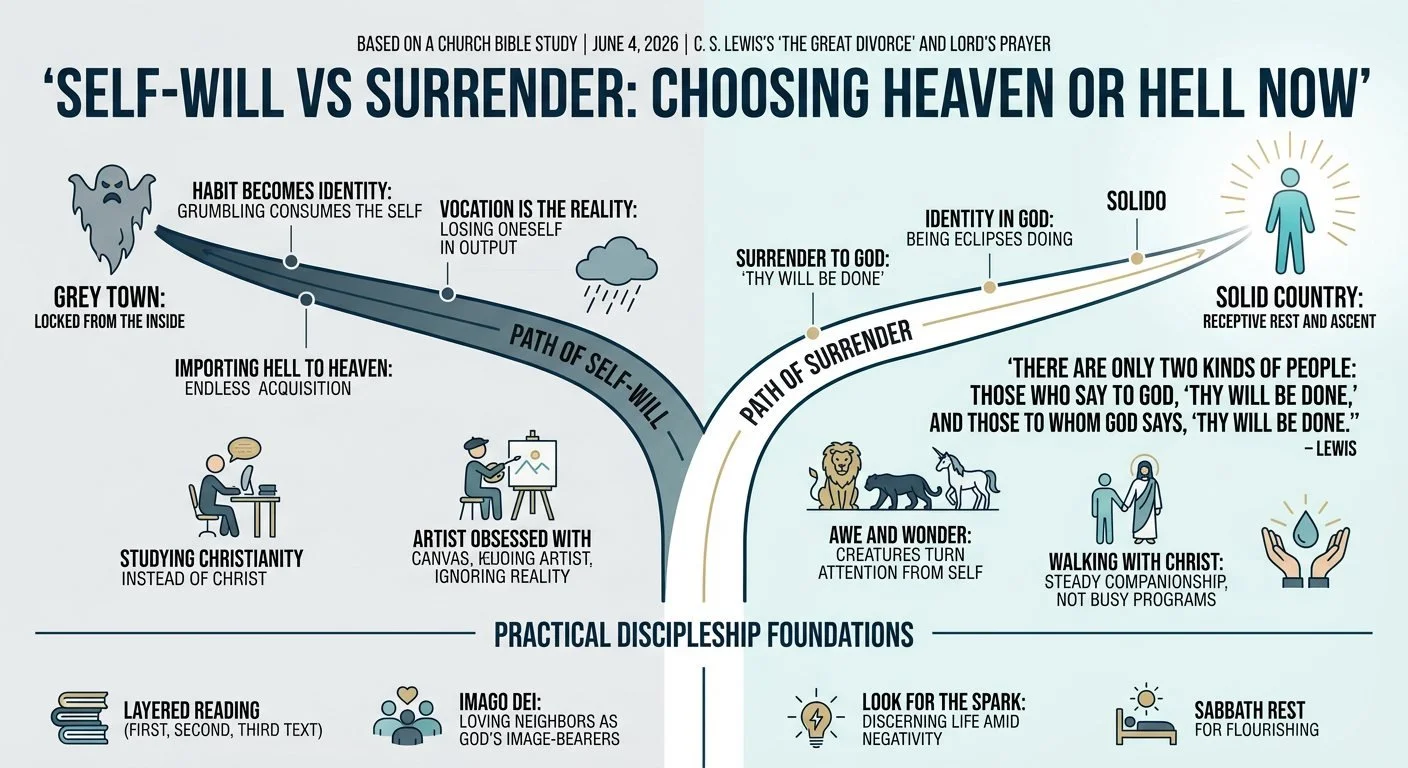
Short summary of the whole class
On June 4, 2026 at 11:01:41, we revisited chapter nine (and pages 79–84) of C. S. Lewis’s The Great Divorce, centering on the stark choice of “Thy will be done”—either to God or, finally, from God to us. We explored how heaven and hell are shaped by our present loves and habits, how grumbling can become identity, and how religious busyness can eclipse a living walk with Christ. George MacDonald’s influence on Lewis framed a discussion about the finality of choice, while Lewis’s imagery (lions, panthers, unicorns, solid people, and the painter) taught selflessness, awe, and identity in God rather than vocation. Scriptures from the Lord’s Prayer, Jesus’ table fellowship, burden-bearing, Sabbath rest, and the call to avoid grumbling grounded the conversation in practical discipleship.
Section-by-section walkthrough and summaries
1) Re-orienting in The Great Divorce: the heart of chapter nine and “Thy will be done”
What we talked about:
We located ourselves mid–chapter nine and anchored the class in Lewis’s central quote: “There are only two kinds of people in the end: Those who say to God, ‘Thy will be done,’ and to those whom God says in the end, ‘Thy will be done.’”
We framed heaven and hell as the outworking of self-will versus surrender, noting Lewis’s image that “the door to Hell is locked from the inside.”
We considered characters like the grumbling woman and the frightened ghost as case studies in our daily, formative choices.
Bible verses mentioned:
Matthew 6:9–13; Luke 11:2–4 — The Lord’s Prayer (“Your will be done, on earth as it is in heaven”).
Stories/books mentioned:
C. S. Lewis, The Great Divorce (chapter nine).
Short summary:
We grounded our study in Lewis’s core thesis: eternity flows from our will—either surrender to God or commitment to self—and that choice has real, present consequences.
2) Reading deeply: first text, second text, and intention
What we talked about:
We adopted a layered reading method: the first text (words), the second text (author’s purpose), and a third layer (underlying realities/emotions).
This approach prepared us to engage Lewis beyond narrative, attending to spiritual dynamics and intention.
Bible verses mentioned:
None directly cited.
Stories/books mentioned:
C. S. Lewis, The Great Divorce.
Short summary:
Reading with layered attention helps us discern Lewis’s purpose and the spiritual heart beneath his words.
3) The Great Divorce invites repeated, transformative reading
What we talked about:
Participants noted that rereading reveals new depths; the book’s simplicity masks profound spiritual insight.
Bible verses mentioned:
None directly cited.
Stories/books mentioned:
The Great Divorce.
Short summary:
Lewis’s work rewards rereading, continually opening fresh areas for spiritual growth.
4) “On earth as it is in heaven”: rethinking the Lord’s Prayer in daily life
What we talked about:
We challenged “fire insurance” Christianity by asking how to embody heaven’s will now.
Practical self-examination: Are we choosing hell today by refusing forgiveness, seeking control, or nursing grievances?
Bible verses mentioned:
Matthew 6:9–13; Luke 11:2–4 — The Lord’s Prayer.
Stories/books mentioned:
The Great Divorce (heaven/hell as present choices).
Short summary:
The Lord’s Prayer calls us into present obedience that mirrors heaven, not mere future escape.
5) Who eats at the table? Jesus with tax collectors and sinners
What we talked about:
We asked whether we would accept sharing heaven with people we struggle to forgive—would we remove ourselves?
This pressed our willingness to embrace God’s radical hospitality.
Bible verses mentioned:
Matthew 9:10–13; Mark 2:15–17; Luke 5:29–32 — Jesus dining with tax collectors and sinners.
Stories/books mentioned:
The Great Divorce — imagined reactions to who is “in” heaven.
Short summary:
Jesus’ table fellowship confronts our exclusionary instincts and invites us into grace toward those we resist.
6) Studying Christianity vs. loving Christ
What we talked about:
Around page 74, Lewis warns against becoming absorbed in studying Christianity while forgetting Christ Himself.
Parallels were drawn to the artist, the grumbling woman, and other ghosts whose good desires get swallowed by lesser pursuits.
Bible verses mentioned:
None directly cited.
Stories/books mentioned:
The Great Divorce, page ~74 (conversation with George MacDonald).
Short summary:
We cautioned against replacing a living love for Jesus with religious analysis or activity.
7) Walking with Christ vs. running for Christ
What we talked about:
A shared refrain: people often “run for Christ” (programs, busyness) rather than “walk with Him.”
The practical check: “How goes your walk with Christ today?”
Bible verses mentioned:
Matthew 11:28–30 — Rest in Christ (later explicitly connected).
Stories/books mentioned:
Personal wisdom shared; The Great Divorce themes of presence vs. performance.
Short summary:
Slow down to walk with Jesus; resist performance-driven religiosity.
8) Imago Dei and a simple creed of love and service
What we talked about:
A personal creed: Jesus saves people; God loves people; therefore we love and serve whom God loves.
Recognizing every person as God’s image-bearer grounds faith in tangible care.
Bible verses mentioned:
Genesis 1:26–27 — Humanity made in God’s image (alluded to).
Stories/books mentioned:
Applied in community and church life.
Short summary:
Seeing neighbors as image-bearers keeps our discipleship concrete and guards against self-will.
9) “Thy will be done” means “not my will”
What we talked about:
A pastoral reminder reframed the prayer: asking God’s will means relinquishing our own agendas.
Confronted “fire-and-brimstone” and “fire insurance” distortions of the gospel.
Bible verses mentioned:
Matthew 6:10 — “Your will be done.”
Stories/books mentioned:
The Great Divorce — surrender vs. self-will.
Short summary:
Submitting to God’s will displaces self-rule and reframes salvation as obedient trust.
10) The grumbling woman: when habit becomes identity
What we talked about:
Pages 76–77: Is she a person who grumbles, or has she become “a grumble”?
If there’s a spark under the ashes, it can be fanned back to life; if only ashes remain, they must be swept away.
We applied this to personal tendencies, church culture, and local frustrations.
Bible verses mentioned:
Philippians 2:14 — Do all things without grumbling (alluded to throughout).
Stories/books mentioned:
The Great Divorce, pages 76–77 (the grumbling woman).
Short summary:
Occasional complaint can be honest; habitual grumbling can consume us until it defines who we are.
11) Clarifying grumble vs. grumbler
What we talked about:
We distinguished constructive critique (naming issues with hope) from identity-level negativity.
Bible verses mentioned:
Philippians 2:14 — Do all things without grumbling (implicit).
Stories/books mentioned:
The Great Divorce principle applied to everyday discernment.
Short summary:
Discern the difference between situational complaint and a corrosive habit that erodes the self.
12) Everyday examples: community complaints and church assessment
What we talked about:
Local Facebook negativity, traffic and construction frustrations, and a Bethel church assessment where initial impressions of decline were corrected by discovering genuine life—“spark under the ashes.”
Bible verses mentioned:
None directly cited here.
Stories/books mentioned:
Bethel church assessment; social media examples; The Great Divorce principle.
Short summary:
Patience and deeper look can uncover embers worth fanning into flame amid dominant negativity.
13) George MacDonald’s influence and the finality of choice
What we talked about:
Lewis discovered MacDonald’s Phantastes as a teen; MacDonald shaped Lewis’s imagination and theology.
In The Great Divorce, Lewis puts his own views into MacDonald’s mouth: Lewis rejects universalism, insisting the choice for hell is final, whereas MacDonald believed hell was purgative.
Influences noted on Narnia (wardrobe motif) and Tolkien.
Bible verses mentioned:
None directly cited.
Stories/books mentioned:
George MacDonald, Phantastes; The Great Divorce (MacDonald as guide); The Chronicles of Narnia; J. R. R. Tolkien.
Short summary:
Lewis honors MacDonald while diverging theologically, using MacDonald’s character to articulate the permanence of our choices.
14) Social media, negativity, and grumbling (opening discussion of pp. 79–84)
What we talked about:
Cultural megaphones reward complaint and self-promotion; this mirrors Lewis’s “grumble” motif.
Bible verses mentioned:
Philippians 2:14 — Do all things without grumbling (anticipated).
Stories/books mentioned:
Reddit Polestar forum complaints; local restaurant posts; disengagement from social media.
Short summary:
Our mediascape amplifies grumbling, which can train hearts toward negativity rather than gratitude.
15) Unicorns, lions, and panthers—attention and awe (page 79)
What we talked about:
These creatures act like “jumper cables,” jolting ghosts out of self-preoccupation toward majesty—fear (lions/panthers) and wonder (unicorns).
Awe can break cycles of self-focus.
Bible verses mentioned:
Psalm 19:1 — Creation declares God’s glory (implicit).
Job 38–41 — God teaches through creation (implicit).
Stories/books mentioned:
The Great Divorce, page 79; Narnia-like resonance.
Short summary:
Heaven’s creatures teach by awakening fear and wonder, turning attention from self to glory.
16) Teachers in the solid country; selflessness vs. selfishness
What we talked about:
Solid people, and even creatures, function as teachers of self-giving; “rest on me” invites burden-sharing and ascent toward the mountains.
Bible verses mentioned:
Galatians 6:2 — Bear one another’s burdens.
Matthew 11:28–30 — Rest in Christ.
Stories/books mentioned:
The Great Divorce — guidance from solid people.
Short summary:
Heaven’s pedagogy trains us in selflessness and grace, moving us from isolation to shared strength.
17) Narrow views vs. totality—“teachers who return with lectures” (pp. 79–80)
What we talked about:
The temptation to reduce Jesus to maps, stats, or lectures; the hammer-and-nail metaphor cautions against single-angle faith.
Bible verses mentioned:
Colossians 1:15–20 — The fullness of Christ (implicit).
Stories/books mentioned:
The Great Divorce, pages 79–80.
Short summary:
Partial perspectives can eclipse the whole Christ; heaven invites comprehensive vision over fragmented expertise.
18) Importing hell into heaven—paving over the grasslands (page 80)
What we talked about:
Ghosts who want to asphalt heaven with Gray Town’s ethic—endless acquisition and self-will—cannot coexist with glory’s gift economy.
Bible verses mentioned:
Matthew 6:19–21 — Treasures in heaven.
Mark 8:36 — Gain the world, lose your soul.
Stories/books mentioned:
The Great Divorce, page 80; Peggy Lee’s “Is That All There Is?” as cultural critique.
Short summary:
Hell’s logic of self-assertion can’t be imported into heaven’s surrender; greed cannot pave over grace.
19) Community, service, and changing capacity to serve
What we talked about:
From volunteer fire departments to paid service; small-town neighborliness vs. modern concerns; the enduring call to serve.
Bible verses mentioned:
Luke 10:25–37 — The Good Samaritan (resonant theme).
Stories/books mentioned:
California hills fires; small-town memories; differing community cultures.
Short summary:
Contexts change, but love of neighbor remains; heaven’s selflessness critiques our drift toward comfort and self-protection.
20) The pull of complaint—venting at the “haves” (page 82)
What we talked about:
Making complaint a vocation—score-settling with “prigs and snobs”—distorts the heart.
Bible verses mentioned:
James 3:5–10 — The tongue’s power.
Philippians 2:14 — Do all things without grumbling (implicit).
Stories/books mentioned:
The Great Divorce, page 82; humorous text interruption.
Short summary:
A life organized around complaint shrinks the soul; heaven invites humility and praise instead.
21) The painter—identity beyond vocation (pages 83–84)
What we talked about:
Earthly vocations are signs pointing to Reality; in heaven, identity in God eclipses output. If we are what we do, we are nothing next to the Real.
Reflections on retirement, storm imagery, and Sabbath reoriented toward human flourishing.
Bible verses mentioned:
Mark 2:27 — The Sabbath was made for man.
Matthew 6:33 — Seek first the kingdom.
1 Corinthians 13:12 — From partial sight to face-to-face.
Psalm 90:17 — Work established by God (implicitly contrasted).
Stories/books mentioned:
The Great Divorce, pages 83–84; hurricane/wind and “glorious fire” imagery.
Short summary:
Our calling points to God but cannot carry our identity; in heaven, the Sign yields to the Reality and we rest our selves in Him.
22) Rest, zeal, and simply being
What we talked about:
Holiness isn’t achieved by zeal; readiness for heaven is receptive rest under grace.
Bible verses mentioned:
Luke 10:38–42 — Mary and Martha.
Hebrews 4:9–11 — Enter God’s rest.
Stories/books mentioned:
Recent sermon: “Why are you here?”; laying down frantic rule-keeping.
Short summary:
Heaven trains us to receive rather than strive; presence with Christ precedes performance for Christ.
Medium-length summary of the class (June 4, 2026)
On June 4, 2026, our Bible study used C. S. Lewis’s The Great Divorce to explore how the Lord’s Prayer reshapes daily discipleship. We centered on chapter nine’s thesis—either we say “Thy will be done” to God or He says it to us—framing heaven and hell as the fruit of our present loves and habits. A layered reading approach helped us attend to Lewis’s intention, while Jesus’ table fellowship confronted our readiness to share heaven with those we resist. We warned against studying Christianity while neglecting Christ, and emphasized walking with Him over running programs for Him. Affirming the imago Dei grounded a simple creed of loving whom God loves. Lewis’s “grumbling woman” pressed us to distinguish situational complaint from becoming “a grumble,” with everyday examples in social media negativity and church assessments where deeper patience found sparks of life. We traced George MacDonald’s influence and Lewis’s divergence from universalism, then turned to pages 79–84: unicorns, lions, and panthers as teachers of awe; solid people bearing burdens; the folly of importing Gray Town’s self-will into heaven; and the painter’s lesson that identity rests in God, not vocation. Scripture on rest, Sabbath, bearing burdens, and the tongue’s power framed a call to surrender self-will, practice grace, and let heaven’s life break into our present through humility, forgiveness, and steady companionship with Christ.
Main points
The core choice: “Thy will be done” to God vs. God saying it to us—self-will vs. surrender.
Heaven and hell are shaped by present loves, habits, and daily decisions.
Read spiritually with layered attention: words, purpose, and underlying realities.
The Great Divorce rewards rereading and ongoing transformation.
The Lord’s Prayer calls us to embody heaven’s will now, not treat faith as fire insurance.
Jesus’ table fellowship challenges our boundaries and invites radical grace.
Beware letting study or ministry eclipse love for Christ Himself.
Walk with Christ daily rather than merely “run” for Him.
Every person bears God’s image; love and serve whom God loves.
“Thy will be done” requires relinquishing our own agendas.
Distinguish constructive critique from becoming defined by grumbling.
Look for the spark under the ashes—in people, churches, and communities—and fan it into flame.
Heaven’s creatures and solid people teach awe, burden-bearing, and selflessness.
You cannot import hell’s acquisitive ethic into heaven’s gift economy.
Identity rests in God, not vocation or output; holiness is received in restful presence.
Bible Scriptures mentioned
Matthew 6:9–13; Luke 11:2–4 — The Lord’s Prayer (“Your will be done”).
Matthew 9:10–13; Mark 2:15–17; Luke 5:29–32 — Jesus with tax collectors and sinners.
Genesis 1:26–27 — Humanity in God’s image (imago Dei).
Philippians 2:14 — Do all things without grumbling.
Galatians 6:2 — Bear one another’s burdens.
Matthew 11:28–30 — Rest in Christ.
Colossians 1:15–20 — The fullness of Christ.
Matthew 6:19–21 — Treasures in heaven.
Mark 8:36 — Gain the world, lose your soul.
Luke 10:25–37 — The Good Samaritan.
James 3:5–10 — The tongue’s power.
Mark 2:27 — The Sabbath was made for man.
Matthew 6:33 — Seek first the kingdom.
1 Corinthians 13:12 — From partial sight to face-to-face.
Psalm 19:1 — Creation declares God’s glory.
Job 38–41 — God teaches through creation’s majesty.
Luke 10:38–42 — Mary and Martha.
Hebrews 4:9–11 — Enter God’s rest.
Stories and books referenced
C. S. Lewis, The Great Divorce:
Chapter nine — “There are only two kinds of people…”
Pages ~74 — Studying Christianity vs. loving Christ (conversation with George MacDonald).
Pages 76–77 — The grumbling woman (“becoming a grumble”).
Page 79 — Unicorns, lions, panthers as attention-getters.
Pages 79–80 — Narrow lectures vs. the totality of Christ.
Page 80 — Ghosts wanting to pave heaven’s grasslands (importing Gray Town).
Page 82 — Complaint as vocation and score-settling.
Pages 83–84 — The painter and identity beyond vocation.
George MacDonald, Phantastes — formative influence on Lewis; wardrobe motif echoed in Narnia.
The Chronicles of Narnia — influence from MacDonald’s fantasy; wardrobe concept.
J. R. R. Tolkien — influenced by MacDonald and Lewis’s fantasy lineage.
Bethel church assessment — initial reports of decline corrected by discovered signs of life (“spark under the ashes”).
Social media examples — local Facebook negativity; Reddit Polestar forum complaints; restaurant posts.
Peggy Lee’s “Is That All There Is?” — cultural critique of acquisitive futility.
Content creation date: 2026-06-04 11:01:41.