
Mark Chapter 9a Class 14 - Wednesday Bible Study
Gospel of Mark Chapter 9a
This is our 14th class on Mark
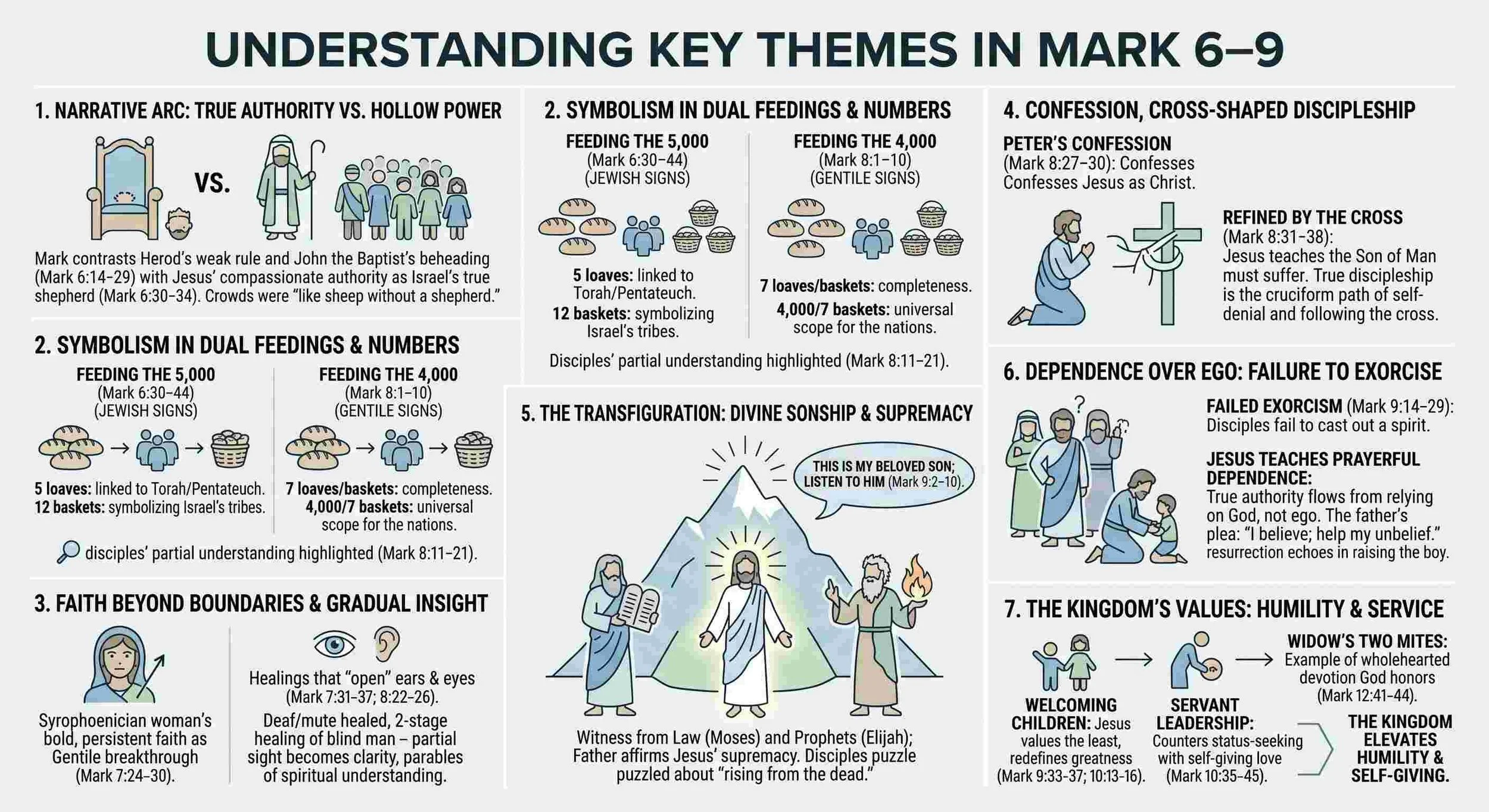
This is an AI Recap of the class.
Some things may be incorrect.
Short summary of the whole class
On September 23, 2026 (content creation date: 2026-09-23 18:37:16), our class walked through Mark 6–9, linking John the Baptist’s death and Herod’s hollow power to Jesus as the true shepherd in the feeding of the five thousand. We explored the symbolism of numbers (five/Torah, twelve/Israel, seven/completeness, four/universality), the dual feedings (5,000 and 4,000) as signs for Israel and the nations, and healings that “open ears and eyes” as parables of dawning understanding. We reflected on defilement from within, the faith of the Syrophoenician woman, Peter’s confession and misunderstanding, Jesus’ call to take up the cross, and the Transfiguration where Moses and Elijah witness to the beloved Son. Descending the mountain, we examined the failed exorcism, the father’s cry—“I believe; help my unbelief”—and Jesus’ teaching that some battles require prayer (and fasting), drawing lessons about humility, dependence, and the dangers of ego. We also noted Mark’s “messianic secret,” why Jesus sometimes restricts testimony among Israelites while encouraging Gentiles, and looked ahead to themes of welcoming children, servant leadership, and the widow’s two mites.
Section-by-section walkthrough with summaries, verses, and stories
1) Mark’s narrative arc: From John’s beheading to the true shepherd
What we discussed:
We recapped Mark’s literary structure, noting that John the Baptist’s beheading exposes Herod’s feckless power and frames Jesus as the true shepherd for leaderless crowds.
The crowds are “like sheep without a shepherd,” setting up the feeding of the five thousand as a revelation of Jesus’ compassionate authority.
Bible verses and stories mentioned:
Mark 6:14–29 (Beheading of John the Baptist)
Mark 6:30–34 (Sheep without a shepherd theme)
Short summary of this section:
Mark contrasts Herod’s weak rule with Jesus’ true authority and compassion, preparing readers to see Jesus as Israel’s shepherd.
2) Numbers, feedings, and meaning in Mark’s structure
What we discussed:
Feeding of the 5,000 (Mark 6:30–44) connected to Jewish symbolism: five loaves (linked to the Pentateuch), twelve baskets (Israel’s tribes), and the disciples’ dullness highlighted by Jesus’ reminder about “the loaves.”
Jesus walking on the sea (Mark 6:45–52) reinforces the disciples’ lack of understanding.
Teaching on defilement from within shifts focus from ritual to the heart (Mark 7:14–23).
In Gentile territory, feeding of the 4,000 (Mark 8:1–10): seven loaves and seven baskets point to completeness; “four” evokes the “four corners of the earth,” suggesting universality for the nations.
Jesus warns about the “leaven of the Pharisees,” quizzes the disciples on the two feedings, and presses them beyond literal bread (Mark 8:11–21).
A lighthearted correction: the leader mistakenly linked five to the Star of David’s points; the group noted it has six points—turning into a shared laugh about learning together.
Bible verses and stories mentioned:
Mark 6:30–44 (Feeding 5,000)
Mark 6:45–52 (Walking on the sea; reminder about the loaves)
Mark 7:14–23 (Defilement from within)
Mark 8:1–10; 8:11–21 (Feeding 4,000; leaven warning; quiz on baskets)
Short summary of this section:
The dual feedings depict Jesus’ provision for Israel and the nations, with numbers (5, 7, 12, 4) signaling Torah, completeness, Israel, and universality, while exposing the disciples’ partial understanding and inviting deeper insight.
3) Gentile breakthrough and “opening” miracles
What we discussed:
The Syrophoenician woman’s bold, persistent faith (Mark 7:24–30) as a Gentile breakthrough.
Healings that “open” (Mark 7:31–37; 8:22–26): ears opened, tongues loosed, and a two-stage healing of a blind man—“trees walking”—portraying partial perception becoming clarity.
Bible verses and stories mentioned:
Mark 7:24–30 (Syrophoenician woman)
Mark 7:31–37 (Healing of deaf/mute)
Mark 8:22–26 (Two-stage healing of a blind man)
Short summary of this section:
Gentile faith is welcomed, and Jesus’ “opening” miracles become living parables of gradual spiritual insight.
4) Peter’s confession, misunderstanding, and the call to the cross
What we discussed:
At Caesarea Philippi, Peter confesses Jesus as the Christ (Mark 8:27–30), echoing Mark 1:1 (“Son of God”).
Jesus immediately teaches that the Son of Man must suffer, be killed, and rise (Mark 8:31); Peter’s rebuke shows partial sight—like the two-stage healing.
Jesus calls disciples to deny themselves, take up their cross, and follow (Mark 8:34–38), challenging power expectations with the cruciform path.
Bible verses and stories mentioned:
Mark 8:27–38 (Peter’s confession; first passion prediction; take up your cross)
Mark 1:1 (Gospel opening claim)
Mark 6:14–16 (Herod’s speculations, echoing identity questions)
Short summary of this section:
Confessing Jesus is only the beginning; true discipleship follows the way of the cross, moving from blurry to clear vision about Messiahship.
5) The Transfiguration: Moses, Elijah, and the beloved Son
What we discussed:
On a high mountain, Jesus is transfigured; Moses and Elijah appear; a cloud and the Voice declare, “This is my beloved Son; listen to him” (Mark 9:2–10).
Classic view: Moses (Law) and Elijah (Prophets) witness to Jesus; another lens: Moses (who died and was hidden) and Elijah (taken up) converge to signal Jesus’ mission.
Once the Father speaks, Moses and Elijah depart, leaving “Jesus only,” underscoring his supremacy.
The secrecy command—“until the Son of Man is risen”—and the disciples’ puzzlement about rising from the dead.
We connected themes from Joshua, Moses, and Elijah: Elijah and Elisha’s Jordan crossings (2 Kings 2) “retracing” Joshua’s conquest as a symbolic move away from the way of violent kings toward grace; Moses viewing the land and unknown burial (Deut 34).
Peter’s impulse to build shelters/tabernacles (Mark 9:5–6) was read as a fear-driven attempt to memorialize and level Moses and Elijah with Jesus; the Father redirects focus to the Son alone. We noted tabernacle echoes (Exodus 25–40; Leviticus 23:33–43) and the anonymity of the mountain resisting shrine culture.
Bible verses and stories mentioned:
Mark 9:2–10 (Transfiguration; “listen to him”; secrecy)
Parallels: Matthew 17:1–8; Luke 9:28–36
Mark 1:9–11 (Baptism; beloved Son)
Deuteronomy 34 (Moses viewing the land; unknown burial)
2 Kings 2 (Elijah parts the Jordan; transition to Elisha)
Exodus 25–40; Leviticus 23:33–43 (tabernacle/booths background)
Short summary of this section:
The mountain scene unveils Jesus’ divine sonship and supremacy over Law and Prophets; God’s command—“Listen to him”—turns disciples from memorializing to obedient hearing.
6) “Elijah must come first” and the end of the violent way
What we discussed:
The disciples ask about Elijah’s coming; Jesus affirms restoration yet highlights the Son of Man’s destined suffering and rejection (Mark 9:11–13), linking Elijah/John the Baptist’s treatment to a long pattern of violence that culminates—and stops—in Jesus’ cross.
Background motifs: Isaiah 53 and Daniel 7 informing the Son of Man’s suffering and vindication.
Bible verses and stories mentioned:
Mark 9:11–13 (Elijah must come first; suffering Son of Man)
Matthew 17:10–13 (Elijah and John the Baptist connection)
Isaiah 53; Daniel 7 (suffering/vindication motifs)
Short summary of this section:
Jesus reframes expectations about Elijah to center his own redemptive suffering, signaling the end of the cycle of violent rejection in the cross.
7) Coming down the mountain: a desperate father, faith’s struggle, and prayerful dependence
What we discussed:
The disciples fail to cast out a mute/deaf spirit from a boy; Jesus laments unbelief, engages the father’s honest plea—“I believe; help my unbelief”—and delivers the child (Mark 9:14–29).
Jesus teaches, “This kind can come out by nothing but prayer” (with textual notes on “prayer and fasting”), emphasizing posture over technique—dependence over ego.
We noted resurrection echoes: the boy appears like a corpse; Jesus lifts him—mirroring “raising” scenes like the paralytic (Mark 2:1–12).
Bible verses and stories mentioned:
Mark 9:14–29 (Failed exorcism; “only by prayer”; father’s plea)
Manuscript note on “prayer” vs. “prayer and fasting”
Mark 2:1–12 (Paralytic healed and lifted)
Mark 6:7,13 (Earlier disciple authority over demons)
Short summary of this section:
True authority flows from prayerful reliance on God; Jesus meets mingled faith and doubt with deliverance, foreshadowing resurrection power.
8) Why Jesus sometimes said “don’t tell” and sometimes “go tell”
What we discussed:
We compared Jesus’ instructions: often silencing testimony among Israelites (to manage timing, avoid premature acclaim/assassination, and prevent misunderstanding) while encouraging proclamation among Gentiles.
Mark’s “messianic secret” invites readers to finish the Gospel and then reread to truly “retell” the story with understanding.
Comparative references: Samaritan woman’s open witness (John 4), the grateful Samaritan leper (Luke 17:11–19), and Nicodemus’ cautious journey (John 3; 7:50–52; 19:39).
Bible verses and stories mentioned:
Mark 1:43–45; 5:43; 7:36; 8:26 (Silencing commands)
John 4 (Samaritan woman)
Luke 17:11–19 (Ten lepers; one Samaritan returns)
John 3; 7:50–52; 19:39 (Nicodemus)
Short summary of this section:
Jesus’ differing directions balance prudence and pedagogy; Mark’s narrative strategy forms witnesses who speak at the right time with deeper understanding.
9) Looking ahead: children, status, servant leadership, and the widow’s two mites
What we discussed:
Post-Transfiguration drift into ego: Jesus redefines greatness by welcoming children and calling disciples to servanthood.
James and John’s request reveals status-seeking; Jesus counters with the pattern of the cross.
The widow’s two mites exemplify humble, wholehearted devotion that God honors.
Bible verses and stories mentioned:
Mark 9:33–37 (Welcoming a child; true greatness)
Mark 10:13–16 (Jesus and the children)
Mark 10:35–45 (James and John’s request; servant leadership)
Mark 12:41–44 (Widow’s two mites)
Short summary of this section:
The kingdom honors humility and self-giving; Jesus dismantles ladder-climbing and centers servant love.
Medium-length closing summary (class recap dated 2026-09-23 18:37:16)
On September 23, 2026, we traced Mark’s carefully crafted narrative from Herod’s hollow power and John’s martyrdom to Jesus as the shepherd who feeds Israel and, through a second feeding, signals provision for the nations. We explored how numbers—five (Torah), twelve (Israel), seven (completeness), and four (universality)—work within Mark’s structure and how healings that open ears and eyes function as parables of emerging insight. The Syrophoenician woman’s bold faith heralded Gentile inclusion. Peter’s confession gave way to Jesus’ first passion prediction and the call to take up the cross, exposing partial sight that must be refined by the cruciform path. On the mountain, Moses and Elijah bore witness as the Father affirmed Jesus as the beloved Son and commanded, “Listen to him,” after which “Jesus only” remained. We connected Elijah and Elisha’s “reverse” Jordan journey and Moses’ hidden burial to a movement away from conquest toward grace fulfilled in Jesus. Coming down the mountain, a failed exorcism revealed the danger of ego and the necessity of prayerful dependence; the father’s cry—“I believe; help my unbelief”—met Jesus’ compassionate authority, with resurrection echoes in the boy’s raising. We considered why Jesus sometimes restricted testimony and sometimes released it, seeing Mark’s “messianic secret” as formative timing. Finally, we looked ahead to Jesus’ teaching on humility, welcoming children, servant leadership, and the widow’s two mites, which together call disciples from status to self-giving love.
Main points
Mark writes a literary-theological narrative contrasting Herod’s weakness with Jesus’ true authority.
The feeding signs (5,000 and 4,000) symbolize Jesus’ provision for Israel and the nations.
Numbers in Mark (5, 7, 12, 4) underscore Torah, completeness, Israel’s identity, and universality.
Defilement arises from within; Jesus targets the heart.
Gentile faith (Syrophoenician woman) is welcomed; “opening” miracles portray gradual understanding.
Peter’s confession is refined by the cross: discipleship means self-denial and following Jesus.
The Transfiguration reveals Jesus’ divine sonship and supremacy over Law and Prophets; “Listen to him.”
Elijah’s role points to Jesus’ suffering, where the cycle of violence culminates and ends.
Ministry power flows from prayerful dependence, not ego or technique; “This kind” comes out only by prayer (and fasting).
Mark’s “messianic secret” shapes timing and understanding of witness.
The kingdom elevates humility, children, servant leadership, and the widow’s wholehearted trust.
Scriptures mentioned
Mark 1:1; 1:9–11
Mark 2:1–12
Mark 6:14–29; 6:30–44; 6:45–52
Mark 7:14–23; 7:24–30; 7:31–37; 7:36
Mark 8:1–10; 8:11–21; 8:22–26; 8:26; 8:27–38
Mark 9:1–10; 9:2–13; 9:5–6; 9:8–10; 9:11–13; 9:14–29; 9:33–37
Mark 10:13–16; 10:35–45
Mark 12:41–44
Deuteronomy 34
Exodus 25–40
Leviticus 23:33–43
Joshua 6
2 Kings 2
Isaiah 53
Daniel 7
Parallel/related passages: Matthew 17:1–13; Luke 9:28–36; John 4; John 3; 7:50–52; 19:39; Luke 17:11–19
Stories referenced
Beheading of John the Baptist
Feeding of the 5,000 and the 4,000
Jesus walking on the sea; reminder about the loaves
Teaching on what defiles
Syrophoenician woman’s plea
Healing of the deaf/mute and the two-stage healing of the blind man (“trees walking”)
Peter’s confession and Jesus’ first passion prediction; call to take up the cross
The Transfiguration with Moses and Elijah; the Father’s voice; Peter’s shelters proposal
Elijah and Elisha at the Jordan; Moses viewing the land and hidden burial
Healing of the demon-tormented boy; “I believe; help my unbelief”; “only by prayer”
Children welcomed by Jesus; James and John’s status request; the widow’s two mites