The Great Divorce Chapters 10-11 - Thursday Bible Study
Great Divorce Chapters 10-11a
This is our 6th class on The Book
This is an AI Recap of the class.
Some things may be incorrect.
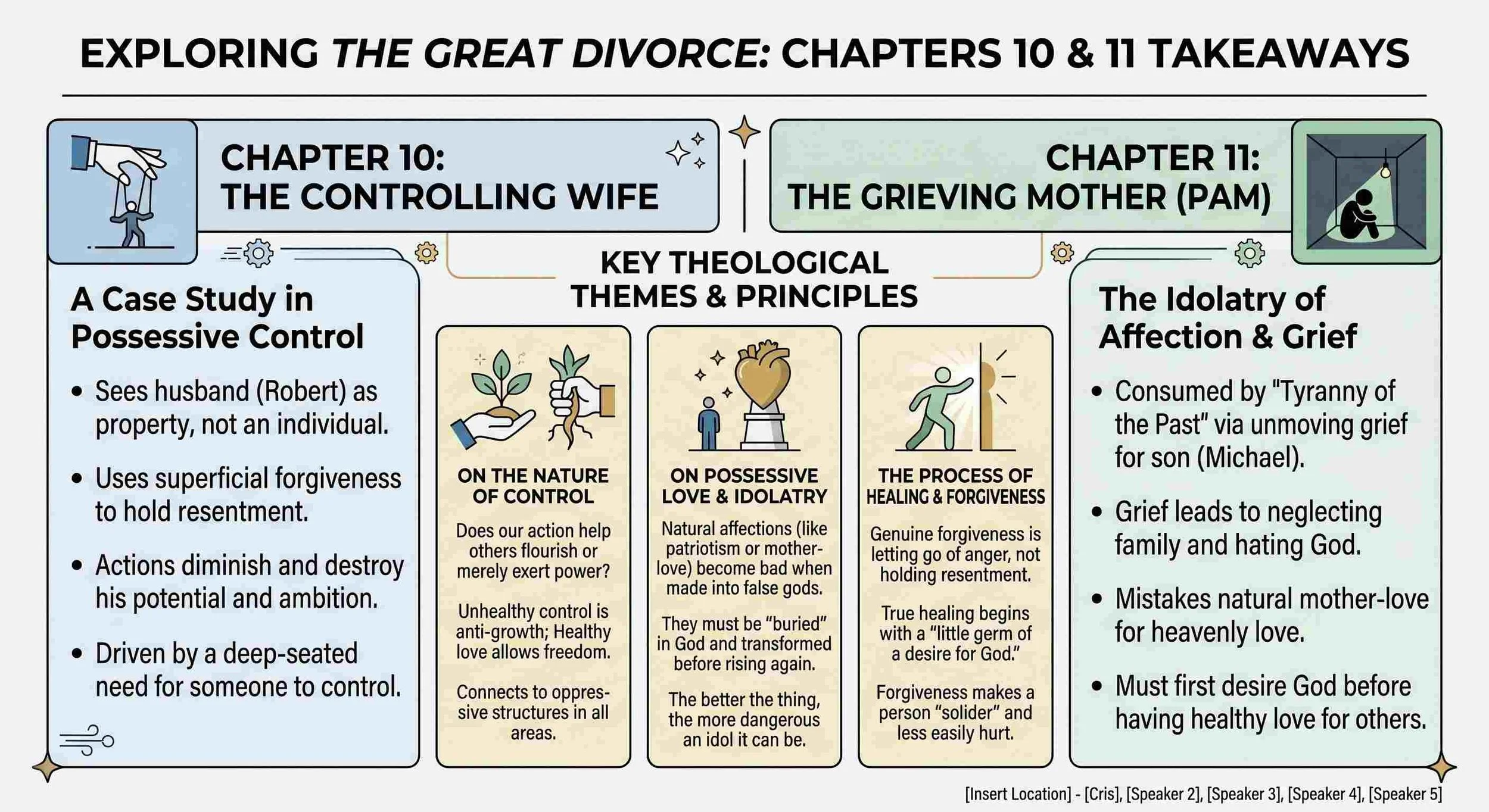
Discussion of Chapter 10: The Controlling Wife
Description:
The group analyzed the character of the controlling wife, describing her as hypocritical, depressing, critical, and self-centered.
Her identity was completely centered on managing her husband, Robert, whom she treated as property.
Her phrase, "I forgive him as a Christian," was seen as a way to hold onto resentment while appearing righteous.
The group discussed that genuine forgiveness means letting go of anger, even if one doesn't forget. An analogy was made to a sober alcoholic who turns their past struggle into a strength.
The wife's actions, such as destroying her husband's ambition, were seen as diminishing him. Her final statement, "I am so miserable. I must have someone to do things to," revealed her motivation was control, not service.
Discussion of Chapter 11: The Grieving Mother (Pam)
Description:
The discussion shifted to Pam, a mother grieving her son, Michael. Participants debated the son's age at his death.
Her grief led her to neglect her family and hate God. Her ten-year ritual of keeping her son's room unchanged was cited as an example of being consumed by the "tyranny of the past."
The group compared this "grieving ghost" to the controlling wife, noting the different approaches to handling them.
Key passages were highlighted:
"You cannot love a fellow creature fully till you love God."
"You'll become solid enough for Michael to perceive you when you learn to want someone else besides Michael."
It was emphasized that one must first exist as God's creature before being Michael's mother. The healing process begins with a "little germ of a desire for God," not using God as a means to an end.
Theological Themes: Love, Control, and Idolatry
The Nature of Control vs. Allowing Flourishing:
The group connected the theme of control to real-world examples, like parents pushing children for their own ambitions or churches clinging to traditions that prevent growth.
A parallel was drawn between the book's themes and unhealthy structures in churches, HOAs, and businesses where power and control become central. Healthy structures were described as a "taste of heaven."
The key takeaway was the need for self-honesty to determine if one's actions are about helping others flourish or simply about control, posing the question: "Are they flourishing when they are doing exactly what I told them to do?"
The Nature of Love, Loss, and Forgiveness:
The group discussed that the ghost's state might be rooted in anger at God, which prevents healing. This led to a conversation on empathy and seeing others' perspectives.
The destructive nature of possessive love was a central theme. Natural affection can be mistaken for heavenly love and must be "buried" (a theology of the cross) before it can rise again, transformed.
A key quote was discussed: "No natural feelings are high or low... They are all holy when God's hand is on the reign. They all go bad when we... make them into false gods."
A reference was made to an interview between Stephen Colbert and Anderson Cooper, highlighting the value of having loved despite the pain of grief.
Forgiveness was linked to becoming "solider," where others lose the power to hurt you.
The Idolatry of Good Things:
It was noted that good things, like mother-love or patriotism, are easier to turn into idols than more obvious passions. Demons are made from fallen archangels, not lesser things.
Examples of "good things" becoming idols included: "family-friendly" branding, unquestioning patriotism, specific forms of masculinity, and intense sports fandom amplified by betting.
Biblical References and Connections:
The discussion touched on biblical stories involving Naaman and Elisha, though participants needed to review the details. This was connected to a sermon series where Elisha repeats Elijah's actions in a gentler, more spiritual way, moving from past violence toward something new.
The group also briefly mentioned biblical structures like alphabetical psalms, symmetrical patterns in the Sermon on the Mount, and numerological codes in the Torah.