
The Great Divorce Chapters 12-13 - Thursday Bible Study
Great Divorce Chapters 12-13
This is our 8th class on The Book
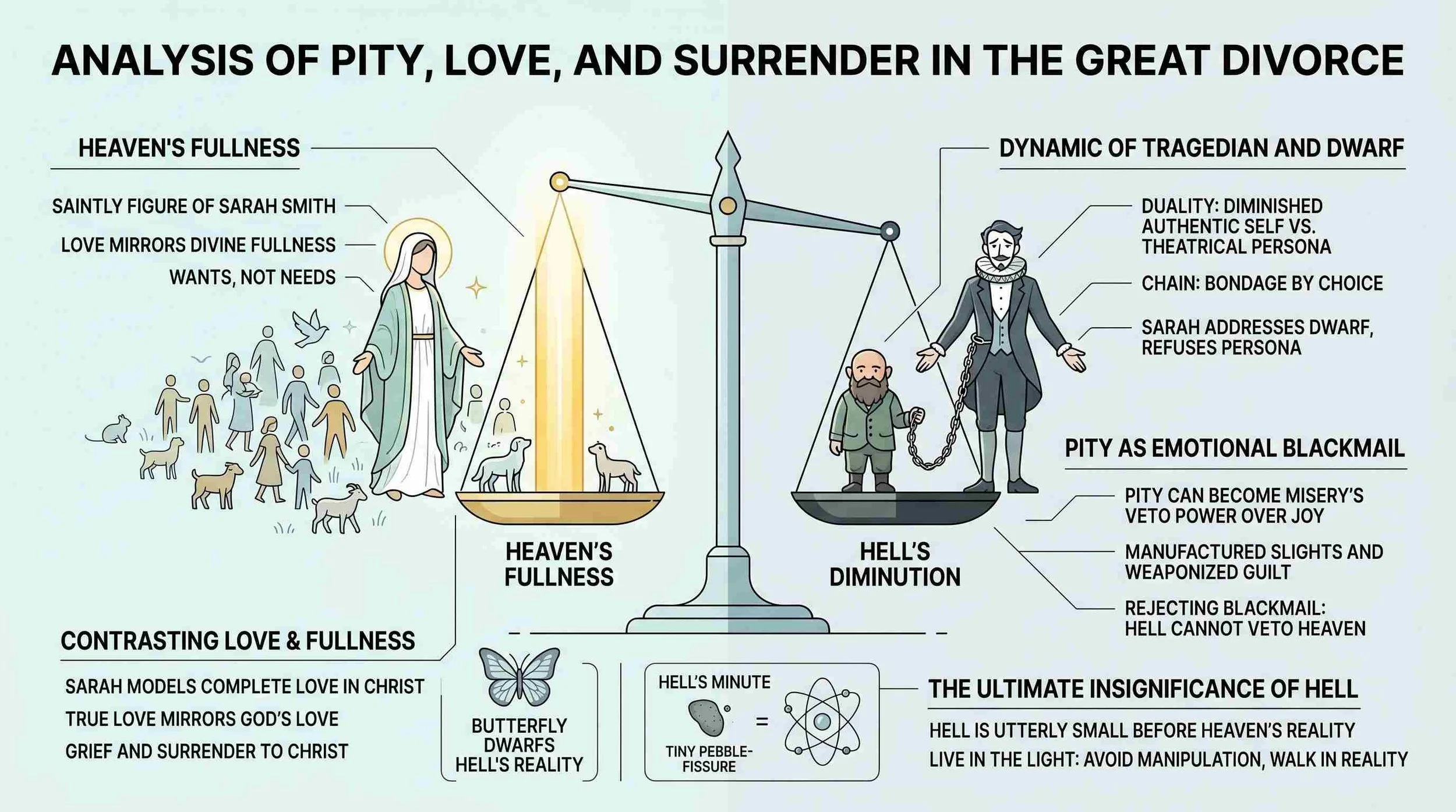
This is an AI Recap of the class.
Some things may be incorrect.
Short Summary of the Class
On June 25, 2026, our class delved into chapters 12 and 13 of C.S. Lewis's "The Great Divorce," focusing on the characters of Sarah Smith and her husband, the Dwarf/Tragedian. We discussed the contrast between Sarah's radiant, non-possessive love and her husband's manipulative self-pity, which functions as a self-forged chain reminiscent of Marley in A Christmas Carol. We explored how his behavior exemplifies "emotional blackmail" and how true, selfless love, like God's, comes from fullness, not neediness. The conversation highlighted the immense difficulty of surrendering our earthly griefs to God, the necessity of setting boundaries so that "hell cannot veto heaven," and the striking image of hell's ultimate smallness. We concluded that God’s will is not a formula but a reality to be lived, with our hope resting firmly in Christ's victory over darkness.
Detailed Class Summary
Here is a breakdown of the topics we covered during our discussion.
1) Setting the Study: Continuing The Great Divorce (Chs. 12–13)
Our discussion began by noting we were likely finishing the study of The Great Divorce and that chapters 12 and 13 are deeply intertwined. We acknowledged the difficulty of Lewis’s euphemistic, layered language, especially for newer readers, and how his interwoven poetry, while "not epic," is "quite lovely" and enhances the metaphorical narrative. The group reflected on the central question posed by the story: Is it tolerable that the woman in heaven (Sarah Smith) remains untouched by her husband's self-made misery? The consensus was that love in heaven must not be subject to manipulation from hell.
Summary: We framed the session around the connected narrative of chapters 12–13, set expectations for Lewis’s dense, poetic style, and affirmed that heaven’s love cannot be ruled by another’s self-chosen misery.
Bible Verses Mentioned: None cited in this opening frame.
Stories Mentioned: Class logistics and reading challenges.
2) Sarah Smith’s Quiet Sainthood and Expansive Love
We identified Sarah Smith as a figure of quiet, unnoticed sainthood. This resonated with a participant's childhood memory of a kind church woman who welcomed children. Cris shared a story from Texas about an unassuming youth leader whose massive funeral revealed his hidden, widespread impact, highlighting how true holiness is often humble and recognized late. We observed that Lewis’s choice of a common name, "Sarah Smith," signals that great saints are often ordinary in worldly terms. Her sainthood is expressed through expansive, non-possessive love. Her motherhood doesn't "steal" children but enlarges their capacity to love their own families more, a model of investing in people without controlling them. This love overflows to creation itself; as the text says, every beast and bird "in her became themselves," which we connected to the Franciscan tradition of care for all creatures.
Summary: We recognized Sarah Smith as a type of unnoticed, ordinary saint whose humble, non-possessive love multiplies affection, restores creation, and shapes many lives, echoing real-world experiences of hidden, impactful servants.
Bible Verses Mentioned:
Matthew 6:1–4 (giving in secret; hidden righteousness)
Matthew 23:11–12 (the greatest is the servant)
Hebrews 13:2 (hospitality to strangers)
1 Peter 5:5–6 (humility exalted by God)
1 Samuel 16:7 (God looks on the heart)
1 Corinthians 1:26–29 (God chooses the lowly)
Philippians 2:3–4 (looking to others’ interests)
1 Thessalonians 2:7–8 (gentle, sharing life)
Galatians 6:2 (bearing burdens)
Genesis 1:28; 2:15 (care for creation)
Romans 8:19–22 (creation longing for restoration)
Proverbs 12:10 (the righteous care for animals)
Stories Mentioned:
Texas youth leader’s funeral revealing wide impact.
St. Francis of Assisi’s care for animals.
Personal anecdotes about the commonness of the name "Smith."
3) Radiance and Edenic Innocence
Reading the description of Sarah Smith's appearance, we noted the question, "Is she naked? Is she clothed?" Cris connected this to the Edenic state of being "naked without shame," where one's presence is no longer about fear or concealment but about glory. Her robe and crown are as natural as lips or eyes, embodying a restored, shame-free existence in the kingdom.
Summary: Sarah’s radiance evokes Eden restored—a shame-free, glory-clothed presence that embodies life in the kingdom.
Bible Verses Mentioned:
Genesis 2:25 (naked and not ashamed)
Psalm 8:5 (crowned with glory and honor)
Revelation 19:7–8 (the bride’s fine linen—righteous acts)
Stories Mentioned: Eden imagery.
4) The Dwarf and the Tragedian: Emotional Blackmail vs. Authentic Love
We analyzed the character of Sarah’s husband, who appears as both the Dwarf (the true self) and the Tragedian (a theatrical persona). His pouting and emotional neediness were identified as a form of manipulation, which someone aptly called "emotional blackmail." This lifelong tool for control started in his childhood, where he would sulk to make his sisters feel sorry for him. The Dwarf holds the chain of this self-pity, while the Tragedian wears the collar, performing to avoid genuine engagement. Sarah addresses the Dwarf, the true self, ignoring the persona. We contrasted this manipulative "love" with the true, selfless love his wife now possesses. On page 126, she explains she is "full now," "in love itself," no longer needing him but freely wanting him to share her joy. This mirrors God’s love for us: He is already completely full but still desires a relationship.
Summary: The scene contrasts Sarah’s genuine, "full" love with her husband’s manipulative performance. We identified his behavior as "emotional blackmail"—a destructive tactic rooted in neediness that stands in opposition to the selfless, giving nature of God's love.
Bible Verses Mentioned:
Ephesians 4:22–24 (put off the old self; put on the new)
Matthew 5:37 (simple truth without theatrics)
John 1:39 (The wife's invitation to "Come and see" was compared to Jesus's invitation to His disciples).
Stories Mentioned: The story of the Tragedian's childhood manipulation of his sisters.
5) Chains We Forge: Self-Pity, Grief, and Surrender
The discussion turned to the chain the Dwarf carries, representing his self-pity. We drew a parallel to Marley's self-forged chains of greed in Charles Dickens’s A Christmas Carol. The Dwarf clings to his chain, using pity to manipulate and control, shrinking as he rejects heaven. This led to a vulnerable conversation about the difficulty of surrender, especially in the face of profound loss, like the death of a child or spouse. We acknowledged that true peace comes only through Christ, which requires surrendering what we hold tightly. Personal testimonies were shared about how faith provides comfort, knowing a loved one is with the Lord. We also noted how the pressure to grieve "perfectly" can feel like being forced to be an actor, just like the Tragedian.
Summary: Self-pity and a ledger of grievances become self-forged chains that pull us from grace. Surrendering these attachments and our deepest griefs to God is incredibly difficult but essential, and faith in Christ is the only source of true comfort and freedom.
Bible Verses Mentioned:
Galatians 5:1 (Christ sets us free; do not be entangled again)
2 Corinthians 7:10 (godly sorrow vs. worldly sorrow)
James 3:14–16 (selfish ambition breeds disorder)
1 Corinthians 13:5 (love keeps no record of wrongs)
Stories Mentioned:
Charles Dickens’s A Christmas Carol (Marley’s chains).
A woman grieving the loss of her child (referenced from another part of "The Great Divorce").
Personal stories of losing family members and finding comfort in faith.
6) Resisting Hell's Veto: Pity, Boundaries, and Coercion
We explored how the Tragedian uses pity to hold others' joy for ransom. The class noted how guilt and self-pity are used to force conformity in relationships, which was compared to historical lobotomy practices—a metaphor for coercive change rather than invited transformation. Sarah Smith establishes a firm boundary, declaring she "cannot bring hell into me." This resonated with Lewis's larger point that hell cannot be allowed to "veto heaven." True Christian service was distinguished from enabling dysfunction; enabling is not love. The Tragedian ultimately chooses his self-pity, and the Dwarf disappears, swallowed by the persona.
Summary: We defined pity as a chain the Tragedian used for emotional blackmail. Sarah’s refusal to let his misery corrupt her joy served as a powerful lesson on setting boundaries and distinguishing true love from enabling or coercion.
Bible Verses Mentioned:
Colossians 3:12–14 (compassion bound with love)
Romans 12:2 (transformation by renewal, not coercion)
Stories Mentioned:
One Flew Over the Cuckoo’s Nest (lobotomy reference).
General historical notes on lobotomy practices.
7) The Smallness of Hell and the Power of Light
The class was moved by Lewis's striking image of hell's true size. The guide reveals that the bus from hell came through a fissure in the soil "no bigger than" a blade of grass, and that "all hell is smaller than one pebble" of the earthly world. This underscored heaven’s vastness and hell’s impotence, which we connected to the biblical truth that "the darkness cannot overcome the light." Cris shared a pastoral story of comforting a grieving friend, illustrating that even a tiny light (a Bic lighter in a dark field) pierces overwhelming darkness. The takeaway was that light doesn't strain to overcome darkness; it simply shines.
Summary: Lewis’s vision portrays hell as infinitesimally small before heaven’s reality, reinforcing the biblical truth that light inevitably overcomes darkness; a pastoral story made this hope concrete.
Bible Verses Mentioned:
John 1:5 (the light shines in the darkness, and the darkness has not overcome it) — referenced conceptually.
Stories Mentioned:
Cris’s pastoral visit to a grieving friend; the "field and Bic lighter" illustration.
8) Living God's Will in Reality
Finally, we discussed Lewis’s caution against defining eternal reality, quoting from the end of p. 141: “it must be lived.” Lewis isn't focusing on universalism or predestination but on lived obedience and love. Cris emphasized a “live life” theology: we discern God’s will through faithful living and hindsight more than abstract certainty. This was illustrated with a participant's career path from chemical engineering to firefighting and the quip, “man plans and God laughs.” We concluded that perfection isn’t the requirement for our assurance, which rests solely in Jesus’ death and resurrection. The session ended with an agreement to continue with a full debrief next week.
Summary: Lewis reframes debates about eternal destiny, calling us to live reality with God. The class affirmed that God’s will is discerned through faithful living, with our ultimate confidence rooted in Christ’s finished work.
Bible Verses Mentioned (Implied/Alluded to):
Romans 8:28 (God works all things for good)
John 11:25 or 1 Corinthians 15 (Christ’s death and resurrection)
Psalm 37:23 (steps ordered by the Lord)
Stories Mentioned:
Speaker 4’s vocational journey (engineering to firefighting).
Class quip: “man plans and God laughs.”
Final Summary
Our study session on June 25, 2026, was a profound exploration of C. S. Lewis’s The Great Divorce (chapters 12–13), focusing on love, manipulation, and surrender. We dissected the character of the Tragedian, identifying his behavior as "emotional blackmail"—a toxic form of control rooted in manufactured neediness and self-pity. This was contrasted with Sarah Smith, a figure of radiant, Eden-like innocence whose ordinary name belies an extraordinary holiness expressed through expansive, non-possessive love. Her love comes from a place of fullness, modeling God's own selfless love for us. The discussion led to a vulnerable look at the difficulty of surrendering our earthly attachments and griefs, with members sharing how faith in Christ is the only true way to find peace. We were moved by Lewis’s breathtaking image of hell as a minuscule crack set against the immeasurable reality of heaven, reinforcing the gospel truth that light overcomes darkness. We concluded with Lewis’s call to live out God’s will rather than merely defining it, recognizing that our assurance rests not in our perfection but in Christ’s death and resurrection.
Main Points
Lewis’s language in The Great Divorce is dense and poetic; chapters 12–13 are tightly connected.
Sarah Smith exemplifies humble, radiant sainthood; her expansive love multiplies affection and restores creation.
Emotional manipulation, or "emotional blackmail," is a destructive tool that creates unhealthy relationships.
True love, like God’s, comes from fullness, not neediness, and gives freely.
Chains of self-pity are self-forged through manipulation and keeping ledgers of slights.
Surrendering our deepest pains and griefs to God is difficult but necessary for true peace.
We must set boundaries to prevent misery from corrupting God-given joy; hell cannot be allowed to veto heaven.
Hell is unimaginably small before heaven’s reality; light overcomes darkness.
God’s will is a reality to be lived and is often discerned in hindsight.
Our assurance rests in Jesus’ death and resurrection, not in human perfection.
Bible Scriptures Mentioned
Genesis 1:28; 2:15 — Care for creation.
Genesis 2:25 — Naked and not ashamed.
1 Samuel 16:7 — God looks at the heart.
Psalm 8:5 — Crowned with glory and honor.
Proverbs 12:10 — The righteous care for animals.
Matthew 5:37 — Let your “Yes” be yes.
Matthew 6:1–4 — Giving in secret; hidden righteousness.
Matthew 23:11–12 — The greatest is the servant.
John 1:5 — The light shines in the darkness, and the darkness has not overcome it (referenced conceptually).
John 1:39 — Referenced in the context of the invitation to "Come and see."
Romans 8:19–22 — Creation’s longing for restoration.
Romans 12:2 — Transformation by renewing the mind.
1 Corinthians 1:26–29 — God chooses the lowly.
1 Corinthians 13:5 — Love keeps no record of wrongs.
2 Corinthians 7:10 — Godly sorrow versus worldly sorrow.
Galatians 5:1 — Freedom in Christ; do not be entangled again.
Galatians 6:2 — Bearing burdens.
Ephesians 4:22–24 — Put off the old self; put on the new.
Philippians 2:3–4 — Looking to others’ interests.
Colossians 3:12–14 — Compassion bound in love.
1 Thessalonians 2:7–8 — Gentle, sharing life.
Hebrews 13:2 — Hospitality to strangers.
James 3:14–16 — Selfish ambition and disorder.
1 Peter 5:5–6 — Humility and exaltation.
Resurrection assurance (allusions to passages like John 11:25; 1 Corinthians 15).
Providence and guidance themes (conceptual allusions such as Romans 8:28; Psalm 37:23).
Stories Referenced
C. S. Lewis, The Great Divorce (chapters 12–13): The primary text, focusing on Sarah Smith, the Dwarf, and the Tragedian.
Texas story: A quiet youth leader with a large funeral due to his hidden investments in people.
St. Francis of Assisi: Referenced for his care for animals.
Charles Dickens, A Christmas Carol: Used as an analogy for self-forged chains (Marley’s chains).
One Flew Over the Cuckoo’s Nest and historical lobotomy: Used as a metaphor for coercive conformity.
Cris’s pastoral story: An illustration of light overcoming darkness using a Bic lighter in a field.
A woman grieving her child: Referenced from another part of The Great Divorce to discuss surrendering loss.
Vocational journey story: A class member's path from studying chemical engineering to becoming a firefighter.
Personal Stories: Members shared experiences of losing loved ones and finding comfort in their faith.
Class quip: “Man plans and God laughs,” highlighting God’s providence.