
The Great Divorce Chapters 2-4 - Thursday Bible Study
Great Divorce Chapters 2-4
This is our 2nd class on The Book
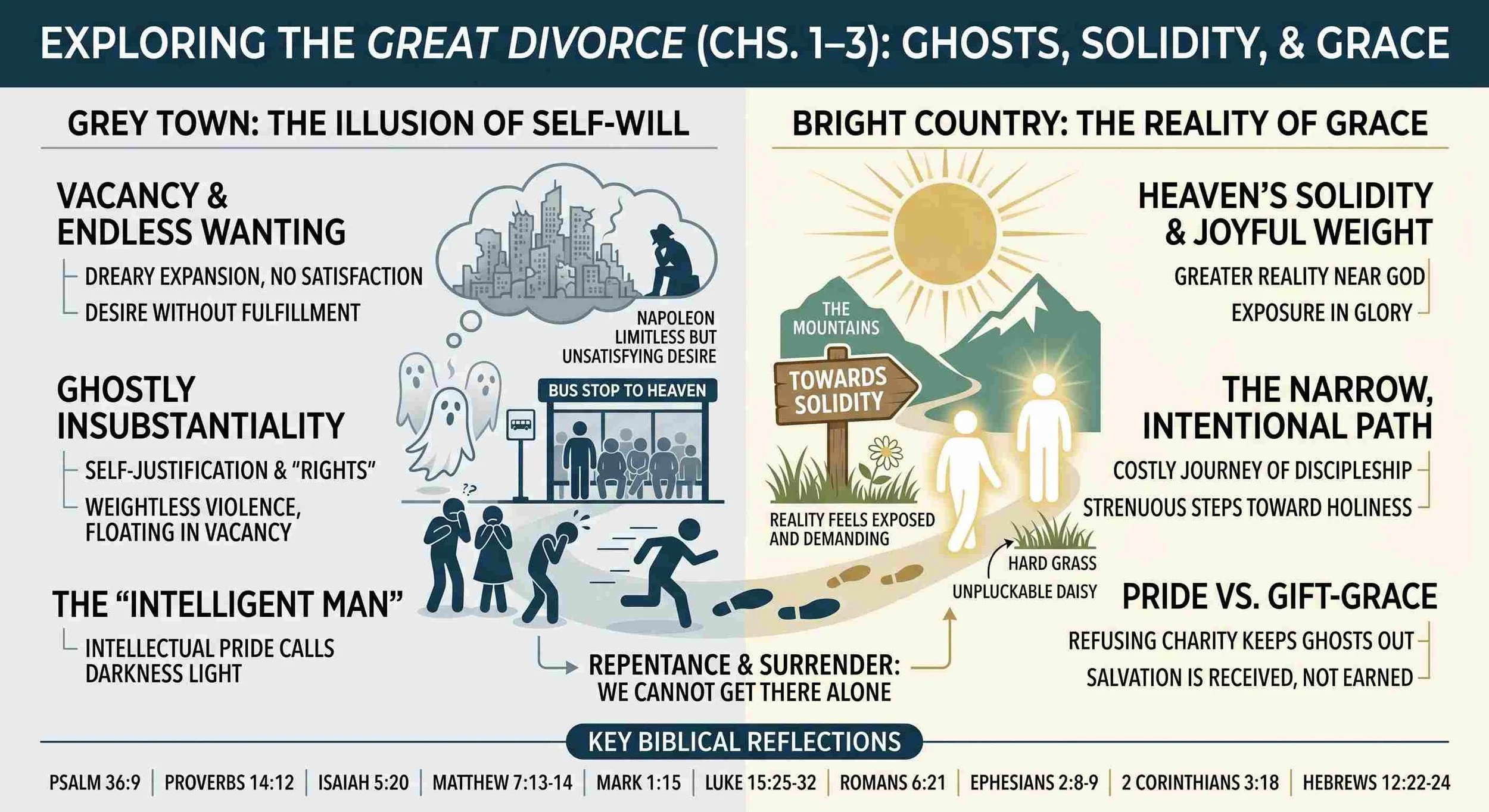
This is an AI Recap of the class.
Some things may be incorrect.
Short summary of the whole class
Our class revisited key scenes from The Great Divorce—life in the Grey Town, the bus ride, and arrival in the bright country—using them to examine desire, dissatisfaction, humility, and the hard, intentional path of discipleship. We contrasted ghosts’ self-justifying “rights” with heaven’s gift-grace, discussed fear-driven retreats and huddled hesitancy, and reflected on transformation as God makes us real. Scripture guided us through themes of wisdom, repentance, forgiveness, and the weight of glory.
Walk-through summary with sections, verses, stories, and end-of-section summaries
1) Setting the stage: where we left off
Discussion: We picked up from last week’s progress through page 14 (most of Chapter 2), choosing to revisit Chapter 2 before moving into Chapter 3. Handouts included character studies and an AI-generated overview/graphic to track figures (noting AI’s limitations).
Themes: Orientation to characters and motifs; careful reengagement with the text.
Scripture connections: None explicitly read in this opening segment.
Stories/literary references: The Great Divorce (Chs. 1–2); mention of the handouts and overview graphic.
End-of-section summary: We reoriented to Chapters 1–2 with tools to clarify characters and themes, preparing to engage the text thoughtfully.
2) Grey Town overview: “hell” as vacancy and endless wanting
Discussion: Grey Town appears as a place where one can have anything by mere thought yet never be satisfied—houses don’t keep out weather; even Napoleon broods alone. We contrasted cultural images of hell (Dante-like flames) with Lewis’s drab, ever-expanding vacancy. Some noted how Catholics might see the bus stop region as purgatory; Lewis plays with that notion.
Themes: Desire without fulfillment; emptiness rather than fiery torment; modern parallels (raises that quickly lose charm).
Scripture connections: Later tied to biblical themes of desire and dissatisfaction; no specific verses cited in this section.
Stories/literary references: The Great Divorce; Dante’s Inferno; workplace raises analogy.
End-of-section summary: Lewis’s “hell” is restless emptiness—always wanting, never satisfied—setting up the contrast with the solid joy of heaven.
3) Are the ghosts lost-lost? The shrinking Grey Town and widening mountains
Discussion: We previewed Lewis’s end-of-book reveal: hell/Gray Town is tiny from heaven’s vantage—a “fissure in the soil”—though it seems vast from below. As the bus rises toward the mountains (the outskirts of heaven), reality grows more spacious and solid.
Themes: Perspective shift; nearness to God increases reality and exposure; hope for change.
Scripture connections: Anticipated themes later tied to Psalm 36:9 and 1 Corinthians 15:49.
Stories/literary references: The Great Divorce imagery of rising to the bright country.
End-of-section summary: From below, hell looks vast; from above, it’s small. Near the mountains, things grow more real, hinting that moving toward God is an increase of reality.
4) Flickers of solidity and the problem of self-justification (end of Chapter 2)
Discussion: Characters display brief clarity—“solid thoughts”—then slide back into self-absorption (e.g., the “big ghost” fixated on rights). The narrator glimpses his own ghostly reflection. The chapter closes with a fight and gunshot that feel harmless, underscoring their insubstantiality—“floating in pure vacancy.”
Themes: Self-deception, rights-obsession, weightless violence in unreality.
Scripture connections: Proverbs 14:12; Jeremiah 17:9; Romans 6:21.
Stories/literary references: The Great Divorce scenes of the bus stop quarrel and the narrator’s mirror moment.
End-of-section summary: Moments of self-recognition fade as ghosts revert to self-justifying patterns; ego and violence look big in Grey Town but prove weightless in reality.
5) Opening the window: first signs of longing for the mountains
Discussion: On the bus, the narrator opens a window to fresh air; others scold him for risking a “cold.” We asked why the ghosts were at the bus stop: dim openness to correction, herd behavior, or curiosity. Some ride and later retreat when faced with the cost of becoming solid.
Themes: Desire for reality versus fear-driven conformity; will tested by exposure to the solid.
Scripture connections: Proverbs 1:20–23; Proverbs 9:4–6; Matthew 7:13–14.
Stories/literary references: The Great Divorce bus scene; Lady Wisdom’s call as biblical parallel.
End-of-section summary: Desire for reality flickers, but fear and groupthink pull many back; the will must consent to be changed.
6) Arrival in Chapter 3: bright country, hard grass, and ghostly hands
Discussion: The bus hovers over a bright, level land with river and birdsong. Disembarking brings chaos, then stillness. The grass is so solid it hurts ghostly feet; a daisy stem won’t twist and nearly peels skin. The country feels freeing yet exposing.
Themes: Heaven’s solidity; our transparency; exposure in glory.
Scripture connections: Psalm 36:9; 2 Corinthians 3:18; 1 Corinthians 15:42–49; 2 Corinthians 4:17–18.
Stories/literary references: The Great Divorce; note on Hans Christian Andersen (The Little Mermaid) as an image for painful steps in a more real world.
End-of-section summary: Heaven’s outskirts are startlingly solid; compared to it, the ghosts are unreal. The more real the world, the more our unreality feels exposed.
7) The “intelligent man” and the comfort of clever error
Discussion: The “intelligent man” reframes Grey Town as enlightened dawn, dismissing longing for “real commodities” as retrograde materialism—while fearing a fresh breeze. Cleverness rationalizes emptiness, preferring safe theories to unsafe reality.
Themes: Intellectual pride; calling darkness light; abstractions over tangible grace.
Scripture connections: Isaiah 5:20; 2 Timothy 3:7; 1 Corinthians 8:1.
Stories/literary references: The Great Divorce “intelligent man” vignette.
End-of-section summary: Intellectual pride can rename emptiness “progress,” turning from tangible grace to safe ideas.
8) “The road to heaven is harder”: intentional steps and the narrow way
Discussion: Participants noted every step in the bright country must be intentional; becoming solid initially feels strenuous—like straining to lift a leaf. Discipleship is deliberate and costly.
Themes: Narrow path; sanctification’s early resistance; purposeful growth.
Scripture connections: Matthew 7:13–14; Luke 9:23.
Stories/literary references: The Great Divorce leaf-lifting image; a bear-chase joke illustrating the trap of comparative righteousness (contrasted with humility).
End-of-section summary: The way to life requires purposeful, often painful steps as grace strengthens us for glory.
9) Fear and flight: “It gives me the pip”—running back to the bus
Discussion: A ghost panics—“It gives me the pip”—and flees back to the bus. We compared this to addiction: outsiders see hollowness, yet sufferers return to the familiar. Grey Town’s “ease” contrasts with heaven’s demanded capacities and desires.
Themes: Fear of change; addiction to comfort/control; relapse.
Scripture connections: 2 Peter 2:22; Proverbs 26:11.
Stories/literary references: The Great Divorce fleeing ghost; real-life addiction parallels.
End-of-section summary: When holiness confronts our attachments, fear can drive us back to comfort; freedom requires staying to be changed.
10) The Big Man and “my rights”: refusing the charity of heaven
Discussion: The Big Man asks, “When have we got to be back?”—a control posture. He is obsessed with rights and refuses heaven’s charity, wanting merit-based entry. Anticipation of his encounter with a Solid Person highlighted the offense of gift-grace.
Themes: Pride versus grace; entitlement versus gratitude; elder-brother resentment.
Scripture connections: Ephesians 2:8–9; Luke 15:25–32; Matthew 20:1–16.
Stories/literary references: The Great Divorce Big Man; vineyard workers; elder brother.
End-of-section summary: Heaven is received, not earned; insisting on “rights” keeps us ghostly outside the gates of gift.
11) The approach of the Solid People: bright, weighty, and from the mountains
Discussion: Those coming from the mountains are ageless and bright; the earth shakes under their tread; dew rises from crushed grass. Two ghosts flee; others huddle. We pondered degrees of reality and fear in the presence of holiness.
Themes: Holiness as joyful weight; exposure; invitation to transformation.
Scripture connections: 2 Corinthians 3:18; Exodus 34:29–35; Hebrews 12:22–24.
Stories/literary references: The Great Divorce Solid People descending.
End-of-section summary: True holiness has joyful weight; its approach exposes fear yet invites us to stand and be made new.
12) “Solid thoughts” and mixed motives: why get on the bus at all?
Discussion: We debated whether ghosts had “solid thoughts”—glimpses of heaven’s values—mixed with old motives (e.g., trying to profit by bringing back something solid). Huddling may be an early, hesitant communal step.
Themes: Prevenient grace; conflicted desires; early stages of repentance-in-community.
Scripture connections: Mark 9:24; Philippians 2:12–13.
Stories/literary references: The Great Divorce salesman-like impulse; huddling behavior.
End-of-section summary: Early grace often looks like mixed motives and trembling steps; God can use even hesitant huddling to move us toward the mountains.
13) “The Big Man” meets a redeemed murderer: forgiveness vs. rights
Discussion: A redeemed solid man (who had murdered “Jack”) seeks out the Big Ghost, confessing long hatred, asking forgiveness, offering service, and inviting him to come. The Big Ghost fixates on fairness, classifies sins, insists he’s a “decent chap,” and rejects “bleeding charity.”
Themes: Forgiveness that transforms; repentance and discipleship; the offense of grace to pride.
Scripture connections: Mark 1:15 (repent and believe the good news).
Stories/literary references: The Great Divorce confrontation over “poor Jack”; Hans Christian Andersen reference noted earlier for painful steps imagery.
End-of-section summary: Humble repentance welcomes grace and offers reconciliation; pride clinging to “rights” refuses charity and remains ghostly.
14) Repentance, discipleship, and the tragic refusal
Discussion: The solid man pleads, “You can never get there alone. I was sent to you.” The Big Ghost prefers independence and “being right,” choosing to “go home” rather than accept charity—almost happy to have something to refuse.
Themes: Surrender and trust versus self-will; the perverse satisfaction of refusal.
Scripture connections: Mark 1:15 (call to repent and believe).
Stories/literary references: The Great Divorce decision point; ghosts huddling or fleeing.
End-of-section summary: Salvation involves surrender and being led; pride can find satisfaction in refusal, choosing isolation over joy.
Medium-length final summary of the class
On May 7, 2026 (11:01:06), our Bible study revisited C. S. Lewis’s The Great Divorce, rereading Chapter 2 and moving into Chapter 3 to deepen our grasp of Lewis’s contrast between the Grey Town and the bright country. We considered hell as vacancy—ceaseless wanting without satisfaction—and noted how what seems vast below proves tiny from heaven’s view. As the bus rises toward the mountains, reality becomes more solid and exposing: grass pierces ghostly feet, flowers resist being plucked, and the narrator recognizes his own ghostliness. We traced flickers of “solid thoughts” that often dissolve back into rights-obsession, intellectual pride, or fear-driven retreats to the familiar. The “intelligent man” rationalizes emptiness; the Big Ghost insists on merit and refuses charity. The approach of the Solid People, weighty with joy, provokes both fear and hope, inviting transformation through surrender. In the poignant encounter between the Big Ghost and a redeemed murderer, we saw the gospel’s shape: grace exposes and forgives, reorienting the past in love, while pride clings to “rights” and refuses to be led. In conversation with Scripture, we reflected on wisdom, humility, repentance, and the weight of glory—the costly journey toward becoming truly solid in Christ.
Main points
Hell as vacancy: Grey Town offers anything on demand yet never satisfies.
Heaven’s solidity: the bright country is more real than the ghosts; exposure in glory hurts until grace makes us solid.
Perspective shift: hell shrinks from heaven’s vantage; reality expands near God.
Flickers of desire: brief clarity competes with rights-obsession, self-justification, and clever rationalizations.
Narrow, intentional path: discipleship entails strenuous, purposeful steps.
Fear and relapse: attachment to comfort can send us back to the bus.
Pride versus grace: heaven is received, not earned; “rights” block mercy.
Holiness has joyful weight: Solid People embody transformative goodness.
Early grace often looks mixed: hesitant, communal steps can move us toward God.
Repentance and surrender: we cannot get there alone; we must be led and let go.
Bible Scriptures mentioned
Psalm 36:9
Proverbs 1:20–23
Proverbs 9:4–6
Proverbs 14:12
Proverbs 26:11
Isaiah 5:20
Matthew 7:1–5
Matthew 7:13–14
Mark 1:15
Mark 8:34–36
Mark 9:24
Luke 9:23
Luke 14:28–33
Luke 15:25–32
Romans 6:21
1 Corinthians 8:1
1 Corinthians 13
1 Corinthians 15:42–49
1 Corinthians 15:53–54
2 Corinthians 3:18
2 Corinthians 4:17–18
Philippians 2:12–13
Philippians 3:20–21
Ephesians 2:8–9
Hebrews 12:22–24
Stories and literary references discussed
C. S. Lewis, The Great Divorce (Chs. 1–3): Grey Town, bus ride, Napoleon’s isolation, the “intelligent man,” the big ghost obsessed with rights, solid people descending, hard grass and unpluckable flowers, ghosts huddling and fleeing, the Big Ghost’s encounter with the redeemed murderer of “Jack.”
Dante’s Inferno: contrasted imagery of hell.
Hans Christian Andersen, The Little Mermaid: painful steps as a metaphor for walking in a more solid world.
Workplace raises analogy: modern parallel to endless wanting without satisfaction.
Bear-chase joke: illustrates the trap of comparative righteousness.
Personal addiction conversation: highlights relapse into familiar bondage.
Content creation date: 2026-05-07 11:01:06.