Micah Chapter 4-5 Class 3 - Bible Study
Micah Intro and Chapter 4-5
This is our 3rd class on Micah
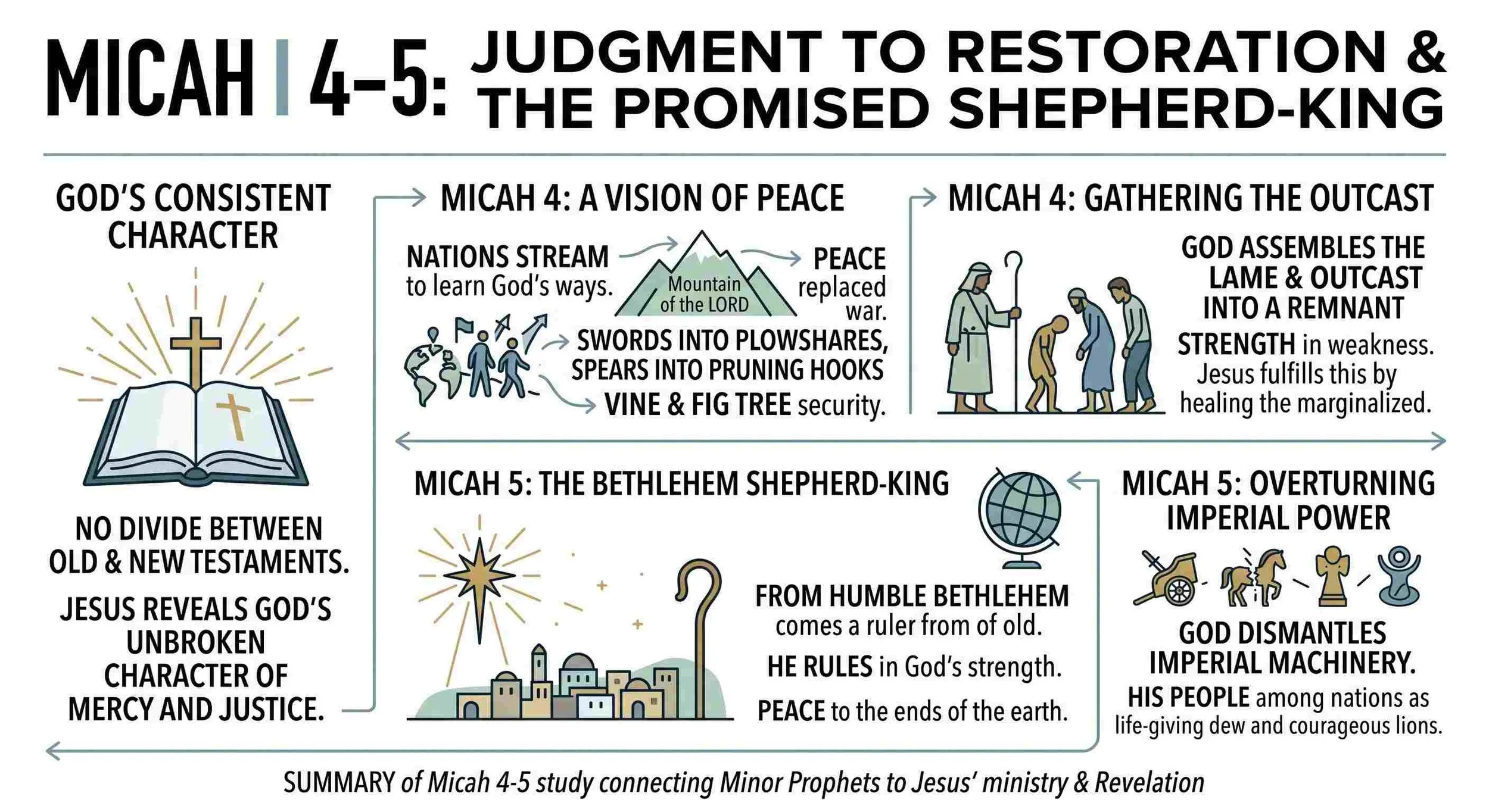
This is an AI Recap of the class.
Some things may be incorrect.
Short summary of the whole class
We read Micah 4–5 and traced a law-and-gospel rhythm from judgment to restoration. We explored God’s unbroken character across the Old and New Testaments; the mountain of the LORD and nations streaming; swords into plowshares; vine-and-fig-tree peace; exile and redemption; gathering the lame and outcast into a remnant; and the promised ruler from Bethlehem who shepherds in God’s strength and brings peace to the ends of the earth. We connected Micah to Isaiah 2, Revelation’s New Jerusalem and witness theme, Jesus’ ministry (including the temple cleansing and fig tree), Eden echoes, Jacob’s limp, Exodus’ overthrow of empire, and Luke’s census framing Jesus as David’s faithful heir.
Walkthrough and discussion highlights, with section summaries
Opening recap and theme-setting
We noted our prior stopping point (Micah 2–3) and began Micah 4, with some discussion reaching into Micah 5.
Observation that Micah (with Amos and Joel) “sounds like Revelation,” suggesting intertextual prophetic echoes.
Core conviction: no divide between the God of the Old and New Testaments; Jesus reveals God’s consistent character.
The Minor Prophets’ cadence mirrors law-and-gospel: exposing injustice, then promising restoration.
Short summary of this section:
We framed Micah 4 within Scripture’s larger arc, emphasizing God’s continuity, Revelation echoes, and a law-and-gospel approach.
Bible verses and stories:
Micah 2–3 (context)
Revelation (prophetic echoes)
Reading Micah 4:1–8 aloud
“Latter days,” exalted mountain of the LORD; nations streaming to learn God’s ways.
Signature imagery: swords into plowshares, spears into pruning hooks; no more learning war; everyone under vine and fig tree.
God gathers the lame and outcast as a strong remnant; the LORD reigns from Zion; “Tower of the Flock” and restoration to Daughter of Jerusalem.
Short summary of this section:
Micah 4 paints a peace-filled future where God’s teaching spreads, empires disarm, people flourish, and the marginalized are gathered and strengthened.
Bible verses and stories:
Micah 4:1–8
Exile, deliverance, and threshing (Micah 4:9–13)
Zion in labor pains; going to Babylon yet promised redemption.
Enemies misread God’s counsel; Zion told, “Arise and thresh” with iron horns/bronze hooves; gains consecrated to the LORD.
Short summary of this section:
Exile is a painful prelude, not the end; God redeems and repurposes His people’s struggle toward His consecrated victory.
Bible verses and stories:
Micah 4:9–13
Immediate reactions: battle and peace
Tension noted between God sending to battle and the broader vision of peace.
Reframing: Micah juxtaposes human conflict with God’s ultimate peace.
Short summary of this section:
Conflict appears in the storyline, but God’s horizon is transformative peace that turns weapons into tools for cultivation.
Bible verses and stories:
Micah 4 themes (peace, transformation)
“Daughter of Zion” and city-as-feminine language
“Daughter of Zion” personifies Jerusalem in feminine terms—a poetic address signaling care and restoration.
Short summary of this section:
“Daughter of Zion” is Scripture’s tender, corrective way of speaking to Jerusalem as a people God loves and will restore.
Bible verses and stories:
Micah 4 (usage of “Daughter of Zion”)
“Nations” and “Gentiles,” “LORD” and “Adonai”
“Nations/Gentiles” highlights inclusion beyond Israel.
“LORD” (small caps) renders the divine name YHWH; Jewish tradition reads “Adonai.”
How “Jehovah” arose via vowel-pointing.
Short summary of this section:
Translation choices shape meaning: the global scope of salvation and the reverent handling of God’s name.
Bible verses and stories:
Micah 4:1–3 (nations/Gentiles)
Notes on divine name usage
“Torah” vs. “Law,” and gospel as “good news”
“Torah” conveys covenantal instruction and saving story, not merely rules.
“Gospel” means good news (euangelion), not another law.
Torah includes God’s saving acts (Abraham, Exodus).
Short summary of this section:
God’s “law/Torah” is a way to walk shaped by His saving story, complemented by the gospel’s good news.
Bible verses and stories:
Micah 4:2 (“law/Torah” goes forth)
Allusions to Abraham’s call and the Exodus
Jesus present in the Old Testament and the continuity of God
Affirmation of the Son’s presence before the Incarnation; a Christ-centered reading of Micah.
Short summary of this section:
Micah’s voice aligns with Jesus’ revelation of God, grounding a Christological reading across Scripture.
Bible verses and stories:
Creation/Trinity allusion (Genesis)
Cross, temple, and Revelation echoes
Micah 3’s critique of corrupt leadership sets up Micah 4’s hope.
Jesus as true temple; Revelation’s descent of God’s dwelling.
Strong parallels to Isaiah 2’s mountain and plowshares imagery; intertextual, not derivative.
Short summary of this section:
From judgment on corruption to God’s restored dwelling, Micah 4 mirrors Isaiah 2 and foreshadows Revelation, centered on Jesus’ temple-fulfillment.
Bible verses and stories:
Micah 3; Micah 4:1–4
Isaiah 2:1–4
Revelation (New Jerusalem)
Walking God’s paths: peace, fruitfulness, and fig tree imagery
“Teach us His ways; walk in His paths” reframes law as lived wisdom.
Peace: tools of war become tools for cultivation; vine and fig tree rest.
Eden echoes of shade and fruit; Jesus’ fig tree sign warns against fruitlessness.
Short summary of this section:
God’s way leads to peace and true fruitfulness from Eden to the Gospels, contrasting performative power with Spirit-born fruit.
Bible verses and stories:
Micah 4:2–4
Matthew 21:18–22; Mark 11:12–14, 20–25 (fig tree)
Genesis 2–3 (Eden)
Gathering the lame and the remnant; witness and martyr
God assembles the lame/outcast into a strong remnant (Micah 4:6–7).
Revelation’s “witness” (martys) theme: faithful testimony often through weakness.
Warning against triumphalist “remnant” rhetoric.
Short summary of this section:
God perfects strength in weakness, forming a humble remnant whose witness aligns with the Lamb’s people in Revelation.
Bible verses and stories:
Micah 4:6–7
Revelation (witness/martyr motif)
Micah 4:6–8 — God gathers the lame and outcast (focus)
Hebrew tie between “lame” and Jacob’s limp (Genesis 32), dignifying weakness.
Contrast of ways: nations walk in their gods’ names, God’s people in the LORD’s name.
Short summary of this section:
God regathers the weak as His remnant under His reign, calling His people to walk His distinct path.
Bible verses and stories:
Micah 4:6–8; Micah 4:5
Genesis 32 (Jacob’s limp)
Jesus and the temple — cleansing as inclusion, not mere outrage
Jesus’ cleansing removes corruption and welcomes the blind and lame for healing, embodying Micah’s remnant vision.
Short summary of this section:
Jesus turns the temple into a house of healing, enacting the prophetic hope for the marginalized.
Bible verses and stories:
Matthew 21:12–14; Mark 11; Luke 19; John 2
Micah 4:9–13 — Birth pains, Babylon, and recycled imagery (focus)
Birth pains language echoed by Jesus and Paul; threshing imagery anticipates wheat/chaff themes.
“Careful what you wish for”: adopting Babylon’s ways leads to Babylon’s fate—yet redemption remains.
Short summary of this section:
Pain precedes deliverance; God warns against imperial imitation and promises final redemption.
Bible verses and stories:
Micah 4:9–13
Matthew 3:12 (wheat/chaff)
Matthew 24:8; Romans 8:22; 1 Thessalonians 5:3 (birth pains)
Micah 5:1–5a — Bethlehem and the Shepherd-Ruler
From little Bethlehem comes a ruler “from of old.”
Davidic expectations fulfilled in Jesus; Nazareth’s humble connotations noted.
Luke’s census read theologically against David’s failed census; Jesus as faithful heir.
“This one shall be peace”; global scope of reign.
Short summary of this section:
God raises a humble shepherd-king from Bethlehem whose peace reaches the ends of the earth, fulfilling and surpassing David’s line.
Bible verses and stories:
Micah 5:1–5a
2 Samuel 24 (David’s census)
Luke 2:1–7; Luke 3; Matthew 1
Micah 5:5b–15 — Remnant among the nations; God overturns imperial power
Assyrian threat met by God’s provision (seven shepherds/eight princes).
Remnant “like dew” (quiet life-giving) and “like a lion” (protective strength).
Violent-sounding verses reframed from the vantage of the weak: God dismantles horses, chariots, strongholds, sorceries, idols.
Exodus parallel: “horse and rider” thrown into the sea; God unmakes oppressive power.
Short summary of this section:
God protects His weak remnant, topples imperial idols, and plants His people among the nations as refreshing and courageous witnesses.
Bible verses and stories:
Micah 5:5b–15
Exodus 14–15 (horse and rider)
Isaiah 31:1; Psalm 20:7
Matthew 2 (magi as a class reframed in redemption)
Medium-length final summary (content creation date: 2026-04-16 11:07:13)
In our study of Micah 4–5, we followed Scripture’s law-and-gospel rhythm from judgment on corrupt power to God’s surprising restoration. We saw the exalted mountain of the LORD, nations streaming to learn His ways, and the transformation of weapons into tools for cultivation as people rest under their vines and fig trees. We clarified key terms and translations, underlining the Bible’s inclusive vision and reverent handling of God’s name, and reframed “law/Torah” as God’s covenantal instruction and saving story. Reading Micah through a Christ-centered lens, we linked its images with Isaiah 2 and Revelation’s New Jerusalem and witness, with Eden’s fruitfulness and Jesus’ fig tree sign. Micah 4 promised that God gathers the lame and outcast into a strong remnant, a theme we saw Jesus enact as He cleansed the temple and healed the marginalized. Micah 4:9–13 framed exile as birth pains before redemption, warning that imitating Babylon invites its fate. Micah 5 then spotlighted a humble ruler from Bethlehem whose shepherding strength and peace extend to the ends of the earth, echoing Luke’s census as a theological counter to David’s failed census. Finally, Micah 5:5b–15 presented God’s overthrow of imperial machinery—horses, chariots, strongholds, sorceries, idols—planting His remnant among the nations as both refreshing dew and courageous lion. Throughout, we emphasized that God’s kingdom overturns worldly power by lifting the lowly, purifying His people, and extending blessing to all nations.
Main points
God’s character is consistent across Old and New Testaments; Jesus reveals this continuity.
Micah 4 parallels Isaiah 2 and echoes Revelation: nations streaming, peace replacing war.
Law-and-gospel rhythm: exposure of injustice followed by restoration and hope.
Translation matters: nations/Gentiles, LORD/Adonai, and Torah/law shape inclusion, reverence, and instruction.
Peace and fruitfulness: swords into plowshares; vine and fig tree rest with Eden echoes and Jesus’ fig tree sign.
Christological reading: Jesus as true temple; cross and restoration themes align with Micah’s hope.
Remnant redefined: God gathers the lame and outcast; strength perfected in weakness and faithful witness (martys).
Bethlehem’s ruler: the shepherd-king brings peace to the ends of the earth and fulfills David’s line.
God overturns imperial power and idolatry, planting a purified people among the nations as dew and lion.
Bible Scriptures mentioned
Micah 2–5 (focus on 4:1–13; 5:1–15)
Isaiah 2:1–4
Revelation (New Jerusalem; faithful witnesses)
Genesis 2–3; Genesis 32
Exodus 14–15
Psalm 20:7
Isaiah 31:1
2 Samuel 24
Matthew 1–2; Matthew 3:12; Matthew 21:12–14; Matthew 21:18–22
Mark 11:12–14, 20–25; Mark 11 (temple cleansing)
Luke 2:1–7; Luke 19; Luke 3
John 2
Romans 8:22
1 Thessalonians 5:3
Matthew 24:8
Stories discussed
Nations streaming to God’s mountain; swords into plowshares; vine and fig tree peace
Daughter of Zion personification; exile to Babylon and promised redemption
Jacob wrestling and limping
Eden’s fruitfulness and shade
Jesus and the fig tree
Jesus cleansing the temple and healing the blind and lame
David’s census and consequences; Luke’s census framing Jesus’ birth
Exodus: horse and rider thrown into the sea
Magi as ancient court sages (reframed in Matthew’s nativity)
Remnant as dew and lion among the nations
Generated by gpt-5 on 2026-04-16 11:07:13 (content creation date).