
Mark Chapter 9b Class 15 - Wednesday Bible Study
Gospel of Mark Chapter 9b
This is our 15th class on Mark
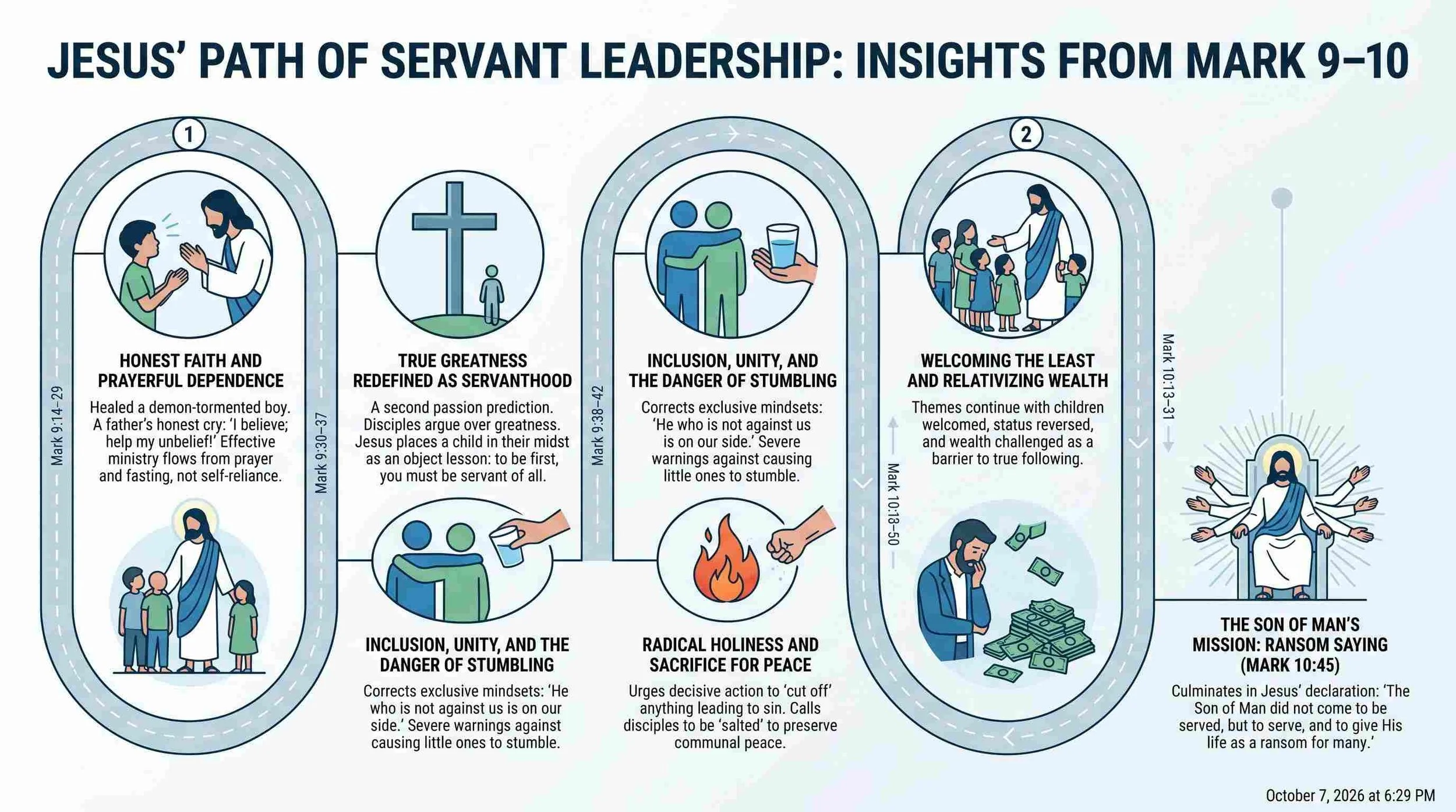
This is an AI Recap of the class.
Some things may be incorrect.
Short summary of the whole class
On October 7, 2026 at 6:29 PM, we treated Mark as crafted literature and read Mark 9:14–50 with previews into Mark 10. We examined the healing of the demon-tormented boy and the father’s honest faith, Jesus’ passion predictions, the paradox of true greatness through servanthood and welcoming children, inclusion beyond insider boundaries, warnings against causing believers to stumble, and vivid calls to radical holiness (“cut it off”) tied to salt and peace. We discussed spiritual pride—both in the disciples and in modern church life—textual notes on “where their worm does not die,” Gehenna’s imagery, and how all these threads point to Jesus’ path of suffering and service culminating in Mark 10:45.
Walkthrough and section-by-section summaries
1) Framing the study: Mark as literature and the middle pivot
We situated Mark 9–10 as the turning point “where the rubber meets the road,” just before Holy Week (Mark 11).
Watched a ~5-minute BibleProject overview of Mark’s design: first half asks “Who is Jesus?”; second half “How does he become king?” with the pivot at Peter’s confession and Jesus’ path of suffering (Mark 1:1; 8:27–33; 10:45).
Emphasized reading Mark on its own terms, not homogenizing the four Gospels.
Recalled earlier narratives that set up the disciples’ journey from partial to clear sight: Herod’s beheading of John, the feedings of 5,000 and 4,000, defilement teaching, two-stage healing of the blind man, and the Transfiguration.
Short summary of section:
We framed Mark as carefully crafted literature around a central pivot—Peter’s confession and Jesus’ servant-king mission—linking prior stories to read Mark 9–10 with clarity.
Scriptures mentioned:
Mark 1:1; Mark 6; Mark 6:30–44; Mark 7:14–23; Mark 8:1–10; Mark 8:14–21; Mark 8:22–26; Mark 8:27–33; Mark 9:2–8; Mark 10:45.
Stories discussed:
BibleProject overview video (Mark’s structure).
Herod beheading John the Baptist.
Feeding of the 5,000 and 4,000.
Defilement teaching.
Two-stage healing of the blind man.
Transfiguration.
2) The boy is healed: faith, prayer, and progressive understanding (Mark 9:14–29)
Read Mark 9:14–29: crowd and scribes disputing; a father describes his son’s torment (seizures, muteness, danger).
Jesus laments the “faithless generation,” invites trust: “If you can believe, all things are possible to him who believes” (9:23).
The father’s cry: “I believe; help my unbelief” (9:24).
Jesus rebukes the spirit; the boy appears dead, then Jesus raises him by the hand (9:25–27).
Privately explains, “This kind can come out by nothing but prayer and fasting” (9:29), underscoring dependence on God over technique or status.
Connected to the disciples’ failure stemming from pride and self-reliance; prayer as humble dependence.
Short summary of section:
We saw honest faith and Jesus’ power, learning that effective ministry flows from prayerful dependence and that the journey from unbelief to belief is gradual.
Scriptures mentioned:
Mark 9:14–29; Mark 8:22–26.
Stories discussed:
Healing of the demon-tormented boy.
The father’s struggle with faith.
3) Second passion prediction and the greatness paradox (Mark 9:30–37)
Jesus teaches privately: “The Son of Man is being betrayed… they will kill him… after three days he will rise” (9:31); the disciples do not understand and fear asking (9:32).
At Capernaum, Jesus confronts their argument about who is greatest (9:33–34).
Redefinition of greatness: “If anyone desires to be first, he shall be last of all and servant of all” (9:35).
Object lesson: embraces a child—receiving the lowly equals receiving Jesus and the Father (9:36–37).
Historical context: children as figures with little social status; welcoming “the least of these.”
Application: Jesus contrasts worldly power with divine servanthood, preparing for the cross as paradoxical power.
Short summary of section:
Jesus pairs His suffering prediction with a radical redefinition of greatness: true leadership is humble service that welcomes the least.
Scriptures mentioned:
Mark 9:30–37; Mark 8:31–35.
Stories discussed:
Disciples’ road dispute about greatness.
Jesus placing a child in their midst.
4) Elijah, the Transfiguration, and the path of servanthood (Mark 9:10–13; 9:2–8; OT background)
Question on Elijah in Mark 9:11–13: John the Baptist came in the spirit of Elijah; Jesus, unlike Elijah’s dramatic judgments, embraces the path of suffering.
Reviewed Elijah’s ministry: contest with prophets of Baal (1 Kings 18), encounter with God in the whisper (1 Kings 19), mantle to Elisha (1 Kings 19; 2 Kings 2).
The Transfiguration (Mark 9:2–8): Moses and Elijah appear with Jesus, signaling fulfillment; Jesus perfects Law and Prophets through servanthood.
Theological thread: movement from Old Covenant expectations of power/violence to Jesus’ new covenant of suffering, grace, and service.
Short summary of section:
Elijah and the Transfiguration highlight Jesus as the fulfillment of the Law and Prophets, choosing servanthood and suffering over force, pointing to the cross.
Scriptures mentioned:
Mark 9:2–8; Mark 9:10–13; 1 Kings 18–19; 2 Kings 2.
Stories discussed:
Transfiguration.
Elijah and the prophets of Baal.
Elijah hearing God in the whisper.
Elijah passing the mantle to Elisha.
5) Inclusion, unity, and the danger of causing others to stumble (Mark 9:38–42)
John reports an outsider casting out demons in Jesus’ name; the disciples tried to stop him (9:38).
Jesus: “Do not forbid him… he who is not against us is on our side” (9:39–40).
Commends small acts (a cup of water) with promised reward (9:41).
Warns against causing “little ones who believe” to stumble; better a millstone and the sea (9:42).
Application: Corrects sectarian, exclusive mindsets; prioritizes kingdom fruit and care for the vulnerable over status.
Short summary of section:
Jesus widens the mission beyond insider boundaries and issues sober warnings: unity and care for the vulnerable outweigh tribal status claims.
Scriptures mentioned:
Mark 9:38–42.
Stories discussed:
Outsider exorcist acting in Jesus’ name.
6) Radical holiness, Gehenna, textual notes, and the salt-peace exhortation (Mark 9:43–50; Isaiah 66:24)
Strong hyperbole: cut off hand/foot, pluck out eye—better to enter life maimed than be thrown into Gehenna (9:43–48).
Gehenna explained as Jerusalem’s horrific dump: perpetual fire, smoke, disease—visceral image of ruin.
Textual note: phrase “where their worm does not die, and the fire is not quenched” (Isaiah 66:24) appears in 9:48; its repetition in 9:44 and 9:46 in some manuscripts (e.g., Textus Receptus/KJV) likely a later rhetorical addition; modern translations (e.g., NIV) omit 9:44, 46.
“Everyone will be seasoned with fire… every sacrifice… with salt” (9:49); “Have salt in yourselves, and have peace with one another” (9:50).
Interpreted “cut it off” as metaphor for radical sacrifice: relinquishing status, wealth, or behaviors that cause sin or harm; better humble dependence on God than powerful self-righteousness.
Short summary of section:
Jesus urges decisive, inner holiness, using Gehenna’s vivid imagery and calling disciples to be “salted” people who preserve communal peace through humble, sacrificial living.
Scriptures mentioned:
Mark 9:43–50; Isaiah 66:24.
Stories discussed:
Modern parallel to Gehenna (e.g., Guatemala City dump as illustrative imagery).
Anecdotes on spiritual pride in church life (e.g., denominational exclusivism; Reformation Day joke; St. Peter-at-the-gates joke; homeless man example).
7) Preview into Mark 10: children, wealth, servanthood, and the ransom saying
Continued themes: Jesus blessing children (10:13–16), wealth and discipleship (rich man, 10:17–31), third passion prediction and servant leadership (10:32–45).
Anchor: “The Son of Man did not come to be served, but to serve, and to give His life as a ransom for many” (10:45).
Trajectory: welcoming children, reversing status, relativizing wealth, embracing servanthood on the road to the cross.
Short summary of section:
Mark 10 extends the servant-king pattern—children welcomed, wealth relativized, status reversed—and centers Jesus’ mission in the ransom saying.
Scriptures mentioned:
Mark 10:13–16; Mark 10:17–31; Mark 10:32–45; Mark 10:45.
Stories discussed:
Jesus blessing children.
The rich man and the call to follow.
Teaching on servanthood with the third passion prediction.
Medium-length summary of the class
On October 7, 2026 at 6:29 PM, our Bible study read Mark 9:14–50 in the larger literary arc of Mark and previewed Mark 10. We began with the healing of a demon-tormented boy, where the father’s “I believe; help my unbelief” and Jesus’ note that “this kind comes out by prayer and fasting” taught humble dependence over prideful technique. Jesus’ second passion prediction framed His path, while the disciples’ argument about greatness exposed their status concerns; Jesus answered by embracing a child and redefining greatness as servanthood. We explored Elijah and the Transfiguration to show Jesus fulfilling the Law and Prophets by choosing suffering over force. Jesus broadened mission beyond insider circles and issued stern warnings not to cause “little ones” to stumble. We discussed Gehenna’s vivid imagery, textual notes on the “worm” phrase, and Jesus’ hyperbolic call to cut off whatever leads to sin—interpreted as radical, humble sacrifice that preserves peace. Looking into Mark 10, we saw the themes continue—children welcomed, wealth challenged, status reversed—culminating in Jesus’ declaration that He came to serve and to give His life as a ransom for many.
Main points
Mark is crafted literature with a two-part structure and a pivotal middle around Peter’s confession.
Jesus is Messiah who becomes king through suffering, service, and sacrifice.
Faith is honest and dependent: “I believe; help my unbelief”; effective ministry flows from prayer and fasting.
True greatness is servanthood and welcoming the lowly, not status competition.
Mission is broader than our group; don’t forbid faithful work done in Jesus’ name.
Guard the vulnerable; do not cause “little ones” to stumble.
Pursue radical inner holiness—be willing to sacrifice anything that leads to sin or harms others.
“Salted” discipleship preserves peace in community.
The trajectory points to the cross: the Son of Man serves and gives His life as a ransom (Mark 10:45).
Beware spiritual pride and sectarian exclusivity in modern church life.
Bible scriptures mentioned
Mark 1:1
Mark 6 (Herod and John the Baptist)
Mark 6:30–44 (Feeding of the 5,000)
Mark 7:14–23 (Defilement from within)
Mark 8:1–10 (Feeding of the 4,000)
Mark 8:14–21 (The loaves—disciples’ misunderstanding)
Mark 8:22–26 (Two-stage healing of the blind man)
Mark 8:27–33 (Peter’s confession and rebuke)
Mark 9:2–8 (Transfiguration)
Mark 9:10–13 (Elijah question)
Mark 9:14–29 (Healing of the demon-tormented boy; prayer and fasting)
Mark 9:30–37 (Second passion prediction; true greatness; child in the midst)
Mark 9:38–42 (Outsider exorcist; stumbling blocks)
Mark 9:43–50 (Radical holiness; Gehenna; salt and peace)
Mark 10:13–16 (Jesus blesses children)
Mark 10:17–31 (Rich man and discipleship)
Mark 10:32–45 (Third passion prediction; servanthood)
Mark 10:45 (Ransom saying)
Isaiah 66:24 (Imagery echoed: “their worm does not die”)
1 Kings 18 (Elijah and prophets of Baal)
1 Kings 19 (Elijah and the whisper)
2 Kings 2 (Elisha receives the mantle)
Stories discussed
BibleProject overview of Mark’s structure and purpose.
Herod’s beheading of John the Baptist.
Feeding of the 5,000 and 4,000.
Defilement teaching (what comes out of a person).
Two-stage healing of the blind man.
Peter’s confession and misunderstanding (“Get behind me, Satan”).
The Transfiguration (Jesus with Moses and Elijah; Peter’s response).
Healing of the demon-tormented boy; “I believe; help my unbelief.”
The disciples arguing about who is the greatest; Jesus’ child object lesson.
The outsider casting out demons in Jesus’ name.
Warnings about stumbling blocks; millstone imagery.
Gehenna depicted as Jerusalem’s dump; modern parallel (Guatemala City dump).
“Cut it off” metaphor for radical sacrifice and humility.
Anecdotes on spiritual pride and denominational exclusivism (Reformation Day joke; St. Peter-at-the-gates joke; homeless man example).
Jesus blessing children (Mark 10).
The rich man and the call to follow (Mark 10).
Teaching on servanthood with the third passion prediction; ransom saying (Mark 10:45).