

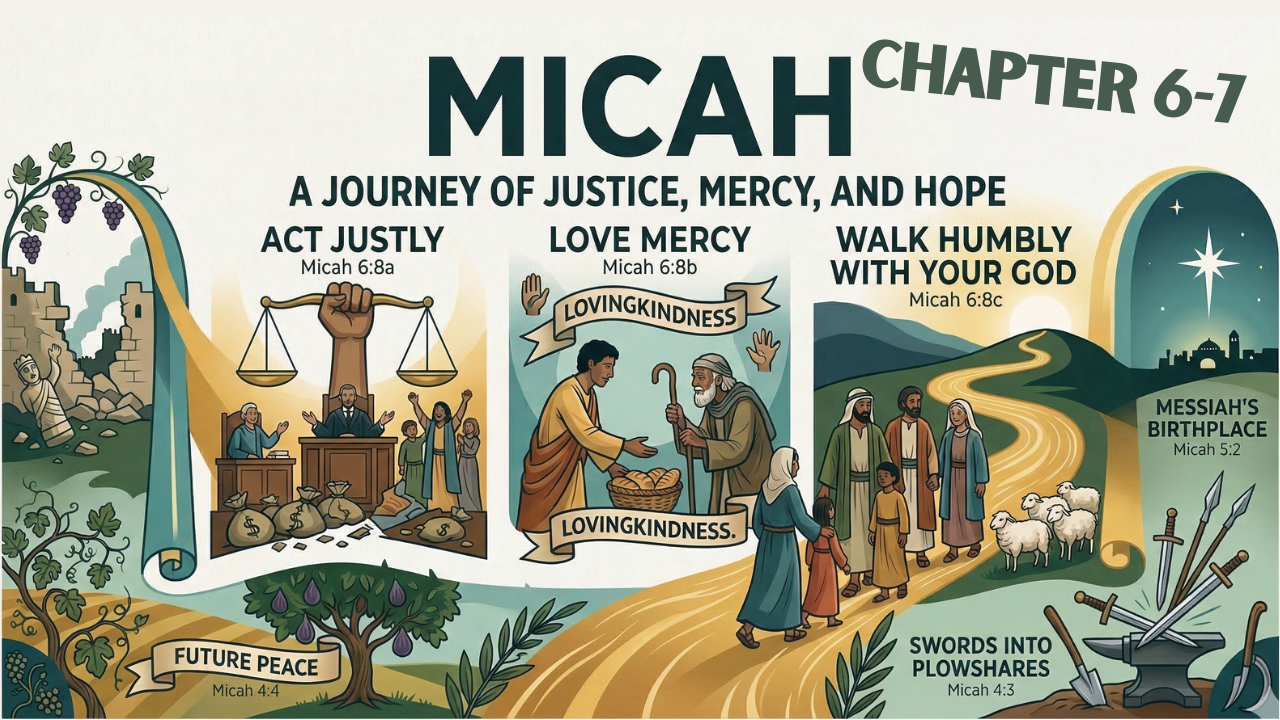
Micah Chapter 6-7 Class 4 - Bible Study
On April 23, 2026, our class explored Micah 6–7, God’s deliverance from Egypt, the legacies of Omri/Ahab/Jezebel, Balaam and Balak, Elijah’s gentle whisper, and Jesus’ teaching on allegiance and endurance—emphasizing justice, mercy, humility, and trust in God’s protecting purposes.
Micah Intro and Chapter 6-7
This is our 4th class on Micah
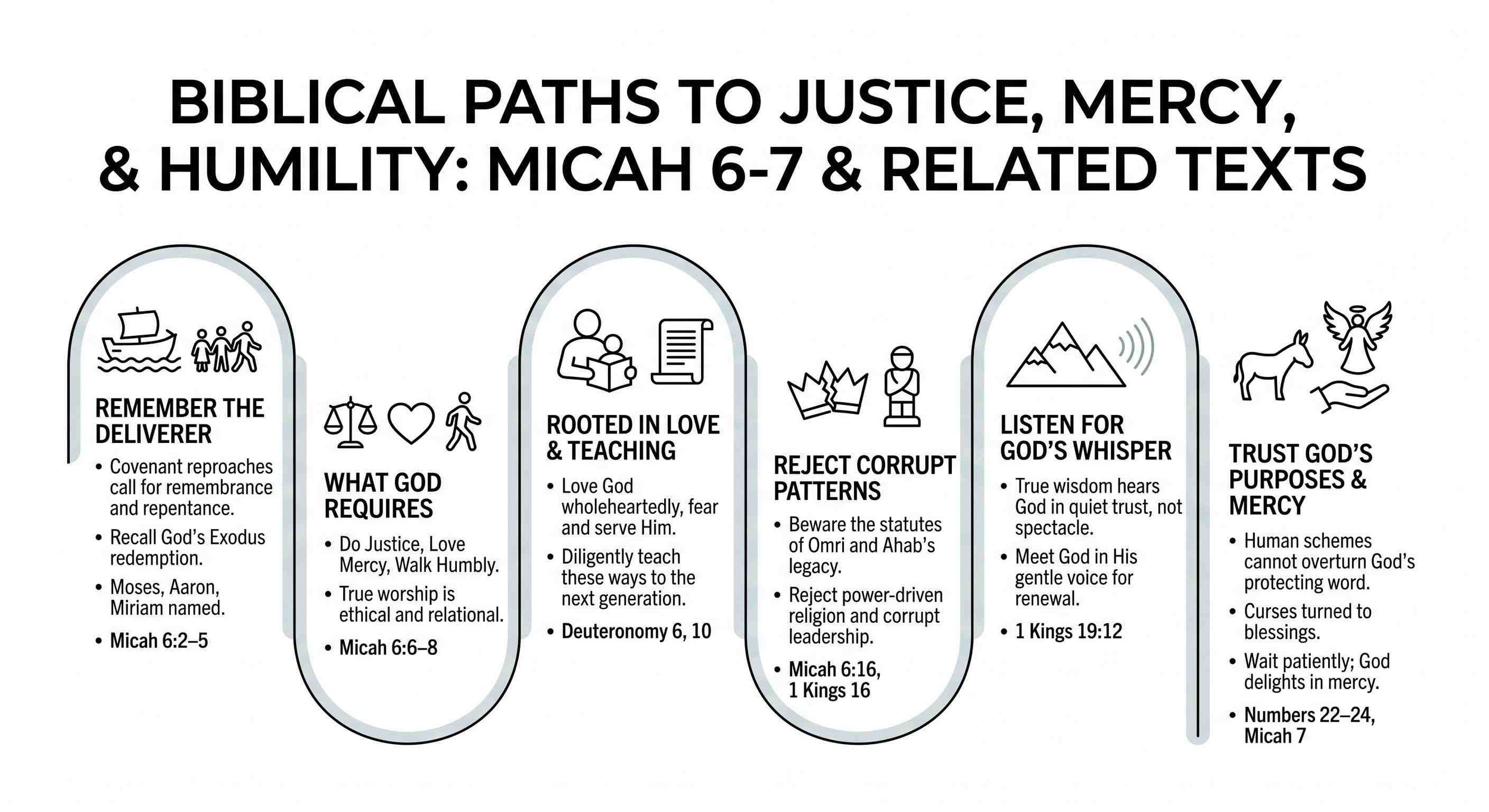
This is an AI Recap of the class.
Some things may be incorrect.
Short Summary of the Whole Class
On April 23, 2026, we traced a biblical thread from Micah 6–7 through Numbers, 1–2 Kings, Deuteronomy, and the Gospels. We reflected on God’s covenant complaint and Exodus deliverance (Micah 6), the warning of Omri/Ahab/Jezebel’s corrupt statutes, Balaam and Balak’s failed cursing scheme, and Elijah’s renewal in God’s gentle whisper. We connected Micah’s call—do justice, love mercy, walk humbly—to Deuteronomy’s love-and-teach foundation and Jesus’ words about allegiance and endurance amid familial and societal conflict (Matthew 10; Mark 13). We concluded that true wisdom remembers God the Deliverer, rejects power-driven corruption, listens for God’s quiet voice, and lives justice and mercy in faithful trust.
Walk-through Summary with Section-by-Section Notes
1) Micah’s “Reproaches” and God’s Complaint
Discussion:
We opened with Micah’s covenant lawsuit: “Hear, O you mountains, the Lord’s complaint” (Micah 6:2), evoking Good Friday-style “reproaches” (“O my people… what have I done to you?”).
God identifies Himself as the Deliverer who brought Israel out of Egypt, naming Moses, Aaron, and Miriam (Micah 6:4), and recalling Balak and Balaam (Micah 6:5).
Theme:
Remembering God’s faithful deliverance exposes our forgetfulness and calls us to return to covenant obedience.
Verses:
Micah 6:2–5.
Stories:
Exodus remembrance (Moses, Aaron, Miriam).
Short summary of this section:
God summons His people to remember the Exodus and His faithfulness, grounding repentance in the memory of deliverance.
2) What God Requires: Justice, Mercy, and Humility
Discussion:
We wrestled with “What’s enough for God?” and landed on Micah 6:8—do justice, love mercy, walk humbly—over performative religion.
We noted how Scripture itself demands justice and mercy, not mere ritual.
Theme:
True worship is ethical and relational; it shows up in how we treat others made in God’s image.
Verses:
Micah 6:6–8.
Stories:
Ethical living illustrations; contrast with empty ritual (no single narrative focus).
Short summary of this section:
God desires hearts and lives of justice, mercy, and humble walking with Him, not outward show.
3) Deuteronomy’s Foundation: Love God and Teach Diligently
Discussion:
We linked Micah’s call to Deuteronomy’s heart: fear, love, and serve the Lord (Deut 10:12), and the Shema’s call to teach children diligently (Deut 6:4–7).
Emphasis on shaping the next generation amid modern distractions.
Theme:
Wholehearted love for God and diligent discipleship at home form the backbone of faithful living.
Verses:
Deuteronomy 10:12; Deuteronomy 6:4–7.
Stories:
Family discipleship practices (conceptual, not narrative).
Short summary of this section:
From the beginning, God called His people to wholehearted love and to teach these ways diligently to the next generation.
4) Omri, Ahab, and Jezebel: Foundations of Decline
Discussion:
We examined how Omri’s political strategies led into Ahab and Jezebel’s Baal worship (1 Kings 16), illuminating Micah 6:16’s “statutes of Omri” and “works of Ahab’s house.”
Highlight: Ahab “did more evil than all before him” (1 Kings 16:30–33).
Theme:
Societal decline follows when leaders and people embrace idolatrous counsel and corrupt patterns.
Verses:
1 Kings 16:25–33; Micah 6:16.
Stories:
Ahab and Jezebel’s marriage alliance and the national turn to Baal.
Short summary of this section:
Micah condemns both corrupt leadership and complicit people, warning that shared compromise invites desolation.
5) Elijah’s Encounter with God’s Gentle Voice
Discussion:
We previewed Elijah’s conflict with Ahab and Jezebel and focused on his renewal: God was not in wind, earthquake, or fire but in a gentle whisper (1 Kings 19:12).
Application: Listen attentively for God’s quiet guidance amid turmoil.
Theme:
True wisdom hears God in quiet trust rather than in spectacle.
Verses:
1 Kings 19:12 (with context).
Stories:
Elijah’s flight, discouragement, and renewal at Horeb.
Short summary of this section:
Elijah’s story shows faithful resilience arises from meeting God in His gentle voice.
6) Balaam and Balak: Attempts to Curse God’s People
Discussion:
We revisited Numbers 22–24: Balak summons Balaam at Moab to curse Israel; the angel blocks Balaam; the talking donkey episode; Balaam can only speak what God gives—resulting in blessing, not curse.
Micah 6:5 recalls this event to underscore God’s protecting purposes.
Theme:
God’s word and purposes stand; He turns intended curses into blessing.
Verses:
Numbers 22–24 (esp. 22:21–35); Micah 6:5.
Stories:
Balak’s summons; Balaam’s donkey and angel; Balaam’s oracles of blessing.
Short summary of this section:
Human schemes cannot overturn God’s purposes; He protects His people and transforms curses into blessings.
7) Micah 7: Corruption, Lament, and Hope in Mercy
Discussion:
Micah 7:1–7 depicts societal breakdown—bribes, betrayal—even within households; counsel: trust God, not human alliances.
Micah 7:7–9: like Job, wait on the Lord, confess, and trust God to plead our case and bring light.
Micah 7:18–20: God delights in mercy, subdues iniquity, and casts sins into the sea.
Theme:
In pervasive injustice, the faithful posture is repentance, patience, and confident hope in God’s mercy and vindication.
Verses:
Micah 7:1–7; 7:7–9; 7:18–20; (also 7:13, 7:16 noted in discussion of consequences and humbled nations).
Stories:
Job’s posture (thematic reference).
Short summary of this section:
Micah moves from stark lament to radiant hope—God’s final word is mercy and restoration.
8) Jesus on Allegiance and Endurance: Echoes of Micah
Discussion:
Matthew 10:26–36: Jesus prepares disciples for public allegiance and division within families (echoing Micah 7:6), not as a call to violence but a sober cost of discipleship.
Mark 13:10–13: the gospel to all nations, Spirit-given words in trials, endurance to the end; connected with our anticipation of Mark 13:1–10’s challenge to temple-centered confidence.
Theme:
Discipleship may divide loyalties and invite opposition; rely on the Spirit and endure in faithful witness.
Verses:
Matthew 10:26–36; Mark 13:10–13; preview connection to Mark 13:1–10.
Stories:
Jesus sending the disciples; early Christian witness under pressure (conceptual).
Short summary of this section:
Jesus reframes power and peace: allegiance to Him brings conflict, but the Spirit sustains endurance and faithful testimony.
9) Application: Remember the Deliverer and Reject Corrupt Patterns
Discussion:
We tied Micah’s call—remember the Exodus and Balaam/Balak—to our context: reject the “statutes of Omri,” avoid baptizing power with religious language, and live justice, mercy, and humility.
Question: Are we building bigger temples—or building obedient hearts that remember and reflect God’s deliverance?
Theme:
Identity and allegiance—live as a people formed by the Deliverer’s mercy rather than by cultural or political idols.
Verses:
Micah 6:4–5; 6:16; Numbers 22–24; 1 Kings 16; 1 Kings 19:12; Micah 7 selections; Matthew 10; Mark 13.
Stories:
Exodus memory; Omri/Ahab decline; Elijah’s whisper; Balaam’s thwarted curse; disciples sent amid conflict.
Short summary of this section:
True wisdom is lived remembrance—reject corrupt counsels and embody God’s justice, mercy, and humble trust.
Medium-Length Summary of the Class
On April 23, 2026, we centered on Micah 6–7, where God summons creation to hear His complaint and calls His people to remember the Exodus. We linked Micah’s “reproaches” to the warning against the “statutes of Omri” and the corrupt legacy of Ahab and Jezebel (1 Kings 16). We saw Elijah’s renewal in God’s gentle whisper (1 Kings 19:12) as a model for quiet, attentive faith. Returning to Numbers 22–24, we recalled how Balaam could only bless what Balak sought to curse, underscoring God’s protecting word (Micah 6:5). Deuteronomy 6 and 10 anchored this in love for God and diligent teaching of the next generation. Reading Jesus’ words in Matthew 10 and Mark 13, we recognized that allegiance to Christ may divide families and invite persecution, yet the Spirit sustains enduring witness. Across these texts, the class emphasized that God the Deliverer defines His people, His mercy triumphs over sin (Micah 7:18–20), and His purposes outlast human schemes—calling us to reject corrupt patterns, listen for His gentle voice, and live justice, mercy, and humility.
Main Points
God’s covenant “reproaches” call us to remember His Exodus deliverance and repentant return (Micah 6:2–5).
What God requires is clear: do justice, love mercy, walk humbly (Micah 6:8).
Deuteronomy roots faith in wholehearted love for God and diligent teaching of children (Deut 6; 10).
The “statutes of Omri” and Ahab/Jezebel’s legacy warn against adopting corrupt counsel (Micah 6:16; 1 Kings 16).
Elijah’s renewal came through God’s gentle whisper—wisdom listens in quiet trust (1 Kings 19:12).
Balaam and Balak show that God protects His people and turns curses into blessing (Numbers 22–24; Micah 6:5).
Jesus prepares disciples for allegiance amid division and persecution; rely on the Spirit and endure (Matthew 10; Mark 13).
Application: Reject power-driven religion and live as a people shaped by God’s saving acts—justice, mercy, humility.
Bible Scriptures Mentioned
Micah 6:2–5; Micah 6:6–8; Micah 6:16
Micah 7:1–7; Micah 7:7–9; Micah 7:18–20 (with 7:13, 7:16 noted)
Numbers 22–24 (esp. 22:21–35)
1 Kings 16:25–33
1 Kings 19:12 (with context)
Deuteronomy 6:4–7
Deuteronomy 10:12
Matthew 10:26–36
Mark 13:10–13 (and preview of 13:1–10)
Stories Discussed
Exodus remembrance: God bringing Israel out of Egypt; leadership of Moses, Aaron, and Miriam.
Omri’s political legacy and Ahab/Jezebel’s turn to Baal worship (1 Kings 16).
Elijah’s encounter with God’s gentle whisper (1 Kings 19).
Balaam and Balak: the talking donkey, the angel’s intervention, and blessing over cursing (Numbers 22–24).
Jesus sending the disciples and teaching on allegiance, conflict, and endurance (Matthew 10; Mark 13).
Content creation date: 2026-04-23 14:43:13
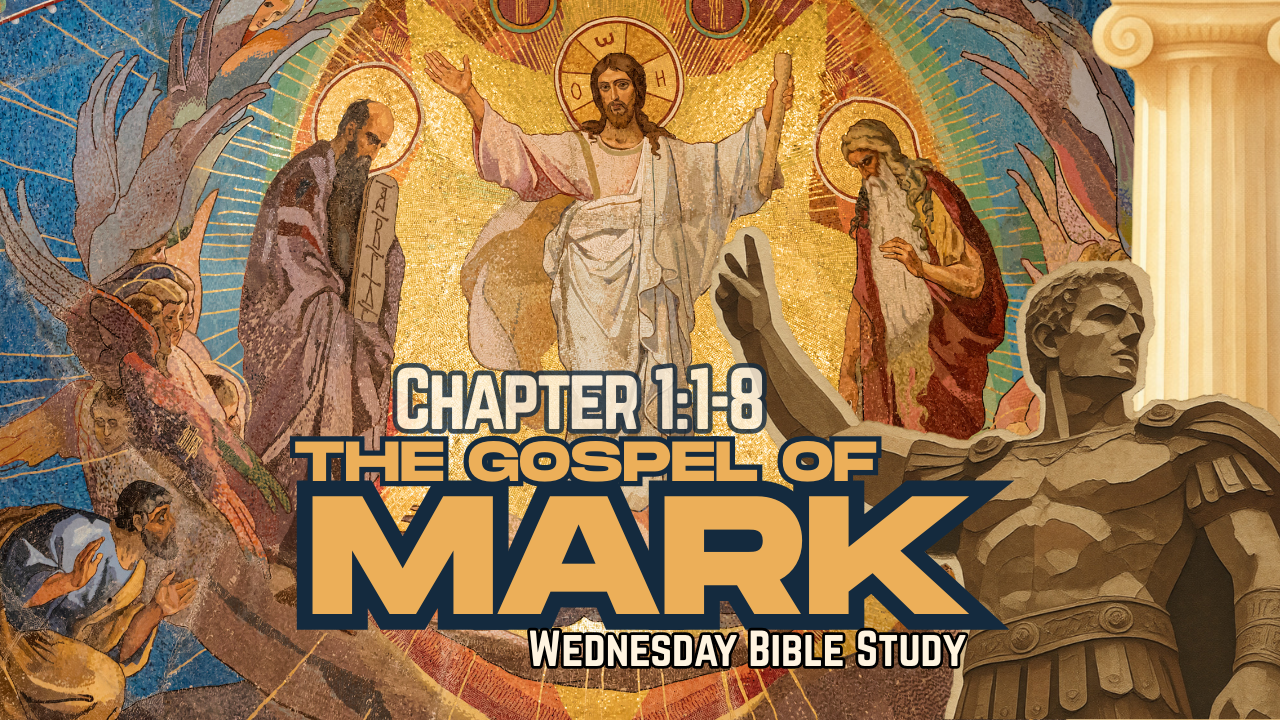
Mark Chapter 1:1-8 Class 1 - Wednesday Bible Study
A fast-moving, beginner-friendly study launched our journey through Mark 1:1–28—framing the Bible as literature from an oral tradition, exploring John the Baptist, Jesus’ baptism and temptation, the first disciples’ call, and Jesus’ authoritative teaching and exorcism.
Gospel of Mark Intro and Chapter 1:1-8
This is our 1st class on Mark
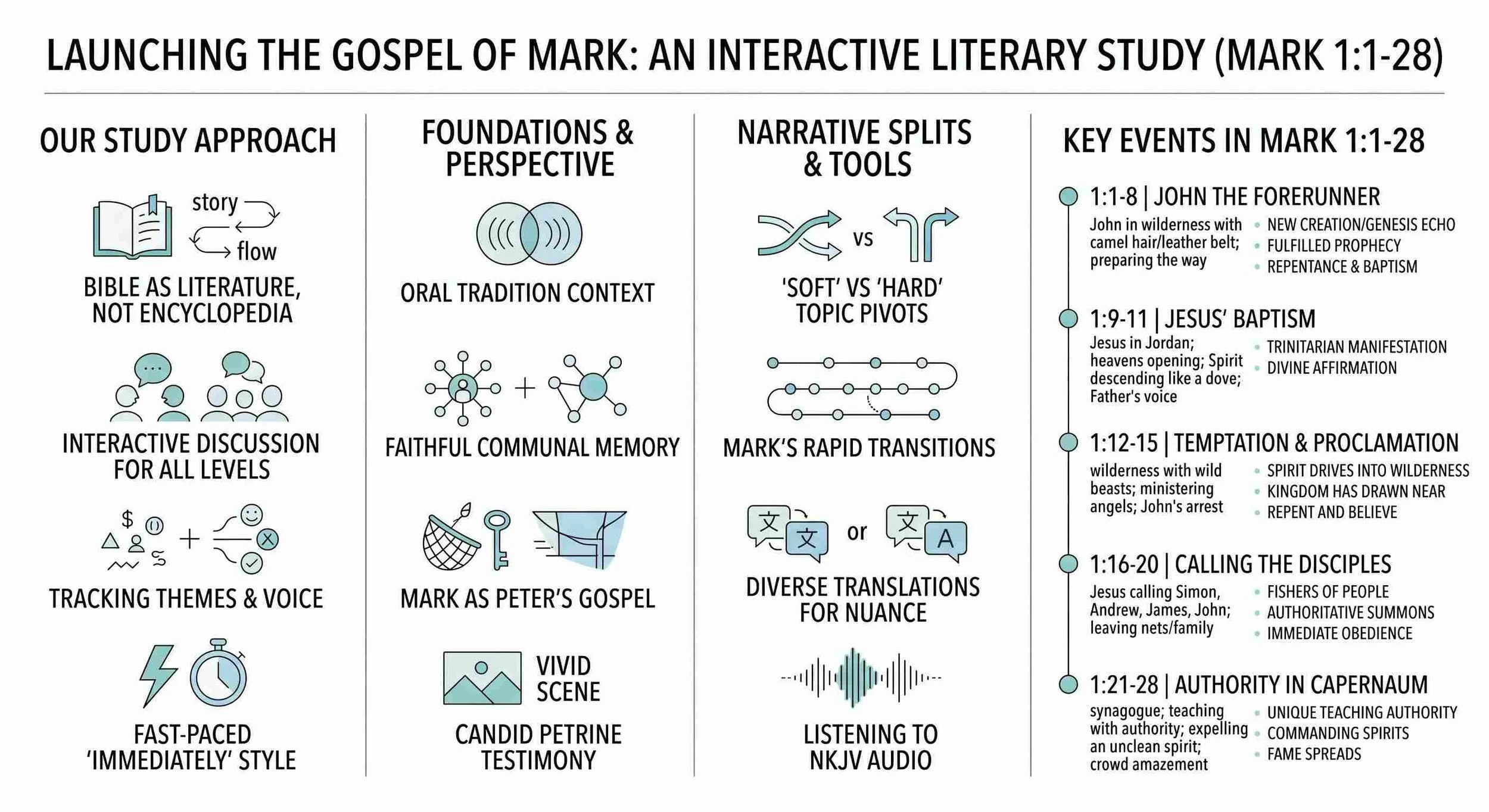
This is an AI Recap of the class.
Some things may be incorrect.
Short summary of the whole class
On 2026-04-22 at 18:32:01, we opened an interactive Gospel of Mark study that treats Scripture as inspired literature shaped by human voices within an oral tradition. We then read Mark 1:1–28, noting fulfilled prophecy in John the Baptist’s wilderness ministry, the Trinitarian revelation at Jesus’ baptism, the brief but urgent temptation account, the immediate call of the first disciples, and Jesus’ authoritative teaching and deliverance in Capernaum. Along the way we tracked Mark’s rapid “immediately” pace, soft and hard narrative splits, translation nuances, and themes of authority, repentance, and the Kingdom’s nearness.
Class walkthrough with section-by-section summaries, verses, and stories
1) Welcome, ground rules, and study approach
What we discussed:
Questions are encouraged; discussion is for newcomers and experienced readers alike.
Read the Bible as literature, not an encyclopedia; learn a practical framework for reading.
Mark is fast-paced; we’ll watch for themes and narrative breaks (“soft” vs “hard” splits).
Stories/examples:
Class context and Chris’s prior experience leading Mark.
Bible scriptures mentioned:
None directly cited.
Short section summary:
We set an interactive, theme-driven approach to reading Mark that welcomes all levels of experience.
2) What is the Bible? Literature, not an encyclopedia
What we discussed:
The Bible is a diverse, inspired library shaped by human authors and contexts.
Expect authorial voice; we’ll learn to “hear” Mark and later assess whether Mark’s traditional ending fits his voice.
Stories/examples:
Literary analogy: loaded phrases gain meaning from the whole story.
Bible scriptures mentioned:
None directly cited.
Short section summary:
We will read Scripture as narrative literature where context and authorial voice shape meaning.
3) Literary themes and the “Boy Who Lived” analogy
What we discussed:
Themes accumulate significance across a narrative; single phrases carry weight because of the whole.
Our study lets themes—not isolated proof texts—drive interpretation.
Stories/examples:
Harry Potter’s “the boy who lived” as a motif analogy.
Bible scriptures mentioned:
None directly cited.
Short section summary:
Meaning in Mark emerges from recurring themes and the unfolding story rather than isolated verses.
4) The Bible in an oral tradition versus our written (and changing) culture
What we discussed:
Gospels arose in communal oral tradition; variations reflect faithful memory, not error.
Our era is shifting again (digital/AI) from purely written conventions.
Stories/examples:
Player piano donation that caught fire (community memory/retelling).
Joke-telling as a living oral tradition.
Bible scriptures mentioned:
None directly cited.
Short section summary:
Understanding oral tradition helps us read Gospel differences as faithful communal memory.
5) Reading Mark with “soft splits” and “hard splits”
What we discussed:
Soft split: same topic with shifting anecdotes; hard split: pivot to a new topic.
Mark’s hallmark pace (“immediately”) requires attention to transitions.
Stories/examples:
Roller coaster marathon (82 rides) and pivot to hotels—illustrating split types.
Bible scriptures mentioned:
None directly cited (preparing to read Mark).
Short section summary:
We will track Mark’s rapid transitions to see how scenes connect or pivot to new themes.
6) Authorship and perspective: Mark as Peter’s gospel
What we discussed:
Traditional view: Mark (John Mark) captures Peter’s preaching.
Mark’s tough portrayal of Peter may reflect Peter’s own self-critical testimony.
Stories/examples:
Broad references to Peter’s denials.
Bible scriptures mentioned:
Anticipation of Peter narratives in Mark; no verses read yet.
Short section summary:
Expect a Petrine flavor: vivid, urgent storytelling and candid treatment of Peter.
7) Translations, versions, and why we’ll listen to NKJV
What we discussed:
Plan: hear dramatized NKJV while participants follow in various translations (NIV, ESV, NRSV, NASB, Complete Jewish Study Bible).
Interlinear demo shows why translation isn’t one-to-one; wording choices matter.
Stories/examples:
Panama “caliente” nuance—language differences can mislead.
Bible scriptures mentioned:
Interlinear preview for Mark 1:1.
Short section summary:
Diverse translations and NKJV audio will sharpen attention to wording, flow, and nuance.
8) Housekeeping and launch into Mark 1
What we discussed:
Flag significant translation differences.
Light humor about tests and AI notes; begin reading Mark 1:1–(TBD).
Stories/examples:
Class logistics and humor.
Bible scriptures mentioned:
Plan to read Mark 1:1–(TBD).
Short section summary:
With expectations set, we launched into reading Mark 1 together.
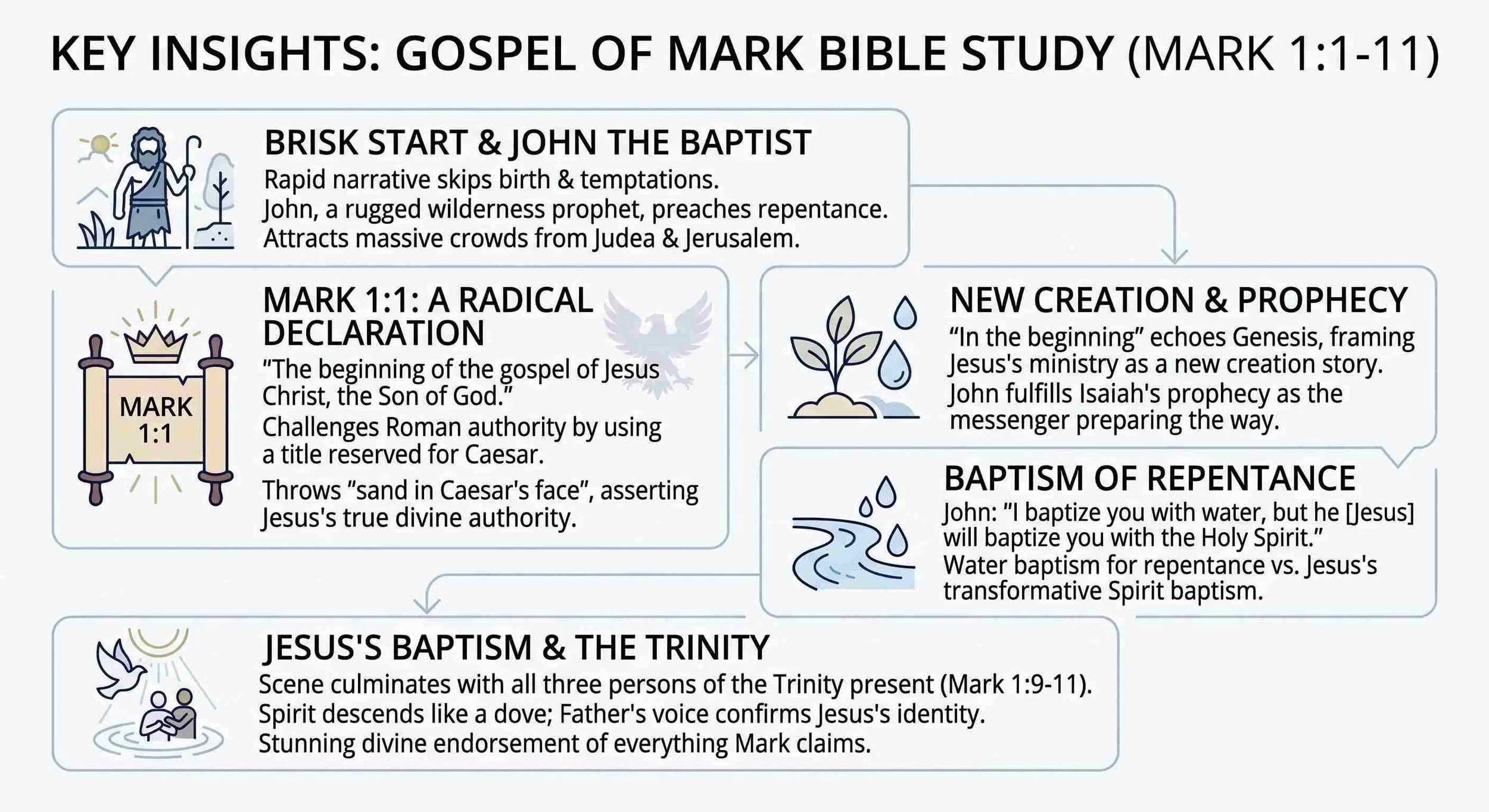
9) Mark’s opening and prologue themes (Mark 1:1–8)
What we discussed:
Mark 1:1 echoes Genesis 1 (“beginning”), framing Jesus’ story as new creation.
“Gospel” (euangelion) as real good news; subverts Roman imperial “good news” of Caesar, the so‑called “son of god.”
Textual note: some manuscripts omit “Son of God,” but the tradition is strong.
Prophetic setup (Isaiah/Malachi): a forerunner prepares the Lord’s way; John appears in the wilderness preaching repentance and baptizing.
John’s attire and diet (camel’s hair, leather belt, locusts, wild honey) evoke Elijah and prophetic austerity.
“Baptize” as “plunge/immerse”; John contrasts his water baptism with Jesus’ Spirit baptism.
Stories/examples:
Roman imperial announcements (“good news” of Caesar).
Dead Sea Scrolls reference (textual reliability).
Jokes about honey-dipped locusts; John’s rugged lifestyle.
Bible scriptures mentioned:
Mark 1:1–8; Isaiah 40:3; Malachi 3:1; Genesis 1:1 (echo); Isaiah 44:3 (Spirit poured out).
Short section summary:
Mark inaugurates a new-creation good news centered on Jesus, fulfills prophecy through John’s wilderness call, and anticipates Jesus’ Spirit baptism.
10) Jesus’ baptism and Trinitarian manifestation (Mark 1:9–11)
What we discussed:
Jesus is baptized; heavens open; Spirit descends like a dove; Father declares, “You are my beloved Son.”
All three Persons of the Trinity are present.
Stories/examples:
The baptism scene and divine affirmation.
Bible scriptures mentioned:
Mark 1:9–11.
Short section summary:
The Father and Spirit publicly affirm Jesus’ identity at the launch of His ministry.
11) Temptation and Kingdom proclamation (Mark 1:12–15)
What we discussed:
“Immediately” the Spirit drives Jesus into the wilderness for forty days; tempted by Satan; wild beasts; angels minister.
After John’s arrest, Jesus proclaims: “The time is fulfilled… repent and believe in the gospel.”
Contrast between Jesus’ hopeful call and Pharisaic condemnations.
Stories/examples:
Wilderness testing and ministering angels.
Bible scriptures mentioned:
Mark 1:12–15.
Short section summary:
Tested yet sustained, Jesus begins with an urgent call to repentance and faith because God’s Kingdom has drawn near.
12) Calling the first disciples (Mark 1:16–20)
What we discussed:
Jesus calls Simon (Peter) and Andrew; then James and John; they immediately leave nets and family business.
“Fishers of men/people”: inclusive sense (anthrōpōn).
Mark’s repeated “immediately” underscores Jesus’ authority and their decisive obedience.
Stories/examples:
Fishermen abandoning their work to follow Jesus.
Bible scriptures mentioned:
Mark 1:16–20; Mark 1:17 (inclusive “people” note).
Short section summary:
Ordinary workers respond at once to Jesus’ authoritative summons, reoriented toward gathering people.
13) Teaching with authority and casting out an unclean spirit (Mark 1:21–28)
What we discussed:
In Capernaum’s synagogue, Jesus teaches with authority—unlike the scribes.
An unclean spirit recognizes Him; Jesus rebukes and expels the demon.
Crowd marvels: a new teaching with authority; fame spreads quickly.
Stories/examples:
Synagogue exorcism; public amazement at Jesus’ words and works.
Bible scriptures mentioned:
Mark 1:21–28.
Short section summary:
Jesus’ authority appears in both word and deed, confronting evil and signaling the inbreaking Kingdom.
Medium-length final summary of the class
On 2026-04-22 at 18:32:01, we launched an interactive study of the Gospel of Mark built on reading Scripture as inspired literature emerging from an oral tradition. We introduced tools for tracking Mark’s rapid pace, including “soft” and “hard” narrative splits, and discussed authorship with a likely Petrine voice. After previewing translation nuances and listening to NKJV audio alongside various translations, we read Mark 1:1–28. Mark’s opening echoed Genesis and subverted Roman “good news,” proclaiming Jesus as the true Son of God. Prophecy set the stage for John the Baptist’s wilderness ministry of repentance, whose ascetic profile evoked Elijah. Jesus’ baptism revealed the Trinity together, followed by His brief but urgent temptation account and His inaugural proclamation that the Kingdom has drawn near, calling for repentance and belief. Jesus’ authority compelled immediate obedience from the first disciples and astonished crowds in Capernaum as His teaching and exorcism demonstrated power over unclean spirits. Throughout, we emphasized themes of authority, urgency, repentance, fulfillment, and Spirit outpouring, preparing to continue reading Mark with careful attention to voice, themes, and transitions.
Main points
The Bible is an inspired, humanly authored library to be read as literature within its oral-tradition context.
Mark’s Gospel moves with urgency (“immediately”) and requires attention to soft/hard narrative splits.
Mark 1:1 echoes Genesis and subverts Roman imperial “good news,” proclaiming Jesus as the true Son of God.
Prophetic promises (Isaiah/Malachi) frame John the Baptist as the wilderness forerunner calling Israel to repent.
Jesus’ baptism publicly reveals the Trinity; His identity is affirmed by the Father and Spirit.
The temptation account is brief but shows testing and God’s care; Jesus begins with a concise Kingdom proclamation.
Jesus’ authoritative call reorients ordinary people into mission (“fishers of people”).
Jesus teaches with unique authority and commands unclean spirits, signaling the inbreaking Kingdom.
Translation nuances matter; hearing NKJV dramatized while reading various translations clarifies wording and flow.
We will later evaluate whether Mark’s traditional ending aligns with his established voice.
Bible scriptures mentioned
Mark 1:1–28 (primary passage)
Mark 1:1 (interlinear preview; textual variant “Son of God”)
Mark 1:2–3 (prophetic citation)
Mark 1:4–8 (John’s ministry; baptism of repentance)
Mark 1:9–11 (Jesus’ baptism; Trinitarian manifestation)
Mark 1:12–13 (temptation; wilderness; angels)
Mark 1:14–15 (Kingdom proclamation)
Mark 1:16–20 (call of the first disciples; “fishers of people”)
Mark 1:21–28 (teaching with authority; exorcism in Capernaum)
Genesis 1:1 (echoed in Mark’s opening)
Isaiah 40:3 (voice in the wilderness; prepare the way)
Malachi 3:1 (messenger prepares the Lord’s way)
Isaiah 44:3 (Spirit poured out)
Stories and illustrations mentioned
Harry Potter’s “the boy who lived” (theme analogy)
Player piano donation that caught fire (oral memory/retelling)
Joke-telling as an example of oral tradition
Roller coaster marathon (82 rides) and hotel pivot (soft vs hard splits)
Panama “caliente” translation mishap (language nuance)
Roman imperial “good news” of Caesar, the “son of god”
John the Baptist’s wilderness lifestyle (camel’s hair, leather belt, locusts, wild honey)
Jesus’ baptism in the Jordan and divine affirmation
Jesus’ temptation with wild beasts and ministering angels
Fishermen leaving nets and family business to follow Jesus
Synagogue exorcism in Capernaum; crowd astonishment at Jesus’ authority
Content creation date for this summary: 2026-04-22 18:32:01
![Mark [Wednesday Bible Study]](https://images.squarespace-cdn.com/content/v1/5852f18a20099e30cd2c01dc/ba6ca3bb-2b74-4e61-a480-be2a15a0af81/Bible+Study+2+%282%29.jpg)
Mark [Wednesday Bible Study]
"While the Gospel of Mark is the shortest, it is the most direct; it reveals that the true Son of God is found not in our desires for power, but in the God who comes in humility to amaze us all."
"While the Gospel of Mark is the shortest, it is the most direct; it reveals that the true Son of God is found not in our desires for power, but in the God who comes in humility to amaze us all."
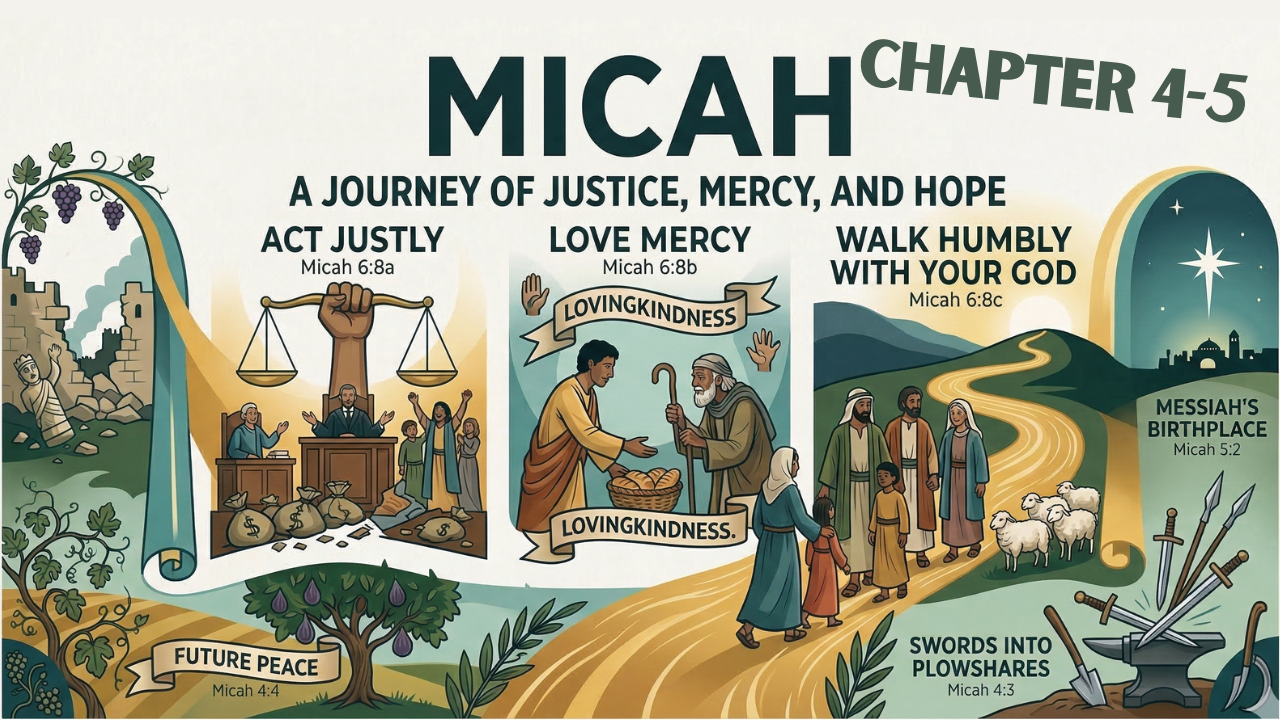
Micah Chapter 4-5 Class 3 - Bible Study
A lively study of Micah 4–5 connected the Minor Prophets to Isaiah, Revelation, and Jesus’ ministry, highlighting God’s consistent character, peace over violence, care for the outcast, and the Bethlehem shepherd-king whose reign blesses all nations.
Micah Intro and Chapter 4-5
This is our 3rd class on Micah
This is an AI Recap of the class.
Some things may be incorrect.
Short summary of the whole class
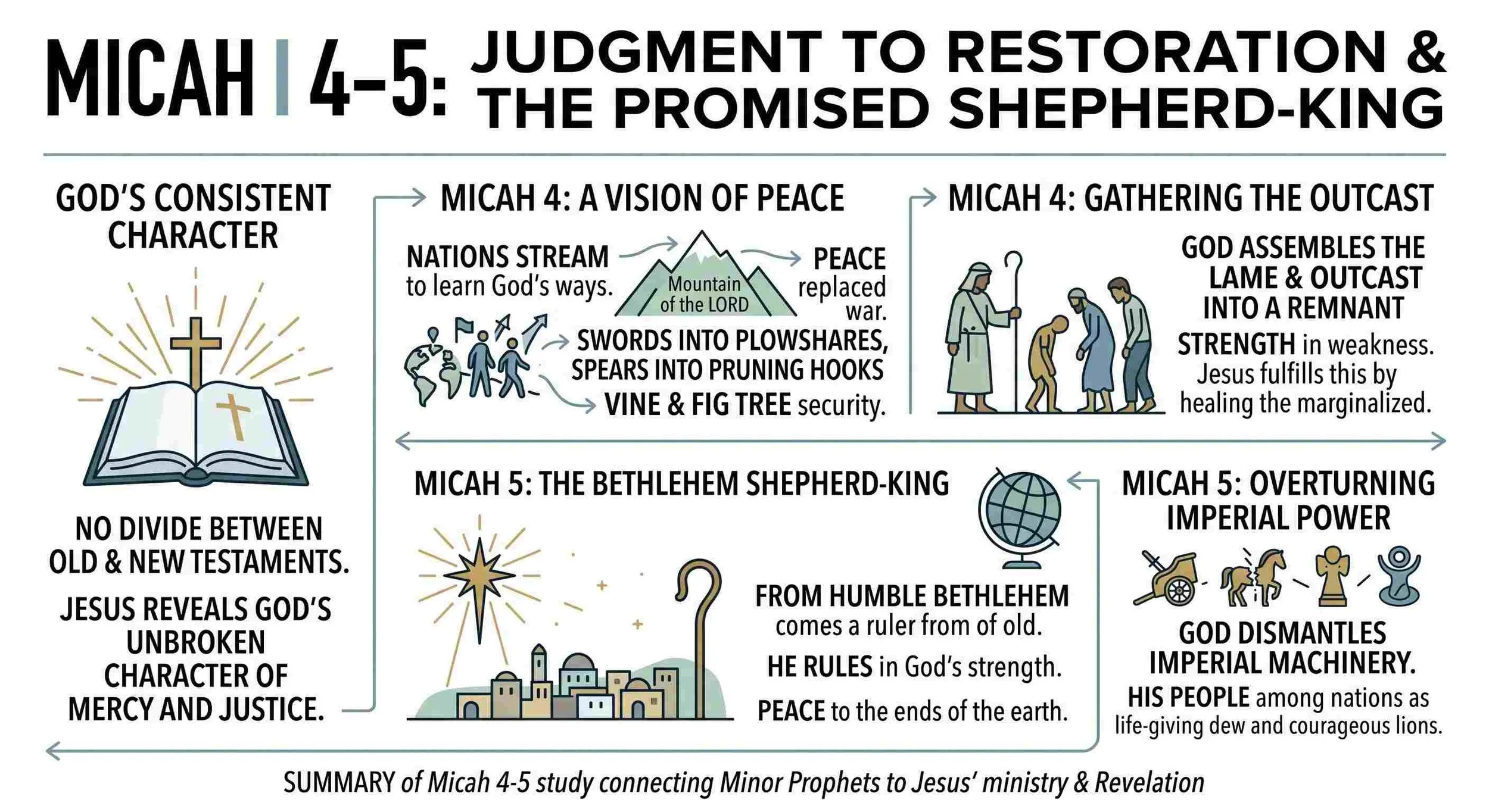
We read Micah 4–5 and traced a law-and-gospel rhythm from judgment to restoration. We explored God’s unbroken character across the Old and New Testaments; the mountain of the LORD and nations streaming; swords into plowshares; vine-and-fig-tree peace; exile and redemption; gathering the lame and outcast into a remnant; and the promised ruler from Bethlehem who shepherds in God’s strength and brings peace to the ends of the earth. We connected Micah to Isaiah 2, Revelation’s New Jerusalem and witness theme, Jesus’ ministry (including the temple cleansing and fig tree), Eden echoes, Jacob’s limp, Exodus’ overthrow of empire, and Luke’s census framing Jesus as David’s faithful heir.
Walkthrough and discussion highlights, with section summaries
Opening recap and theme-setting
We noted our prior stopping point (Micah 2–3) and began Micah 4, with some discussion reaching into Micah 5.
Observation that Micah (with Amos and Joel) “sounds like Revelation,” suggesting intertextual prophetic echoes.
Core conviction: no divide between the God of the Old and New Testaments; Jesus reveals God’s consistent character.
The Minor Prophets’ cadence mirrors law-and-gospel: exposing injustice, then promising restoration.
Short summary of this section:
We framed Micah 4 within Scripture’s larger arc, emphasizing God’s continuity, Revelation echoes, and a law-and-gospel approach.
Bible verses and stories:
Micah 2–3 (context)
Revelation (prophetic echoes)
Reading Micah 4:1–8 aloud
“Latter days,” exalted mountain of the LORD; nations streaming to learn God’s ways.
Signature imagery: swords into plowshares, spears into pruning hooks; no more learning war; everyone under vine and fig tree.
God gathers the lame and outcast as a strong remnant; the LORD reigns from Zion; “Tower of the Flock” and restoration to Daughter of Jerusalem.
Short summary of this section:
Micah 4 paints a peace-filled future where God’s teaching spreads, empires disarm, people flourish, and the marginalized are gathered and strengthened.
Bible verses and stories:
Micah 4:1–8
Exile, deliverance, and threshing (Micah 4:9–13)
Zion in labor pains; going to Babylon yet promised redemption.
Enemies misread God’s counsel; Zion told, “Arise and thresh” with iron horns/bronze hooves; gains consecrated to the LORD.
Short summary of this section:
Exile is a painful prelude, not the end; God redeems and repurposes His people’s struggle toward His consecrated victory.
Bible verses and stories:
Micah 4:9–13
Immediate reactions: battle and peace
Tension noted between God sending to battle and the broader vision of peace.
Reframing: Micah juxtaposes human conflict with God’s ultimate peace.
Short summary of this section:
Conflict appears in the storyline, but God’s horizon is transformative peace that turns weapons into tools for cultivation.
Bible verses and stories:
Micah 4 themes (peace, transformation)
“Daughter of Zion” and city-as-feminine language
“Daughter of Zion” personifies Jerusalem in feminine terms—a poetic address signaling care and restoration.
Short summary of this section:
“Daughter of Zion” is Scripture’s tender, corrective way of speaking to Jerusalem as a people God loves and will restore.
Bible verses and stories:
Micah 4 (usage of “Daughter of Zion”)
“Nations” and “Gentiles,” “LORD” and “Adonai”
“Nations/Gentiles” highlights inclusion beyond Israel.
“LORD” (small caps) renders the divine name YHWH; Jewish tradition reads “Adonai.”
How “Jehovah” arose via vowel-pointing.
Short summary of this section:
Translation choices shape meaning: the global scope of salvation and the reverent handling of God’s name.
Bible verses and stories:
Micah 4:1–3 (nations/Gentiles)
Notes on divine name usage
“Torah” vs. “Law,” and gospel as “good news”
“Torah” conveys covenantal instruction and saving story, not merely rules.
“Gospel” means good news (euangelion), not another law.
Torah includes God’s saving acts (Abraham, Exodus).
Short summary of this section:
God’s “law/Torah” is a way to walk shaped by His saving story, complemented by the gospel’s good news.
Bible verses and stories:
Micah 4:2 (“law/Torah” goes forth)
Allusions to Abraham’s call and the Exodus
Jesus present in the Old Testament and the continuity of God
Affirmation of the Son’s presence before the Incarnation; a Christ-centered reading of Micah.
Short summary of this section:
Micah’s voice aligns with Jesus’ revelation of God, grounding a Christological reading across Scripture.
Bible verses and stories:
Creation/Trinity allusion (Genesis)
Cross, temple, and Revelation echoes
Micah 3’s critique of corrupt leadership sets up Micah 4’s hope.
Jesus as true temple; Revelation’s descent of God’s dwelling.
Strong parallels to Isaiah 2’s mountain and plowshares imagery; intertextual, not derivative.
Short summary of this section:
From judgment on corruption to God’s restored dwelling, Micah 4 mirrors Isaiah 2 and foreshadows Revelation, centered on Jesus’ temple-fulfillment.
Bible verses and stories:
Micah 3; Micah 4:1–4
Isaiah 2:1–4
Revelation (New Jerusalem)
Walking God’s paths: peace, fruitfulness, and fig tree imagery
“Teach us His ways; walk in His paths” reframes law as lived wisdom.
Peace: tools of war become tools for cultivation; vine and fig tree rest.
Eden echoes of shade and fruit; Jesus’ fig tree sign warns against fruitlessness.
Short summary of this section:
God’s way leads to peace and true fruitfulness from Eden to the Gospels, contrasting performative power with Spirit-born fruit.
Bible verses and stories:
Micah 4:2–4
Matthew 21:18–22; Mark 11:12–14, 20–25 (fig tree)
Genesis 2–3 (Eden)
Gathering the lame and the remnant; witness and martyr
God assembles the lame/outcast into a strong remnant (Micah 4:6–7).
Revelation’s “witness” (martys) theme: faithful testimony often through weakness.
Warning against triumphalist “remnant” rhetoric.
Short summary of this section:
God perfects strength in weakness, forming a humble remnant whose witness aligns with the Lamb’s people in Revelation.
Bible verses and stories:
Micah 4:6–7
Revelation (witness/martyr motif)
Micah 4:6–8 — God gathers the lame and outcast (focus)
Hebrew tie between “lame” and Jacob’s limp (Genesis 32), dignifying weakness.
Contrast of ways: nations walk in their gods’ names, God’s people in the LORD’s name.
Short summary of this section:
God regathers the weak as His remnant under His reign, calling His people to walk His distinct path.
Bible verses and stories:
Micah 4:6–8; Micah 4:5
Genesis 32 (Jacob’s limp)
Jesus and the temple — cleansing as inclusion, not mere outrage
Jesus’ cleansing removes corruption and welcomes the blind and lame for healing, embodying Micah’s remnant vision.
Short summary of this section:
Jesus turns the temple into a house of healing, enacting the prophetic hope for the marginalized.
Bible verses and stories:
Matthew 21:12–14; Mark 11; Luke 19; John 2
Micah 4:9–13 — Birth pains, Babylon, and recycled imagery (focus)
Birth pains language echoed by Jesus and Paul; threshing imagery anticipates wheat/chaff themes.
“Careful what you wish for”: adopting Babylon’s ways leads to Babylon’s fate—yet redemption remains.
Short summary of this section:
Pain precedes deliverance; God warns against imperial imitation and promises final redemption.
Bible verses and stories:
Micah 4:9–13
Matthew 3:12 (wheat/chaff)
Matthew 24:8; Romans 8:22; 1 Thessalonians 5:3 (birth pains)
Micah 5:1–5a — Bethlehem and the Shepherd-Ruler
From little Bethlehem comes a ruler “from of old.”
Davidic expectations fulfilled in Jesus; Nazareth’s humble connotations noted.
Luke’s census read theologically against David’s failed census; Jesus as faithful heir.
“This one shall be peace”; global scope of reign.
Short summary of this section:
God raises a humble shepherd-king from Bethlehem whose peace reaches the ends of the earth, fulfilling and surpassing David’s line.
Bible verses and stories:
Micah 5:1–5a
2 Samuel 24 (David’s census)
Luke 2:1–7; Luke 3; Matthew 1
Micah 5:5b–15 — Remnant among the nations; God overturns imperial power
Assyrian threat met by God’s provision (seven shepherds/eight princes).
Remnant “like dew” (quiet life-giving) and “like a lion” (protective strength).
Violent-sounding verses reframed from the vantage of the weak: God dismantles horses, chariots, strongholds, sorceries, idols.
Exodus parallel: “horse and rider” thrown into the sea; God unmakes oppressive power.
Short summary of this section:
God protects His weak remnant, topples imperial idols, and plants His people among the nations as refreshing and courageous witnesses.
Bible verses and stories:
Micah 5:5b–15
Exodus 14–15 (horse and rider)
Isaiah 31:1; Psalm 20:7
Matthew 2 (magi as a class reframed in redemption)
Medium-length final summary (content creation date: 2026-04-16 11:07:13)
In our study of Micah 4–5, we followed Scripture’s law-and-gospel rhythm from judgment on corrupt power to God’s surprising restoration. We saw the exalted mountain of the LORD, nations streaming to learn His ways, and the transformation of weapons into tools for cultivation as people rest under their vines and fig trees. We clarified key terms and translations, underlining the Bible’s inclusive vision and reverent handling of God’s name, and reframed “law/Torah” as God’s covenantal instruction and saving story. Reading Micah through a Christ-centered lens, we linked its images with Isaiah 2 and Revelation’s New Jerusalem and witness, with Eden’s fruitfulness and Jesus’ fig tree sign. Micah 4 promised that God gathers the lame and outcast into a strong remnant, a theme we saw Jesus enact as He cleansed the temple and healed the marginalized. Micah 4:9–13 framed exile as birth pains before redemption, warning that imitating Babylon invites its fate. Micah 5 then spotlighted a humble ruler from Bethlehem whose shepherding strength and peace extend to the ends of the earth, echoing Luke’s census as a theological counter to David’s failed census. Finally, Micah 5:5b–15 presented God’s overthrow of imperial machinery—horses, chariots, strongholds, sorceries, idols—planting His remnant among the nations as both refreshing dew and courageous lion. Throughout, we emphasized that God’s kingdom overturns worldly power by lifting the lowly, purifying His people, and extending blessing to all nations.
Main points
God’s character is consistent across Old and New Testaments; Jesus reveals this continuity.
Micah 4 parallels Isaiah 2 and echoes Revelation: nations streaming, peace replacing war.
Law-and-gospel rhythm: exposure of injustice followed by restoration and hope.
Translation matters: nations/Gentiles, LORD/Adonai, and Torah/law shape inclusion, reverence, and instruction.
Peace and fruitfulness: swords into plowshares; vine and fig tree rest with Eden echoes and Jesus’ fig tree sign.
Christological reading: Jesus as true temple; cross and restoration themes align with Micah’s hope.
Remnant redefined: God gathers the lame and outcast; strength perfected in weakness and faithful witness (martys).
Bethlehem’s ruler: the shepherd-king brings peace to the ends of the earth and fulfills David’s line.
God overturns imperial power and idolatry, planting a purified people among the nations as dew and lion.
Bible Scriptures mentioned
Micah 2–5 (focus on 4:1–13; 5:1–15)
Isaiah 2:1–4
Revelation (New Jerusalem; faithful witnesses)
Genesis 2–3; Genesis 32
Exodus 14–15
Psalm 20:7
Isaiah 31:1
2 Samuel 24
Matthew 1–2; Matthew 3:12; Matthew 21:12–14; Matthew 21:18–22
Mark 11:12–14, 20–25; Mark 11 (temple cleansing)
Luke 2:1–7; Luke 19; Luke 3
John 2
Romans 8:22
1 Thessalonians 5:3
Matthew 24:8
Stories discussed
Nations streaming to God’s mountain; swords into plowshares; vine and fig tree peace
Daughter of Zion personification; exile to Babylon and promised redemption
Jacob wrestling and limping
Eden’s fruitfulness and shade
Jesus and the fig tree
Jesus cleansing the temple and healing the blind and lame
David’s census and consequences; Luke’s census framing Jesus’ birth
Exodus: horse and rider thrown into the sea
Magi as ancient court sages (reframed in Matthew’s nativity)
Remnant as dew and lion among the nations
Generated by gpt-5 on 2026-04-16 11:07:13 (content creation date).
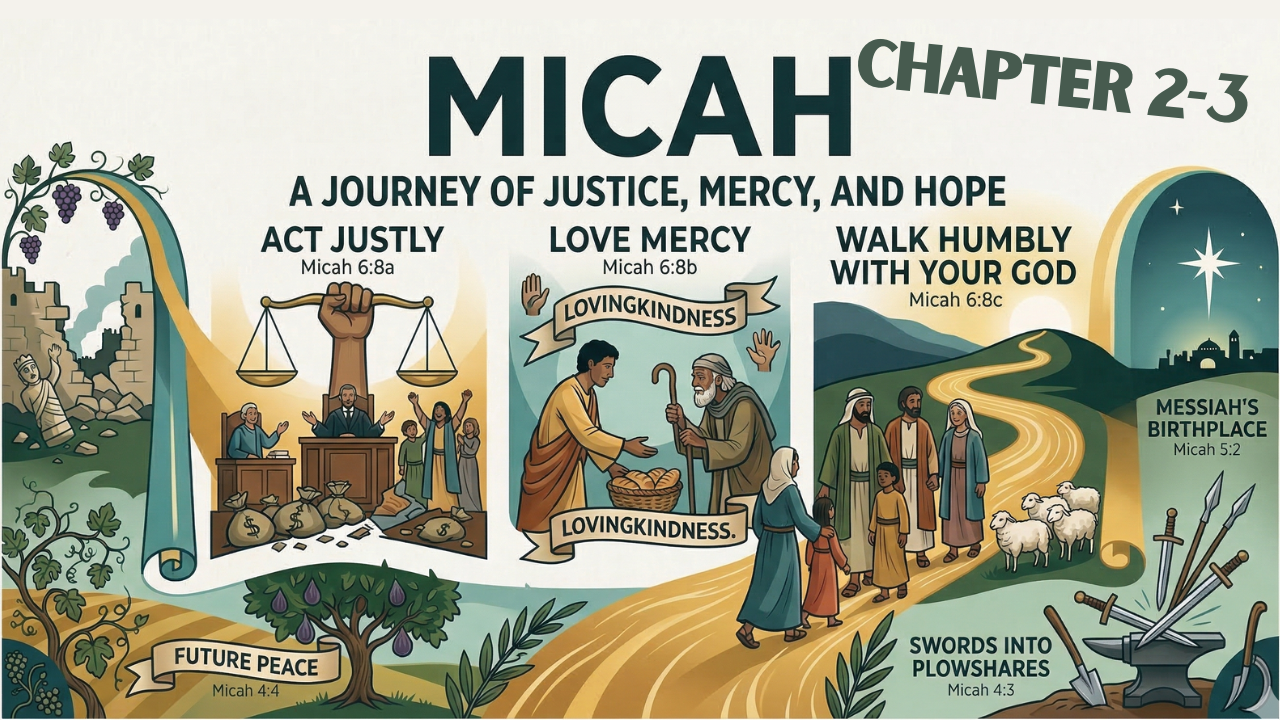
Micah Chapter 2-3 Class 2 - Bible Study
In our Bible study on April 9, 2026, we reviewed key themes from the book of Micah, focusing on God's judgment against corrupt leaders, His call for justice and mercy over power, and the recurring pattern of judgment followed by redemption.
Micah Intro and Chapter 2-3
This is our 2nd class on Micah
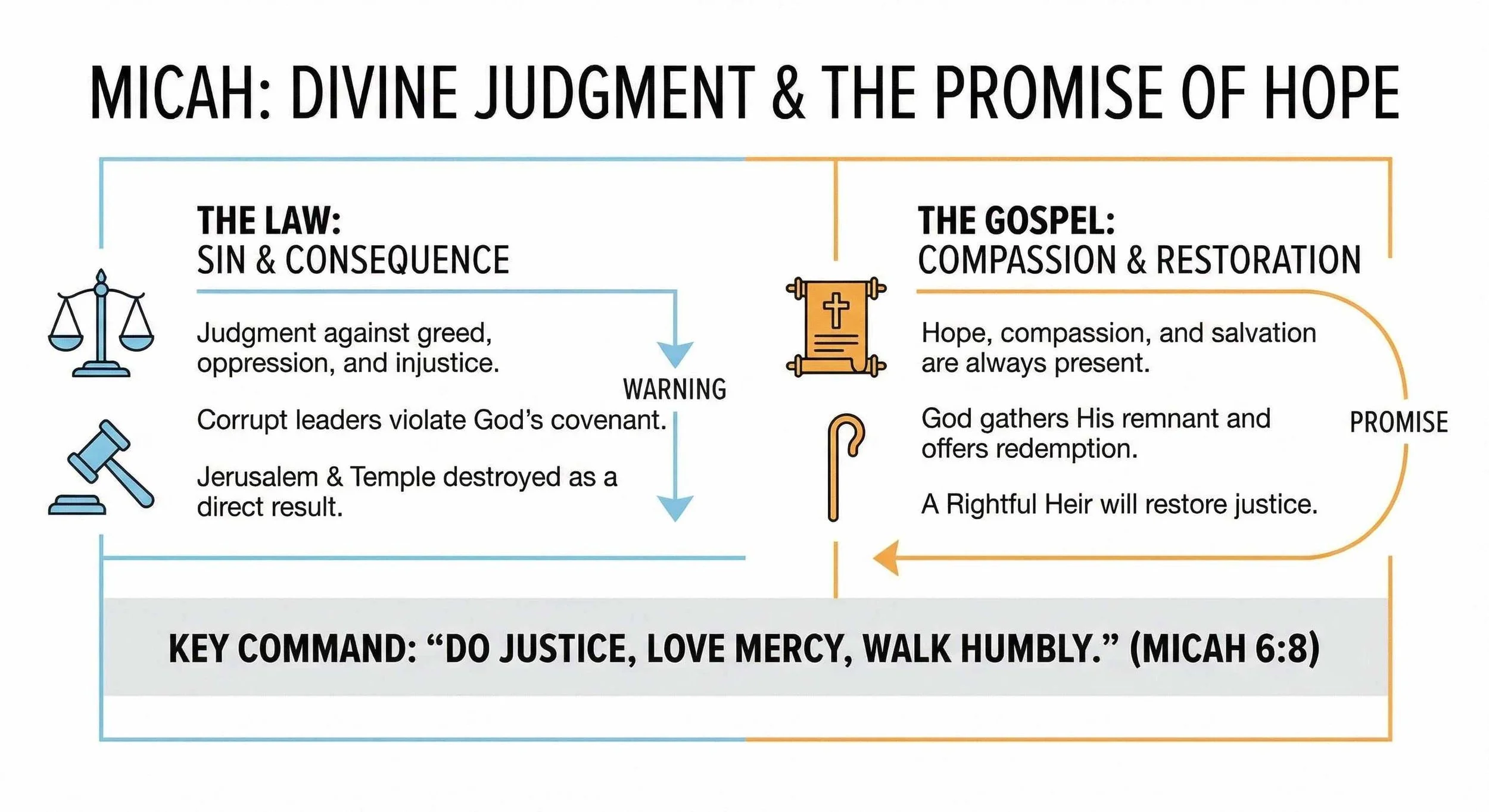
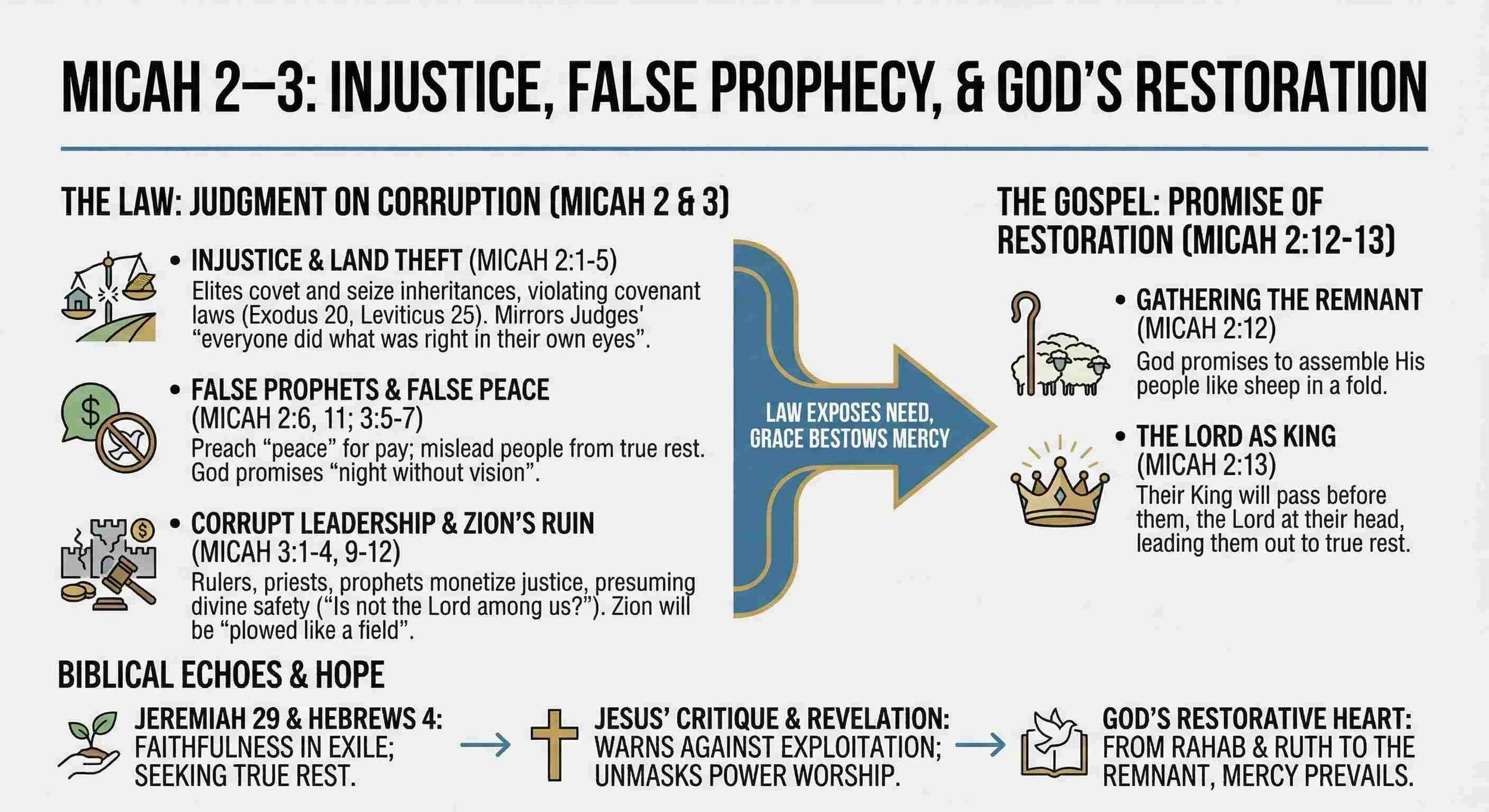
This is an AI Recap of the class.
Some things may be incorrect.
Short Summary of the Class
On Thursday, April 9, 2026, our group dove into chapters 2 and 3 of the book of Micah. We began by reading the text, which details God's pronouncement of "woe" upon the powerful in Israel who were oppressing the poor by seizing their land and inheritance, a direct violation of how God had established their society. We discussed how these actions broke several commandments and how this theme of "might makes right" was leading them to self-destruction. The discussion highlighted the contrast between the first eleven verses of chapter 2, filled with judgment, and the final two verses, which offer a glimpse of hope and restoration. We then moved into chapter 3, which continues the condemnation of Israel's corrupt leaders, priests, and prophets who exploit their positions for money while falsely claiming God's favor. We explored the stark imagery of their destruction and the recurring biblical theme of law and gospel, where the law reveals our sin and points to our need for the grace found in the gospel.
Detailed Class Summary
Review of Previous Micah Study and Prophetic Themes
We then transitioned to the Bible study portion by reviewing our last discussion on the minor prophets, specifically Micah. Two primary themes were revisited. The first was the structure of the prophetic messages, which often present a strong word of judgment followed by a promise of God's salvation. This pattern was compared to the "law and gospel" preaching model.
The second major theme was the consistent message across prophets calling Israel back to God’s core requirements: "to do justice, love mercy, and walk humbly with your God" (Micah 6:8). The prophets condemned Israel for becoming obsessed with power and wealth while neglecting the poor, a theme echoed in the New Testament book of Revelation. We also recalled the clever "prophetic wordplay" in Micah chapter 1, where the Hebrew names of cities reinforce the prophecy of judgment.
Section Summary: We reviewed how Micah and other minor prophets follow a "law-gospel" pattern of judgment then salvation. We also discussed their unified message condemning the pursuit of power over God's call to practice justice and mercy, and the literary device of prophetic wordplay.
Bible Verses: Micah 6:8, Micah 1:8-15
Bible Stories/Concepts: Parallels with the book of Revelation.
Section 1: Micah Chapter 2 - Judgment and the Consequences of Greed
Our class on April 9, 2026, began with a reading of Micah, chapter 2. The chapter opens with a "woe" to those who plot evil and, because of their power, violently seize fields and houses, oppressing their own people. We noted that this greed and theft were direct violations of God's commandments, specifically those against coveting and stealing. It was pointed out that this practice of seizing land went against the redemption plan God had established for Israelite inheritances, as illustrated in the book of Ruth with the story of the kinsman-redeemer.
The phrase "careful what you wish for" was used to describe the consequences foretold in verses 4 and 5. The very people who were seizing land would have their own heritage taken from them, with no one left to even "determine boundaries by lot in the assembly of the Lord." This pursuit of wealth was a form of self-destruction, echoing the theme from the book of Judges where "they did what was right in their own eyes." The discussion also touched on the false prophets mentioned in verse 11, who would tell the people what they wanted to hear—prophecies of "wine and drink"—rather than God's truth. This was compared to the false prophets in Jeremiah's time who promised peace while the people were being led into captivity. The chapter ends, however, with a shift in tone. After eleven verses of judgment, the final two verses promise that God will surely gather the "remnant of Israel" like a flock, with their King and the Lord leading them.
Summary of Section 1: We discussed how the wealthy in Israel were ignoring God's laws by violently taking land from the poor. This greed, encouraged by false prophets promising good times, was leading the nation toward its own destruction, a judgment from which God promised He would ultimately rescue a remnant of His people.
Bible Verses and Stories Mentioned:
Micah 2: The primary text for this section.
Book of Ruth: The story of Naomi, Ruth, and Boaz (the kinsman-redeemer) was mentioned to illustrate God's original plan for land inheritance.
Book of Judges: Referenced for its recurring theme of "they did what was right in their own eyes."
Jeremiah 29:11: Discussed in the context of false prophets promising peace and prosperity, noting that this verse was originally spoken to people already in exile.
Revelation 21: Mentioned in passing regarding a sermon on the "Eighth Day of Creation."
Section 2: Micah Chapter 3 - Corrupt Leadership and the Call for Justice
We then proceeded to read and discuss Micah, chapter 3. This chapter continues the strong condemnation, this time aimed directly at the "heads of Jacob and you rulers of the house of Israel." They are accused of hating good, loving evil, and metaphorically cannibalizing their own people. The prophets are again called out for chanting "peace" for profit while preparing "war against him who puts nothing into their mouths."
A key point of discussion was the theme of "might makes right." The leaders, priests, and prophets were all corrupt, judging for bribes, teaching for pay, and divining for money. Yet, in their hypocrisy, they would "lean on the Lord and say, 'Is not the Lord among us? No harm can come upon us.'" They used their status as God's chosen people as a license to sin. Micah's response is a devastating prophecy: because of their actions, "Zion shall be plowed like a field, Jerusalem shall become heaps of ruins." We also explored the poetic use of "Jacob" and "Israel" in the same verses, concluding it was likely for emphasis, to encompass the entire nation from its past to its present. The theme of "Law and Gospel" was brought up, explaining that the law (like Micah's harsh words) reveals our sin and demonstrates our desperate need for the gospel (God's grace).
Summary of Section 2: This section focused on the corruption of Israel's entire leadership structure—rulers, priests, and prophets—who exploited the people for financial gain while hypocritically claiming God's protection. Micah prophesies complete destruction for Jerusalem and the temple as a direct result of their twisting of justice and perversion of faith.
Bible Verses and Stories Mentioned:
Micah 3: The primary text for this section.
John 8:44: Referenced when discussing how the rulers "twist everything that is straight," connecting it to Jesus calling Satan the "father of lies."
2 Corinthians 1:3: Contrasted with the harsh judgment, highlighting God as the "Father of mercies and God of all comfort."
Story of Jonah: Jonah was presented as an example of a prophet who, unlike Micah, did not want God's mercy to extend to others and embodied the selfish attitude Micah preached against.
Story of Rahab and Ruth: Mentioned as examples of Gentiles included in Jesus' lineage, showing God's plan of redemption was always for all people.
Final Summary
In our Bible study on Thursday, April 9, 2026, we examined the powerful prophecies of Micah in chapters 2 and 3. Our discussion centered on God's indictment against the people of Israel, particularly its wealthy and powerful leaders, for their systemic injustice and greed. We observed how they violated God's commands by violently seizing land, oppressing the poor, and creating a society where "might makes right." This behavior was enabled by corrupt priests and false prophets who offered messages of peace and prosperity in exchange for money, lulling the people into a false sense of security.
We discussed how this path of doing "what was right in their own eyes" was leading them to self-destruction, a stark warning that what they were doing to others would be done to them. Micah prophesies that their inheritance would become desolation, with Jerusalem and the temple itself being turned into a heap of ruins. A significant part of our conversation highlighted the hypocrisy of the leaders who sinned while claiming, "Is not the Lord among us?" using their chosen status as an excuse for evil. We connected these themes to other scriptures, such as the stories of Ruth and Jonah, and the teachings of Jesus against the Pharisees. Despite the heavy judgment, we also noted the glimmers of hope and the "gospel" promise at the end of chapter 2, where God pledges to gather the remnant of His people and lead them as their King, reminding us that even in His righteous anger, God's ultimate plan is one of redemption.
Main Points
The wealthy and powerful in Israel were using their power to oppress the poor and seize their land, directly violating God's laws.
This societal greed was a form of self-destruction; the very ruin they brought on others would be visited upon them.
False prophets were complicit, telling the people what they wanted to hear ("peace," "wine and drink") for personal gain.
Israel's leaders—rulers, priests, and prophets—were corrupt, commercializing justice and religious teaching.
The leaders hypocritically believed they were immune from harm because they were God's people, using their faith as a license to sin.
Micah's prophecy foretells the complete destruction of Jerusalem and the temple as a consequence of their injustice.
Despite the overwhelming message of judgment ("the Law"), there is a promise of future restoration and salvation ("the Gospel").
Scriptures and Stories Mentioned
Bible Chapters:
Micah 2
Micah 3
Bible Verses:
Jeremiah 29:11
John 8:44
2 Corinthians 1:3
Revelation 21
Stories/Concepts:
The commandments against coveting and stealing
The kinsman-redeemer and land inheritance (Book of Ruth)
"They did what was right in their own eyes" (Book of Judges)
Jesus's condemnation of the Pharisees "devouring widows' homes"
The concept of Law and Gospel
The story of Jonah pouting over God's mercy to Nineveh
The inclusion of Gentiles (Rahab, Ruth) in the lineage of Jesus
Jesus as Prophet, Priest, and King
The Pax Romana ("Roman Peace") as a form of peace through coercion
Solomon's Temple
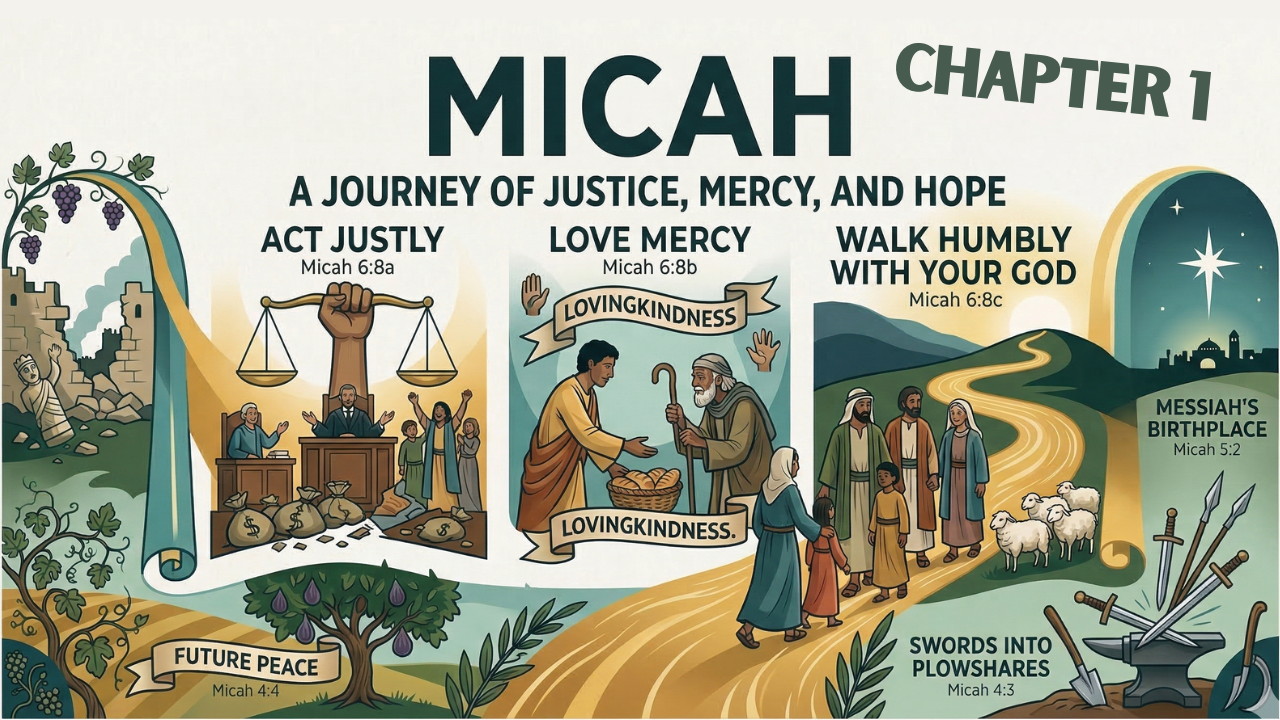
Micah Intro & Chapter 1 Class 1 - Bible Study
During our Bible study on March 26, 2026, we explored the first chapter of Micah, focusing on God's impending judgment against both Samaria and Jerusalem for their shared sins of idolatry and self-righteousness.
Micah Intro and Chapter 1
This is our 1st class on Micah
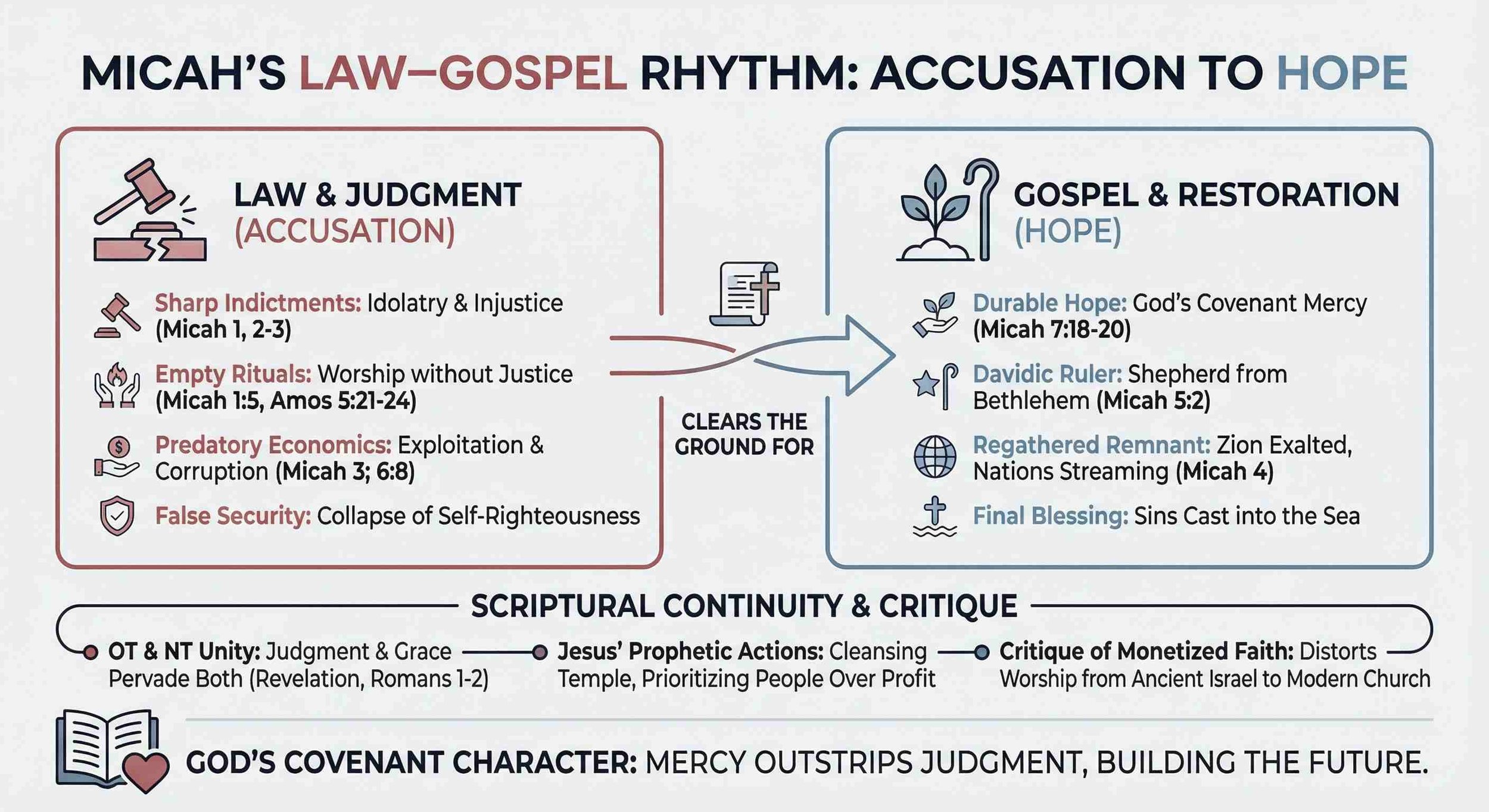
This is an overview of Micah.
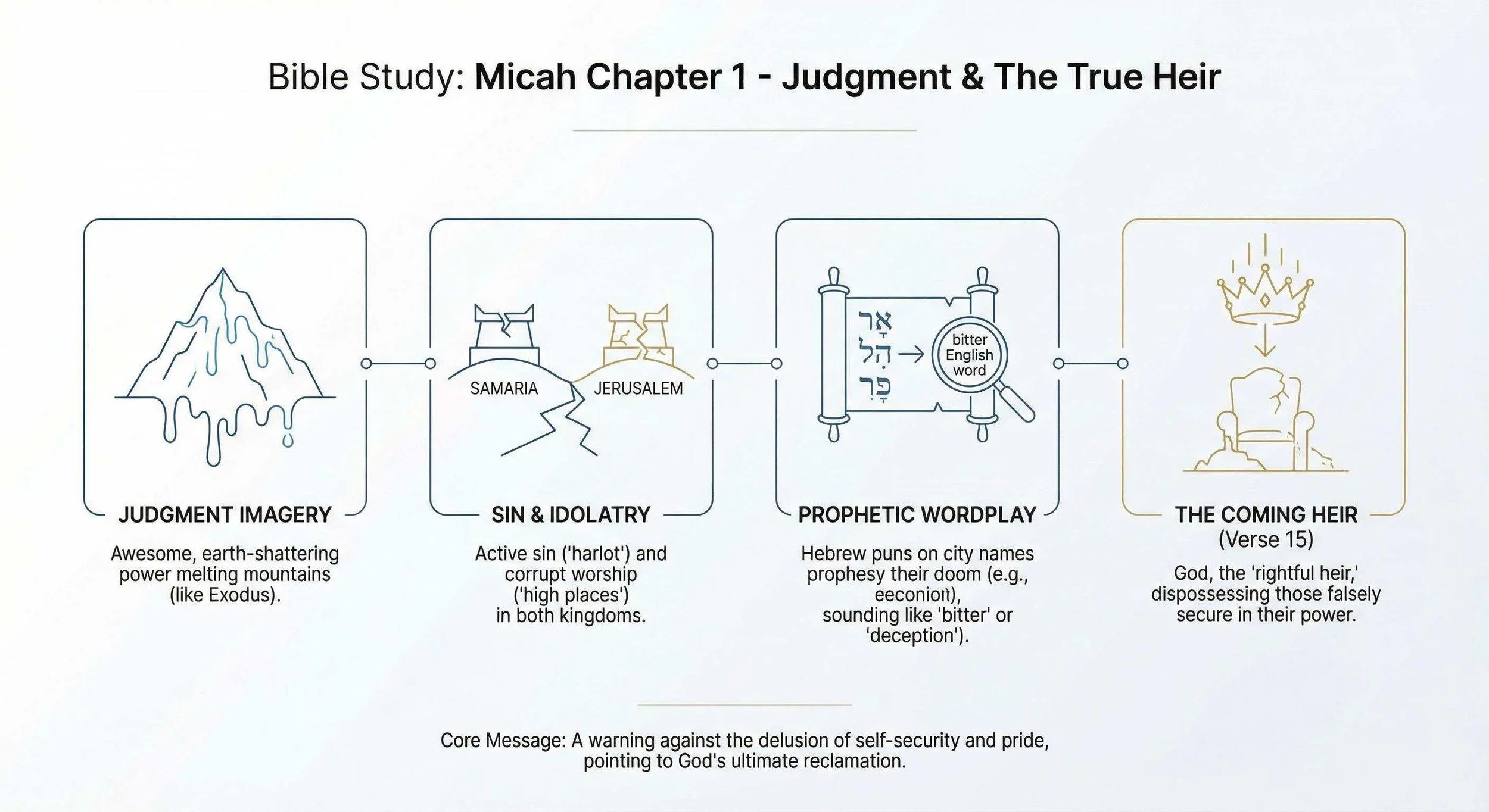
This is an AI Recap of the class.
Some things may be incorrect.
Short summary of the whole class
We read Micah—starting with Micah 1—and explored its Law–Gospel rhythm: sharp indictments of injustice, idolatry, and self-righteousness, followed by durable hope in God’s covenant mercy and a promised Davidic ruler from Bethlehem. Along the way we linked Micah’s themes to Revelation’s critique of power, Paul’s indictments in Romans, and Jesus’s prophetic actions (cleansing the temple; delivering the Gerasene demoniac), and reflected on how monetizing religion—from ancient Israel to indulgences to modern church culture—distorts worship and justice. We also examined translation nuances in Micah 1, poetic place-name wordplay, and the continuity between Old and New Testaments, concluding that divine judgment clears the ground for restoration.
Walkthrough summary with section-by-section notes
1) Opening reflections: Continuity between Old and New Testaments and the Law–Gospel pattern
What we discussed:
Scripture’s unity: the same human tendencies to power, domination, and wealth appear across the Testaments.
The “good news” looks forward and backward: God will set things right and, in Christ, has begun to do so.
The prophets, including Micah, follow a recognizable Law–Gospel rhythm—confrontation of sin followed by promises of restoration—and Revelation often recycles prophetic themes.
Stories/Scriptures mentioned:
Revelation (general thematic reference)
General references to Joel, Amos, Jonah, Obadiah, Micah
Short summary of this section:
We framed Micah within Scripture’s continuity and a Law–Gospel pattern, noting that Revelation echoes prophetic themes of judgment and hope.
2) Reading Micah 1: God’s descent, idolatry, and lament
What we discussed:
God’s theophany: the Lord descends; mountains melt; valleys split (Micah 1:3–4).
Judgment on both Samaria and Jerusalem for transgression and idolatry (Micah 1:5–7).
Lament imagery—wailing, dust, shame, baldness, captivity—calling for sober grief (Micah 1:8–16).
Judah is not morally superior; no one is exempt from critique.
Stories/Scriptures mentioned:
Micah 1:1–16
Short summary of this section:
Micah 1 announces sweeping judgment over both kingdoms, exposing idolatry and self-assured religiosity and calling for lament.
3) Imagery echoes and the “harlot” motif: Exodus, Proverbs, and Hosea
What we discussed:
Exodus echo: Micah 1’s earth-shaking presence recalls God’s powerful interventions in history.
“Harlot/prostitute” language (Micah 1:7) connected to Proverbs’ seductive sin and Hosea’s symbolic marriage—idolatry as relational betrayal, a selling of oneself.
Stories/Scriptures mentioned:
Micah 1:7
Exodus (themes of theophany and deliverance; e.g., Exodus 14–15; 19 thematically)
Proverbs (harlot/prostitute motif; general references)
Hosea 1–3 (prophet’s marriage as sign-act)
Short summary of this section:
Micah’s imagery taps Exodus’s divine power and portrays sin, via Proverbs and Hosea, as an active, relational unfaithfulness.
4) Who is being confronted? Judah, Samaria, and the collapse of self-righteousness
What we discussed:
Micah 1:5 levels the field: Judah’s “high places” mirror Samaria’s; prophetic sarcasm punctures self-righteousness.
Ritual without justice is empty; idolatry undercuts religious confidence.
Stories/Scriptures mentioned:
Micah 1:5
Amos 5:21–24 (thematic link: God’s rejection of empty festivals)
Short summary of this section:
Micah dismantles Judah’s false security: religious forms without faithfulness and justice cannot shield from judgment.
5) “High places” and reverence—then critique
What we discussed:
High places historically evoke reverence (Sinai), but prophets condemn altars divorced from obedience and justice.
Amos’s rebuke reinforces that height and ritual mean nothing without covenant faithfulness.
Stories/Scriptures mentioned:
Micah 1 (high places language)
Exodus 19 (Sinai theophany; thematic)
Amos 5:21–24
Short summary of this section:
Awe without obedience is hollow; God seeks justice and faithfulness, not mere elevated ritual.
6) Translation matters in Micah 1:16 and 1:15—“eagle” or “vulture”; “heir,” “conqueror,” or “dispossessor”?
What we discussed:
Micah 1:16: “Make yourself bald”—mourning and disgrace; the Hebrew term may be “eagle” or “vulture,” with “vulture” fitting lament’s tone.
Micah 1:15: the term variously rendered “heir,” “conqueror,” or “dispossessor”; the thrust is that rightful rule will dispossess pretenders.
Illustrations included study notes and a Robin Hood analogy (rightful heir displaces a pretender).
Stories/Scriptures mentioned:
Micah 1:16; Micah 1:15
Genesis 15 (heir/possession language; thematic)
Robin Hood analogy (story illustration)
Short summary of this section:
Nuanced translation sharpens the text’s tone and theology: mourning is stark, and God’s rightful authority overturns false securities.
7) Place-name wordplay and omen-like warnings (Micah 1:10–14)
What we discussed:
Micah’s puns on town names amplify the message: surface beauty masks decay; fates align with names.
Stories/Scriptures mentioned:
Micah 1:10–14
Short summary of this section:
Poetic wordplay serves prophecy—names become omens exposing the gap between appearance and reality.
8) Power, captivity, and Revelation’s critique—then and in Jesus’s day
What we discussed:
Micah 1:16 ties pride to captivity; Revelation critiques false security in power and wealth.
Parallels to Pharisees and Sadducees protecting status and opposing Jesus.
Stories/Scriptures mentioned:
Micah 1:16
Revelation (general thematic reference)
Gospel-era accounts of Pharisees and Sadducees resisting Jesus (e.g., John 11:47–53 thematically)
Short summary of this section:
Pride breeds captivity; whether in Micah’s day or the Gospels, protecting power resists God’s true king.
9) Watching and processing an overview of Micah: accusation and hope
What we discussed:
Historical setting: Micah of Moresheth (Judah), contemporary with Isaiah; covenant-breaking in Israel and Judah.
Warnings: Assyria’s devastation of the north; Babylon’s later destruction.
Accusations: leaders and prophets enriching themselves; justice bent for the wealthy; land theft; prophetic corruption—Naboth’s vineyard as emblematic injustice.
Hope: God as shepherd regathers a remnant; exalted Zion with nations streaming; exile and return; a Davidic king from Bethlehem; final justice and blessing to the nations.
Micah 6:8 as covenant heartbeat; Micah 7:18–20 grounding hope in God’s character.
Stories/Scriptures mentioned:
Micah 3 (prophetic strength/accusation); Micah 4 (nations to Zion); Micah 5:2 (Bethlehem ruler); Micah 6:8; Micah 7:18–20
1 Kings 21 (Ahab and Naboth’s vineyard)
Assyria and Babylon as instruments of judgment
Short summary of this section:
Micah alternates tough indictments with sturdy hope: God confronts injustice yet promises a shepherd-king and covenant mercy.
10) OT “fire and brimstone” and NT continuity
What we discussed:
Is the OT uniquely “hellfire and brimstone”? The NT shares moral urgency—Paul’s indictments and Revelation’s prophetic cadence.
We tend to find what we seek; both Testaments carry sustained hope.
Tone shift: OT promises forward (“God will”), NT proclaims fulfillment (“God has done”).
Stories/Scriptures mentioned:
Romans 1–2
Revelation (prophetic pattern)
The Gospels as narrative continuity with the patriarchs
Short summary of this section:
Judgment and grace pervade both Testaments; the promises of the OT meet fulfillment in the NT without losing ethical edge.
11) Jesus and the economics of the kingdom
What we discussed:
Jesus confronts exploitative systems—cleansing the temple to restore prayer and justice.
Gerasene demoniac: deliverance at economic cost (drowned pigs) exposes resistance when profit is threatened.
Warning against “devouring widows’ houses.”
Stories/Scriptures mentioned:
Temple cleansing: Matthew 21:12–13; Mark 11:15–17; Luke 19:45–46; John 2:13–17
Gerasene/Gadarene demoniac and pigs: Mark 5:1–20; Luke 8:26–39; Matthew 8:28–34
“Devouring widows’ houses”: Mark 12:40; Luke 20:47
Short summary of this section:
Jesus stands in the prophetic stream, prioritizing people over profit and provoking backlash from vested interests.
12) Commercialization of faith—then and now
What we discussed:
Prophetic rebukes (Amos, Micah) of wealth built on exploitation; parallels in church history (indulgences under Pope Leo X) and Luther’s revulsion at monetized piety.
Modern concerns: institutional self-preservation, staffing over care, public distrust, and the “chicken and egg” tension of wealth amid visible poverty.
Stories/Scriptures mentioned:
Amos 2:6–7; 4:1; 5:11–24 (themes)
Micah 2–3; 6:8
Church history: indulgences; Luther’s pilgrimage practices and protest
Short summary of this section:
Monetizing faith corrodes justice and credibility—from Israel’s courts to medieval indulgences to modern church culture.
13) Returning to Micah’s heartbeat: judgment unto hope
What we discussed:
If Israel is to bless the nations, God must confront Israel’s evil; exile as consequence and cure.
Restoration through the Davidic shepherd from Bethlehem; God delights in steadfast love and casts sins into the sea.
Stories/Scriptures mentioned:
Micah 5:2
Micah 7:18–20
Genesis 12:1–3 (thematic: blessing to the nations)
Short summary of this section:
Micah’s rhythm—law then gospel—shows judgment as a pathway to covenantal restoration and global blessing.
Medium-length final summary (created on 2026-03-26 11:08:46)
Our study moved from Micah 1’s thunderous theophany and indictments of idolatry and injustice to the book’s larger Law–Gospel cadence: God confronts corrupt leadership, predatory economics, and hollow religiosity, yet promises to shepherd, regather, and renew his people through a Davidic ruler from Bethlehem. We connected Micah’s warnings (Assyria, Babylon) and hopes (Zion’s restoration; nations streaming; sins hurled into the sea) to Revelation’s critique of power, Paul’s indictments in Romans, and Jesus’s prophetic actions—cleansing the temple and delivering the demonized at economic cost. Translation nuances (eagle/vulture; heir/conqueror/dispossessor) and poetic place-name wordplay deepened our reading of Micah 1. We wrestled with how monetizing faith—from ancient Israel to indulgences to present church culture—distorts worship and justice. Throughout, we emphasized Scripture’s continuity: the OT’s forward-looking promises meet NT fulfillment without losing ethical urgency. Micah closes by grounding hope not in human reform but in God’s covenant character: he delights in steadfast love, pardons iniquity, and casts sins into the sea—judgment clears the ground; mercy builds the future.
Main points
Micah and the prophets follow a Law–Gospel rhythm: accusation of sin paired with promises of restoration.
God’s judgment falls on both Samaria and Jerusalem; self-righteousness and ritual without justice cannot protect.
Micah’s imagery echoes Exodus; idolatry is active betrayal (harlot motif via Proverbs and Hosea).
Translation nuances (Micah 1:15–16) sharpen tone and theology: rightful rule dispossesses pretenders; lament is stark.
Poetic place-name wordplay in Micah 1 underscores appearance versus reality.
Micah indicts corrupt leadership and predatory economics; judgment comes via Assyria and Babylon.
Hope interrupts judgment: remnant regathered, Zion restored, nations welcomed, Davidic ruler from Bethlehem.
The OT’s moral urgency continues in the NT (Romans, Revelation); Jesus embodies the prophetic critique.
Jesus confronts exploitative religion and economics (temple cleansing; pigs episode), prioritizing people over profit.
Monetizing faith—ancient or modern—distorts worship and justice and undermines credibility.
God’s covenant character has the final word: mercy outstrips judgment; sins are trampled and cast into the sea.
Scriptures mentioned
Micah: 1:1–16; 3; 4; 5:2; 6:8; 7:18–20
Exodus: 14–15 (thematic); 19 (Sinai theophany)
Proverbs: passages on the harlot/prostitute motif (general)
Hosea: 1–3 (prophet’s marriage as sign-act)
Amos: 2:6–7; 4:1; 5:11–24; 5:21–24
1 Kings 21 (Naboth’s vineyard)
Genesis 12:1–3; 15 (thematic)
Romans 1–2
Revelation (general thematic references)
Gospels:
Temple cleansing: Matthew 21:12–13; Mark 11:15–17; Luke 19:45–46; John 2:13–17
Gerasene/Gadarene demoniac and pigs: Mark 5:1–20; Luke 8:26–39; Matthew 8:28–34
“Devouring widows’ houses”: Mark 12:40; Luke 20:47
Religious leaders resisting Jesus: John 11:47–53 (thematic)
Stories referenced
Naboth’s vineyard (1 Kings 21) as a paradigm of judicial theft and corruption.
Hosea’s marriage (Hosea 1–3) as a living parable of unfaithfulness and restoration.
Exodus: theophany and mighty acts (parting waters; Sinai).
Jesus cleansing the temple (driving out commerce to restore prayer and justice).
The Gerasene demoniac and the drowned pigs (deliverance that challenges economic interests).
Pharisees and Sadducees resisting Jesus to safeguard power (e.g., John 11:47–53 thematically).
Robin Hood analogy: rightful heir displacing a pretender (illustrating “heir/dispossessor”).
Amos Chapters 9 & Obadiah Class 5 - Bible Study
Our class closed Amos with chapter 9’s sweeping judgment and surprising hope, then turned to Obadiah’s focus on Edom and all nations, tracing themes of justice, restoration, and God’s kingship with messianic echoes.
Amos Chapters 9 - Obadiah
This is our 5th class on Amos
This is an AI Recap of the class.
Some things may be incorrect.
Short summary of the whole class
On 2026-02-26, we listened to and discussed Amos 9, moving from temple-toppling judgment and inescapable justice to the restoration of the “booth of David” overflowing to the nations. We explored translation nuances (Sheol vs. “hell,” “in/on” the land), water/chaos imagery, Eden-like abundance, and intertextual ties in the Gospels and Revelation. We then read Obadiah, examining Edom’s pride and betrayal during Babylon’s conquest, the Day of the Lord widening judgment to all nations, and the closing affirmation that “the kingdom shall be the Lord’s,” while comparing themes with Joel and Amos and discussing the debated location of “Sepharad.” We concluded by planning to study Jonah next and likely read C. S. Lewis’s The Great Divorce after Easter.
Walkthrough and sectional summaries
1) Setting goals and lighthearted opener (Amos 9 and Obadiah)
Plan: finish Amos with chapter 9; begin Obadiah.
Framing: Amos’s consistent indictment of exploitation of the poor and resonance with the Gospels and Revelation.
Personal anecdote: two childhood cats named Oba (for Obadiah) and Bob—“Bob was the best cat.”
Short summary of section:
We set goals to complete Amos 9 and start Obadiah, recalling Amos’s justice theme and sharing a light personal story.
Bible verses mentioned:
General reference to Amos (no specific verse cited here).
Stories mentioned:
Childhood cats: Oba and Bob.
2) Listening to Amos 9 (reading and first impressions)
Read/heard Amos 9:1–15.
Noted the stark arc from judgment to a “glimmer of hope” in verse 11.
Short summary of section:
We heard Amos 9 in full, recognizing its shift from total judgment to promised restoration.
Bible verses mentioned:
Amos 9:1–15 (highlighted v. 11).
Stories mentioned:
None.
3) Initial observations: judgment, humility, and false security
Israel is not exempt from justice (Amos 9:7–10).
Amos 9:10 challenges complacency: “calamity shall not overtake us.”
Short summary of section:
Amos confronts Israel’s moral complacency: being God’s people does not shield unrepentant injustice from judgment.
Bible verses mentioned:
Amos 9:7–10.
Stories mentioned:
None.
4) Promise of restoration and Eden imagery
Reversal of earlier deprivation: abundance, rebuilt cities, vineyards (Amos 9:13–15).
“The plowman shall overtake the reaper” signals overflowing fruitfulness.
Short summary of section:
Amos pivots to Eden-like renewal, where God replaces deprivation with abundant delight.
Bible verses mentioned:
Amos 9:13–15.
Stories mentioned:
None.
5) Temple-pillar language and the scope of judgment (Amos 9:1)
“Strike the tops of the pillars/doorposts/capitals” to collapse the sanctuary.
Emphasis on judgment reaching even sacred spaces.
Short summary of section:
God topples the sanctuary from its highest points, signaling comprehensive judgment.
Bible verses mentioned:
Amos 9:1.
Stories mentioned:
None.
6) Sheol, the sea, and the inescapability of God (Amos 9:2–6)
Translation note: prefer “Sheol” over “hell.”
No escape: heights, depths, Carmel, sea—God finds them (Amos 9:2–3).
Chaos-water motifs: serpent in the sea, Nile swelling, God summoning waters (Amos 9:5–6).
Intertext: creation waters, Noah’s flood, Revelation’s abyss/sea.
Short summary of section:
Amos portrays God’s searching judgment using Sheol and chaos-water imagery to show there’s no hiding place.
Bible verses mentioned:
Amos 9:2–6.
Allusions: Genesis 1; Genesis 6–9; Revelation (abyss/sea).
Stories mentioned:
None (intertextual themes noted).
7) “On that day” and the Booth of David (Amos 9:11–12)
“On that day” marks restoration.
“Booth/tabernacle of David” restored—messianic resonance.
Nations included: remnant of Edom and “all the Gentiles who are called by my name.”
Short summary of section:
Restoration is messianic and expansive: God rebuilds David’s booth and gathers Israel and the nations.
Bible verses mentioned:
Amos 9:11–12.
Stories mentioned:
Gospel theme: Jesus as true temple (veil imagery referenced).
8) Abundance fulfilled and Garden imagery carried into the Gospels
Overflowing wine, gardens, rebuilt cities (Amos 9:13–15).
John 20: Mary mistakes the risen Jesus for a gardener—Eden echo.
Short summary of section:
Amos’s restoration imagery flavors the resurrection garden scene, signaling new creation.
Bible verses mentioned:
Amos 9:13–15.
John 20 (Mary and the gardener).
Stories mentioned:
Mary Magdalene at the tomb.
9) Translation nuance: “in” vs. “on,” and spirit/wind/breath
Amos 9:15: “in/on their land” reflects Hebrew preposition range.
Note on single Hebrew/Greek terms for spirit/wind/breath.
Short summary of section:
We observed how translation choices shape meaning, especially with prepositions and key theological terms.
Bible verses mentioned:
Amos 9:15.
Stories mentioned:
None.
10) Amos’s core indictment and a pastoral reflection
Amos critiques showy religion alongside exploitation of the poor.
Practical reflection: caution against performative religiosity (e.g., public fasting) without justice and mercy.
Short summary of section:
Amos calls for authentic obedience—justice for the poor over religious performance.
Bible verses mentioned:
Thematic reference to Amos’s broader critique (no single verse cited here).
Stories mentioned:
Practical note related to public religious displays.
11) Obadiah overview: setting the stage
Positioned Obadiah in the crisis of Babylon’s conquest (background: 2 Kings 25).
Watched a short overview video to frame reading.
Short summary of section:
We located Obadiah within the Babylonian crisis and prepped to read the book with an overview.
Bible verses mentioned:
Historical backdrop: 2 Kings 25 (not read aloud).
Stories mentioned:
None.
12) Public reading of Obadiah 1:1–9 (Pride and downfall)
Edom’s pride deceived them; God will bring them down (1:3–4).
Thorough searching out; failed alliances; end of Teman’s wisdom (1:5–9).
Short summary of section:
God indicts Edom’s arrogance and announces comprehensive collapse, even among their allies and sages.
Bible verses mentioned:
Obadiah 1:1–9.
Stories mentioned:
None.
13) Obadiah 1:10–14 (Betrayal of a brother)
“Violence against your brother Jacob” (1:10).
Charges: gloating, looting, ambushing refugees, handing survivors over (1:12–14).
Short summary of section:
Edom’s guilt centers on fraternal betrayal—gloating and harming Judah at its most vulnerable.
Bible verses mentioned:
Obadiah 1:10–14.
Background: Genesis (Jacob and Esau).
Stories mentioned:
Jacob and Esau as ancestral backdrop.
14) Class reflections: family, pride, and internal strife
Betrayal is worse when done by those who “know better.”
Parallels to Judges’ intra-Israel conflict; teacher recalled a sermon titled “Don’t Look Away.”
Pride and gloating as spiritual decay.
Short summary of section:
We reflected on the moral weight of harming kin and how pride corrodes communities.
Bible verses mentioned:
Judges (theme of internal conflict; no specific verse cited).
Stories mentioned:
Sermon: “Don’t Look Away.”
15) Obadiah 1:15–18 (The Day of the Lord and recompense)
Hinge to all nations: “The day of the Lord… is near” (1:15).
Principle: “As you have done, it shall be done to you” (1:15).
Zion’s deliverance; Jacob and Joseph as fire, Esau as stubble (1:17–18).
Short summary of section:
Judgment widens to all nations with measure-for-measure justice; Zion becomes the locus of deliverance.
Bible verses mentioned:
Obadiah 1:15–18.
Stories mentioned:
None.
16) Obadiah 1:19–21 (Restoration and the Lord’s kingdom)
Restoration geography and return of exiles (1:19–20).
“Saviors shall come to Mount Zion… And the kingdom shall be the Lord’s” (1:21).
Short summary of section:
Obadiah closes with restoration for Zion’s remnant and the universal claim of God’s kingship.
Bible verses mentioned:
Obadiah 1:19–21.
Stories mentioned:
None.
17) Comparing Obadiah with Amos and Joel
Tension: Amos 9:11–12 includes “remnant of Edom and all nations”; Obadiah 1:18 stresses severe judgment on Esau.
Harmonizing lens: Edom as a historical nation and a type of human pride; prophetic hope still envisions nations called by God’s name.
Joel contributes post-judgment deliverance from Zion.
Short summary of section:
We contrasted Obadiah’s sharp judgments with Amos’s and Joel’s inclusive restoration, seeing Edom as both concrete and symbolic.
Bible verses mentioned:
Amos 9:11–12.
Joel 2–3.
Stories mentioned:
None.
18) Notes on terms and places: Sepharad and later identity
Obadiah 1:20 mentions “Sepharad”—debated identifications: Sardis (Asia Minor), Spain (Sephardim), Western Media, others.
Recognized long-standing Jewish association with Spain shaping diaspora identity.
Short summary of section:
“Sepharad” has multiple scholarly proposals, with the Spanish association shaping the identity of Sephardic Jews.
Bible verses mentioned:
Obadiah 1:20.
Stories mentioned:
Historical-cultural note on Sephardic Jews.
19) Obadiah’s ending and God’s kingship
Translation nuance: “the kingdom/kingship will be the Lord’s” (Obadiah 1:21).
Obadiah centers God’s direct kingship without explicitly foregrounding a Davidic messiah.
Resonances with Deuteronomic/Joshua themes of covenantal justice and conquest.
Short summary of section:
Obadiah climaxes with God’s kingship, emphasizing covenantal justice more than royal messianism.
Bible verses mentioned:
Obadiah 1:21.
Thematic references: Deuteronomy, Joshua (no specific verses cited).
Stories mentioned:
None.
20) Concluding plans: Jonah next; The Great Divorce after Easter
Next study: Jonah (2–3 weeks).
Likely post-Easter reading: C. S. Lewis’s The Great Divorce.
Short summary of section:
We wrapped Obadiah and set plans to study Jonah next, with a likely return to The Great Divorce after Easter.
Bible verses mentioned:
None (future study preview).
Stories mentioned:
Literary work: C. S. Lewis’s The Great Divorce.
Medium-length summary of the class
On 2026-02-26, we concluded Amos with chapter 9, tracing its movement from God’s temple-toppling judgment and inescapable justice (Amos 9:1–10) to the restoration of the “booth of David” that embraces the remnant of Edom and all Gentiles called by God’s name (9:11–12), culminating in Eden-like abundance (9:13–15). We noted translation nuances (Sheol vs. “hell,” “in/on” the land) and water/chaos motifs linking creation, flood, and Revelation. Turning to Obadiah, we read the whole book and examined Edom’s pride and fraternal betrayal (1:1–14), the hinge to a universal Day of the Lord with measure-for-measure justice (1:15–18), and the restoration culminating in “the kingdom shall be the Lord’s” (1:19–21). We discussed the debated location of “Sepharad” (1:20), thematic comparisons with Joel and Amos on judgment and inclusion, and how Obadiah foregrounds God’s kingship with Deuteronomic/Joshua resonances. We closed by planning to study Jonah next and likely read The Great Divorce after Easter.
Main points
God’s judgment is comprehensive and inescapable (Amos 9:1–10).
Chaos-water imagery underscores divine sovereignty and judgment (Amos 9:2–6).
Translation matters: Sheol vs. “hell,” “in/on” the land, spirit/wind/breath.
Restoration follows judgment: God rebuilds the “booth of David,” including the nations (Amos 9:11–12).
Eden-like abundance symbolizes renewal (Amos 9:13–15).
Obadiah indicts Edom’s pride and betrayal, then widens judgment to all nations (Obadiah 1:1–18).
Measure-for-measure justice: “As you have done, it shall be done to you” (Obadiah 1:15).
Obadiah ends with God’s universal kingship: “the kingdom shall be the Lord’s” (Obadiah 1:21).
“Sepharad” (Obadiah 1:20) has debated identifications; Spanish association shaped Sephardic identity.
Comparative theme: Amos and Joel highlight post-judgment inclusion; Obadiah stresses severe judgment but shares Zion-centered hope.
Next steps: Study Jonah; likely read The Great Divorce after Easter.
Scriptures mentioned
Amos 9:1–15 (focus on 9:1; 9:2–6; 9:7–10; 9:11–12; 9:13–15)
Obadiah 1:1–21 (focus on 1:1–9; 1:10–14; 1:15–18; 1:19–21)
Genesis 1 (creation waters/Spirit)
Genesis 6–9 (Noah’s flood)
Genesis (Jacob and Esau background)
2 Kings 25 (Babylon’s conquest context)
Joel 2–3 (Day of the Lord; Zion deliverance)
Judges (theme of internal conflict)
John 20 (Mary and the “gardener”)
Revelation (abyss/sea imagery)
Stories and works mentioned
Childhood cats: Oba (Obadiah) and Bob.
Mary Magdalene mistaking the risen Jesus for the gardener (John 20).
Sermon reference: “Don’t Look Away.”
Historical-cultural: Sephardic Jews (Sephardim) and association with Spain.
Upcoming/related: C. S. Lewis’s The Great Divorce.
Content creation date: 2026-02-26 12:04:06.
Amos Chapters 6-8 Class 4 - Bible Study
This week, our study of Amos 6-8 revealed God's unwavering standard of justice, showing how complacency, social injustice, and the rejection of His word lead to inescapable judgment, symbolized by a plumb line and a basket of summer fruit.
Amos Chapters 4-8
This is our 4th class on Amos
This is an AI Recap of the class.
Some things may be incorrect.
Short Summary of the Whole Class
In our Bible study on February 19, 2026, we delved into chapters six through eight of the book of Amos. We explored the prophet's powerful rebukes against the wealthy and complacent elite of Israel who lived in luxury while perverting justice and exploiting the poor. The class discussed Amos's visions of the locusts, fire, and the plumb line, noting the shift from God's patience to a fixed and final judgment. We examined the dramatic confrontation between Amos and Amaziah, the priest of Bethel, which highlighted the conflict between divine prophecy and corrupt human authority. Finally, we studied the vision of the basket of summer fruit, symbolizing that Israel was ripe for judgment, and the dire prophecy of a "famine for hearing the words of the Lord" as a consequence of their sin.
Detailed Class Summary
Section 1: The Woe to the Complacent (Amos 6:1-7)
Our class began by recapping the book of Amos, noting its core theme: the condemnation of social injustice and hollow religiosity that contradicted God's command to "let justice flow like a river." This hypocrisy, where religious displays masked a lack of genuine faith, was compared to the teachings of James.
We then read the first half of Amos chapter 6, which pronounces "Woe" upon those "at ease in Zion." The discussion focused on how these verses target the comfortable and wealthy elite who believed they were immune to the coming "day of doom." They indulged in luxury—lying on ivory beds, anointing themselves with expensive oils, and inventing new musical instruments—all while being completely indifferent to the suffering of the poor, described as the "affliction of Joseph." We explored the dual meaning of "Joseph" as both a historical reference to their ancestors' slavery and a metaphor for the current oppression within their own nation. The prophecy is clear: because they did not grieve for the oppressed, they would be the "first of the captives" to be led into exile.
Summary of Section 1
This section set the stage by reviewing the core themes of Amos. In Amos 6:1-7, we saw a direct confrontation with Israel's ruling class, who are condemned for their luxurious, self-absorbed lifestyles and their failure to care for the poor. God's judgment is that their comfort will be stripped away, and they will be the first to suffer the consequences.
Bible Verses: Amos 5:24, Amos 6:1-7
Stories/References: The openings of Revelation, Joel, and Romans; James's teaching on faith and works; the affliction of Joseph in Egypt.
Section 2: The Perversion of Justice and Inescapable Judgment (Amos 6:8-14)
Continuing in Amos 6, we discussed God's oath to "abhor the pride of Jacob" and "hate his palaces." The class noted the use of the name "Jacob" instead of "Israel," suggesting the nation had spiritually regressed to its old, deceitful character before Jacob wrestled with God. The imagery in verses 9-11 depicts a devastating plague where death is so widespread that survivors "dare not mention the name of the Lord," fearing it might bring more destruction.
We then examined verse 12: "Do horses run on rocks? Does one plow there with oxen?" The class saw this as a metaphor for common sense. Just as a farmer knows not to do these things, Israel should have known that their perversion of justice went against the natural and moral order. They had turned "justice into gall and the fruit of righteousness into wormwood," making what should be good into something bitter and poisonous. The chapter ends with God's explicit threat to raise up a nation to afflict them.
Summary of Section 2
In this part of the study, we focused on the finality of God's judgment in Amos 6. The "pride of Jacob" is condemned, and the destruction will be so total it silences even prayer. The discussion highlighted how Israel's injustice was a violation of common sense and the created order, leading to the inevitable consequence of being overthrown by a foreign nation.
Bible Verses: Amos 6:8-14, Amos 8:7
Stories/References: Jacob wrestling with God; Jesus's warning of two men in a field (Matthew 24:40).
Section 3: The Visions of Mercy and the Point of No Return (Amos 7:1-9)
We moved into Amos 7, which presents a series of three visions. The first is a swarm of locusts, and the second is a devouring fire. In both instances, Amos intercedes, pleading, "O Lord God, forgive, I pray... for Jacob is small!" This was compared to Abraham's negotiation with God over Sodom. In response to Amos's plea, God relents.
The third vision, however, marks a significant shift. God is shown standing by a wall with a plumb line, a tool used to measure if a structure is perfectly vertical. God declares, "Behold, I am setting a plumb line in the midst of my people Israel; I will not pass by them anymore." The class understood this to mean God had measured Israel against His perfect standard of righteousness and found them hopelessly "crooked." Unlike the first two visions, there is no more intercession and no more relenting. Judgment is now fixed.
Summary of Section 3
This section covered the three visions in Amos 7. The first two (locusts and fire) show God's mercy as He responds to Amos's intercession. The third vision (the plumb line) signifies a point of no return. God has measured His people, found them irredeemably corrupt, and declared that judgment is now unavoidable.
Bible Verses: Amos 7:1-9
Stories/References: The visions of Amos (locusts, fire, plumb line); Abraham negotiating with God for Sodom (Genesis 18).
Section 4: The Prophet vs. The Priest (Amos 7:10-17)
The final part of our discussion on chapter 7 focused on the narrative confrontation between Amos and Amaziah, the priest of the royal sanctuary at Bethel. Amaziah reports Amos to King Jeroboam as a traitor and then tells Amos to flee and stop prophesying, dismissing Bethel as "the king's sanctuary."
Amos's powerful response defines his prophetic calling. He declares, "I was no prophet, nor was I a son of a prophet, but I was a sheep breeder... and the Lord took me... and the Lord said to me, 'Go, prophesy to my people Israel.'" He clarifies he is not a professional speaking for money but is delivering a direct word from God. Because Amaziah tried to silence God's word, Amos pronounces a specific judgment upon him: his family will be destroyed, his land seized, and he will die in a foreign, "defiled land," a personal example of the national collapse to come.
Summary of Section 4
This section explored the conflict between God's prophet and the corrupt religious establishment. Amaziah tries to silence Amos to protect the status quo. Amos defends his divine calling, showing his authority comes directly from God. The confrontation ends with a harsh curse on Amaziah, demonstrating the severe consequences of obstructing God's message.
Bible Verses: Amos 7:10-17
Stories/References: The confrontation between Amos and Amaziah, the priest of Bethel.
Section 5: The Ripe Fruit and the Spiritual Famine (Amos 8)
Our class concluded with Amos chapter 8, which opens with the vision of a basket of ripe summer fruit. This image symbolizes that Israel is "ripe" for judgment and the end has come. The reason for this judgment is again social injustice. The wealthy are condemned for "swallowing up the needy" by "making the ephah small and the shekel large" and falsifying scales to exploit the vulnerable. This was connected to the imagery of the Four Horsemen in Revelation.
The prophecy then describes the consequences in apocalyptic terms: the sun will go down at noon and feasts will turn to mourning. Most strikingly, there will be a famine—not for bread or water, but for "hearing the words of the Lord." The people will search desperately for a word from God but will not find it, a punishment of divine silence. We noted how Jesus uses similar themes when offering "living water" and declaring that man does not live by "bread alone."
Summary of Section 5
This section focused on the vision of summer fruit, signifying that Israel's time was up. We discussed how their downfall was directly linked to their economic exploitation of the poor. The resulting judgment would be a cosmic disruption and a spiritual famine for God's word, where the people would be met with divine silence.
Bible Verses: Amos 8, Jeremiah 4:23
Stories/Imagery: Vision of the basket of summer fruit; the famine for the word of the Lord; merchants falsifying scales.
Overall Class Summary
Our Bible study on February 19, 2026, provided a deep dive into Amos chapters 6 through 8, exploring the prophet's searing indictment of Israel. We began with Amos 6, where the wealthy elite are condemned for living in decadent luxury while ignoring the poor and perverting justice. The class discussed the powerful language used to describe their sin and the significance of God abhorring the "pride of Jacob."
We then transitioned to the visions in Amos 7. We saw God's patience in the visions of locusts and fire, where He relents after Amos intercedes. However, the vision of the plumb line marked a crucial turning point, symbolizing that Israel had been measured against God's perfect standard and found deficient; judgment was now inevitable. This led to the dramatic confrontation between Amos and Amaziah, the priest of Bethel, highlighting the tension between true prophetic authority and a corrupt religious establishment serving human power.
Finally, we explored the vision of the basket of summer fruit in chapter 8, a metaphor indicating Israel was ripe for judgment. This judgment was a direct result of rampant social injustice, particularly the economic exploitation of the poor. The prophesied consequences were dire, including cosmic upheaval and a unique "famine for hearing the word of the Lord," where God would withdraw His guidance completely. Throughout the study, we saw the enduring relevance of Amos's call for justice and true righteousness.
Main Points
Israel's elite were condemned for their luxurious lifestyle, complacency, and indifference to social injustice.
Religious activity without a foundation of justice and righteousness is meaningless to God.
The plumb line represents God's perfect, unchangeable standard of righteousness, which revealed Israel's corruption.
God's judgment, while patient, is not infinite; the plumb line vision signifies that a final verdict has been passed.
The vision of summer fruit symbolizes that Israel is ripe for judgment, and the end is near.
True prophets receive their authority directly from God and cannot be silenced by human institutions.
The primary reason for God's judgment is social injustice and the economic exploitation of the poor.
The ultimate punishment would be a spiritual famine for the word of the Lord, where the people would seek God's guidance but be met with silence.
Scriptures and Stories Mentioned
Bible Scriptures
Amos 5:24 ("let justice flow like a river")
Amos 6:1-14 (Woe to the complacent, judgment on the proud)
Amos 7:1-17 (Visions of locusts, fire, plumb line; Amos and Amaziah)
Amos 8:1-14 (Vision of summer fruit, famine for the word)
Book of Joel (Comparison of prophetic openings)
Book of Revelation (Comparison of prophetic openings; the Four Horsemen)
Book of Romans (Chapters 1-2) (Comparison of listing sins)
Book of James (Teaching on faith and works)
Jeremiah 4:23 (Reference to creation undone)
Matthew 24:40 (Reference to two men in a field)
Book of Daniel (General reference to Jesus's trial)
Stories and Key References
The affliction of Joseph and slavery in Egypt.
Abraham negotiating with God for Sodom (Genesis 18).
Jacob wrestling with God and being renamed Israel.
The visions of Amos: locusts, fire, the plumb line, and the basket of summer fruit.
The confrontation between Amos and Amaziah, the priest of Bethel.
Jesus cursing the barren fig tree.
Jesus overturning the tables of the money changers in the Temple.
The darkness over the land during Jesus's crucifixion.
Amos Chapters 3-5 Class 3 - Bible Study
During our February 11, 2026, study, we explored Amos chapters 3-5, where God challenges Israel's hypocrisy, condemning their social injustice and empty religious rituals while calling them to let justice and righteousness flow like a mighty stream.
Amos Chapters 3-5
This is our 3rd class on Amos
This is an AI Recap of the class.
Some things may be incorrect.
Short Summary of the Whole Class
On February 11, 2026, our Bible study covered Amos chapters 3-5, exploring God's profound disappointment with Israel. We discussed how their special covenant relationship led to greater accountability, not immunity, as God condemned their social injustice, oppression of the poor, and idolatry. The group analyzed the prophet's sharp critique of Israel's empty religious performances, noting how God sent a series of escalating calamities as warnings, all of which were ignored. We concluded by focusing on God's ultimate desire, expressed in the powerful call to "let justice run down like water, and righteousness like a mighty stream," contrasting it with the solemn final warning: "Prepare to meet your God."
Detailed Class Summary
Here is a breakdown of our discussion from the Bible study on February 11, 2026.
A Message to Israel: Accountability and Consequences (Amos 3)
We began our study in Amos chapter 3, which establishes why God is judging Israel so harshly. Recapping chapters 1 and 2, we noted how the focus narrows from the surrounding nations to God's own chosen people. Cris pointed out the principle that a great calling brings great responsibility and, therefore, great consequences. God reminds Israel of their unique covenant, established at the Exodus, which holds them to a higher standard. They had become as corrupt as the nations around them and could not expect to escape judgment.
Amos then uses a series of cause-and-effect questions (vv. 3-8) to show that God's judgment is the logical and obvious result of their sin. Just as a lion's roar signals danger, the prophet's words signal impending divine doom. We discussed how Israel was ignoring these clear warnings. The chapter ends with a stark vision of their destruction, symbolized by a shepherd rescuing only "two legs or a piece of an ear" from a lion—a meager, useless remnant serving only as a token of what was lost. Their great wealth and false altars at Bethel would be utterly destroyed.
Summary of This Section: We discussed how God, in Amos 3, establishes that Israel's special covenant relationship meant greater accountability for their sins. Using self-evident truths, Amos declares that God's judgment is an unavoidable consequence of their rebellion, prophesying a near-total destruction where only useless fragments would remain.
Bible Verses: Amos 1-2 (Recap), Amos 3.
Stories/Themes: The Exodus from Egypt; comparisons to Romans 1-2 and the book of Job.
The Cows of Bashan and Ignored Warnings (Amos 4)
Moving to chapter 4, the tone becomes even more direct. We examined the shocking address, "Hear this word, you cows of Bashan," aimed at the wealthy, complacent women of Samaria who oppressed the poor to fund their luxurious lifestyles. Their punishment is described as being led away into exile with fishhooks. The conversation then shifted to the powerful sarcasm in Amos 4:4-5, where the prophet mockingly invites the Israelites to "Come to Bethel and transgress," condemning their hypocritical, performative worship. They made a great public show of their piety, boasting about sacrifices and tithes, while their hearts were far from God.
God then lists the escalating calamities He sent to warn them: famine, drought, blight, plague, and war. After each disaster, the heartbreaking refrain is repeated: "Yet you have not returned to me." Because they ignored every warning, the chapter culminates in one of the most sobering lines in Scripture: "Prepare to meet your God, O Israel." This was no longer a call for attention but a final, solemn declaration that judgment was unavoidable.
Summary of This Section: We analyzed Amos 4's harsh condemnation of the wealthy elite ("cows of Bashan") and their empty religious rituals. God recounts a series of disasters sent as warnings, each ignored by Israel. Having exhausted all warnings, God summons them to a final, unavoidable confrontation, telling them to "prepare to meet your God."
Bible Verses: Amos 4:4-5, Amos 4:10, Amos 4:12-13.
Stories/Themes: The Plagues of Egypt during the Exodus; Moses and the golden calf incident.
True Worship vs. Empty Rituals (Amos 5)
Our discussion concluded with Amos chapter 5, where God pleads with Israel, "Seek me and live," but warns them against their corrupt religious centers. God expresses his hatred for their religious festivals and songs because they are a hypocritical cover for systemic injustice. Their worship was rejected because it was detached from righteousness. We compared this to Paul's frustration with the Corinthian church's abuse of communion and Jesus cleansing the temple, where religious systems were used to exploit the marginalized.
The core message, we concluded, is found in Amos 5:24: "But let justice run down like water, and righteousness like a mighty stream." This is the true purpose of the worship that God desires. Genuine faith must result in a community defined by justice and compassion. We contrasted this with Israel's self-serving attitude, which had twisted its divine mission. The chapter serves as a powerful call to choose Christ's way of justice and servant leadership over the world's systems of oppressive power.
Summary of This Section: We concluded that in Amos 5, God desires justice and righteousness above hollow religious performance. The core problem identified was the human tendency to build systems of exploitation and then sanctify them with religious language. The solution is found in the call to let justice and righteousness flow, which is the true fruit of genuine worship.
Bible Verses: Amos 5:4-6, Amos 5:14, Amos 5:21-24.
Stories/Themes: Paul's rebuke of the Corinthian church; Jesus cleansing the temple; Jesus at Caesarea Philippi.
Final Summary
In our Bible study on February 11, 2026, we delved into Amos chapters 3-5, examining God's case against the northern kingdom of Israel. We began with chapter 3, where God reminds Israel of their unique, chosen status, which brings a higher level of accountability. Their covenant relationship meant their sins of injustice and idolatry were a deep betrayal. Amos uses a series of rhetorical questions to illustrate that the coming judgment is an inevitable consequence of their rebellion.
In chapter 4, the prophecy intensifies with a provocative attack on the wealthy women of Samaria, the "cows of Bashan," who live in luxury sustained by oppression. God then recounts the series of corrective judgments He sent—famine, drought, and war—each one failing to bring repentance, underscored by the haunting refrain, "Yet you have not returned to me." Since all warnings were ignored, the prophecy climaxes with the solemn command to "prepare to meet your God."
Finally, in chapter 5, God rejects their empty religious rituals, declaring, "I hate, I despise your feast days." Their worship is meaningless because it is divorced from social justice. The study culminated in identifying the heart of God's desire in Amos 5:24: "But let justice run down like water, and righteousness like a mighty stream." This powerful verse encapsulates the true worship God seeks—a faith demonstrated through active compassion and justice for all.
Main Points
Greater Calling, Greater Accountability: Israel’s special covenant with God meant they were held to a higher standard than other nations.
Cause and Effect: God's judgment is not random but a direct and logical consequence of Israel's sin.
Condemnation of Social Injustice: Amos fiercely condemns the wealthy elite for oppressing the poor to fund their lavish lifestyles.
Failure of Empty Religion: God rejects Israel’s religious rituals (sacrifices, festivals, songs) because they are not accompanied by justice and true repentance.
Ignored Warnings: God sent escalating disasters to call Israel back, but they stubbornly refused to return to Him.
The Final Summons vs. True Worship: Having exhausted all warnings, God calls Israel to a final confrontation, while also revealing that what He truly desires is a society where justice and righteousness flow freely.
Scriptures and Stories Mentioned
Bible Scriptures:
Amos 1-5
Romans 1-2
Genesis (mentioned as foundational)
Exodus (mentioned as foundational)
Job (thematic reference)
The book of Joel (thematic reference)
The book of James (thematic reference)
Biblical Stories and Events:
The Creation Story
The Exodus from Egypt
The stories of Abraham, Isaac, Jacob, and Joseph
The destruction of Sodom and Gomorrah
The Plagues of Egypt
Moses and the Golden Calf
Paul's rebuke of the Corinthian church's handling of the Lord's Supper
Jesus cleansing the temple
Jesus at Caesarea Philippi asking, "Who do you say I am?"
Amos Chapters 1-2 Class 2 - Bible Study
In our study of Amos, we explored God's judgment against nations for their social injustices and lack of compassion, revealing the timeless warning against seeking security in worldly power ("becoming Babylon") and the call to find our true identity in God's kingdom rather than in tribalism.
Amos Chapters 1-2
This is our 2nd class on Amos
This is an AI Recap of the class.
Some things may be incorrect.
Short Summary of the Class
Our class explored the prophecies of Amos, focusing on God's structured judgments against Israel and its neighbors. We discussed how each nation's specific sin—from breaking covenants to horrific violence—was met with a fitting punishment. The core theme was that Amos builds a case against other nations to ultimately turn the focus on Judah and Israel, whose sins of social injustice and rejecting God's law were even greater because they should have known better. We connected this to the recurring biblical temptation to "become Babylon"—relying on worldly power instead of God—and how this leads to hypocrisy and moral decay, a warning echoed by the Apostle Paul in Romans.
Detailed Class Summary
Who Was Amos?
We began our session by exploring the identity of the prophet Amos. The text describes him as a "sheep breeder of Tekoa," leading to two possible interpretations. One view portrays him as a humble shepherd who came "out of the hills" to deliver a radical message against the establishment. The other, suggested by sources like the Jewish Study Bible, is that "sheep breeder" implies he was a wealthy landowner, giving him an insider's perspective on the very systems he was critiquing. This dual possibility is interesting to hold in mind while reading, as it could mean he was either a simple farmer connected to the sacrificial system or a wealthy man witnessing the corruption of that system firsthand. We made a humorous comparison to a joke from our study of Joel about "rending your garments," imagining a special room in the temple with pre-ripped clothes for official mourning, highlighting how religious practices can become institutionalized and lose their meaning.
Summary: The class discussed the background of Amos, considering that he could have been either a simple shepherd or a wealthy landowner. This distinction changes how we might interpret his prophetic critique of the nation's social and religious corruption.
Bible Verses: Joel (mentioned in comparison)
Stories/Connections: The background of Amos as a shepherd/sheep breeder.
Judgment on the Nations: Violence and Betrayal
After our introduction, we read through the powerful, repetitive formula in Amos chapters 1 and 2: "For three transgressions of [a nation], and for four, I will not turn away its punishment." We observed God's judgment falling upon Damascus, Gaza, Tyre, Edom, Ammon, and Moab for their specific sins. A key theme we identified was that the punishment often fit the crime—a principle of reaping what you sow.
We focused on several examples. Edom was condemned for pursuing its "brother" (Israel, descended from Jacob) with the sword and "stifling all compassion," a violation of their shared ancestry. Tyre was condemned for breaking a "covenant of brotherhood" and selling entire communities into slavery, an act especially egregious since God's foundational act for Israel was freeing them from slavery in Egypt. The charge against Ammon was particularly disturbing: they "ripped open the women with child... that they might enlarge their territory," showcasing extreme violence for the sake of expansion. Finally, Moab was judged for burning "the bones of the king of Edom to lime," an act of ultimate desecration. These judgments highlighted that God holds nations accountable for their violence, inhumanity, and betrayal of relationships.
Summary: We analyzed the structure of judgment in Amos 1, where God condemns the surrounding nations for their specific crimes, including brutal violence, breaking covenants, and slave trading. We noted that the punishments often mirrored the transgressions, establishing a theme of divine justice against inhumanity.
Bible Verses: Amos 1
Stories/Connections: The brotherhood of Jacob and Esau, The Exodus from Egypt, the covenant between Hiram and David.
The Turn to Judah and Israel: Hypocrisy and Social Injustice
With the judgment on Judah, we saw the purpose of Amos's prophetic strategy. After listing the sins of the surrounding nations, he turns the lens on God's own people. Judah's sin was that they "rejected the law of the Lord," and a participant powerfully stated God's message: "Of all people, you should know better." Possessing the law made them more accountable, not superior.
This culminated in the climactic judgment on Israel. Their sins were deeply social and economic: they sold the "righteous for silver," trampled on "the heads of the poor," and denied "justice to the oppressed." We connected this to the story of Joseph, a righteous man sold for silver by his own brothers. Israel was perpetrating the very kinds of oppression from which God had saved them. Furthermore, they actively resisted God's correction. When God raised up prophets and Nazarites, Israel commanded the prophets, "Do not prophesy," and corrupted the Nazarites with wine. They silenced the truth because they were comfortable. Consequently, God declared that their earthly strength—their warriors and swift runners—would utterly fail them.
Summary: The prophecy pivots to Judah and Israel, whose sins are judged more harshly because they had received God's law. Israel, in particular, was condemned for deep-seated social injustice—oppressing the poor and valuing profit over people—and for actively silencing the prophets God sent to guide them.
Bible Verses: Amos 2
Stories/Connections: The story of Joseph being sold into slavery.
The Danger of "Becoming Babylon" and Tribalism
Our discussion broadened to a central theme: the danger of God's people trying to "become Babylon"—that is, seeking security and identity through worldly power, wealth, and might. This temptation was traced from the Tower of Babel, where humanity tried to make a name for itself, to the Roman Empire that crucified Jesus. When God’s people desire to be like these oppressive empires, they risk being consumed by the same corruption.
This "Babylon" mindset manifests today in tribalism. We discussed the "second slap" concept: a person, disillusioned with their own flawed "tribe," flees to an opposing one, only to find it is the other side of the same coin, full of the same exclusionary behavior. This reveals that true righteousness isn't found in human groups but in rejecting the pursuit of power and embracing the values of God's kingdom: love and seeing the image of God in everyone. We drew a powerful parallel between Amos's strategy and the Apostle Paul's in Romans 1-2. Both begin by listing the sins of "outsiders" before turning to God's people to expose their hypocrisy: "You who pass judgment do the same things."
Summary: We framed the lesson around the warning to not "become Babylon" by adopting the world's methods of power and control. We connected this to modern tribalism and the hypocrisy, highlighted by both Amos and Paul, of judging others for sins we also commit, reminding us to seek our identity in God's kingdom, not flawed human groups.
Bible Verses: Romans 1-2, Genesis 3 (Adam and Eve), Genesis 11 (Tower of Babel), John 19:15 ("We have no king but Caesar"), Matthew 11 / Luke 7 (John the Baptist's doubts), Joel 3:10.
Stories/Connections: The story of the Tower of Babel, Adam and Eve, John the Baptist questioning Jesus.
Overall Summary
Our Bible study on Amos delved into the prophet's fiery warnings, which we framed around the central theme of avoiding the temptation to "become Babylon"—a metaphor for seeking ultimate security and power in worldly systems and tribal identities. We began by analyzing the structured judgments against Israel's neighbors, noting how sins of brutality, betrayal, and inhumanity were met with fitting divine justice. It became clear that Amos was building a rhetorical case to get his audience to agree with these condemnations before masterfully turning the focus inward.
The lesson’s core was the judgment against Judah and, most pointedly, Israel. Their sin was not just idolatry but a profound societal sickness. They had rejected God's law, which was fundamentally about justice and compassion, and instead oppressed the poor in a way that mirrored the very slavery God had rescued them from in Egypt. We discussed how they compounded their sin by actively silencing God's messengers. Drawing a powerful parallel to Paul's argument in Romans, we emphasized that possessing God's law made them more responsible, and their hypocrisy in judging others was a grave offense. The ultimate message was a call to reject the world's currency of power and embrace the economy of God's kingdom, founded on love, mercy, and recognizing the inherent worth of all people.
Main Points
Amos's background as either a humble shepherd or a wealthy landowner provides two different lenses for understanding his prophecy.
God judges nations for specific sins related to injustice and inhumanity, such as extreme violence, breaking covenants, and especially enslaving others.
A key theme is that the punishment fits the crime; those who live by violence and oppression will be destroyed by it.
Amos's prophecy is structured to condemn surrounding nations before turning the focus on Judah and Israel to show they are not superior and, in fact, more accountable.
Israel's primary sins were internal and social: oppressing the poor, perverting justice, and commodifying human life.
Israel compounded its sin by actively silencing God's messengers, telling prophets not to prophesy and corrupting the Nazarites.
It is a recurring human temptation to seek security in worldly empires ("Babylon"), a path that leads to corruption and self-destruction.
The Bible, through prophets like Amos and apostles like Paul, warns sharply against hypocrisy, especially judging others for the same sins we commit.
The kingdom of God operates on a different currency than the world: love for others, including our enemies, rather than the pursuit of power.
Scriptures and Stories Mentioned
Bible Scriptures:
Amos 1
Amos 2
Romans 1-2
Genesis 3 (Adam and Eve)
Genesis 11 (Tower of Babel)
Joel (mentioned in comparison)
Matthew 11 / Luke 7 (John the Baptist's Doubts)
John 19:15 ("We have no king but Caesar")
1 & 2 Kings (mentioned in reference to Solomon)
Stories:
Amos's background as a shepherd/sheep breeder from Tekoa.
The judgment against the nations (Damascus, Gaza, Tyre, Edom, Ammon, Moab).
The relationship between Jacob (Israel) and Esau (Edom).
The covenant between King Hiram of Tyre and King David.
God bringing Israel out of slavery in Egypt.
The story of Joseph being sold into slavery by his brothers.
The Tower of Babel.
The story of Adam and Eve in the garden.
Solomon building the temple with slave labor.
Jesus's teaching to "turn the other cheek."
Amos Overview Class 1 - Bible Study
We launched our study of Amos with an overview, read the book aloud, and discussed true worship expressed through justice and righteousness, Israel’s hypocrisy and idolatry, God’s judgment, and hope of restoration.
Amos Overview
This is our 1st class on Amos
This is an AI Recap of the class.
Some things may be incorrect.
Short Summary of the Whole Class
We previewed Amos’s themes with a BibleProject overview, then read through the book, pausing to discuss judgments on surrounding nations and Israel, the critique of social injustice and hollow religion, visions of impending judgment, and a closing promise of restoration that includes the nations. We connected Amos’s call for justice and righteousness to Jesus’s cleansing of the temple and noted the historical setting under Jeroboam II and Uzziah.
Section-by-Section Walkthrough and Summaries
Opening Setup and Goals
We introduced Amos as the next study after Joel, planned to watch the BibleProject summary, and read the entire book of Amos in one sitting (~30 minutes).
Amos was framed as a countryside shepherd-fig farmer confronting urban complacency, well-known for “Let justice roll like waters” (Amos 5:24).
We connected the prophetic emphasis to the Kingdom of God’s priority of people over wealth or ritual.
Short summary:
We set the plan to watch an overview, read Amos fully, and focus on its timeless call to prioritize people through justice and righteousness.
Stories/Scriptures mentioned:
Amos 5:24.
Broader themes referenced: Joel; Revelation; Kingdom of God.
BibleProject Video Overview
Amos’s identity: shepherd and fig farmer from Tekoa near Judah/Israel border.
Historical context: Northern Kingdom under Jeroboam II; prosperity, idolatry, neglect of the poor; links to 1 Kings 12.
Structure:
Amos 1–2: oracles against nations, culminating with Israel.
Amos 3–6: poems exposing religious hypocrisy, social injustice, idolatry; call for justice and righteousness.
Amos 7–9: visions of judgment; final hope to restore David’s house and include the nations.
Key themes: religious hypocrisy, justice (mishpat) and righteousness (tzedakah), idolatry, Day of the Lord, hope of restoration.
Short summary:
The overview highlighted Amos’s background, structure, and central message: true worship must include justice and righteousness; idolatry and injustice bring judgment, yet God promises restoration.
Stories/Scriptures mentioned:
Amos 1; Jeroboam II; Uzziah.
1 Kings 12.
Amos 5:24; Amos 5; Amos 8–9; Amos 9:11–15.
Connection to Jesus and Temple Cleansing
We drew parallels between Amos’s critique of ritual without justice and Jesus overturning temple tables.
After cleansing, Jesus welcomes the poor and the lame, restoring the temple’s purpose.
Warning against treating worship like transactional penance rather than covenant faithfulness.
Short summary:
Amos’s indictment of hollow worship aligns with Jesus’s temple cleansing, emphasizing mercy, justice, and inclusion of the marginalized.
Stories/Scriptures mentioned:
Matthew 21:12–14; Mark 11:15–17; Luke 19:45–46.
Amos 5:21–24.
Reading Amos: Oracles Against the Nations (Amos 1–2)
Time markers: “days of Uzziah king of Judah” and “Jeroboam son of Joash king of Israel,” “two years before the earthquake” (Amos 1:1).
Opening image: “The Lord roars from Zion” (Amos 1:2).
Refrain: “For three transgressions … and for four, I will not revoke the punishment.”
Nations indicted:
Damascus/Aram (Amos 1:3–5).
Gaza/Philistia (Amos 1:6–8).
Tyre (Amos 1:9–10).
Edom (Amos 1:11–12).
Ammon (Amos 1:13–15).
The sequence circles Israel to set up Israel as the central target.
Short summary:
God’s judgments begin with neighboring nations for their atrocities, signaling His universal justice and preparing the confrontation with Israel.
Stories/Scriptures mentioned:
Amos 1:1–15 (Damascus, Gaza, Tyre, Edom, Ammon).
Israel in the Crosshairs and Covenant Responsibility (Amos 2–6)
Israel’s indictment:
Selling the righteous for silver, needy for sandals; trampling the poor; corrupt courts (Amos 2:6–7).
Sexual exploitation and profaning God’s name (Amos 2:7).
Idolatry and luxurious worship disconnected from justice (Amos 4–5).
Covenant reminder: chosen to bless the nations; greater responsibility (Amos 3:1–2; echo Genesis 12).
God rejects festivals and sacrifices when injustice persists (Amos 5:21–23).
Central call: “Let justice roll like waters, and righteousness like an ever-flowing stream” (Amos 5:24).
“Seek me and live” and “Seek good, not evil” (Amos 5:4, 6, 14).
Warning of the Day of the Lord as darkness (Amos 5:18–27); exile fulfilled later by Assyria.
Short summary:
Amos confronts Israel’s systemic injustice and hollow worship, urging them to seek God through justice and righteousness, lest the Day of the Lord bring judgment.
Stories/Scriptures mentioned:
Amos 2:6–8; Amos 3:1–2; Amos 4–5; Amos 5:4, 14, 18–27.
Genesis 12 (alluded).
1 Kings 12.
Visions of Judgment and Final Hope (Amos 7–9)
Visions:
Locusts (Amos 7:1–3).
Fire (Amos 7:4–6).
Plumb line (Amos 7:7–9).
Basket of summer fruit (Amos 8:1–3).
Striking the temple; none escape (Amos 9:1–4).
Amaziah’s opposition (Amos 7:10–17).
Final hope: restoration of David’s house; inclusion of the nations; renewal of land (Amos 9:11–15).
Short summary:
Amos’s visions depict imminent judgment yet end with hope: God will restore David’s house and gather a renewed, multi-nation people under His mercy.
Stories/Scriptures mentioned:
Amos 7:1–17; Amos 8:1–3; Amos 9:1–4, 11–15.
Amaziah confronting Amos (Amos 7:10–17).
Expanded Readings: Moab, Judah, and Israel (Amos 2:1–16)
Charges against Moab for desecrating Edom’s king’s bones; Judah for despising God’s law; Israel for exploiting the poor and embracing immorality and idolatry.
God recalls past grace: defeat of the Amorites, deliverance from Egypt, prophets and Nazarites; Israel silenced His messengers.
Judgment will be inescapable; even the strong won’t survive.
Short summary:
Past grace intensifies present accountability; Moab, Judah, and especially Israel are indicted for moral corruption and oppression.
Stories/Scriptures mentioned:
Amos 2:1–16.
Amorites; Exodus; prophets; Nazarites.
Agreement with God and Prophetic Inevitability (Amos 3:1–15)
“Can two walk together unless they are agreed?” emphasizes covenant responsibility.
Images of lion, snares, trumpets: judgment has a cause—Israel’s injustice.
God reveals plans to prophets; prophetic word compels proclamation.
Witness against Samaria’s violence; adversary will plunder palaces.
Bethel’s altars destroyed; luxury homes—winter, summer, ivory—ended.
Shepherd rescuing scraps illustrates a remnant.
Short summary:
Israel’s special calling brings stricter judgment; prophetic warning is compelled by God’s word; idolatry and luxury will be torn down.
Stories/Scriptures mentioned:
Amos 3:1–15.
Palace proclamations to Ashdod and Egypt; remnant image.
“Cows of Bashan” and Counterfeit Worship (Amos 4:1–13)
Wealthy oppressors warned of exile.
God catalogues corrective judgments—famine, drought, blight, mildew, locusts, plague, warfare, near-destruction like Sodom and Gomorrah—yet Israel did not return.
Climactic call: “Prepare to meet your God,” asserting His sovereignty over creation.
Short summary:
Despite repeated corrective judgments, Israel refused to return; God summons them to meet Him, the Creator and Judge.
Stories/Scriptures mentioned:
Amos 4:1–13.
Droughts; echoes of Egypt’s plagues; Sodom and Gomorrah.
Seek the Lord and Live; Justice vs. Empty Religion (Amos 5:1–27)
Lament over Israel’s fall; call to seek the Lord, not sanctuaries (Bethel, Gilgal, Beersheba).
Condemnation of social sins: trampling the poor, taking bribes, perverting justice.
Commands: “Seek good, not evil,” “Hate evil, love good,” “Establish justice in the gate.”
Warning: the Day of the Lord is darkness for the unrepentant.
God rejects hollow worship; demands justice to roll down and righteousness to flow.
Short summary:
Life is found in seeking God with justice; the Day of the Lord brings doom for the unrepentant; God despises worship without righteousness.
Stories/Scriptures mentioned:
Amos 5:1–27.
Images of fleeing lion then bear; serpent bite at home.
Woe to Complacent Luxury; Certainty of Judgment (Amos 6:1–14)
Critique of indulgence—beds of ivory, music, bowls of wine, fine ointments—paired with indifference to “the affliction of Joseph.”
God swears to deliver the city; devastation will be comprehensive.
Parables: horses running on rocks; plowing rock—exposing the absurdity of turning justice into gall and righteousness into wormwood.
Human boasting rebuked; God will raise a nation to humble Israel.
Short summary:
Arrogant ease blinds Israel to injustice; God will overturn pride and bring pervasive judgment.
Stories/Scriptures mentioned:
Amos 6:1–14.
Calneh, Hamath, Gath; funerary scenes of silent dread.
Visions: Intercession and Conflict with Amaziah (Amos 7:1–17)
Locusts and fire visions lead Amos to intercede; God relents.
Plumb line: God measures moral straightness; declares He will no longer pass by.
Sanctuaries and house of Jeroboam face the sword.
Amaziah accuses Amos; Amos recounts his calling as shepherd and sycamore dresser; prophesies judgment on Amaziah’s household and Israel’s exile.
Short summary:
God hears intercession but ultimately judges; true prophetic calling stands firm against religious and political pressure.
Stories/Scriptures mentioned:
Amos 7:1–17.
Amos’s rural vocation; royal and priestly opposition.
Vision of Summer Fruit and a “Famine” of God’s Word (Amos 8:1–14)
Basket of summer fruit signals “the end.”
Economic exploitation: dishonest scales, selling bad wheat, buying the needy for sandals.
Cosmic signs: midday darkness; universal mourning.
A unique judgment: famine of hearing God’s word; seekers won’t find it.
Idol-swearers will fall.
Short summary:
Exploitation brings physical and spiritual catastrophe; the worst famine is the silence of God’s word.
Stories/Scriptures mentioned:
Amos 8:1–14.
Marketplace deceit; noon-day darkness; spiritual drought.
Final Vision: Inescapable Judgment and Promised Restoration (Amos 9:1–15)
God stands by the altar and commands judgment—no escape by depth, height, mountain, sea, or captivity.
God’s sovereignty over nations noted; sifting comes: sinful kingdom destroyed, but house of Jacob not utterly destroyed.
Hope: raise the fallen “booth/tabernacle of David,” include Gentiles called by His name, era of abundance—plowman overtaking reaper, mountains dripping sweet wine.
Exiles return; cities rebuilt; vineyards planted; people planted permanently.
Short summary:
Judgment is thorough yet not total; God preserves a remnant and promises messianic restoration that embraces the nations and renews the land.
Stories/Scriptures mentioned:
Amos 9:1–15.
Thresholds shaken; cosmic pursuit; agricultural overflow; rebuilding cities.
Additional Thematic Links and Notes
Amos’s humble origins (Amos 7:14); God uses unexpected people.
Parallels with Isaiah and Joel’s “Day of the Lord” imagery; Revelation’s patterns (seven churches; scales).
Amos and Job connections: creation tour rhetoric (Job 38–41).
Intercession parallels: Abraham for Sodom (Genesis 18).
Textual note flagged: “days” vs. “years” in Amos 4:4 (to be studied further).
Zacchaeus (Luke 19) referenced as an example of unexpected people God uses.
Contemporary analogy: Hunger Games’ Capitol excess illustrating exploitative luxury.
Short summary:
We noted cross-canonical echoes, Amos’s humble calling, intercessory patterns, a translation nuance, and used modern imagery to illuminate prophetic critique.
Stories/Scriptures mentioned:
Amos 7:14.
Isaiah (unspecified), Joel (unspecified).
Job 38–41.
Genesis 18.
Revelation 2–3; Revelation 6.
Luke 19.
Amos 4:4.
Medium-Length Summary of the Class
Our study journeyed through Amos’s oracles and visions, revealing a God who holds both the nations and His covenant people accountable for injustice, idolatry, and hypocrisy. After a BibleProject overview, we read the book aloud, noting the opening judgments on surrounding nations that crescendo into a focused indictment of Israel’s exploitation of the poor, corrupt courts, and luxury cloaked in religious ritual. Amos insists that true worship is inseparable from justice and righteousness, calling the people to “seek the Lord and live” and warning that the Day of the Lord will be darkness for the unrepentant. We traced the visions—from intercession and relenting (locusts, fire) to measurement and inescapable judgment (plumb line, collapsing temple)—and observed resistance from Amaziah. The study closed with hope: God will raise the fallen house of David, include the nations, and bring abundant renewal. Throughout, we connected Amos’s critique to Jesus’s cleansing of the temple, explored cross-links with Job, Joel, and Revelation, and highlighted that covenant privilege increases responsibility. Genuine faith, we concluded, is measured by how we treat people.
Main Points
Amos confronts social injustice and religious hypocrisy, especially among Israel’s wealthy and leaders.
True worship demands justice (mishpat) and righteousness (tzedakah) flowing through community life.
Israel’s covenant calling carries greater responsibility; betrayal invites judgment.
Idolatry corrodes moral life and leads to oppression and empty ritual.
The Day of the Lord brings real consequences for the unrepentant, yet God’s long-term purpose is restoration.
Jesus’s temple cleansing echoes Amos’s concern: worship must serve people and reflect God’s justice.
Prophetic visions move from intercession and relenting to measurement and certain judgment, ending with hope.
Silencing God’s word leads to a spiritual famine more devastating than physical lack.
Restoration includes the nations under the restored “house/tabernacle of David.”
Scriptures Mentioned
Amos 1:1–2
Amos 1:3–15
Amos 2:1–16
Amos 2:6–8
Amos 3:1–15
Amos 4:1–13
Amos 4:4
Amos 5:1–27
Amos 5:4, 6, 14
Amos 5:18–27
Amos 5:21–24
Amos 5:24
Amos 6:1–14
Amos 7:1–17
Amos 7:14
Amos 8:1–14
Amos 9:1–4
Amos 9:11–15
1 Kings 12
Genesis 12 (alluded)
Genesis 18
Matthew 21:12–14
Mark 11:15–17
Luke 19:45–46
Luke 19
Job 38–41 (implied parallels)
Isaiah (unspecified passages)
Joel (unspecified passages)
Revelation 2–3
Revelation 6
Stories Mentioned
Amos’s background as a shepherd and fig farmer from Tekoa (Amos 7:14).
Surrounding nations’ injustices and God’s judgments against them.
Israel’s systemic exploitation of the poor and legal corruption.
Jesus overturning the money changers’ tables and welcoming the needy into the temple.
Amos’s confrontations and visions (locusts, fire, plumb line, summer fruit, collapsing temple).
Amaziah opposing Amos.
The defeat of the Amorites and the Exodus from Egypt; prophets and Nazarites resisted.
“Cows of Bashan” (wealthy oppressors); repeated corrective calamities; echoes of Sodom and Gomorrah.
Lament imagery: fleeing a lion, meeting a bear; serpent bite at home.
Luxury and complacency—beds of ivory, music, bowls of wine—ignoring Joseph’s affliction.
Famine of hearing God’s word; marketplace deceit; noon-day darkness.
Restoration promises: raising the “house/tabernacle of David”; inclusion of the nations; agricultural abundance; rebuilding cities.
Zacchaeus (Luke 19) as an example of unexpected people God uses.
Contemporary illustration: Hunger Games’ Capitol excess as a mirror of exploitative luxury.
Joel Chapters 2:18-3 - Bible Study
A study through Joel 2:18–3:21 explored God’s call to heartfelt repentance, His promise to restore, and His just judgment on nations that commodify and oppress people, contrasting worldly power with God’s care for the humble.
Joel Chapters 2:18-3
This is our 3nd class on Joel
This is an AI Recap of the class.
Some things may be incorrect.
Short summary of the whole class
We continued our series in Joel, recalling last week’s locust imagery as both Exodus echoes and an Assyrian invasion metaphor. We listened to Joel 2:18–3:21 (NKJV) and discussed authentic repentance—“rend your hearts, not your garments”—versus transactional religion. We traced themes of mercantilism and commodification, connected Joel’s judgment scenes to Revelation’s harvest and “grapes of wrath,” clarified that “Let the weak say, ‘I am strong’” is a taunt to the nations, and emphasized God’s justice, His shelter for His people, and the reversal of exploitative systems. We also framed Joel’s hope in “now-and-not-yet” terms, highlighting the kingdom’s true currency—people over transactions—and connections to Pentecost, Isaiah/Micah’s peace vision, and Jesus’ teaching, closing with plans to study Amos next.
Section-by-section walkthrough with summaries, verses, and stories
1) Recap and setup: Locusts, Assyria, and authentic repentance
Discussion points:
Joel’s locust imagery evokes Egypt/Exodus and symbolizes Assyria’s invasion—locusts appearing almost supernatural in their devastation.
Joel’s call: “Rend your hearts, not your garments” emphasizes real repentance over external displays.
Warning against transactional religion: using religious acts to “keep God pleased,” contrasted with Jesus’ call to love and fruit.
Verses mentioned:
Joel 2:13
Allusions to Matthew 23; John 13:35
Stories mentioned:
Job making precautionary sacrifices for his children (Job 1:5).
Short summary of section:
Joel contrasts empty religious pomp with genuine heart-turning to God, setting the stage with locusts as both historical image and prophetic metaphor.
2) Reading plan and versions
Discussion points:
We listened to Joel 2:18 through the end of the book (NKJV), noting the Jewish Study Bible’s different chapter numbering at 2:27/3:1.
Multiple translations are welcome; NKJV was used for clarity and dramatized reading.
Verses mentioned:
Joel 2:18–3:21 (NKJV); note on numbering at Joel 2:27/3:1.
Stories mentioned:
None.
Short summary of section:
The class oriented around the NKJV reading of Joel 2:18–3:21, ready to trace themes across translation nuances.
3) Joel 2:18–27: Restoration after devastation
Discussion points:
God’s pity and zeal lead to tangible restoration—grain, new wine, oil, rain, and fruitfulness—reversing locust losses.
Presence formula: “You shall know that I am in the midst of Israel.”
Verses mentioned:
Joel 2:18–27; especially 2:25, 2:27.
Stories mentioned:
None.
Short summary of section:
After judgment, God restores abundance and dignity to His people, affirming His presence among them.
4) Joel 2:28–32: Spirit outpouring and salvation for all who call
Discussion points:
Universal scope of the Spirit’s work crossing gender, age, and class.
Day of the Lord signs coupled with the real promise of salvation for all who call on the Lord’s name.
Connection to Pentecost as fulfillment.
Verses mentioned:
Joel 2:28–32; Acts 2:16–21.
Stories mentioned:
Pentecost event: the apostles accused of drunkenness, Peter’s sermon (Acts 2).
Short summary of section:
God’s future includes inclusive prophetic empowerment and accessible salvation, fulfilled and extended at Pentecost.
5) Joel 3:1–8: Indictment of nations for commodifying people
Discussion points:
God gathers the nations for judgment over scattering Israel, dividing land, casting lots for people, and trafficking boys and girls.
Mercantilism theme: buying/selling and quid pro quo exposed as false currency.
Retaliation principle: exploitation boomerangs back—“I will return your retaliation upon your own head.”
Verses mentioned:
Joel 3:1–8.
Stories mentioned:
John the Baptist’s beheading at Herod’s banquet (Matthew 14:1–12; Mark 6:17–29) as an example of corrupt, transactional power.
Short summary of section:
God indicts the nations for turning people into commodities; His justice mirrors their exploitation back upon them.
6) Joel 3:9–16: The taunt to the nations and the harvest of judgment
Discussion points:
Clarification: “Let the weak say, ‘I am strong’” is a taunt to God’s enemies—summoning the nations to muster all strength and still be judged.
Harvest and winepress imagery linked to Revelation’s “grapes of wrath.”
Contrast between weaponized pride and God’s shelter for His people.
Verses mentioned:
Joel 3:9–16; Revelation 14:14–20; Revelation 16:16.
Stories mentioned:
Revelation’s harvest and winepress scenes.
Short summary of section:
God challenges boastful nations and judges their pride; at the same time, He remains a shelter for His people in the valley of decision.
7) Joel 3:17–21: Holy Jerusalem and enduring peace
Discussion points:
Final vision: holy Jerusalem, no more invaders, flowing abundance, and a life-giving fountain from the Lord’s house.
Moral reversal: violent nations become desolate; God acquits bloodguilt and dwells with His people.
“Now-and-not-yet” frame: hope points beyond borders to the preservation of God’s people as His treasure.
Verses mentioned:
Joel 3:17–21; Romans 8:39 (for “nothing can separate us” hope); Isaiah 2:4; Micah 4:3.
Stories mentioned:
Exodus deliverance echoes in Egypt/Edom’s desolation (Exodus 14–15).
Short summary of section:
The book closes with God’s abiding presence and abundance for His people, contrasted with the desolation of oppressive powers.
8) How we read Scripture and the kingdom’s currency
Discussion points:
Three layers of reading: text (plain sense), authorial intent/literary devices, and historical context.
God’s kingdom currency is people, not transactions or borders; look for fruit and helpers even when evil’s “stench” is exposed.
Building on the rock: the church is people, not buildings; treasure heaven’s values.
Verses mentioned:
Matthew 6:19–21; Matthew 7:24–27; Matthew 16:16–23; Matthew 18:1–5; Joel 2:20.
Stories mentioned:
Child among the disciples (Matthew 18).
Exposed evil (analogy to church abuse scandals) as a picture of Joel 2:20’s “foul odor.”
Short summary of section:
Reading Joel well engages text, intent, and context; God values people over profit, grows fruit amid exposed evil, and builds His church with living stones.
9) Repentance over weaponization; Babylon as a pattern; Pentecost and heart-currency
Discussion points:
Rend hearts vs. weaponize: Joel’s “plowshares into swords” (judgment context) contrasted with Isaiah/Micah’s post-judgment peace (swords into plowshares).
“Babylon” as a recurring pattern for oppressive empires—Edom, Egypt, Rome, and beyond.
Pentecost confirms Joel’s vision: the Spirit poured out on all flesh, prioritizing the weak and overlooked.
Verses mentioned:
Joel 2:13; Joel 3:9–10; Isaiah 2:4; Micah 4:3; 1 Samuel 16:7 (theme); Acts 2:16–21; John 20:24–29; Mark 5:1–20; Mark 5:21–43.
Stories mentioned:
Gerasene demoniac delivered (Mark 5:1–20).
Jairus’s daughter and the hemorrhaging woman (Mark 5:21–43).
The risen Jesus showing scars to Thomas (John 20:24–29).
Short summary of section:
God calls His people to heart-deep repentance and fruitfulness, judges oppressive “Babylons,” and fulfills Joel at Pentecost—pouring out His Spirit on all and dignifying weakness.
Medium-length final summary
We explored Joel 2:18–3:21 through the lens of apocalyptic “now and not yet,” hearing the NKJV reading and revisiting the locust imagery as both Exodus echo and Assyrian metaphor. Joel presses for authentic repentance—“rend your hearts, not your garments”—warning against transactional religion. God responds with presence and restoration, promising to “restore the years the locust has eaten,” and to pour out His Spirit on all flesh—fulfilled at Pentecost. We focused on God’s indictment of nations that commodify people, tracing a mercantile pattern of buying, selling, and trafficking, and seeing how God reverses exploitation onto the exploiters. We clarified that “Let the weak say, ‘I am strong’” is a taunt to the nations in the judgment summons, and connected Joel’s harvest and winepress imagery to Revelation’s “grapes of wrath.” The closing vision presents holy Jerusalem, abundant life flowing from God’s presence, and judgment on violent empires—read as a hope that centers people over borders or transactions. Throughout, we practiced reading Scripture with attention to text, intent, and context, contrasted weaponization with cultivation (Isaiah/Micah’s peace vision), recognized “Babylon” as a recurring pattern of oppression, and celebrated Jesus’ kingdom where the weak are dignified and the Spirit empowers all.
Main points
Joel calls for heartfelt repentance over outward religious performance.
God promises restoration: presence, provision, and honor for His people.
The Spirit’s outpouring is inclusive and accessible to all who call on the Lord.
Nations are judged for commodifying and exploiting people.
“Let the weak say, ‘I am strong’” in Joel 3:10 is a taunt to the nations, not a believer’s mantra.
Joel’s judgment imagery aligns with Revelation’s harvest and winepress (“grapes of wrath”).
God shelters His people and establishes a holy, enduring Jerusalem.
Read Scripture with text, intent, and context; the kingdom’s currency is people, not transactions.
Repentance and cultivation (peace) are God’s path over weaponization and conquest.
“Babylon” is a recurring pattern of oppressive empire God judges; Pentecost confirms Joel’s inclusive hope.
Bible Scriptures mentioned
Joel 2:13; 2:18–27; 2:25; 2:27; 2:28–32; 3:1–8; 3:9–16; 3:17–21
Job 1:5
Matthew 6:19–21; 7:24–27; 16:16–23; 18:1–5; 23; 14:1–12
Mark 5:1–20; 5:21–43; 6:17–29
John 13:35; 20:24–29
Acts 2:16–21
Romans 8:39
1 Samuel 16:7
Isaiah 2:4
Micah 4:3
Revelation 14:14–20; 16:16
Exodus 14–15
Stories and examples referenced
Job’s precautionary sacrifices for his children (Job 1:5).
John the Baptist’s beheading after Herod’s rash banquet promise (Matthew 14:1–12; Mark 6:17–29).
Pentecost: apostles accused of drunkenness; Peter cites Joel (Acts 2:16–21).
Revelation’s harvest and winepress (“grapes of wrath”) imagery (Revelation 14:14–20; 16:16).
Child placed among the disciples (Matthew 18:1–5).
Church abuse scandal as an illustration of exposed evil (Joel 2:20’s “foul odor”).
Gerasene demoniac delivered (Mark 5:1–20).
Jairus’s daughter and the woman with the issue of blood (Mark 5:21–43).
The risen Jesus showing scars to Thomas (John 20:24–29).
Exodus deliverance: Pharaoh’s army drowned (Exodus 14–15).
Next week: Amos.
Joel Chapters 1-2:27 - Bible Study
This week in our study of Joel, we explored chapters 1 and 2, discussing how the prophet uses the imagery of a devastating locust plague to represent a coming judgment, call God's people to heartfelt repentance, and promise profound restoration and the outpouring of His Spirit.
Joel Chapters 1-2:27
This is our 2nd class on Joel
This is an AI Recap of the class.
Some things may be incorrect.
Short Summary of the Class
Our class dove into the first two chapters of the book of Joel, beginning with the vivid and destructive imagery of a locust plague. We discussed how this natural disaster served as a metaphor for the spiritual state of Israel, whose turning away from God resulted in a loss of fruitfulness reminiscent of the Fall in Eden. The locusts were then re-imagined as a terrifying, unstoppable army in chapter two, symbolizing the "Day of the Lord"—a time of divine judgment against Israel for emulating the corrupt empires around them, like Assyria and Babylon. The group explored the themes of creation's suffering, the futility of human defenses against God's judgment, and the profound call to sincere, heartfelt repentance offered by God, who is gracious and merciful, promising complete restoration and the ultimate outpouring of His Spirit.
Detailed Class Summary
Section 1: The Plague of Locusts and Echoes of the Past (Joel Chapter 1)
Our discussion began by reading through Joel chapter 1, which opens with a dramatic and urgent call to witness an unprecedented disaster—a complete devastation of the land by waves of locusts. We concluded that the "farmers" and "vinedressers" (v. 11) are symbolic of God's people, Israel, whose failure to live out the word has led to a spiritual "drought." The imagery of desolation, with vines wasted and fig trees stripped bare (v. 7), was seen as a "death of Eden."
We connected this to the grand narrative of the Bible, starting with the fruitful creation in the Garden of Eden. Sin brought death and a loss of that fruitfulness, a pattern repeated at the Tower of Babel. A cycle was identified where God's people, after being rescued, chase after "Babylon"—a term we used for corrupt, power-hungry empires—which leads them back into desolation. The strong connection to the book of Exodus was also noted; the locust plague in Joel serves as a direct reminder of the eighth plague God sent upon Egypt, framing this event not as a random catastrophe but as an act of divine judgment. The devastation was so complete that the priests could no longer make their daily grain sacrifices, showing a complete breakdown in their relationship with God and causing suffering for all creation. A key point was raised from verse 3: "Tell your children about it... and their children another generation." This disaster is meant to be a lasting lesson to break the cycle of forgetting God, embracing sin, and facing judgment.
Summary of Section 1: In this section, we interpreted the locust plague in Joel 1 as a metaphor for the spiritual death and desolation Israel experienced by turning away from God. This act of chasing after worldly empires ("Babylon") reversed the fruitfulness of Eden, causing all of creation to suffer and serving as a divine judgment reminiscent of the plagues in Egypt. The event was meant to be a lesson passed down through generations.
Bible Verses Mentioned: Joel 1 (entire chapter), especially Joel 1:3, 7, 11
Stories Mentioned: The 10 Plagues of Egypt, The Garden of Eden (Creation), The Tower of Babel, The Israelites wandering in the wilderness.
Section 2: The Day of the Lord and the Invading Army (Joel Chapters 1 & 2)
We then focused on the concept of the "Day of the Lord," mentioned in Joel 1:15. This was defined as a great and glorious day of reckoning or judgment from God, now directed at Israel itself. The reason, as one member put it, was that "they were trying to be Babylon so bad themselves." God was allowing them to be overcome by the very corrupt empires they desired to emulate. The invading nation mentioned in Joel 1:6 was identified as Assyria, acting as a "Babylon-type" empire in this context.
Moving into chapter 2, we observed a shift in the imagery. The locusts are now described as a terrifying and unstoppable army of soldiers (Joel 2:4-9). The class noted the sheer terror this would inspire, as the army scales walls like ninjas, enters homes like thieves, and cannot be stopped by weapons. This brought up a point about complacency: the people trusted in their man-made walls rather than in God. The imagery emphasizes the overwhelming nature of God's judgment; no human defense could stand against the "army" He was sending. Verse 11 makes it explicit: "The Lord gives voice before His army... For strong is the one who executes his word." The destruction was coming from God Himself, a terrifying description also linked to the future tribulation in the book of Revelation.
Summary of Section 2: This part of our study defined the "Day of the Lord" as a time of divine judgment now aimed at Israel for emulating corrupt empires like Assyria. In chapter 2, the locusts are re-imagined as a terrifying, supernatural army sent by God, highlighting the futility of human defenses against His judgment.
Bible Verses Mentioned: Joel 1:6, 1:15; Joel 2:4-9, 11
Bible Characters Mentioned: Jeremiah, Daniel
Stories Mentioned: The Plagues of Egypt, The Crossing of the Red Sea, The Book of Revelation (Tribulation).
Section 3: The Call to Genuine Repentance (Joel Chapter 2:12-17)
At the height of this despair, the tone of the text dramatically shifts. Beginning in verse 12, God offers a way out with a desperate call for genuine repentance: "Turn to me with all your heart, with fasting, with weeping, and with mourning." The key instruction is to "rend your heart, and not your garments" (v. 13), which the class interpreted as a critique of performative, outward expressions of righteousness. God calls for a deep, internal change, not just going through the expected motions.
The discussion highlighted that Joel 2:13 ("for he is gracious and merciful, slow to anger, and abounding in steadfast love") is a direct quotation from Exodus 34:6. This quote originally appeared after the golden calf incident, another time Israel had turned from God. Its repetition throughout the Old Testament serves as a constant reminder of God's fundamental character, offering hope even in the darkest times. The call to repentance is for the entire nation, from elders to children, to assemble and cry out to God to spare them, based on the hope found in His merciful nature.
Summary of Section 3: Amid the terrifying prophecy of judgment, God extends a profound invitation to heartfelt, genuine repentance. The command to "rend your heart, not your garments" signifies a call for deep, internal change over empty, outward rituals. The hope for this repentance is grounded in God's own character, described as gracious and merciful, echoing His words from Exodus.
Bible Verses Mentioned: Joel 2:12-17; Exodus 34:6
Stories Mentioned: The Golden Calf Incident.
Section 4: The Promise of Restoration and the Spirit (Joel Chapter 2:18-32)
The final part of our discussion focused on God's response to this repentance. The Lord becomes "zealous for his land and pitied his people" (Joel 2:18) and promises total restoration. He will not only remove the invading "northern army" but also restore the land's fruitfulness. The promise, "I will restore to you the years that the swarming locust has eaten" (v. 25), is a powerful declaration that God will reverse the destruction and bring back abundance, like a restoration of Eden. The "stench" of the defeated army (v. 20) was seen as a revelation of evil for what it truly is.
This restoration is not just physical but also spiritual. The climax of this promise is found in verses 28-29: "I will pour out my spirit on all flesh." This radical promise, immediately identified as the event of Pentecost in Acts 2, means God’s Spirit would no longer be limited but would be given to everyone—sons and daughters, old and young, male and female, servant and free. This outpouring precedes the "great and awesome day of the Lord," and a final promise is given: "whoever calls on the name of the Lord shall be saved" (v. 32). The ultimate fulfillment of this restoration was connected to the crucifixion and resurrection of Jesus, who endures the "day of the Lord" on our behalf, making the outpouring of the Spirit possible.
Summary of Section 4: This section covered God's promised response to true repentance: complete restoration. He vows to heal the land, reverse the damage done by the "locust army," and restore the honor of His people. More profoundly, He promises a future outpouring of His Spirit on all people, which finds its fulfillment at Pentecost and culminates in the ultimate promise of salvation for all who call on His name.
Bible Verses Mentioned: Joel 2:18-32, especially 2:18, 20, 25, 28-29, 32; Acts 2
Stories Mentioned: The Crucifixion and Resurrection of Jesus, The event of Pentecost.
Medium-Length Summary
Our Bible study delved into the profound shift within Joel chapters 1 and 2, moving from a depiction of utter devastation to a powerful message of mercy and restoration. We began by understanding the plague of locusts as a vivid metaphor for the consequences of Israel's sin and, more specifically, the invading Assyrian army—a force so overwhelming it brought all aspects of life, including religious observance, to a halt. This desolation was framed as a "death of Eden" and a divine judgment reminiscent of the plagues of Egypt. The class then pivoted to the heart of chapter 2: God's call to "rend your heart, and not your garments." This was interpreted as a divine plea for authentic, deep-seated repentance over hollow, performative acts of piety.
We highlighted how the description of God as "gracious and merciful, slow to anger" is a direct quote from Exodus, reminding the people of God's unchanging character. The discussion then moved to the promise of full restoration, where God pledges to "restore to you the years that the swarming locust has eaten," painting a picture of a renewed, Eden-like abundance. A significant portion of the class was dedicated to connecting the prophecy of God pouring out His Spirit on all flesh (Joel 2:28-29) to the New Testament event of Pentecost. This act was seen as the ultimate fulfillment of God's restorative plan, made possible through the work of Christ. The class concluded by affirming that the crucifixion and resurrection of Jesus represent the ultimate answer to the devastation, as He endures the "day of the Lord" on our behalf, allowing His death and resurrection to become ours and enabling the promised outpouring of the Spirit.
Main Points
The locust plague in Joel 1 symbolizes the spiritual death, divine judgment, and loss of fruitfulness that results from turning away from God.
Israel's desire to be like worldly empires ("Babylon" or "Assyria") invited God's judgment upon them in the form of the "Day of the Lord."
The locusts are re-imagined as a terrifying army in Joel 2 to show that no human defense can withstand God's judgment.
The call to "rend your heart, not your garments" is a critique of performative religion, demanding genuine, heartfelt repentance.
God's primary desire is not destruction but repentance, based on His unchanging character as gracious and merciful.
God promises complete restoration—physically and spiritually—to those who repent, repaying the "years the locust has eaten."
The ultimate promise is the outpouring of the Holy Spirit on all people and salvation for all who call on God's name, fulfilled at Pentecost and through the work of Christ.
Scriptures and Stories Mentioned
Bible Scriptures:
Joel Chapter 1 (entire chapter)
Joel Chapter 2 (entire chapter)
Exodus 34:6
Acts 2
Revelation (the "Grapes of Wrath" imagery)
Stories/Concepts:
The 10 Plagues of Egypt
Creation and the Garden of Eden
The Tower of Babel
The Israelites in the Wilderness Complaining
The Golden Calf Incident
The Assyrian Invasion
The Ministries of Jeremiah and Daniel
The Crucifixion and Resurrection of Jesus
The event of Pentecost
The Tribulation (from the Book of Revelation)
The Lord of the Rings (analogy of orcs)
Joel Overview - Bible Study
This week, we began our study of the book of Joel, exploring its major themes of judgment, genuine repentance, and God's ultimate promise of restoration and the outpouring of His Spirit.
Joel Overview
This is our First class on Joel
This is an AI Recap of the class.
Some things may be incorrect.
Short Summary of the Whole Class
In our study of the book of Joel, we began with a high-level overview using a Bible Project video and then read through the entire book. We discussed its structure, which parallels a past "Day of the Lord" (a devastating locust plague) with a future one, highlighting God's call to genuine repentance. The class noted the book's deep connections to other scriptures, particularly Genesis and Exodus, and explored its central message: God is gracious and compassionate, and His judgment ultimately gives way to hope, restoration, and the outpouring of His Spirit, drawing parallels to themes in Revelation and its connection to the New Testament.
Detailed Class Summary
Introduction to the Study of Joel
We started our new Bible study series on the book of Joel, choosing this short but key prophetic book, which is also a reading for Ash Wednesday. The plan was to get a broad overview by watching the Bible Project video on Joel before reading through the entire book. We acknowledged that Joel is a unique and fascinating book, and its pictorial outline would be helpful in understanding its structure and message. The study is expected to last two or three weeks.
Summary of this Section: The class began a new study on the book of Joel, planning to use the Bible Project video as an introduction before reading the entire book to understand its overall themes and structure.
Bible Project Video and Initial Reactions
We watched the Bible Project video, which highlighted several unique features of Joel. It was noted that the book's date is likely post-exilic, during the time of Ezra and Nehemiah, as it mentions the temple but no king. Joel is also deeply familiar with other scriptures, quoting or alluding to prophets like Isaiah, Amos, and Ezekiel, and referencing foundational texts like Exodus. A key point was that Joel doesn't name Israel's specific sins, assuming his audience is already familiar with their history of rebellion from other prophetic works.
The video explained that the book is structured around the "Day of the Lord," a major prophetic theme.
Chapters 1-2: These chapters present two parallel poems. Chapter 1 describes a past Day of the Lord—a devastating locust swarm. Chapter 2 describes a future Day of the Lord, using military and cosmic imagery to portray the locusts as God's approaching army. In both instances, Joel calls for genuine repentance, urging the people to "rend your hearts, not your garments." This call is based on God's character as described in Exodus: "gracious and compassionate, slow to anger and...full of love."
God's Response: Following the people's repentance, God responds with a three-part promise: He will defeat the invaders, restore the ravaged land, and bring His divine presence.
Future Hope: The final section expands these promises. The promise of God's presence becomes the outpouring of His Spirit on all people. The defeat of the locusts becomes a picture of God confronting evil among all nations, and the restoration of the land points to the renewal of all creation.
Summary of this Section: The Bible Project video outlined Joel's structure, focusing on the "Day of the Lord" as both a past judgment (locust plague) and a future event. It emphasized God's call to sincere repentance, based on His merciful nature, which leads to promises of restoration, the outpouring of His Spirit, and the renewal of all creation.
Bible Verses Mentioned: Exodus 10, Exodus 34:6 (implied)
A Land in Devastation and a Call to Repentance
Reading through Joel, we started with the grim picture of an unprecedented disaster in Chapter 1: a multi-wave locust plague that has completely decimated the land, destroying all sources of joy and sustenance. The devastation affects every level of society, leading the prophet to call for national mourning, recognizing this event as a sign that "the day of the Lord is at hand."
Chapter 2 opens with an alarm signaling an even greater threat. The "Day of the Lord" is described as a day of darkness, with an approaching army likened to the locusts but more terrifying. In the face of this judgment, God offers mercy, calling His people to return to Him "with all your heart." The call is for genuine, internal change—to "rend your heart, and not your garments," based on God's nature as gracious and merciful. The chapter repeats the call for a sacred assembly, gathering everyone from elders to infants to collectively seek God's mercy.
Summary of this Section: We read about a catastrophic locust invasion that served as a powerful metaphor for spiritual emptiness and a sign of the approaching Day of the Lord. Amid this dire warning, a message of hope emerges as God calls for sincere, heartfelt repentance, emphasizing His desire to show grace and mercy.
Bible Verses Mentioned: Joel Chapter 1, Joel 2:1-17
Stories/Imagery: The four types of locusts destroying the land; a virgin mourning her husband; the "Northern Army" that runs like mighty men; the call to "rend your heart, and not your garments."
Restoration, Judgment, and Final Hope
Responding to the people's repentance, the tone shifts dramatically to restoration. The Lord promises to restore the land abundantly, sending grain, new wine, and oil. He will "restore the years that the locusts have eaten," removing their shame. This physical restoration leads to an even greater spiritual promise: "I will pour out my Spirit on all flesh." This radical prophecy declares that the Spirit will be given to all people—sons and daughters, old and young—and culminates in the promise that "whoever calls on the name of the Lord shall be saved."
The final chapter moves to the ultimate "Day of the Lord," where God judges the nations in the "Valley of Jehoshaphat" for their mistreatment of Israel. In a striking reversal of Isaiah's prophecy, the nations are told to "Beat your plowshares into swords" to gather for judgment. The imagery is of a harvest, where the wickedness of the nations is "ripe." In contrast, the Lord will be a refuge for His people, and the book concludes with the promise of an eternally holy Jerusalem where "the Lord dwells in Zion."
Summary of this Section: We read God's compassionate response, promising to restore what was lost and more. This leads to the significant prophecy of the outpouring of the Spirit on all people and salvation for all who call on God. The book concludes with a final judgment of the nations and the eternal security of God's people.
Bible Verses Mentioned: Joel 2:18-32, Joel Chapter 3, Isaiah 2:4, Micah 4:3
Stories/Imagery: God restoring the years the locusts have eaten; the outpouring of the Spirit on all flesh; the judgment of nations in the "Valley of Decision"; the reversal of "beat your plowshares into swords."
Class Discussion and Reflections
The class discussed the connections between Joel and other parts of the Bible.
We explored the changing voices in Joel, a common feature of prophetic writing where the prophet speaks on God's behalf.
A major theme was the recurring human temptation to build our own "Tower of Babylon"—a metaphor for seeking power on our own terms. Joel's call to "rend your hearts" is a direct command to abandon this path for genuine repentance.
The themes of judgment and hope reminded the group of the book of Revelation. Both books, while containing stark warnings, are ultimately uplifting because they end with restoration. The imagery of the "Day of the Lord" as a final, battle-less battle strongly parallels Revelation.
We noted that Joel is frequently quoted in the New Testament, particularly in the Gospel of Matthew. The outpouring of the Spirit is a foundational prophecy fulfilled at Pentecost.
Summary of this Section: The class connected Joel's themes to the broader biblical narrative, discussing the "Tower of Babylon" temptation, the call to authentic repentance, and the shared pattern of judgment followed by uplifting hope found in both Joel and Revelation.
Final Summary of the Class
Today’s class served as an introduction to our study on the book of Joel. We began with an overview from a Bible Project video and then read through the book, exploring its powerful prophetic message. We examined how Joel uses a recent disaster—a plague of locusts—as both a tangible symbol of judgment and a template for understanding the future "Day of the Lord." Central to the book is the call for sincere repentance ("rend your hearts, not your garments"), grounded in the knowledge of God's immense mercy and compassion as revealed in Exodus.
In our discussion, we noted Joel's deep connections to the Pentateuch, especially Genesis and Exodus, re-contextualizing events like the plagues and the Garden of Eden. We drew parallels between Joel and the book of Revelation, recognizing a common narrative of judgment that ultimately leads to an uplifting message of hope. The book's arc moves from desolation and "uncreation" to God's glorious promises of restoration. This includes not only reversing the material disaster but also the pinnacle promise of the outpouring of the Holy Spirit on all people, making salvation available to all who call on the name of the Lord. The study concluded by looking ahead to the final judgment of nations and the ultimate, eternal security of God's people in a purified Jerusalem where He dwells with them forever.
Main Points
We are beginning a new Bible study on the book of Joel, a short but powerful prophetic work.
Joel uses a devastating locust plague as a wake-up call to address the people's spiritual state and the coming "Day of the Lord."
A central theme is the rejection of humanity's self-serving quest for power (the "Tower of Babylon") in favor of genuine humility and repentance.
Joel calls for sincere repentance ("rend your hearts"), based on God's character as merciful and gracious.
God's response to repentance is a promise of total restoration, making up for lost time and opportunity.
The book's ultimate hope is the outpouring of the Holy Spirit on all flesh and the promise that salvation is for all who call on God's name.
Joel shares thematic similarities with Revelation, depicting a final judgment of worldly powers that gives way to a restored, Eden-like paradise for God's people.
Scriptures and Stories Mentioned
Bible Scriptures:
The Book of Joel (Chapters 1, 2, and 3)
Exodus 10 (Plague of Locusts)
Exodus 34:6 (God's character as gracious and compassionate)
Isaiah 2:4, Micah 4:3 (Beat swords into plowshares)
Prophets alluded to by Joel: Isaiah, Amos, Zephaniah, Nahum, Obadiah, Ezekiel, Malachi
Matthew (quotes Joel)
Bible Stories and Concepts:
The Ten Plagues of Egypt (specifically the locust plague)
The Tower of Babel (Babylon)
Israel making the Golden Calf (the context for God revealing His mercy)
David and Bathsheba
The Garden of Eden
The Battle of Armageddon (from Revelation)
The concept of tohu va'vohu (formless and void/wild and waste) from Genesis
The Cross of Jesus (described as the ultimate "Day of the Lord" where God takes judgment on Himself)
1 John Chapter 5 & 2nd and 3rd John - The Johns Bible Study
This Bible study explored 1 John 5 and the letters of 2 and 3 John, emphasizing that true belief in Jesus is inseparably linked to actively loving others, which empowers believers to overcome the world, discern false teachings, and reject self-righteous leadership.
1st, 2nd, and 3rd John
1 John Chapter 5 & 2nd and 3rd John
This is an AI Recap of the class.
Some things may be incorrect.
Short Summary of the Whole Class
The class delved into the conclusion of 1 John and the short letters of 2 and 3 John, continuing the themes of God as light and love. The discussion highlighted that genuine faith in Jesus Christ is not a passive belief but is demonstrated through active obedience to His commandments, primarily to love God and others. We explored how this active love allows believers to overcome the world and identify false teachers, who may profess faith but lack loving actions. The session touched on the nature of mortal sin, identifying it with the destructive Gnostic heresy that denied Jesus came in the flesh. 2 John provided a practical warning against supporting these deceivers, while 3 John contrasted the faithful hospitality of Gaius with the self-important, exclusionary leadership of Diotrephes. The study connected these concepts to the transformative story of Scrooge and the flawed human attempt to create a "perfect" group, as seen in the story of Noah.
In-Depth Class Summary
Introduction and Recap of 1 John
The session began by recapping the themes from the previous weeks, drawing from a Bible Project guide on 1 John. The first three chapters established the theme that "God is light," while the previous week’s discussion focused on "God is love." A key point from 1 John chapter 4 was revisited: the inseparable link between loving God and loving fellow human beings. One cannot claim to love the unseen God while hating a brother or sister they can see. This set the stage for diving into 1 John chapter 5.
Summary: The class started by reviewing the core themes of 1 John: God is light and God is love. The main takeaway from the previous session was that loving God requires loving others, which provided the foundation for the current study.
Bible Verses Mentioned:
1 John chapter 4
Reading and Initial Reactions to 1 John 5
The class then read through the entirety of 1 John chapter 5. Key themes included belief in Jesus, keeping God's commandments, overcoming the world through faith, and the testimony of the spirit, water, and blood. A significant point of discussion was how John views faith and keeping God's commandments not as two separate steps but as one cohesive unit. It’s not that you have faith and then you keep the commandments; rather, genuine faith is expressed through keeping the commandments. This understanding is crucial for interpreting the rest of the chapter.
Summary: After reading 1 John 5, the class noted its parallels with Revelation and focused on how John presents faith and obedience to God's commandments as a single, unified action.
Bible Verses Mentioned:
1 John chapter 5 (entire chapter)
The Witness of God and Discerning False Teachers
The conversation moved to verses 9-12, which discuss the "witness of God" about His Son. This was connected to the idea that to "believe in the Son" is to join God in His life-giving work. Verse 10 states, "he who does not believe God has made him a liar." If someone claims to be all about God but shows no love, their claim is false. This concept was illustrated using the story of Scrooge from A Christmas Carol. Scrooge’s transformation wasn't a mental agreement but a complete change that compelled him to go out and actively do good.
This principle serves as a rubric for discernment. The warning in verse 21 to "keep yourselves from idols" was interpreted as a caution against the false teachings John counters throughout the letter. False teachers can be identified by their lack of love. If they actively push people away from showing love, their message should be treated with caution.
Summary: Believing God’s witness means joining in His life-giving work. A claim to faith without loving action is a lie, as illustrated by Scrooge's transformation. This principle helps identify false teachers ("idols") who lack the fruit of love.
Bible Verses Mentioned:
1 John 5:9-12
1 John 5:21
Stories Mentioned:
The transformation of Scrooge in A Christmas Carol
The shepherds visiting the baby Jesus in the manger
Sin, Prayer, and False Teachers (1 John 5:16-21)
The class wrestled with the difficult verses 16-17, which distinguish between "sin which does not lead to death" and "sin leading to death." The consensus was that the "sin leading to death" likely refers to the destructive heresy of the false Gnostic teachers. However, John encourages prayer for them, suggesting they are not a lost cause. The letter concludes by reaffirming the believer's identity in God—we are "born of God," kept from the "wicked one," and have true understanding through Jesus Christ. The purpose of 1 John was to warn the church to watch out for messengers whose message lacks the core truths of God as light and love.
Summary: We discussed 1 John 5:16-21, interpreting "sin leading to death" as the Gnostic heresy. John encourages prayer for these individuals while urging the church to remain vigilant, rest in the truth of Christ, and avoid the "idols" of false teaching.
Bible Verses Mentioned:
1 John 5:14-21
Stories/Concepts Mentioned:
Gnosticism (the heresy that physical matter is evil and spirit is good)
2 John: Do Not Support Deceivers
The class moved on to 2 John, interpreting the "elect lady and her children" as a local church. The letter’s central theme is walking in "truth" and loving one another. This is immediately contrasted with the "many deceivers" who "do not confess Jesus Christ as coming in the flesh." John gives a stern warning not to receive these teachers into their house or even greet them, as doing so would mean sharing in their evil deeds. This letter serves as a practical application of the warnings in 1 John.
Summary: 2 John serves as a direct warning to the church. John urges believers to walk in truth and love but to firmly reject and refuse to support traveling false teachers who deny that Jesus Christ came in a physical body.
Bible Verses Mentioned:
2 John (entire letter), especially vv. 7, 10
Stories/Concepts Mentioned:
The "elect lady" as a metaphor for the church.
3 John: An Example of Good and Bad Leadership
The final letter, 3 John, was addressed to Gaius, who is praised for his faithfulness and hospitality toward true Christian missionaries. In stark contrast is Diotrephes, described as one "who loves to have the preeminence" (v. 9). Diotrephes rejects John's authority and excommunicates members who show hospitality to the brethren. He exemplifies evil leadership rooted in pride. This was connected to the temptation within churches to become exclusive and self-righteous, an impulse illustrated by the story of Noah, where God's attempt to create a "perfect" group still resulted in sin. Diotrephes represents this flawed human desire to purify the church by force rather than living in grace.
Summary: 3 John presents a case study in church leadership, contrasting the hospitable Gaius with the prideful, exclusionary Diotrephes. The letter warns against leaders who put themselves first and seek to purify the church by kicking people out, reminding us that this self-righteous impulse is flawed.
Bible Verses Mentioned:
3 John (entire letter), especially v. 9
Stories/Concepts Mentioned:
The story of Noah and the flood as an allegory for the failed attempt to create a "perfect" group free of sin.
Final Summary
In our study, we journeyed through 1 John 5 and the epistles of 2 and 3 John, connecting their themes of truth, love, and discernment. The central argument was that John presents belief in Jesus Christ not as a passive, intellectual agreement but as a dynamic, living faith demonstrated through actions—specifically, by loving God and others. This fusion of faith and works is the key to "overcoming the world" and serves as a practical tool for discernment. The way to identify false teachers, or the "idols" John warns against, is to examine the fruit of their lives.
We concluded that the "sin leading to death" in 1 John 5 was a reference to destructive Gnostic heresies that denied Jesus's physical incarnation. This theme was reinforced in 2 John, which gives a stark command not to support these "deceivers." Finally, 3 John provided a real-world example, contrasting the faithful Gaius, who lovingly supported true missionaries, with the prideful church leader Diotrephes, who "loves to be first." This led to a broader discussion on the dangers of self-righteousness and the flawed temptation to create an exclusive "holy" group, illustrated by the story of Noah. Ultimately, John's letters call us to a faith that walks in the truth of Jesus Christ come in the flesh, loves the brethren, and wisely rejects any teaching or leader not rooted in God's light and love.
Main Points
True faith in Jesus is demonstrated by keeping His commandments to love God and love your neighbor.
Faith and loving action are one cohesive unit, and this active faith is how believers "overcome the world."
A profession of faith without the action of love is a lie.
The primary heresy John combats is a form of Gnosticism that denies Jesus Christ came in a physical body.
The church must be discerning and not offer support to those who spread false doctrine.
Church leadership should be modeled on humble service (like Gaius) and not on pride or a desire for preeminence (like Diotrephes).
The impulse to "purify" the church by kicking out sinners is a dangerous temptation that goes against the lesson of grace.
Confidence in prayer comes from aligning our will and actions with God’s loving will.
Scriptures and Stories Mentioned
Bible Scriptures:
1 John Chapter 4
1 John Chapter 5 (specifically verses 9-12, 14-21)
2 John (entire letter)
3 John (entire letter)
Stories and Concepts:
The transformation of Scrooge in Charles Dickens' A Christmas Carol.
The story of the shepherds visiting the manger after Jesus' birth.
Gnosticism
The story of Noah and the Flood (Genesis 6-9)
1st John Chapter 4-5 - The Johns Bible Study
This week, we explored 1 John chapters 4 and 5, discussing how abiding in God's perfect love casts out fear, compels us to love our neighbors as a reflection of our love for God, and helps us overcome the world through faith.
1st, 2nd, and 3rd John
1 John Chapter 4-5
This is an AI Recap of the class.
Some things may be incorrect.
Short Summary of the Whole Class
Our class delved into 1 John chapters 4 and 5, focusing on the central theme that "God is love." The discussion centered on identifying the "spirit of the Antichrist" not as a future figure, but as a present reality of anti-love behavior that cloaks worldly power in religious language. We contrasted this with the true spirit of God, which is recognized by confessing Jesus in the flesh and by demonstrating authentic, heartfelt love for others. Through personal stories and scriptural analysis, we emphasized that genuine love and service are the natural outcomes of faith, not a checklist for salvation. The conversation highlighted that God's love was shown through humility—Christ's birth in a manger—and that our calling is to love one another in the same tangible, self-giving way, which is the true mark of a Christian community that is secure in God's grace.
Detailed Class Summary
The Spirit of Truth vs. The Spirit of Error
We began by reading through 1 John chapters 4 and 5. The initial discussion focused on the opening verses of chapter 4, which urge believers to "test the spirits." The class identified that our actions, particularly how we treat other people, are a visible sign of our faith. This was described as "fruitfulness," which is a natural result of being saved, not a requirement to earn salvation.
The conversation then turned to the "spirit of the Antichrist" mentioned in 1 John 4:3. The group noted that this isn’t just a future, personified figure, but a present spirit of "anti-love" behavior. This spirit represents a form of idolatry where worldly power and values are wrapped in religious language. It's a spirit that denies that Christ came in the flesh, preferring a disembodied, spiritual ideal over the tangible, messy reality of God’s love shown in the world. This is contrasted with the spirit of God, which confesses Jesus Christ has come in the flesh. An example was given of a video that set the Lord's Prayer to images of military hardware, which was identified as a modern manifestation of the spirit of the Antichrist. People are drawn to it because it cloaks worldly power with the name of Jesus, but it is not the message of the cross.
Summary: This section established the core conflict John is addressing: the difference between a true, embodied faith demonstrated through loving actions and a false, worldly spirituality (the spirit of the Antichrist) that prioritizes power and appearances over genuine love.
Bible Verses: 1 John 4, 1 John 4:3, 1 John 4:6
Stories: The analogy of a video setting the Lord's Prayer to images of military hardware.
God is Love and Authentic Community
The focus then shifted to 1 John 4:7-8: "Beloved, let us love one another, for love is of God... He who does not love does not know God, for God is love." The class discussed how some Christian communities can use the idea of "love" to justify hateful or judgmental statements, believing they are acting for someone's "own good." This is often rooted in a "theology of glory," where we believe we must achieve spiritual perfection to earn God’s favor.
In contrast, a "theology of the cross" shows that God’s love is revealed in humility and vulnerability. The story of Jesus’s birth was used as a prime example. He was born in a manger, not a palace, suggesting that God entered the world as an outsider. Therefore, our love for one another is the true calling card of a Christian. This authenticity is crucial. A member contrasted our church’s welcoming environment with an experience at another church where the greeting process felt "so fake." Our church’s greeters serve because they genuinely love people, and this natural, unforced friendliness is what makes people feel truly welcome. It was described as a "symptom of everything's going to be okay," a generosity that flows from a sense of security in God's love.
Summary: True knowledge of God is inseparable from practicing love. God's love was demonstrated in the humility of Christ's incarnation, and our primary calling is to reflect this self-giving love for one another. A welcoming church isn't created by a committee but by fostering a genuine culture of love and fellowship.
Bible Verses: 1 John 4:7-8
Stories: The Birth of Jesus in a manger; a story of visiting a church where the welcome felt "fake."
Perfect Love Casts Out Fear
Next, we examined 1 John 4:17-19, which includes the classic verse, "There is no fear in love, but perfect love casts out fear, because fear involves torment." The discussion highlighted that this love is expressed in how we treat our neighbors. It doesn't involve tormenting them, which is a stark contrast to how some Christians approach "hot button issues." The true point is the people. The Christian hope is not that we must change ourselves to be saved, but that God, in Jesus, entered into our world of sin and struggle to save us.
This led to a personal story from the speaker about his time as a pastor in Arkansas. He realized that people in his congregation were dealing with immense personal struggles—one person took extra pain medicine just to attend church, and another family would argue heatedly on their way to the service. This led to a profound shift in his perspective: his role wasn’t to "beat people up" with doctrine but to give them the "good stuff"—the outpouring of God’s love.
Summary: This part of the discussion focused on how God’s perfect love eliminates the fear of judgment. Our love for others should mirror Christ’s love for us—entering into their struggles rather than judging from a distance. This is the opposite of using faith to torment or condemn others.
Bible Verses: 1 John 4:15-19
Stories: The pastor's experience in Arkansas with a parishioner in pain and a family arguing before church; the conversion of Paul on the road to Damascus.
Loving God by Loving Your Brother
The conversation then moved to 1 John 4:20: "If someone says, 'I love God,' and hates his brother, he is a liar; for he who does not love his brother whom he has seen, how can he love God whom he has not seen?" This verse is a powerful reminder that our faith is about people. Our love for the people around us is the true test of our love for God.
This led to stories illustrating how pain can make people act in ways that don't reflect the "fruitfulness" of faith. One story was about the speaker’s grandmother, who, during a difficult Thanksgiving when she was in immense pain, began yelling at everyone. Another was about the speaker's own experience with intense shoulder pain after a bicycle accident. The anger he felt from the pain gave him a new empathy for older people who are often angry because they are in constant pain. These stories served as a reminder that we should approach others with empathy rather than judgment. This was further illustrated by a story of a waitress at Denny's who, seeing the kitchen was short-staffed, stepped in to help the lone cook without being asked—a perfect example of going beyond one's job description to show love.
Summary: This section drove home the point that loving God is inseparable from loving people. We cannot claim to love a God we can’t see if we hate the brother we can see. Personal stories illustrated how pain and suffering can obscure the "fruit of the Spirit," calling for empathy and understanding rather than judgment.
Bible Verses: 1 John 4:20
Stories: The speaker’s grandmother yelling at Thanksgiving due to pain; the speaker’s own anger and newfound empathy after a painful shoulder injury; the story of the waitress at Denny's who stepped in to help the lone cook.
Overcoming the World and the Three Witnesses
Finally, the class looked at the beginning of chapter 5. We focused on 1 John 5:4: "For whoever is born of God overcomes the world. And this is the victory that has overcome the world—our faith." We then delved into the meaning of the three witnesses John mentions in 1 John 5:6-8: the water, the blood, and the Spirit. The "water" symbolizes Jesus’s baptism, and the "blood" symbolizes His death on the cross. The Spirit is the third witness, who testifies to the truth of who Jesus is.
This interpretation is a direct response to the Gnostic heresy, which taught that Jesus was only a spirit being. By emphasizing the "water and blood," John powerfully affirms the full, physical reality of Jesus’s life and sacrificial death. The session also addressed a textual variation in 1 John 5:7, where some later Bible versions include an explicit reference to the Trinity ("the Father, the Word, and the Holy Ghost"). It was noted that this phrase is not found in early Greek manuscripts and was likely a later scribal addition to clarify doctrine.
Summary: The final part of the study reinforced the theme of overcoming the world through our faith in God. We also examined the "spirit, water, and blood" as witnesses to Christ's full humanity and divinity, a teaching that directly countered the Gnostic heresy. A brief scholarly discussion on a textual variant in 1 John 5 highlighted how some Trinitarian formulas were likely later additions to the biblical text.
Bible Verses: 1 John 5:4, 1 John 5:6-8
Stories: The concepts of Jesus's Baptism and Crucifixion as historical witnesses.
Medium Length Summary
In this Bible study, we delved into 1 John chapters 4 and 5, centering on the profound truth that "God is love." The discussion emphasized that our primary calling as Christians is not to prove our doctrinal purity but to actively love and care for the community around us. We explored how abiding in God’s love transforms us, moving us from a place of judgment to one of compassion. A key takeaway was from 1 John 4:18, that "perfect love casts out fear," meaning that a true relationship with God frees us from the torment of judgment and empowers us to love others without condemnation.
The class stressed the inseparable link between loving God and loving our fellow human beings, as stated in 1 John 4:20: if we hate our brother whom we see, we cannot possibly love the God we don’t see. Through personal anecdotes about dealing with family members in pain and witnessing selfless acts of service, we acknowledged that human suffering can often make it difficult to show love, which calls for greater empathy. The session concluded by touching on the theme of overcoming the world through faith (1 John 5:4) and analyzing the "spirit, water, and blood" as witnesses to Christ's full humanity, a direct refutation of the Gnostic heresy.
Main Points
Our actions and how we treat others are the visible "fruitfulness" of our faith.
The "spirit of the Antichrist" is a present reality of anti-love behavior that wraps worldly power in religious language.
The defining mark of a Christian is love for one another, as "God is love."
Perfect love, as described in 1 John, casts out the fear and torment of judgment.
Loving God is impossible if you do not love your brother and sister.
Personal pain and suffering can make it difficult to show love, which calls for empathy.
Our faith is the victory that overcomes the world.
The "spirit, water, and blood" testify to the full humanity and divinity of Jesus, countering the Gnostic heresy.
Scriptures and Stories Mentioned
Bible Scriptures
1 John 4 & 5: The primary texts for the discussion.
1 John 4:3: Mentioned in the context of the spirit of the Antichrist.
1 John 4:6: Discussed in relation to who hears the message of God versus the world.
1 John 4:7-8: Central verses for the theme "God is love."
1 John 4:15-19: Confessing Jesus, abiding in love, and how perfect love casts out fear.
1 John 4:20: He who says he loves God but hates his brother is a liar.
1 John 5:4: Our faith is the victory that overcomes the world.
1 John 5:6-8: The three that testify (the Spirit, the water, and the blood), and the discussion of the Trinitarian textual variant.
Thessalonians 4:13 or 15: Referenced as a passage often taken out of context.
Stories and Analogies
The Birth of Jesus: Used as the primary example of God’s love shown through humility.
The pastor's realization in Arkansas that his congregants were dealing with deep struggles.
The conversion of Paul on the road to Damascus from Acts 9.
The speaker’s grandmother yelling at Thanksgiving while she was in great pain.
The speaker’s experience of anger and newfound empathy resulting from a severe shoulder injury.
The story of the waitress at Denny’s who stepped in to help the lone cook.
The story of visiting a church where the welcoming committee felt "fake."
Dolores’s personal testimony of how she found the church’s Bible study after her husband’s passing.
An analogy of a video that set the Lord’s Prayer to images of military hardware.
The Tower of Babel: Used as a metaphor for speaking from a worldly, prideful perspective.
Scrooge / A Christmas Carol: Referenced in relation to ignoring the "ignorance and want" in the world.

1st John Chapter 3-5 - The Johns Bible Study
This week's Bible study explored the theme of "God is love" in 1 John, emphasizing that genuine love for our brothers and sisters—a love demonstrated through forgiveness and action—is the primary evidence of our relationship with God and the key to overcoming the world.
1st, 2nd, and 3rd John
1 John Chapter 3-5
This is an AI Recap of the class.
Some things may be incorrect.
Short Summary of the Class
The class continued its study of 1 John, transitioning from the theme of "God is light" to "God is love." Reading from 1 John 3 through 1 John 5, the discussion centered on the apostle's core message: our love for fellow believers is the tangible proof of our salvation. We explored the nature of this love, defining it not as a sentimental feeling but as active, sacrificial agape love, shown through forgiveness and practical deeds. This was contrasted with the world's hatred, using Cain as an example of what a lack of love produces. The discussion also covered the need to "test the spirits" to discern true, Christ-centered teachings from false ones, specifically those denying that Jesus came in the flesh. The session concluded by affirming the assurance of eternal life that comes from believing in Jesus and loving one another.
Detailed Class Summary
Introduction and Transition to "God is Love"
The class began by recapping its progress through the books of 1st, 2nd, and 3rd John. The previous sessions, which concluded before Thanksgiving at 1 John 3:10, focused on the theme of "God is light." The speaker noted how this theme, particularly the verse "if we say we have no sin... we deceive ourselves" from 1 John chapter 1, connected well with a recent sermon. The study now transitions to the next major section of the book, which focuses on the theme that "God is love," picking up at 1 John 3:10.
Section Summary: The study is moving from the first major theme of 1 John, "God is light," into the second major theme, "God is love." The class is picking up where they left off at 1 John 3:10.
Bible Verses: 1 John 1
The Struggle and Misconception of Christian Love
We started our discussion by addressing a common, almost cartoonish vision of Christian love—a "sunshine and unicorns" feeling of constant affection for everyone. It was quickly acknowledged that this is an unattainable and inaccurate picture. The reality is that loving everyone is hard. The conversation touched on the idea that our actions matter because the biblical vision is of a renewed creation where we will live face-to-face with each other forever, making forgiveness and how we treat people now incredibly important. Drawing from C.S. Lewis’s The Great Divorce, we considered the idea that hell is a state of ultimate loneliness that results from a refusal to forgive.
Section Summary: We began by deconstructing the idealistic but unrealistic view of Christian love, recognizing the real-world difficulty of loving others and emphasizing that our present actions have eternal significance in a renewed creation, making forgiveness essential.
Stories: The Great Divorce by C.S. Lewis
Defining Love: Affection vs. Action (1 John 3)
The discussion then moved to better define what "love" means in this context. It was pointed out that the command to love everyone doesn't necessarily mean we must have a warm affection for them. The biblical command often refers to agape love—a selfless, sacrificial action, exemplified by Jesus. The text in 1 John 3 makes a stark distinction between the children of God, who practice righteousness and love, and the children of the devil. The Greek word used for "love" in verses 10, 11, and 18 is agape, reinforcing that the focus is on a selfless, willed love, not just a feeling.
Section Summary: We clarified that the biblical command to "love" is not about feeling affection but about demonstrating agape—a selfless, sacrificial love shown through action, as modeled by Christ. This is the kind of love 1 John calls us to.
Bible Verses: 1 John 3:10-11, 1 John 3:18
Stories: The sacrifice of Jesus
The Consequence of Hate: The Story of Cain and Abel (1 John 3)
The passage in 1 John immediately uses the story of Cain and Abel as the primary example of what a lack of love looks like. Cain murdered his brother because his own works were evil. This act is presented as the ultimate consequence of hate—death. Verse 15 drives this point home: "Whoever hates his brother is a murderer." This hatred is contrary to the eternal life that should be abiding in us. The passage extends this concept to sins of omission. Verse 17 asks how the love of God can be in someone who has worldly goods, sees a brother in need, and does nothing. This is what it means to love in "deed and in truth," not just in words.
Section Summary: Using the story of Cain and Abel, we identified hatred as a form of murder where we usurp God's authority. This "murder" can be an active desire to harm or a passive refusal to help someone in need, both of which are antithetical to the love of God.
Bible Verses: 1 John 3:12, 1 John 3:14-15, 1 John 3:17
Stories: Cain and Abel, The Parable of the Good Samaritan (alluded to)
The Commandment of God: Belief and Love (1 John 3)
The discussion centered on the commandments of God. Verse 23 summarizes this perfectly: "And this is his commandment, that we should believe on the name of his Son Jesus Christ and love one another." The two are inextricably linked. We are called to believe in Jesus and, out of that belief and the forgiveness we receive, to love one another. We concluded by acknowledging how incredibly difficult this is. Yet, as verse 20 reminds us, even when our own hearts condemn us or fail us, "God is greater than our heart," and His love empowers us.
Section Summary: We concluded that God's core commandment is twofold: to believe in Jesus Christ and to love one another. This love is the natural outflow of our faith and forgiveness. We can take comfort that God's power to love is greater than our own heart's limitations.
Bible Verses: 1 John 3:20, 1 John 3:22-23, Matthew 7:12
Testing the Spirits (1 John 4)
The class then moved into 1 John, Chapter 4, beginning with the instruction to "test the spirits." The term "spirit" was interpreted not as literal angels and demons, but as the underlying motivation, attitude, or teaching that moves a person. The Bible teaches that you will know them by their fruits. The passage in 1 John 4:2-3 specifies the primary test: "every spirit that confesses that Christ has come in the flesh is of God." John was directly combating the Gnostic heresy, which taught that the physical world was evil and that Jesus was only a spirit. To deny that Jesus came in the flesh is described as the "spirit of the Antichrist." While we are called to love everyone, we must also be wise and protect the community from harmful, divisive, and false teachings.
Section Summary: The instruction to "test the spirits" from 1 John 4 means we should discern the teachings and motivations of others. The key test is whether they confess Jesus came in the flesh, a truth that counters the Gnostic heresy and identifies the "spirit of the Antichrist."
Bible Verses: 1 John 4:1-6
God is Love and Overcoming the World (1 John 4-5)
This section of 1 John contains the central declaration: "God is love." Our ability to love comes from God, because He first loved us by sending His Son. Therefore, if God loved us so much, we must also love one another. The passage argues that it is impossible to claim to love God, whom we cannot see, while hating a brother, whom we can see. The reading concluded with the theme of victory from chapter 5. Belief that Jesus is the Son of God is what "overcomes the world." This belief is tied to keeping God's commandments, which are described as "not burdensome." John writes these things so that believers may "know that you have eternal life."
Section Summary: The class read through the foundational truth that "God is love" and that our love for others is a response to His love for us. This faith in Jesus Christ is the victory that overcomes the world and gives us the assurance of eternal life.
Bible Verses: 1 John 4, 1 John 5
Medium Length Summary
This week, the Bible study group continued its journey through the epistles of John, shifting its focus from "God is light" to the profound concept that "God is love." Beginning at 1 John 3:10, the class read aloud through 1 John 5:17, immersing themselves in the apostle's passionate plea for genuine, active love among believers. The discussion dismissed a simplistic, sentimental notion of love, acknowledging the real-world struggle to love difficult people. Instead, love was defined as agape—a selfless, sacrificial love demonstrated through actions and forgiveness.
The discussion highlighted John's central argument: the most reliable evidence of being a "child of God" is the tangible practice of loving one's brother. This was starkly contrasted with the world's hatred, using the biblical story of Cain and Abel as a prime example of how a lack of love leads to death. The session emphasized that love must be more than words; it must be demonstrated "in deed and in truth," such as by providing for a brother in material need. The study also covered the importance of spiritual discernment from 1 John 4, "testing the spirits" to identify false prophets. The ultimate test is the confession that Jesus Christ came in the flesh, a direct refutation of the Gnostic heresy. The session concluded by touching on the assurance of eternal life and the victory over the world that believers have through faith in Jesus, all rooted in the foundational truth that God first loved us.
Main Points
The study transitioned from the theme "God is light" to "God is love."
The biblical concept of love is not a sentimental feeling but a difficult, active, and sacrificial choice (agape).
Loving your brother is the primary evidence that you are a child of God and have passed from death to life.
Hate is characteristic of the world and is equated with murder, as exemplified by Cain. This can be active harm or passive refusal to help.
God's primary commandment is to believe in Jesus Christ and to love one another as a result of that faith.
Believers are called to "test the spirits" to discern truth from error, with the central test being the confession of Jesus Christ in the flesh.
The foundation of our love is that God first loved us and sent His Son.
Faith in Jesus Christ is the victory that overcomes the world, and believers can have assurance that they possess eternal life.
When we find it impossible to love, we can trust that "God is greater than our heart" and can work through us.
Scriptures and Stories Mentioned
Bible Scriptures:
1 John (Chapters 1, 3, 4, 5)
1 John 3:10 - 5:17 (Main reading)
Matthew 7:12 (The Golden Rule)
Ephesians (Chapter 5)
Bible Stories:
Cain and Abel
The life and sacrifice of Jesus
The Parable of the Good Samaritan (alluded to)
Other Stories and Analogies:
The Great Divorce by C.S. Lewis
The Magician's Nephew by C.S. Lewis
1st John Chapter 1:1-3:10 - The Johns Bible Study
A candid, lively study in 1 John 1–3 explored living in the light of Christ through honest confession, embodied fellowship, love over hatred, resisting worldliness, discerning “antichrist” attitudes, and abiding in Jesus as children of God.
1st, 2nd, and 3rd John
1 John Chapter 1:1 - 3:10
This is an AI Recap of the class.
Some things may be incorrect.
Short Summary of the Whole Class
We revisited the Christian hope of bodily resurrection and read through 1 John 1:1–3:10. John grounds faith in Jesus’ tangible incarnation and calls us to walk in the light through confession, fellowship, and love. We discussed Jesus as our Advocate and atoning sacrifice, the “old yet new” command to love, identity as God’s children, resisting the world’s desires, discerning “many antichrists,” abiding in the truth by the Spirit’s anointing, and practicing righteousness. Along the way we connected Genesis, Isaiah, Revelation, Gospel texts, and practical stories—from “sunshine laws” and cockroaches scattering in light to C. S. Lewis’s The Great Divorce, everyday neighbor-love, church leadership dynamics, and a discussion challenging closed communion. We concluded by celebrating Christ’s victory over darkness and our invitation to keep walking in the light together.
Section-by-Section Summary
Opening Context: Death, Suffering, and the Hope of Resurrection
What we discussed:
We acknowledged pastoral concerns around death and suffering and emphasized that Christian hope centers on bodily resurrection, not a disembodied escape.
Seeing Scripture through this lens clarifies passages and aligns with the goodness of creation and the incarnation.
Bible verses mentioned:
Allusions to Genesis 1:3 (“Let there be light”) and Revelation’s new-creation light.
Stories/Illustrations:
Contrast between popular notions of a disembodied soul and the biblical picture of embodied resurrection.
Short summary:
Framing our study with the hope of bodily resurrection shapes how we understand suffering, creation’s goodness, and the incarnation.
1 John 1:1–4 — The Word of Life, Manifestation, and Fellowship
What we discussed:
John’s eyewitness language (“heard,” “seen,” “handled”) asserts Jesus’ tangible, historical reality.
Purpose: fellowship with the Father and the Son and fullness of joy.
Pushback against Gnostic ideas: the physical is good; Jesus is truly human.
Faith is active life in God’s kingdom, not mere cognitive assent.
Bible verses mentioned:
1 John 1:1–4
Stories/Illustrations:
Gnosticism explained; The Da Vinci Code as a popular reflection of Gnostic themes.
Short summary:
John grounds the gospel in tangible reality to secure fellowship and joy, opposing any denial of Jesus’ real humanity and creation’s goodness.
1 John 1:5–10 — God Is Light; Walking in the Light Through Confession and Fellowship
What we discussed:
“God is light, and in him is no darkness at all”: holiness, truth, and life versus evil and falsehood.
Walking in the light involves fellowship, confession, and cleansing by Jesus’ blood.
Claiming sinlessness is self-deception; confession brings forgiveness and renewal.
Transparency builds trust and community.
Bible verses mentioned:
1 John 1:5–10
John 1:1–9 (alluded), Isaiah 9:2, Genesis 1:3 (alluded), Revelation’s light imagery
Stories/Illustrations:
Florida “sunshine laws”; cockroaches scattering when the light turns on; C. S. Lewis’s The Great Divorce.
Short summary:
God’s light exposes and heals; confession and fellowship mark a community walking in the light.
1 John 2:1–6 — Advocate and Propitiation; Obedience and Imitation
What we discussed:
Comfort: If we sin, Jesus Christ the Righteous is our Advocate and atoning sacrifice for our sins and the whole world.
Knowing Christ is evidenced by keeping his commandments; abide in him by walking as he walked.
Counters antinomianism and disembodied spirituality.
Bible verses mentioned:
1 John 2:1–6
Stories/Illustrations:
None specific in this segment.
Short summary:
Christ advocates and atones for us; true knowledge of him is seen in obedient, Christ-like living.
1 John 2:7–11 — Old and New Commandment; Love Versus Hate
What we discussed:
Love is both “old” (from the beginning) and “new” (true in Christ and believers).
Darkness is passing; the true light is already shining.
Test of living in the light: loving our brothers and sisters; hatred signals darkness and blindness.
Bible verses mentioned:
1 John 2:7–11
Stories/Illustrations:
Practical neighbor-love in ordinary settings (e.g., self-checkout story, helping an elderly person).
Short summary:
Love is the concrete mark of the light; hatred exposes darkness and causes stumbling.
1 John 2:12–17 — Identity and Not Loving the World
What we discussed:
Poetic address to “children,” “fathers,” and “young people”: forgiveness, knowledge of God, strength, overcoming the evil one.
“Do not love the world”: desires and pride are passing away; doing God’s will abides forever.
Identity as “little children” calls us to humility and belonging.
Translation note on “overcome/conquer” (nikaō) and its resonance with Revelation.
Bible verses mentioned:
1 John 2:12–17
Cross-references: 1 John 4:4; 5:4–5; Revelation 2–3; Hebrews 5:12–14; 1 Corinthians 3:1–2
Stories/Illustrations:
Jesus welcoming little children; metaphors of milk vs. meat; Gladiator’s emperor-as-father trope contrasted with God’s true fatherhood.
Short summary:
As God’s children we overcome by abiding in his word and rejecting worldly desires that fade.
1 John 2:18–27 — Antichrists, Abiding Truth, and Anointing
What we discussed:
“Last hour”: many antichrists—those denying Jesus as the Christ and departing the fellowship.
Abide in what you heard from the beginning; remain in the Son and the Father.
Anointing from the Holy One grants discernment to resist deception.
Antichrist attitudes: self-exalting puffery versus childlike humility and love.
Bible verses mentioned:
1 John 2:18–27
Stories/Illustrations:
HOA and church leadership dynamics; a young man leaving St. Andrew when his contractor wasn’t chosen; leadership vacuums and notoriety seeking.
Short summary:
In an age of deception, abide in the original gospel and rely on God’s anointing to remain in the truth.
Community Health, Power, and Healing (Applied Themes of Fellowship)
What we discussed:
Patient, gracious leadership rebuilds community health; resisting power grabs leads to durable fellowship.
Example of long-term reform leading to care initiatives (e.g., Alzheimer’s daycare).
Bible verses mentioned:
Fellowship themes implied from 1 John 1:3
Stories/Illustrations:
Mark’s church slowly becoming healthy through gracious reform and communal care.
Short summary:
Healthy churches grow through patient, gracious leadership and care-oriented practices.
Light vs. Darkness: Choosing the Kingdom’s Reality (Applied to Daily Life)
What we discussed:
The Kingdom’s reality invites us to forgiveness and fellowship rather than insisting on our own way.
Isolation and self-will reflect darkness; humility and unity reflect light.
Bible verses mentioned:
1 John 1:5–7 (implied)
Stories/Illustrations:
C. S. Lewis’s The Great Divorce as a picture of choosing isolation over fellowship.
Short summary:
Living in the light means forgiving and belonging; self-centered exclusion drifts toward darkness.
Sin, Confession, and Relationships in the Light (Applied Pastoral Care)
What we discussed:
Mistakes don’t fix identity; confession and truth illuminate relationships for healing.
Healthy marriages and friendships keep communication open; counseling helps “let the light back in.”
Bible verses mentioned:
1 John 1:8–9 (implied)
Stories/Illustrations:
Personal testimony: friendship forged through disagreements handled in the light.
Short summary:
Open confession and communication sustain relationships and keep communities in God’s light.
Violence, Politics, and the Darkness of Contempt
What we discussed:
Violence and contempt reject God’s light and place us above others, undermining love of neighbor.
Political polarization tempts us to label neighbors as enemies.
Bible verses mentioned:
Love-of-neighbor themes implicit; 1 John’s light/darkness framework
Stories/Illustrations:
Observations about polarization and contempt for those who vote differently.
Short summary:
Love and humility resist polarization; contempt and violence are expressions of darkness.
Communion and Togetherness: Challenging Closed Communion
What we discussed:
Strong disagreement with closed communion; Jesus’ invitation and Paul’s teaching emphasize unity.
Communion expresses togetherness; exclusion undermines fellowship.
Bible verses mentioned:
Matthew 26:27; Mark 14:23; Luke 22:17–20 (Words of Institution)
1 Corinthians 10–11 (unity and discernment)
Stories/Illustrations:
Personal story of being turned away from communion at a Lutheran church.
Short summary:
The Lord’s Supper should embody unity and shared fellowship; exclusion contradicts the gospel’s togetherness.
1 John 2:28–3:10 — Children of God, Hope, Purity, and Practicing Righteousness
What we discussed:
Confidence at Christ’s appearing through abiding in him.
“Behold what manner of love”: we are God’s children now; we will be like Christ.
Hope leads to purity; practicing righteousness and love shows new birth; persistent sin reflects darkness.
Bible verses mentioned:
1 John 2:28–3:10
Stories/Illustrations:
None specific beyond overarching contrasts.
Short summary:
As God’s children, we live with hope and purity, practicing righteousness and love because Christ destroys the devil’s works.
Christ’s Victory Over Darkness: Creation Imagery and the Cross
What we discussed:
Jesus’ death and resurrection as decisive defeat of darkness; new-creation light.
Ongoing confession keeps us in the light and in fellowship.
Bible verses mentioned:
Genesis 1:3; Genesis 15:5 (imagery); 1 John 1:9 (implied)
Stories/Illustrations:
Teaching metaphor: Abraham’s stars coalescing into tomb’s darkness; God speaking “Let there be light again.”
Short summary:
Christ brings new-creation light into our darkness; confession keeps us walking together in his grace.
Medium-Length Summary of the Class
Our study in 1 John 1:1–3:10, framed by the pastoral realities of death and suffering, reaffirmed the Christian hope of bodily resurrection and the goodness of creation. John’s eyewitness testimony anchors faith in Jesus’ tangible incarnation to secure fellowship and joy. We explored the light/darkness motif: God is pure light, and walking in that light means transparent confession, mutual fellowship, and cleansing through Christ’s blood. We received comfort in Jesus as our Advocate and atoning sacrifice, while hearing the call to obey his commands and walk as he walked. Love—both old and new—is the decisive mark of living in the light; hatred reveals darkness.
John’s poetic identity language (“children, fathers, young people”) reminded us we overcome the evil one by God’s word abiding in us and by not loving the world’s desires. We discern “many antichrists” as patterns that deny Christ and depart the fellowship, and we remain anchored by the anointing that teaches us to abide in the truth. Practically, we applied these themes to church life, leadership, and daily choices: patient, gracious reform builds healthy communities; insisting on our own way fosters darkness. We discussed confession as relational light, resisted polarization and contempt, and challenged closed communion in favor of unity and togetherness. We ended by celebrating Christ’s victory over darkness and God’s new-creation light, committing to ongoing confession and fellowship as children of God who practice righteousness and love.
Main Points
Christian hope centers on bodily resurrection, affirming creation’s goodness.
Jesus’ incarnation is tangible and real; faith is lived, not merely believed.
God is light; walking in the light means confession, cleansing, and fellowship.
Claiming sinlessness is self-deception; confession brings forgiveness and renewal.
Jesus is our Advocate and atoning sacrifice; grace empowers obedient imitation.
Love of brothers and sisters is the decisive mark of living in the light; hatred signals darkness.
Our identity as God’s children calls us to humility, hope, purity, and practiced righteousness.
Do not love the world’s desires; those who do God’s will abide forever.
Many “antichrists” deny Christ and depart; abide in the original truth and rely on the anointing.
Healthy church life resists power grabs and nurtures gracious, patient reform.
Communion should embody unity and togetherness; closed communion was challenged as divisive.
Bible Scriptures Mentioned
1 John 1:1–4 — Manifestation of the Word of Life; fellowship; full joy
1 John 1:5–10 — God is light; walking in the light; confession and cleansing
1 John 2:1–6 — Advocate and propitiation; obedience; walking as Jesus walked
1 John 2:7–11 — Old/new commandment; love vs. hate; darkness passing, true light shining
1 John 2:12–17 — Identity poem; overcoming; not loving the world
1 John 2:18–27 — Antichrists; abiding; anointing and truth
1 John 2:28–3:10 — Children of God; hope; purity; practicing righteousness
John 1:1–9 (alluded) — Light shining in darkness
Genesis 1:3 (alluded) — “Let there be light”
Isaiah 9:2 (quoted/alluded) — Great light for those in darkness
Revelation 2–3 (alluded) — Overcoming (nikaō)
Matthew 22:37–40; Mark 12:29–31 — Greatest commandments: love God and neighbor
Matthew 25:31–46 — Sheep and goats (Christ the King emphasis)
1 Corinthians 10–11 — Communion, unity, and discernment
Hebrews 5:12–14; 1 Corinthians 3:1–2 — Milk and meat (growth and humility)
Genesis 15:5 (alluded) — Abraham’s stars
Stories and Illustrations Mentioned
Gnosticism explained; The Da Vinci Code noted for Gnostic themes
Florida “sunshine laws” as a transparency analogy
Cockroaches scattering when the light turns on (exposure and cleansing)
C. S. Lewis’s The Great Divorce (isolation vs. fellowship)
Self-checkout anecdote (choosing neighbor-love and humility)
Gladiator movie reference (emperor-as-father vs. God’s true fatherhood)
HOA/church leadership dynamics; a young man leaving St. Andrew over a contractor decision
Mark’s church: patient, gracious reform leading to an Alzheimer’s daycare and healthier community
Personal testimony: friendship strengthened through disagreements handled in the light
Experience of being turned away from communion at a Lutheran church (closed communion debate)
Teaching metaphor: Abraham’s stars coalescing into the tomb’s darkness; God speaking new-creation light again
1st John Chapter 1 - The Johns Bible Study
This week in our study of 1st, 2nd, and 3rd John, we explored the core message that God is light and love, which led to a profound discussion on the Christian hope of resurrection in the face of death and suffering.
1st, 2nd, and 3rd John
1 John Chapter 1
This is an AI Recap of the class.
Some things may be incorrect.
Short Summary of the Class
Our class began with an overview of 1st, 2nd, and 3rd John, establishing their context as letters written to combat false teachings and encourage believers. We focused on the opening chapters of 1 John, discussing the foundational themes of God as light, the necessity of walking in that light, and the command to love one another. This discussion on light versus darkness naturally transitioned into a deep and personal conversation about the Christian understanding of death. We challenged the idea that death is a release, instead affirming it as an enemy overcome by Christ. The class concluded by exploring the robust, hopeful vision of the resurrection, where grief coexists with the joyful promise of a renewed creation and reunion with our loved ones.
Detailed Class Summary
Introduction and Overview of 1st, 2nd, and 3rd John
The class started with a brief overview of our plan to study 1st, 2nd, and 3rd John, along with some housekeeping notes about our upcoming schedule around Thanksgiving and Christmas. To get a big-picture view, we watched a Bible Project video on the letters of John. The video explained that these letters were written by "the Elder" (likely the apostle John) to a network of house churches facing a crisis from a group that had broken away and denied that Jesus was the Messiah.
2nd John warns a church not to support these "deceivers."
3rd John encourages a man named Gaius to welcome legitimate missionaries.
1st John is a poetic, sermon-like letter written as "damage control" to remind believers of the truth they already know.
The video highlighted 1st John's unique literary style, which uses "amplification" to cycle repeatedly around core ideas like life, truth, and love, using stark contrasts like light vs. darkness. The sermon is structured around two main declarations: "God is light" and "God is love."
Summary: We established our study topic and holiday schedule. A video provided crucial context, explaining that John's letters were written to combat false teachings and encourage believers to hold fast to the truth of Jesus, with 1st John being a poetic sermon centered on the themes that God is light and God is love.
Reading and Discussion: 1 John 1:1 - 2:11
After discussing the video, we read the first portion of the letter, focusing on the foundational concepts.
The Word of Life and Fellowship (1 John 1:1-4): John begins by establishing the apostles' authority as eyewitnesses to Jesus, the "Word of life." Their purpose is to bring readers into koinonia (fellowship) with the Father and the Son, which is the source of full joy.
Walking in the Light (1 John 1:5-10): John delivers the first core message: "God is light." True fellowship requires us to "walk in the light." This means living truthfully, which includes confessing our sins. We noted how the phrase from 1 John 1:8-9, "If we say we have no sin, we deceive ourselves," is a familiar part of Christian liturgy. The path forward is confession, and God is "faithful and just" to forgive and cleanse us.
Christ Our Advocate and Keeping His Commands (1 John 2:1-11): John addresses his readers as "my little children," assuring them that when we sin, we have an "advocate with the Father, Jesus Christ the righteous." Jesus is the "propitiation" (atoning sacrifice) for our sins. True knowledge of God is proven by obedience, specifically to the "old" yet "new" commandment to love one another. This love is the practical test of whether we are walking in the light or stumbling in darkness.
Summary: In this section, John establishes that fellowship with God requires walking in the light. This involves honestly confessing our sins, for which Jesus is our advocate and atoning sacrifice. The primary evidence that we know God and are walking in His light is our obedience to His command to love one another.
Gnosticism, Death, and the Problem of Suffering
The discussion of light versus darkness, and John's use of the term "my dear children" in 1 John 2:1, led to a deeper theological conversation. John was addressing a serious heresy known as Gnosticism, the belief that the spiritual realm is good while the physical realm (including our bodies) is evil. This ancient heresy still influences modern thought, often surfacing in phrases like someone being "released from their body of captivity" at death.
The class challenged this idea, affirming the biblical truth from Genesis 1 that creation, including our physical bodies, was made "good." The pastor shared a pivotal realization from his early ministry: "Death's the problem. Why are we celebrating death?" We concluded that death is not a victory but the ultimate consequence of sin and brokenness. The true victory is the resurrection. While it's comforting to say someone is "free from pain," the reality is they have succumbed to it. Our hope is not in death itself, but in the fact that, as Paul writes in Romans 8:38-39, nothing—not even death—can separate us from the love of God.
Summary: We identified and deconstructed the heresy of Gnosticism, which wrongly views the physical body as evil. The class concluded that death is the ultimate problem and the result of sin, not a release. Our true hope is in the resurrection and the promise that even in death, we remain with Jesus.
The Hope of Resurrection and Our Resurrected Bodies
The conversation then explored the nature of our future resurrected bodies. The example of the resurrected Jesus, who still bore the wounds of his crucifixion, was central. His scars were not a sign of diminishment but a testament to his victory and identity. This led to a reflection on how our own scars and wounds shape who we are. Erasing them might mean erasing a part of ourselves.
Instead of a flawless existence, the resurrection promises a renewed creation where "life is on the loose," ruled by life and light. In this new reality, our scars may still be part of our story, but the pain associated with them will be gone. To illustrate this, a story from C.S. Lewis's The Magician's Nephew was shared, where a talking animal's fall into a mud puddle in pre-fallen Narnia results in innocent, joyful laughter, not shame. This paints a picture of an existence where mishaps are simply part of a full life of learning.
Summary: We contemplated what our resurrected bodies will be like, using the image of Jesus's post-resurrection scars. Our scars are part of our identity, and in the resurrection, they will exist without pain in a world where life is unencumbered and God's light reigns supreme.
Grieving with Hope
The class concluded by reinforcing the central message: death is the problem, but light and life are the answer. Our ultimate Christian hope is in the "resurrection of the dead and the life of the world to come." We do not grieve like those who have no hope (1 Thessalonians 4:13); we grieve honestly, but with the profound hope of the resurrection. A Christian funeral, therefore, is not a denial of sadness but an acknowledgment of loss coupled with a powerful declaration of hope in Jesus's victory.
The church community plays a vital role in this, gathering to support the grieving and affirm their shared hope, often through the simple act of sharing a meal. This robust, resurrection-focused view of death and the afterlife provides a deep and lasting encouragement, grounding our faith in the promise of new life.
Summary: The final focus was on our ultimate hope in the resurrection. We grieve with hope, and the church community gathers to support one another, affirming that light and life triumph over darkness and death.
Final Summary
In our study on the letters of John, we established the historical context, learning they were written by the apostle John to a community of churches facing false teachings that denied the truth about Jesus Christ. 1st John, in particular, is a pastoral and poetic sermon written to reassure the faithful.
Our study focused on the first part of this sermon (1 John 1:1–2:11), where John grounds his message in the apostles' direct experience of Jesus, the "Word of life." He presents the foundational truth that "God is light," which has immediate practical implications: to walk with God, we must also walk in the light. This means living truthfully, which includes acknowledging and confessing our sin. John provides comfort by reminding us that when we fail, we have an advocate in Jesus, whose death is the atoning sacrifice for our sins. The ultimate proof of walking in the light is concrete obedience to Christ's command to love one another.
This theme of light versus darkness led to a profound discussion on the Christian understanding of death and suffering. We confronted the ancient heresy of Gnosticism, which wrongly views the physical body as evil and death as a welcome release. The class firmly rejected this, affirming the biblical view that our bodies are created good and that death is the true enemy. Our hope is not in escaping our bodies, but in the promise of the resurrection. Using the example of Jesus, who retained his crucifixion scars, we considered that our own scars might remain as part of our story, but without the associated pain. We concluded that our hope is not in death, but in the life and light that flows from Christ's victory over the grave, trusting that we and our loved ones will be reunited in a new creation.
Main Points
The letters of 1st, 2nd, and 3rd John were written to address a crisis of false teachers who denied Jesus.
The two central themes of 1st John are "God is light" and "God is love."
Walking in the light is necessary for fellowship with God and involves honest confession of sin and obedience to His command to love one another.
Gnosticism, the belief that the physical body is evil, is an ancient heresy that wrongly frames death as a release.
Death is not a victory; it is the problem and the consequence of sin that Christ came to overcome.
Our ultimate hope is not in death, but in the resurrection of the body and the life of the world to come.
The resurrected Jesus retained his scars, suggesting our resurrected selves may retain the marks of our story, but without the pain.
Christians grieve, but we grieve with hope in the resurrection, which fundamentally changes our experience of loss.
Scriptures and Stories Mentioned
Bible Scriptures:
1 John (entire book)
2 John (entire book)
3 John (entire book)
1 John 1:1-10
1 John 1:8-9: "If we say we have no sin, we deceive ourselves, and the truth is not in us."
1 John 2:1-11
Gospel of John (Referenced for similar themes and language)
John 13-17: Jesus' final speech, which provides the key ideas for 1 John.
Genesis 1: The creation story, specifically God's command, "Let there be light."
Genesis 3: The introduction of sin and death into the world.
Genesis 4: The story of Cain and Abel.
Proverbs 8 (Referenced in comparison to John's prologue)
Romans 8:38-39 (Paraphrased): "Neither death nor life... will be able to separate us from the love of God that is in Christ Jesus our Lord."
1 Thessalonians 4:13 (Paraphrased): "We do not grieve like others do [who are without hope]. We grieve, but we grieve with hope in the resurrection."
Revelation (General): Mentioned in reference to the theme of light and the final victory over death.
Stories and Illustrations:
The Story of Creation: God speaking light into darkness on the first day.
The Story of Cain and Abel: Mentioned as an example of hatred leading to murder, contrasted with Christian love.
The Last Supper: Mentioned as the context where Jesus gave the "old/new" command to love one another.
The Crucifixion and Resurrection of Jesus: The ultimate story of light overcoming darkness, with Jesus retaining his scars after his resurrection.
The Story of Abraham: God telling Abraham to look at the stars in the night sky as a promise.
C.S. Lewis's The Magician's Nephew: A story where a talking animal falls in a mud puddle in pre-fallen Narnia, and the reaction is innocent laughter rather than shame.
C.S. Lewis's The Great Divorce: The image of souls journeying closer and closer to the mountains in heaven.
The pastor's personal story: A realization after a funeral early in his ministry that death is the problem, which reshaped his entire approach to funerals and grief.
During our Bible study on May 27, 2026, we explored Mark 4:1–34, focusing on Jesus's parables—especially the Sower—and how they reveal a deeper, hopeful message about the kingdom of God, spiritual growth, and the critical theme of truly hearing and seeing God's word to bear fruit.