
Mark Chapter 4-5 Class 7 - Wednesday Bible Study
Gospel of Mark Chapter 4-5
This is our 7th class on Mark
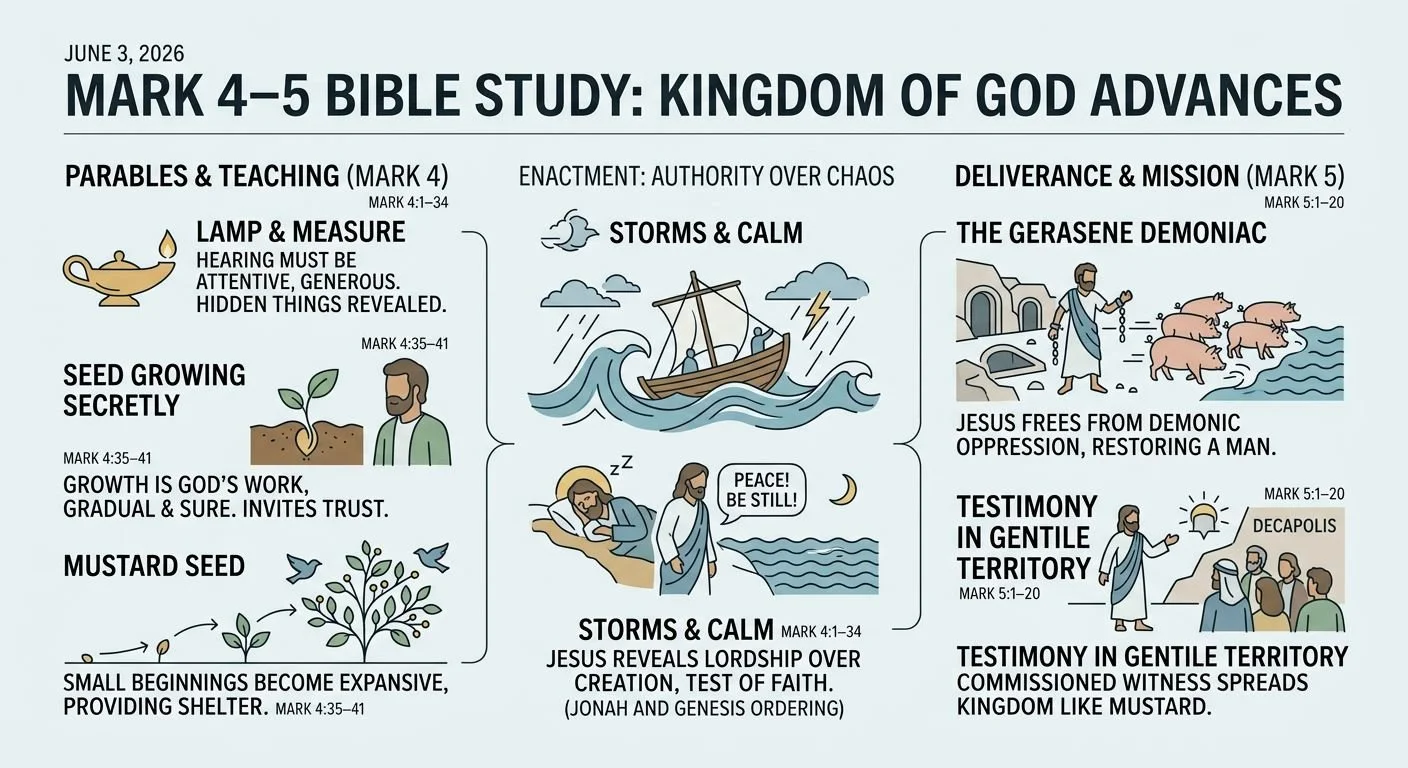
This is an AI Recap of the class.
Some things may be incorrect.
Short summary of the whole class
On June 3, 2026, we welcomed newcomers and studied Mark 4:19–5:20 (with previews of 5:21–43), revisiting the Parable of the Sower’s pastoral tension (“What if I’m bad soil?”) and connecting it to Jesus’ sayings about the lamp and the measure, the seed growing secretly, and the mustard seed. We saw these teachings enacted as Jesus calmed the storm and freed the man with “Legion,” commissioning him to witness in Gentile territory. Along the way we noted “hard” versus “soft” narrative splits, cross-referenced Isaiah, Genesis, Jonah, and Leviathan imagery, and anticipated the healing of the bleeding woman and Jairus’s daughter—concluding that God’s Kingdom advances irresistibly, turning even “bad soil” into good.
Section-by-section walkthrough
1) Setup, class method, and translations
We welcomed first-time attendees, explained our practice of reading from the NKJV dramatized audio while allowing other translations, and encouraged noting translation differences (sometimes peeking at Greek).
We framed the study of Mark with “splits”—distinguishing “hard” (new movement/scene) and “soft” (development within a theme) transitions.
We set the reading scope: Mark 4:19 through the first story of Mark 5.
Short summary of this section:
Orientation to method (NKJV focus, comparative notes), preview of Mark 4–5, and the “hard vs. soft split” lens for tracking Mark’s flow.
Bible verses mentioned:
Announced Mark 4:19–5:20 (NKJV).
Stories discussed:
None specifically expounded yet; setup for Mark 4–5.
2) Parable of the Sower revisited: “What if I’m bad soil?” (Mark 4:1–20; read 4:19–20)
We revisited last week’s topic and raised a pastoral concern: “What if I’m just bad soil?” The parable names soils without prescribing how to change soil type, which can feel unresolved.
A participant offered that faith can grow even from “cement,” emphasizing personal responsibility and resilient faith.
We recognized the tension and prepared to read onward for how Mark addresses hearing, growth, and transformation.
Short summary of this section:
We wrestled with anxiety about being “bad soil,” affirmed resilient faith, and acknowledged the parable’s limits—looking ahead to how subsequent teachings and stories speak to transformation.
Bible verses mentioned:
Mark 4:3–20 (especially 4:19–20).
Stories discussed:
Parable of the Sower.
3) Lamp under a basket and measure given (Mark 4:21–25)
“Nothing hidden… will not be revealed”; “Take heed what you hear… with the measure you use, it will be measured to you.”
We connected these sayings to the “bad soil” concern: attentive hearing and generous receptivity shape understanding. Hiddenness now doesn’t preclude future revelation—hope for anxious hearts.
Short summary of this section:
Jesus urges careful, open hearing; hidden things will come to light, and generous reception brings greater understanding.
Bible verses mentioned:
Mark 4:21–25.
Stories discussed:
Lamp under a basket; measure you use.
4) The seed growing secretly (Mark 4:26–29)
The kingdom grows “he himself does not know how,” moving from blade to full grain—God’s initiative at work beyond our control.
This encourages those worried about visible progress: growth can be real though unseen.
Short summary of this section:
The kingdom’s growth is God-driven, gradual, and sure—inviting trust when we can’t see or engineer results.
Bible verses mentioned:
Mark 4:26–29.
Stories discussed:
Parable of the growing seed.
5) The mustard seed (Mark 4:30–34)
From the smallest beginnings to a sprawling plant sheltering “birds of the air.”
We noted the expansive, even unwieldy, spread of the kingdom—small faith leading to shelter for many.
Mark notes Jesus used parables publicly and explained them privately—highlighting hearing and understanding, even amid disciples’ frequent confusion.
Short summary of this section:
The kingdom starts small but grows large enough to shelter others; Jesus tailors revelation to hearers’ capacity.
Bible verses mentioned:
Mark 4:30–34.
Stories discussed:
Mustard seed; Jesus’ use of parables and private explanations.
6) Connecting parables to the storm: structure and faith
We debated whether Jesus calming the storm is a “hard shift” or thematically continuous with the seed parables.
Conclusion: It’s connected by faith—Jesus’ question, “Why are you so afraid? Do you still have no faith?” tests whether teaching has taken root; tiny-seed faith should grow in the disciples.
Short summary of this section:
The storm narrative enacts the parable lessons: hearing must mature into trusting action; small faith is meant to grow.
Bible verses mentioned:
Mark 4:21–34 (context), Mark 4:35–41 (transition link).
Stories discussed:
Parables (lamp, growing seed, mustard seed) linked to calming the storm.
7) Calming the storm—Jesus as Lord over chaos (Mark 4:35–41)
Same day, crossing the lake; a great windstorm threatens. Jesus sleeps; the disciples panic: “Teacher, do You not care that we are perishing?”
Jesus rebukes wind and sea: “Peace! Be still!” Then: “Why are you so fearful? How is it that you have no faith?”
The class connected this to biblical chaos imagery: Genesis’ ordering of waters (tohu va-vohu), Jonah asleep in a storm, and Leviathan motifs—Jesus imposes divine order over creation.
Short summary of this section:
Teaching becomes test; Jesus reveals authority over chaos, confronting fear and calling for faith; the disciples’ awe advances revelation.
Bible verses mentioned:
Mark 4:35–41; Genesis 1:2–8; Jonah 1; Job 41; Psalm 74:14; Isaiah 27:1.
Stories discussed:
Calming the storm; Jonah in the storm; creation ordering; Leviathan imagery.
8) Crossing to the Gerasenes—deliverance in Gentile territory (Mark 5:1–20)
Arrival “on the other side”: a man living among tombs confronts Jesus; “Legion,” many demons, recognize Him as “Son of the Most High God.”
Jesus permits demons into pigs (~2,000); the herd rushes into the sea and drowns. The man is found “sitting, clothed, and in his right mind.”
Townspeople fear and plead for Jesus to leave; the delivered man begs to accompany Jesus. Instead, Jesus sends him home to testify: “Tell them what great things the Lord has done for you and how He has had compassion on you.” He proclaims in the Decapolis; “all marveled.”
We discussed purity laws, Gentile setting, economic impact, and how Jesus’ mission disrupts systems that value profit over people. We also noted a strategic “split”: while Jesus often hushes witnesses in Jewish regions, here He commissions Gentile proclamation.
Short summary of this section:
Jesus’ authority frees a tormented man; fear pushes some away, but the healed man becomes a missionary—planting mustard-seed witness in new soil.
Bible verses mentioned:
Mark 5:1–20; parallels noted: Matthew 8:28–34; Luke 8:26–39.
Stories discussed:
Gerasene/Gadarene demoniac; pigs rushing into the sea; Decapolis testimony.
9) Anticipation: unclean and death overcome (Mark 5:21–43 preview)
We previewed the woman with a 12-year hemorrhage (ceremonial impurity; Leviticus 15) and Jairus’s daughter (death as the ultimate barrier).
Thematic arc: what looks like “bad soil” (impurity, death) becomes receptive ground through Jesus’ power and the woman’s faith.
Short summary of this section:
Upcoming stories continue the pattern: Jesus meets impurity and death and brings healing and life.
Bible verses mentioned:
Mark 5:21–43 (preview); Leviticus 15; parallels Matthew 9:18–26; Luke 8:40–56.
Stories discussed:
Preview: bleeding woman; Jairus’s daughter raised.
10) Hard vs. soft splits and discipleship, understanding, and communal faith
We traced “soft” splits across sayings and parables (Mark 4:21–34) and “hard” shifts into enacted narratives (storm; Gerasenes), noting thematic continuity: hearing, faith, growth, mission.
The disciples’ partial understanding—“Who then is this?”—highlights a journey toward clarity, later empowered by the Spirit (Acts 2).
We emphasized communal faith: when personal faith is thin, the church bears one another—reflecting how the kingdom grows together.
Short summary of this section:
Mark’s structure moves from teaching to testing to mission; disciples grow from partial grasp to Spirit-shaped clarity, supported by communal faith.
Bible verses mentioned:
Mark 4:21–34; Mark 4:35–41; Mark 5:1–20; Acts 2 (implied).
Stories discussed:
Flow across parables, storm, and exorcism; early church community (conceptual).
Medium-length final summary (dated 2026-06-03 18:31:56)
On June 3, 2026, our class followed Mark’s unified arc from teaching to testing to mission. We revisited the Parable of the Sower and the pastoral worry, “What if I’m bad soil?” and then listened to Jesus’ sayings on the lamp and the measure, the seed that grows “we know not how,” and the mustard seed—learning that hearing must be attentive, growth is God’s work, and small beginnings can shelter many. The narrative moved from parables to enactment as Jesus calmed the storm, confronting fear and revealing authority over chaos with echoes of Genesis, Jonah, and Leviathan imagery. Crossing into Gentile territory, Jesus liberated the Gerasene demoniac, restoring him and commissioning him to testify—an intentional witness strategy beyond Israel that challenges economic priorities and spreads the kingdom like mustard. We previewed the healing of the bleeding woman and raising of Jairus’s daughter, seeing how Jesus overcomes impurity and death. Throughout, we tracked “soft” and “hard” splits, recognized the disciples’ partial understanding, and emphasized communal faith—arriving at the conclusion that the Kingdom advances irresistibly, turning even “bad soil” into good through Jesus’ compassionate authority.
Main points
The Parable of the Sower raises real pastoral anxiety about being “bad soil.”
Jesus’ lamp and measure sayings call for attentive, generous hearing; hidden things will be revealed.
The kingdom’s growth is God’s initiative—often unseen yet sure.
Mustard-seed beginnings become expansive and sheltering.
The storm narrative tests whether parable teaching has matured into faith; Jesus reveals authority over creation and chaos.
Deliverance in the Gerasenes shows Jesus’ power over demonic oppression, critiques profit-over-people priorities, and plants witness in Gentile territory.
Witness strategy shifts: “go tell” in Gentile regions versus frequent hush in Jewish contexts.
Upcoming healings (bleeding woman; Jairus’s daughter) reveal authority over impurity and death.
Mark’s “soft” and “hard” splits serve a continuous narrative about hearing, faith, growth, and mission.
Discipleship moves from partial understanding to Spirit-enabled clarity, sustained by communal faith.
Bible Scriptures mentioned
Mark 4:1–20 (Parable of the Sower; focus on 4:19–20)
Mark 4:21–25 (Lamp under a basket; measure you use)
Mark 4:26–29 (Seed growing secretly)
Mark 4:30–34 (Mustard seed; parables explained to disciples)
Mark 4:35–41 (Jesus calms the storm)
Mark 5:1–20 (Gerasene/Gadarene demoniac; Decapolis testimony)
Mark 5:21–43 (Preview: bleeding woman; Jairus’s daughter)
Genesis 1:2–8 (Ordering the waters; chaos to order)
Jonah 1 (Jonah asleep in the storm; awakening)
Job 41; Psalm 74:14; Isaiah 27:1 (Leviathan/sea-chaos imagery)
Leviticus 15 (Laws on ceremonial impurity)
Acts 2 (implied; Spirit’s coming)
Stories discussed
Parable of the Sower (seed on different soils)
Lamp under a basket (light meant to shine)
Seed growing secretly (mysterious, God-driven growth)
Mustard seed (small becomes expansive; shelter for many)
Jesus calming the storm (authority over wind and waves)
Jonah in the storm (sleeping, awakening, danger confronted)
Creation ordering in Genesis (God subdues the deep)
The Gerasene demoniac and “Legion” (deliverance; pigs; Decapolis witness)
Preview: the woman with a 12-year hemorrhage and Jairus’s daughter raised from the dead
Content creation date: 2026-06-03 18:31:56