Mark Chapter 1:21-2:12 Class 3 - Wednesday Bible Study
Gospel of Mark Chapter 1:21-2:12
This is our 3rd class on Mark
This is an AI Recap of the class.
Some things may be incorrect.
Short Summary of the Class
During our Bible study on May 6, 2026, we discussed the beginning of Jesus's public ministry as recorded in Mark 1:14-2:12. We noted Mark's rapid-fire storytelling, which emphasizes Jesus's actions and authority. A key theme was the "Messianic Secret," exploring why Jesus commanded demons and healed individuals to be silent—likely to control the timing of His ministry and define His mission through compassionate acts rather than popular messianic expectations. The class traced the escalating demonstration of Jesus's authority, from His power over demons and disease to His ultimate claim of divine authority to forgive sins. The healing of the paralytic was identified as a pivotal moment and a "microcosm of the entire gospel," as it explicitly linked His power to heal with His power to forgive, directly challenging the religious leaders.
Detailed Class Summary
Introduction: Mark's Fast-Paced Gospel and Jesus's Humble Character
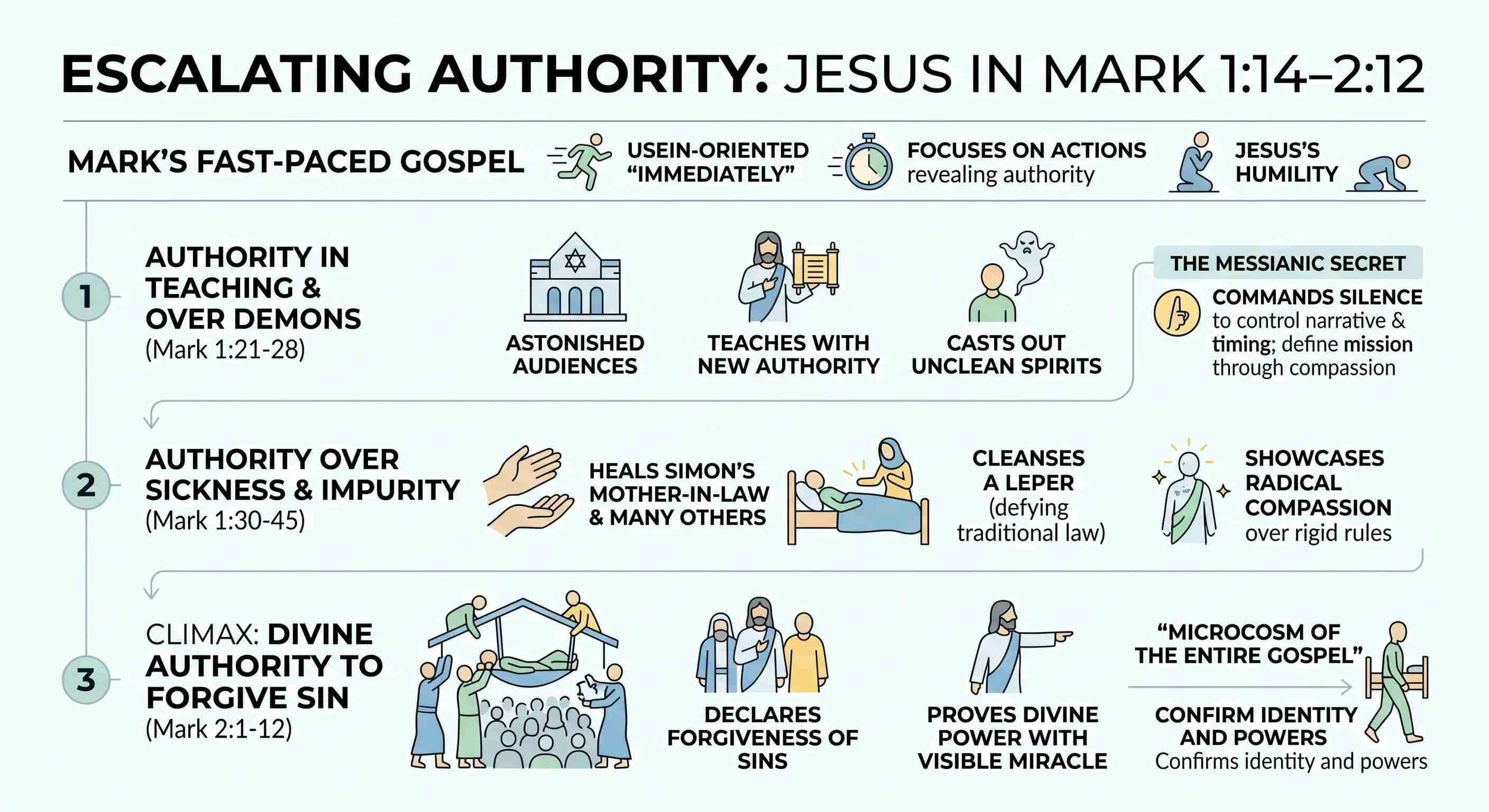
The class began by summarizing the first section of Mark’s Gospel, noting its fast-paced, action-oriented style, which often uses the word "immediately" to move between events. This narrative structure focuses more on what Jesus did than what he said. We established that Jesus is presented as the true source of hope ("good news about Jesus, the Messiah, the Son of God"), contrasting with the false hope people placed in earthly powers. A key characteristic of Jesus highlighted was His profound humility. He often sought private places to pray, demonstrating that His miracles were not for self-acclaim but to draw people to His primary message of salvation. His compassionate, grassroots approach stood in stark contrast to the public, self-seeking nature of the religious leaders of the day.
Summary: We established that Mark's Gospel is an action-packed narrative presenting Jesus as the true source of hope. His ministry was characterized by humility and compassion, using miracles to gather an audience for his message rather than for personal glory.
The "Messianic Secret": Why Jesus Commanded Silence
A central question arose from the reading: why did Jesus repeatedly silence both the demons who recognized Him (Mark 1:34) and the leper He had just cleansed (Mark 1:44)? The class concluded this was a deliberate strategy, often called the "Messianic Secret." Jesus was controlling the narrative of His ministry. By commanding silence, He prevented a frenzy based on popular, political expectations of a Messiah and stopped demons from distorting His true purpose. He wanted His compassionate words and deeds to define the kind of Messiah He was, rather than allowing premature declarations to misrepresent His mission. The consequences of disobedience were seen when the healed leper talked freely, forcing Jesus out of the towns and into lonely places (Mark 1:45).
Summary: We concluded that Jesus commanded silence to control the timing and nature of His self-revelation. He aimed to define His messiahship through service and teaching, rather than allowing popular expectations or demonic declarations to misrepresent His mission.
Jesus's Escalating Authority vs. Established Powers
The discussion then focused on the overarching theme that ties the stories in Mark 1 and 2 together: the escalating authority of Jesus and the resulting tension with established powers. This authority was not just claimed but demonstrated in a sequence of powerful acts:
Authority in Teaching: In the Capernaum synagogue, the people were "astonished" because He taught "as one who had authority, and not as the religious officials taught" (Mark 1:22).
Authority over Unclean Spirits: He immediately backed up His teaching by casting out an unclean spirit, causing the crowd to marvel at His "new teaching with authority" (Mark 1:27).
Authority over Sickness: He demonstrated power over physical disease by healing Simon’s mother-in-law (Mark 1:30-31) and later, "the whole city" that brought their sick to Him (Mark 1:32-34).
Authority over Ritual Impurity: In a profound act of compassion that defied religious law, Jesus "stretched out his hand and touched" a man with leprosy, cleansing him completely (Mark 1:40-42). This act challenged social and religious barriers.
Summary: The central theme connecting these stories is Jesus’s escalating demonstration of authority. He showed power over teaching, demons, disease, and ritual impurity, which amazed the people and set the stage for conflict with the religious leaders whose own authority was being undermined.
The Climax: The Forgiveness and Healing of the Paralytic
The class identified the healing of the paralytic (Mark 2:1-12) as the climax of this section and a microcosm of the entire gospel message. In a crowded house in Capernaum, friends lowered a paralyzed man through the roof. Seeing their faith, Jesus first declared, "Son, your sins are forgiven you" (Mark 2:5). The scribes present immediately recognized the radical nature of this claim, thinking, "Who can forgive sins but God alone?" (Mark 2:7). Jesus then proved His unseen, divine authority to forgive sins by performing the visible miracle. He asked, "Which is easier...?" and then commanded the man to "Arise, take up your bed and walk" (Mark 2:9-11). The man's immediate healing left everyone amazed and proved that the Son of Man has authority on earth to forgive sins. This event masterfully connects Jesus's power to heal with His divine power to forgive, confirming His identity and foreshadowing His ultimate triumph over sin and death.
Summary: The healing of the paralytic was presented as a condensed version of the gospel. Jesus explicitly claimed the divine authority to forgive sins and then proved it with a physical miracle, demonstrating His power over both the spiritual and physical realms and leaving the crowds in awe.
Final Summary
The Bible study on May 6, 2026, provided a deep dive into Mark 1:14-2:12, exploring the explosive start to Jesus's public ministry. We began by highlighting Jesus's humble character and Mark's fast-paced, action-oriented narrative style. A key topic was the "Messianic Secret," where we concluded that Jesus's commands for silence were a deliberate strategy to define His messiahship through compassionate action rather than allowing it to be distorted by popular expectations.
The primary theme discussed was the escalating authority of Jesus. We traced how Mark strategically builds this theme through a sequence of events: His authoritative teaching, His command over unclean spirits, His power over sickness and disease, and His compassion that transcended purity laws in healing a leper. These acts directly challenged the established religious leaders. The climax of this narrative arc was identified in the story of the paralytic. Here, Jesus makes His most profound claim: the authority to forgive sins. By linking the declaration "Your sins are forgiven" to the visible, miraculous healing of the man's paralysis, Jesus proved His divine power. This single event was seen as a "microcosm of the entire gospel," encapsulating conflict with religious leaders, the demonstration of power over sin and helplessness, and the awe-inspiring reaction of the people.
Main Points
Mark’s Gospel is fast-paced and focuses on Jesus's actions to reveal His identity and authority.
Jesus's ministry was characterized by humility, using miracles to draw people to His message, not for personal glory.
Jesus commanded silence (the "Messianic Secret") to control the timing and perception of His ministry, avoiding popular misconceptions of the Messiah.
A central, unifying theme in Mark 1:14-2:12 is the escalating demonstration of Jesus's authority.
Jesus shows authority over demonic spirits, physical diseases, ritual impurity (leprosy), and ultimately, sin itself.
The healing of the paralytic serves as a thesis statement or "microcosm" for the entire Gospel of Mark.
Jesus proves his divine authority to forgive sins by performing a visible miracle (healing the paralytic), a power belonging to God alone.
Scriptures and Stories Mentioned
Bible Verses: Mark 1:14-2:12
Mark 1:22 (Teaching with authority)
Mark 1:27 (Authority over unclean spirits)
Mark 1:30-31 (Healing of Simon’s mother-in-law)
Mark 1:34 (Commanding demons to be silent)
Mark 1:35-37 (Jesus prays in a solitary place)
Mark 1:40-45 (The cleansing of a man with leprosy)
Mark 2:1-12 (The forgiveness and healing of the paralytic)
Stories Discussed:
The beginning of Jesus’s ministry in Galilee (Mark 1:14-15)
The Calling of the Four Fishermen (Mark 1:16-20)
The Man with an Unclean Spirit in the Synagogue (Mark 1:21-28)
The Healing of Simon’s Mother-in-Law (Mark 1:29-31)
Jesus Heals the Sick at Evening (Mark 1:32-34)
The Cleansing of a Man with Leprosy (Mark 1:40-45)
The Forgiveness and Healing of the Paralytic (Mark 2:1-12