
Micah Intro & Chapter 1 Class 1 - Bible Study
Micah Intro and Chapter 1
This is our 1st class on Micah
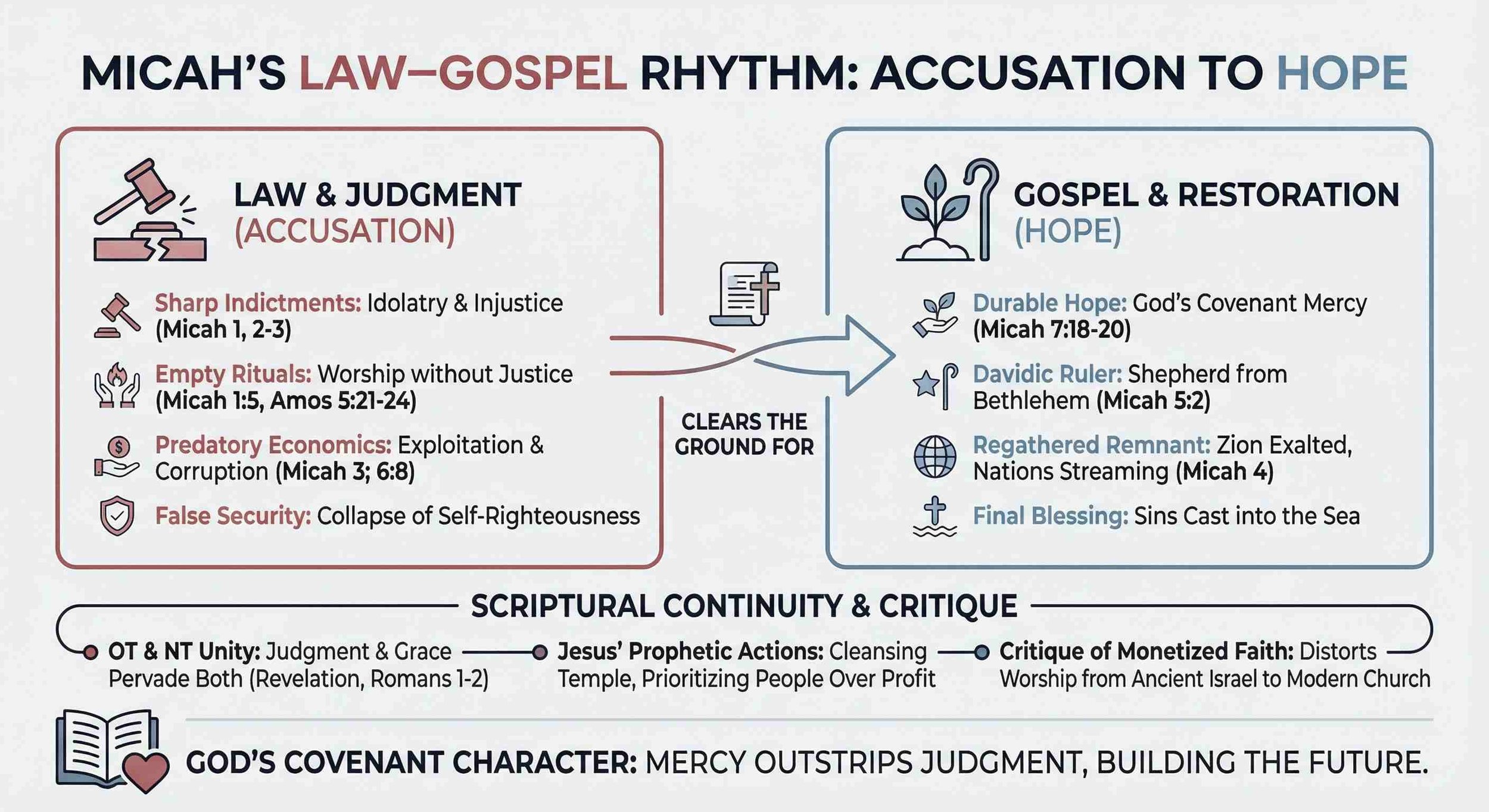
This is an overview of Micah.
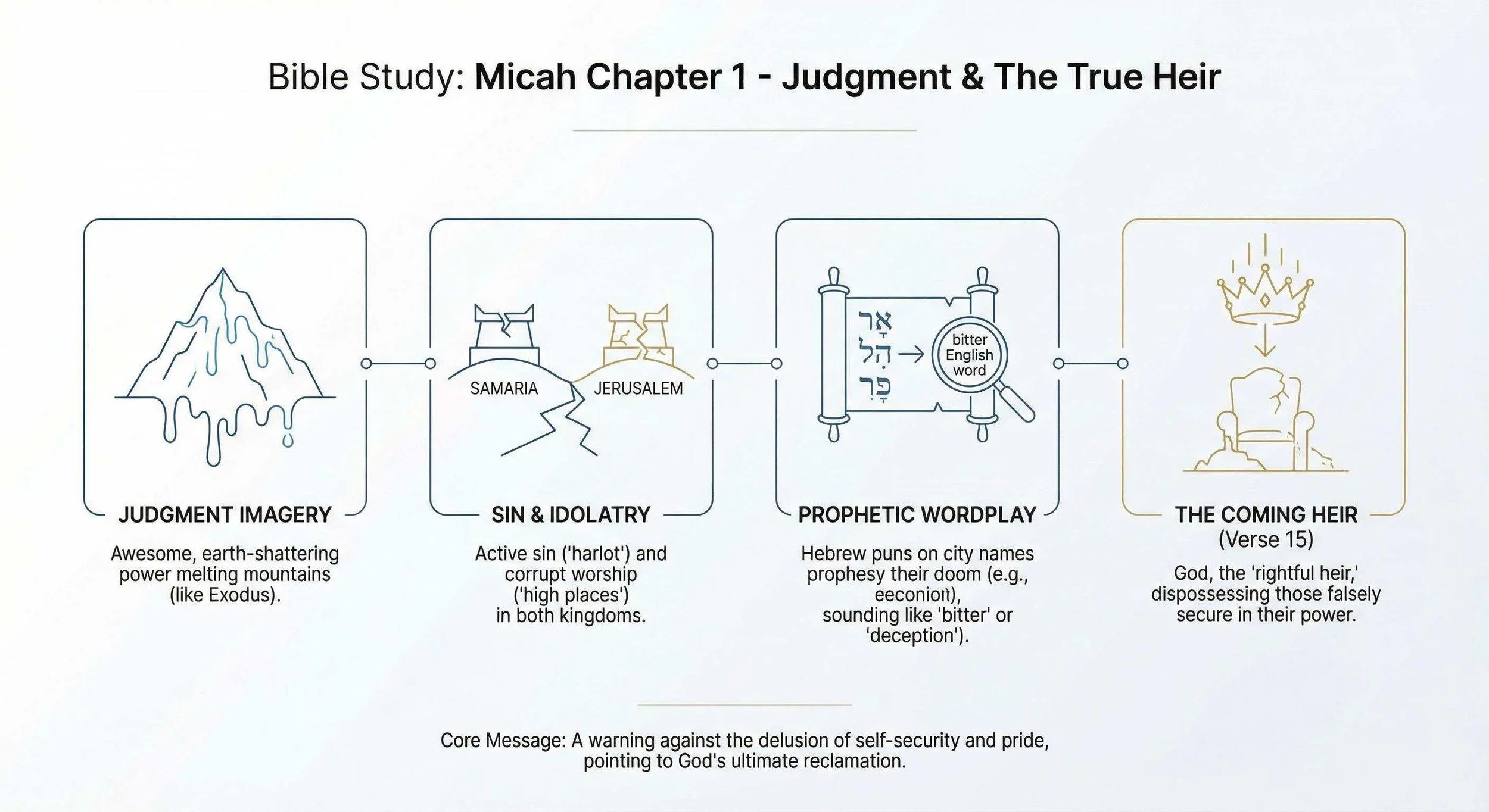
This is an AI Recap of the class.
Some things may be incorrect.
Short summary of the whole class
We read Micah—starting with Micah 1—and explored its Law–Gospel rhythm: sharp indictments of injustice, idolatry, and self-righteousness, followed by durable hope in God’s covenant mercy and a promised Davidic ruler from Bethlehem. Along the way we linked Micah’s themes to Revelation’s critique of power, Paul’s indictments in Romans, and Jesus’s prophetic actions (cleansing the temple; delivering the Gerasene demoniac), and reflected on how monetizing religion—from ancient Israel to indulgences to modern church culture—distorts worship and justice. We also examined translation nuances in Micah 1, poetic place-name wordplay, and the continuity between Old and New Testaments, concluding that divine judgment clears the ground for restoration.
Walkthrough summary with section-by-section notes
1) Opening reflections: Continuity between Old and New Testaments and the Law–Gospel pattern
What we discussed:
Scripture’s unity: the same human tendencies to power, domination, and wealth appear across the Testaments.
The “good news” looks forward and backward: God will set things right and, in Christ, has begun to do so.
The prophets, including Micah, follow a recognizable Law–Gospel rhythm—confrontation of sin followed by promises of restoration—and Revelation often recycles prophetic themes.
Stories/Scriptures mentioned:
Revelation (general thematic reference)
General references to Joel, Amos, Jonah, Obadiah, Micah
Short summary of this section:
We framed Micah within Scripture’s continuity and a Law–Gospel pattern, noting that Revelation echoes prophetic themes of judgment and hope.
2) Reading Micah 1: God’s descent, idolatry, and lament
What we discussed:
God’s theophany: the Lord descends; mountains melt; valleys split (Micah 1:3–4).
Judgment on both Samaria and Jerusalem for transgression and idolatry (Micah 1:5–7).
Lament imagery—wailing, dust, shame, baldness, captivity—calling for sober grief (Micah 1:8–16).
Judah is not morally superior; no one is exempt from critique.
Stories/Scriptures mentioned:
Micah 1:1–16
Short summary of this section:
Micah 1 announces sweeping judgment over both kingdoms, exposing idolatry and self-assured religiosity and calling for lament.
3) Imagery echoes and the “harlot” motif: Exodus, Proverbs, and Hosea
What we discussed:
Exodus echo: Micah 1’s earth-shaking presence recalls God’s powerful interventions in history.
“Harlot/prostitute” language (Micah 1:7) connected to Proverbs’ seductive sin and Hosea’s symbolic marriage—idolatry as relational betrayal, a selling of oneself.
Stories/Scriptures mentioned:
Micah 1:7
Exodus (themes of theophany and deliverance; e.g., Exodus 14–15; 19 thematically)
Proverbs (harlot/prostitute motif; general references)
Hosea 1–3 (prophet’s marriage as sign-act)
Short summary of this section:
Micah’s imagery taps Exodus’s divine power and portrays sin, via Proverbs and Hosea, as an active, relational unfaithfulness.
4) Who is being confronted? Judah, Samaria, and the collapse of self-righteousness
What we discussed:
Micah 1:5 levels the field: Judah’s “high places” mirror Samaria’s; prophetic sarcasm punctures self-righteousness.
Ritual without justice is empty; idolatry undercuts religious confidence.
Stories/Scriptures mentioned:
Micah 1:5
Amos 5:21–24 (thematic link: God’s rejection of empty festivals)
Short summary of this section:
Micah dismantles Judah’s false security: religious forms without faithfulness and justice cannot shield from judgment.
5) “High places” and reverence—then critique
What we discussed:
High places historically evoke reverence (Sinai), but prophets condemn altars divorced from obedience and justice.
Amos’s rebuke reinforces that height and ritual mean nothing without covenant faithfulness.
Stories/Scriptures mentioned:
Micah 1 (high places language)
Exodus 19 (Sinai theophany; thematic)
Amos 5:21–24
Short summary of this section:
Awe without obedience is hollow; God seeks justice and faithfulness, not mere elevated ritual.
6) Translation matters in Micah 1:16 and 1:15—“eagle” or “vulture”; “heir,” “conqueror,” or “dispossessor”?
What we discussed:
Micah 1:16: “Make yourself bald”—mourning and disgrace; the Hebrew term may be “eagle” or “vulture,” with “vulture” fitting lament’s tone.
Micah 1:15: the term variously rendered “heir,” “conqueror,” or “dispossessor”; the thrust is that rightful rule will dispossess pretenders.
Illustrations included study notes and a Robin Hood analogy (rightful heir displaces a pretender).
Stories/Scriptures mentioned:
Micah 1:16; Micah 1:15
Genesis 15 (heir/possession language; thematic)
Robin Hood analogy (story illustration)
Short summary of this section:
Nuanced translation sharpens the text’s tone and theology: mourning is stark, and God’s rightful authority overturns false securities.
7) Place-name wordplay and omen-like warnings (Micah 1:10–14)
What we discussed:
Micah’s puns on town names amplify the message: surface beauty masks decay; fates align with names.
Stories/Scriptures mentioned:
Micah 1:10–14
Short summary of this section:
Poetic wordplay serves prophecy—names become omens exposing the gap between appearance and reality.
8) Power, captivity, and Revelation’s critique—then and in Jesus’s day
What we discussed:
Micah 1:16 ties pride to captivity; Revelation critiques false security in power and wealth.
Parallels to Pharisees and Sadducees protecting status and opposing Jesus.
Stories/Scriptures mentioned:
Micah 1:16
Revelation (general thematic reference)
Gospel-era accounts of Pharisees and Sadducees resisting Jesus (e.g., John 11:47–53 thematically)
Short summary of this section:
Pride breeds captivity; whether in Micah’s day or the Gospels, protecting power resists God’s true king.
9) Watching and processing an overview of Micah: accusation and hope
What we discussed:
Historical setting: Micah of Moresheth (Judah), contemporary with Isaiah; covenant-breaking in Israel and Judah.
Warnings: Assyria’s devastation of the north; Babylon’s later destruction.
Accusations: leaders and prophets enriching themselves; justice bent for the wealthy; land theft; prophetic corruption—Naboth’s vineyard as emblematic injustice.
Hope: God as shepherd regathers a remnant; exalted Zion with nations streaming; exile and return; a Davidic king from Bethlehem; final justice and blessing to the nations.
Micah 6:8 as covenant heartbeat; Micah 7:18–20 grounding hope in God’s character.
Stories/Scriptures mentioned:
Micah 3 (prophetic strength/accusation); Micah 4 (nations to Zion); Micah 5:2 (Bethlehem ruler); Micah 6:8; Micah 7:18–20
1 Kings 21 (Ahab and Naboth’s vineyard)
Assyria and Babylon as instruments of judgment
Short summary of this section:
Micah alternates tough indictments with sturdy hope: God confronts injustice yet promises a shepherd-king and covenant mercy.
10) OT “fire and brimstone” and NT continuity
What we discussed:
Is the OT uniquely “hellfire and brimstone”? The NT shares moral urgency—Paul’s indictments and Revelation’s prophetic cadence.
We tend to find what we seek; both Testaments carry sustained hope.
Tone shift: OT promises forward (“God will”), NT proclaims fulfillment (“God has done”).
Stories/Scriptures mentioned:
Romans 1–2
Revelation (prophetic pattern)
The Gospels as narrative continuity with the patriarchs
Short summary of this section:
Judgment and grace pervade both Testaments; the promises of the OT meet fulfillment in the NT without losing ethical edge.
11) Jesus and the economics of the kingdom
What we discussed:
Jesus confronts exploitative systems—cleansing the temple to restore prayer and justice.
Gerasene demoniac: deliverance at economic cost (drowned pigs) exposes resistance when profit is threatened.
Warning against “devouring widows’ houses.”
Stories/Scriptures mentioned:
Temple cleansing: Matthew 21:12–13; Mark 11:15–17; Luke 19:45–46; John 2:13–17
Gerasene/Gadarene demoniac and pigs: Mark 5:1–20; Luke 8:26–39; Matthew 8:28–34
“Devouring widows’ houses”: Mark 12:40; Luke 20:47
Short summary of this section:
Jesus stands in the prophetic stream, prioritizing people over profit and provoking backlash from vested interests.
12) Commercialization of faith—then and now
What we discussed:
Prophetic rebukes (Amos, Micah) of wealth built on exploitation; parallels in church history (indulgences under Pope Leo X) and Luther’s revulsion at monetized piety.
Modern concerns: institutional self-preservation, staffing over care, public distrust, and the “chicken and egg” tension of wealth amid visible poverty.
Stories/Scriptures mentioned:
Amos 2:6–7; 4:1; 5:11–24 (themes)
Micah 2–3; 6:8
Church history: indulgences; Luther’s pilgrimage practices and protest
Short summary of this section:
Monetizing faith corrodes justice and credibility—from Israel’s courts to medieval indulgences to modern church culture.
13) Returning to Micah’s heartbeat: judgment unto hope
What we discussed:
If Israel is to bless the nations, God must confront Israel’s evil; exile as consequence and cure.
Restoration through the Davidic shepherd from Bethlehem; God delights in steadfast love and casts sins into the sea.
Stories/Scriptures mentioned:
Micah 5:2
Micah 7:18–20
Genesis 12:1–3 (thematic: blessing to the nations)
Short summary of this section:
Micah’s rhythm—law then gospel—shows judgment as a pathway to covenantal restoration and global blessing.
Medium-length final summary (created on 2026-03-26 11:08:46)
Our study moved from Micah 1’s thunderous theophany and indictments of idolatry and injustice to the book’s larger Law–Gospel cadence: God confronts corrupt leadership, predatory economics, and hollow religiosity, yet promises to shepherd, regather, and renew his people through a Davidic ruler from Bethlehem. We connected Micah’s warnings (Assyria, Babylon) and hopes (Zion’s restoration; nations streaming; sins hurled into the sea) to Revelation’s critique of power, Paul’s indictments in Romans, and Jesus’s prophetic actions—cleansing the temple and delivering the demonized at economic cost. Translation nuances (eagle/vulture; heir/conqueror/dispossessor) and poetic place-name wordplay deepened our reading of Micah 1. We wrestled with how monetizing faith—from ancient Israel to indulgences to present church culture—distorts worship and justice. Throughout, we emphasized Scripture’s continuity: the OT’s forward-looking promises meet NT fulfillment without losing ethical urgency. Micah closes by grounding hope not in human reform but in God’s covenant character: he delights in steadfast love, pardons iniquity, and casts sins into the sea—judgment clears the ground; mercy builds the future.
Main points
Micah and the prophets follow a Law–Gospel rhythm: accusation of sin paired with promises of restoration.
God’s judgment falls on both Samaria and Jerusalem; self-righteousness and ritual without justice cannot protect.
Micah’s imagery echoes Exodus; idolatry is active betrayal (harlot motif via Proverbs and Hosea).
Translation nuances (Micah 1:15–16) sharpen tone and theology: rightful rule dispossesses pretenders; lament is stark.
Poetic place-name wordplay in Micah 1 underscores appearance versus reality.
Micah indicts corrupt leadership and predatory economics; judgment comes via Assyria and Babylon.
Hope interrupts judgment: remnant regathered, Zion restored, nations welcomed, Davidic ruler from Bethlehem.
The OT’s moral urgency continues in the NT (Romans, Revelation); Jesus embodies the prophetic critique.
Jesus confronts exploitative religion and economics (temple cleansing; pigs episode), prioritizing people over profit.
Monetizing faith—ancient or modern—distorts worship and justice and undermines credibility.
God’s covenant character has the final word: mercy outstrips judgment; sins are trampled and cast into the sea.
Scriptures mentioned
Micah: 1:1–16; 3; 4; 5:2; 6:8; 7:18–20
Exodus: 14–15 (thematic); 19 (Sinai theophany)
Proverbs: passages on the harlot/prostitute motif (general)
Hosea: 1–3 (prophet’s marriage as sign-act)
Amos: 2:6–7; 4:1; 5:11–24; 5:21–24
1 Kings 21 (Naboth’s vineyard)
Genesis 12:1–3; 15 (thematic)
Romans 1–2
Revelation (general thematic references)
Gospels:
Temple cleansing: Matthew 21:12–13; Mark 11:15–17; Luke 19:45–46; John 2:13–17
Gerasene/Gadarene demoniac and pigs: Mark 5:1–20; Luke 8:26–39; Matthew 8:28–34
“Devouring widows’ houses”: Mark 12:40; Luke 20:47
Religious leaders resisting Jesus: John 11:47–53 (thematic)
Stories referenced
Naboth’s vineyard (1 Kings 21) as a paradigm of judicial theft and corruption.
Hosea’s marriage (Hosea 1–3) as a living parable of unfaithfulness and restoration.
Exodus: theophany and mighty acts (parting waters; Sinai).
Jesus cleansing the temple (driving out commerce to restore prayer and justice).
The Gerasene demoniac and the drowned pigs (deliverance that challenges economic interests).
Pharisees and Sadducees resisting Jesus to safeguard power (e.g., John 11:47–53 thematically).
Robin Hood analogy: rightful heir displacing a pretender (illustrating “heir/dispossessor”).