
Mark Chapter 3 Class 5 - Wednesday Bible Study
Gospel of Mark Chapter 3
This is our 5th class on Mark
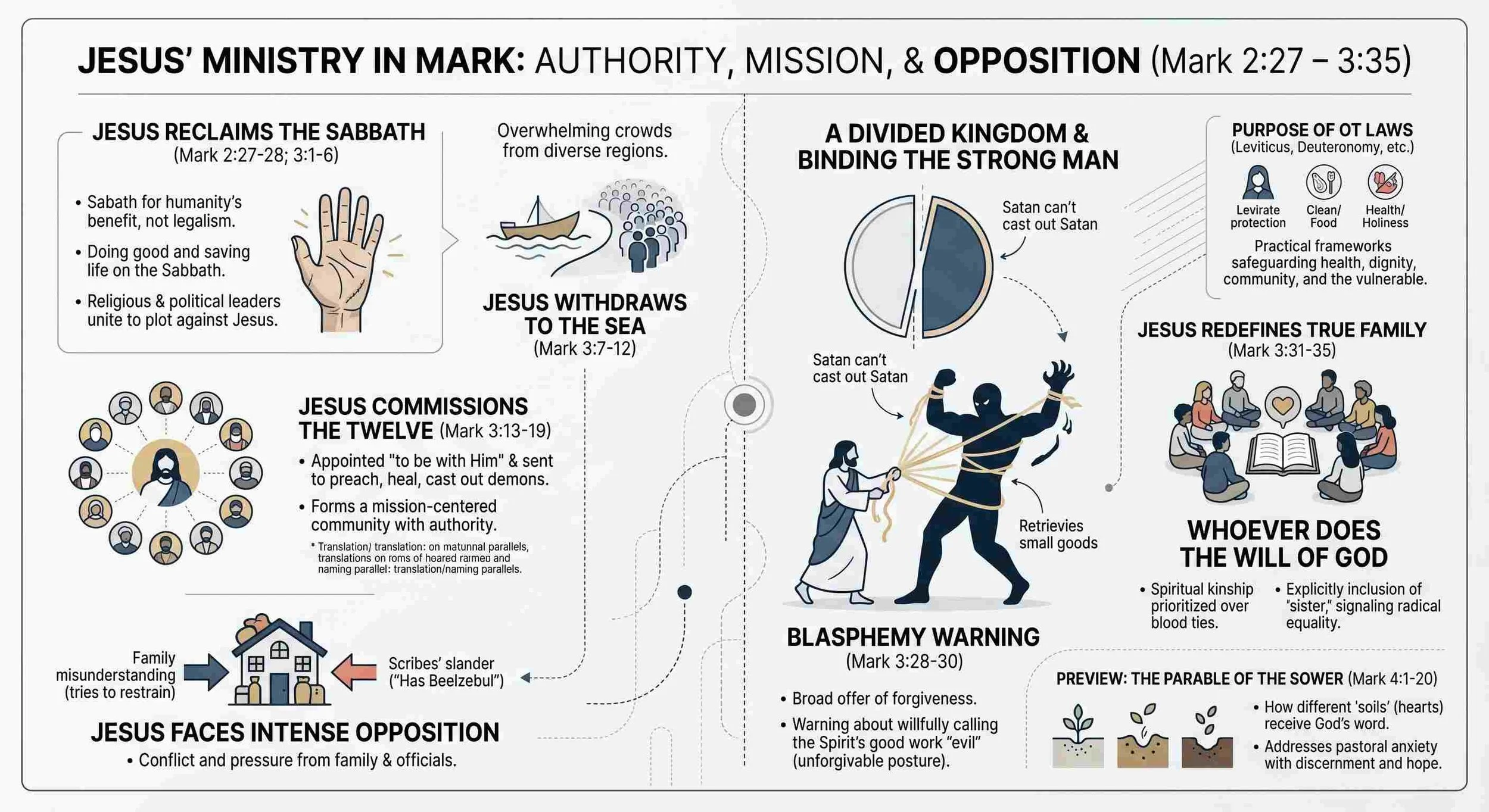
This is an AI Recap of the class.
Some things may be incorrect.
Short Summary of the Whole Class
On May 20, 2026, we traced Mark’s narrative from the Sabbath controversy into Jesus’ escalating ministry pressures: huge crowds, unclean spirits recognizing Him, and the commissioning of the Twelve. Opposition intensified—from Pharisees and Herodians plotting, scribes accusing Him of demonic power, and family misunderstanding Him. Jesus answered with the “house divided” logic and “binding the strong man,” warned about blasphemy against the Holy Spirit, and redefined true family around doing God’s will. We also discussed translation and naming, practical purposes of Old Testament laws (care for the vulnerable, health, holiness), and previewed the Parable of the Sower, engaging pastoral questions about “bad soil.”
Section-by-Section Walkthrough
1) Transition from Sabbath Conflict to Growing Opposition (Mark 2:27–28; 3:1–6)
What we discussed:
Recap: “The Sabbath was made for man, not man for the Sabbath” (Mark 2:27–28), highlighting mercy and life over legalism.
Jesus heals a man with a withered hand on the Sabbath (Mark 3:1–5), revealing God’s heart.
Pharisees and Herodians immediately conspire to destroy Jesus (Mark 3:6), aligning religious and political powers against Him.
Big idea: Mark exposes three human power spheres—religious, political, personal—and shows Jesus challenging them.
Scriptures mentioned:
Mark 2:27–28; Mark 3:1–6.
Stories referenced:
Healing of the man with the withered hand.
Short summary of this section:
Jesus restores the Sabbath’s purpose with healing and mercy; threatened leaders unite to plot His death.
2) Hard Split to Withdrawal and the Surge of the Crowds (Mark 3:7–12)
What we discussed:
A narrative “hard split” at Mark 3:7: Jesus withdraws to the sea; crowds converge from many regions (Galilee, Judea, Jerusalem, Idumea, beyond the Jordan, Tyre, Sidon).
Practical detail: Jesus asks for a small boat to avoid being crushed—“super crowded,” likely hundreds pressing in.
Unclean spirits recognize Him as the Son of God; He silences them to control revelation timing.
Scriptures mentioned:
Mark 3:7–12.
Stories referenced:
Crowds pressing; Jesus requesting a boat.
Demons declaring, “You are the Son of God.”
Short summary of this section:
Jesus’ fame explodes across regions; He heals many while managing overwhelming crowds and restraining premature acclaim.
3) Calling and Commissioning the Twelve; Translation and Names (Mark 3:13–19; Daniel 1:7)
What we discussed:
Jesus appoints twelve “to be with Him” and to be sent to preach, heal, and cast out demons (Mark 3:13–19).
Names include Simon Peter; James and John (Boanerges, “Sons of Thunder”); and Judas Iscariot.
Shift from controversy to mission: forming a sent community with kingdom authority.
Translation notes: preserving Greek/Hebrew name forms (Petros, Yakbos, Philippus, Bartholomews, Tomos); “commissioners” emphasizing mission.
Daniel parallel: Hebrew names vs. Babylonian given names (“slave names”)—Belteshazzar (Daniel), Shadrach, Meshach, Abednego (Daniel 1:7).
Scriptures mentioned:
Mark 3:13–19; Daniel 1:7.
Stories referenced:
Appointment and naming of the Twelve.
Renaming in exile (Daniel and companions).
Short summary of this section:
Jesus establishes a sent community with authority; translation and naming underscore mission and identity in God’s kingdom.
4) Crowding, Family Misunderstanding, and Scribes’ Accusation (Mark 3:20–22)
What we discussed:
The house is so crowded “they could not even eat” (Mark 3:20).
“His own people” (likely family) try to restrain Him: “He is out of his mind” (Mark 3:21).
Scribes from Jerusalem accuse Him: “He has Beelzebul… by the ruler of the demons He casts out demons” (Mark 3:22).
Thread: Opposition escalates from religious elites, political collaborators, and even family—personal power and expectations press in.
Scriptures mentioned:
Mark 3:20–22.
Stories referenced:
Family attempting to restrain Jesus; scribes’ accusation.
Short summary of this section:
Misunderstanding and slander intensify as crowding, family pressure, and official accusations converge.
5) A Divided Kingdom, Binding the Strong Man, and Blasphemy Against the Holy Spirit (Mark 3:23–30; Luke 15:11–32; Acts 2)
What we discussed:
Jesus’ parables: a kingdom/house divided cannot stand—Satan doesn’t cast out Satan (Mark 3:23–26).
“No one can enter a strong man’s house and plunder his goods unless he first binds the strong man” (Mark 3:27)—Jesus is conquering Satan, not collaborating with him.
Broad offer of forgiveness—“all sins… and whatever blasphemies”—but a grave warning: blasphemy against the Holy Spirit “never has forgiveness” (Mark 3:28–29), because some were claiming He had an unclean spirit (Mark 3:30).
Class consensus: blasphemy here is knowingly attributing the Spirit’s good work to evil—hard-hearted mislabeling.
Pastoral caution: youth-group anxiety over an “unforgivable sin”; focus on discernment rather than fear.
Analogies: elder brother in the prodigal son as self-exclusion (Luke 15:11–32); Pentecost reminder not to mislabel the Spirit’s work (Acts 2).
Scriptures mentioned:
Mark 3:23–30; Luke 15:11–32; Acts 2.
Stories referenced:
Parables of the divided kingdom and binding the strong man.
The elder brother in the prodigal son (analogy).
Pentecost and the Spirit empowering the church.
Short summary of this section:
Jesus dismantles the accusation with clear logic, asserts His victory over Satan, and warns that calling the Spirit’s work evil is a grave posture that shuts one off from forgiveness.
6) Jesus Redefines True Family and Equality (Mark 3:31–35; Matthew 12:46–50; Luke 8:19–21; Galatians 1:19)
What we discussed:
Jesus’ mother and brothers arrive, seeking Him; He points to those sitting around Him and says, “Whoever does the will of God is my brother and sister and mother” (Mark 3:31–35).
Inclusion of “sister” signals radical equality within a patriarchal culture; Jesus widens the circle of belonging.
Clarifications: Jesus had brothers (e.g., James; Galatians 1:19); traditions like Mary’s perpetual virginity were noted as differing views.
Illustrations: church cultures calling one another “brother” and “sister” (Amish country, southern fundamentalist churches) as echoes of spiritual kinship.
Scriptures mentioned:
Mark 3:31–35; Matthew 12:46–50; Luke 8:19–21; Galatians 1:19.
Stories referenced:
Family seeking Jesus; equality and inclusion in the kingdom family.
Short summary of this section:
Jesus centers obedience to God as the basis of true family, explicitly affirming women as equal “sisters” and expanding spiritual kinship beyond blood ties.
7) Old Testament Laws: Practical Purposes and Care for the Vulnerable (Deuteronomy 25:5–10; Leviticus 11; Leviticus 17:10–14)
What we discussed:
The traditional count of 613 commandments (mitzvot) in Jewish tradition—positive and negative precepts.
Practical reasons for many laws: wilderness living, sanitation, food safety, communal order, identity, and holiness.
Levirate marriage (Deuteronomy 25:5–10) as protection for widows, preserving lineage and provision in a patriarchal society.
Kosher restrictions (Leviticus 11) and prohibitions around blood (Leviticus 17:10–14) for health and sacred identity.
Emphasis: laws as protective and compassionate frameworks, not arbitrary rules.
Scriptures mentioned:
Deuteronomy 25:5–10; Leviticus 11; Leviticus 17:10–14.
Stories/illustrations referenced:
Practical examples of food safety (e.g., scavenger foods).
Short summary of this section:
Old Testament laws often function to safeguard health, dignity, and community—especially for the vulnerable—underscoring God’s compassionate order.
8) Preview: The Parable of the Sower and the Question of “Bad Soil” (Mark 4:1–20; Matthew 13:24–30)
What we discussed:
Preview of the Parable of the Sower (Mark 4:1–20): seed on the path, rocky ground, among thorns, and good soil; varied responses to God’s word.
Pastoral question: “What if you’re just bad soil?”—raised by a friend with anxiety; class balanced realism with compassion and hope.
Pragmatic note: focus effort where the word is received while caring for those who struggle.
Tangential mention: Parable of the Weeds (Matthew 13:24–30) as a similar agricultural story.
Scriptures mentioned:
Mark 4:1–20; Matthew 13:24–30.
Stories/illustrations referenced:
The Sower’s seed; agricultural analogies for spiritual growth.
Short summary of this section:
We previewed how the word meets different “soils” and addressed pastoral concerns about spiritual receptivity with grace-centered encouragement.
Medium-Length Summary of the Class
On May 20, 2026, our Bible study continued from Mark 2:27–28 into Mark 3, where Jesus’ Sabbath healing exposed the Law’s intent—mercy and life—and triggered opposition as Pharisees and Herodians plotted to destroy Him. A hard shift at Mark 3:7 showed withdrawal to the sea amid surging crowds from across the region, so intense that Jesus requested a boat. Unclean spirits recognized Him as the Son of God, but He silenced them to govern the timing and nature of His revelation. On the mountain, He appointed the Twelve to be with Him and be sent to preach, heal, and cast out demons, forming a mission-centered community. Pressure mounted: a jam-packed house, family trying to restrain Him as “out of his mind,” and scribes accusing Him of demonic power. Jesus answered with the “house divided” parable and “binding the strong man,” asserting He is overpowering Satan, not collaborating with him. He issued a sober warning about blasphemy against the Holy Spirit—willfully labeling the Spirit’s good work as evil—which closes one off from forgiveness. Finally, Jesus redefined true family around those who do God’s will, explicitly including “sister,” signaling radical equality. We reflected on translation and naming, the practical and protective purposes of Old Testament laws (care for widows, health, holiness), and previewed the Parable of the Sower, engaging pastoral questions about “bad soil” with discernment and hope.
Main Points
Jesus restores the original intent of Sabbath: mercy, life, and doing good (Mark 2:27–28; 3:1–5).
Religious and political powers unite against Jesus when He threatens their control (Mark 3:6).
A hard transition in Mark 3:7 shifts to overwhelming public response and growing fame (Mark 3:7–12).
Unclean spirits confess Jesus as the Son of God; He silences them to control revelation timing (Mark 3:11–12).
Jesus appoints the Twelve to be with Him and be sent with authority to preach, heal, and cast out demons (Mark 3:13–19).
Opposition intensifies: family misunderstanding and official slander from Jerusalem scribes (Mark 3:20–22).
“House divided” teaching refutes the Beelzebul accusation; Jesus is binding the strong man to plunder Satan’s domain (Mark 3:23–27).
Warning on blasphemy against the Holy Spirit addresses willful mislabeling of the Spirit’s work as evil (Mark 3:28–30).
True family is defined by doing God’s will, explicitly affirming women as equal “sisters” (Mark 3:31–35; parallels in Matthew 12:46–50; Luke 8:19–21).
Translation and naming highlight mission and identity (Mark 3:13–19; Daniel 1:7).
Old Testament laws often have practical, protective purposes for health and the vulnerable (Deuteronomy 25:5–10; Leviticus 11; Leviticus 17:10–14).
Preview of the Parable of the Sower raises pastoral questions about “bad soil,” inviting grace-centered discernment (Mark 4:1–20; Matthew 13:24–30).
Bible Scriptures Mentioned
Mark 2:27–28 — Sabbath made for man; Son of Man is Lord of the Sabbath.
Mark 3:1–6 — Healing of the man with the withered hand; Pharisees and Herodians plot to destroy Jesus.
Mark 3:7–12 — Crowds from many regions; boat prepared; unclean spirits confess Jesus; He silences them.
Mark 3:13–19 — Appointment and naming of the Twelve; mission and authority.
Mark 3:20–22 — Crowding; family’s attempt to restrain Him; scribes accuse Him of Beelzebul.
Mark 3:23–27 — “House divided” and “binding the strong man” parables.
Mark 3:28–30 — Warning on blasphemy against the Holy Spirit.
Mark 3:31–35 — Jesus’ true family defined; inclusion of “sister.”
Matthew 12:46–50 — Parallel account of redefining family.
Luke 8:19–21 — Parallel account of redefining family.
Galatians 1:19 — James referenced as Jesus’ brother.
Daniel 1:7 — Babylonian names: Belteshazzar (Daniel), Shadrach, Meshach, Abednego.
Deuteronomy 25:5–10 — Levirate marriage provisions.
Leviticus 11 — Clean and unclean animals (kosher laws).
Leviticus 17:10–14 — Prohibition of eating blood.
Mark 4:1–20 — Parable of the Sower (previewed).
Matthew 13:24–30 — Parable of the Weeds (referenced by analogy).
Luke 15:11–32 — Prodigal son; elder brother’s self-exclusion (analogy).
Acts 2 — Pentecost and the coming of the Holy Spirit.
Stories Mentioned
Healing on the Sabbath: the man with the withered hand.
Massive crowds pressing in; Jesus requests a boat.
Unclean spirits crying out, “You are the Son of God.”
Appointment and mission of the Twelve “commissioners.”
Parables of the divided kingdom and binding the strong man.
The elder brother in the prodigal son (as an analogy for mislabeling mercy).
Pentecost and the Spirit empowering the church.
Daniel and his friends receiving Babylonian names in exile.
Family seeking Jesus; Jesus naming doers of God’s will as true family.
Practical examples around food safety and kosher restrictions.
Preview of the Parable of the Sower and pastoral questions about “bad soil.”