
Mark Chapter 2 - 3:6 Class 4 - Wednesday Bible Study
Gospel of Mark Chapter 2 - 3:6
This is our 4th class on Mark
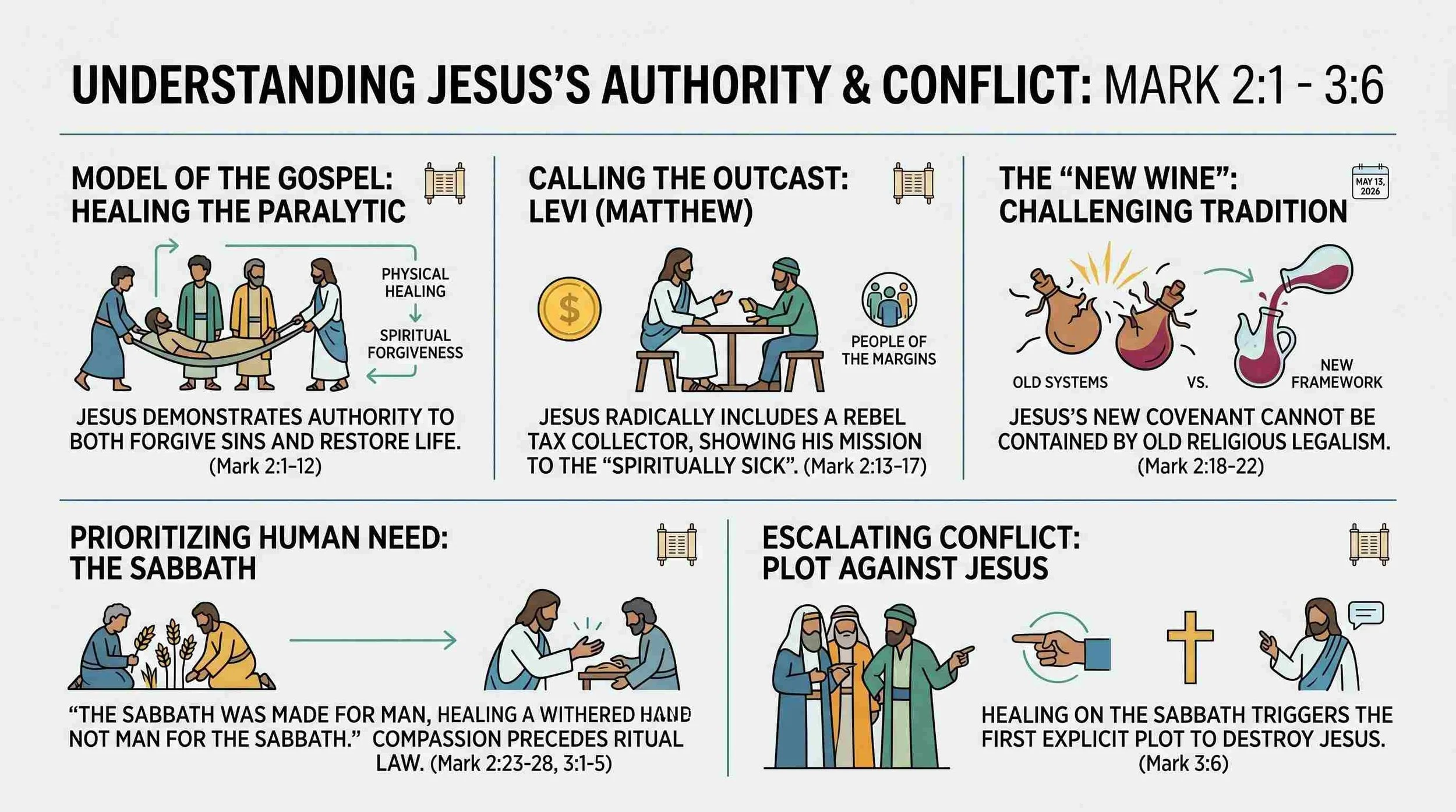
This is an AI Recap of the class.
Some things may be incorrect.
Short Summary of the Whole Class
During our Bible study on May 13, 2026, we recapped the beginning of Mark and then delved into a detailed reading and discussion of Mark chapter 2 through chapter 3, verse 6. The class focused on identifying the structure of Mark's narrative, questioning the man-made chapter breaks, and understanding the significance of the stories presented. Key topics included Jesus healing the paralytic as a model of the gospel, the controversial calling of Levi (Matthew) the tax collector, and the escalating conflict with the Pharisees over fasting and the Sabbath, culminating in a plot against Jesus's life.
Detailed Class Summary
Recap and Introduction (Mark 1 - 2:12)
The class began with a recap of the first part of Mark's Gospel. The speaker highlighted the powerful opening, which invokes the theme of a new creation with the arrival of Jesus Christ, the Son of God. This preamble sets the stage, contrasting the power of Caesar and Rome with the true authority of Jesus. We reviewed the ministry of John the Baptist, Jesus's baptism where the "heavens are ripped open," and the subsequent period of miracles and healings.
A key point of discussion was the story of the healing of the paralytic at the beginning of chapter two, which we had discussed the previous week. The speaker proposed that this miracle serves as a perfect illustration of the entire gospel message: Jesus demonstrates his authority not just to heal physically but, more importantly, to forgive sins. The man is forgiven, then healed, and the crowd's reaction is "amazement," a word the speaker suggested is a signifier of the resurrection throughout Mark's Gospel.
Section Summary: The opening of Mark establishes Jesus's divine authority, which is then demonstrated through his baptism and early ministry of healing. The story of the paralytic in Mark 2 is presented as a microcosm of the gospel itself, combining the forgiveness of sins with physical restoration, pointing toward the ultimate power of the resurrection.
Bible Verses: Mark 1, Mark 2:1-12
Stories: The ministry of John the Baptist, the Baptism of Jesus, the Healing of the Paralytic.
Questioning Structure and Calling Levi (Mark 2:13-17)
After a lively reading of Mark 2:1 through 3:6, the class shifted to a discussion about the structure of the text. The speaker challenged the group to look for "hard splits" or transitions in the narrative and questioned the chapter break between chapters 2 and 3. It was noted that these chapter and verse divisions were added in medieval times and are not part of the original text, reminding us that they are interpretive additions. The flow of the narrative, with its frequent use of "and then," suggests a continuous account of Jesus's ministry during this period.
The discussion then focused on the calling of Levi, the son of Alphaeus, who was sitting at a tax office. The class explored the significance of this act. We noted that Levi is also known as Matthew and that he came from a priestly family line (the tribe of Levi). For a man from a priestly family to be working as a tax collector for the occupying Roman Empire would have been seen as a profound betrayal. Jesus calls this man seen as a traitor and sinner to be one of his followers and then dines at his house with other "tax collectors and sinners." Jesus's response to the Pharisees' criticism, "I did not come to call the righteous, but sinners," demonstrates that his message is for everyone, especially those on the margins and aware of their spiritual sickness.
Section Summary: We learned to read Mark's Gospel with an awareness that chapter breaks are not original and can interrupt the narrative flow. The calling of Levi (Matthew), a tax collector from a priestly family, is a radical act where Jesus extends his invitation to a social and religious outcast, reinforcing his mission to seek and save the lost.
Bible Verses: Mark 2:13-17
Stories: The Calling of Levi (Matthew).
Conflict and New Ways (Mark 2:18 - 3:6)
The final part of our discussion centered on the escalating conflict between Jesus and the religious leaders, specifically the scribes and Pharisees. This conflict is highlighted through a series of confrontations.
First, Jesus is questioned about why his disciples do not fast. Jesus responds with the analogy of the bridegroom, stating that it is a time for celebration, not mourning, while he is present. He then uses the parables of the unshrunk cloth on an old garment and new wine in old wineskins to illustrate that his new covenant cannot be patched onto the old systems of religious legalism; it requires a completely new framework.
The conflict intensifies over the issue of the Sabbath. The Pharisees challenge Jesus when his disciples pluck heads of grain on the Sabbath. Jesus defends their actions by citing the story of David eating the consecrated showbread, arguing that human need can take precedence over ritual law and declaring, "The Sabbath was made for man, not man for the Sabbath." This confrontation culminates in the synagogue, where Jesus encounters a man with a withered hand on the Sabbath. He directly challenges the Pharisees: "Is it lawful on the Sabbath to do good or to do evil, to save life or to kill?" When they remain silent, Jesus, grieved by their hardness of heart, heals the man. This act of compassion is the final straw for the Pharisees, who immediately go out and begin to plot with the Herodians on how to destroy Jesus.
Section Summary: Jesus's ministry represents a radical break from the religious traditions of the day, which he illustrates with parables about new wine and new cloth. His conflicts with the Pharisees over fasting and the Sabbath demonstrate that his kingdom prioritizes people over rules. His healing of the man with the withered hand on the Sabbath solidifies the opposition against him, leading to the first explicit plot to kill him.
Bible Verses: Mark 2:18-28, Mark 3:1-6
Stories: The question about fasting (Parable of the Bridegroom, New Cloth, New Wineskins), Disciples plucking grain on the Sabbath (David and the Showbread), Healing the man with the withered hand on the Sabbath.
Medium-Length Summary
In our Bible study on May 13, 2026, we explored the rich narrative of Mark chapters 2 and 3, focusing on how Mark presents Jesus's authority and the escalating conflict his ministry provokes. We began by revisiting the healing of the paralytic, which serves as a powerful model for the entire gospel: Jesus has the power to both forgive sins and restore life. A central theme was Jesus's radical inclusivity, powerfully demonstrated in his calling of Levi (Matthew), a tax collector seen as a collaborator with the Roman enemy. By calling Levi and eating with sinners, Jesus showed that his message was for the outcasts who knew they were spiritually sick. This led to a series of confrontations with the Pharisees. Jesus defended his disciples for not fasting using the analogy of the bridegroom and explained through parables (new wine in old wineskins) that his new covenant could not be contained by old religious structures. The conflict peaked over the observance of the Sabbath, first when his disciples plucked grain and then when Jesus healed a man's withered hand in the synagogue. This definitive act of choosing compassion over legalism, framed by Jesus's declaration that "The Sabbath was made for man, not man for the Sabbath," led the Pharisees to immediately conspire with the Herodians to destroy him.
Main Points
The healing of the paralytic is a model of the gospel, combining forgiveness of sins and physical healing.
Chapter and verse divisions are not original to the text and should not limit our understanding of the narrative flow.
Jesus's calling of Levi the tax collector demonstrates his mission to society's outcasts.
Jesus's teachings represent a "new wine" that cannot be contained by the "old wineskins" of rigid religious tradition.
Conflict with the Pharisees intensifies over issues of fasting and the Sabbath.
Jesus prioritizes human need and compassion over strict adherence to religious law ("The Sabbath was made for man, not man for the Sabbath").
Jesus's healing of the man with the withered hand on the Sabbath is the event that triggers the first plot to kill him.
Scriptures and Stories Mentioned
Bible Scriptures:
Mark 1
Mark 2:1-28
Mark 3:1-6
Stories:
The Baptism of Jesus
The Healing of the Paralytic
The Calling of Levi (Matthew)
The Question About Fasting (including parables of the Bridegroom, New Cloth, and New Wineskins)
Disciples Plucking Grain on the Sabbath (referencing David and the Showbread)
The Healing of the Man with the Withered Hand