

The Chosen Study Episode 7-8 - Summer Bible Club Study
We explored Episode 7-8 of The Chosen
This is our last class on The Chosen this year
The Chosen Season 1 Episode 7-8
This is our last class on The Chosen this year.
The Chosen Study Episode 5 - Summer Bible Club Study
We explored Episode 5 of The Chosen (“The Wedding at Cana”), examining themes of calling, community, faith, and Jesus’s patient leadership through the cultural and scriptural lens of the Gospel of John.
The Chosen Season 1 Episode 5
This is our 4rd class on The Chosen
This is an AI Recap of the class.
Some things may be incorrect.
Short Summary of the Whole Class
On July 1, 2026 at 6:06:24 PM, our class discussed The Chosen, Season 1, Episode 5 (“The Wedding at Cana”), focusing on how the show illuminates first-century culture and discipleship. We explored themes of calling imperfect people, the honor/shame dynamics of a wedding crisis, and Jesus's patient, compassionate leadership. Key topics included the prophetic language of John the Baptist, the characterization of Thomas as meticulous and doubting, Mary’s pivotal role in prompting Jesus's first miracle, and how the episode weaves biblical themes from the Gospel of John and the Old Testament into relatable character arcs.
Section-by-Section Summary
1) Opening: Episode Focus and Unlikely Beginnings
We began by welcoming everyone and setting the focus on Episode 5 of The Chosen: “The Wedding at Cana.” The leader praised how the series visually and narratively explains the culture of the time, helping modern viewers grasp biblical stories and the everyday realities and social tensions that make the text more intelligible.
Discussion highlights included the humor and humanity in the episode, from awkward first meetings among disciples to the observation that Jesus isn’t choosing “the best” by worldly standards but gathering ruffians and misfits. This resonates with the Gospels’ portrayal of His followers.
Peter’s early mindset was noted as longing for importance, expecting a militant messiah, and seeking power and recognition. It was also noted that Jesus was portrayed as accessible, even "building a ramp so that people could get up to him," and the Greek word for craftsman and carpenter being the same added a layer to his background as a stonemason in the show.
Short Summary of Section:
We introduced Episode 5, affirming The Chosen’s value in portraying first-century culture and how it captures the messy, humble beginnings of discipleship as Jesus calls imperfect people.
Stories/Bible Verses Mentioned:
Story: Early interactions among the disciples forming an uneasy, diverse group.
2) John the Baptist, Nicodemus, and Prophetic Witness
A clip was referenced showing Nicodemus speaking with John the Baptist in prison, touching on the phrase “make straight the way,” echoing Roman imperial processions where roads were prepared for Caesar. John’s prophetic language (“Prepare the way of the Lord”) resonates within Roman occupation, highlighting how people were used by ruling powers.
Another discussion examined the powerful exchange where John the Baptist confronts Nicodemus with prophetic questions from Proverbs 30:4 about the One who gathers the wind and establishes the earth, pressing the issue of God’s Son. The pushback—“God doesn’t have a son except Israel”—exposed the tension over sonship.
This was connected to the Gospel of John's central claims about Jesus' identity as the Light, calling people to awaken. John 1:1-14 was read aloud and discussed, focusing on the Word, creation, life, light, witness, and the right to become children of God by receiving the Son.
Short Summary of Section:
We connected John the Baptist’s call to “prepare the way” with Roman practices and explored his prophetic witness to Nicodemus, which presses the question of Jesus's divine identity and sonship, calling hearers from darkness into light.
Stories/Bible Verses Mentioned:
John the Baptist’s call: Isaiah 40:3; echoed in John 1:23; Mark 1:2–3; Matthew 3:3; Luke 3:4
Jesus's Identity and Sonship: John 1:1–14
Prophetic Questions: Proverbs 30:4 ("What is his name, and what is his son’s name?")
Scene: Nicodemus and John in prison (The Chosen depiction)
3) Peter’s Call and Eden’s Faith: Echoes of Elisha
A clip was focused on where Simon (Peter) explains his call to follow Jesus to his wife, Eden, with a conviction that signals genuine change.
This was connected to the calling of Elisha in 1 Kings 19:19–21, who leaves his wealth, slaughters his oxen, and follows Elijah. This prefigures the way of the Messiah: a turn from kings and war to prophetic humility and transformative obedience.
Eden’s discernment and trust were seen as symbolizing the church’s faith—recognizing authentic repentance and supporting costly discipleship. Her name suggests a vision of the church as a foretaste of restored Eden.
Short Summary of Section:
We saw Peter’s call mirrored in Elisha’s, noted Eden’s faith as a model for the church, and reflected on how true calling reorients a life from power to Messiah-shaped obedience.
Stories/Bible Verses Mentioned:
Elijah's Call of Elisha: 1 Kings 19:19–21
Peter's Call: Luke 5:1–11 (Miraculous catch of fish)
John's Testimony: John 1:29 (“Behold, the Lamb of God”)
Story: Peter's confession and call; Eden’s supportive faith.
4) The Wedding at Cana: Honor, Humility, and Mary's Faith
The discussion highlighted the honor/shame dynamics at ancient weddings—running out of wine was a community crisis, not a simple inconvenience. The show contrasted a wealthy family’s perfectionism with the bride’s family’s acceptance of beauty in brokenness (e.g., decorating a crooked "kupa" canopy with flowers).
It was noted that Jesus attended the wedding solely because of his mother. We discussed the callback to an earlier scene where a young Jesus tells Mary, "If not now, then when?" which she uses to prompt him. Mary's request was private and faith-filled ("They have no wine," and "Do whatever he tells you"), born of a genuine need to save the family from dishonor.
The group praised the visual portrayal of the look between Mary and Jesus, conveying her faith and his empathetic response. Mary’s calm trust anticipated Jesus’ provision.
Short Summary of Section:
We discussed Mary’s pivotal role, her faith-filled prompt to Jesus, and how the wedding’s honor/shame culture illuminated the significance of Jesus’ compassionate, private miracle.
Stories/Bible Verses Mentioned:
The Wedding at Cana: John 2:1–11
Mary at Cana: John 2:1–5
Story: Wedding preparations, social tensions, and the beautifying of the crooked "kupa."
5) Thomas’s Character: Meticulous Doubt and a New Calling
Group observations noted Thomas as a meticulous, calculative, and consistently doubting wine server, concerned about logistics. This was seen as setting up his well-known "doubting" theme.
Jesus performs the miracle discreetly while Thomas is away. This was significant because Thomas, who needs to measure everything, couldn't explain the miracle away and was left simply amazed.
When Thomas expresses confusion, Jesus responds with kindness, affirming, "It's good to ask. It's good to measure," then tells him, "I'll give you a different way to measure this time." This was seen as Jesus compassionately calling Thomas from his nature of doubt, just as he called Peter to a new way of fishing.
The thematic connection was made to the post-resurrection story in John 20, showing a narrative thread in John's Gospel of signs, belief, and skepticism.
Short Summary of Section:
We examined Thomas’s portrayal as a careful, questioning planner, and admired how Jesus met him with kindness, validating his nature while calling him to a new kind of faith beyond measurement.
Stories/Bible Verses Mentioned:
Thomas’s doubt post-resurrection: John 20:24–29
Wedding at Cana: John 2:1–11
Story: Context of Cana miracle with Thomas present in The Chosen (narrative adaptation)
6) Jesus's Leadership: Patience, Humility, and Service
The discussion reflected on how Jesus leads people who think in “old ways” with patient redirection rather than rebuke, often using parables or gentle instruction. He avoids sarcasm and harshness, declining self-promotion to keep focus on the Father’s purpose.
This was contrasted with Simon’s ambition to leverage the wedding to gather powerful allies. Jesus’s quiet resistance showed him prioritizing the couple’s day over public strategy, redirecting Simon toward servanthood.
Jesus is shown working humbly as a craftsman, building what serves the vulnerable (like accessible latrines), and distinguishing private miracles from public ministry with the words, "My time has not yet come."
A member shared appreciation for a non-biblical scene where Jesus jokes with the disciples, delivering a "Jesus burn." This humorous, relatable side changed perceptions from a stoic figure to someone joyful.
Short Summary of Section:
We saw Jesus reshape Simon’s ambition toward humble service, modeling patient, non-rebuking leadership, and serving the vulnerable while waiting for the Father’s timing.
Stories/Bible Verses Mentioned:
Jesus's Timing: John 2:4 (“My hour has not yet come”)
Greatness as Service: Luke 22:24–27
Story: Discipleship table talk about Jesus' work as a craftsman and building accessible facilities.
7) Discipleship Growth and Concluding Thoughts
The disciples' default to "watch and learn" was contrasted with Jesus’s later commissioning of them "two by two." The class concluded that while observation is foundational, growth requires being sent, risking mistakes, and learning obedience through practice.
The instructor challenged the class to consider why John’s Gospel places the joyful wedding at Cana (turning water into wine) immediately before the cleansing of the temple in John 2.
A question was raised about why the show intentionally never depicts Jesus drinking alcohol, seen as a deliberate choice to be sensitive to certain Christian denominations.
The schedule for the next classes was announced: July 8, 2026 for episodes six and seven, and July 15, 2026 for episode eight.
Short Summary of Section:
We contrasted passive observation with active mission in discipleship and ended with a theological question about the structure of John 2, a note on the show's creative choices, and an announcement of future classes.
Stories/Bible Verses Mentioned:
Sending the Disciples: Mark 6:7; Luke 10:1–3
Juxtaposed Events in John 2: The Wedding at Cana (John 2:1-11) and The Cleansing of the Temple (John 2:13-22)
Medium-Length Summary of the Class
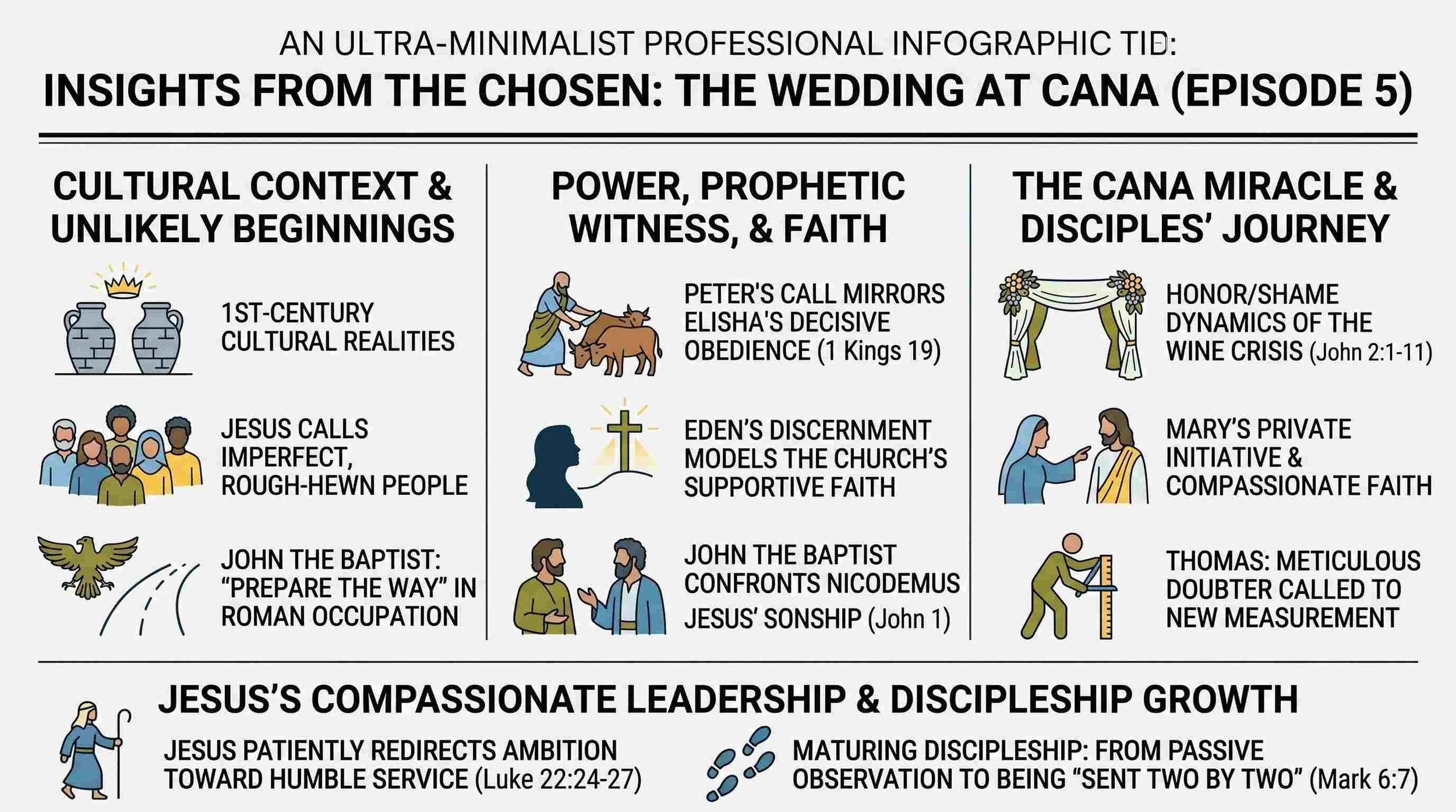
On July 1, 2026, our Bible study used The Chosen’s Cana episode to explore how Jesus forms disciples amid awkward starts, mixed motives, and cultural pressures. We began by appreciating the show's humanizing portrayal of Jesus and the disciples. A key discussion connected Peter’s call to the story of Elijah and Elisha, highlighting a shift from worldly power to Messiah-shaped obedience, with Peter's wife Eden modeling the church's supportive faith. We then explored the honor/shame dynamics at the wedding, recognizing that running out of wine was a social crisis and that Mary’s quiet confidence ushered in Jesus’s first sign. We examined the character of Thomas, whose need to "measure" was met with Jesus's compassionate call to a new kind of faith. The study also highlighted the prophetic confrontation between John the Baptist and Nicodemus over Jesus's identity as the Son of God. Throughout, we observed how Jesus patiently redirects ambition toward humble service, subverting expectations of status and power, and intentionally choosing unlikely people while waiting for his "hour" to come. The class concluded by reflecting on the growth from "watching" to being "sent," and the theological pairing of the Cana miracle with the temple cleansing in John 2.
Main Points
The Chosen effectively portrays first-century cultural context, Roman-Jewish tensions, and the humble, messy beginnings of discipleship.
Jesus calls imperfect, unlikely people and forms them into a community of faith, patiently redirecting their worldly ambitions toward humble service.
Peter’s call mirrors Elisha’s decisive obedience, signaling a shift from power and war to the Messiah-shaped way of service.
Honor/shame dynamics at Cana explain the crisis of running out of wine and the compassionate significance of Jesus’s first sign.
Mary’s initiative at Cana was a private act of faith that prompted Jesus’s first sign and saved a family from dishonor.
Thomas is depicted as a meticulous, doubting planner, and Jesus meets his skepticism with kindness, calling him to a faith beyond empirical measurement.
John the Baptist’s witness to Nicodemus stresses Jesus’s divine identity and sonship, calling people from darkness into light.
Discipleship matures when observation leads to being sent on active mission.
Jesus’s timing is deliberate, distinguishing private miracles from his public ministry, which had "not yet come."
Bible Scriptures Mentioned
John 1:1–14: The Word, light, witness, and becoming children of God.
John 1:23: John the Baptist: “Make straight the way of the Lord.”
John 1:29: “Behold, the Lamb of God, who takes away the sin of the world.”
John 2:1–11: The Wedding at Cana; Jesus’s first sign.
John 2:4: “My hour has not yet come.”
John 2:13-22: The Cleansing of the Temple.
John 20:24–29: Thomas’s doubt and confession after the resurrection.
Luke 5:1–11: Miraculous catch of fish; Peter’s confession and call.
Luke 10:1–3: Jesus appoints seventy-two and sends them two by two.
Luke 22:24–27: Greatness through serving.
Mark 6:7: Jesus sends the twelve two by two.
Synoptics on "Prepare the Way": Mark 1:2–3; Matthew 3:3; Luke 3:4.
1 Kings 19:19–21: Elijah’s call of Elisha.
Isaiah 40:3: Prophetic source for “prepare the way.”
Proverbs 30:4: Oracle of Agur: “What is his name, and what is his son’s name?”
Stories Discussed
The Wedding at Cana: The wine crisis, Mary’s intercession, Jesus bringing more guests, the discreet miracle, and honoring the family.
Discipleship and Calling: Awkward beginnings among misfits; Peter's call after the miraculous catch; Eden’s supportive faith; moving from "watching" to being "sent two by two."
Elijah and Elisha: Prophetic calling and Elisha’s decisive break with his past.
John the Baptist and Nicodemus: The interaction in prison in The Chosen, highlighting Roman context and the question of sonship.
Doubting Thomas: His depiction at Cana and the connection to his post-resurrection encounter with Jesus.
Jesus's Character and Leadership: Patient teaching style; working as a craftsman; building accessible facilities; redirecting Simon's ambition; his humor and relatability.
Humble Wedding Details: Beautifying the crooked “kupa” with flowers; the pride of the wealthy father (Abner) versus the family’s humility.
The Chosen Study Episode 4 - Summer Bible Club Study
Scenes from The Chosen to explore Jesus’ compassionate mission to outcasts, the meaning of the Sabbath, the power of personal transformation and testimony, childlike discipleship, and the tension between comforting mercy and costly allegiance to Christ.
The Chosen Season 1 Episode 4
This is our 3rd class on The Chosen
This is an AI Recap of the class.
Some things may be incorrect.
Short Summary of the Whole Class
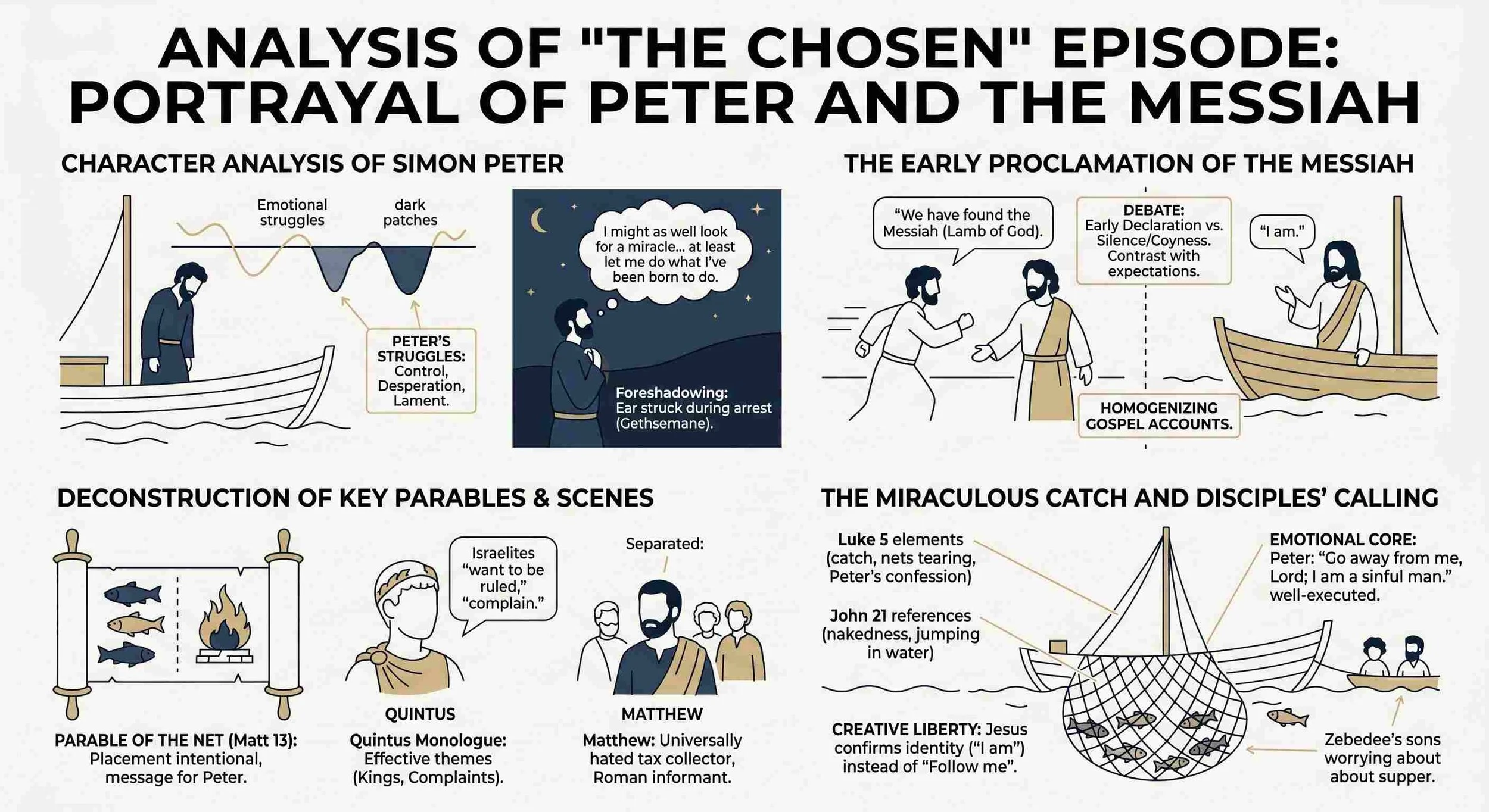
The group analyzes an episode of "The Chosen," focusing on its portrayal of Simon Peter's struggles, the early proclamation of Jesus as the Messiah, and the show's blending of various gospel accounts. Key discussion points include the creative liberties taken with scripture, the thematic representation of Israel's history through Peter's lament, and the narrative setup for future character dynamics.
Character Analysis of Simon Peter
This section covers the group's discussion on the depiction of Simon Peter, exploring his character arc within the episode. The analysis begins by highlighting Peter's emotional state, which one speaker likens to a personal "dark patch" where an individual becomes consumed with trying to control their own life and fix problems single-handedly. This is exemplified in the episode as Peter, despondent and on the verge of financial ruin, returns to fishing alone as a last resort. The group notes his desperation is captured in the thought, "I might as well look for a miracle out on the water," or simply to "at least let me do what I've been born to do."
A significant scene discussed is Peter's monologue while fishing at night, which is characterized as a lament that mirrors the historical struggles of Israel. He recounts a pattern of divine deliverance followed by suffering: enslavement in Egypt, wandering in the desert, exile in Babylon, and oppression under Rome. Cris views this lament as a positive, psalm-like form of questioning God. The discussion also identifies a key moment of foreshadowing where Peter's ear is struck during his arrest, an allusion to the Garden of Gethsemane where he will cut off the ear of the high priest's servant. This detail is seen as a clever way to show Peter's potential to become a "brute like the Romans."
The Early Proclamation of the Messiah
This section focuses on the central debate regarding the show's decision to have Jesus and his followers openly declare him as the Messiah early in the narrative. Participants noted that the show "bends full into calling him the Messiah from the very beginning," which felt odd compared to the accounts in Mark and Matthew where Jesus often commands silence about his identity. The discussion highlights the scene where Andrew runs to Simon, proclaiming he has seen the "Lamb of God," and later when Peter confesses Jesus's identity, to which Jesus explicitly confirms, "I am."
The group explores the theological and narrative implications of this creative choice. One speaker suggests this early declaration serves to contrast Jesus's true nature with the Pharisees' expectations of a messiah. Another speaker, however, argues it would have been more powerful if Jesus had remained "coy," forcing the disciples into a deeper journey of faith while still questioning "who is this man?" The conversation delves into scriptural sources, noting that John 1:40-42 does record Andrew telling Peter, "We have found the Messiah." The group concludes the show is homogenizing various gospel accounts. Additionally, Cris explains that when Peter says "Go away from me, Lord" in Luke 5, the Greek word used is "Kyrie," signifying a supreme authority or master, which supports the show's depiction of Peter's immediate recognition.
Deconstruction of Key Parables and Scenes
This section details the analysis of specific parables and scenes used in the episode, with a primary focus on Jesus's sermon from the boat. The group found the inclusion of the "parable of the net" from Matthew 13 to be an "odd" choice for this point in the story, particularly due to its severe language about separating good and bad fish and casting the latter into a "fiery furnace." The consensus was that its placement was intentional, serving as a direct message targeted at Simon Peter, who was struggling with his own path and trying to control his destiny.
The discussion also examined a monologue by the Roman official Quintus, who asserts that the Israelites are a "miserable lot" who inherently "want to be ruled" and "want an excuse to complain." Cris praised this as an effective way to highlight two major themes from the Old Testament: the Israelites' demand for a king and their history of complaining. The portrayal of Matthew as a universally hated tax collector and Roman informant was also analyzed, with the group noting the show's success in setting up the social isolation he would have faced. On a lighter note, Cris critiqued the scene of Jesus preaching, pointing out that the small number of extras did not convincingly portray the large crowd described in scripture, though acknowledging the production constraints.
The Miraculous Catch and Disciples' Calling
This section covers the climactic scene where Jesus directs the miraculous catch of fish, which is primarily based on Luke 5:1-11. The group analyzed how the show blends elements from different gospels, noting that while the tearing nets are from Luke, Peter's nakedness and jumping into the water reference the post-resurrection account in John 21. This homogenization was seen as a way to create a more cohesive and emotionally impactful narrative for the calling of the first disciples.
The emotional core of the scene, where Peter falls to his knees and says, "Go away from me, Lord; I am a sinful man," was deemed well-executed and touching. However, the creative liberty of having Jesus explicitly confirm his identity with "I am" was debated. Cris suggested the scene would have been more powerful if Jesus had simply responded with "Follow me," leaving the disciples to continue their journey of discovery. The speakers also appreciated the show's inclusion of relatable details, such as Zebedee's sons worrying about what their mother would say when they missed supper, and Zebedee's own "nice little touch" of suggesting they could escape to Egypt, referencing the Holy Family's flight.
The Chosen Study Episode 2 - Summer Bible Club Study
Scenes from The Chosen to explore Jesus’ compassionate mission to outcasts, the meaning of the Sabbath, the power of personal transformation and testimony, childlike discipleship, and the tension between comforting mercy and costly allegiance to Christ.
The Chosen Season 1 Episode 2-3
This is our 1st class on The Chosen
This is an AI Recap of the class.
Some things may be incorrect.
Short Summary of the Whole Class
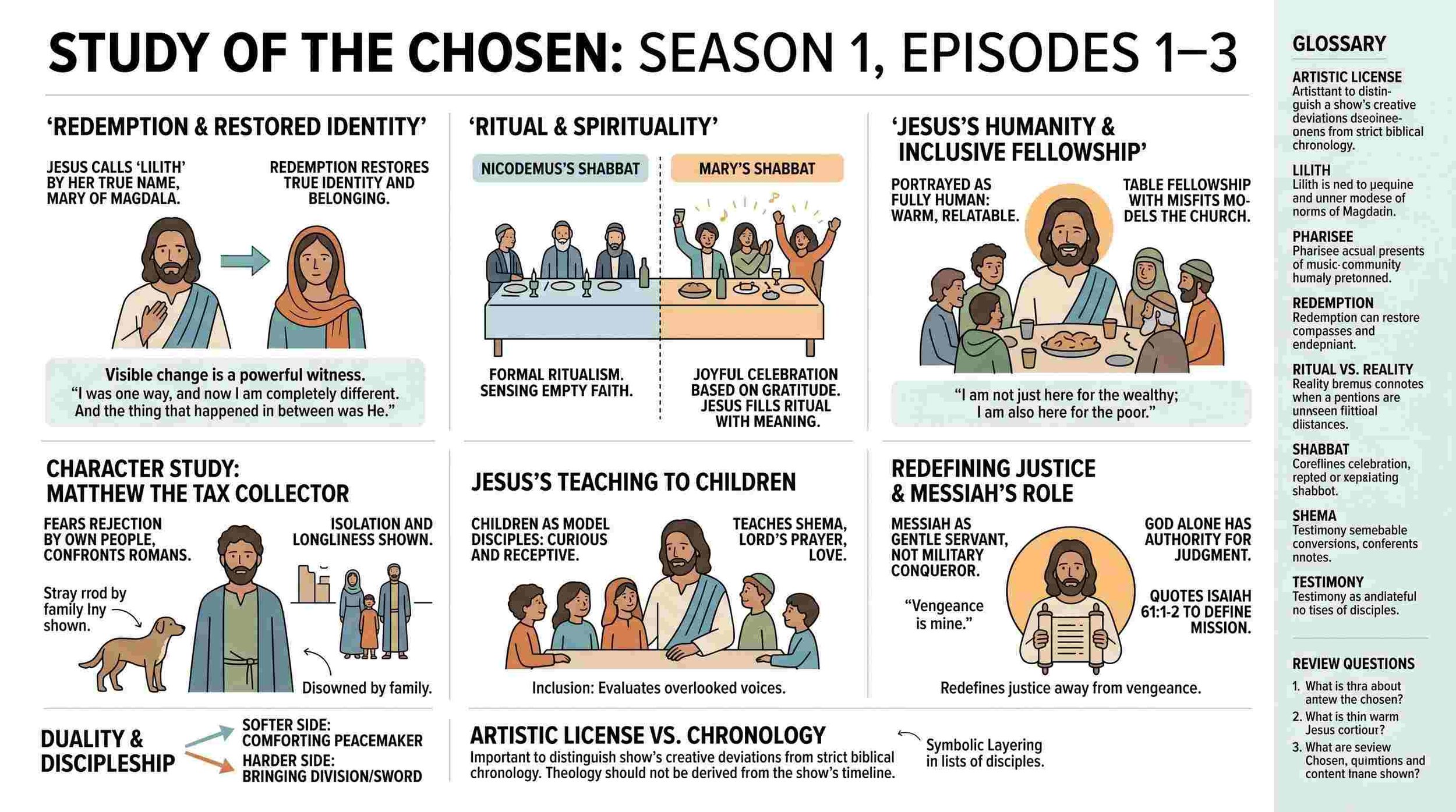
On June 18, 2026 at 14:47:33, our Bible study examined episodes two and three of The Chosen, reflecting on Mary Magdalene’s redemption, multiple Sabbath tables, Matthew’s isolation, and Nicodemus’s crisis of faith. We discussed Isaiah 61 and the Beatitudes, the power of testimony and miracles, Jesus’s teaching of children as a model for discipleship, and the paradox of Jesus bringing peace and yet a “sword” that can divide families. We concluded with an exhortation to “give them Jesus”—presenting both His compassion for the broken and His demanding call to follow Him fully.
Section-by-Section Walkthrough with Summaries
1) The Power of Redemption and Storytelling
We revisited the end of episode one where Jesus finds Mary Magdalene, calls her by name, and redeems her. The emotional impact of this scene illustrated how narrative can communicate Jesus’s redemptive power more effectively than merely quoting verses. We noted The Chosen’s strength in crafting resonant, Jesus-centered stories, even while recognizing artistic liberties.
Summary: Mary’s redemption scene modeled Jesus-oriented storytelling, showing how narratives about His meaning and mercy can deeply move hearts.
Bible verses mentioned: Isaiah 43:1 (“I have redeemed you; I have called you by name, you are mine.”)
Stories discussed: Mary Magdalene’s deliverance (Lilith) when Jesus casts out her demons.
2) The Sabbath and Its Many Tables
Episode two centers on Shabbat, showing four Sabbath meals: Jesus with His group, Mary hosting her first Sabbath in years, Matthew eating alone with his dog, and Nicodemus at a formal dinner. We examined how each table revealed the social and spiritual realities of its participants. A key conversation was Nicodemus’s wife reflecting on beauty created amid imperfection (tapestry from the Maccabees era), raising questions about art, morality, and religious practice.
Summary: The varied Sabbath scenes highlight community, exclusion, and formality, contrasting hollow ritual with humble, grace-filled fellowship.
Bible verses mentioned: Deuteronomy 6:4 (the Shema, in the broader Sabbath context noted later); Proverbs 31 (recited by Nicodemus); references to Sabbath themes.
Stories discussed: The four Sabbath meals; Nicodemus’s wife and the tapestry (Maccabees reference).
3) The Humanity of Jesus and the Misfits
We noted Jesus’s relatable humanity—such as His playful wink after the “Nazareth” joke. Mary’s Sabbath table portrayed the awkward reintegration of someone long excluded, echoing the woman who bled for twelve years. The scene captured a community of outcasts and misfits drawn together by Jesus’s call. We also addressed the show’s artistic license (e.g., who calls Jesus “teacher” first, Mary’s early calling) and the need to distinguish narrative choices from strict biblical chronology.
Summary: Jesus’s warm humanity and His fellowship with misfits show the nature of His kingdom—welcoming the unclean and marginalized into grace-filled community.
Bible verses mentioned: Allusion to the healing narrative in the Gospels (woman with the issue of blood); general references to Jesus calling disciples.
Stories discussed: The woman who bled for twelve years; Jesus eating with tax collectors and sinners; early disciple interactions.
4) The Isolation and Character of Matthew
Matthew appears on the spectrum, explaining his rule-bound logic and fearless confrontation with Roman official Quintus. He experiences deep familial estrangement—his father says he “has no son.” A poignant scene shows Matthew buying a Sabbath meal, looking in on his family’s celebration, then returning to eat with his dog in an alley. The group connected this to the pain some feel on holidays like Father’s Day.
Summary: Matthew’s isolation and precise logic underscore the ache of estrangement and the longing for home that Jesus’s call ultimately answers.
Bible verses mentioned: None explicitly tied to Matthew’s scene here, though themes relate to Jesus calling sinners.
Stories discussed: Matthew’s life before being called; Matthew’s lonely Sabbath meal with his dog.
5) Nicodemus’s Search for Truth
Nicodemus initially believes he healed Mary but learns from her that “someone else” called her by name and said, “You are mine.” This shatters his pride and reveals the emptiness of his formal Sabbath observance, pushing him toward genuine pursuit of truth and an encounter with divine power beyond his understanding.
Summary: Nicodemus moves from pride to humility, recognizing the limits of ritual and the necessity of a true encounter with Jesus.
Bible verses mentioned: Isaiah 43:1 (echoed through Mary’s testimony); Proverbs 31 (earlier at his Sabbath table).
Stories discussed: Nicodemus’s encounter with healed Mary Magdalene.
6) A Transformed Life vs. Empty Ritual
We contrasted Mary’s heartfelt, freedom-filled Sabbath with Nicodemus’s scholarly, rote observance. Mary’s testimony—“I was one way, and now I am completely different”—captured the essence of transformation. Nicodemus’s lifeless recitation of Proverbs 31 highlighted the difference between duty and devotion.
Summary: True faith is relational and transformative, moving us from hollow performance to joyful worship born of grace.
Bible verses mentioned: Proverbs 31.
Stories discussed: Mary Magdalene’s healing and first Sabbath celebration; Nicodemus’s ritualistic Sabbath.
7) The Power of Testimony and Miracles
We affirmed that a changed life is a powerful witness. Miracles validate Jesus’s authority—“if you don’t believe me, believe the miracle.” Mary’s deliverance connects with John 9’s healed blind man: once blind, now seeing. Testimony and miracles together point to Jesus’s identity.
Summary: Personal testimony, confirmed by miracles, is compelling evidence of Jesus’s divinity and transformative power.
Bible verses mentioned: John 9 (man born blind).
Stories discussed: Jesus healing the sick and casting out demons; the blind man’s testimony.
8) Isolation and Community
Sin isolates—seen in Matthew (with his dog), Simon fishing on the Sabbath, and Nicodemus’s scholarly solitude. In contrast, Mary’s Sabbath meal models the community Jesus creates, even symbolically placing Jesus in Elijah’s seat, pointing to fulfillment and presence.
Summary: Jesus breaks isolation and builds fellowship, drawing the excluded into a new family centered on His presence.
Bible verses mentioned: Deuteronomy 6:4 (the Shema); liturgical blessings over bread and wine (Sabbath prayers).
Stories discussed: Mary hosting a communal Sabbath dinner; Simon fishing on the Sabbath.
9) Jesus and the Children: A Model for Discipleship
We discussed the episode where Jesus teaches children, showing how one must become like a child to enter the kingdom. He teaches foundational truths (the Lord’s Prayer, the Shema), reframes “eye for an eye” with God’s justice and mercy, and references David sparing Saul. The children’s quick grasp was noted: “It seems like the kids caught on quicker than the disciples did.”
Summary: Childlike humility and teachability exemplify how Jesus forms disciples—patiently revealing a kingdom of mercy over vengeance.
Bible verses mentioned: Matthew 18:3 (become like children); Matthew 6:9–13 (the Lord’s Prayer); Deuteronomy 6:4 (the Shema); Deuteronomy 32:35 (“Vengeance is mine”); background texts on “eye for an eye” (Exodus 21:24; Leviticus 24:20; Deuteronomy 19:21).
Stories discussed: Jesus teaching children; David sparing King Saul’s life.
10) Isaiah 61 and Jesus’s Mission
We read Isaiah 61:1–2: good news to the poor, binding up the brokenhearted, freedom for captives, release from darkness, the year of the Lord’s favor. This framed Jesus’s compassion for outcasts and the lowly, contrasting human retribution with God’s comforting justice.
Summary: Isaiah 61 encapsulates Jesus’s liberating mission—mercy, healing, and favor for the marginalized.
Bible verses mentioned: Isaiah 61:1–2; Romans 12:19 (“Vengeance is mine”); “eye for an eye” background (Exodus 21:24; Leviticus 24:20; Deuteronomy 19:21).
Stories discussed: Episode depictions of ministry to the poor and outcast.
11) The Tension in Jesus’s Teaching: Peace and Division
We wrestled with Jesus blessing peacemakers (Beatitudes) while also saying He brings a “sword” that can divide families (Matthew 10:34–36). Faithful discipleship may require separation from sinful influences and challenging cultural norms. The Chosen’s comfort emphasis was balanced by the cost of allegiance to Jesus.
Summary: Discipleship embraces paradox—Jesus’s peace alongside the real divisions that allegiance to Him can cause.
Bible verses mentioned: Matthew 5:3–12 (Beatitudes), especially Matthew 5:9; Matthew 10:34–36.
Stories discussed: Episode imagery of peacemaking and relational strain due to following Jesus.
12) Concluding Exhortation: “Give Them Jesus”
We closed by urging a holistic witness: present Jesus in His fullness—compassion for the broken, miracles and mercy, and a demanding call to repentance and loyal discipleship.
Summary: Our call is to give people Jesus Himself—His tender heart and His uncompromising claim on our lives.
Medium-Length Final Summary
On June 18, 2026 at 14:47:33, our Bible study used The Chosen to explore the heart of Jesus’s ministry and the nature of true discipleship. We began with Mary Magdalene’s redemption, recognizing the power of storytelling to convey Jesus’s mercy. Episode two’s Shabbat scenes contrasted hollow ritual with humble fellowship, highlighting Matthew’s isolation, Nicodemus’s emerging humility, and a table of misfits finding belonging. We affirmed that testimony and miracles together witness to Christ’s identity, while sin isolates and Jesus builds community. Jesus’s interactions with children modeled discipleship—humble, teachable, grounded in foundational truths like the Shema and the Lord’s Prayer, moving from “eye for an eye” to mercy, as seen when David spared Saul. Isaiah 61 framed His mission to the poor and brokenhearted, and the Beatitudes reminded us He blesses peacemakers, even as Matthew 10:34–36 warns that allegiance to Him can create familial division. We concluded with “give them Jesus,” committing to present both His compassionate heart for outcasts and His costly call to follow Him.
Main Points
Storytelling over dogma: narrative power communicates Jesus’s redemption deeply.
The meaning of the Sabbath: beyond ritual—community, rest, presence with God.
Jesus and the misfits: He gathers outcasts into a grace-filled community.
The pain of exclusion: Mary and Matthew embody estrangement and longing for home.
Search for truth: Nicodemus moves from prideful ritual to genuine pursuit of Jesus.
A changed life is powerful testimony; miracles validate Jesus’s authority.
Sin isolates; faith in Christ builds fellowship.
Childlike discipleship: humility and teachability are essential.
Jesus’s kingdom emphasizes mercy over vengeance.
Discipleship’s tension: peacemaking alongside divisions caused by allegiance to Jesus.
Artistic license: The Chosen reorders events for narrative aims—distinguish from literal chronology.
Exhortation: “Give them Jesus”—present His compassion and His call.
Bible Scriptures Mentioned
Isaiah 43:1
Isaiah 61:1–2
Deuteronomy 6:4 (the Shema)
Matthew 6:9–13 (the Lord’s Prayer)
Matthew 5:3–12 (Beatitudes), especially Matthew 5:9
Matthew 10:34–36
Matthew 18:3
John 9 (man born blind)
Deuteronomy 32:35 (“Vengeance is mine”)
Exodus 21:24; Leviticus 24:20; Deuteronomy 19:21 (“eye for an eye” background)
Proverbs 31
Stories and Images Discussed
Mary Magdalene’s deliverance and first Sabbath celebration
The woman who bled for twelve years and was healed
Jesus eating with tax collectors and sinners
The calling and early interactions of disciples (Thaddeus, James, Peter)
The four Sabbath meals (Jesus’s group, Mary’s table, Matthew’s lonely meal with his dog, Nicodemus’s formal dinner)
Nicodemus’s encounter with healed Mary and his ritualistic Sabbath
Matthew’s estrangement and alley meal
Simon fishing on the Sabbath
Jesus teaching children; children grasping the message quickly
David sparing King Saul’s life
Isaiah 61 imagery of mercy and liberation
Beatitudes and the tension of peace and division
The tapestry story (Maccabees reference) and art amid imperfection
The Chosen Study Episode 1 - Summer Bible Club Study
A lively Bible study on June 10, 2026, explored The Chosen’s portrayals of Mary Magdalene, Matthew the tax collector, Peter, and Nicodemus, and how these narratives illuminate Scripture, discipleship, grace, and the humanity of Jesus.
The Chosen Season 1 Episode 1
This is our 1st class on The Chosen
This is an AI Recap of the class.
Some things may be incorrect.
Overview and First Impressions of "The Chosen" – Episode 1
Group reactions to Episode 1 were mixed: several first-time viewers found it slow, with [Speaker 2] noting they fell asleep; fans suggested the series gains momentum by Episode 3.
A scene was discussed where a religious leader condemns Sabbath fishing, emphasizing righteousness for the Messiah’s coming, contrasted with fishermen’s economic desperation.
Character Portrayals and Arcs
Mary Magdalene:
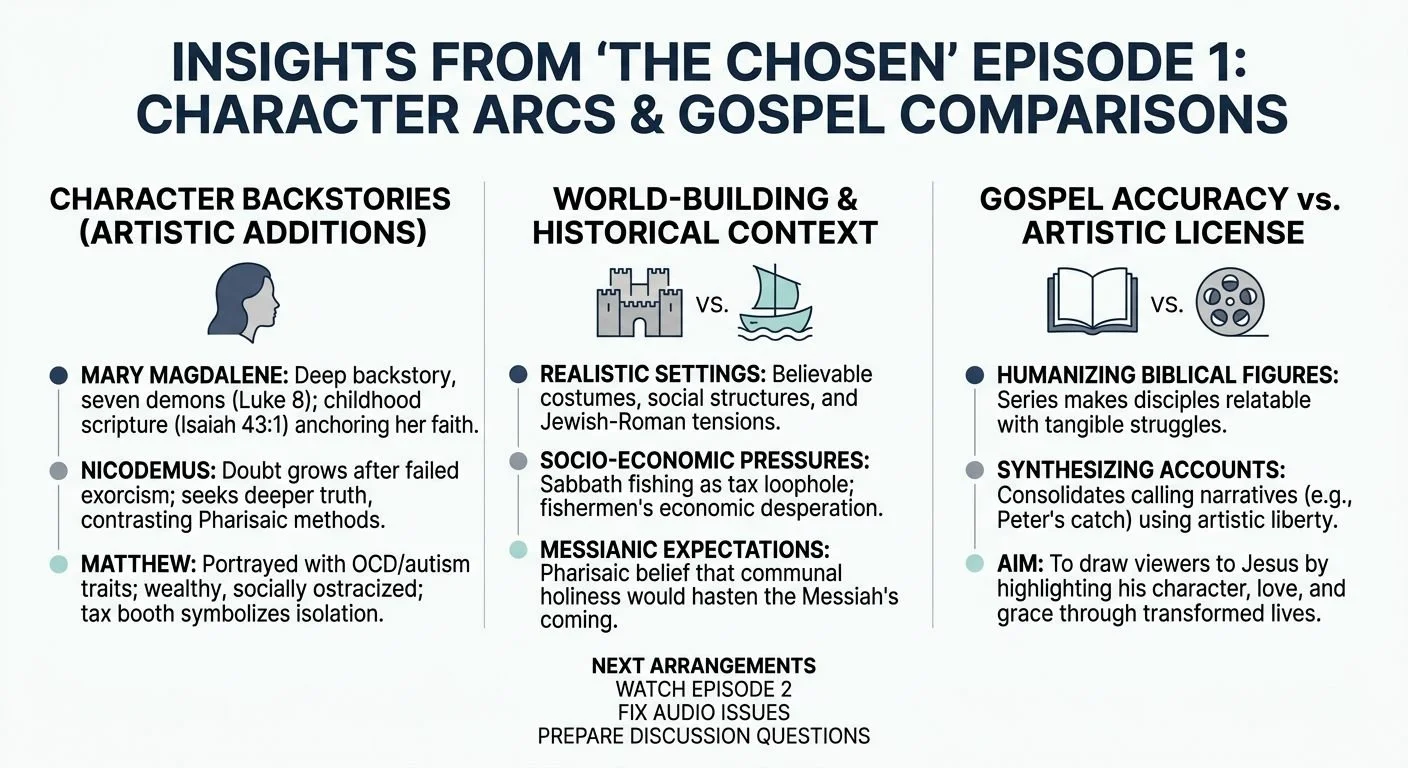
Based on Luke 8’s note of seven demons, the show expands her backstory, depicting suicidal despair before Jesus calls her—an artistic addition not explicit in scripture.
Her father teaching her scripture (unusual for the time) empowers her portrayal; Isaiah 43:1 becomes a personal anchor, kept in a childhood doll and later quoted by Jesus, catalyzing her transformation and devotion through the crucifixion.
Nicodemus:
Drawn from the Gospel of John, his arc starts with a failed exorcism of Mary, provoking doubt in Pharisaic methods and a search for deeper truth, culminating in belief and involvement in Jesus’s burial.
Interactions with Romans highlight Jewish-Roman tension and hypocrisy, including remarks about taxing the people.
Matthew:
Presented as erudite with OCD/autism-spectrum traits, wealthy yet socially ostracized; his fortified tax booth and guard emphasize fear and public hostility.
Market scenes underscore his insecurity; Jesus dining with tax collectors and sinners reflects grace extended to the marginalized.
Peter (and Andrew):
Portrayed as beaten down and desperate, engaged in fighting and moral compromise (snitching on other fishermen to escape debt).
His animosity toward Matthew contrasts with Matthew’s transactional view of Peter as a debtor; their dynamic illustrates grace within the emerging community.
World-Building and Historical Context
Costumes, settings, and social structures were praised as more believable than older productions.
Effective details include:
Sabbath fishing as a tax-avoidance loophole.
Matthew’s fortified booth symbolizing his isolation.
Jewish-Roman tensions and taxation politics.
Messianic expectations and Pharisaic belief that communal holiness would hasten the Messiah.
Gospel Accounts and Storytelling Choices
The series uses artistic license to humanize biblical figures and synthesize elements across gospels:
Variations in the calling narratives: Luke 5’s miraculous catch preceding Peter’s call; Mark’s concise account; John’s large catch tied to the resurrection.
Production consults ministers to maintain doctrinal core while expanding context and character backstories.
Viewers debated accessibility versus accuracy; many appreciated how the show makes scripture emotionally resonant and relatable.
Portrayal of Jesus and Thematic Impact
Jesus is depicted with warmth and joy—laughing, dancing, hugging, and meeting individuals where they are—enhancing the felt experience of miracles.
The show’s aim is seen as drawing viewers to Jesus by highlighting his character, love, and beauty through transformed lives.
Technical and General Observations
Audio quality during the meeting was poor; a planned clip replay was canceled due to technical issues.
The disciples are portrayed as real, relatable people facing tangible socio-economic pressures.