
The Chosen Study Episode 5 - Summer Bible Club Study
The Chosen Season 1 Episode 5
This is our 4rd class on The Chosen
This is an AI Recap of the class.
Some things may be incorrect.
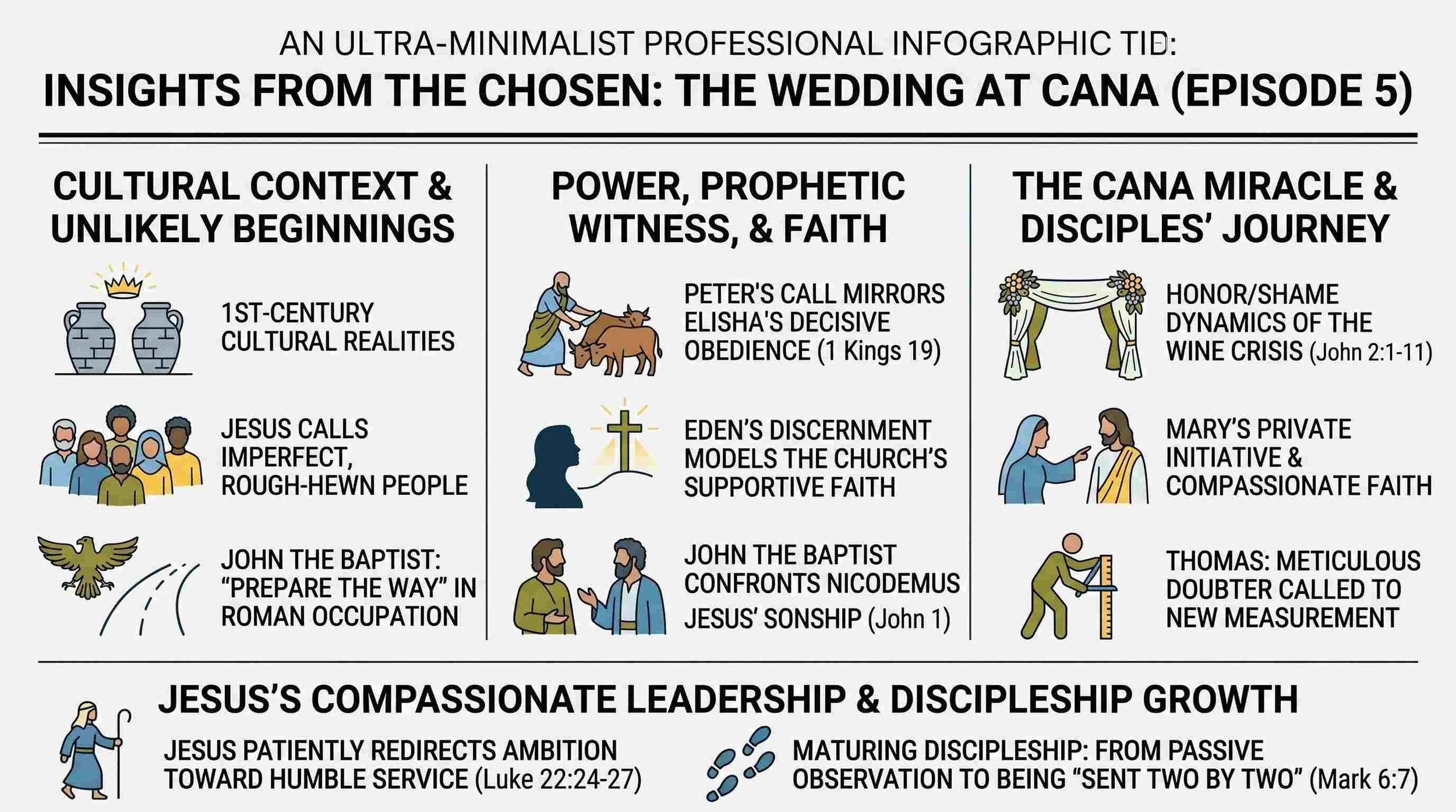
Short Summary of the Whole Class
On July 1, 2026 at 6:06:24 PM, our class discussed The Chosen, Season 1, Episode 5 (“The Wedding at Cana”), focusing on how the show illuminates first-century culture and discipleship. We explored themes of calling imperfect people, the honor/shame dynamics of a wedding crisis, and Jesus's patient, compassionate leadership. Key topics included the prophetic language of John the Baptist, the characterization of Thomas as meticulous and doubting, Mary’s pivotal role in prompting Jesus's first miracle, and how the episode weaves biblical themes from the Gospel of John and the Old Testament into relatable character arcs.
Section-by-Section Summary
1) Opening: Episode Focus and Unlikely Beginnings
We began by welcoming everyone and setting the focus on Episode 5 of The Chosen: “The Wedding at Cana.” The leader praised how the series visually and narratively explains the culture of the time, helping modern viewers grasp biblical stories and the everyday realities and social tensions that make the text more intelligible.
Discussion highlights included the humor and humanity in the episode, from awkward first meetings among disciples to the observation that Jesus isn’t choosing “the best” by worldly standards but gathering ruffians and misfits. This resonates with the Gospels’ portrayal of His followers.
Peter’s early mindset was noted as longing for importance, expecting a militant messiah, and seeking power and recognition. It was also noted that Jesus was portrayed as accessible, even "building a ramp so that people could get up to him," and the Greek word for craftsman and carpenter being the same added a layer to his background as a stonemason in the show.
Short Summary of Section:
We introduced Episode 5, affirming The Chosen’s value in portraying first-century culture and how it captures the messy, humble beginnings of discipleship as Jesus calls imperfect people.
Stories/Bible Verses Mentioned:
Story: Early interactions among the disciples forming an uneasy, diverse group.
2) John the Baptist, Nicodemus, and Prophetic Witness
A clip was referenced showing Nicodemus speaking with John the Baptist in prison, touching on the phrase “make straight the way,” echoing Roman imperial processions where roads were prepared for Caesar. John’s prophetic language (“Prepare the way of the Lord”) resonates within Roman occupation, highlighting how people were used by ruling powers.
Another discussion examined the powerful exchange where John the Baptist confronts Nicodemus with prophetic questions from Proverbs 30:4 about the One who gathers the wind and establishes the earth, pressing the issue of God’s Son. The pushback—“God doesn’t have a son except Israel”—exposed the tension over sonship.
This was connected to the Gospel of John's central claims about Jesus' identity as the Light, calling people to awaken. John 1:1-14 was read aloud and discussed, focusing on the Word, creation, life, light, witness, and the right to become children of God by receiving the Son.
Short Summary of Section:
We connected John the Baptist’s call to “prepare the way” with Roman practices and explored his prophetic witness to Nicodemus, which presses the question of Jesus's divine identity and sonship, calling hearers from darkness into light.
Stories/Bible Verses Mentioned:
John the Baptist’s call: Isaiah 40:3; echoed in John 1:23; Mark 1:2–3; Matthew 3:3; Luke 3:4
Jesus's Identity and Sonship: John 1:1–14
Prophetic Questions: Proverbs 30:4 ("What is his name, and what is his son’s name?")
Scene: Nicodemus and John in prison (The Chosen depiction)
3) Peter’s Call and Eden’s Faith: Echoes of Elisha
A clip was focused on where Simon (Peter) explains his call to follow Jesus to his wife, Eden, with a conviction that signals genuine change.
This was connected to the calling of Elisha in 1 Kings 19:19–21, who leaves his wealth, slaughters his oxen, and follows Elijah. This prefigures the way of the Messiah: a turn from kings and war to prophetic humility and transformative obedience.
Eden’s discernment and trust were seen as symbolizing the church’s faith—recognizing authentic repentance and supporting costly discipleship. Her name suggests a vision of the church as a foretaste of restored Eden.
Short Summary of Section:
We saw Peter’s call mirrored in Elisha’s, noted Eden’s faith as a model for the church, and reflected on how true calling reorients a life from power to Messiah-shaped obedience.
Stories/Bible Verses Mentioned:
Elijah's Call of Elisha: 1 Kings 19:19–21
Peter's Call: Luke 5:1–11 (Miraculous catch of fish)
John's Testimony: John 1:29 (“Behold, the Lamb of God”)
Story: Peter's confession and call; Eden’s supportive faith.
4) The Wedding at Cana: Honor, Humility, and Mary's Faith
The discussion highlighted the honor/shame dynamics at ancient weddings—running out of wine was a community crisis, not a simple inconvenience. The show contrasted a wealthy family’s perfectionism with the bride’s family’s acceptance of beauty in brokenness (e.g., decorating a crooked "kupa" canopy with flowers).
It was noted that Jesus attended the wedding solely because of his mother. We discussed the callback to an earlier scene where a young Jesus tells Mary, "If not now, then when?" which she uses to prompt him. Mary's request was private and faith-filled ("They have no wine," and "Do whatever he tells you"), born of a genuine need to save the family from dishonor.
The group praised the visual portrayal of the look between Mary and Jesus, conveying her faith and his empathetic response. Mary’s calm trust anticipated Jesus’ provision.
Short Summary of Section:
We discussed Mary’s pivotal role, her faith-filled prompt to Jesus, and how the wedding’s honor/shame culture illuminated the significance of Jesus’ compassionate, private miracle.
Stories/Bible Verses Mentioned:
The Wedding at Cana: John 2:1–11
Mary at Cana: John 2:1–5
Story: Wedding preparations, social tensions, and the beautifying of the crooked "kupa."
5) Thomas’s Character: Meticulous Doubt and a New Calling
Group observations noted Thomas as a meticulous, calculative, and consistently doubting wine server, concerned about logistics. This was seen as setting up his well-known "doubting" theme.
Jesus performs the miracle discreetly while Thomas is away. This was significant because Thomas, who needs to measure everything, couldn't explain the miracle away and was left simply amazed.
When Thomas expresses confusion, Jesus responds with kindness, affirming, "It's good to ask. It's good to measure," then tells him, "I'll give you a different way to measure this time." This was seen as Jesus compassionately calling Thomas from his nature of doubt, just as he called Peter to a new way of fishing.
The thematic connection was made to the post-resurrection story in John 20, showing a narrative thread in John's Gospel of signs, belief, and skepticism.
Short Summary of Section:
We examined Thomas’s portrayal as a careful, questioning planner, and admired how Jesus met him with kindness, validating his nature while calling him to a new kind of faith beyond measurement.
Stories/Bible Verses Mentioned:
Thomas’s doubt post-resurrection: John 20:24–29
Wedding at Cana: John 2:1–11
Story: Context of Cana miracle with Thomas present in The Chosen (narrative adaptation)
6) Jesus's Leadership: Patience, Humility, and Service
The discussion reflected on how Jesus leads people who think in “old ways” with patient redirection rather than rebuke, often using parables or gentle instruction. He avoids sarcasm and harshness, declining self-promotion to keep focus on the Father’s purpose.
This was contrasted with Simon’s ambition to leverage the wedding to gather powerful allies. Jesus’s quiet resistance showed him prioritizing the couple’s day over public strategy, redirecting Simon toward servanthood.
Jesus is shown working humbly as a craftsman, building what serves the vulnerable (like accessible latrines), and distinguishing private miracles from public ministry with the words, "My time has not yet come."
A member shared appreciation for a non-biblical scene where Jesus jokes with the disciples, delivering a "Jesus burn." This humorous, relatable side changed perceptions from a stoic figure to someone joyful.
Short Summary of Section:
We saw Jesus reshape Simon’s ambition toward humble service, modeling patient, non-rebuking leadership, and serving the vulnerable while waiting for the Father’s timing.
Stories/Bible Verses Mentioned:
Jesus's Timing: John 2:4 (“My hour has not yet come”)
Greatness as Service: Luke 22:24–27
Story: Discipleship table talk about Jesus' work as a craftsman and building accessible facilities.
7) Discipleship Growth and Concluding Thoughts
The disciples' default to "watch and learn" was contrasted with Jesus’s later commissioning of them "two by two." The class concluded that while observation is foundational, growth requires being sent, risking mistakes, and learning obedience through practice.
The instructor challenged the class to consider why John’s Gospel places the joyful wedding at Cana (turning water into wine) immediately before the cleansing of the temple in John 2.
A question was raised about why the show intentionally never depicts Jesus drinking alcohol, seen as a deliberate choice to be sensitive to certain Christian denominations.
The schedule for the next classes was announced: July 8, 2026 for episodes six and seven, and July 15, 2026 for episode eight.
Short Summary of Section:
We contrasted passive observation with active mission in discipleship and ended with a theological question about the structure of John 2, a note on the show's creative choices, and an announcement of future classes.
Stories/Bible Verses Mentioned:
Sending the Disciples: Mark 6:7; Luke 10:1–3
Juxtaposed Events in John 2: The Wedding at Cana (John 2:1-11) and The Cleansing of the Temple (John 2:13-22)
Medium-Length Summary of the Class
On July 1, 2026, our Bible study used The Chosen’s Cana episode to explore how Jesus forms disciples amid awkward starts, mixed motives, and cultural pressures. We began by appreciating the show's humanizing portrayal of Jesus and the disciples. A key discussion connected Peter’s call to the story of Elijah and Elisha, highlighting a shift from worldly power to Messiah-shaped obedience, with Peter's wife Eden modeling the church's supportive faith. We then explored the honor/shame dynamics at the wedding, recognizing that running out of wine was a social crisis and that Mary’s quiet confidence ushered in Jesus’s first sign. We examined the character of Thomas, whose need to "measure" was met with Jesus's compassionate call to a new kind of faith. The study also highlighted the prophetic confrontation between John the Baptist and Nicodemus over Jesus's identity as the Son of God. Throughout, we observed how Jesus patiently redirects ambition toward humble service, subverting expectations of status and power, and intentionally choosing unlikely people while waiting for his "hour" to come. The class concluded by reflecting on the growth from "watching" to being "sent," and the theological pairing of the Cana miracle with the temple cleansing in John 2.
Main Points
The Chosen effectively portrays first-century cultural context, Roman-Jewish tensions, and the humble, messy beginnings of discipleship.
Jesus calls imperfect, unlikely people and forms them into a community of faith, patiently redirecting their worldly ambitions toward humble service.
Peter’s call mirrors Elisha’s decisive obedience, signaling a shift from power and war to the Messiah-shaped way of service.
Honor/shame dynamics at Cana explain the crisis of running out of wine and the compassionate significance of Jesus’s first sign.
Mary’s initiative at Cana was a private act of faith that prompted Jesus’s first sign and saved a family from dishonor.
Thomas is depicted as a meticulous, doubting planner, and Jesus meets his skepticism with kindness, calling him to a faith beyond empirical measurement.
John the Baptist’s witness to Nicodemus stresses Jesus’s divine identity and sonship, calling people from darkness into light.
Discipleship matures when observation leads to being sent on active mission.
Jesus’s timing is deliberate, distinguishing private miracles from his public ministry, which had "not yet come."
Bible Scriptures Mentioned
John 1:1–14: The Word, light, witness, and becoming children of God.
John 1:23: John the Baptist: “Make straight the way of the Lord.”
John 1:29: “Behold, the Lamb of God, who takes away the sin of the world.”
John 2:1–11: The Wedding at Cana; Jesus’s first sign.
John 2:4: “My hour has not yet come.”
John 2:13-22: The Cleansing of the Temple.
John 20:24–29: Thomas’s doubt and confession after the resurrection.
Luke 5:1–11: Miraculous catch of fish; Peter’s confession and call.
Luke 10:1–3: Jesus appoints seventy-two and sends them two by two.
Luke 22:24–27: Greatness through serving.
Mark 6:7: Jesus sends the twelve two by two.
Synoptics on "Prepare the Way": Mark 1:2–3; Matthew 3:3; Luke 3:4.
1 Kings 19:19–21: Elijah’s call of Elisha.
Isaiah 40:3: Prophetic source for “prepare the way.”
Proverbs 30:4: Oracle of Agur: “What is his name, and what is his son’s name?”
Stories Discussed
The Wedding at Cana: The wine crisis, Mary’s intercession, Jesus bringing more guests, the discreet miracle, and honoring the family.
Discipleship and Calling: Awkward beginnings among misfits; Peter's call after the miraculous catch; Eden’s supportive faith; moving from "watching" to being "sent two by two."
Elijah and Elisha: Prophetic calling and Elisha’s decisive break with his past.
John the Baptist and Nicodemus: The interaction in prison in The Chosen, highlighting Roman context and the question of sonship.
Doubting Thomas: His depiction at Cana and the connection to his post-resurrection encounter with Jesus.
Jesus's Character and Leadership: Patient teaching style; working as a craftsman; building accessible facilities; redirecting Simon's ambition; his humor and relatability.
Humble Wedding Details: Beautifying the crooked “kupa” with flowers; the pride of the wealthy father (Abner) versus the family’s humility.