
The Chosen Study Episode 2 - Summer Bible Club Study
The Chosen Season 1 Episode 2-3
This is our 1st class on The Chosen
This is an AI Recap of the class.
Some things may be incorrect.
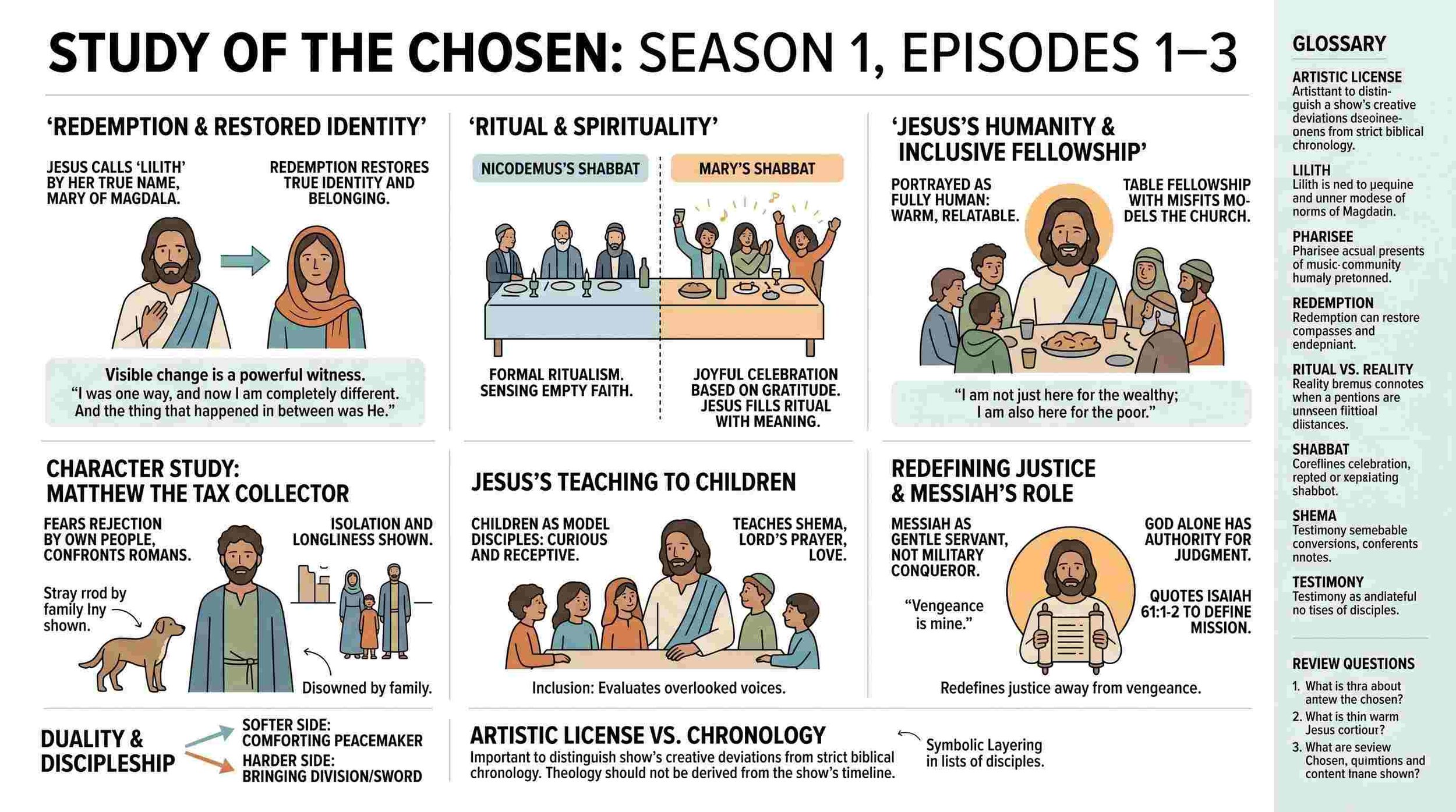
Short Summary of the Whole Class
On June 18, 2026 at 14:47:33, our Bible study examined episodes two and three of The Chosen, reflecting on Mary Magdalene’s redemption, multiple Sabbath tables, Matthew’s isolation, and Nicodemus’s crisis of faith. We discussed Isaiah 61 and the Beatitudes, the power of testimony and miracles, Jesus’s teaching of children as a model for discipleship, and the paradox of Jesus bringing peace and yet a “sword” that can divide families. We concluded with an exhortation to “give them Jesus”—presenting both His compassion for the broken and His demanding call to follow Him fully.
Section-by-Section Walkthrough with Summaries
1) The Power of Redemption and Storytelling
We revisited the end of episode one where Jesus finds Mary Magdalene, calls her by name, and redeems her. The emotional impact of this scene illustrated how narrative can communicate Jesus’s redemptive power more effectively than merely quoting verses. We noted The Chosen’s strength in crafting resonant, Jesus-centered stories, even while recognizing artistic liberties.
Summary: Mary’s redemption scene modeled Jesus-oriented storytelling, showing how narratives about His meaning and mercy can deeply move hearts.
Bible verses mentioned: Isaiah 43:1 (“I have redeemed you; I have called you by name, you are mine.”)
Stories discussed: Mary Magdalene’s deliverance (Lilith) when Jesus casts out her demons.
2) The Sabbath and Its Many Tables
Episode two centers on Shabbat, showing four Sabbath meals: Jesus with His group, Mary hosting her first Sabbath in years, Matthew eating alone with his dog, and Nicodemus at a formal dinner. We examined how each table revealed the social and spiritual realities of its participants. A key conversation was Nicodemus’s wife reflecting on beauty created amid imperfection (tapestry from the Maccabees era), raising questions about art, morality, and religious practice.
Summary: The varied Sabbath scenes highlight community, exclusion, and formality, contrasting hollow ritual with humble, grace-filled fellowship.
Bible verses mentioned: Deuteronomy 6:4 (the Shema, in the broader Sabbath context noted later); Proverbs 31 (recited by Nicodemus); references to Sabbath themes.
Stories discussed: The four Sabbath meals; Nicodemus’s wife and the tapestry (Maccabees reference).
3) The Humanity of Jesus and the Misfits
We noted Jesus’s relatable humanity—such as His playful wink after the “Nazareth” joke. Mary’s Sabbath table portrayed the awkward reintegration of someone long excluded, echoing the woman who bled for twelve years. The scene captured a community of outcasts and misfits drawn together by Jesus’s call. We also addressed the show’s artistic license (e.g., who calls Jesus “teacher” first, Mary’s early calling) and the need to distinguish narrative choices from strict biblical chronology.
Summary: Jesus’s warm humanity and His fellowship with misfits show the nature of His kingdom—welcoming the unclean and marginalized into grace-filled community.
Bible verses mentioned: Allusion to the healing narrative in the Gospels (woman with the issue of blood); general references to Jesus calling disciples.
Stories discussed: The woman who bled for twelve years; Jesus eating with tax collectors and sinners; early disciple interactions.
4) The Isolation and Character of Matthew
Matthew appears on the spectrum, explaining his rule-bound logic and fearless confrontation with Roman official Quintus. He experiences deep familial estrangement—his father says he “has no son.” A poignant scene shows Matthew buying a Sabbath meal, looking in on his family’s celebration, then returning to eat with his dog in an alley. The group connected this to the pain some feel on holidays like Father’s Day.
Summary: Matthew’s isolation and precise logic underscore the ache of estrangement and the longing for home that Jesus’s call ultimately answers.
Bible verses mentioned: None explicitly tied to Matthew’s scene here, though themes relate to Jesus calling sinners.
Stories discussed: Matthew’s life before being called; Matthew’s lonely Sabbath meal with his dog.
5) Nicodemus’s Search for Truth
Nicodemus initially believes he healed Mary but learns from her that “someone else” called her by name and said, “You are mine.” This shatters his pride and reveals the emptiness of his formal Sabbath observance, pushing him toward genuine pursuit of truth and an encounter with divine power beyond his understanding.
Summary: Nicodemus moves from pride to humility, recognizing the limits of ritual and the necessity of a true encounter with Jesus.
Bible verses mentioned: Isaiah 43:1 (echoed through Mary’s testimony); Proverbs 31 (earlier at his Sabbath table).
Stories discussed: Nicodemus’s encounter with healed Mary Magdalene.
6) A Transformed Life vs. Empty Ritual
We contrasted Mary’s heartfelt, freedom-filled Sabbath with Nicodemus’s scholarly, rote observance. Mary’s testimony—“I was one way, and now I am completely different”—captured the essence of transformation. Nicodemus’s lifeless recitation of Proverbs 31 highlighted the difference between duty and devotion.
Summary: True faith is relational and transformative, moving us from hollow performance to joyful worship born of grace.
Bible verses mentioned: Proverbs 31.
Stories discussed: Mary Magdalene’s healing and first Sabbath celebration; Nicodemus’s ritualistic Sabbath.
7) The Power of Testimony and Miracles
We affirmed that a changed life is a powerful witness. Miracles validate Jesus’s authority—“if you don’t believe me, believe the miracle.” Mary’s deliverance connects with John 9’s healed blind man: once blind, now seeing. Testimony and miracles together point to Jesus’s identity.
Summary: Personal testimony, confirmed by miracles, is compelling evidence of Jesus’s divinity and transformative power.
Bible verses mentioned: John 9 (man born blind).
Stories discussed: Jesus healing the sick and casting out demons; the blind man’s testimony.
8) Isolation and Community
Sin isolates—seen in Matthew (with his dog), Simon fishing on the Sabbath, and Nicodemus’s scholarly solitude. In contrast, Mary’s Sabbath meal models the community Jesus creates, even symbolically placing Jesus in Elijah’s seat, pointing to fulfillment and presence.
Summary: Jesus breaks isolation and builds fellowship, drawing the excluded into a new family centered on His presence.
Bible verses mentioned: Deuteronomy 6:4 (the Shema); liturgical blessings over bread and wine (Sabbath prayers).
Stories discussed: Mary hosting a communal Sabbath dinner; Simon fishing on the Sabbath.
9) Jesus and the Children: A Model for Discipleship
We discussed the episode where Jesus teaches children, showing how one must become like a child to enter the kingdom. He teaches foundational truths (the Lord’s Prayer, the Shema), reframes “eye for an eye” with God’s justice and mercy, and references David sparing Saul. The children’s quick grasp was noted: “It seems like the kids caught on quicker than the disciples did.”
Summary: Childlike humility and teachability exemplify how Jesus forms disciples—patiently revealing a kingdom of mercy over vengeance.
Bible verses mentioned: Matthew 18:3 (become like children); Matthew 6:9–13 (the Lord’s Prayer); Deuteronomy 6:4 (the Shema); Deuteronomy 32:35 (“Vengeance is mine”); background texts on “eye for an eye” (Exodus 21:24; Leviticus 24:20; Deuteronomy 19:21).
Stories discussed: Jesus teaching children; David sparing King Saul’s life.
10) Isaiah 61 and Jesus’s Mission
We read Isaiah 61:1–2: good news to the poor, binding up the brokenhearted, freedom for captives, release from darkness, the year of the Lord’s favor. This framed Jesus’s compassion for outcasts and the lowly, contrasting human retribution with God’s comforting justice.
Summary: Isaiah 61 encapsulates Jesus’s liberating mission—mercy, healing, and favor for the marginalized.
Bible verses mentioned: Isaiah 61:1–2; Romans 12:19 (“Vengeance is mine”); “eye for an eye” background (Exodus 21:24; Leviticus 24:20; Deuteronomy 19:21).
Stories discussed: Episode depictions of ministry to the poor and outcast.
11) The Tension in Jesus’s Teaching: Peace and Division
We wrestled with Jesus blessing peacemakers (Beatitudes) while also saying He brings a “sword” that can divide families (Matthew 10:34–36). Faithful discipleship may require separation from sinful influences and challenging cultural norms. The Chosen’s comfort emphasis was balanced by the cost of allegiance to Jesus.
Summary: Discipleship embraces paradox—Jesus’s peace alongside the real divisions that allegiance to Him can cause.
Bible verses mentioned: Matthew 5:3–12 (Beatitudes), especially Matthew 5:9; Matthew 10:34–36.
Stories discussed: Episode imagery of peacemaking and relational strain due to following Jesus.
12) Concluding Exhortation: “Give Them Jesus”
We closed by urging a holistic witness: present Jesus in His fullness—compassion for the broken, miracles and mercy, and a demanding call to repentance and loyal discipleship.
Summary: Our call is to give people Jesus Himself—His tender heart and His uncompromising claim on our lives.
Medium-Length Final Summary
On June 18, 2026 at 14:47:33, our Bible study used The Chosen to explore the heart of Jesus’s ministry and the nature of true discipleship. We began with Mary Magdalene’s redemption, recognizing the power of storytelling to convey Jesus’s mercy. Episode two’s Shabbat scenes contrasted hollow ritual with humble fellowship, highlighting Matthew’s isolation, Nicodemus’s emerging humility, and a table of misfits finding belonging. We affirmed that testimony and miracles together witness to Christ’s identity, while sin isolates and Jesus builds community. Jesus’s interactions with children modeled discipleship—humble, teachable, grounded in foundational truths like the Shema and the Lord’s Prayer, moving from “eye for an eye” to mercy, as seen when David spared Saul. Isaiah 61 framed His mission to the poor and brokenhearted, and the Beatitudes reminded us He blesses peacemakers, even as Matthew 10:34–36 warns that allegiance to Him can create familial division. We concluded with “give them Jesus,” committing to present both His compassionate heart for outcasts and His costly call to follow Him.
Main Points
Storytelling over dogma: narrative power communicates Jesus’s redemption deeply.
The meaning of the Sabbath: beyond ritual—community, rest, presence with God.
Jesus and the misfits: He gathers outcasts into a grace-filled community.
The pain of exclusion: Mary and Matthew embody estrangement and longing for home.
Search for truth: Nicodemus moves from prideful ritual to genuine pursuit of Jesus.
A changed life is powerful testimony; miracles validate Jesus’s authority.
Sin isolates; faith in Christ builds fellowship.
Childlike discipleship: humility and teachability are essential.
Jesus’s kingdom emphasizes mercy over vengeance.
Discipleship’s tension: peacemaking alongside divisions caused by allegiance to Jesus.
Artistic license: The Chosen reorders events for narrative aims—distinguish from literal chronology.
Exhortation: “Give them Jesus”—present His compassion and His call.
Bible Scriptures Mentioned
Isaiah 43:1
Isaiah 61:1–2
Deuteronomy 6:4 (the Shema)
Matthew 6:9–13 (the Lord’s Prayer)
Matthew 5:3–12 (Beatitudes), especially Matthew 5:9
Matthew 10:34–36
Matthew 18:3
John 9 (man born blind)
Deuteronomy 32:35 (“Vengeance is mine”)
Exodus 21:24; Leviticus 24:20; Deuteronomy 19:21 (“eye for an eye” background)
Proverbs 31
Stories and Images Discussed
Mary Magdalene’s deliverance and first Sabbath celebration
The woman who bled for twelve years and was healed
Jesus eating with tax collectors and sinners
The calling and early interactions of disciples (Thaddeus, James, Peter)
The four Sabbath meals (Jesus’s group, Mary’s table, Matthew’s lonely meal with his dog, Nicodemus’s formal dinner)
Nicodemus’s encounter with healed Mary and his ritualistic Sabbath
Matthew’s estrangement and alley meal
Simon fishing on the Sabbath
Jesus teaching children; children grasping the message quickly
David sparing King Saul’s life
Isaiah 61 imagery of mercy and liberation
Beatitudes and the tension of peace and division
The tapestry story (Maccabees reference) and art amid imperfection