
The Chosen Study Episode 4 - Summer Bible Club Study
The Chosen Season 1 Episode 4
This is our 3rd class on The Chosen
This is an AI Recap of the class.
Some things may be incorrect.
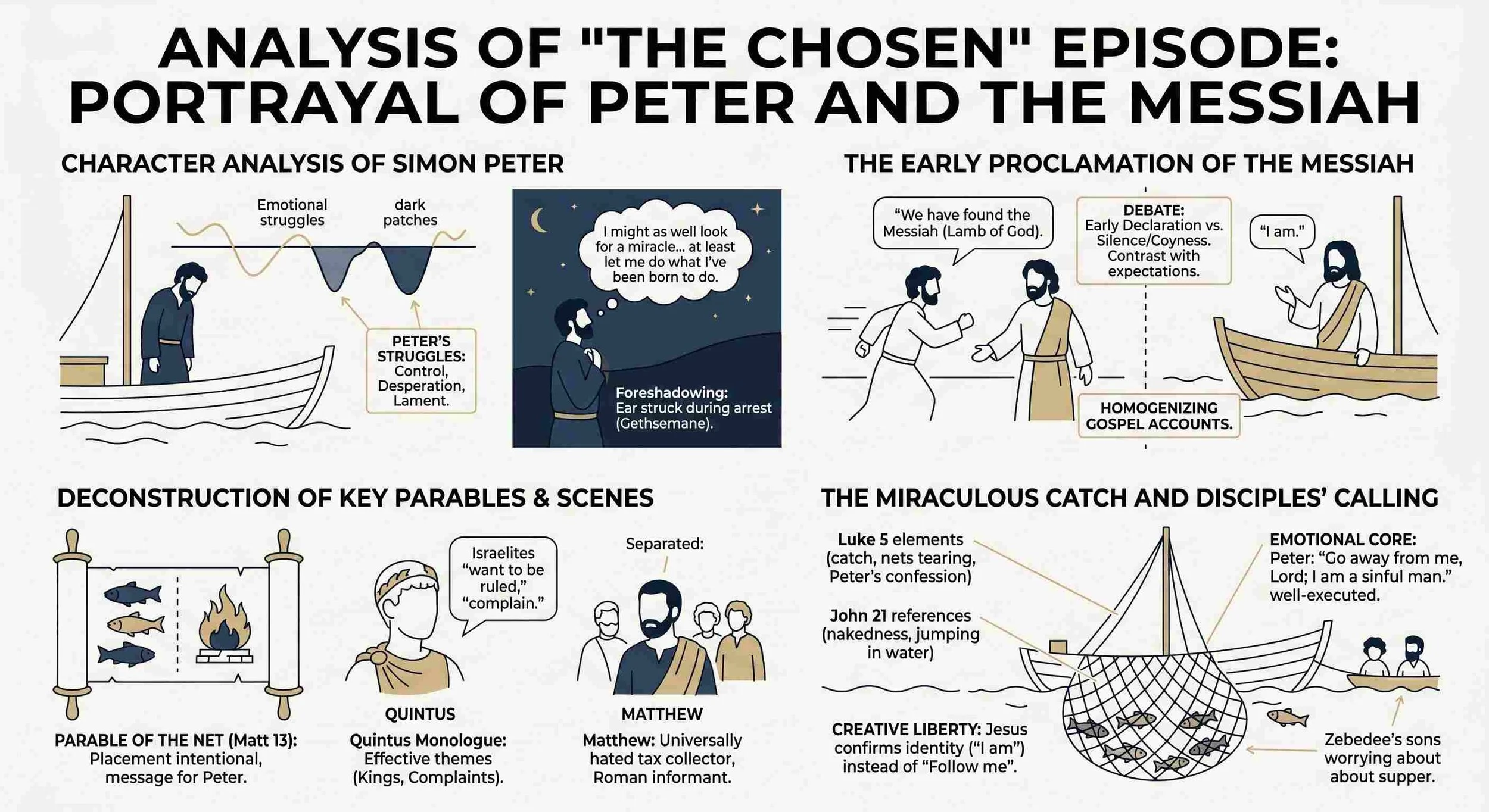
Short Summary of the Whole Class
The group analyzes an episode of "The Chosen," focusing on its portrayal of Simon Peter's struggles, the early proclamation of Jesus as the Messiah, and the show's blending of various gospel accounts. Key discussion points include the creative liberties taken with scripture, the thematic representation of Israel's history through Peter's lament, and the narrative setup for future character dynamics.
Character Analysis of Simon Peter
This section covers the group's discussion on the depiction of Simon Peter, exploring his character arc within the episode. The analysis begins by highlighting Peter's emotional state, which one speaker likens to a personal "dark patch" where an individual becomes consumed with trying to control their own life and fix problems single-handedly. This is exemplified in the episode as Peter, despondent and on the verge of financial ruin, returns to fishing alone as a last resort. The group notes his desperation is captured in the thought, "I might as well look for a miracle out on the water," or simply to "at least let me do what I've been born to do."
A significant scene discussed is Peter's monologue while fishing at night, which is characterized as a lament that mirrors the historical struggles of Israel. He recounts a pattern of divine deliverance followed by suffering: enslavement in Egypt, wandering in the desert, exile in Babylon, and oppression under Rome. Cris views this lament as a positive, psalm-like form of questioning God. The discussion also identifies a key moment of foreshadowing where Peter's ear is struck during his arrest, an allusion to the Garden of Gethsemane where he will cut off the ear of the high priest's servant. This detail is seen as a clever way to show Peter's potential to become a "brute like the Romans."
The Early Proclamation of the Messiah
This section focuses on the central debate regarding the show's decision to have Jesus and his followers openly declare him as the Messiah early in the narrative. Participants noted that the show "bends full into calling him the Messiah from the very beginning," which felt odd compared to the accounts in Mark and Matthew where Jesus often commands silence about his identity. The discussion highlights the scene where Andrew runs to Simon, proclaiming he has seen the "Lamb of God," and later when Peter confesses Jesus's identity, to which Jesus explicitly confirms, "I am."
The group explores the theological and narrative implications of this creative choice. One speaker suggests this early declaration serves to contrast Jesus's true nature with the Pharisees' expectations of a messiah. Another speaker, however, argues it would have been more powerful if Jesus had remained "coy," forcing the disciples into a deeper journey of faith while still questioning "who is this man?" The conversation delves into scriptural sources, noting that John 1:40-42 does record Andrew telling Peter, "We have found the Messiah." The group concludes the show is homogenizing various gospel accounts. Additionally, Cris explains that when Peter says "Go away from me, Lord" in Luke 5, the Greek word used is "Kyrie," signifying a supreme authority or master, which supports the show's depiction of Peter's immediate recognition.
Deconstruction of Key Parables and Scenes
This section details the analysis of specific parables and scenes used in the episode, with a primary focus on Jesus's sermon from the boat. The group found the inclusion of the "parable of the net" from Matthew 13 to be an "odd" choice for this point in the story, particularly due to its severe language about separating good and bad fish and casting the latter into a "fiery furnace." The consensus was that its placement was intentional, serving as a direct message targeted at Simon Peter, who was struggling with his own path and trying to control his destiny.
The discussion also examined a monologue by the Roman official Quintus, who asserts that the Israelites are a "miserable lot" who inherently "want to be ruled" and "want an excuse to complain." Cris praised this as an effective way to highlight two major themes from the Old Testament: the Israelites' demand for a king and their history of complaining. The portrayal of Matthew as a universally hated tax collector and Roman informant was also analyzed, with the group noting the show's success in setting up the social isolation he would have faced. On a lighter note, Cris critiqued the scene of Jesus preaching, pointing out that the small number of extras did not convincingly portray the large crowd described in scripture, though acknowledging the production constraints.
The Miraculous Catch and Disciples' Calling
This section covers the climactic scene where Jesus directs the miraculous catch of fish, which is primarily based on Luke 5:1-11. The group analyzed how the show blends elements from different gospels, noting that while the tearing nets are from Luke, Peter's nakedness and jumping into the water reference the post-resurrection account in John 21. This homogenization was seen as a way to create a more cohesive and emotionally impactful narrative for the calling of the first disciples.
The emotional core of the scene, where Peter falls to his knees and says, "Go away from me, Lord; I am a sinful man," was deemed well-executed and touching. However, the creative liberty of having Jesus explicitly confirm his identity with "I am" was debated. Cris suggested the scene would have been more powerful if Jesus had simply responded with "Follow me," leaving the disciples to continue their journey of discovery. The speakers also appreciated the show's inclusion of relatable details, such as Zebedee's sons worrying about what their mother would say when they missed supper, and Zebedee's own "nice little touch" of suggesting they could escape to Egypt, referencing the Holy Family's flight.