
The Chosen Study Episode 1 - Summer Bible Club Study
The Chosen Season 1 Episode 1
This is our 1st class on The Chosen
This is an AI Recap of the class.
Some things may be incorrect.
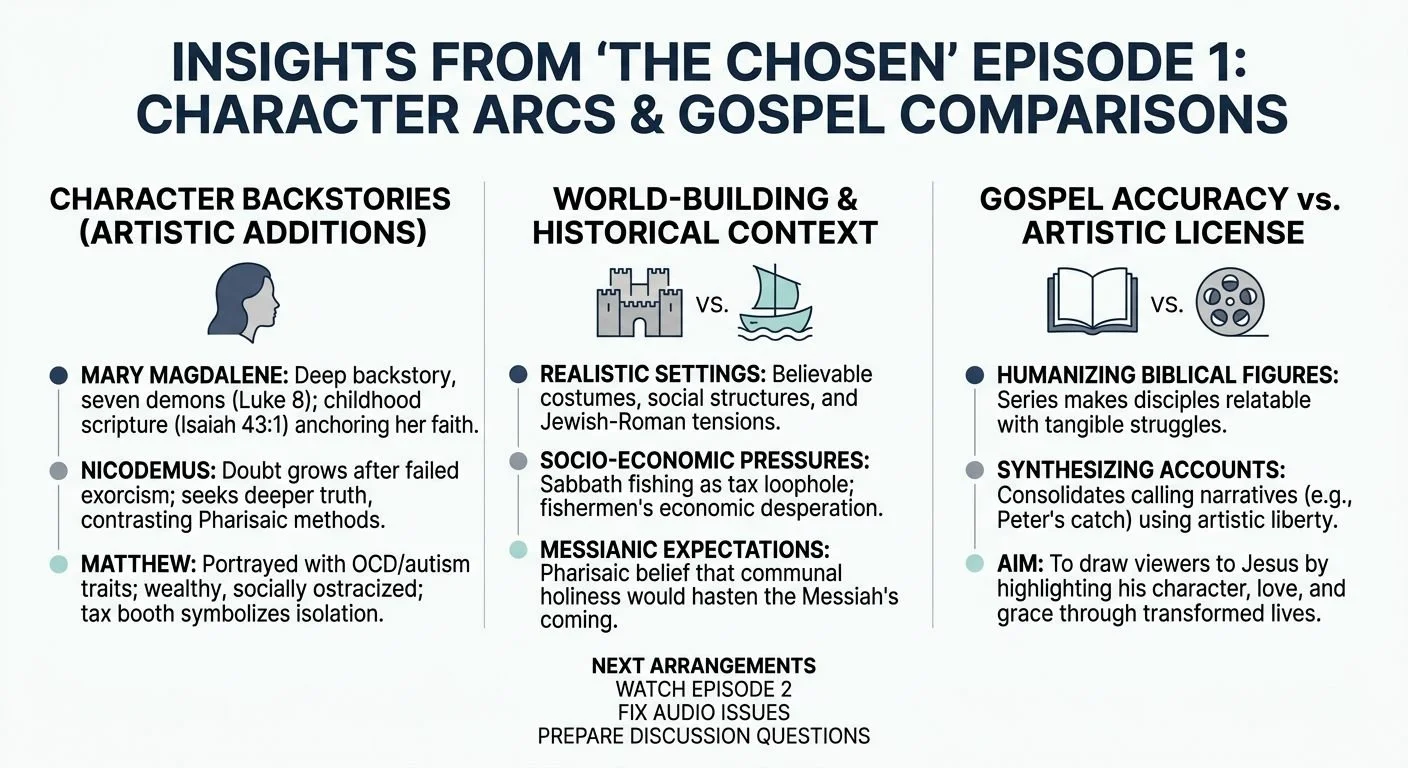
Overview and First Impressions of "The Chosen" – Episode 1
Group reactions to Episode 1 were mixed: several first-time viewers found it slow, with [Speaker 2] noting they fell asleep; fans suggested the series gains momentum by Episode 3.
A scene was discussed where a religious leader condemns Sabbath fishing, emphasizing righteousness for the Messiah’s coming, contrasted with fishermen’s economic desperation.
Character Portrayals and Arcs
Mary Magdalene:
Based on Luke 8’s note of seven demons, the show expands her backstory, depicting suicidal despair before Jesus calls her—an artistic addition not explicit in scripture.
Her father teaching her scripture (unusual for the time) empowers her portrayal; Isaiah 43:1 becomes a personal anchor, kept in a childhood doll and later quoted by Jesus, catalyzing her transformation and devotion through the crucifixion.
Nicodemus:
Drawn from the Gospel of John, his arc starts with a failed exorcism of Mary, provoking doubt in Pharisaic methods and a search for deeper truth, culminating in belief and involvement in Jesus’s burial.
Interactions with Romans highlight Jewish-Roman tension and hypocrisy, including remarks about taxing the people.
Matthew:
Presented as erudite with OCD/autism-spectrum traits, wealthy yet socially ostracized; his fortified tax booth and guard emphasize fear and public hostility.
Market scenes underscore his insecurity; Jesus dining with tax collectors and sinners reflects grace extended to the marginalized.
Peter (and Andrew):
Portrayed as beaten down and desperate, engaged in fighting and moral compromise (snitching on other fishermen to escape debt).
His animosity toward Matthew contrasts with Matthew’s transactional view of Peter as a debtor; their dynamic illustrates grace within the emerging community.
World-Building and Historical Context
Costumes, settings, and social structures were praised as more believable than older productions.
Effective details include:
Sabbath fishing as a tax-avoidance loophole.
Matthew’s fortified booth symbolizing his isolation.
Jewish-Roman tensions and taxation politics.
Messianic expectations and Pharisaic belief that communal holiness would hasten the Messiah.
Gospel Accounts and Storytelling Choices
The series uses artistic license to humanize biblical figures and synthesize elements across gospels:
Variations in the calling narratives: Luke 5’s miraculous catch preceding Peter’s call; Mark’s concise account; John’s large catch tied to the resurrection.
Production consults ministers to maintain doctrinal core while expanding context and character backstories.
Viewers debated accessibility versus accuracy; many appreciated how the show makes scripture emotionally resonant and relatable.
Portrayal of Jesus and Thematic Impact
Jesus is depicted with warmth and joy—laughing, dancing, hugging, and meeting individuals where they are—enhancing the felt experience of miracles.
The show’s aim is seen as drawing viewers to Jesus by highlighting his character, love, and beauty through transformed lives.
Technical and General Observations
Audio quality during the meeting was poor; a planned clip replay was canceled due to technical issues.
The disciples are portrayed as real, relatable people facing tangible socio-economic pressures.