

Philippians Chapter 4 Class 4 - Tuesday Bible Study
We wrapped up Philippians by exploring unity in Christ, rejoicing and prayerful peace, virtuous focus, learned contentment through Christ’s strength, generous partnership as worship, identity in Christ amid Paul’s imprisonments, the Saul/Paul name usage, and the gospel’s reach—even into Caesar’s household.
Gospel of Philippians Chapter 4
This is our 4rd class on Philippians
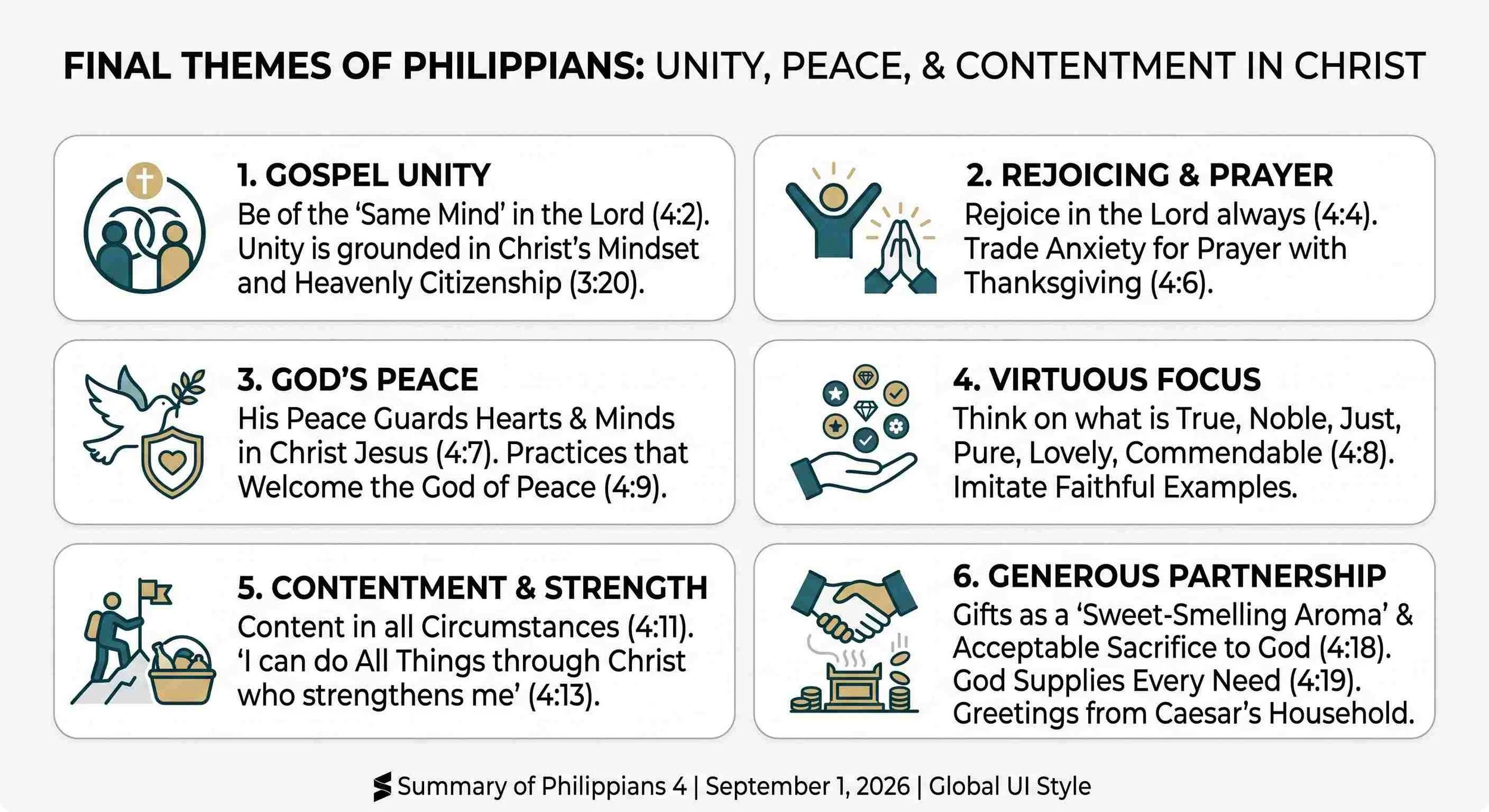
This is an AI Recap of the class.
Some things may be incorrect.
Short Summary of the Whole Class
During our Bible study on September 2, 2026, we revisited Mark chapter 6, analyzing its pivotal role in the Gospel. We discussed Jesus's rejection in his hometown, the mission of the Twelve, and the stark contrast between King Herod's feckless leadership and Jesus's compassionate shepherding. The class focused on the feeding of the five thousand and Jesus walking on water, noting how these miracles serve as a powerful critique of the disciples' "hardened hearts." We contrasted their lack of faith with the desperate faith of outsiders and concluded that Mark presents the disciples' failures to help us see our own weaknesses and recognize our need for Jesus, who redeems us even in our lack of understanding. Throughout, we connected these narratives to foundational themes from Genesis and Exodus.
Detailed Class Summary (September 2, 2026)
Section 1: Context and Rereading Mark 6
Our discussion opened by deciding to re-walk through Mark 6, as some participants had missed the previous session and the chapter is pivotal to the Gospel. The plan was to read the whole chapter and "walk our way through it." We noted that future studies on Tuesdays will start with Genesis, emphasizing how Genesis and Exodus form a primer for the whole Bible. The Gospels, including Mark 6, often echo these foundational stories of creation, covenant, and deliverance, such as Matthew’s infancy narrative paralleling the Exodus story.
Summary of Section 1: We set the study plan to reread Mark 6 comprehensively and connected the importance of Genesis and Exodus as a foundational lens for understanding the rest of Scripture, including the Gospels' themes of rejection, mission, and faith.
Bible Verses & Stories Mentioned:
General: Genesis, Exodus as foundational to the Bible.
Matthew’s Infancy Narrative: Mentioned as an echo of Exodus (Herod and the flight to Egypt).
Section 2: Rejection in Nazareth and the Mission of the Twelve
We began by reading Mark 6:1–13. Jesus returns to his hometown of Nazareth, and the people are "astonished" in a way that turns to offense, questioning his authority: "Isn’t this the carpenter… Mary’s son?" Jesus responds with the proverb, "A prophet is not without honor except in his own country." We discussed how this unbelief impacted Jesus’s ministry there; he "could do no mighty work there" and marveled at their unbelief. The class considered whether he "couldn't" or "chose not to," with a study Bible suggesting the latter. This rejection in Nazareth was seen as a microcosm of Israel’s broader rejection of its prophets.
Jesus then sends out the Twelve "two by two," giving them authority over unclean spirits. He instructs them to travel light (staff, sandals, no bread, no money), an exercise in faith showing their dependence on God and hospitality. This made them resemble itinerant preachers or prophets of old. If rejected, they were to "shake off your dirt off your feet," a powerful statement typically made by Jews leaving a Gentile region, signifying judgment. The disciples then went out, preached repentance, cast out demons, and healed the sick, acting as true representatives of God.
Summary of Section 2: Mark 6:1–13 shows the contrast between hometown rejection and faithful mission. Unbelief in Nazareth hinders Jesus’s wonders, while the disciples, sent out in dependence and with authority, multiply his work through preaching, healing, and deliverance, calling Israel to repent.
Bible Verses & Stories Mentioned:
Mark 6:1–13: Rejection at Nazareth; sending of the Twelve.
Genesis 18–19: Sodom and Gomorrah (alluded to in the judgment context).
Cross-references: Jesus's statements on prophets dying in Jerusalem (cf. Luke 13:33–34; Matthew 23:37).
Echoes of Exodus: The pattern of God's deliverers and prophets being rejected.
Section 3: The Failed Leadership of King Herod
The discussion then shifted to the flashback account of John the Baptist's beheading (Mark 6:14–29), which begins with Herod hearing of Jesus and fearing he is a resurrected John. We analyzed Herod as a "feckless ruler," a king in name only who was a slave to his ego and public image. Though he "heard [John] gladly," he made a foolish oath to his stepdaughter during a birthday feast. When she, prompted by her mother Herodias, asked for John the Baptist’s head, Herod was "exceedingly sorry" but felt compelled to follow through because of his pride. This portrayed him as a weak, self-serving leader who fails his people and is ruled by bluster rather than justice. The non-linear narrative structure was noted as a theological tool Mark uses to reveal truths about Jesus by contrasting him with such failed leadership.
Summary of Section 3: The story of John the Baptist’s beheading serves as a flashback to characterize King Herod as a weak leader. His ego and fear of losing face led him to execute a prophet he respected, showcasing a king who fails his people and is ruled by pride.
Bible Verses & Stories Mentioned:
Mark 6:14–29: The story of King Herod and the beheading of John the Baptist.
Section 4: Jesus the True Shepherd and a Miraculous Meal
Next, we connected the story of Herod to the feeding of the five thousand (Mark 6:30–44). The crowd following Jesus into the wilderness or "deserted place" was described as "sheep without a shepherd" (Mark 6:34). This statement stands in stark contrast to Herod. Where Herod hosted a feast for the powerful ending in death, Jesus acts as the true, compassionate shepherd for the leaderless flock.
The disciples' first instinct was to "send them away," a rational but uncaring response. Jesus challenged their limited perspective with the command, "You give them something to eat." He then took five loaves and two fish, and the class noted the significance of the number seven (5+2) as a symbol of completion. The language—he "took," "blessed," "broke," and "gave"—intentionally parallels the words of Communion. The twelve baskets of leftovers were a clear reference to the twelve tribes of Israel, showing God's abundant provision. The five thousand men were interpreted as representing the Pentateuch, framing this as an "all-Israel" event where Jesus, the Shepherd-King, provides for his nation.
Summary of Section 4: In direct contrast to Herod, Jesus is presented as the true shepherd. He sees the crowd with compassion and miraculously feeds them in the wilderness. This sacrament-like event is rich with symbolism, pointing to Jesus as the divine provider who fulfills the needs of his people where their earthly king had failed.
Bible Verses & Stories Mentioned:
Mark 6:30–44: The feeding of the five thousand.
Mark 6:34: Jesus's compassion for the "sheep not having a shepherd."
Mark 6:41: Jesus blesses and breaks the loaves, echoing communion language.
Psalm 23: The Lord is my Shepherd, illustrating a king's role.
The Exodus: The wilderness setting and provision of food echoes God providing manna.
Feeding of the Four Thousand: Mentioned as a future event showing provision for Gentiles.
Section 5: Walking on Water and Hardened Hearts
We then examined Jesus walking on water (Mark 6:45–52), which immediately follows the feeding. While the disciples were "straining at the oars," a metaphor for their spiritual struggle, Jesus appeared. Their reaction was terror, thinking he was a ghost. The key to this section is Mark 6:52: "for they had not understood about the loaves, because their heart was hardened." This verse, the class concluded, is Mark's central point. The disciples’ inability to comprehend the miracle of the loaves led directly to their fear on the water.
The phrase "hardened heart" explicitly links them to Pharaoh in Exodus. Just as Pharaoh witnessed God’s miracles but refused to believe, the disciples saw Jesus's divine power yet failed to understand who he was. They were still viewing him through a lens of political power, not as their divine savior.
Summary of Section 5: The disciples' fear while Jesus walked on water was a direct result of their failure to understand the feeding of the five thousand. Mark diagnoses their problem as having "hardened hearts," a term that equates their spiritual blindness with that of Pharaoh, revealing their deep-seated lack of faith.
Bible Verses & Stories Mentioned:
Mark 6:45–52: The story of Jesus walking on the water.
Mark 6:52: "...their heart was hardened." Identified as the key verse for the chapter.
Pharaoh's Hardened Heart (Exodus): The disciples' condition was directly compared to Pharaoh's.
Section 6: A Contrast in Faith and the Purpose of Failure
The chapter concludes with Jesus arriving in Gennesaret. The contrast in reception is stark. In Jewish Nazareth, unbelief limited his work. Here, in a Gentile-associated region, the people have such faith that they seek healing by merely touching the hem of his garment. This highlights a theme of "outsiders" often showing more faith than "insiders" like the disciples.
The discussion wrapped up by considering why Mark (recording Peter's account) would portray the disciples so negatively. The consensus was that their failures are relatable. We, too, forget the "loaves"—the times God has provided. We, too, have hardened hearts. The story of the disciples, from their failures to their eventual restoration, shows us that our faith journey is imperfect and that we are saved by grace in the midst of our failures, not by our own strength.
Summary of Section 6: The chapter contrasts the disciples' hardened hearts with the eager faith of the people in Gennesaret. The class concluded that the disciples’ failures are included to help us see ourselves in their story, reminding us that we all depend entirely on Jesus's grace for redemption.
Bible Verses & Stories Mentioned:
Healing of the Gerasene Demoniac (Mark 5): Referenced as a previous event in the region.
Woman who touched the hem of Jesus's garment (Mark 5:25–34): Compared to the faith of the people in Gennesaret.
Jesus's Rejection in Nazareth (Mark 6:1–6): Contrasted with his reception in Gennesaret.
The Transfiguration & The Rich Young Ruler: Mentioned as future stories that will expose the disciples' struggles.
Final Summary
In our Bible study on September 2, 2026, we conducted an in-depth analysis of Mark chapter 6, walking through its interconnected narratives. We began with Jesus's rejection in his hometown of Nazareth, which served as a microcosm of prophetic dishonor. From there, we examined the sending of the Twelve, who were commissioned to preach, heal, and act with dependence on God. The study then delved into a major theological contrast: the failed, self-serving leadership of King Herod, who beheaded John the Baptist out of pride, versus the compassionate leadership of Jesus, the true Shepherd-King.
This contrast was powerfully illustrated in the feeding of the five thousand. Where Herod hosted a fatal feast for the elite, Jesus hosted a life-giving feast for the common people, who were "like sheep without a shepherd." This miracle was laden with symbolism connecting Jesus to Israel’s history and his identity as the divine provider. However, the disciples failed to grasp its meaning. The subsequent story of Jesus walking on water exposed their core spiritual problem. Their terror was a symptom of their failure to understand the loaves, as Mark 6:52 states their hearts were "hardened," explicitly comparing them to Pharaoh in Exodus. Ultimately, the class concluded that Mark presents the disciples' flaws—contrasted with the eager faith of outsiders in Gennesaret—so that we can see our own struggles in their story and recognize that salvation comes not from our own understanding, but from the grace of Jesus, who redeems us even in our weakness.
Main Points
Mark 6 is pivotal, showcasing themes of rejection, mission, divine identity, and the nature of faith.
Jesus's rejection in Nazareth illustrates prophetic dishonor at home, where unbelief can constrain the environment for miracles.
The Twelve are sent out with authority and simplicity, modeling dependence on God and accountability for the reception of their message.
The narrative deliberately contrasts Herod, the bad shepherd, with Jesus, the good shepherd.
The feeding of the five thousand is a sacramental event filled with symbolism (the numbers 7, 12, 5000; communion language) connecting Jesus to Israel's history and his role as the divine provider.
The disciples' fear on the water was a direct consequence of their "hardened hearts" and failure to understand the miracle of the loaves, linking their unbelief to that of Pharaoh.
Genesis–Exodus patterns (rejection of prophets, deliverance, wilderness provision) form a primer for reading the Gospels.
The eager faith of Gentiles in Gennesaret stands in stark contrast to the hardened hearts of the disciples.
The disciples' failures are included in the Gospel to help us see our own weaknesses and our desperate need for Jesus's grace.
Scriptures and Stories Mentioned
Bible Scriptures:
Mark 6 (entire chapter): Particularly Mark 6:1–13, 14–29, 30–44, 45–52.
Mark 6:52: "for they had not understood about the loaves, because their heart was hardened."
Mark 6:34: Jesus's compassion for the crowd, "like sheep not having a shepherd."
Psalm 23: The Lord is my shepherd.
Genesis & Exodus (General): Creation; patriarchs (Abraham, Isaac, Jacob, Joseph); Exodus deliverance; Pharaoh's hardened heart.
Genesis 18–19: Sodom and Gomorrah.
Matthew’s infancy narrative (Matthew 2:13–18): Flight to Egypt; Herod’s slaughter of infants.
Cross-references: Luke 13:33–34; Matthew 23:37 (prophets dying in Jerusalem).
Bible Stories:
Jesus rejected in Nazareth.
The sending out of the twelve disciples.
The beheading of John the Baptist.
The feeding of the five thousand.
Jesus walking on water.
The Israelites wandering in the wilderness (Exodus) and the providing of manna.
The Creation Story (seven days).
The healing of the Gerasene demoniac (Legion).
The woman who touched the hem of Jesus's garment.
The feeding of the four thousand.
The Transfiguration.
The story of the Rich Young Ruler.
Philippians Chapter 3 Class 3 - Tuesday Bible Study
Philippians chapter 3, where Paul teaches us to count all earthly achievements as loss compared to knowing Christ, contrasting righteousness by faith with legalism, and anchoring our hope in our heavenly citizenship and Christ's resurrection.
Gospel of Philippians Chapter 3
This is our 3rd class on Philippians
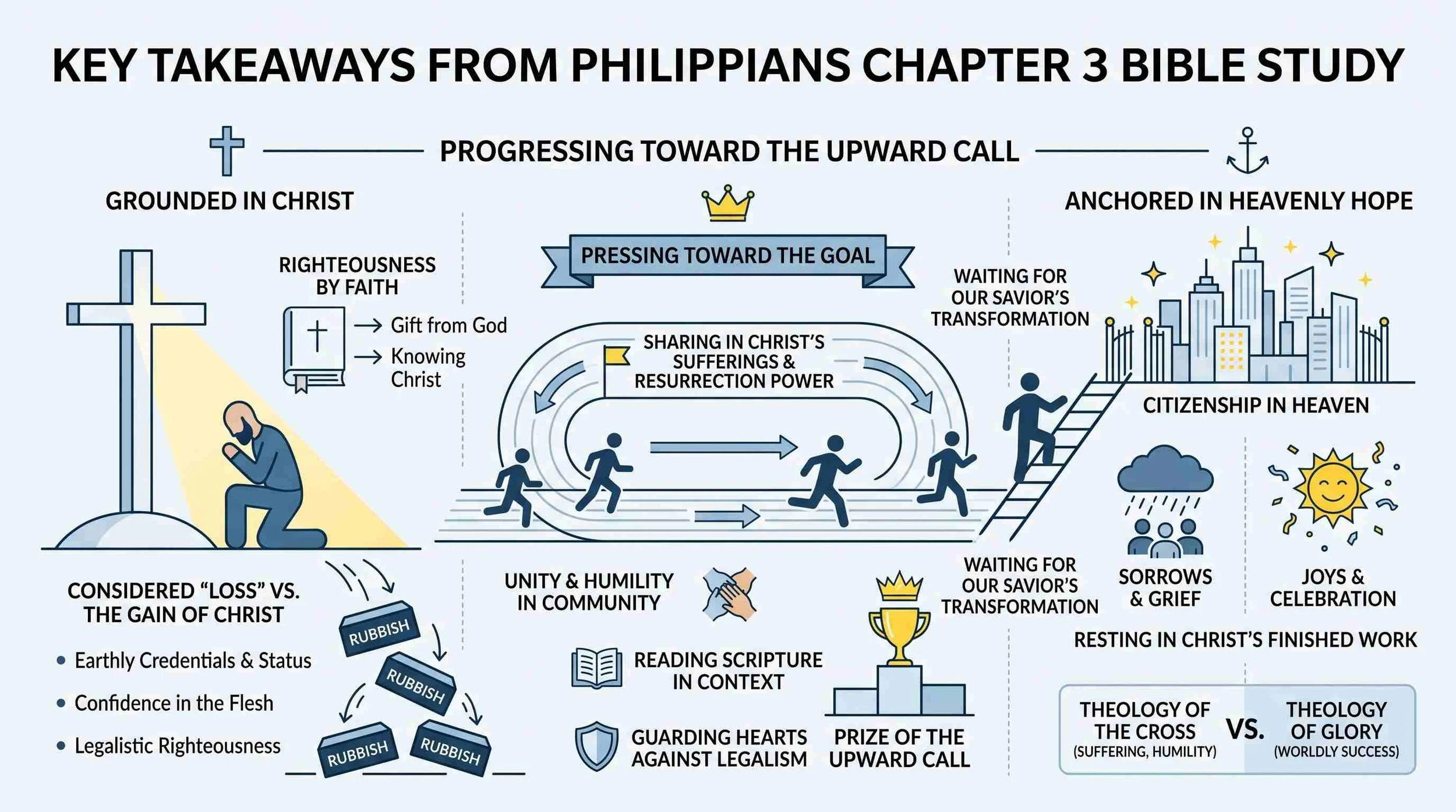
This is an AI Recap of the class.
Some things may be incorrect.
Short Summary of the Whole Class
During our class on August 24-25, 2026, we dove into Philippians chapter 3, continuing our series on Paul's letter. The session began by recapping the "theology of the cross," emphasizing Christ's selfless humility. We then unpacked Paul's powerful arguments against placing "confidence in the flesh," exploring his sharp rhetoric against "dogs" and "mutilators" (likely Judaizers). Paul lists his own impressive Jewish credentials only to declare them "rubbish" compared to knowing Jesus. The discussion highlighted the contrast between righteousness from the law and righteousness through faith, the connection between suffering with Christ and the power of His resurrection, and the danger of gossip and legalism. We concluded by focusing on our heavenly citizenship (3:20-4:1), the call to stand firm in unity, and how Christ's finished work on the cross frees us to live with hope through both joys and sorrows.
Detailed Class Summary
1. Recap: The Theology of the Cross & Reading of Philippians 3
The class began with a quick review of our previous sessions from August 17 and 24, 2026, revisiting the "theology of the cross," a central theme in Philippians 1 & 2. We recalled the message of Christ's selfless humility, who "made Himself nothing," as the ultimate example for believers. This set the stage for our main text.
We then listened to a full reading of Philippians chapter 3, along with the first verse of chapter 4. In this chapter, Paul starts with a call to "rejoice in the Lord" before issuing a stern warning against "evil workers" and "the mutilation." He contrasts them with the true "circumcision" who worship in the spirit and have "no confidence in the flesh." Paul lists his prestigious background as a Pharisee—a "Hebrew of the Hebrews," blameless under the law—only to state that he now considers all these advantages "rubbish" for the sake of knowing Christ. He explains his desire is to gain Christ and the righteousness that comes from God through faith, pressing on toward the goal of the resurrection. He warns, with tears, against the "enemies of the cross of Christ" whose focus is earthly, reminding believers that "our citizenship is in heaven."
Section Summary: We started by remembering the key message from Philippians 1 and 2: our attitude should mirror Christ’s humility. Then, through a reading of Philippians 3, we heard Paul warn against legalism, using his own impeccable pedigree to show that all worldly credentials are worthless compared to knowing Jesus and receiving righteousness through faith.
Bible Verses Mentioned: Philippians, Chapters 1 & 2 (recap); Philippians, Chapter 3 (main text); Philippians 4:1.
Stories Mentioned: The poem in Philippians 2 describing Christ humbling Himself; Paul’s personal testimony of his life as a zealous Pharisee.
2. “Beware of the Dogs”: Paul's Rhetoric and Early Church Context
We focused on Philippians 3:2–3, unpacking Paul’s warnings about “dogs” and “mutilators.” Participants asked what “dogs” means, and we discussed it as an ancient term of derision, sometimes used by Jews for Gentiles. Cris suggested Paul is using sharp rhetoric and sarcasm to grab his listeners' attention. The class considered that Paul was likely aiming at Judaizers—people inside the early church pressing Old Testament law-keeping on Gentile believers. We noted how little of the New Testament was available then, making the Torah a default authority and Paul's challenge quite daring. A key theme was discerning the spirit behind commands rather than using laws as a ladder to righteousness, noting that many Old Testament laws (like dietary restrictions) had practical health and communal-protection purposes.
Section Summary: Paul warns the church against those pushing external markers like circumcision, using provocative language ("dogs," "mutilators") to expose misplaced confidence. He confronts these internal pressures to ground righteousness in law-keeping, re-centering the church on Christ.
Bible Verses Mentioned: Philippians 3:2–3; General references to Old Testament law (Leviticus, Deuteronomy).
Stories Mentioned: Paul’s rhetorical technique—sarcasm/metonymy—was highlighted using the everyday analogy of “raining cats and dogs.”
3. True Circumcision and the Danger of Zeal
A Jewish Bible note was shared, stating that "the circumcision that God accepts is first spiritual”—a circumcision of hearts and ears. Cris connected this to Paul’s theme: our boast should be in our union with Christ, not our religious performance (e.g., who baptized us). We then looked at Paul’s résumé and zeal—“persecuting the church”—and how he now counts it as a loss. Cris noted how the book of Acts repeatedly exposes misguided zeal as self-righteous action. This led to a discussion on worship styles, contrasting liturgical “smells and bells” with contemporary “bands and fog machines,” with a caution against equating method with righteousness. The key is whether a practice helps the community see the death and resurrection of Jesus.
Section Summary: The mark that matters is inward—confidence in Christ, not external rituals or prestige. Paul rejects his former status and even his zeal as loss, reminding us that methods of worship should serve the gospel, not become badges of superiority.
Bible Verses Mentioned: Philippians 3:3, 3:4–7; Acts (series reference); Romans 2:29 and Deuteronomy 10:16 (conceptually referenced).
Stories Mentioned: Worship style contrasts: “smells and bells” vs. “bands and fog machines.”
4. Righteousness by Faith and Sharing in Christ's Sufferings
We read Philippians 3:8–11, focusing on righteousness “from God that depends on faith,” knowing Christ, the power of His resurrection, and the fellowship in His sufferings. We remembered that Paul writes this from prison, embodying the union of suffering and hope. The class connected this to Peter’s vision in Acts 10, where he learns not to call unclean what God has called clean, a story that expands the gospel's inclusion. We revisited Paul's use of sarcasm as a pastoral tool to warn against teachings that subtly enslave consciences. Attendees affirmed the need to stay anchored in grace rather than neighbor-judgment or rule-policing, noting how easily church communities can slip into fault-finding and gossip.
Section Summary: True righteousness is a gift by faith, through which believers share in Christ’s sufferings and resurrection power. This grace reorients our identity, fosters inclusion, and calls us to resist the petty judgments and legalism that can stifle a church community.
Bible Verses Mentioned: Philippians 3:8–11; Acts 10 (Peter and Cornelius).
Stories Mentioned: Peter and Cornelius (Acts 10): the vision of clean/unclean and inclusion of Gentiles; Church life examples of gossip/petty negativity.
5. Guarding Our Hearts and Building on the Right Foundation
The class candidly discussed how easy it is to speak carelessly or whisper in ways that sow dissent, often as a way to tear others down to lift oneself up. Paul’s attitude of counting his gains as “rubbish” for Christ was seen as a refreshing corrective. We then recalled Jesus’ teaching on building on the rock, connecting it to the idea of the church as "soft stones"—people, not cinder blocks. Physical facilities are helpful but not foundational to salvation. Jesus is the cornerstone, and His Spirit indwells the people.
Section Summary: We acknowledged the harm of careless speech and self-promotion, embracing Paul’s Christ-centered humility. We affirmed that God’s true building is His people, with Jesus as the foundation; our hope is in Christ, not in physical rooms or materials.
Bible Verses Mentioned: Philippians 3:7–8 (implied); Matthew 7:24–27; Matthew 16:18 (implied).
Stories Mentioned: Pastoral observation about church whispering causing rifts; Practical jokes about the room’s movable wall and peeling paint to emphasize that facilities don't equal salvation.
6. Following Examples and Resisting Enemies of the Cross
Reading Philippians 3:17–19, we discussed following faithful examples and having the "same mind"—a shared focus on Christ's saving work, not uniformity of personality. Paul’s tears over the “enemies of the cross” were interpreted as a strong warning against legalism. Adding requirements to salvation, like circumcision, "takes Jesus off the cross" by implying we can save ourselves. From a counseling perspective, it was noted that the cross is a completed historical event that our sins cannot undo. These "enemies" are driven by earthly priorities ("their god is their belly"), glorying in what leads to shame.
Section Summary: Unity in the church is rooted in a shared Christ-centered mindset. We must resist legalism and self-exaltation, which oppose the gospel, and rest solely on Christ’s finished work for salvation.
Bible Verses Mentioned: Philippians 3:17–19; Philippians 3:2 (implied).
Stories Mentioned: Reference to Lutheran Counselors of Florida and the reassurance that no personal failure is bigger than Jesus’ cross.
7. Heavenly Citizenship, Unity, and the Theology of the Cross
Focusing on Philippians 3:20–4:1, we affirmed our shared "citizenship is in heaven," from where we await Jesus to transform us. This gives us hope through life's tensions: some days feel like resurrection joy, others like cross-bearing suffering. In both, we belong to Christ. This allows us to celebrate joys (like a birthday party) and grieve losses (like Helga’s passing) without losing hope, because our righteousness is not based on our daily mood or outcome. The idea of "sin boldly" was explained as resting confidently in Christ’s finished work.
This led to a discussion on humility within denominational differences (including LCMS), rejecting elitist "remnant" thinking, and holding translation preferences humbly. We also appreciated learning from Jewish festivals and how they can point to Christ. Finally, we contrasted the "theology of the cross" (focusing on Christ's saving work in suffering) with the "theology of glory" (focusing on triumphalism and earthly success), reaffirming the former as our true center.
Section Summary: As citizens of heaven, we live in hope, anchored by Christ's resurrection. This identity allows us to navigate both joy and grief honestly, practice humility in our traditions, pursue inclusive unity, and center our faith on the theology of the cross rather than worldly glory.
Bible Verses Mentioned: Philippians 3:20–4:1; Romans 6:3–5 (implied); Psalm 23; 1 Peter 3:21 (alluded); Genesis 1:2 (alluded); John 10:22 (alluded).
Stories Mentioned: A birthday party at Dave & Buster’s; Community grief over Helga’s death; LCMS “company man” anecdote; Neighbor teaching Psalm 23 “the correct way”; St. Paul Boca’s teaching on Jewish festivals.
Medium-Length Summary of the Class
On August 24-25, 2026, our class delved into Philippians 3, building on the theme of Christ’s humility. We began by exploring Paul’s powerful argument against placing "confidence in the flesh," analyzing his sharp rhetoric against "dogs" and "mutilators"—likely Judaizers insisting on circumcision. Paul presents his own "spiritual resume" only to declare it "rubbish" compared to the immeasurable value of knowing Christ. We contrasted righteousness from the law with righteousness by faith, connecting this to how we should approach worship styles and avoid pride. The discussion affirmed that the Christian life involves sharing in Christ's sufferings and resurrection power, a reality Paul lived out from prison. We then examined Philippians 3:17–4:1, focusing on our heavenly citizenship. We discussed the dangers of gossip and legalism, affirming that the church is built on people, not buildings. Paul's warning against "enemies of the cross" reminded us that salvation rests entirely on Jesus' finished work. This truth frees us to navigate life’s joys (like birthdays) and sorrows (like the death of a member, Helga), knowing our hope is secure. We concluded by committing to a "theology of the cross" over a "theology of glory," embracing humility, unity, and a confident rest in Christ.
Main Points
No Confidence in the Flesh: We should not trust our heritage, works, or status for our standing with God. Paul’s impressive credentials are “loss” compared to knowing Jesus.
Righteousness by Faith, Not Law: True righteousness is a gift from God through faith in Christ, not earned by keeping the law.
Pressing Toward the Goal: The Christian life is a forward-moving race toward the upward call of God, sharing in both Christ’s sufferings and resurrection power.
Warning Against Earthly-Mindedness: Paul warns against "enemies of the cross" (legalists, the self-indulgent) whose focus is on earthly things and self-salvation.
Citizenship in Heaven: Our ultimate identity and hope are not in this world; we await our Savior, who will transform us.
Theology of the Cross vs. Theology of Glory: Our focus should be on Christ's saving work through suffering and humility, not on worldly triumphalism or success.
Unity and Humility: We are called to have the "same mind" in Christ, guarding against gossip, elitism, and denominational pride, and building the church on people, not structures.
Contextual Scripture Reading: We must read Scripture with humility and in context, avoiding proof-texting or turning rituals like baptism into standalone works of righteousness.
Bible Scriptures Mentioned
Philippians, Chapters 1-3 (main text)
Philippians 4:1
Philippians 3:2-3
Philippians 3:4-7
Philippians 3:8-11
Philippians 3:17-21
Acts 10 (Peter and Cornelius)
Matthew 7:24-27 (Sermon on the Mount; building on the rock)
Matthew 16:18 (implied; “on this rock” with Peter)
Psalm 23
Romans 6:3-5 (implied/alluded; union with Christ in baptism)
1 Peter 3:21 (alluded; baptism)
Genesis 1:2 (alluded; chaos/tohu vavohu)
Colossians 2:11-12 (alluded; circumcision/baptism)
John 10:22 (alluded; Feast of Dedication/Hanukkah)
General references to Old Testament law (Leviticus/Deuteronomy).
Stories and Illustrations Mentioned
The poem in Philippians 2 describing Christ humbling Himself.
Paul’s testimony of his former life as a zealous Pharisee.
Paul's rhetorical/sarcastic approach to expose misplaced confidence (e.g., "dogs," "mutilators").
The analogy "raining cats and dogs" to explain figures of speech.
Worship style contrasts: “smells and bells” vs. “bands and fog machines.”
Peter and Cornelius (Acts 10): the vision of clean/unclean animals and Gentile inclusion.
Pastoral observations about church whispering and gossip.
Room details (movable wall, peeling paint) illustrating that buildings aren’t our foundation.
Counseling note about Lutheran Counselors of Florida and reassurance that no sin is bigger than the cross.
A birthday party at Dave & Buster’s as an example of legitimate joy.
Grieving Helga’s passing while holding to resurrection hope.
LCMS “company man” anecdote about humility amid disagreement.
Story of a neighbor insisting on the “correct” wording of Psalm 23.
St. Paul Boca’s ministry teaching on Jewish festivals and their connection to Christ.
Philippians Chapter 2 Class 2 - Tuesday Bible Study
Bible study explored Philippians 2, focusing on humility, service, and Christ’s self-emptying, with reflections on unity, practical ministry, and Paul’s pastoral tone.
Gospel of Philippians Chapter 2
This is our 2nd class on Philippians
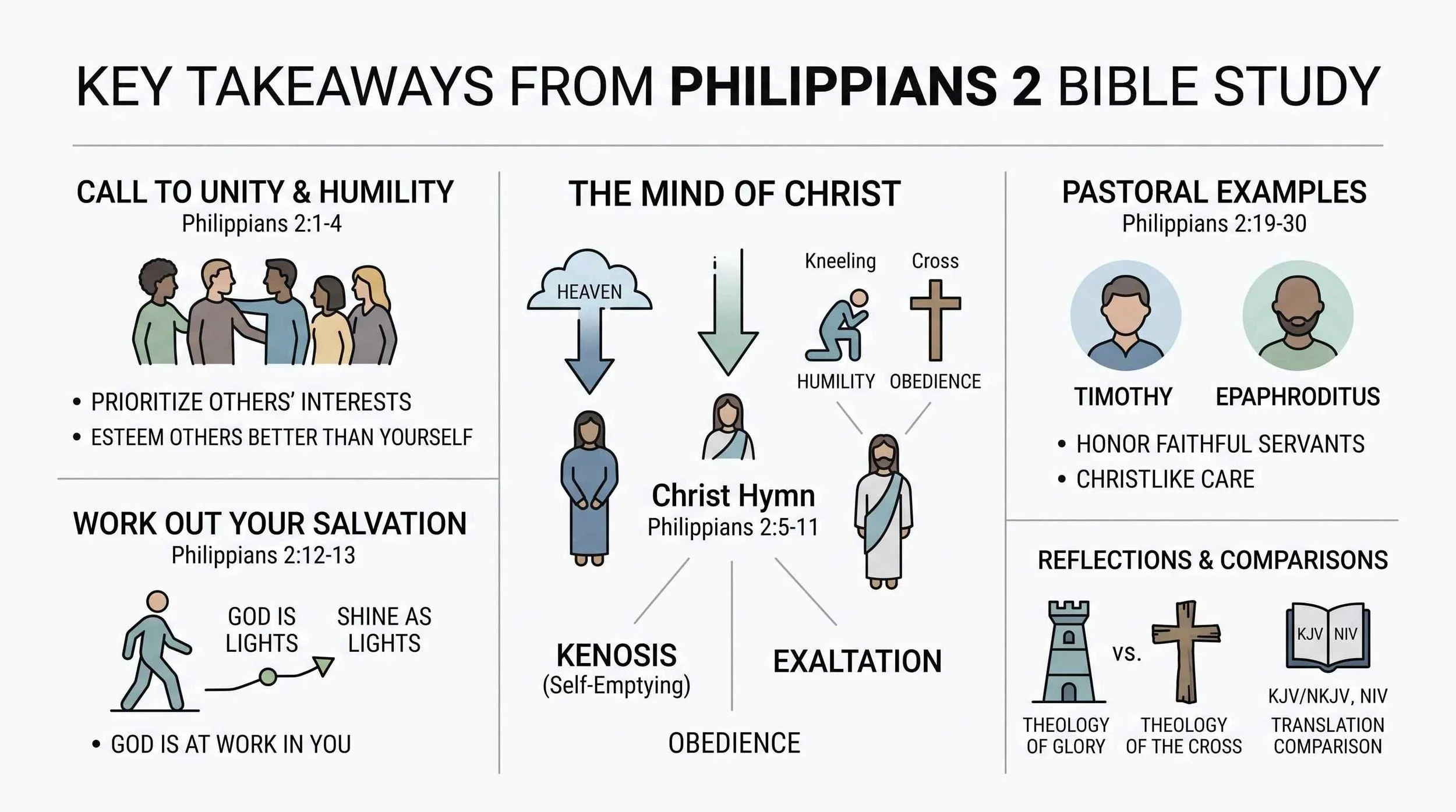
This is an AI Recap of the class.
Some things may be incorrect.
Short summary of the whole class
We held an abbreviated Bible study on August 18, 2026, due to a scheduling conflict, listened to Philippians 2, and discussed its call to unity, humility, and serving others in the mind of Christ. We connected Paul’s “Christ hymn” to a theology of the cross, contrasted Philippians’ warm tone with Galatians’ severity, considered Paul’s imprisonments and influence, and noted his pastoral care in commending Timothy and Epaphroditus. We also compared Bible translations (NIV, KJV, NKJV) and examined the Greek behind “grasped/robbery.” The class concluded with brief introductions and an encouragement to continue next week.
Section-by-section walkthrough with summaries, verses, and stories
1) Opening and context (tech issues, class format, timing)
We began with brief tech challenges related to Zoom and recording, noted the class would end early due to a district Zoom meeting at 10:30 AM on August 18, 2026, and restated our study format: listen to a chapter, then discuss.
Review of last week’s focus on Philippians 1:18 and themes of “theology of the cross” vs. “theology of glory.”
Class rule-of-thumb: even “dumb questions” can lead to good ones.
Short summary:
We set expectations for a shorter session, recalled our discussion style, and connected to last week’s emphasis on Christ being preached regardless of motives (Philippians 1:18).
References:
Philippians 1:18
Themes: Theology of the cross vs. theology of glory
Story/illustration: Tech hiccups; class recording via Zoom.
2) Worship “wars” and theology of glory vs. cross
Discussion of contemporary vs. traditional worship debates (LCMS context), referencing a video “Low Church: Low Missouri.”
Caution against becoming “theologians of glory,” where style or strictness becomes the arbiter of truth rather than the cross of Christ.
Personal anecdotes about sermon-writing with a friend and early “bad sermons” still preaching the gospel.
Short summary:
We applied Philippians’ theme to modern worship disagreements, warning against prideful “glory” theology and affirming that Christ preached—even imperfectly—is still good news.
References:
Philippians 1:18 (recall)
Themes: Theology of glory vs. theology of the cross
Stories: LCMS worship debates; “Low Church: Low Missouri”; early sermons on cassette; weekly sermon-writing with Mark.
3) Reading Philippians 2:1–11 (the Christ hymn) and initial responses
We listened to Philippians 2 and highlighted humility, service, and considering others’ interests (2:1–4).
Focus on verse 5: “Let this mind be in you which was also in Christ Jesus,” leading into the “Christ hymn” (2:6–11).
Emphasis on Christ’s self-emptying (kenosis), not grasping equality with God for personal advantage, taking the form of a servant, humbling Himself to death on a cross, and God exalting Him—every knee bowing, every tongue confessing.
Short summary:
Philippians 2 calls the church to unity and humility modeled by Jesus’ self-emptying and obedience, culminating in His exaltation.
References:
Philippians 2:1–11
Themes: Humility, service, kenosis, exaltation
Stories: Personal note on memorization in non-KJV wording.
4) “General Electric Power Company” mnemonic and epistle importance
A participant shared a mnemonic—Galatians, Ephesians, Philippians, Colossians—as “General Electric Power Company.”
Reflection on the high value of certain epistles (Romans, Philippians), and the gospels’ primacy.
Brief comments on 1 Peter and Acts reading like Old Testament narrative.
Short summary:
We noted Philippians’ place among pivotal epistles and a memorable mnemonic tying together letters that guide Christian living.
References:
Galatians, Ephesians, Philippians, Colossians (no single verse, mnemonic)
Themes: Epistle significance
Stories: Mnemonic “General Electric Power Company”; rank of books.
5) Paul’s imprisonment, tone differences, and pastoral focus
Contrast between Philippians’ warm tone and Galatians’ sharper rebukes.
Paul writes Philippians from prison; discussion of his significant time incarcerated.
Reflections on how suffering and opposition relate to the message and ministry.
Short summary:
Paul’s imprisonment frames Philippians’ tender encouragement, distinguishing it from Galatians’ corrective tone and underscoring perseverance in ministry.
References:
Philippians (overall tone)
Galatians (overall tone; e.g., sharp rebukes)
Stories: Pre-COVID Acts sermon series; realization of Paul’s lengthy imprisonments.
6) Why was Paul repeatedly imprisoned? Power structures and liberation
Exploration of social-religious dynamics: Jewish leadership’s opposition, Roman legal constraints (Paul as a Roman citizen), and fear of movements that liberate and remove control through grace.
Anticipation of Philippians 3’s credential list (Pharisee of Pharisees) and warning against boasting.
Emphasis that the foundation is the cross itself, not even our understanding of the cross.
Short summary:
Paul’s imprisonments reflect complex Jewish-Roman power dynamics, and his grace-centered message threatened control systems—driving him back to the cross as the church’s true foundation.
References:
Philippians 3 (credentials preview)
Themes: Grace vs. control, foundation in the cross
Stories: Commentary insights on Romans’ and Jews’ views; societal fear of liberated people.
7) Acts-Luke parallels and the church as Christ’s body
Insight: Luke and Acts function as two volumes; Luke centers on Jesus’ body, Acts on the church as Christ’s body.
Birth narrative parallels (Spirit’s coming), shipwreck and serpents as crucifixion-type imagery, Acts’ open ending invites readers to live in the resurrection.
Paul as stand-in for the Christian disciple.
Short summary:
We connected Philippians to the broader biblical arc: Acts portrays the church as Christ’s body living in resurrection, with Paul modeling faithful witness amid trials.
References:
Acts and Luke (literary-parabolic parallels)
Themes: Church as Christ’s body, living in the resurrection
Stories: Shipwreck and serpent episode (Acts 27–28).
8) Philippians 2:12–18—working out salvation; shining as lights
Discussion of “work out your salvation with fear and trembling” (2:12–13), noting God’s work in us to will and act for His good pleasure.
Call to do all things without grumbling, to be blameless in a crooked generation, holding fast the word of life, and Paul’s joy even if poured out as a drink offering.
Short summary:
Believers actively live out their salvation because God is at work within them, shining as lights without grumbling and holding fast to the word of life.
References:
Philippians 2:12–18
Themes: God’s agency in sanctification, witness without complaining
Stories: “Drink offering” imagery as Paul’s sacrificial service.
9) Philippians 2:19–30—Timothy and Epaphroditus, pastoral warmth
Recognition of the “folksy letter” tone: Paul’s plans to send Timothy and praise for his genuine concern (2:19–23).
Epaphroditus commended as brother, fellow worker, fellow soldier; his severe illness and recovery; the church urged to receive him with gladness and esteem (2:25–30).
Short summary:
Paul’s pastoral heart shines as he commends trustworthy servants—Timothy and Epaphroditus—modeling Christlike care and urging the church to honor faithful workers.
References:
Philippians 2:19–30
Themes: Pastoral care, commendation of co-laborers
Stories: Epaphroditus’s near-death illness and recovery.
10) Translation comparison and Greek word study (2:6–7)
KJV/NKJV wording: “did not consider it robbery to be equal with God,” “bondservant.”
NIV: “did not consider equality with God something to be used to his own advantage.”
Note on “grasped/robbery” (harpagmos): seize/plunder; Christ did not clutch at divine status for self-advantage but took the servant’s path.
Slave/servant terminology across translations.
Short summary:
Comparing translations of Philippians 2:6–7 clarifies that Christ refused to exploit equality with God, instead embracing servanthood—underscoring the passage’s humility theme.
References:
Philippians 2:6–7
Themes: Kenosis, translation nuances
Stories: Strong’s/lexical look-up; group discussion on “robbery,” “grasped,” and “bondservant.”
11) Closing and introductions
Acknowledgment of abbreviated class; plan to continue next week.
Brief introductions from participants and welcome to a new resident enjoying the Lutheran church.
Short summary:
We concluded warmly, welcomed newcomers, and looked ahead to continuing the study.
References:
None specific
Themes: Community, hospitality
Stories: Participant introductions.
Medium-length summary of the class
On August 18, 2026, we held a shortened Bible study due to a district Zoom meeting and focused on Philippians 2. After recalling last week’s emphasis on Philippians 1:18 and the theology of the cross versus glory, we listened to the chapter and highlighted its call to unity, humility, and serving others. The “Christ hymn” (2:6–11) anchored our discussion: Jesus did not grasp at equality with God for personal advantage but emptied Himself, became a servant, and obeyed to the point of death on a cross—after which God exalted Him. We contrasted Philippians’ pastoral tone with Galatians’ sharper rebukes, noted Paul’s lengthy imprisonments, and considered how grace threatens control-based power structures. We connected Luke-Acts as a unified story where Acts portrays the church as Christ’s body living in the resurrection. In 2:12–18, we reflected on “working out” salvation because God works in us, living without grumbling and shining as lights. The final section (2:19–30) revealed Paul’s warmth in commending Timothy and Epaphroditus, urging the church to honor faithful servants. We compared translations of key phrases (“robbery,” “grasped,” “bondservant”) and consulted the Greek term harpagmos to clarify Christ’s self-emptying posture. The class ended with friendly introductions and an invitation to continue next week.
Main points
Philippians 2 calls believers to unity, humility, and prioritizing others’ interests (2:1–4).
Christ’s self-emptying (kenosis) demonstrates refusing to exploit divine status and embracing servanthood (2:6–11).
The theology of the cross opposes “glory” approaches that center human performance, style, or control.
Paul’s pastoral tone in Philippians contrasts with Galatians, reflecting encouragement amid imprisonment.
Believers “work out” salvation because God is actively at work in them; they should live without grumbling and shine as lights (2:12–18).
Paul commends faithful coworkers—Timothy and Epaphroditus—and the church should honor such servants (2:19–30).
Translation differences (KJV/NKJV/NIV) around “robbery/grasped” and “bondservant/slave” illuminate the passage’s meaning.
Bible Scriptures mentioned
Philippians 1:18
Philippians 2:1–4
Philippians 2:5–11 (Christ hymn)
Philippians 2:12–18
Philippians 2:19–30
Philippians 3 (credentials, referenced for future discussion)
Galatians (general tone and themes; not a specific verse cited)
Acts 27–28 (shipwreck and serpent episodes; referenced)
Romans (mentioned as significant; not a specific verse cited)
1 Peter (mentioned; not a specific verse cited)
Luke (parallels with Acts; not a specific verse cited)
Stories and illustrations mentioned
LCMS worship debates and the video “Low Church: Low Missouri.”
Pastor’s early sermons on cassette and weekly sermon-writing with Mark.
Mnemonic for epistles: “General Electric Power Company” (Galatians, Ephesians, Philippians, Colossians).
Pre-COVID Acts sermon series and realization of Paul’s extended imprisonments.
Acts parallels: shipwreck and serpent bite as crucifixion-type imagery; Acts’ open ending inviting resurrection living.
Translation/Greek word study: harpagmos (“grasped/robbery”) and “bondservant/slave.”
Philippians Chapter 1 Class 1 - Wednesday Bible Study
Bible study launched a Philippians series, exploring Paul’s joy amid imprisonment, the meaning of “epistle,” and the Lutheran contrast between a theology of the cross and a theology of glory—finding freedom in Christ whether we live or die.
Gospel of Philippians Chapter 1
This is our 1st class on Philippians
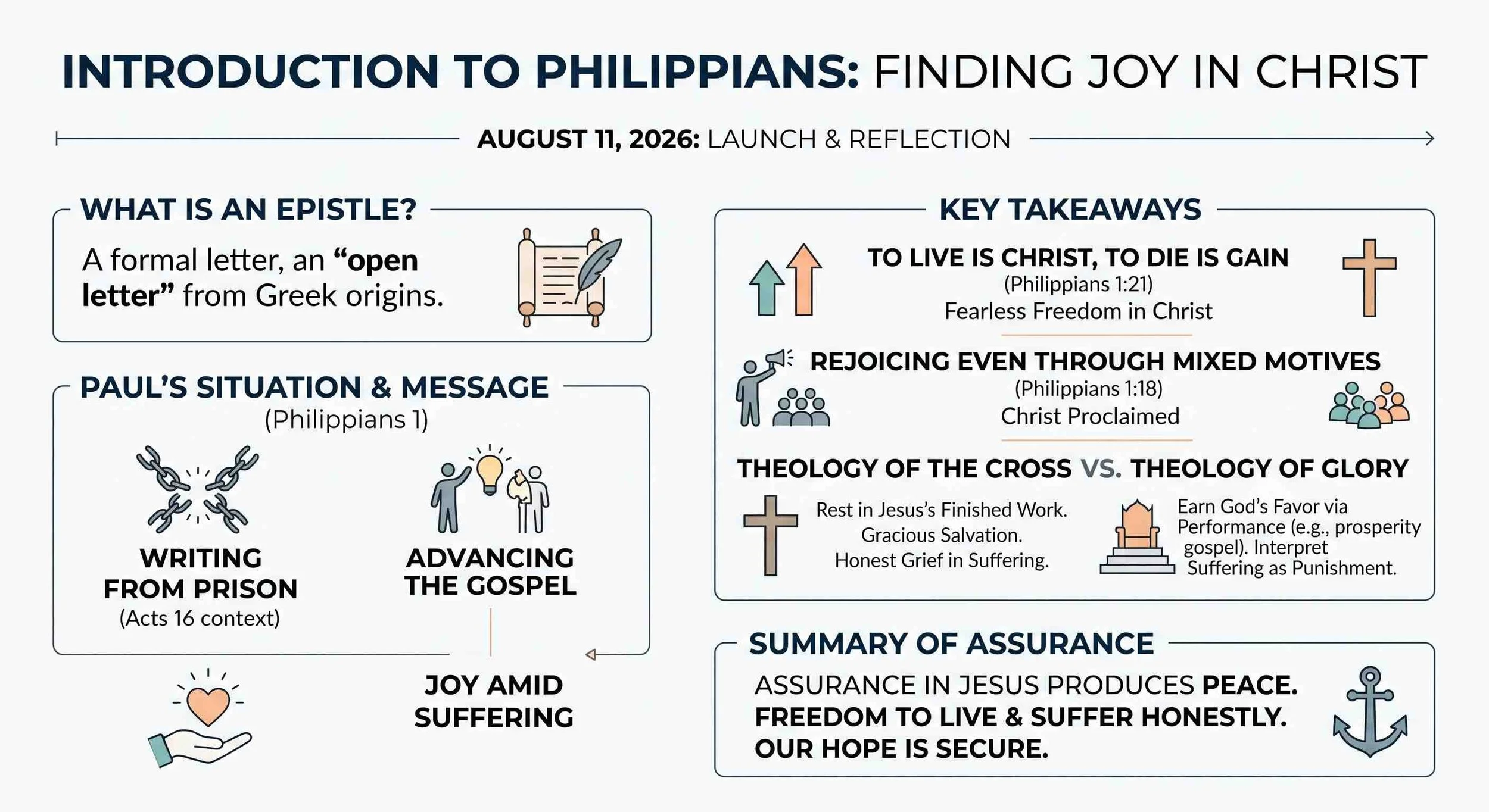
This is an AI Recap of the class.
Some things may be incorrect.
Short Summary of the Whole Class
On August 11, 2026, we began a new Philippians study with an intro video and group reflections. We defined “epistle,” shared personal stories, and discussed Philippians 1—Paul’s fearless joy in prison, “to live is Christ, to die is gain,” and rejoicing when Christ is preached despite mixed motives. We concluded by contrasting the theology of the cross (resting in Jesus’ finished work amid suffering) with the theology of glory (trying to earn God’s favor), emphasizing freedom and assurance in Christ.
Class Walkthrough (with section summaries, verses, and stories)
1) Introduction to Philippians and Personal Connections (Date: August 11, 2026)
What we discussed:
Launched our Philippians series; Cris shared it’s one of his favorite Pauline epistles.
Philippians 2:5–11 has profoundly shaped Cris’s faith and theology.
A member recalled being “thrust” into leading a Bible study, choosing Philippians as their first study.
Vocabulary:
Defined “epistle” as a long, formal letter (from Greek), similar to an “open letter.”
Stories mentioned:
Cris taught Philippians 2 to a high school class on the spot during college.
A cautionary tale: Hope Lutheran Church was burned down by an individual angry about being denied a volunteer leadership position—raising awareness about church discernment and security.
Bible verses:
Philippians 2:5–11 (not read in full, but highlighted as pivotal).
Short summary of this section:
We opened the series by sharing why Philippians matters to us, clarified what an “epistle” is, and reflected on personal stories—including a sobering event—setting a thoughtful, attentive tone for the study.
2) Video Overview: Context and Structure of Philippians
What we discussed:
Paul’s letter was written from prison to the church in Philippi (a Roman colony), likely sent back with Epaphroditus as a thank-you for financial support.
The letter is a set of reflective essays centered around a poem in chapter 2 about Christ’s humility, death, and exaltation.
Main themes: joy, suffering, and living our lives as expressions of Jesus’s story.
Stories/contexts:
The founding of the Philippian church (Acts 16), Paul’s first European church plant.
Bible verses:
Philippians 2 (central Christ hymn, summarized by the video).
Acts 16 (church origin story).
Short summary of this section:
The video framed Philippians as a prison thank-you letter structured around Christ’s humility, calling believers to embody Jesus’s story amid joy and suffering.
3) Reading Philippians Chapter 1: Joy in Chains
What we discussed:
Read Philippians 1 aloud: Paul greets the church, expresses gratitude, and explains how his imprisonment has advanced the gospel.
His chains embolden other believers and make Christ known to the palace guard.
Bible verses:
Philippians 1 (whole chapter).
Short summary of this section:
Paul’s prison circumstances surprisingly fuel gospel progress and deepen communal courage, setting the tone of resilient joy.
4) “To Live is Christ, to Die is Gain” (Philippians 1:20–24)
What we discussed:
Paul’s fearless mindset: living means fruitful labor for Christ; dying means being with Christ—both outcomes are gain.
Cris’s church-building analogy: releasing fear (even if the project failed, believers would still worship elsewhere) enabled faithful action—mirroring Paul’s freedom when nothing essential can be taken away.
Bible verses:
Philippians 1:20–24; especially 1:21.
Stories mentioned:
The congregation’s approach to constructing their church building, choosing courage over fear of failure.
Short summary of this section:
Paul’s two-way win perspective removes fear’s leverage; embracing Christ-centered outcomes frees us to act boldly in faith.
5) Christ Preached from Mixed Motives (Philippians 1:15–18)
What we discussed:
Some preached Christ from envy and rivalry; others from love. Paul rejoices that Christ is preached regardless.
Modern parallels: prosperity preachers (e.g., Tammy Faye Bakker, Joel Osteen) and “fire and brimstone” styles—while motives and methods vary, the name of Christ is proclaimed.
Link to Jesus’s teaching: “Whoever is not against us is for us.”
Bible verses:
Philippians 1:15–18.
Stories/contexts mentioned:
Televangelist examples and differing preaching styles.
The disciples’ complaint about others casting out demons in Jesus’s name (summary reference to the Gospel story).
Short summary of this section:
Paul’s joy in the gospel’s spread surpasses concerns about imperfect messengers, though love remains the better motive.
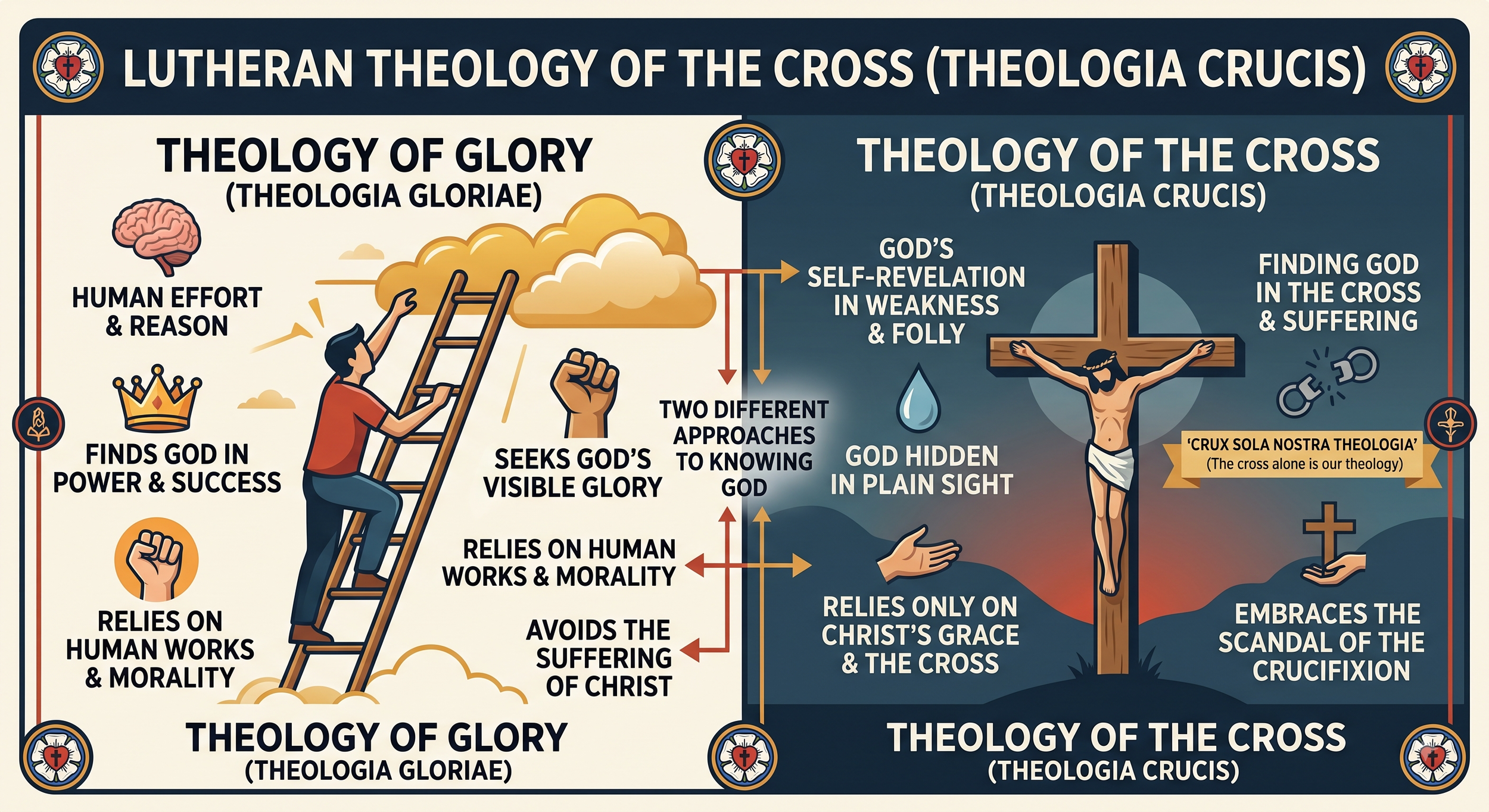
6) Theology of the Cross vs. Theology of Glory (Lutheran Framework)
What we discussed:
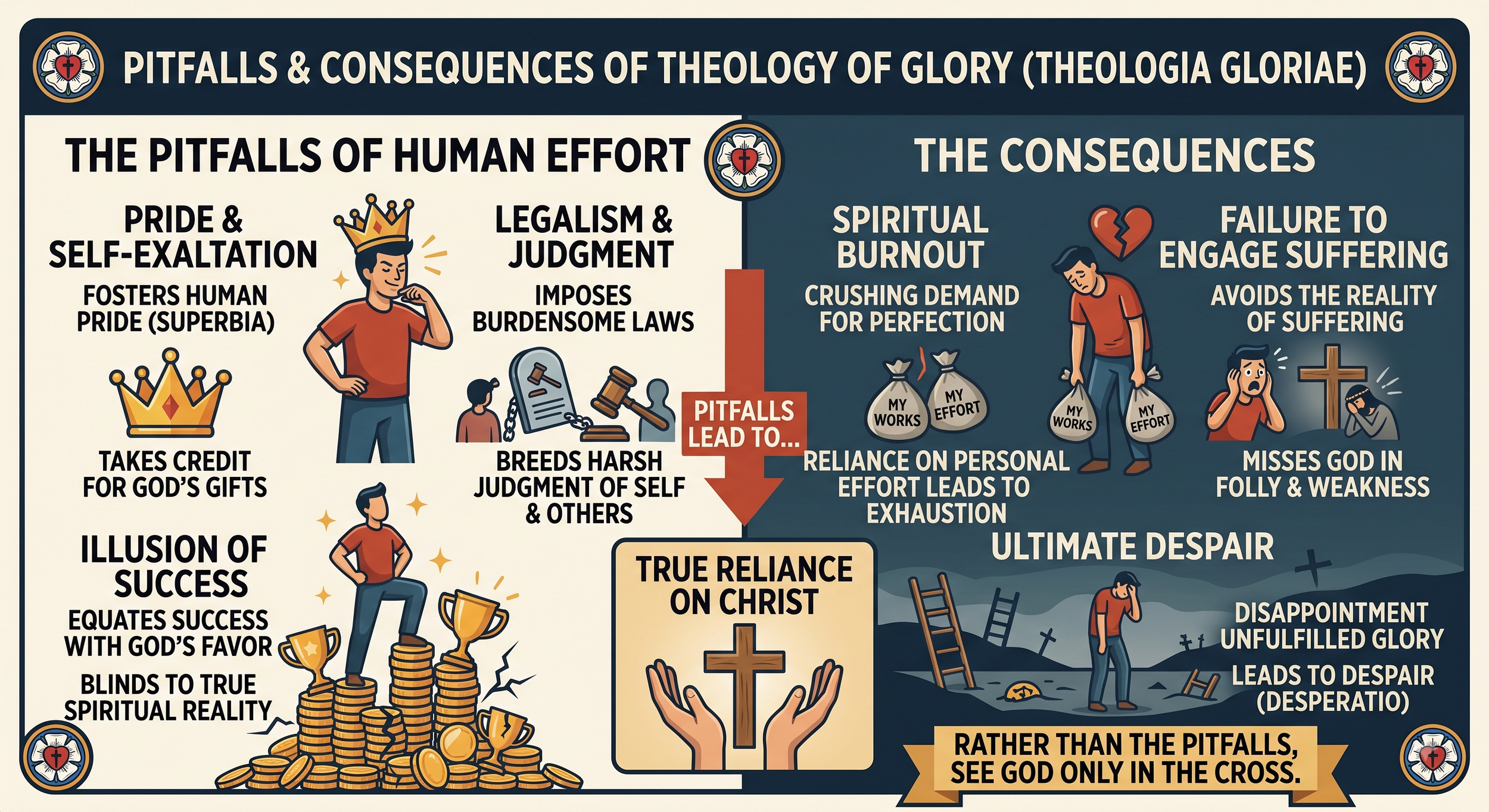
Theology of Glory:
Tries to earn God’s favor or blessings through performance (prayer quotas, giving, moral perfection).
Interprets suffering as God’s punishment.
Examples: prosperity gospel, buying indulgences.
Theology of the Cross:
Centers on Jesus’s finished work; salvation received by grace.
Acknowledges suffering as part of a fallen world, not necessarily God’s displeasure.
Frees believers to grieve honestly while resting in Christ.
Paul’s witness in Philippians shows how suffering can advance the gospel without being called “good.”
Bible verses:
Philippians 1:12 (“my chains in Christ” advancing the gospel).
Philippians 1:15, 1:18, 1:21.
Stories/anecdotes mentioned:
A class member at a hospital bedside for a week asking “Why?”
A seminary professor’s messy divorce and book on how suffering clarifies the gospel.
A class member who lost her second husband and experienced deeper faith.
Historical indulgences as a theology-of-glory example.
Cris’s humorous hypothetical about stubbing a toe to get prayers heard (illustrating performance thinking).
Short summary of this section:
Embracing the theology of the cross reframes suffering, anchors assurance in Christ’s finished work, and grants freedom from performance-driven anxiety.
7) Freedom and Assurance in Christ
What we discussed:
Resting in Christ’s finished work yields freedom: whether we live or die, we belong to Christ (Philippians 1:21).
Life’s “punches” lose ultimate power; God works all things for good.
Bible verses:
Philippians 1:21.
Short summary of this section:
Assurance in Jesus produces unshakable peace—freeing us to live courageously and suffer honestly, knowing our ultimate hope is secure.
Medium-Length Summary (Overall, August 11, 2026, 10:00:42)
On August 11, 2026, our church Bible study began a new series on Philippians with a video overview and personal reflections. We defined “epistle” and shared stories that connected the letter to our lives, including Cris’s spontaneous teaching from Philippians 2 and a sobering local church incident underscoring discernment and security. Reading Philippians 1, we saw how Paul’s imprisonment advanced the gospel and emboldened believers. We focused on Paul’s declaration, “To live is Christ, and to die is gain,” highlighting how this two-way gain dissolves fear and mirrors our own faith decisions, like tackling a church building project without anxiety over failure. We discussed preaching from mixed motives, noting Paul’s joy that Christ is preached regardless, while affirming love as the better way. Finally, we explored the Lutheran distinction between the theology of the cross and the theology of glory: rejecting performance-based attempts to earn God’s favor and reframing suffering not as punishment but as a context where God’s grace becomes clearer. We concluded by embracing the freedom and assurance that, in Christ, nothing essential can be taken from us.
Main Points
Philippians study launched; the letter’s heart centers on Christ’s humility and exaltation (Philippians 2).
“Epistle” means a formal letter; Philippians is a thank-you letter from prison.
Paul’s imprisonment advanced the gospel and emboldened believers (Philippians 1).
“To live is Christ, to die is gain” grants fearless freedom (Philippians 1:20–24).
Christ is proclaimed even through imperfect motives; love remains best (Philippians 1:15–18).
Theology of the cross vs. theology of glory: rest in Jesus’s finished work, not human performance.
Suffering isn’t good or a sign of punishment; God can use it to clarify the gospel (Philippians 1:12).
Assurance in Christ provides peace and courage in all circumstances (Philippians 1:21).
Bible Scriptures Mentioned
Philippians 1 (entire chapter)
Philippians 1:12
Philippians 1:15–18
Philippians 1:20–24
Philippians 1:21
Philippians 2:5–11 (highlighted)
Acts 16 (founding of the Philippian church)
Stories and Anecdotes Mentioned
Cris teaching Philippians 2 to a high school class spontaneously.
A member’s first Bible study leadership on Philippians.
Hope Lutheran Church arson incident—discernment and security.
Church building project analogy—freedom from fear of failure.
Televangelist examples (Tammy Faye Bakker, Joel Osteen) and differing preaching styles.
Disciples complaining about others casting out demons in Jesus’s name (“whoever is not against us is for us”).
Hospital bedside “Why?” experience.
Seminary professor’s messy divorce and book on suffering clarifying the gospel.
A class member losing her second husband, finding faith strengthened.
Historical indulgences as a theology-of-glory example.
Cris’s “stub your toe to get prayers heard” hypothetical.