
Philippians Chapter 3 Class 3 - Tuesday Bible Study
Gospel of Philippians Chapter 3
This is our 3rd class on Philippians
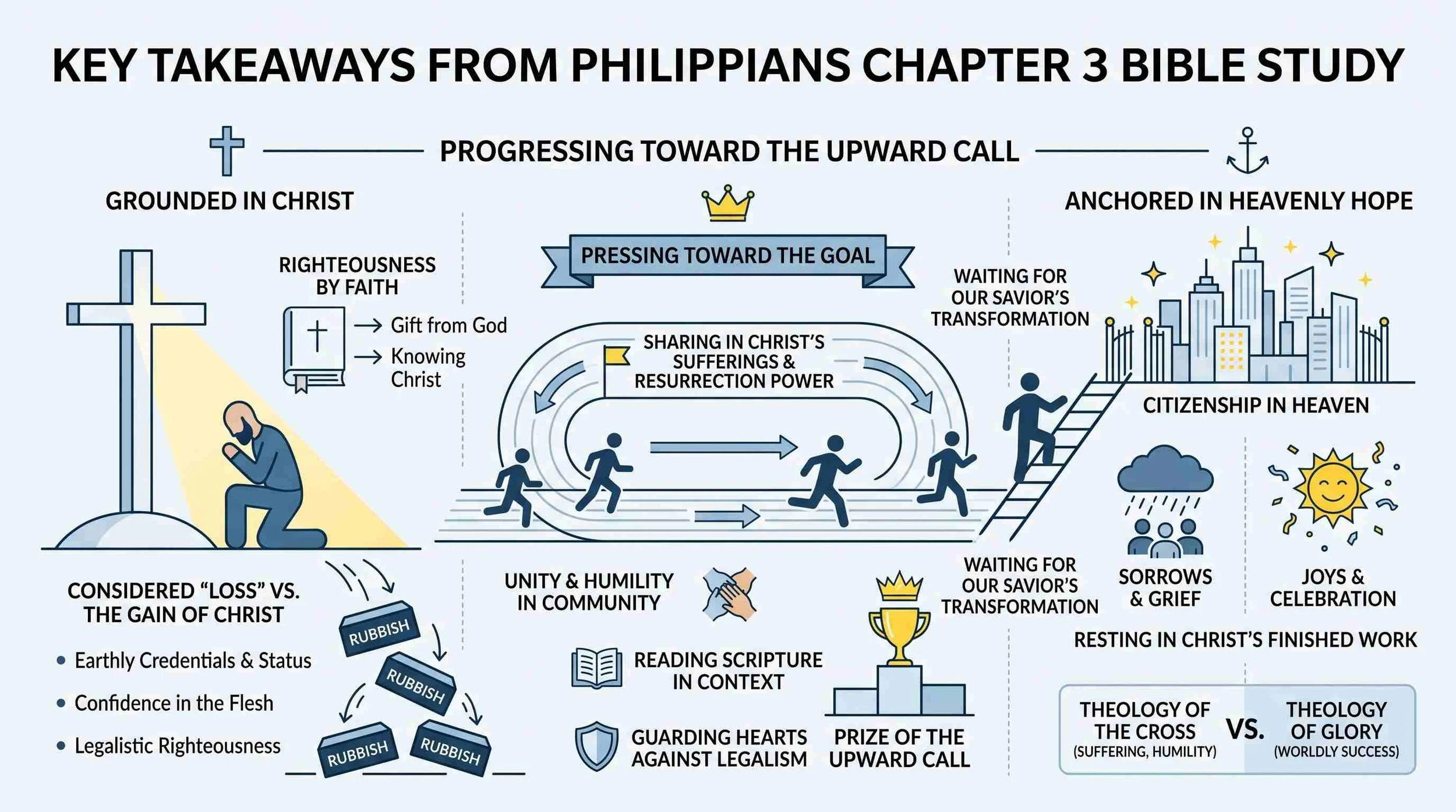
This is an AI Recap of the class.
Some things may be incorrect.
Short Summary of the Whole Class
During our class on August 24-25, 2026, we dove into Philippians chapter 3, continuing our series on Paul's letter. The session began by recapping the "theology of the cross," emphasizing Christ's selfless humility. We then unpacked Paul's powerful arguments against placing "confidence in the flesh," exploring his sharp rhetoric against "dogs" and "mutilators" (likely Judaizers). Paul lists his own impressive Jewish credentials only to declare them "rubbish" compared to knowing Jesus. The discussion highlighted the contrast between righteousness from the law and righteousness through faith, the connection between suffering with Christ and the power of His resurrection, and the danger of gossip and legalism. We concluded by focusing on our heavenly citizenship (3:20-4:1), the call to stand firm in unity, and how Christ's finished work on the cross frees us to live with hope through both joys and sorrows.
Detailed Class Summary
1. Recap: The Theology of the Cross & Reading of Philippians 3
The class began with a quick review of our previous sessions from August 17 and 24, 2026, revisiting the "theology of the cross," a central theme in Philippians 1 & 2. We recalled the message of Christ's selfless humility, who "made Himself nothing," as the ultimate example for believers. This set the stage for our main text.
We then listened to a full reading of Philippians chapter 3, along with the first verse of chapter 4. In this chapter, Paul starts with a call to "rejoice in the Lord" before issuing a stern warning against "evil workers" and "the mutilation." He contrasts them with the true "circumcision" who worship in the spirit and have "no confidence in the flesh." Paul lists his prestigious background as a Pharisee—a "Hebrew of the Hebrews," blameless under the law—only to state that he now considers all these advantages "rubbish" for the sake of knowing Christ. He explains his desire is to gain Christ and the righteousness that comes from God through faith, pressing on toward the goal of the resurrection. He warns, with tears, against the "enemies of the cross of Christ" whose focus is earthly, reminding believers that "our citizenship is in heaven."
Section Summary: We started by remembering the key message from Philippians 1 and 2: our attitude should mirror Christ’s humility. Then, through a reading of Philippians 3, we heard Paul warn against legalism, using his own impeccable pedigree to show that all worldly credentials are worthless compared to knowing Jesus and receiving righteousness through faith.
Bible Verses Mentioned: Philippians, Chapters 1 & 2 (recap); Philippians, Chapter 3 (main text); Philippians 4:1.
Stories Mentioned: The poem in Philippians 2 describing Christ humbling Himself; Paul’s personal testimony of his life as a zealous Pharisee.
2. “Beware of the Dogs”: Paul's Rhetoric and Early Church Context
We focused on Philippians 3:2–3, unpacking Paul’s warnings about “dogs” and “mutilators.” Participants asked what “dogs” means, and we discussed it as an ancient term of derision, sometimes used by Jews for Gentiles. Cris suggested Paul is using sharp rhetoric and sarcasm to grab his listeners' attention. The class considered that Paul was likely aiming at Judaizers—people inside the early church pressing Old Testament law-keeping on Gentile believers. We noted how little of the New Testament was available then, making the Torah a default authority and Paul's challenge quite daring. A key theme was discerning the spirit behind commands rather than using laws as a ladder to righteousness, noting that many Old Testament laws (like dietary restrictions) had practical health and communal-protection purposes.
Section Summary: Paul warns the church against those pushing external markers like circumcision, using provocative language ("dogs," "mutilators") to expose misplaced confidence. He confronts these internal pressures to ground righteousness in law-keeping, re-centering the church on Christ.
Bible Verses Mentioned: Philippians 3:2–3; General references to Old Testament law (Leviticus, Deuteronomy).
Stories Mentioned: Paul’s rhetorical technique—sarcasm/metonymy—was highlighted using the everyday analogy of “raining cats and dogs.”
3. True Circumcision and the Danger of Zeal
A Jewish Bible note was shared, stating that "the circumcision that God accepts is first spiritual”—a circumcision of hearts and ears. Cris connected this to Paul’s theme: our boast should be in our union with Christ, not our religious performance (e.g., who baptized us). We then looked at Paul’s résumé and zeal—“persecuting the church”—and how he now counts it as a loss. Cris noted how the book of Acts repeatedly exposes misguided zeal as self-righteous action. This led to a discussion on worship styles, contrasting liturgical “smells and bells” with contemporary “bands and fog machines,” with a caution against equating method with righteousness. The key is whether a practice helps the community see the death and resurrection of Jesus.
Section Summary: The mark that matters is inward—confidence in Christ, not external rituals or prestige. Paul rejects his former status and even his zeal as loss, reminding us that methods of worship should serve the gospel, not become badges of superiority.
Bible Verses Mentioned: Philippians 3:3, 3:4–7; Acts (series reference); Romans 2:29 and Deuteronomy 10:16 (conceptually referenced).
Stories Mentioned: Worship style contrasts: “smells and bells” vs. “bands and fog machines.”
4. Righteousness by Faith and Sharing in Christ's Sufferings
We read Philippians 3:8–11, focusing on righteousness “from God that depends on faith,” knowing Christ, the power of His resurrection, and the fellowship in His sufferings. We remembered that Paul writes this from prison, embodying the union of suffering and hope. The class connected this to Peter’s vision in Acts 10, where he learns not to call unclean what God has called clean, a story that expands the gospel's inclusion. We revisited Paul's use of sarcasm as a pastoral tool to warn against teachings that subtly enslave consciences. Attendees affirmed the need to stay anchored in grace rather than neighbor-judgment or rule-policing, noting how easily church communities can slip into fault-finding and gossip.
Section Summary: True righteousness is a gift by faith, through which believers share in Christ’s sufferings and resurrection power. This grace reorients our identity, fosters inclusion, and calls us to resist the petty judgments and legalism that can stifle a church community.
Bible Verses Mentioned: Philippians 3:8–11; Acts 10 (Peter and Cornelius).
Stories Mentioned: Peter and Cornelius (Acts 10): the vision of clean/unclean and inclusion of Gentiles; Church life examples of gossip/petty negativity.
5. Guarding Our Hearts and Building on the Right Foundation
The class candidly discussed how easy it is to speak carelessly or whisper in ways that sow dissent, often as a way to tear others down to lift oneself up. Paul’s attitude of counting his gains as “rubbish” for Christ was seen as a refreshing corrective. We then recalled Jesus’ teaching on building on the rock, connecting it to the idea of the church as "soft stones"—people, not cinder blocks. Physical facilities are helpful but not foundational to salvation. Jesus is the cornerstone, and His Spirit indwells the people.
Section Summary: We acknowledged the harm of careless speech and self-promotion, embracing Paul’s Christ-centered humility. We affirmed that God’s true building is His people, with Jesus as the foundation; our hope is in Christ, not in physical rooms or materials.
Bible Verses Mentioned: Philippians 3:7–8 (implied); Matthew 7:24–27; Matthew 16:18 (implied).
Stories Mentioned: Pastoral observation about church whispering causing rifts; Practical jokes about the room’s movable wall and peeling paint to emphasize that facilities don't equal salvation.
6. Following Examples and Resisting Enemies of the Cross
Reading Philippians 3:17–19, we discussed following faithful examples and having the "same mind"—a shared focus on Christ's saving work, not uniformity of personality. Paul’s tears over the “enemies of the cross” were interpreted as a strong warning against legalism. Adding requirements to salvation, like circumcision, "takes Jesus off the cross" by implying we can save ourselves. From a counseling perspective, it was noted that the cross is a completed historical event that our sins cannot undo. These "enemies" are driven by earthly priorities ("their god is their belly"), glorying in what leads to shame.
Section Summary: Unity in the church is rooted in a shared Christ-centered mindset. We must resist legalism and self-exaltation, which oppose the gospel, and rest solely on Christ’s finished work for salvation.
Bible Verses Mentioned: Philippians 3:17–19; Philippians 3:2 (implied).
Stories Mentioned: Reference to Lutheran Counselors of Florida and the reassurance that no personal failure is bigger than Jesus’ cross.
7. Heavenly Citizenship, Unity, and the Theology of the Cross
Focusing on Philippians 3:20–4:1, we affirmed our shared "citizenship is in heaven," from where we await Jesus to transform us. This gives us hope through life's tensions: some days feel like resurrection joy, others like cross-bearing suffering. In both, we belong to Christ. This allows us to celebrate joys (like a birthday party) and grieve losses (like Helga’s passing) without losing hope, because our righteousness is not based on our daily mood or outcome. The idea of "sin boldly" was explained as resting confidently in Christ’s finished work.
This led to a discussion on humility within denominational differences (including LCMS), rejecting elitist "remnant" thinking, and holding translation preferences humbly. We also appreciated learning from Jewish festivals and how they can point to Christ. Finally, we contrasted the "theology of the cross" (focusing on Christ's saving work in suffering) with the "theology of glory" (focusing on triumphalism and earthly success), reaffirming the former as our true center.
Section Summary: As citizens of heaven, we live in hope, anchored by Christ's resurrection. This identity allows us to navigate both joy and grief honestly, practice humility in our traditions, pursue inclusive unity, and center our faith on the theology of the cross rather than worldly glory.
Bible Verses Mentioned: Philippians 3:20–4:1; Romans 6:3–5 (implied); Psalm 23; 1 Peter 3:21 (alluded); Genesis 1:2 (alluded); John 10:22 (alluded).
Stories Mentioned: A birthday party at Dave & Buster’s; Community grief over Helga’s death; LCMS “company man” anecdote; Neighbor teaching Psalm 23 “the correct way”; St. Paul Boca’s teaching on Jewish festivals.
Medium-Length Summary of the Class
On August 24-25, 2026, our class delved into Philippians 3, building on the theme of Christ’s humility. We began by exploring Paul’s powerful argument against placing "confidence in the flesh," analyzing his sharp rhetoric against "dogs" and "mutilators"—likely Judaizers insisting on circumcision. Paul presents his own "spiritual resume" only to declare it "rubbish" compared to the immeasurable value of knowing Christ. We contrasted righteousness from the law with righteousness by faith, connecting this to how we should approach worship styles and avoid pride. The discussion affirmed that the Christian life involves sharing in Christ's sufferings and resurrection power, a reality Paul lived out from prison. We then examined Philippians 3:17–4:1, focusing on our heavenly citizenship. We discussed the dangers of gossip and legalism, affirming that the church is built on people, not buildings. Paul's warning against "enemies of the cross" reminded us that salvation rests entirely on Jesus' finished work. This truth frees us to navigate life’s joys (like birthdays) and sorrows (like the death of a member, Helga), knowing our hope is secure. We concluded by committing to a "theology of the cross" over a "theology of glory," embracing humility, unity, and a confident rest in Christ.
Main Points
No Confidence in the Flesh: We should not trust our heritage, works, or status for our standing with God. Paul’s impressive credentials are “loss” compared to knowing Jesus.
Righteousness by Faith, Not Law: True righteousness is a gift from God through faith in Christ, not earned by keeping the law.
Pressing Toward the Goal: The Christian life is a forward-moving race toward the upward call of God, sharing in both Christ’s sufferings and resurrection power.
Warning Against Earthly-Mindedness: Paul warns against "enemies of the cross" (legalists, the self-indulgent) whose focus is on earthly things and self-salvation.
Citizenship in Heaven: Our ultimate identity and hope are not in this world; we await our Savior, who will transform us.
Theology of the Cross vs. Theology of Glory: Our focus should be on Christ's saving work through suffering and humility, not on worldly triumphalism or success.
Unity and Humility: We are called to have the "same mind" in Christ, guarding against gossip, elitism, and denominational pride, and building the church on people, not structures.
Contextual Scripture Reading: We must read Scripture with humility and in context, avoiding proof-texting or turning rituals like baptism into standalone works of righteousness.
Bible Scriptures Mentioned
Philippians, Chapters 1-3 (main text)
Philippians 4:1
Philippians 3:2-3
Philippians 3:4-7
Philippians 3:8-11
Philippians 3:17-21
Acts 10 (Peter and Cornelius)
Matthew 7:24-27 (Sermon on the Mount; building on the rock)
Matthew 16:18 (implied; “on this rock” with Peter)
Psalm 23
Romans 6:3-5 (implied/alluded; union with Christ in baptism)
1 Peter 3:21 (alluded; baptism)
Genesis 1:2 (alluded; chaos/tohu vavohu)
Colossians 2:11-12 (alluded; circumcision/baptism)
John 10:22 (alluded; Feast of Dedication/Hanukkah)
General references to Old Testament law (Leviticus/Deuteronomy).
Stories and Illustrations Mentioned
The poem in Philippians 2 describing Christ humbling Himself.
Paul’s testimony of his former life as a zealous Pharisee.
Paul's rhetorical/sarcastic approach to expose misplaced confidence (e.g., "dogs," "mutilators").
The analogy "raining cats and dogs" to explain figures of speech.
Worship style contrasts: “smells and bells” vs. “bands and fog machines.”
Peter and Cornelius (Acts 10): the vision of clean/unclean animals and Gentile inclusion.
Pastoral observations about church whispering and gossip.
Room details (movable wall, peeling paint) illustrating that buildings aren’t our foundation.
Counseling note about Lutheran Counselors of Florida and reassurance that no sin is bigger than the cross.
A birthday party at Dave & Buster’s as an example of legitimate joy.
Grieving Helga’s passing while holding to resurrection hope.
LCMS “company man” anecdote about humility amid disagreement.
Story of a neighbor insisting on the “correct” wording of Psalm 23.
St. Paul Boca’s ministry teaching on Jewish festivals and their connection to Christ.