
Philippians Chapter 2 Class 2 - Tuesday Bible Study
Gospel of Philippians Chapter 2
This is our 2nd class on Philippians
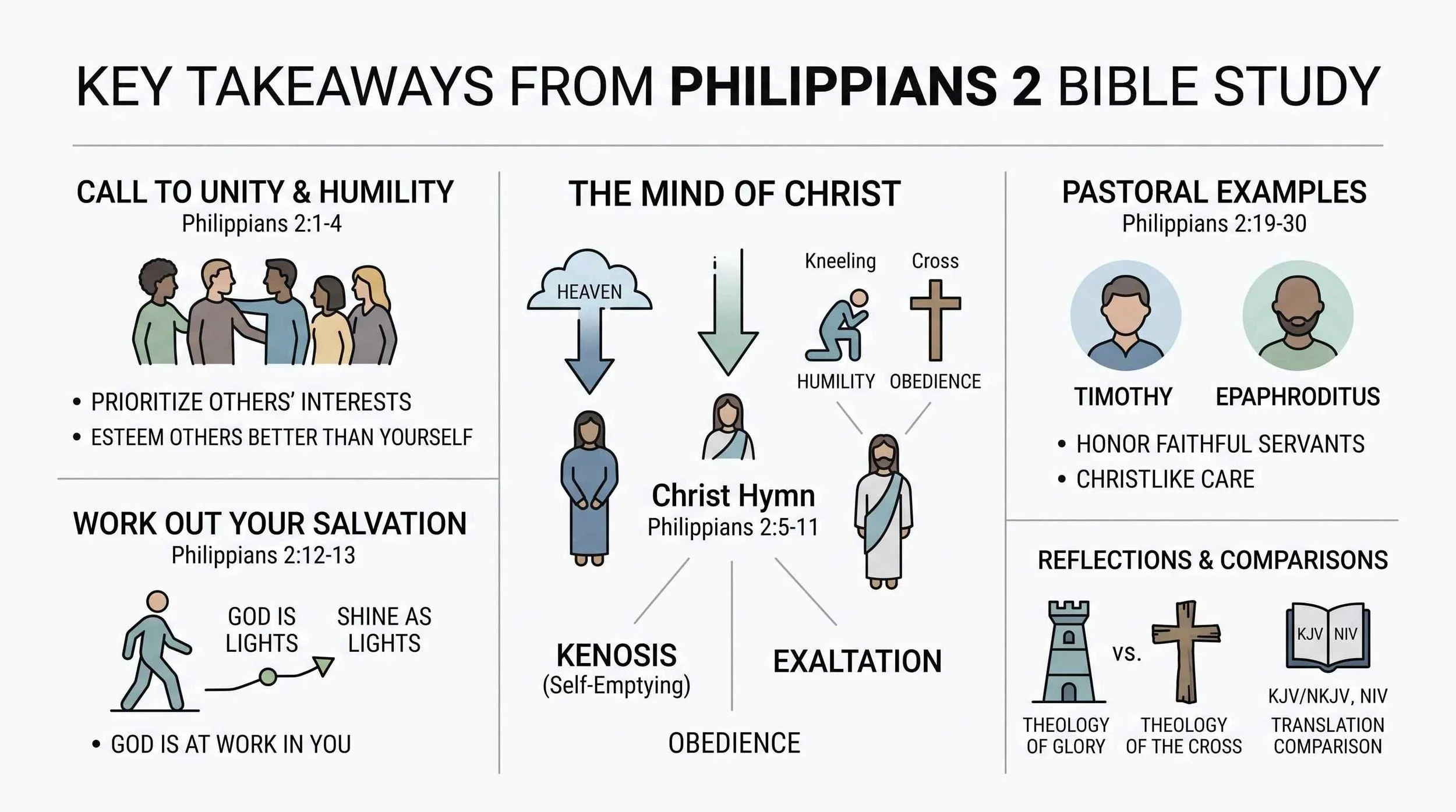
This is an AI Recap of the class.
Some things may be incorrect.
Short summary of the whole class
We held an abbreviated Bible study on August 18, 2026, due to a scheduling conflict, listened to Philippians 2, and discussed its call to unity, humility, and serving others in the mind of Christ. We connected Paul’s “Christ hymn” to a theology of the cross, contrasted Philippians’ warm tone with Galatians’ severity, considered Paul’s imprisonments and influence, and noted his pastoral care in commending Timothy and Epaphroditus. We also compared Bible translations (NIV, KJV, NKJV) and examined the Greek behind “grasped/robbery.” The class concluded with brief introductions and an encouragement to continue next week.
Section-by-section walkthrough with summaries, verses, and stories
1) Opening and context (tech issues, class format, timing)
We began with brief tech challenges related to Zoom and recording, noted the class would end early due to a district Zoom meeting at 10:30 AM on August 18, 2026, and restated our study format: listen to a chapter, then discuss.
Review of last week’s focus on Philippians 1:18 and themes of “theology of the cross” vs. “theology of glory.”
Class rule-of-thumb: even “dumb questions” can lead to good ones.
Short summary:
We set expectations for a shorter session, recalled our discussion style, and connected to last week’s emphasis on Christ being preached regardless of motives (Philippians 1:18).
References:
Philippians 1:18
Themes: Theology of the cross vs. theology of glory
Story/illustration: Tech hiccups; class recording via Zoom.
2) Worship “wars” and theology of glory vs. cross
Discussion of contemporary vs. traditional worship debates (LCMS context), referencing a video “Low Church: Low Missouri.”
Caution against becoming “theologians of glory,” where style or strictness becomes the arbiter of truth rather than the cross of Christ.
Personal anecdotes about sermon-writing with a friend and early “bad sermons” still preaching the gospel.
Short summary:
We applied Philippians’ theme to modern worship disagreements, warning against prideful “glory” theology and affirming that Christ preached—even imperfectly—is still good news.
References:
Philippians 1:18 (recall)
Themes: Theology of glory vs. theology of the cross
Stories: LCMS worship debates; “Low Church: Low Missouri”; early sermons on cassette; weekly sermon-writing with Mark.
3) Reading Philippians 2:1–11 (the Christ hymn) and initial responses
We listened to Philippians 2 and highlighted humility, service, and considering others’ interests (2:1–4).
Focus on verse 5: “Let this mind be in you which was also in Christ Jesus,” leading into the “Christ hymn” (2:6–11).
Emphasis on Christ’s self-emptying (kenosis), not grasping equality with God for personal advantage, taking the form of a servant, humbling Himself to death on a cross, and God exalting Him—every knee bowing, every tongue confessing.
Short summary:
Philippians 2 calls the church to unity and humility modeled by Jesus’ self-emptying and obedience, culminating in His exaltation.
References:
Philippians 2:1–11
Themes: Humility, service, kenosis, exaltation
Stories: Personal note on memorization in non-KJV wording.
4) “General Electric Power Company” mnemonic and epistle importance
A participant shared a mnemonic—Galatians, Ephesians, Philippians, Colossians—as “General Electric Power Company.”
Reflection on the high value of certain epistles (Romans, Philippians), and the gospels’ primacy.
Brief comments on 1 Peter and Acts reading like Old Testament narrative.
Short summary:
We noted Philippians’ place among pivotal epistles and a memorable mnemonic tying together letters that guide Christian living.
References:
Galatians, Ephesians, Philippians, Colossians (no single verse, mnemonic)
Themes: Epistle significance
Stories: Mnemonic “General Electric Power Company”; rank of books.
5) Paul’s imprisonment, tone differences, and pastoral focus
Contrast between Philippians’ warm tone and Galatians’ sharper rebukes.
Paul writes Philippians from prison; discussion of his significant time incarcerated.
Reflections on how suffering and opposition relate to the message and ministry.
Short summary:
Paul’s imprisonment frames Philippians’ tender encouragement, distinguishing it from Galatians’ corrective tone and underscoring perseverance in ministry.
References:
Philippians (overall tone)
Galatians (overall tone; e.g., sharp rebukes)
Stories: Pre-COVID Acts sermon series; realization of Paul’s lengthy imprisonments.
6) Why was Paul repeatedly imprisoned? Power structures and liberation
Exploration of social-religious dynamics: Jewish leadership’s opposition, Roman legal constraints (Paul as a Roman citizen), and fear of movements that liberate and remove control through grace.
Anticipation of Philippians 3’s credential list (Pharisee of Pharisees) and warning against boasting.
Emphasis that the foundation is the cross itself, not even our understanding of the cross.
Short summary:
Paul’s imprisonments reflect complex Jewish-Roman power dynamics, and his grace-centered message threatened control systems—driving him back to the cross as the church’s true foundation.
References:
Philippians 3 (credentials preview)
Themes: Grace vs. control, foundation in the cross
Stories: Commentary insights on Romans’ and Jews’ views; societal fear of liberated people.
7) Acts-Luke parallels and the church as Christ’s body
Insight: Luke and Acts function as two volumes; Luke centers on Jesus’ body, Acts on the church as Christ’s body.
Birth narrative parallels (Spirit’s coming), shipwreck and serpents as crucifixion-type imagery, Acts’ open ending invites readers to live in the resurrection.
Paul as stand-in for the Christian disciple.
Short summary:
We connected Philippians to the broader biblical arc: Acts portrays the church as Christ’s body living in resurrection, with Paul modeling faithful witness amid trials.
References:
Acts and Luke (literary-parabolic parallels)
Themes: Church as Christ’s body, living in the resurrection
Stories: Shipwreck and serpent episode (Acts 27–28).
8) Philippians 2:12–18—working out salvation; shining as lights
Discussion of “work out your salvation with fear and trembling” (2:12–13), noting God’s work in us to will and act for His good pleasure.
Call to do all things without grumbling, to be blameless in a crooked generation, holding fast the word of life, and Paul’s joy even if poured out as a drink offering.
Short summary:
Believers actively live out their salvation because God is at work within them, shining as lights without grumbling and holding fast to the word of life.
References:
Philippians 2:12–18
Themes: God’s agency in sanctification, witness without complaining
Stories: “Drink offering” imagery as Paul’s sacrificial service.
9) Philippians 2:19–30—Timothy and Epaphroditus, pastoral warmth
Recognition of the “folksy letter” tone: Paul’s plans to send Timothy and praise for his genuine concern (2:19–23).
Epaphroditus commended as brother, fellow worker, fellow soldier; his severe illness and recovery; the church urged to receive him with gladness and esteem (2:25–30).
Short summary:
Paul’s pastoral heart shines as he commends trustworthy servants—Timothy and Epaphroditus—modeling Christlike care and urging the church to honor faithful workers.
References:
Philippians 2:19–30
Themes: Pastoral care, commendation of co-laborers
Stories: Epaphroditus’s near-death illness and recovery.
10) Translation comparison and Greek word study (2:6–7)
KJV/NKJV wording: “did not consider it robbery to be equal with God,” “bondservant.”
NIV: “did not consider equality with God something to be used to his own advantage.”
Note on “grasped/robbery” (harpagmos): seize/plunder; Christ did not clutch at divine status for self-advantage but took the servant’s path.
Slave/servant terminology across translations.
Short summary:
Comparing translations of Philippians 2:6–7 clarifies that Christ refused to exploit equality with God, instead embracing servanthood—underscoring the passage’s humility theme.
References:
Philippians 2:6–7
Themes: Kenosis, translation nuances
Stories: Strong’s/lexical look-up; group discussion on “robbery,” “grasped,” and “bondservant.”
11) Closing and introductions
Acknowledgment of abbreviated class; plan to continue next week.
Brief introductions from participants and welcome to a new resident enjoying the Lutheran church.
Short summary:
We concluded warmly, welcomed newcomers, and looked ahead to continuing the study.
References:
None specific
Themes: Community, hospitality
Stories: Participant introductions.
Medium-length summary of the class
On August 18, 2026, we held a shortened Bible study due to a district Zoom meeting and focused on Philippians 2. After recalling last week’s emphasis on Philippians 1:18 and the theology of the cross versus glory, we listened to the chapter and highlighted its call to unity, humility, and serving others. The “Christ hymn” (2:6–11) anchored our discussion: Jesus did not grasp at equality with God for personal advantage but emptied Himself, became a servant, and obeyed to the point of death on a cross—after which God exalted Him. We contrasted Philippians’ pastoral tone with Galatians’ sharper rebukes, noted Paul’s lengthy imprisonments, and considered how grace threatens control-based power structures. We connected Luke-Acts as a unified story where Acts portrays the church as Christ’s body living in the resurrection. In 2:12–18, we reflected on “working out” salvation because God works in us, living without grumbling and shining as lights. The final section (2:19–30) revealed Paul’s warmth in commending Timothy and Epaphroditus, urging the church to honor faithful servants. We compared translations of key phrases (“robbery,” “grasped,” “bondservant”) and consulted the Greek term harpagmos to clarify Christ’s self-emptying posture. The class ended with friendly introductions and an invitation to continue next week.
Main points
Philippians 2 calls believers to unity, humility, and prioritizing others’ interests (2:1–4).
Christ’s self-emptying (kenosis) demonstrates refusing to exploit divine status and embracing servanthood (2:6–11).
The theology of the cross opposes “glory” approaches that center human performance, style, or control.
Paul’s pastoral tone in Philippians contrasts with Galatians, reflecting encouragement amid imprisonment.
Believers “work out” salvation because God is actively at work in them; they should live without grumbling and shine as lights (2:12–18).
Paul commends faithful coworkers—Timothy and Epaphroditus—and the church should honor such servants (2:19–30).
Translation differences (KJV/NKJV/NIV) around “robbery/grasped” and “bondservant/slave” illuminate the passage’s meaning.
Bible Scriptures mentioned
Philippians 1:18
Philippians 2:1–4
Philippians 2:5–11 (Christ hymn)
Philippians 2:12–18
Philippians 2:19–30
Philippians 3 (credentials, referenced for future discussion)
Galatians (general tone and themes; not a specific verse cited)
Acts 27–28 (shipwreck and serpent episodes; referenced)
Romans (mentioned as significant; not a specific verse cited)
1 Peter (mentioned; not a specific verse cited)
Luke (parallels with Acts; not a specific verse cited)
Stories and illustrations mentioned
LCMS worship debates and the video “Low Church: Low Missouri.”
Pastor’s early sermons on cassette and weekly sermon-writing with Mark.
Mnemonic for epistles: “General Electric Power Company” (Galatians, Ephesians, Philippians, Colossians).
Pre-COVID Acts sermon series and realization of Paul’s extended imprisonments.
Acts parallels: shipwreck and serpent bite as crucifixion-type imagery; Acts’ open ending inviting resurrection living.
Translation/Greek word study: harpagmos (“grasped/robbery”) and “bondservant/slave.”