
Philippians Chapter 4 Class 4 - Tuesday Bible Study
Gospel of Philippians Chapter 4
This is our 4rd class on Philippians
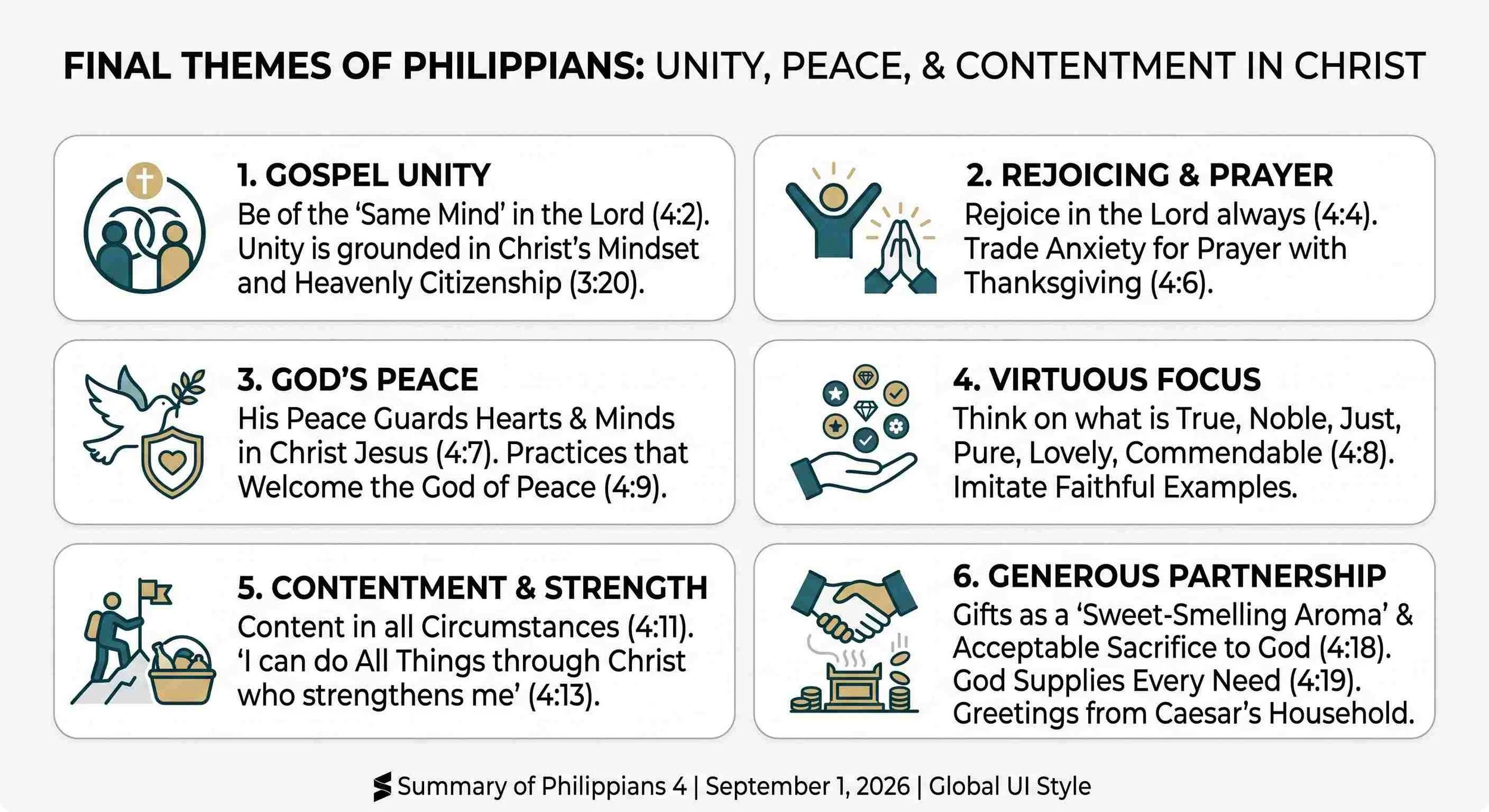
This is an AI Recap of the class.
Some things may be incorrect.
Short Summary of the Whole Class
During our Bible study on September 2, 2026, we revisited Mark chapter 6, analyzing its pivotal role in the Gospel. We discussed Jesus's rejection in his hometown, the mission of the Twelve, and the stark contrast between King Herod's feckless leadership and Jesus's compassionate shepherding. The class focused on the feeding of the five thousand and Jesus walking on water, noting how these miracles serve as a powerful critique of the disciples' "hardened hearts." We contrasted their lack of faith with the desperate faith of outsiders and concluded that Mark presents the disciples' failures to help us see our own weaknesses and recognize our need for Jesus, who redeems us even in our lack of understanding. Throughout, we connected these narratives to foundational themes from Genesis and Exodus.
Detailed Class Summary (September 2, 2026)
Section 1: Context and Rereading Mark 6
Our discussion opened by deciding to re-walk through Mark 6, as some participants had missed the previous session and the chapter is pivotal to the Gospel. The plan was to read the whole chapter and "walk our way through it." We noted that future studies on Tuesdays will start with Genesis, emphasizing how Genesis and Exodus form a primer for the whole Bible. The Gospels, including Mark 6, often echo these foundational stories of creation, covenant, and deliverance, such as Matthew’s infancy narrative paralleling the Exodus story.
Summary of Section 1: We set the study plan to reread Mark 6 comprehensively and connected the importance of Genesis and Exodus as a foundational lens for understanding the rest of Scripture, including the Gospels' themes of rejection, mission, and faith.
Bible Verses & Stories Mentioned:
General: Genesis, Exodus as foundational to the Bible.
Matthew’s Infancy Narrative: Mentioned as an echo of Exodus (Herod and the flight to Egypt).
Section 2: Rejection in Nazareth and the Mission of the Twelve
We began by reading Mark 6:1–13. Jesus returns to his hometown of Nazareth, and the people are "astonished" in a way that turns to offense, questioning his authority: "Isn’t this the carpenter… Mary’s son?" Jesus responds with the proverb, "A prophet is not without honor except in his own country." We discussed how this unbelief impacted Jesus’s ministry there; he "could do no mighty work there" and marveled at their unbelief. The class considered whether he "couldn't" or "chose not to," with a study Bible suggesting the latter. This rejection in Nazareth was seen as a microcosm of Israel’s broader rejection of its prophets.
Jesus then sends out the Twelve "two by two," giving them authority over unclean spirits. He instructs them to travel light (staff, sandals, no bread, no money), an exercise in faith showing their dependence on God and hospitality. This made them resemble itinerant preachers or prophets of old. If rejected, they were to "shake off your dirt off your feet," a powerful statement typically made by Jews leaving a Gentile region, signifying judgment. The disciples then went out, preached repentance, cast out demons, and healed the sick, acting as true representatives of God.
Summary of Section 2: Mark 6:1–13 shows the contrast between hometown rejection and faithful mission. Unbelief in Nazareth hinders Jesus’s wonders, while the disciples, sent out in dependence and with authority, multiply his work through preaching, healing, and deliverance, calling Israel to repent.
Bible Verses & Stories Mentioned:
Mark 6:1–13: Rejection at Nazareth; sending of the Twelve.
Genesis 18–19: Sodom and Gomorrah (alluded to in the judgment context).
Cross-references: Jesus's statements on prophets dying in Jerusalem (cf. Luke 13:33–34; Matthew 23:37).
Echoes of Exodus: The pattern of God's deliverers and prophets being rejected.
Section 3: The Failed Leadership of King Herod
The discussion then shifted to the flashback account of John the Baptist's beheading (Mark 6:14–29), which begins with Herod hearing of Jesus and fearing he is a resurrected John. We analyzed Herod as a "feckless ruler," a king in name only who was a slave to his ego and public image. Though he "heard [John] gladly," he made a foolish oath to his stepdaughter during a birthday feast. When she, prompted by her mother Herodias, asked for John the Baptist’s head, Herod was "exceedingly sorry" but felt compelled to follow through because of his pride. This portrayed him as a weak, self-serving leader who fails his people and is ruled by bluster rather than justice. The non-linear narrative structure was noted as a theological tool Mark uses to reveal truths about Jesus by contrasting him with such failed leadership.
Summary of Section 3: The story of John the Baptist’s beheading serves as a flashback to characterize King Herod as a weak leader. His ego and fear of losing face led him to execute a prophet he respected, showcasing a king who fails his people and is ruled by pride.
Bible Verses & Stories Mentioned:
Mark 6:14–29: The story of King Herod and the beheading of John the Baptist.
Section 4: Jesus the True Shepherd and a Miraculous Meal
Next, we connected the story of Herod to the feeding of the five thousand (Mark 6:30–44). The crowd following Jesus into the wilderness or "deserted place" was described as "sheep without a shepherd" (Mark 6:34). This statement stands in stark contrast to Herod. Where Herod hosted a feast for the powerful ending in death, Jesus acts as the true, compassionate shepherd for the leaderless flock.
The disciples' first instinct was to "send them away," a rational but uncaring response. Jesus challenged their limited perspective with the command, "You give them something to eat." He then took five loaves and two fish, and the class noted the significance of the number seven (5+2) as a symbol of completion. The language—he "took," "blessed," "broke," and "gave"—intentionally parallels the words of Communion. The twelve baskets of leftovers were a clear reference to the twelve tribes of Israel, showing God's abundant provision. The five thousand men were interpreted as representing the Pentateuch, framing this as an "all-Israel" event where Jesus, the Shepherd-King, provides for his nation.
Summary of Section 4: In direct contrast to Herod, Jesus is presented as the true shepherd. He sees the crowd with compassion and miraculously feeds them in the wilderness. This sacrament-like event is rich with symbolism, pointing to Jesus as the divine provider who fulfills the needs of his people where their earthly king had failed.
Bible Verses & Stories Mentioned:
Mark 6:30–44: The feeding of the five thousand.
Mark 6:34: Jesus's compassion for the "sheep not having a shepherd."
Mark 6:41: Jesus blesses and breaks the loaves, echoing communion language.
Psalm 23: The Lord is my Shepherd, illustrating a king's role.
The Exodus: The wilderness setting and provision of food echoes God providing manna.
Feeding of the Four Thousand: Mentioned as a future event showing provision for Gentiles.
Section 5: Walking on Water and Hardened Hearts
We then examined Jesus walking on water (Mark 6:45–52), which immediately follows the feeding. While the disciples were "straining at the oars," a metaphor for their spiritual struggle, Jesus appeared. Their reaction was terror, thinking he was a ghost. The key to this section is Mark 6:52: "for they had not understood about the loaves, because their heart was hardened." This verse, the class concluded, is Mark's central point. The disciples’ inability to comprehend the miracle of the loaves led directly to their fear on the water.
The phrase "hardened heart" explicitly links them to Pharaoh in Exodus. Just as Pharaoh witnessed God’s miracles but refused to believe, the disciples saw Jesus's divine power yet failed to understand who he was. They were still viewing him through a lens of political power, not as their divine savior.
Summary of Section 5: The disciples' fear while Jesus walked on water was a direct result of their failure to understand the feeding of the five thousand. Mark diagnoses their problem as having "hardened hearts," a term that equates their spiritual blindness with that of Pharaoh, revealing their deep-seated lack of faith.
Bible Verses & Stories Mentioned:
Mark 6:45–52: The story of Jesus walking on the water.
Mark 6:52: "...their heart was hardened." Identified as the key verse for the chapter.
Pharaoh's Hardened Heart (Exodus): The disciples' condition was directly compared to Pharaoh's.
Section 6: A Contrast in Faith and the Purpose of Failure
The chapter concludes with Jesus arriving in Gennesaret. The contrast in reception is stark. In Jewish Nazareth, unbelief limited his work. Here, in a Gentile-associated region, the people have such faith that they seek healing by merely touching the hem of his garment. This highlights a theme of "outsiders" often showing more faith than "insiders" like the disciples.
The discussion wrapped up by considering why Mark (recording Peter's account) would portray the disciples so negatively. The consensus was that their failures are relatable. We, too, forget the "loaves"—the times God has provided. We, too, have hardened hearts. The story of the disciples, from their failures to their eventual restoration, shows us that our faith journey is imperfect and that we are saved by grace in the midst of our failures, not by our own strength.
Summary of Section 6: The chapter contrasts the disciples' hardened hearts with the eager faith of the people in Gennesaret. The class concluded that the disciples’ failures are included to help us see ourselves in their story, reminding us that we all depend entirely on Jesus's grace for redemption.
Bible Verses & Stories Mentioned:
Healing of the Gerasene Demoniac (Mark 5): Referenced as a previous event in the region.
Woman who touched the hem of Jesus's garment (Mark 5:25–34): Compared to the faith of the people in Gennesaret.
Jesus's Rejection in Nazareth (Mark 6:1–6): Contrasted with his reception in Gennesaret.
The Transfiguration & The Rich Young Ruler: Mentioned as future stories that will expose the disciples' struggles.
Final Summary
In our Bible study on September 2, 2026, we conducted an in-depth analysis of Mark chapter 6, walking through its interconnected narratives. We began with Jesus's rejection in his hometown of Nazareth, which served as a microcosm of prophetic dishonor. From there, we examined the sending of the Twelve, who were commissioned to preach, heal, and act with dependence on God. The study then delved into a major theological contrast: the failed, self-serving leadership of King Herod, who beheaded John the Baptist out of pride, versus the compassionate leadership of Jesus, the true Shepherd-King.
This contrast was powerfully illustrated in the feeding of the five thousand. Where Herod hosted a fatal feast for the elite, Jesus hosted a life-giving feast for the common people, who were "like sheep without a shepherd." This miracle was laden with symbolism connecting Jesus to Israel’s history and his identity as the divine provider. However, the disciples failed to grasp its meaning. The subsequent story of Jesus walking on water exposed their core spiritual problem. Their terror was a symptom of their failure to understand the loaves, as Mark 6:52 states their hearts were "hardened," explicitly comparing them to Pharaoh in Exodus. Ultimately, the class concluded that Mark presents the disciples' flaws—contrasted with the eager faith of outsiders in Gennesaret—so that we can see our own struggles in their story and recognize that salvation comes not from our own understanding, but from the grace of Jesus, who redeems us even in our weakness.
Main Points
Mark 6 is pivotal, showcasing themes of rejection, mission, divine identity, and the nature of faith.
Jesus's rejection in Nazareth illustrates prophetic dishonor at home, where unbelief can constrain the environment for miracles.
The Twelve are sent out with authority and simplicity, modeling dependence on God and accountability for the reception of their message.
The narrative deliberately contrasts Herod, the bad shepherd, with Jesus, the good shepherd.
The feeding of the five thousand is a sacramental event filled with symbolism (the numbers 7, 12, 5000; communion language) connecting Jesus to Israel's history and his role as the divine provider.
The disciples' fear on the water was a direct consequence of their "hardened hearts" and failure to understand the miracle of the loaves, linking their unbelief to that of Pharaoh.
Genesis–Exodus patterns (rejection of prophets, deliverance, wilderness provision) form a primer for reading the Gospels.
The eager faith of Gentiles in Gennesaret stands in stark contrast to the hardened hearts of the disciples.
The disciples' failures are included in the Gospel to help us see our own weaknesses and our desperate need for Jesus's grace.
Scriptures and Stories Mentioned
Bible Scriptures:
Mark 6 (entire chapter): Particularly Mark 6:1–13, 14–29, 30–44, 45–52.
Mark 6:52: "for they had not understood about the loaves, because their heart was hardened."
Mark 6:34: Jesus's compassion for the crowd, "like sheep not having a shepherd."
Psalm 23: The Lord is my shepherd.
Genesis & Exodus (General): Creation; patriarchs (Abraham, Isaac, Jacob, Joseph); Exodus deliverance; Pharaoh's hardened heart.
Genesis 18–19: Sodom and Gomorrah.
Matthew’s infancy narrative (Matthew 2:13–18): Flight to Egypt; Herod’s slaughter of infants.
Cross-references: Luke 13:33–34; Matthew 23:37 (prophets dying in Jerusalem).
Bible Stories:
Jesus rejected in Nazareth.
The sending out of the twelve disciples.
The beheading of John the Baptist.
The feeding of the five thousand.
Jesus walking on water.
The Israelites wandering in the wilderness (Exodus) and the providing of manna.
The Creation Story (seven days).
The healing of the Gerasene demoniac (Legion).
The woman who touched the hem of Jesus's garment.
The feeding of the four thousand.
The Transfiguration.
The story of the Rich Young Ruler.