
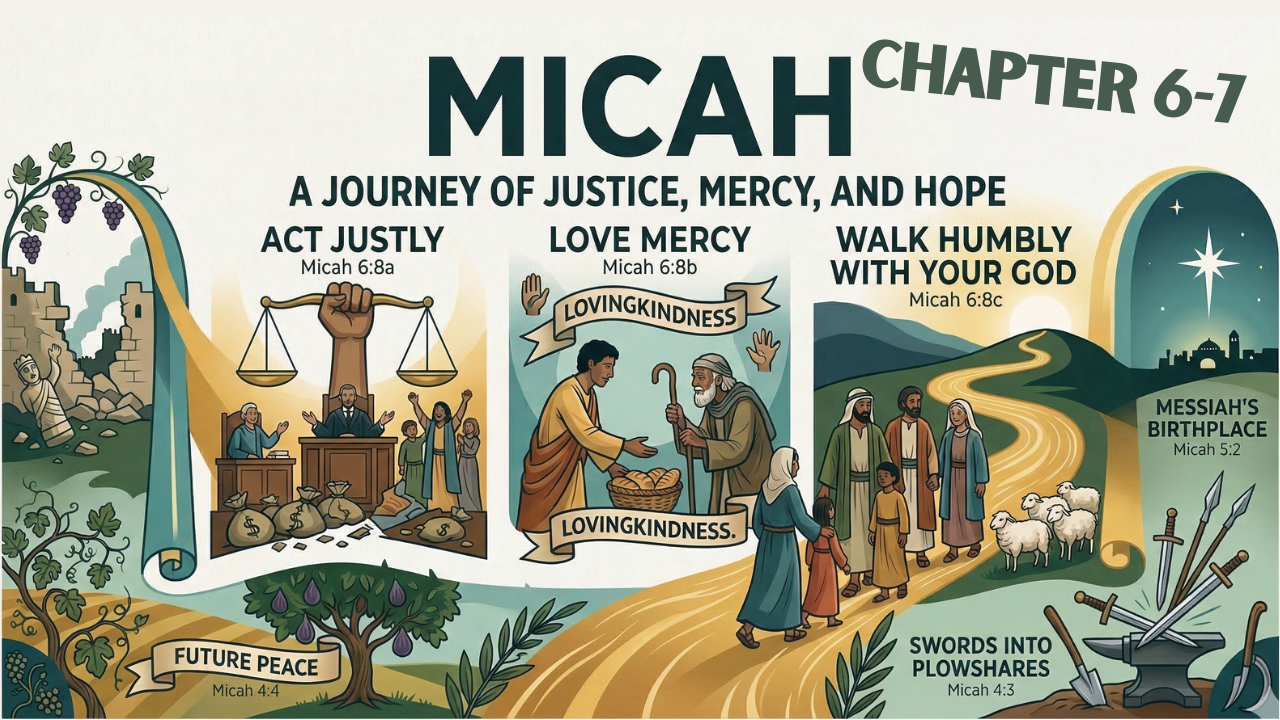
Micah Chapter 6-7 Class 4 - Bible Study
On April 23, 2026, our class explored Micah 6–7, God’s deliverance from Egypt, the legacies of Omri/Ahab/Jezebel, Balaam and Balak, Elijah’s gentle whisper, and Jesus’ teaching on allegiance and endurance—emphasizing justice, mercy, humility, and trust in God’s protecting purposes.
Micah Intro and Chapter 6-7
This is our 4th class on Micah
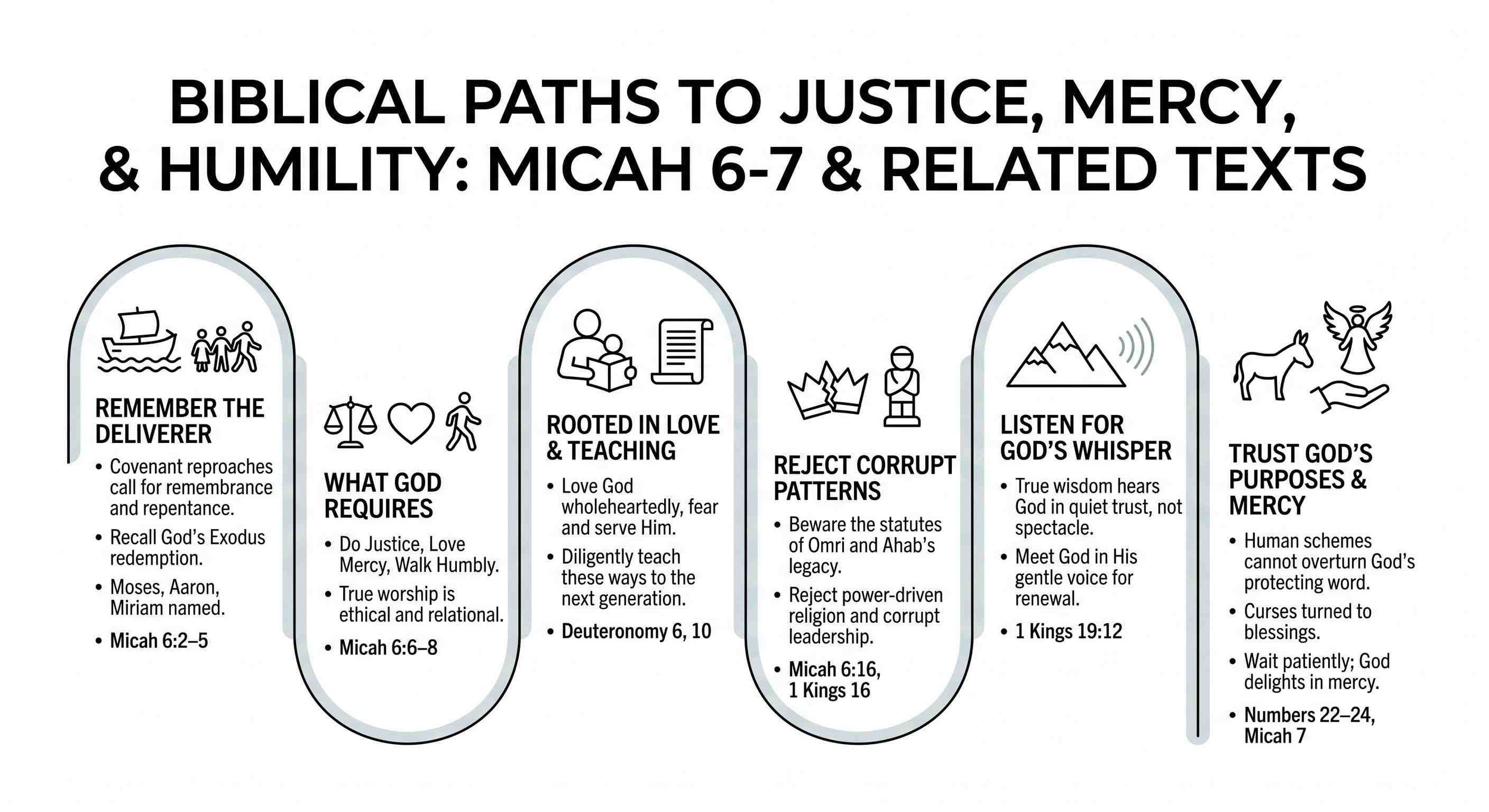
This is an AI Recap of the class.
Some things may be incorrect.
Short Summary of the Whole Class
On April 23, 2026, we traced a biblical thread from Micah 6–7 through Numbers, 1–2 Kings, Deuteronomy, and the Gospels. We reflected on God’s covenant complaint and Exodus deliverance (Micah 6), the warning of Omri/Ahab/Jezebel’s corrupt statutes, Balaam and Balak’s failed cursing scheme, and Elijah’s renewal in God’s gentle whisper. We connected Micah’s call—do justice, love mercy, walk humbly—to Deuteronomy’s love-and-teach foundation and Jesus’ words about allegiance and endurance amid familial and societal conflict (Matthew 10; Mark 13). We concluded that true wisdom remembers God the Deliverer, rejects power-driven corruption, listens for God’s quiet voice, and lives justice and mercy in faithful trust.
Walk-through Summary with Section-by-Section Notes
1) Micah’s “Reproaches” and God’s Complaint
Discussion:
We opened with Micah’s covenant lawsuit: “Hear, O you mountains, the Lord’s complaint” (Micah 6:2), evoking Good Friday-style “reproaches” (“O my people… what have I done to you?”).
God identifies Himself as the Deliverer who brought Israel out of Egypt, naming Moses, Aaron, and Miriam (Micah 6:4), and recalling Balak and Balaam (Micah 6:5).
Theme:
Remembering God’s faithful deliverance exposes our forgetfulness and calls us to return to covenant obedience.
Verses:
Micah 6:2–5.
Stories:
Exodus remembrance (Moses, Aaron, Miriam).
Short summary of this section:
God summons His people to remember the Exodus and His faithfulness, grounding repentance in the memory of deliverance.
2) What God Requires: Justice, Mercy, and Humility
Discussion:
We wrestled with “What’s enough for God?” and landed on Micah 6:8—do justice, love mercy, walk humbly—over performative religion.
We noted how Scripture itself demands justice and mercy, not mere ritual.
Theme:
True worship is ethical and relational; it shows up in how we treat others made in God’s image.
Verses:
Micah 6:6–8.
Stories:
Ethical living illustrations; contrast with empty ritual (no single narrative focus).
Short summary of this section:
God desires hearts and lives of justice, mercy, and humble walking with Him, not outward show.
3) Deuteronomy’s Foundation: Love God and Teach Diligently
Discussion:
We linked Micah’s call to Deuteronomy’s heart: fear, love, and serve the Lord (Deut 10:12), and the Shema’s call to teach children diligently (Deut 6:4–7).
Emphasis on shaping the next generation amid modern distractions.
Theme:
Wholehearted love for God and diligent discipleship at home form the backbone of faithful living.
Verses:
Deuteronomy 10:12; Deuteronomy 6:4–7.
Stories:
Family discipleship practices (conceptual, not narrative).
Short summary of this section:
From the beginning, God called His people to wholehearted love and to teach these ways diligently to the next generation.
4) Omri, Ahab, and Jezebel: Foundations of Decline
Discussion:
We examined how Omri’s political strategies led into Ahab and Jezebel’s Baal worship (1 Kings 16), illuminating Micah 6:16’s “statutes of Omri” and “works of Ahab’s house.”
Highlight: Ahab “did more evil than all before him” (1 Kings 16:30–33).
Theme:
Societal decline follows when leaders and people embrace idolatrous counsel and corrupt patterns.
Verses:
1 Kings 16:25–33; Micah 6:16.
Stories:
Ahab and Jezebel’s marriage alliance and the national turn to Baal.
Short summary of this section:
Micah condemns both corrupt leadership and complicit people, warning that shared compromise invites desolation.
5) Elijah’s Encounter with God’s Gentle Voice
Discussion:
We previewed Elijah’s conflict with Ahab and Jezebel and focused on his renewal: God was not in wind, earthquake, or fire but in a gentle whisper (1 Kings 19:12).
Application: Listen attentively for God’s quiet guidance amid turmoil.
Theme:
True wisdom hears God in quiet trust rather than in spectacle.
Verses:
1 Kings 19:12 (with context).
Stories:
Elijah’s flight, discouragement, and renewal at Horeb.
Short summary of this section:
Elijah’s story shows faithful resilience arises from meeting God in His gentle voice.
6) Balaam and Balak: Attempts to Curse God’s People
Discussion:
We revisited Numbers 22–24: Balak summons Balaam at Moab to curse Israel; the angel blocks Balaam; the talking donkey episode; Balaam can only speak what God gives—resulting in blessing, not curse.
Micah 6:5 recalls this event to underscore God’s protecting purposes.
Theme:
God’s word and purposes stand; He turns intended curses into blessing.
Verses:
Numbers 22–24 (esp. 22:21–35); Micah 6:5.
Stories:
Balak’s summons; Balaam’s donkey and angel; Balaam’s oracles of blessing.
Short summary of this section:
Human schemes cannot overturn God’s purposes; He protects His people and transforms curses into blessings.
7) Micah 7: Corruption, Lament, and Hope in Mercy
Discussion:
Micah 7:1–7 depicts societal breakdown—bribes, betrayal—even within households; counsel: trust God, not human alliances.
Micah 7:7–9: like Job, wait on the Lord, confess, and trust God to plead our case and bring light.
Micah 7:18–20: God delights in mercy, subdues iniquity, and casts sins into the sea.
Theme:
In pervasive injustice, the faithful posture is repentance, patience, and confident hope in God’s mercy and vindication.
Verses:
Micah 7:1–7; 7:7–9; 7:18–20; (also 7:13, 7:16 noted in discussion of consequences and humbled nations).
Stories:
Job’s posture (thematic reference).
Short summary of this section:
Micah moves from stark lament to radiant hope—God’s final word is mercy and restoration.
8) Jesus on Allegiance and Endurance: Echoes of Micah
Discussion:
Matthew 10:26–36: Jesus prepares disciples for public allegiance and division within families (echoing Micah 7:6), not as a call to violence but a sober cost of discipleship.
Mark 13:10–13: the gospel to all nations, Spirit-given words in trials, endurance to the end; connected with our anticipation of Mark 13:1–10’s challenge to temple-centered confidence.
Theme:
Discipleship may divide loyalties and invite opposition; rely on the Spirit and endure in faithful witness.
Verses:
Matthew 10:26–36; Mark 13:10–13; preview connection to Mark 13:1–10.
Stories:
Jesus sending the disciples; early Christian witness under pressure (conceptual).
Short summary of this section:
Jesus reframes power and peace: allegiance to Him brings conflict, but the Spirit sustains endurance and faithful testimony.
9) Application: Remember the Deliverer and Reject Corrupt Patterns
Discussion:
We tied Micah’s call—remember the Exodus and Balaam/Balak—to our context: reject the “statutes of Omri,” avoid baptizing power with religious language, and live justice, mercy, and humility.
Question: Are we building bigger temples—or building obedient hearts that remember and reflect God’s deliverance?
Theme:
Identity and allegiance—live as a people formed by the Deliverer’s mercy rather than by cultural or political idols.
Verses:
Micah 6:4–5; 6:16; Numbers 22–24; 1 Kings 16; 1 Kings 19:12; Micah 7 selections; Matthew 10; Mark 13.
Stories:
Exodus memory; Omri/Ahab decline; Elijah’s whisper; Balaam’s thwarted curse; disciples sent amid conflict.
Short summary of this section:
True wisdom is lived remembrance—reject corrupt counsels and embody God’s justice, mercy, and humble trust.
Medium-Length Summary of the Class
On April 23, 2026, we centered on Micah 6–7, where God summons creation to hear His complaint and calls His people to remember the Exodus. We linked Micah’s “reproaches” to the warning against the “statutes of Omri” and the corrupt legacy of Ahab and Jezebel (1 Kings 16). We saw Elijah’s renewal in God’s gentle whisper (1 Kings 19:12) as a model for quiet, attentive faith. Returning to Numbers 22–24, we recalled how Balaam could only bless what Balak sought to curse, underscoring God’s protecting word (Micah 6:5). Deuteronomy 6 and 10 anchored this in love for God and diligent teaching of the next generation. Reading Jesus’ words in Matthew 10 and Mark 13, we recognized that allegiance to Christ may divide families and invite persecution, yet the Spirit sustains enduring witness. Across these texts, the class emphasized that God the Deliverer defines His people, His mercy triumphs over sin (Micah 7:18–20), and His purposes outlast human schemes—calling us to reject corrupt patterns, listen for His gentle voice, and live justice, mercy, and humility.
Main Points
God’s covenant “reproaches” call us to remember His Exodus deliverance and repentant return (Micah 6:2–5).
What God requires is clear: do justice, love mercy, walk humbly (Micah 6:8).
Deuteronomy roots faith in wholehearted love for God and diligent teaching of children (Deut 6; 10).
The “statutes of Omri” and Ahab/Jezebel’s legacy warn against adopting corrupt counsel (Micah 6:16; 1 Kings 16).
Elijah’s renewal came through God’s gentle whisper—wisdom listens in quiet trust (1 Kings 19:12).
Balaam and Balak show that God protects His people and turns curses into blessing (Numbers 22–24; Micah 6:5).
Jesus prepares disciples for allegiance amid division and persecution; rely on the Spirit and endure (Matthew 10; Mark 13).
Application: Reject power-driven religion and live as a people shaped by God’s saving acts—justice, mercy, humility.
Bible Scriptures Mentioned
Micah 6:2–5; Micah 6:6–8; Micah 6:16
Micah 7:1–7; Micah 7:7–9; Micah 7:18–20 (with 7:13, 7:16 noted)
Numbers 22–24 (esp. 22:21–35)
1 Kings 16:25–33
1 Kings 19:12 (with context)
Deuteronomy 6:4–7
Deuteronomy 10:12
Matthew 10:26–36
Mark 13:10–13 (and preview of 13:1–10)
Stories Discussed
Exodus remembrance: God bringing Israel out of Egypt; leadership of Moses, Aaron, and Miriam.
Omri’s political legacy and Ahab/Jezebel’s turn to Baal worship (1 Kings 16).
Elijah’s encounter with God’s gentle whisper (1 Kings 19).
Balaam and Balak: the talking donkey, the angel’s intervention, and blessing over cursing (Numbers 22–24).
Jesus sending the disciples and teaching on allegiance, conflict, and endurance (Matthew 10; Mark 13).
Content creation date: 2026-04-23 14:43:13
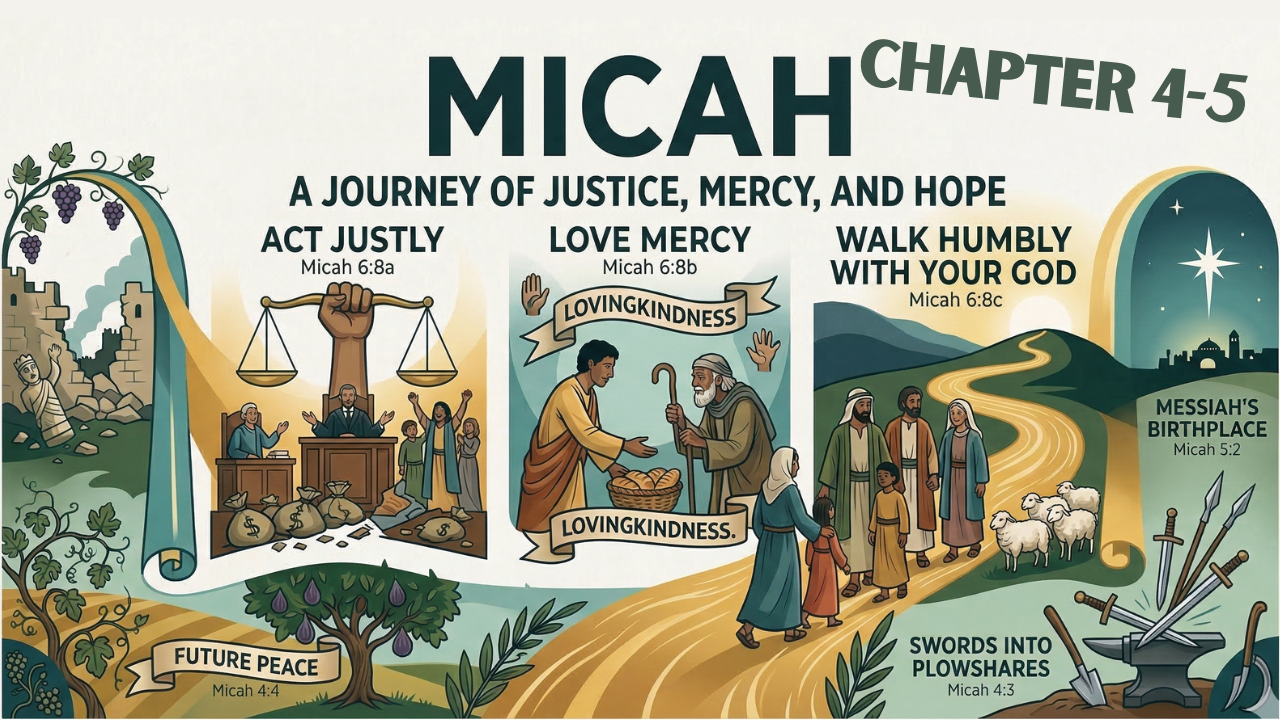
Micah Chapter 4-5 Class 3 - Bible Study
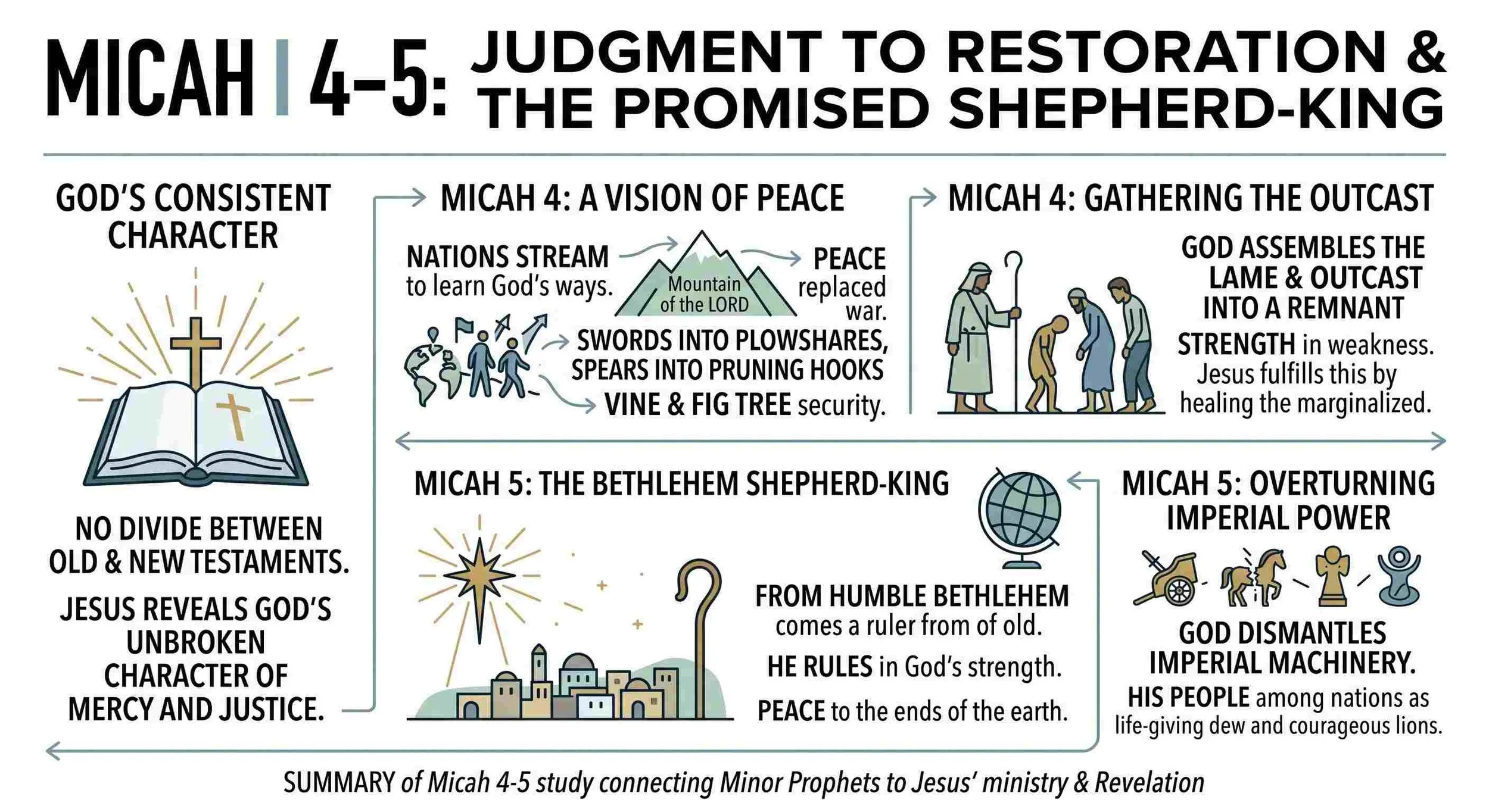
A lively study of Micah 4–5 connected the Minor Prophets to Isaiah, Revelation, and Jesus’ ministry, highlighting God’s consistent character, peace over violence, care for the outcast, and the Bethlehem shepherd-king whose reign blesses all nations.
Micah Intro and Chapter 4-5
This is our 3rd class on Micah
This is an AI Recap of the class.
Some things may be incorrect.
Short summary of the whole class
We read Micah 4–5 and traced a law-and-gospel rhythm from judgment to restoration. We explored God’s unbroken character across the Old and New Testaments; the mountain of the LORD and nations streaming; swords into plowshares; vine-and-fig-tree peace; exile and redemption; gathering the lame and outcast into a remnant; and the promised ruler from Bethlehem who shepherds in God’s strength and brings peace to the ends of the earth. We connected Micah to Isaiah 2, Revelation’s New Jerusalem and witness theme, Jesus’ ministry (including the temple cleansing and fig tree), Eden echoes, Jacob’s limp, Exodus’ overthrow of empire, and Luke’s census framing Jesus as David’s faithful heir.
Walkthrough and discussion highlights, with section summaries
Opening recap and theme-setting
We noted our prior stopping point (Micah 2–3) and began Micah 4, with some discussion reaching into Micah 5.
Observation that Micah (with Amos and Joel) “sounds like Revelation,” suggesting intertextual prophetic echoes.
Core conviction: no divide between the God of the Old and New Testaments; Jesus reveals God’s consistent character.
The Minor Prophets’ cadence mirrors law-and-gospel: exposing injustice, then promising restoration.
Short summary of this section:
We framed Micah 4 within Scripture’s larger arc, emphasizing God’s continuity, Revelation echoes, and a law-and-gospel approach.
Bible verses and stories:
Micah 2–3 (context)
Revelation (prophetic echoes)
Reading Micah 4:1–8 aloud
“Latter days,” exalted mountain of the LORD; nations streaming to learn God’s ways.
Signature imagery: swords into plowshares, spears into pruning hooks; no more learning war; everyone under vine and fig tree.
God gathers the lame and outcast as a strong remnant; the LORD reigns from Zion; “Tower of the Flock” and restoration to Daughter of Jerusalem.
Short summary of this section:
Micah 4 paints a peace-filled future where God’s teaching spreads, empires disarm, people flourish, and the marginalized are gathered and strengthened.
Bible verses and stories:
Micah 4:1–8
Exile, deliverance, and threshing (Micah 4:9–13)
Zion in labor pains; going to Babylon yet promised redemption.
Enemies misread God’s counsel; Zion told, “Arise and thresh” with iron horns/bronze hooves; gains consecrated to the LORD.
Short summary of this section:
Exile is a painful prelude, not the end; God redeems and repurposes His people’s struggle toward His consecrated victory.
Bible verses and stories:
Micah 4:9–13
Immediate reactions: battle and peace
Tension noted between God sending to battle and the broader vision of peace.
Reframing: Micah juxtaposes human conflict with God’s ultimate peace.
Short summary of this section:
Conflict appears in the storyline, but God’s horizon is transformative peace that turns weapons into tools for cultivation.
Bible verses and stories:
Micah 4 themes (peace, transformation)
“Daughter of Zion” and city-as-feminine language
“Daughter of Zion” personifies Jerusalem in feminine terms—a poetic address signaling care and restoration.
Short summary of this section:
“Daughter of Zion” is Scripture’s tender, corrective way of speaking to Jerusalem as a people God loves and will restore.
Bible verses and stories:
Micah 4 (usage of “Daughter of Zion”)
“Nations” and “Gentiles,” “LORD” and “Adonai”
“Nations/Gentiles” highlights inclusion beyond Israel.
“LORD” (small caps) renders the divine name YHWH; Jewish tradition reads “Adonai.”
How “Jehovah” arose via vowel-pointing.
Short summary of this section:
Translation choices shape meaning: the global scope of salvation and the reverent handling of God’s name.
Bible verses and stories:
Micah 4:1–3 (nations/Gentiles)
Notes on divine name usage
“Torah” vs. “Law,” and gospel as “good news”
“Torah” conveys covenantal instruction and saving story, not merely rules.
“Gospel” means good news (euangelion), not another law.
Torah includes God’s saving acts (Abraham, Exodus).
Short summary of this section:
God’s “law/Torah” is a way to walk shaped by His saving story, complemented by the gospel’s good news.
Bible verses and stories:
Micah 4:2 (“law/Torah” goes forth)
Allusions to Abraham’s call and the Exodus
Jesus present in the Old Testament and the continuity of God
Affirmation of the Son’s presence before the Incarnation; a Christ-centered reading of Micah.
Short summary of this section:
Micah’s voice aligns with Jesus’ revelation of God, grounding a Christological reading across Scripture.
Bible verses and stories:
Creation/Trinity allusion (Genesis)
Cross, temple, and Revelation echoes
Micah 3’s critique of corrupt leadership sets up Micah 4’s hope.
Jesus as true temple; Revelation’s descent of God’s dwelling.
Strong parallels to Isaiah 2’s mountain and plowshares imagery; intertextual, not derivative.
Short summary of this section:
From judgment on corruption to God’s restored dwelling, Micah 4 mirrors Isaiah 2 and foreshadows Revelation, centered on Jesus’ temple-fulfillment.
Bible verses and stories:
Micah 3; Micah 4:1–4
Isaiah 2:1–4
Revelation (New Jerusalem)
Walking God’s paths: peace, fruitfulness, and fig tree imagery
“Teach us His ways; walk in His paths” reframes law as lived wisdom.
Peace: tools of war become tools for cultivation; vine and fig tree rest.
Eden echoes of shade and fruit; Jesus’ fig tree sign warns against fruitlessness.
Short summary of this section:
God’s way leads to peace and true fruitfulness from Eden to the Gospels, contrasting performative power with Spirit-born fruit.
Bible verses and stories:
Micah 4:2–4
Matthew 21:18–22; Mark 11:12–14, 20–25 (fig tree)
Genesis 2–3 (Eden)
Gathering the lame and the remnant; witness and martyr
God assembles the lame/outcast into a strong remnant (Micah 4:6–7).
Revelation’s “witness” (martys) theme: faithful testimony often through weakness.
Warning against triumphalist “remnant” rhetoric.
Short summary of this section:
God perfects strength in weakness, forming a humble remnant whose witness aligns with the Lamb’s people in Revelation.
Bible verses and stories:
Micah 4:6–7
Revelation (witness/martyr motif)
Micah 4:6–8 — God gathers the lame and outcast (focus)
Hebrew tie between “lame” and Jacob’s limp (Genesis 32), dignifying weakness.
Contrast of ways: nations walk in their gods’ names, God’s people in the LORD’s name.
Short summary of this section:
God regathers the weak as His remnant under His reign, calling His people to walk His distinct path.
Bible verses and stories:
Micah 4:6–8; Micah 4:5
Genesis 32 (Jacob’s limp)
Jesus and the temple — cleansing as inclusion, not mere outrage
Jesus’ cleansing removes corruption and welcomes the blind and lame for healing, embodying Micah’s remnant vision.
Short summary of this section:
Jesus turns the temple into a house of healing, enacting the prophetic hope for the marginalized.
Bible verses and stories:
Matthew 21:12–14; Mark 11; Luke 19; John 2
Micah 4:9–13 — Birth pains, Babylon, and recycled imagery (focus)
Birth pains language echoed by Jesus and Paul; threshing imagery anticipates wheat/chaff themes.
“Careful what you wish for”: adopting Babylon’s ways leads to Babylon’s fate—yet redemption remains.
Short summary of this section:
Pain precedes deliverance; God warns against imperial imitation and promises final redemption.
Bible verses and stories:
Micah 4:9–13
Matthew 3:12 (wheat/chaff)
Matthew 24:8; Romans 8:22; 1 Thessalonians 5:3 (birth pains)
Micah 5:1–5a — Bethlehem and the Shepherd-Ruler
From little Bethlehem comes a ruler “from of old.”
Davidic expectations fulfilled in Jesus; Nazareth’s humble connotations noted.
Luke’s census read theologically against David’s failed census; Jesus as faithful heir.
“This one shall be peace”; global scope of reign.
Short summary of this section:
God raises a humble shepherd-king from Bethlehem whose peace reaches the ends of the earth, fulfilling and surpassing David’s line.
Bible verses and stories:
Micah 5:1–5a
2 Samuel 24 (David’s census)
Luke 2:1–7; Luke 3; Matthew 1
Micah 5:5b–15 — Remnant among the nations; God overturns imperial power
Assyrian threat met by God’s provision (seven shepherds/eight princes).
Remnant “like dew” (quiet life-giving) and “like a lion” (protective strength).
Violent-sounding verses reframed from the vantage of the weak: God dismantles horses, chariots, strongholds, sorceries, idols.
Exodus parallel: “horse and rider” thrown into the sea; God unmakes oppressive power.
Short summary of this section:
God protects His weak remnant, topples imperial idols, and plants His people among the nations as refreshing and courageous witnesses.
Bible verses and stories:
Micah 5:5b–15
Exodus 14–15 (horse and rider)
Isaiah 31:1; Psalm 20:7
Matthew 2 (magi as a class reframed in redemption)
Medium-length final summary (content creation date: 2026-04-16 11:07:13)
In our study of Micah 4–5, we followed Scripture’s law-and-gospel rhythm from judgment on corrupt power to God’s surprising restoration. We saw the exalted mountain of the LORD, nations streaming to learn His ways, and the transformation of weapons into tools for cultivation as people rest under their vines and fig trees. We clarified key terms and translations, underlining the Bible’s inclusive vision and reverent handling of God’s name, and reframed “law/Torah” as God’s covenantal instruction and saving story. Reading Micah through a Christ-centered lens, we linked its images with Isaiah 2 and Revelation’s New Jerusalem and witness, with Eden’s fruitfulness and Jesus’ fig tree sign. Micah 4 promised that God gathers the lame and outcast into a strong remnant, a theme we saw Jesus enact as He cleansed the temple and healed the marginalized. Micah 4:9–13 framed exile as birth pains before redemption, warning that imitating Babylon invites its fate. Micah 5 then spotlighted a humble ruler from Bethlehem whose shepherding strength and peace extend to the ends of the earth, echoing Luke’s census as a theological counter to David’s failed census. Finally, Micah 5:5b–15 presented God’s overthrow of imperial machinery—horses, chariots, strongholds, sorceries, idols—planting His remnant among the nations as both refreshing dew and courageous lion. Throughout, we emphasized that God’s kingdom overturns worldly power by lifting the lowly, purifying His people, and extending blessing to all nations.
Main points
God’s character is consistent across Old and New Testaments; Jesus reveals this continuity.
Micah 4 parallels Isaiah 2 and echoes Revelation: nations streaming, peace replacing war.
Law-and-gospel rhythm: exposure of injustice followed by restoration and hope.
Translation matters: nations/Gentiles, LORD/Adonai, and Torah/law shape inclusion, reverence, and instruction.
Peace and fruitfulness: swords into plowshares; vine and fig tree rest with Eden echoes and Jesus’ fig tree sign.
Christological reading: Jesus as true temple; cross and restoration themes align with Micah’s hope.
Remnant redefined: God gathers the lame and outcast; strength perfected in weakness and faithful witness (martys).
Bethlehem’s ruler: the shepherd-king brings peace to the ends of the earth and fulfills David’s line.
God overturns imperial power and idolatry, planting a purified people among the nations as dew and lion.
Bible Scriptures mentioned
Micah 2–5 (focus on 4:1–13; 5:1–15)
Isaiah 2:1–4
Revelation (New Jerusalem; faithful witnesses)
Genesis 2–3; Genesis 32
Exodus 14–15
Psalm 20:7
Isaiah 31:1
2 Samuel 24
Matthew 1–2; Matthew 3:12; Matthew 21:12–14; Matthew 21:18–22
Mark 11:12–14, 20–25; Mark 11 (temple cleansing)
Luke 2:1–7; Luke 19; Luke 3
John 2
Romans 8:22
1 Thessalonians 5:3
Matthew 24:8
Stories discussed
Nations streaming to God’s mountain; swords into plowshares; vine and fig tree peace
Daughter of Zion personification; exile to Babylon and promised redemption
Jacob wrestling and limping
Eden’s fruitfulness and shade
Jesus and the fig tree
Jesus cleansing the temple and healing the blind and lame
David’s census and consequences; Luke’s census framing Jesus’ birth
Exodus: horse and rider thrown into the sea
Magi as ancient court sages (reframed in Matthew’s nativity)
Remnant as dew and lion among the nations
Generated by gpt-5 on 2026-04-16 11:07:13 (content creation date).
Micah Chapter 2-3 Class 2 - Bible Study
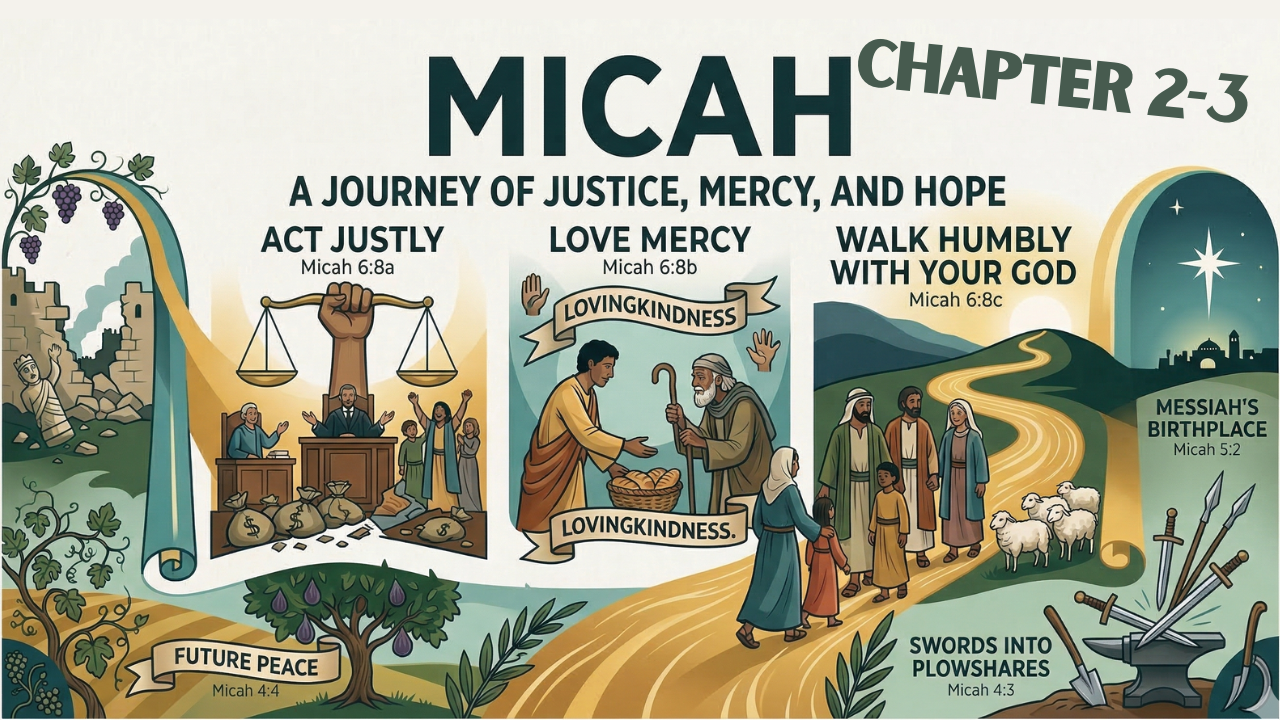
In our Bible study on April 9, 2026, we reviewed key themes from the book of Micah, focusing on God's judgment against corrupt leaders, His call for justice and mercy over power, and the recurring pattern of judgment followed by redemption.
Micah Intro and Chapter 2-3
This is our 2nd class on Micah
This is an AI Recap of the class.
Some things may be incorrect.
Short Summary of the Class
On Thursday, April 9, 2026, our group dove into chapters 2 and 3 of the book of Micah. We began by reading the text, which details God's pronouncement of "woe" upon the powerful in Israel who were oppressing the poor by seizing their land and inheritance, a direct violation of how God had established their society. We discussed how these actions broke several commandments and how this theme of "might makes right" was leading them to self-destruction. The discussion highlighted the contrast between the first eleven verses of chapter 2, filled with judgment, and the final two verses, which offer a glimpse of hope and restoration. We then moved into chapter 3, which continues the condemnation of Israel's corrupt leaders, priests, and prophets who exploit their positions for money while falsely claiming God's favor. We explored the stark imagery of their destruction and the recurring biblical theme of law and gospel, where the law reveals our sin and points to our need for the grace found in the gospel.
Detailed Class Summary
Review of Previous Micah Study and Prophetic Themes
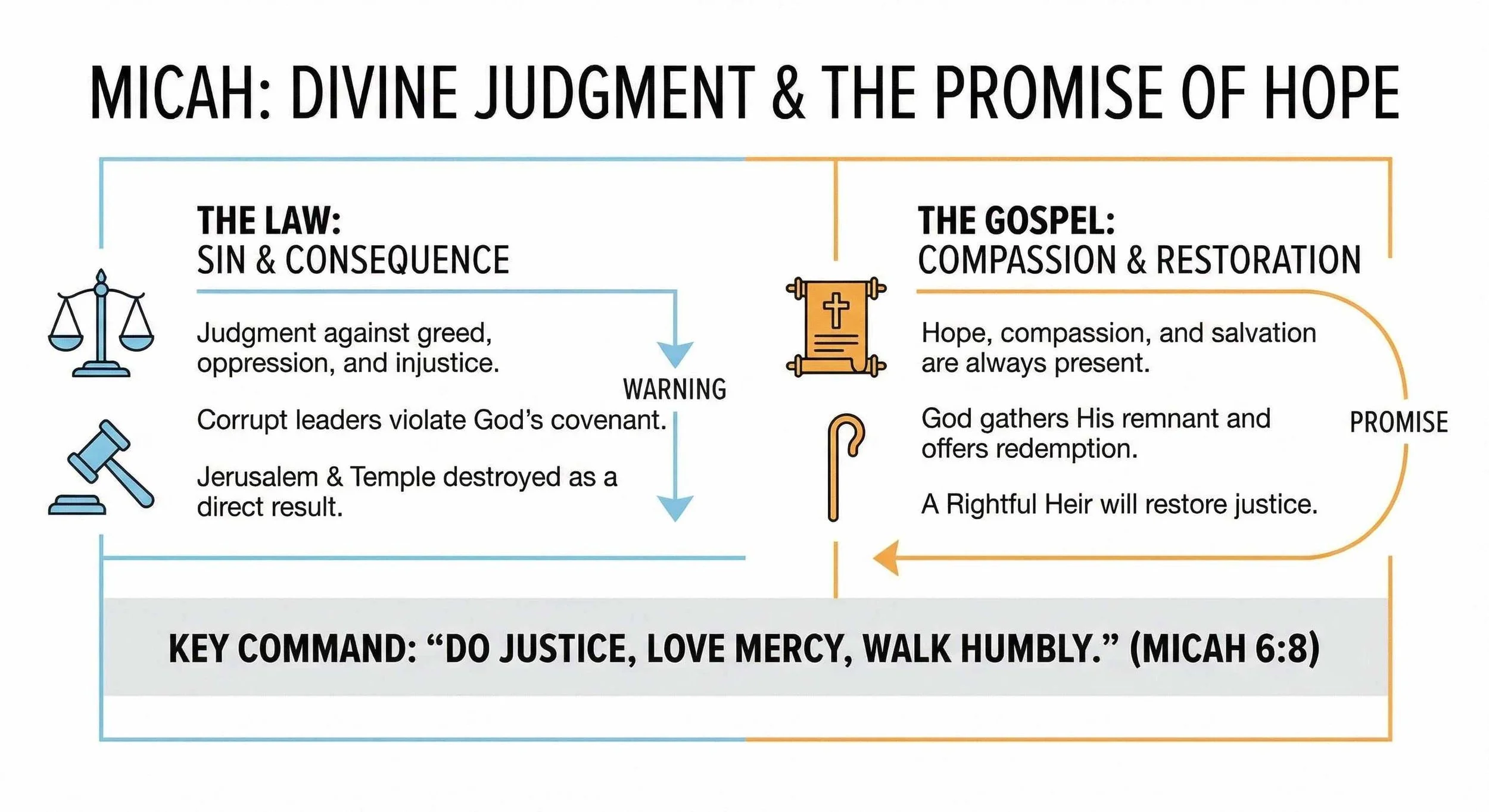
We then transitioned to the Bible study portion by reviewing our last discussion on the minor prophets, specifically Micah. Two primary themes were revisited. The first was the structure of the prophetic messages, which often present a strong word of judgment followed by a promise of God's salvation. This pattern was compared to the "law and gospel" preaching model.
The second major theme was the consistent message across prophets calling Israel back to God’s core requirements: "to do justice, love mercy, and walk humbly with your God" (Micah 6:8). The prophets condemned Israel for becoming obsessed with power and wealth while neglecting the poor, a theme echoed in the New Testament book of Revelation. We also recalled the clever "prophetic wordplay" in Micah chapter 1, where the Hebrew names of cities reinforce the prophecy of judgment.
Section Summary: We reviewed how Micah and other minor prophets follow a "law-gospel" pattern of judgment then salvation. We also discussed their unified message condemning the pursuit of power over God's call to practice justice and mercy, and the literary device of prophetic wordplay.
Bible Verses: Micah 6:8, Micah 1:8-15
Bible Stories/Concepts: Parallels with the book of Revelation.
Section 1: Micah Chapter 2 - Judgment and the Consequences of Greed
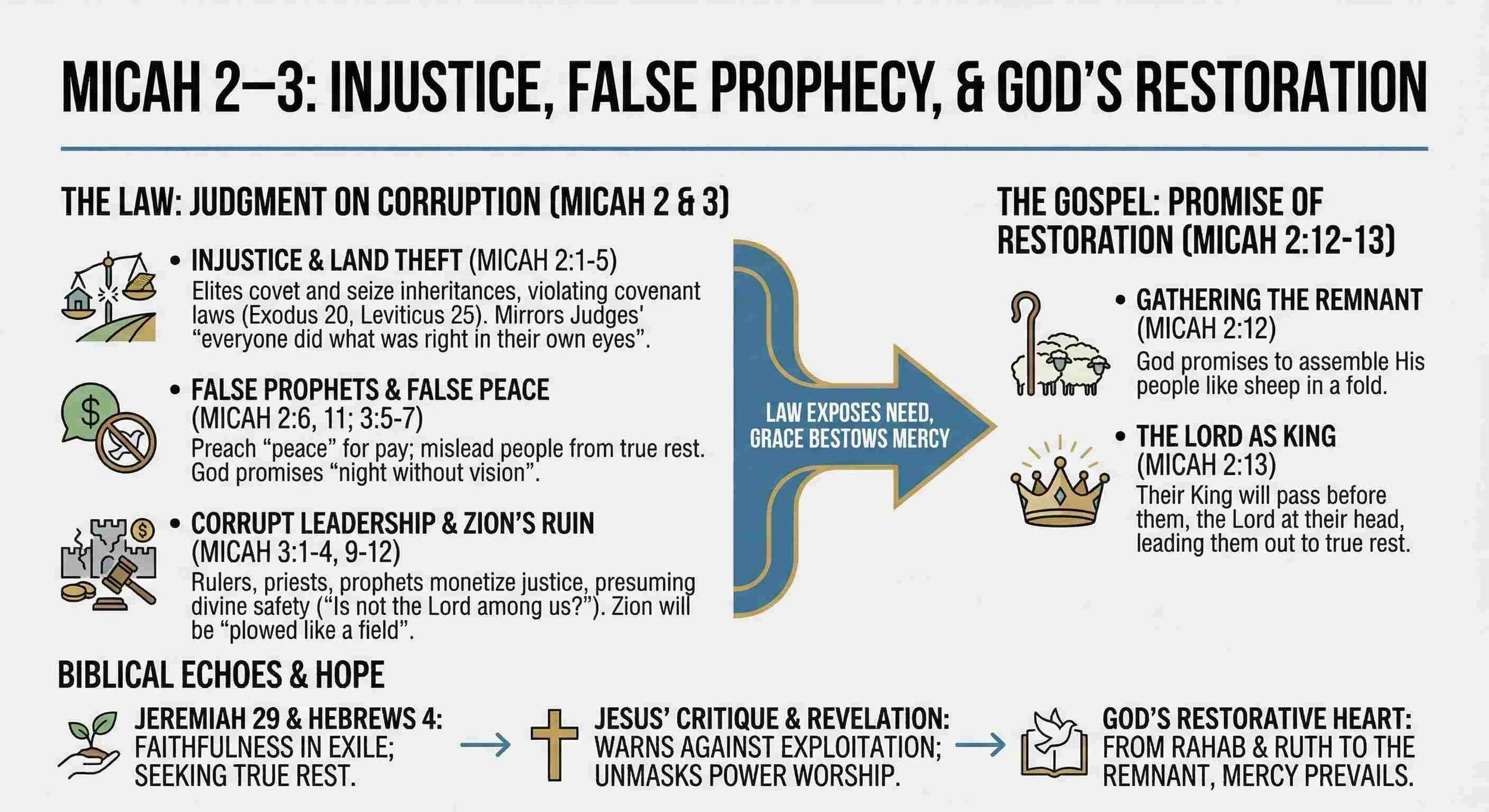
Our class on April 9, 2026, began with a reading of Micah, chapter 2. The chapter opens with a "woe" to those who plot evil and, because of their power, violently seize fields and houses, oppressing their own people. We noted that this greed and theft were direct violations of God's commandments, specifically those against coveting and stealing. It was pointed out that this practice of seizing land went against the redemption plan God had established for Israelite inheritances, as illustrated in the book of Ruth with the story of the kinsman-redeemer.
The phrase "careful what you wish for" was used to describe the consequences foretold in verses 4 and 5. The very people who were seizing land would have their own heritage taken from them, with no one left to even "determine boundaries by lot in the assembly of the Lord." This pursuit of wealth was a form of self-destruction, echoing the theme from the book of Judges where "they did what was right in their own eyes." The discussion also touched on the false prophets mentioned in verse 11, who would tell the people what they wanted to hear—prophecies of "wine and drink"—rather than God's truth. This was compared to the false prophets in Jeremiah's time who promised peace while the people were being led into captivity. The chapter ends, however, with a shift in tone. After eleven verses of judgment, the final two verses promise that God will surely gather the "remnant of Israel" like a flock, with their King and the Lord leading them.
Summary of Section 1: We discussed how the wealthy in Israel were ignoring God's laws by violently taking land from the poor. This greed, encouraged by false prophets promising good times, was leading the nation toward its own destruction, a judgment from which God promised He would ultimately rescue a remnant of His people.
Bible Verses and Stories Mentioned:
Micah 2: The primary text for this section.
Book of Ruth: The story of Naomi, Ruth, and Boaz (the kinsman-redeemer) was mentioned to illustrate God's original plan for land inheritance.
Book of Judges: Referenced for its recurring theme of "they did what was right in their own eyes."
Jeremiah 29:11: Discussed in the context of false prophets promising peace and prosperity, noting that this verse was originally spoken to people already in exile.
Revelation 21: Mentioned in passing regarding a sermon on the "Eighth Day of Creation."
Section 2: Micah Chapter 3 - Corrupt Leadership and the Call for Justice
We then proceeded to read and discuss Micah, chapter 3. This chapter continues the strong condemnation, this time aimed directly at the "heads of Jacob and you rulers of the house of Israel." They are accused of hating good, loving evil, and metaphorically cannibalizing their own people. The prophets are again called out for chanting "peace" for profit while preparing "war against him who puts nothing into their mouths."
A key point of discussion was the theme of "might makes right." The leaders, priests, and prophets were all corrupt, judging for bribes, teaching for pay, and divining for money. Yet, in their hypocrisy, they would "lean on the Lord and say, 'Is not the Lord among us? No harm can come upon us.'" They used their status as God's chosen people as a license to sin. Micah's response is a devastating prophecy: because of their actions, "Zion shall be plowed like a field, Jerusalem shall become heaps of ruins." We also explored the poetic use of "Jacob" and "Israel" in the same verses, concluding it was likely for emphasis, to encompass the entire nation from its past to its present. The theme of "Law and Gospel" was brought up, explaining that the law (like Micah's harsh words) reveals our sin and demonstrates our desperate need for the gospel (God's grace).
Summary of Section 2: This section focused on the corruption of Israel's entire leadership structure—rulers, priests, and prophets—who exploited the people for financial gain while hypocritically claiming God's protection. Micah prophesies complete destruction for Jerusalem and the temple as a direct result of their twisting of justice and perversion of faith.
Bible Verses and Stories Mentioned:
Micah 3: The primary text for this section.
John 8:44: Referenced when discussing how the rulers "twist everything that is straight," connecting it to Jesus calling Satan the "father of lies."
2 Corinthians 1:3: Contrasted with the harsh judgment, highlighting God as the "Father of mercies and God of all comfort."
Story of Jonah: Jonah was presented as an example of a prophet who, unlike Micah, did not want God's mercy to extend to others and embodied the selfish attitude Micah preached against.
Story of Rahab and Ruth: Mentioned as examples of Gentiles included in Jesus' lineage, showing God's plan of redemption was always for all people.
Final Summary
In our Bible study on Thursday, April 9, 2026, we examined the powerful prophecies of Micah in chapters 2 and 3. Our discussion centered on God's indictment against the people of Israel, particularly its wealthy and powerful leaders, for their systemic injustice and greed. We observed how they violated God's commands by violently seizing land, oppressing the poor, and creating a society where "might makes right." This behavior was enabled by corrupt priests and false prophets who offered messages of peace and prosperity in exchange for money, lulling the people into a false sense of security.
We discussed how this path of doing "what was right in their own eyes" was leading them to self-destruction, a stark warning that what they were doing to others would be done to them. Micah prophesies that their inheritance would become desolation, with Jerusalem and the temple itself being turned into a heap of ruins. A significant part of our conversation highlighted the hypocrisy of the leaders who sinned while claiming, "Is not the Lord among us?" using their chosen status as an excuse for evil. We connected these themes to other scriptures, such as the stories of Ruth and Jonah, and the teachings of Jesus against the Pharisees. Despite the heavy judgment, we also noted the glimmers of hope and the "gospel" promise at the end of chapter 2, where God pledges to gather the remnant of His people and lead them as their King, reminding us that even in His righteous anger, God's ultimate plan is one of redemption.
Main Points
The wealthy and powerful in Israel were using their power to oppress the poor and seize their land, directly violating God's laws.
This societal greed was a form of self-destruction; the very ruin they brought on others would be visited upon them.
False prophets were complicit, telling the people what they wanted to hear ("peace," "wine and drink") for personal gain.
Israel's leaders—rulers, priests, and prophets—were corrupt, commercializing justice and religious teaching.
The leaders hypocritically believed they were immune from harm because they were God's people, using their faith as a license to sin.
Micah's prophecy foretells the complete destruction of Jerusalem and the temple as a consequence of their injustice.
Despite the overwhelming message of judgment ("the Law"), there is a promise of future restoration and salvation ("the Gospel").
Scriptures and Stories Mentioned
Bible Chapters:
Micah 2
Micah 3
Bible Verses:
Jeremiah 29:11
John 8:44
2 Corinthians 1:3
Revelation 21
Stories/Concepts:
The commandments against coveting and stealing
The kinsman-redeemer and land inheritance (Book of Ruth)
"They did what was right in their own eyes" (Book of Judges)
Jesus's condemnation of the Pharisees "devouring widows' homes"
The concept of Law and Gospel
The story of Jonah pouting over God's mercy to Nineveh
The inclusion of Gentiles (Rahab, Ruth) in the lineage of Jesus
Jesus as Prophet, Priest, and King
The Pax Romana ("Roman Peace") as a form of peace through coercion
Solomon's Temple
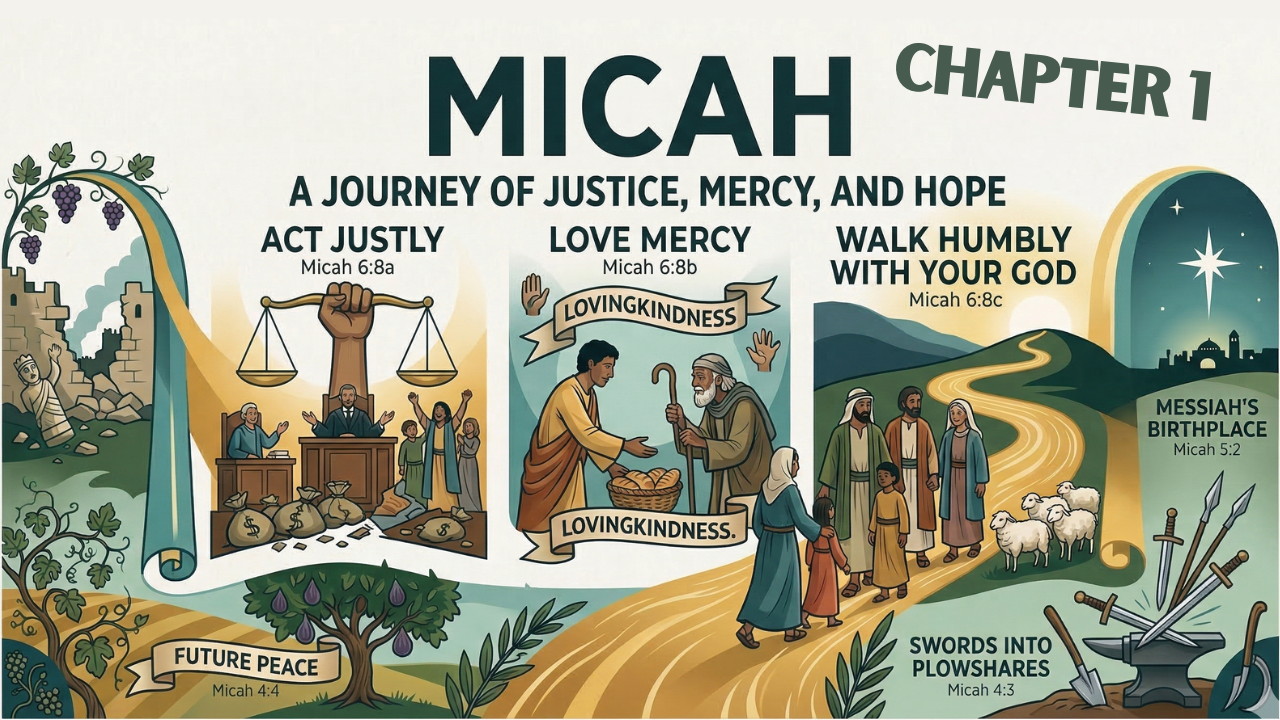
Micah Intro & Chapter 1 Class 1 - Bible Study
During our Bible study on March 26, 2026, we explored the first chapter of Micah, focusing on God's impending judgment against both Samaria and Jerusalem for their shared sins of idolatry and self-righteousness.
Micah Intro and Chapter 1
This is our 1st class on Micah
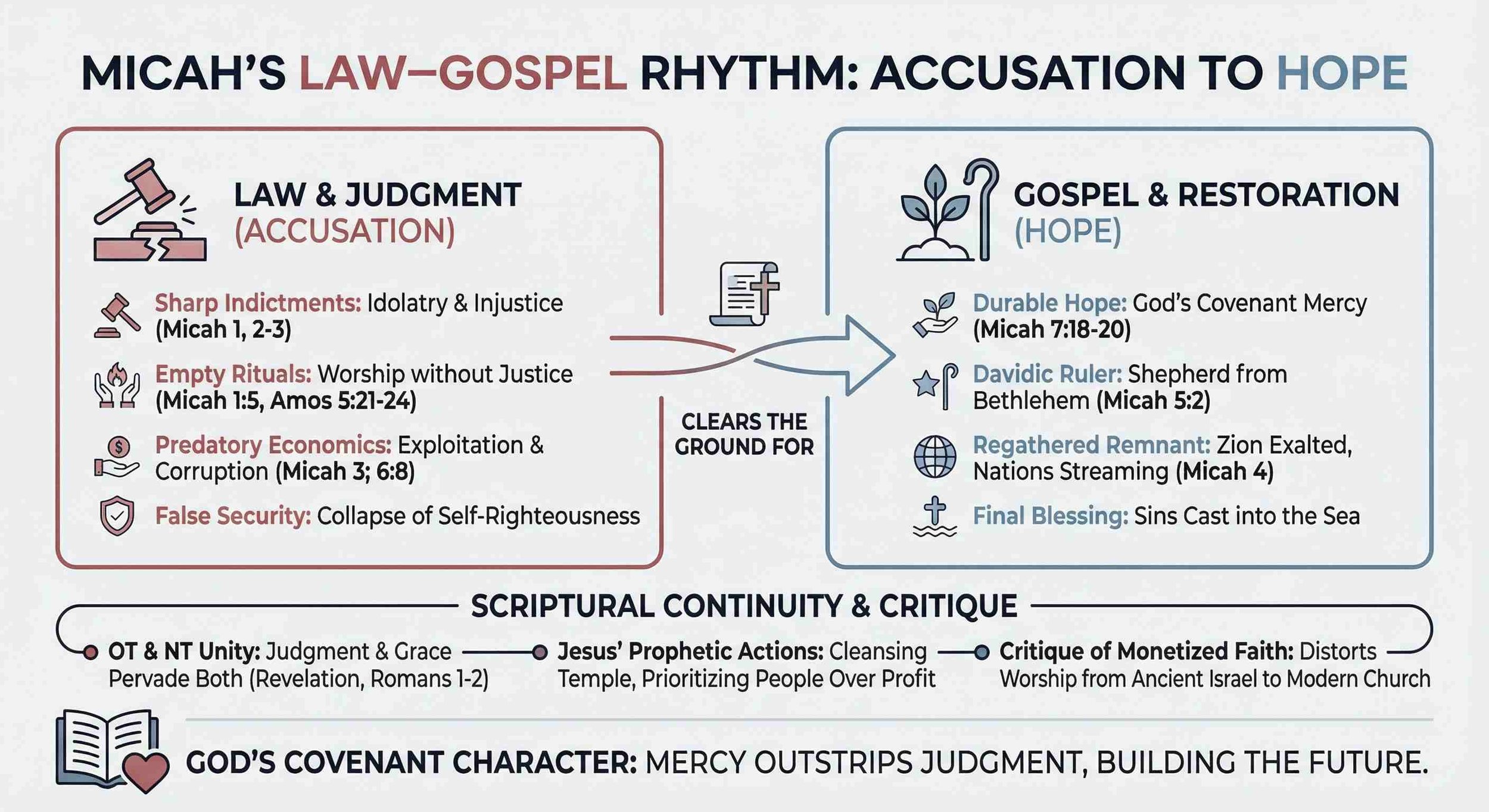
This is an overview of Micah.
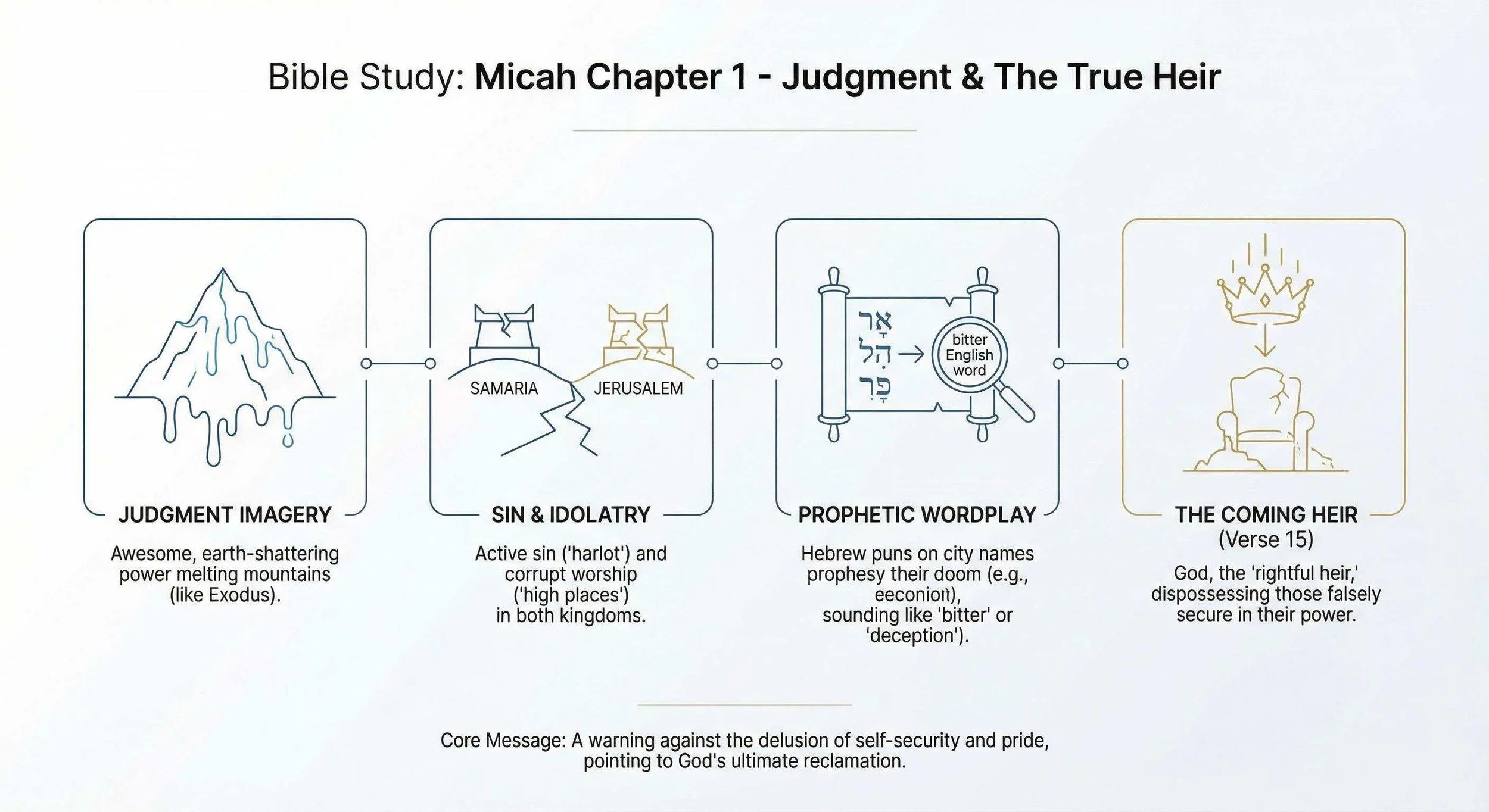
This is an AI Recap of the class.
Some things may be incorrect.
Short summary of the whole class
We read Micah—starting with Micah 1—and explored its Law–Gospel rhythm: sharp indictments of injustice, idolatry, and self-righteousness, followed by durable hope in God’s covenant mercy and a promised Davidic ruler from Bethlehem. Along the way we linked Micah’s themes to Revelation’s critique of power, Paul’s indictments in Romans, and Jesus’s prophetic actions (cleansing the temple; delivering the Gerasene demoniac), and reflected on how monetizing religion—from ancient Israel to indulgences to modern church culture—distorts worship and justice. We also examined translation nuances in Micah 1, poetic place-name wordplay, and the continuity between Old and New Testaments, concluding that divine judgment clears the ground for restoration.
Walkthrough summary with section-by-section notes
1) Opening reflections: Continuity between Old and New Testaments and the Law–Gospel pattern
What we discussed:
Scripture’s unity: the same human tendencies to power, domination, and wealth appear across the Testaments.
The “good news” looks forward and backward: God will set things right and, in Christ, has begun to do so.
The prophets, including Micah, follow a recognizable Law–Gospel rhythm—confrontation of sin followed by promises of restoration—and Revelation often recycles prophetic themes.
Stories/Scriptures mentioned:
Revelation (general thematic reference)
General references to Joel, Amos, Jonah, Obadiah, Micah
Short summary of this section:
We framed Micah within Scripture’s continuity and a Law–Gospel pattern, noting that Revelation echoes prophetic themes of judgment and hope.
2) Reading Micah 1: God’s descent, idolatry, and lament
What we discussed:
God’s theophany: the Lord descends; mountains melt; valleys split (Micah 1:3–4).
Judgment on both Samaria and Jerusalem for transgression and idolatry (Micah 1:5–7).
Lament imagery—wailing, dust, shame, baldness, captivity—calling for sober grief (Micah 1:8–16).
Judah is not morally superior; no one is exempt from critique.
Stories/Scriptures mentioned:
Micah 1:1–16
Short summary of this section:
Micah 1 announces sweeping judgment over both kingdoms, exposing idolatry and self-assured religiosity and calling for lament.
3) Imagery echoes and the “harlot” motif: Exodus, Proverbs, and Hosea
What we discussed:
Exodus echo: Micah 1’s earth-shaking presence recalls God’s powerful interventions in history.
“Harlot/prostitute” language (Micah 1:7) connected to Proverbs’ seductive sin and Hosea’s symbolic marriage—idolatry as relational betrayal, a selling of oneself.
Stories/Scriptures mentioned:
Micah 1:7
Exodus (themes of theophany and deliverance; e.g., Exodus 14–15; 19 thematically)
Proverbs (harlot/prostitute motif; general references)
Hosea 1–3 (prophet’s marriage as sign-act)
Short summary of this section:
Micah’s imagery taps Exodus’s divine power and portrays sin, via Proverbs and Hosea, as an active, relational unfaithfulness.
4) Who is being confronted? Judah, Samaria, and the collapse of self-righteousness
What we discussed:
Micah 1:5 levels the field: Judah’s “high places” mirror Samaria’s; prophetic sarcasm punctures self-righteousness.
Ritual without justice is empty; idolatry undercuts religious confidence.
Stories/Scriptures mentioned:
Micah 1:5
Amos 5:21–24 (thematic link: God’s rejection of empty festivals)
Short summary of this section:
Micah dismantles Judah’s false security: religious forms without faithfulness and justice cannot shield from judgment.
5) “High places” and reverence—then critique
What we discussed:
High places historically evoke reverence (Sinai), but prophets condemn altars divorced from obedience and justice.
Amos’s rebuke reinforces that height and ritual mean nothing without covenant faithfulness.
Stories/Scriptures mentioned:
Micah 1 (high places language)
Exodus 19 (Sinai theophany; thematic)
Amos 5:21–24
Short summary of this section:
Awe without obedience is hollow; God seeks justice and faithfulness, not mere elevated ritual.
6) Translation matters in Micah 1:16 and 1:15—“eagle” or “vulture”; “heir,” “conqueror,” or “dispossessor”?
What we discussed:
Micah 1:16: “Make yourself bald”—mourning and disgrace; the Hebrew term may be “eagle” or “vulture,” with “vulture” fitting lament’s tone.
Micah 1:15: the term variously rendered “heir,” “conqueror,” or “dispossessor”; the thrust is that rightful rule will dispossess pretenders.
Illustrations included study notes and a Robin Hood analogy (rightful heir displaces a pretender).
Stories/Scriptures mentioned:
Micah 1:16; Micah 1:15
Genesis 15 (heir/possession language; thematic)
Robin Hood analogy (story illustration)
Short summary of this section:
Nuanced translation sharpens the text’s tone and theology: mourning is stark, and God’s rightful authority overturns false securities.
7) Place-name wordplay and omen-like warnings (Micah 1:10–14)
What we discussed:
Micah’s puns on town names amplify the message: surface beauty masks decay; fates align with names.
Stories/Scriptures mentioned:
Micah 1:10–14
Short summary of this section:
Poetic wordplay serves prophecy—names become omens exposing the gap between appearance and reality.
8) Power, captivity, and Revelation’s critique—then and in Jesus’s day
What we discussed:
Micah 1:16 ties pride to captivity; Revelation critiques false security in power and wealth.
Parallels to Pharisees and Sadducees protecting status and opposing Jesus.
Stories/Scriptures mentioned:
Micah 1:16
Revelation (general thematic reference)
Gospel-era accounts of Pharisees and Sadducees resisting Jesus (e.g., John 11:47–53 thematically)
Short summary of this section:
Pride breeds captivity; whether in Micah’s day or the Gospels, protecting power resists God’s true king.
9) Watching and processing an overview of Micah: accusation and hope
What we discussed:
Historical setting: Micah of Moresheth (Judah), contemporary with Isaiah; covenant-breaking in Israel and Judah.
Warnings: Assyria’s devastation of the north; Babylon’s later destruction.
Accusations: leaders and prophets enriching themselves; justice bent for the wealthy; land theft; prophetic corruption—Naboth’s vineyard as emblematic injustice.
Hope: God as shepherd regathers a remnant; exalted Zion with nations streaming; exile and return; a Davidic king from Bethlehem; final justice and blessing to the nations.
Micah 6:8 as covenant heartbeat; Micah 7:18–20 grounding hope in God’s character.
Stories/Scriptures mentioned:
Micah 3 (prophetic strength/accusation); Micah 4 (nations to Zion); Micah 5:2 (Bethlehem ruler); Micah 6:8; Micah 7:18–20
1 Kings 21 (Ahab and Naboth’s vineyard)
Assyria and Babylon as instruments of judgment
Short summary of this section:
Micah alternates tough indictments with sturdy hope: God confronts injustice yet promises a shepherd-king and covenant mercy.
10) OT “fire and brimstone” and NT continuity
What we discussed:
Is the OT uniquely “hellfire and brimstone”? The NT shares moral urgency—Paul’s indictments and Revelation’s prophetic cadence.
We tend to find what we seek; both Testaments carry sustained hope.
Tone shift: OT promises forward (“God will”), NT proclaims fulfillment (“God has done”).
Stories/Scriptures mentioned:
Romans 1–2
Revelation (prophetic pattern)
The Gospels as narrative continuity with the patriarchs
Short summary of this section:
Judgment and grace pervade both Testaments; the promises of the OT meet fulfillment in the NT without losing ethical edge.
11) Jesus and the economics of the kingdom
What we discussed:
Jesus confronts exploitative systems—cleansing the temple to restore prayer and justice.
Gerasene demoniac: deliverance at economic cost (drowned pigs) exposes resistance when profit is threatened.
Warning against “devouring widows’ houses.”
Stories/Scriptures mentioned:
Temple cleansing: Matthew 21:12–13; Mark 11:15–17; Luke 19:45–46; John 2:13–17
Gerasene/Gadarene demoniac and pigs: Mark 5:1–20; Luke 8:26–39; Matthew 8:28–34
“Devouring widows’ houses”: Mark 12:40; Luke 20:47
Short summary of this section:
Jesus stands in the prophetic stream, prioritizing people over profit and provoking backlash from vested interests.
12) Commercialization of faith—then and now
What we discussed:
Prophetic rebukes (Amos, Micah) of wealth built on exploitation; parallels in church history (indulgences under Pope Leo X) and Luther’s revulsion at monetized piety.
Modern concerns: institutional self-preservation, staffing over care, public distrust, and the “chicken and egg” tension of wealth amid visible poverty.
Stories/Scriptures mentioned:
Amos 2:6–7; 4:1; 5:11–24 (themes)
Micah 2–3; 6:8
Church history: indulgences; Luther’s pilgrimage practices and protest
Short summary of this section:
Monetizing faith corrodes justice and credibility—from Israel’s courts to medieval indulgences to modern church culture.
13) Returning to Micah’s heartbeat: judgment unto hope
What we discussed:
If Israel is to bless the nations, God must confront Israel’s evil; exile as consequence and cure.
Restoration through the Davidic shepherd from Bethlehem; God delights in steadfast love and casts sins into the sea.
Stories/Scriptures mentioned:
Micah 5:2
Micah 7:18–20
Genesis 12:1–3 (thematic: blessing to the nations)
Short summary of this section:
Micah’s rhythm—law then gospel—shows judgment as a pathway to covenantal restoration and global blessing.
Medium-length final summary (created on 2026-03-26 11:08:46)
Our study moved from Micah 1’s thunderous theophany and indictments of idolatry and injustice to the book’s larger Law–Gospel cadence: God confronts corrupt leadership, predatory economics, and hollow religiosity, yet promises to shepherd, regather, and renew his people through a Davidic ruler from Bethlehem. We connected Micah’s warnings (Assyria, Babylon) and hopes (Zion’s restoration; nations streaming; sins hurled into the sea) to Revelation’s critique of power, Paul’s indictments in Romans, and Jesus’s prophetic actions—cleansing the temple and delivering the demonized at economic cost. Translation nuances (eagle/vulture; heir/conqueror/dispossessor) and poetic place-name wordplay deepened our reading of Micah 1. We wrestled with how monetizing faith—from ancient Israel to indulgences to present church culture—distorts worship and justice. Throughout, we emphasized Scripture’s continuity: the OT’s forward-looking promises meet NT fulfillment without losing ethical urgency. Micah closes by grounding hope not in human reform but in God’s covenant character: he delights in steadfast love, pardons iniquity, and casts sins into the sea—judgment clears the ground; mercy builds the future.
Main points
Micah and the prophets follow a Law–Gospel rhythm: accusation of sin paired with promises of restoration.
God’s judgment falls on both Samaria and Jerusalem; self-righteousness and ritual without justice cannot protect.
Micah’s imagery echoes Exodus; idolatry is active betrayal (harlot motif via Proverbs and Hosea).
Translation nuances (Micah 1:15–16) sharpen tone and theology: rightful rule dispossesses pretenders; lament is stark.
Poetic place-name wordplay in Micah 1 underscores appearance versus reality.
Micah indicts corrupt leadership and predatory economics; judgment comes via Assyria and Babylon.
Hope interrupts judgment: remnant regathered, Zion restored, nations welcomed, Davidic ruler from Bethlehem.
The OT’s moral urgency continues in the NT (Romans, Revelation); Jesus embodies the prophetic critique.
Jesus confronts exploitative religion and economics (temple cleansing; pigs episode), prioritizing people over profit.
Monetizing faith—ancient or modern—distorts worship and justice and undermines credibility.
God’s covenant character has the final word: mercy outstrips judgment; sins are trampled and cast into the sea.
Scriptures mentioned
Micah: 1:1–16; 3; 4; 5:2; 6:8; 7:18–20
Exodus: 14–15 (thematic); 19 (Sinai theophany)
Proverbs: passages on the harlot/prostitute motif (general)
Hosea: 1–3 (prophet’s marriage as sign-act)
Amos: 2:6–7; 4:1; 5:11–24; 5:21–24
1 Kings 21 (Naboth’s vineyard)
Genesis 12:1–3; 15 (thematic)
Romans 1–2
Revelation (general thematic references)
Gospels:
Temple cleansing: Matthew 21:12–13; Mark 11:15–17; Luke 19:45–46; John 2:13–17
Gerasene/Gadarene demoniac and pigs: Mark 5:1–20; Luke 8:26–39; Matthew 8:28–34
“Devouring widows’ houses”: Mark 12:40; Luke 20:47
Religious leaders resisting Jesus: John 11:47–53 (thematic)
Stories referenced
Naboth’s vineyard (1 Kings 21) as a paradigm of judicial theft and corruption.
Hosea’s marriage (Hosea 1–3) as a living parable of unfaithfulness and restoration.
Exodus: theophany and mighty acts (parting waters; Sinai).
Jesus cleansing the temple (driving out commerce to restore prayer and justice).
The Gerasene demoniac and the drowned pigs (deliverance that challenges economic interests).
Pharisees and Sadducees resisting Jesus to safeguard power (e.g., John 11:47–53 thematically).
Robin Hood analogy: rightful heir displacing a pretender (illustrating “heir/dispossessor”).
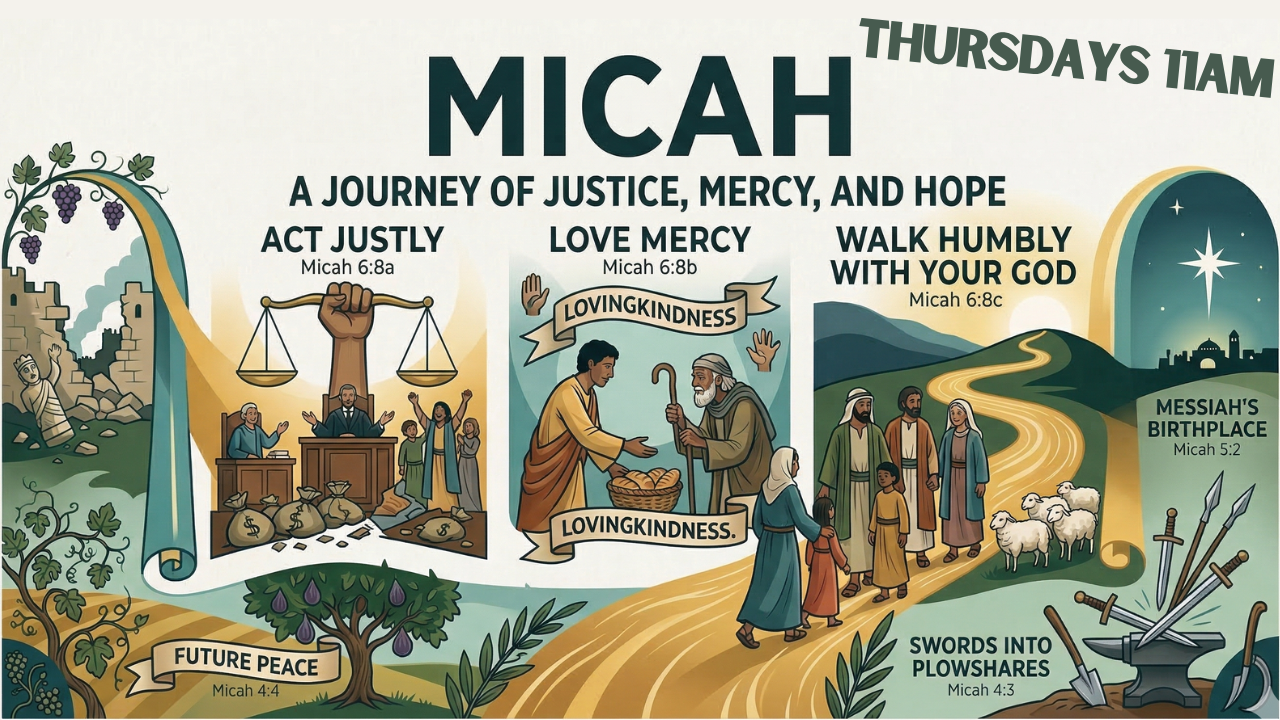
On April 23, 2026, our class explored Micah 6–7, God’s deliverance from Egypt, the legacies of Omri/Ahab/Jezebel, Balaam and Balak, Elijah’s gentle whisper, and Jesus’ teaching on allegiance and endurance—emphasizing justice, mercy, humility, and trust in God’s protecting purposes.