

Mark Chapter 9b Class 15 - Wednesday Bible Study
Bible study on October 7, 2026 explored Mark 9–10, contrasting the disciples’ pride with Jesus’ servant-king mission, and tracing themes of healing, humility, unity, radical holiness, and the call to follow.
Gospel of Mark Chapter 9b
This is our 15th class on Mark
This is an AI Recap of the class.
Some things may be incorrect.
Short summary of the whole class
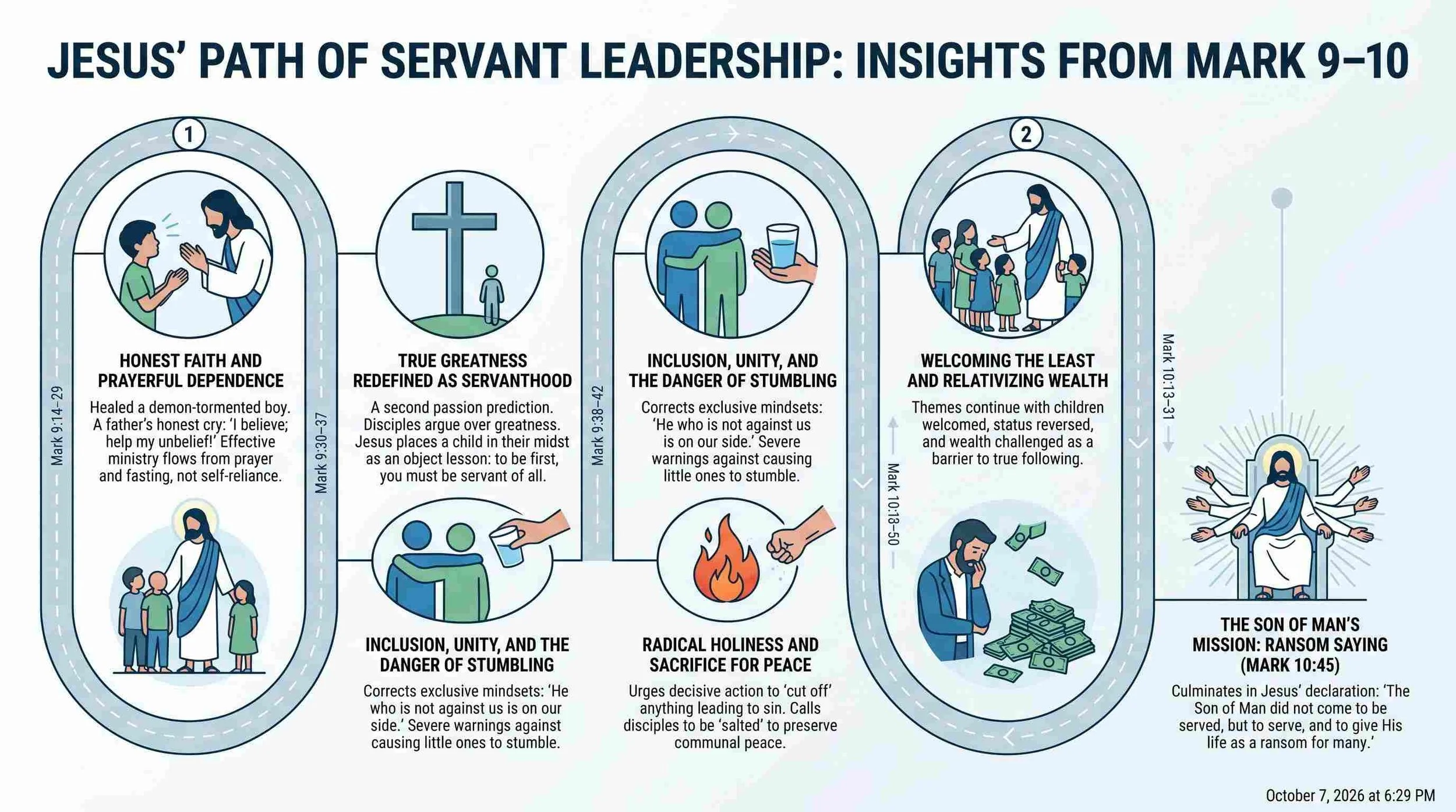
On October 7, 2026 at 6:29 PM, we treated Mark as crafted literature and read Mark 9:14–50 with previews into Mark 10. We examined the healing of the demon-tormented boy and the father’s honest faith, Jesus’ passion predictions, the paradox of true greatness through servanthood and welcoming children, inclusion beyond insider boundaries, warnings against causing believers to stumble, and vivid calls to radical holiness (“cut it off”) tied to salt and peace. We discussed spiritual pride—both in the disciples and in modern church life—textual notes on “where their worm does not die,” Gehenna’s imagery, and how all these threads point to Jesus’ path of suffering and service culminating in Mark 10:45.
Walkthrough and section-by-section summaries
1) Framing the study: Mark as literature and the middle pivot
We situated Mark 9–10 as the turning point “where the rubber meets the road,” just before Holy Week (Mark 11).
Watched a ~5-minute BibleProject overview of Mark’s design: first half asks “Who is Jesus?”; second half “How does he become king?” with the pivot at Peter’s confession and Jesus’ path of suffering (Mark 1:1; 8:27–33; 10:45).
Emphasized reading Mark on its own terms, not homogenizing the four Gospels.
Recalled earlier narratives that set up the disciples’ journey from partial to clear sight: Herod’s beheading of John, the feedings of 5,000 and 4,000, defilement teaching, two-stage healing of the blind man, and the Transfiguration.
Short summary of section:
We framed Mark as carefully crafted literature around a central pivot—Peter’s confession and Jesus’ servant-king mission—linking prior stories to read Mark 9–10 with clarity.
Scriptures mentioned:
Mark 1:1; Mark 6; Mark 6:30–44; Mark 7:14–23; Mark 8:1–10; Mark 8:14–21; Mark 8:22–26; Mark 8:27–33; Mark 9:2–8; Mark 10:45.
Stories discussed:
BibleProject overview video (Mark’s structure).
Herod beheading John the Baptist.
Feeding of the 5,000 and 4,000.
Defilement teaching.
Two-stage healing of the blind man.
Transfiguration.
2) The boy is healed: faith, prayer, and progressive understanding (Mark 9:14–29)
Read Mark 9:14–29: crowd and scribes disputing; a father describes his son’s torment (seizures, muteness, danger).
Jesus laments the “faithless generation,” invites trust: “If you can believe, all things are possible to him who believes” (9:23).
The father’s cry: “I believe; help my unbelief” (9:24).
Jesus rebukes the spirit; the boy appears dead, then Jesus raises him by the hand (9:25–27).
Privately explains, “This kind can come out by nothing but prayer and fasting” (9:29), underscoring dependence on God over technique or status.
Connected to the disciples’ failure stemming from pride and self-reliance; prayer as humble dependence.
Short summary of section:
We saw honest faith and Jesus’ power, learning that effective ministry flows from prayerful dependence and that the journey from unbelief to belief is gradual.
Scriptures mentioned:
Mark 9:14–29; Mark 8:22–26.
Stories discussed:
Healing of the demon-tormented boy.
The father’s struggle with faith.
3) Second passion prediction and the greatness paradox (Mark 9:30–37)
Jesus teaches privately: “The Son of Man is being betrayed… they will kill him… after three days he will rise” (9:31); the disciples do not understand and fear asking (9:32).
At Capernaum, Jesus confronts their argument about who is greatest (9:33–34).
Redefinition of greatness: “If anyone desires to be first, he shall be last of all and servant of all” (9:35).
Object lesson: embraces a child—receiving the lowly equals receiving Jesus and the Father (9:36–37).
Historical context: children as figures with little social status; welcoming “the least of these.”
Application: Jesus contrasts worldly power with divine servanthood, preparing for the cross as paradoxical power.
Short summary of section:
Jesus pairs His suffering prediction with a radical redefinition of greatness: true leadership is humble service that welcomes the least.
Scriptures mentioned:
Mark 9:30–37; Mark 8:31–35.
Stories discussed:
Disciples’ road dispute about greatness.
Jesus placing a child in their midst.
4) Elijah, the Transfiguration, and the path of servanthood (Mark 9:10–13; 9:2–8; OT background)
Question on Elijah in Mark 9:11–13: John the Baptist came in the spirit of Elijah; Jesus, unlike Elijah’s dramatic judgments, embraces the path of suffering.
Reviewed Elijah’s ministry: contest with prophets of Baal (1 Kings 18), encounter with God in the whisper (1 Kings 19), mantle to Elisha (1 Kings 19; 2 Kings 2).
The Transfiguration (Mark 9:2–8): Moses and Elijah appear with Jesus, signaling fulfillment; Jesus perfects Law and Prophets through servanthood.
Theological thread: movement from Old Covenant expectations of power/violence to Jesus’ new covenant of suffering, grace, and service.
Short summary of section:
Elijah and the Transfiguration highlight Jesus as the fulfillment of the Law and Prophets, choosing servanthood and suffering over force, pointing to the cross.
Scriptures mentioned:
Mark 9:2–8; Mark 9:10–13; 1 Kings 18–19; 2 Kings 2.
Stories discussed:
Transfiguration.
Elijah and the prophets of Baal.
Elijah hearing God in the whisper.
Elijah passing the mantle to Elisha.
5) Inclusion, unity, and the danger of causing others to stumble (Mark 9:38–42)
John reports an outsider casting out demons in Jesus’ name; the disciples tried to stop him (9:38).
Jesus: “Do not forbid him… he who is not against us is on our side” (9:39–40).
Commends small acts (a cup of water) with promised reward (9:41).
Warns against causing “little ones who believe” to stumble; better a millstone and the sea (9:42).
Application: Corrects sectarian, exclusive mindsets; prioritizes kingdom fruit and care for the vulnerable over status.
Short summary of section:
Jesus widens the mission beyond insider boundaries and issues sober warnings: unity and care for the vulnerable outweigh tribal status claims.
Scriptures mentioned:
Mark 9:38–42.
Stories discussed:
Outsider exorcist acting in Jesus’ name.
6) Radical holiness, Gehenna, textual notes, and the salt-peace exhortation (Mark 9:43–50; Isaiah 66:24)
Strong hyperbole: cut off hand/foot, pluck out eye—better to enter life maimed than be thrown into Gehenna (9:43–48).
Gehenna explained as Jerusalem’s horrific dump: perpetual fire, smoke, disease—visceral image of ruin.
Textual note: phrase “where their worm does not die, and the fire is not quenched” (Isaiah 66:24) appears in 9:48; its repetition in 9:44 and 9:46 in some manuscripts (e.g., Textus Receptus/KJV) likely a later rhetorical addition; modern translations (e.g., NIV) omit 9:44, 46.
“Everyone will be seasoned with fire… every sacrifice… with salt” (9:49); “Have salt in yourselves, and have peace with one another” (9:50).
Interpreted “cut it off” as metaphor for radical sacrifice: relinquishing status, wealth, or behaviors that cause sin or harm; better humble dependence on God than powerful self-righteousness.
Short summary of section:
Jesus urges decisive, inner holiness, using Gehenna’s vivid imagery and calling disciples to be “salted” people who preserve communal peace through humble, sacrificial living.
Scriptures mentioned:
Mark 9:43–50; Isaiah 66:24.
Stories discussed:
Modern parallel to Gehenna (e.g., Guatemala City dump as illustrative imagery).
Anecdotes on spiritual pride in church life (e.g., denominational exclusivism; Reformation Day joke; St. Peter-at-the-gates joke; homeless man example).
7) Preview into Mark 10: children, wealth, servanthood, and the ransom saying
Continued themes: Jesus blessing children (10:13–16), wealth and discipleship (rich man, 10:17–31), third passion prediction and servant leadership (10:32–45).
Anchor: “The Son of Man did not come to be served, but to serve, and to give His life as a ransom for many” (10:45).
Trajectory: welcoming children, reversing status, relativizing wealth, embracing servanthood on the road to the cross.
Short summary of section:
Mark 10 extends the servant-king pattern—children welcomed, wealth relativized, status reversed—and centers Jesus’ mission in the ransom saying.
Scriptures mentioned:
Mark 10:13–16; Mark 10:17–31; Mark 10:32–45; Mark 10:45.
Stories discussed:
Jesus blessing children.
The rich man and the call to follow.
Teaching on servanthood with the third passion prediction.
Medium-length summary of the class
On October 7, 2026 at 6:29 PM, our Bible study read Mark 9:14–50 in the larger literary arc of Mark and previewed Mark 10. We began with the healing of a demon-tormented boy, where the father’s “I believe; help my unbelief” and Jesus’ note that “this kind comes out by prayer and fasting” taught humble dependence over prideful technique. Jesus’ second passion prediction framed His path, while the disciples’ argument about greatness exposed their status concerns; Jesus answered by embracing a child and redefining greatness as servanthood. We explored Elijah and the Transfiguration to show Jesus fulfilling the Law and Prophets by choosing suffering over force. Jesus broadened mission beyond insider circles and issued stern warnings not to cause “little ones” to stumble. We discussed Gehenna’s vivid imagery, textual notes on the “worm” phrase, and Jesus’ hyperbolic call to cut off whatever leads to sin—interpreted as radical, humble sacrifice that preserves peace. Looking into Mark 10, we saw the themes continue—children welcomed, wealth challenged, status reversed—culminating in Jesus’ declaration that He came to serve and to give His life as a ransom for many.
Main points
Mark is crafted literature with a two-part structure and a pivotal middle around Peter’s confession.
Jesus is Messiah who becomes king through suffering, service, and sacrifice.
Faith is honest and dependent: “I believe; help my unbelief”; effective ministry flows from prayer and fasting.
True greatness is servanthood and welcoming the lowly, not status competition.
Mission is broader than our group; don’t forbid faithful work done in Jesus’ name.
Guard the vulnerable; do not cause “little ones” to stumble.
Pursue radical inner holiness—be willing to sacrifice anything that leads to sin or harms others.
“Salted” discipleship preserves peace in community.
The trajectory points to the cross: the Son of Man serves and gives His life as a ransom (Mark 10:45).
Beware spiritual pride and sectarian exclusivity in modern church life.
Bible scriptures mentioned
Mark 1:1
Mark 6 (Herod and John the Baptist)
Mark 6:30–44 (Feeding of the 5,000)
Mark 7:14–23 (Defilement from within)
Mark 8:1–10 (Feeding of the 4,000)
Mark 8:14–21 (The loaves—disciples’ misunderstanding)
Mark 8:22–26 (Two-stage healing of the blind man)
Mark 8:27–33 (Peter’s confession and rebuke)
Mark 9:2–8 (Transfiguration)
Mark 9:10–13 (Elijah question)
Mark 9:14–29 (Healing of the demon-tormented boy; prayer and fasting)
Mark 9:30–37 (Second passion prediction; true greatness; child in the midst)
Mark 9:38–42 (Outsider exorcist; stumbling blocks)
Mark 9:43–50 (Radical holiness; Gehenna; salt and peace)
Mark 10:13–16 (Jesus blesses children)
Mark 10:17–31 (Rich man and discipleship)
Mark 10:32–45 (Third passion prediction; servanthood)
Mark 10:45 (Ransom saying)
Isaiah 66:24 (Imagery echoed: “their worm does not die”)
1 Kings 18 (Elijah and prophets of Baal)
1 Kings 19 (Elijah and the whisper)
2 Kings 2 (Elisha receives the mantle)
Stories discussed
BibleProject overview of Mark’s structure and purpose.
Herod’s beheading of John the Baptist.
Feeding of the 5,000 and 4,000.
Defilement teaching (what comes out of a person).
Two-stage healing of the blind man.
Peter’s confession and misunderstanding (“Get behind me, Satan”).
The Transfiguration (Jesus with Moses and Elijah; Peter’s response).
Healing of the demon-tormented boy; “I believe; help my unbelief.”
The disciples arguing about who is the greatest; Jesus’ child object lesson.
The outsider casting out demons in Jesus’ name.
Warnings about stumbling blocks; millstone imagery.
Gehenna depicted as Jerusalem’s dump; modern parallel (Guatemala City dump).
“Cut it off” metaphor for radical sacrifice and humility.
Anecdotes on spiritual pride and denominational exclusivism (Reformation Day joke; St. Peter-at-the-gates joke; homeless man example).
Jesus blessing children (Mark 10).
The rich man and the call to follow (Mark 10).
Teaching on servanthood with the third passion prediction; ransom saying (Mark 10:45).
Mark Chapter 9a Class 14 - Wednesday Bible Study
A lively Bible study traced Mark’s unfolding revelation of Jesus—from John’s beheading and the feeding signs through Peter’s confession and the Transfiguration to prayerful dependence—highlighting Jewish and Gentile symbolism, numbers (5, 7, 12, 4), the Son of Man/Son of God themes, and the call to faith, humility, and cross-shaped discipleship.
Gospel of Mark Chapter 9a
This is our 14th class on Mark
This is an AI Recap of the class.
Some things may be incorrect.
Short summary of the whole class
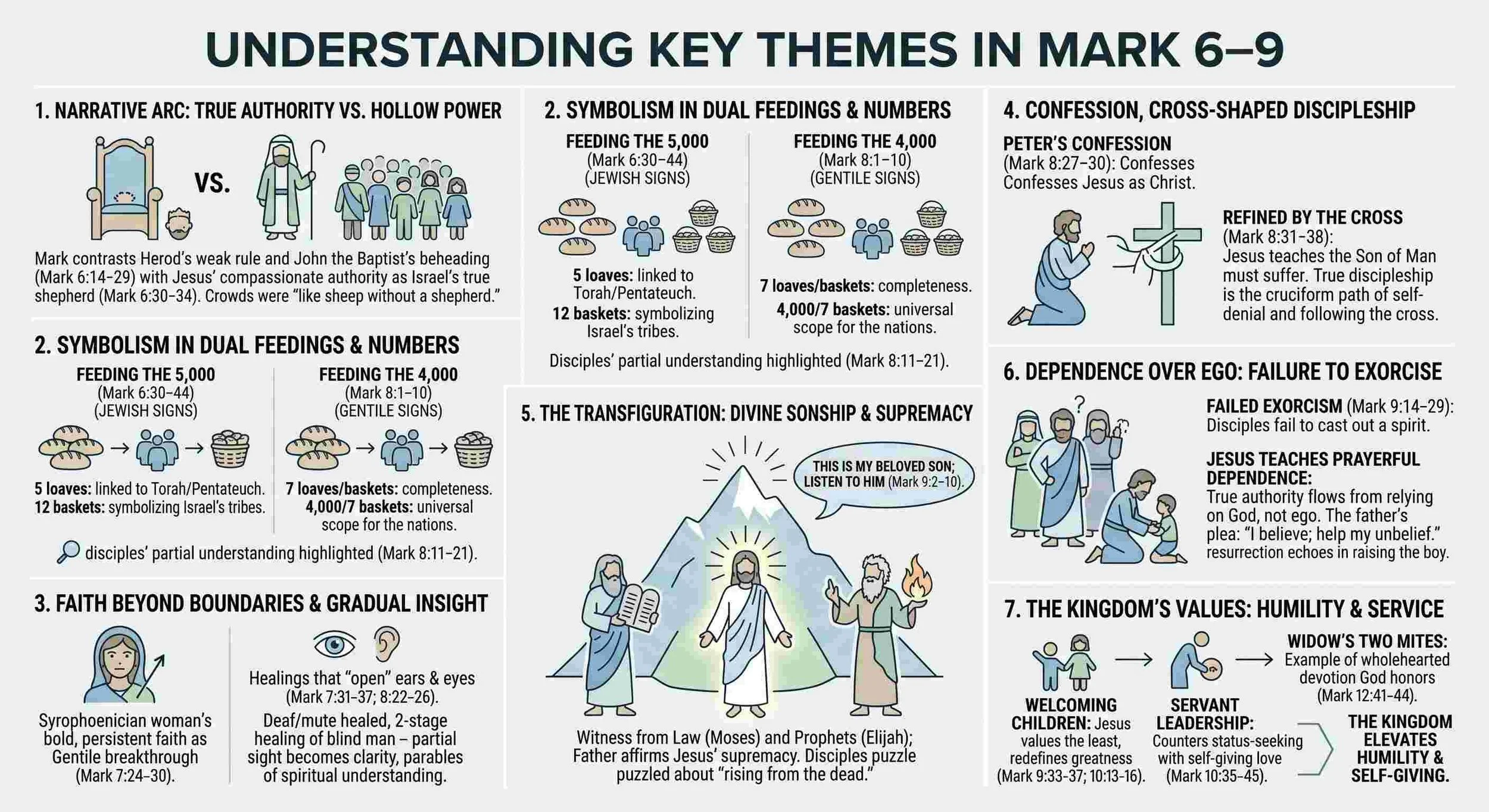
On September 23, 2026 (content creation date: 2026-09-23 18:37:16), our class walked through Mark 6–9, linking John the Baptist’s death and Herod’s hollow power to Jesus as the true shepherd in the feeding of the five thousand. We explored the symbolism of numbers (five/Torah, twelve/Israel, seven/completeness, four/universality), the dual feedings (5,000 and 4,000) as signs for Israel and the nations, and healings that “open ears and eyes” as parables of dawning understanding. We reflected on defilement from within, the faith of the Syrophoenician woman, Peter’s confession and misunderstanding, Jesus’ call to take up the cross, and the Transfiguration where Moses and Elijah witness to the beloved Son. Descending the mountain, we examined the failed exorcism, the father’s cry—“I believe; help my unbelief”—and Jesus’ teaching that some battles require prayer (and fasting), drawing lessons about humility, dependence, and the dangers of ego. We also noted Mark’s “messianic secret,” why Jesus sometimes restricts testimony among Israelites while encouraging Gentiles, and looked ahead to themes of welcoming children, servant leadership, and the widow’s two mites.
Section-by-section walkthrough with summaries, verses, and stories
1) Mark’s narrative arc: From John’s beheading to the true shepherd
What we discussed:
We recapped Mark’s literary structure, noting that John the Baptist’s beheading exposes Herod’s feckless power and frames Jesus as the true shepherd for leaderless crowds.
The crowds are “like sheep without a shepherd,” setting up the feeding of the five thousand as a revelation of Jesus’ compassionate authority.
Bible verses and stories mentioned:
Mark 6:14–29 (Beheading of John the Baptist)
Mark 6:30–34 (Sheep without a shepherd theme)
Short summary of this section:
Mark contrasts Herod’s weak rule with Jesus’ true authority and compassion, preparing readers to see Jesus as Israel’s shepherd.
2) Numbers, feedings, and meaning in Mark’s structure
What we discussed:
Feeding of the 5,000 (Mark 6:30–44) connected to Jewish symbolism: five loaves (linked to the Pentateuch), twelve baskets (Israel’s tribes), and the disciples’ dullness highlighted by Jesus’ reminder about “the loaves.”
Jesus walking on the sea (Mark 6:45–52) reinforces the disciples’ lack of understanding.
Teaching on defilement from within shifts focus from ritual to the heart (Mark 7:14–23).
In Gentile territory, feeding of the 4,000 (Mark 8:1–10): seven loaves and seven baskets point to completeness; “four” evokes the “four corners of the earth,” suggesting universality for the nations.
Jesus warns about the “leaven of the Pharisees,” quizzes the disciples on the two feedings, and presses them beyond literal bread (Mark 8:11–21).
A lighthearted correction: the leader mistakenly linked five to the Star of David’s points; the group noted it has six points—turning into a shared laugh about learning together.
Bible verses and stories mentioned:
Mark 6:30–44 (Feeding 5,000)
Mark 6:45–52 (Walking on the sea; reminder about the loaves)
Mark 7:14–23 (Defilement from within)
Mark 8:1–10; 8:11–21 (Feeding 4,000; leaven warning; quiz on baskets)
Short summary of this section:
The dual feedings depict Jesus’ provision for Israel and the nations, with numbers (5, 7, 12, 4) signaling Torah, completeness, Israel, and universality, while exposing the disciples’ partial understanding and inviting deeper insight.
3) Gentile breakthrough and “opening” miracles
What we discussed:
The Syrophoenician woman’s bold, persistent faith (Mark 7:24–30) as a Gentile breakthrough.
Healings that “open” (Mark 7:31–37; 8:22–26): ears opened, tongues loosed, and a two-stage healing of a blind man—“trees walking”—portraying partial perception becoming clarity.
Bible verses and stories mentioned:
Mark 7:24–30 (Syrophoenician woman)
Mark 7:31–37 (Healing of deaf/mute)
Mark 8:22–26 (Two-stage healing of a blind man)
Short summary of this section:
Gentile faith is welcomed, and Jesus’ “opening” miracles become living parables of gradual spiritual insight.
4) Peter’s confession, misunderstanding, and the call to the cross
What we discussed:
At Caesarea Philippi, Peter confesses Jesus as the Christ (Mark 8:27–30), echoing Mark 1:1 (“Son of God”).
Jesus immediately teaches that the Son of Man must suffer, be killed, and rise (Mark 8:31); Peter’s rebuke shows partial sight—like the two-stage healing.
Jesus calls disciples to deny themselves, take up their cross, and follow (Mark 8:34–38), challenging power expectations with the cruciform path.
Bible verses and stories mentioned:
Mark 8:27–38 (Peter’s confession; first passion prediction; take up your cross)
Mark 1:1 (Gospel opening claim)
Mark 6:14–16 (Herod’s speculations, echoing identity questions)
Short summary of this section:
Confessing Jesus is only the beginning; true discipleship follows the way of the cross, moving from blurry to clear vision about Messiahship.
5) The Transfiguration: Moses, Elijah, and the beloved Son
What we discussed:
On a high mountain, Jesus is transfigured; Moses and Elijah appear; a cloud and the Voice declare, “This is my beloved Son; listen to him” (Mark 9:2–10).
Classic view: Moses (Law) and Elijah (Prophets) witness to Jesus; another lens: Moses (who died and was hidden) and Elijah (taken up) converge to signal Jesus’ mission.
Once the Father speaks, Moses and Elijah depart, leaving “Jesus only,” underscoring his supremacy.
The secrecy command—“until the Son of Man is risen”—and the disciples’ puzzlement about rising from the dead.
We connected themes from Joshua, Moses, and Elijah: Elijah and Elisha’s Jordan crossings (2 Kings 2) “retracing” Joshua’s conquest as a symbolic move away from the way of violent kings toward grace; Moses viewing the land and unknown burial (Deut 34).
Peter’s impulse to build shelters/tabernacles (Mark 9:5–6) was read as a fear-driven attempt to memorialize and level Moses and Elijah with Jesus; the Father redirects focus to the Son alone. We noted tabernacle echoes (Exodus 25–40; Leviticus 23:33–43) and the anonymity of the mountain resisting shrine culture.
Bible verses and stories mentioned:
Mark 9:2–10 (Transfiguration; “listen to him”; secrecy)
Parallels: Matthew 17:1–8; Luke 9:28–36
Mark 1:9–11 (Baptism; beloved Son)
Deuteronomy 34 (Moses viewing the land; unknown burial)
2 Kings 2 (Elijah parts the Jordan; transition to Elisha)
Exodus 25–40; Leviticus 23:33–43 (tabernacle/booths background)
Short summary of this section:
The mountain scene unveils Jesus’ divine sonship and supremacy over Law and Prophets; God’s command—“Listen to him”—turns disciples from memorializing to obedient hearing.
6) “Elijah must come first” and the end of the violent way
What we discussed:
The disciples ask about Elijah’s coming; Jesus affirms restoration yet highlights the Son of Man’s destined suffering and rejection (Mark 9:11–13), linking Elijah/John the Baptist’s treatment to a long pattern of violence that culminates—and stops—in Jesus’ cross.
Background motifs: Isaiah 53 and Daniel 7 informing the Son of Man’s suffering and vindication.
Bible verses and stories mentioned:
Mark 9:11–13 (Elijah must come first; suffering Son of Man)
Matthew 17:10–13 (Elijah and John the Baptist connection)
Isaiah 53; Daniel 7 (suffering/vindication motifs)
Short summary of this section:
Jesus reframes expectations about Elijah to center his own redemptive suffering, signaling the end of the cycle of violent rejection in the cross.
7) Coming down the mountain: a desperate father, faith’s struggle, and prayerful dependence
What we discussed:
The disciples fail to cast out a mute/deaf spirit from a boy; Jesus laments unbelief, engages the father’s honest plea—“I believe; help my unbelief”—and delivers the child (Mark 9:14–29).
Jesus teaches, “This kind can come out by nothing but prayer” (with textual notes on “prayer and fasting”), emphasizing posture over technique—dependence over ego.
We noted resurrection echoes: the boy appears like a corpse; Jesus lifts him—mirroring “raising” scenes like the paralytic (Mark 2:1–12).
Bible verses and stories mentioned:
Mark 9:14–29 (Failed exorcism; “only by prayer”; father’s plea)
Manuscript note on “prayer” vs. “prayer and fasting”
Mark 2:1–12 (Paralytic healed and lifted)
Mark 6:7,13 (Earlier disciple authority over demons)
Short summary of this section:
True authority flows from prayerful reliance on God; Jesus meets mingled faith and doubt with deliverance, foreshadowing resurrection power.
8) Why Jesus sometimes said “don’t tell” and sometimes “go tell”
What we discussed:
We compared Jesus’ instructions: often silencing testimony among Israelites (to manage timing, avoid premature acclaim/assassination, and prevent misunderstanding) while encouraging proclamation among Gentiles.
Mark’s “messianic secret” invites readers to finish the Gospel and then reread to truly “retell” the story with understanding.
Comparative references: Samaritan woman’s open witness (John 4), the grateful Samaritan leper (Luke 17:11–19), and Nicodemus’ cautious journey (John 3; 7:50–52; 19:39).
Bible verses and stories mentioned:
Mark 1:43–45; 5:43; 7:36; 8:26 (Silencing commands)
John 4 (Samaritan woman)
Luke 17:11–19 (Ten lepers; one Samaritan returns)
John 3; 7:50–52; 19:39 (Nicodemus)
Short summary of this section:
Jesus’ differing directions balance prudence and pedagogy; Mark’s narrative strategy forms witnesses who speak at the right time with deeper understanding.
9) Looking ahead: children, status, servant leadership, and the widow’s two mites
What we discussed:
Post-Transfiguration drift into ego: Jesus redefines greatness by welcoming children and calling disciples to servanthood.
James and John’s request reveals status-seeking; Jesus counters with the pattern of the cross.
The widow’s two mites exemplify humble, wholehearted devotion that God honors.
Bible verses and stories mentioned:
Mark 9:33–37 (Welcoming a child; true greatness)
Mark 10:13–16 (Jesus and the children)
Mark 10:35–45 (James and John’s request; servant leadership)
Mark 12:41–44 (Widow’s two mites)
Short summary of this section:
The kingdom honors humility and self-giving; Jesus dismantles ladder-climbing and centers servant love.
Medium-length closing summary (class recap dated 2026-09-23 18:37:16)
On September 23, 2026, we traced Mark’s carefully crafted narrative from Herod’s hollow power and John’s martyrdom to Jesus as the shepherd who feeds Israel and, through a second feeding, signals provision for the nations. We explored how numbers—five (Torah), twelve (Israel), seven (completeness), and four (universality)—work within Mark’s structure and how healings that open ears and eyes function as parables of emerging insight. The Syrophoenician woman’s bold faith heralded Gentile inclusion. Peter’s confession gave way to Jesus’ first passion prediction and the call to take up the cross, exposing partial sight that must be refined by the cruciform path. On the mountain, Moses and Elijah bore witness as the Father affirmed Jesus as the beloved Son and commanded, “Listen to him,” after which “Jesus only” remained. We connected Elijah and Elisha’s “reverse” Jordan journey and Moses’ hidden burial to a movement away from conquest toward grace fulfilled in Jesus. Coming down the mountain, a failed exorcism revealed the danger of ego and the necessity of prayerful dependence; the father’s cry—“I believe; help my unbelief”—met Jesus’ compassionate authority, with resurrection echoes in the boy’s raising. We considered why Jesus sometimes restricted testimony and sometimes released it, seeing Mark’s “messianic secret” as formative timing. Finally, we looked ahead to Jesus’ teaching on humility, welcoming children, servant leadership, and the widow’s two mites, which together call disciples from status to self-giving love.
Main points
Mark writes a literary-theological narrative contrasting Herod’s weakness with Jesus’ true authority.
The feeding signs (5,000 and 4,000) symbolize Jesus’ provision for Israel and the nations.
Numbers in Mark (5, 7, 12, 4) underscore Torah, completeness, Israel’s identity, and universality.
Defilement arises from within; Jesus targets the heart.
Gentile faith (Syrophoenician woman) is welcomed; “opening” miracles portray gradual understanding.
Peter’s confession is refined by the cross: discipleship means self-denial and following Jesus.
The Transfiguration reveals Jesus’ divine sonship and supremacy over Law and Prophets; “Listen to him.”
Elijah’s role points to Jesus’ suffering, where the cycle of violence culminates and ends.
Ministry power flows from prayerful dependence, not ego or technique; “This kind” comes out only by prayer (and fasting).
Mark’s “messianic secret” shapes timing and understanding of witness.
The kingdom elevates humility, children, servant leadership, and the widow’s wholehearted trust.
Scriptures mentioned
Mark 1:1; 1:9–11
Mark 2:1–12
Mark 6:14–29; 6:30–44; 6:45–52
Mark 7:14–23; 7:24–30; 7:31–37; 7:36
Mark 8:1–10; 8:11–21; 8:22–26; 8:26; 8:27–38
Mark 9:1–10; 9:2–13; 9:5–6; 9:8–10; 9:11–13; 9:14–29; 9:33–37
Mark 10:13–16; 10:35–45
Mark 12:41–44
Deuteronomy 34
Exodus 25–40
Leviticus 23:33–43
Joshua 6
2 Kings 2
Isaiah 53
Daniel 7
Parallel/related passages: Matthew 17:1–13; Luke 9:28–36; John 4; John 3; 7:50–52; 19:39; Luke 17:11–19
Stories referenced
Beheading of John the Baptist
Feeding of the 5,000 and the 4,000
Jesus walking on the sea; reminder about the loaves
Teaching on what defiles
Syrophoenician woman’s plea
Healing of the deaf/mute and the two-stage healing of the blind man (“trees walking”)
Peter’s confession and Jesus’ first passion prediction; call to take up the cross
The Transfiguration with Moses and Elijah; the Father’s voice; Peter’s shelters proposal
Elijah and Elisha at the Jordan; Moses viewing the land and hidden burial
Healing of the demon-tormented boy; “I believe; help my unbelief”; “only by prayer”
Children welcomed by Jesus; James and John’s status request; the widow’s two mites
Mark Chapter 8 Class 13 - Wednesday Bible Study
Our class on September 17, 2026, explored how Jesus's miracles and teachings in Mark 6-8 challenge worldly power, culminating in Peter's flawed confession and Jesus's radical call to a discipleship of self-denial and sacrifice.
Gospel of Mark Chapter 8
This is our 13th class on Mark
This is an AI Recap of the class.
Some things may be incorrect.
Short Summary of the Class
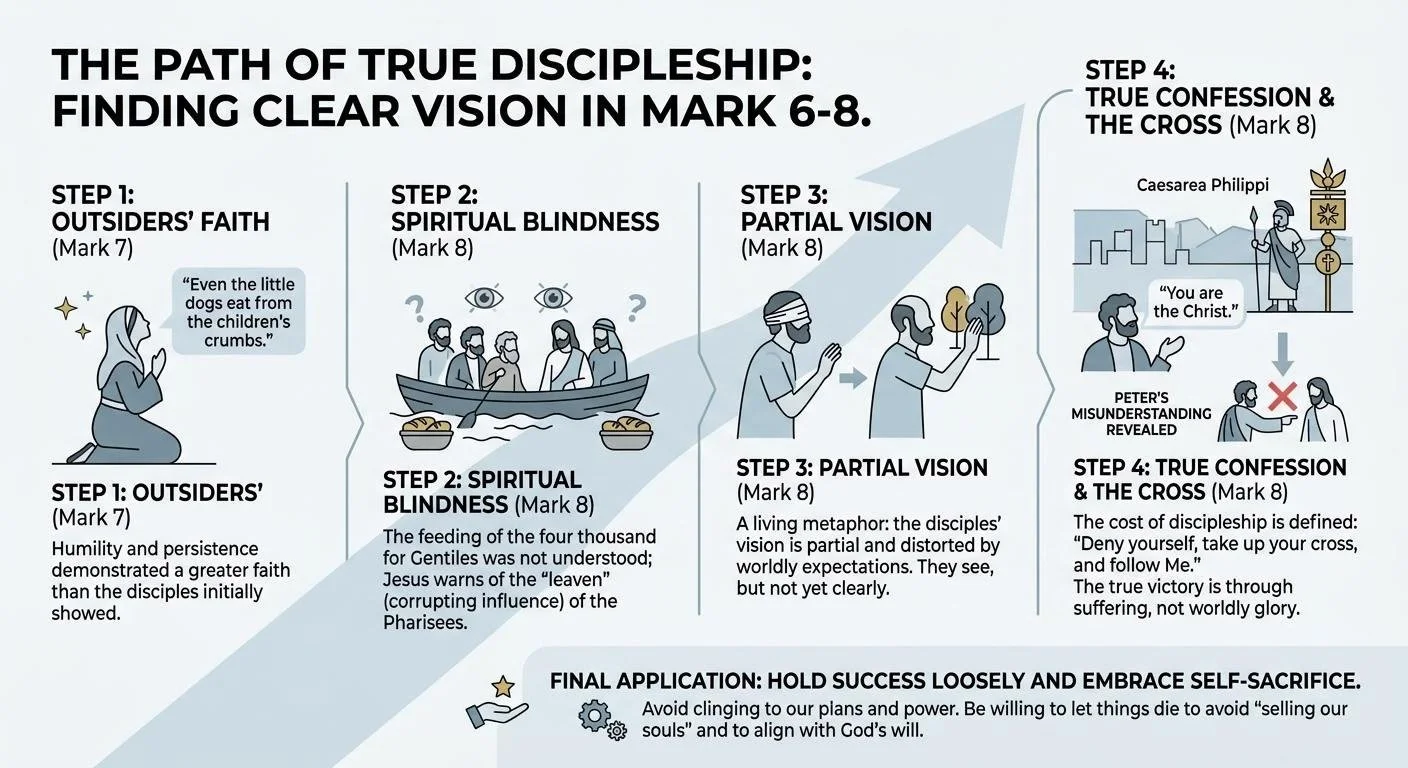
During our Bible study on September 17, 2026, we traced the theme of spiritual blindness and gradual revelation through Mark chapters 6-8. We began with stories of Gentiles, like the Syrophoenician woman, who showed greater insight than the disciples. The discussion then moved to the feeding of the four thousand, a miracle for the Gentile world that the disciples failed to comprehend, prompting Jesus's warning about the "leaven of the Pharisees." This spiritual dullness was paralleled in the two-stage healing of the blind man at Bethsaida, a metaphor for the disciples' own partial understanding. The lesson culminated at Caesarea Philippi, where Peter correctly identified Jesus as the Christ but immediately rejected the idea of a suffering Messiah, revealing his worldly mindset. This led Jesus to teach the true cost of discipleship: to deny oneself, take up one's cross, and follow Him.
Detailed Class Summary
Reviewing Mark 6 & 7: Outsiders Begin to See
The class began by contextualizing the upcoming passages, recapping the events following the beheading of John the Baptist in Mark 6. We noted the sequence: the feeding of the five thousand in a Jewish region, followed by Jesus walking on the sea and chastising the disciples for their hardened hearts. This led into a review of Jesus’s teaching on defilement coming from within, not from what is consumed.
We then reread the story of the Syrophoenician woman from Mark 7:24-30. This was a crucial moment in Mark's narrative. The discussion highlighted that Jesus's interaction with her, where he refers to Gentiles as "little dogs," sets up a powerful contrast. Her humble and witty response—"Yet even the little dogs under the table eat from the children's crumbs"—demonstrated a faith and understanding that the disciples lacked. It was pointed out that in Mark's Gospel, there are three types of power at play: personal (the disciples trying to send people away), religious (the Pharisees), and political (Herod). This woman, possessing none of these, subverts them all by simply accepting her position and petitioning Jesus in faith. Her story serves as a metaphor for the spiritually "deaf and mute" Gentiles who are beginning to hear and speak righteousness, while those who should understand remain blind. This idea was reinforced by the subsequent healing of the deaf man with a speech impediment (Mark 7:31-37), where the crowd is "astonished beyond measure"—a word often linked in Mark to the awe of the resurrection. We also connected her persistence to the Old Testament story of Jacob wrestling with God, arguing that faith often involves struggle and angst to receive a blessing.
Summary of Section: This section revisited key events in Mark to establish a theme: those considered outsiders, like the Syrophoenician woman, are demonstrating greater spiritual insight than Jesus's own disciples. Their stories illustrate that faith, not status or power, is what matters, and the spiritually "deaf" are beginning to hear.
Bible Verses: Mark 7:24-30, Mark 7:31-37
Bible Stories: The Syrophoenician Woman, Jesus Heals a Deaf and Mute Man, Beheading of John the Baptist (Mark 6), Feeding of the Five Thousand (Mark 6), Jacob wrestling with God (Genesis 32)
Mark 8: Feeding the Four Thousand and the Leaven of the Pharisees
Moving into Mark chapter 8, we read the account of the feeding of the four thousand (Mark 8:1-10). The class discussed the significance of this second feeding miracle. While the feeding of the five thousand took place in a Jewish region and likely symbolized the Pentateuch (the first five books of the law), this feeding of four thousand took place in a Gentile region. The number four was interpreted as representing the "four corners of the world," symbolizing that Jesus's provision is for everyone, not just the Jews. Similarly, the seven loaves used were seen as a symbol of completion and creation, further underscoring the universal scope of this miracle.
Despite witnessing this second incredible act of provision, the disciples immediately worry about having no bread in the boat. Their forgetfulness and hardened hearts are a recurring theme, and we noted their persistent need for a sign, similar to the Pharisees. We discussed that faith is a prerequisite for miracles to take root, like seed needing good soil. Jesus uses their anxiety to warn them, "Beware of the leaven of the Pharisees and the leaven of Herod" (Mark 8:15). He isn't talking about literal bread but about the corrupting influence of religious and political power structures that seek signs yet remain blind. The class found humor in the disciples' literal interpretation: "Is it because we have no bread?" (Mark 8:16). Jesus explicitly rebuked them for their spiritual dullness, reminding them of the twelve and seven baskets of leftovers from the two feedings and asking, "Do you have eyes but fail to see, and ears but fail to hear?" (Mark 8:18).
Summary of Section: The feeding of the four thousand symbolizes Jesus's ministry extending to the Gentiles. The disciples’ failure to understand this, focusing instead on physical bread, reveals their spiritual blindness and prompts Jesus's warning against the corrupting "leaven" (influence) of the Pharisees and Herod.
Bible Verses: Mark 8:1-10, Mark 8:11-21, Mark 8:15, Mark 8:16, Mark 8:18
Bible Stories: The Feeding of the Four Thousand, The Pharisees Demand a Sign, The Leaven of the Pharisees and Herod
The Blind Man at Bethsaida: A Metaphor for the Disciples
The final passage discussed was the unique healing of the blind man at Bethsaida (Mark 8:22-26). Unlike other miracles, this healing happens in two stages. After Jesus's first touch, the man sees people who look "like trees walking" (Mark 8:24). Only after a second touch is his sight fully restored. The class interpreted this two-stage healing as a direct metaphor for the disciples' own spiritual condition. Just as the blind man first saw things unclearly, the disciples were beginning to see who Jesus was, but their vision was still blurry and distorted by worldly expectations. Their understanding, like the blind man's sight, needs a second touch before it is complete. This story perfectly illustrates the disciples' partial-but-not-yet-complete grasp of who Jesus is, setting the stage for Peter's upcoming confession.
Summary of Section: The two-stage healing of the blind man serves as a powerful metaphor for the disciples' partial spiritual sight. They are no longer completely blind, but they do not yet see clearly. It required a second touch, or further revelation, for them to see Jesus and His mission clearly, moving from partial belief to full clarity.
Bible Verses: Mark 8:22-26, Mark 8:24
Bible Stories: Jesus Heals a Blind Man at Bethsaida
Peter's Confession and the Revelation of the Cross
The climax of our discussion was Peter’s great confession at Caesarea Philippi (Mark 8:27-38). The setting was significant; a city named for Caesar, a symbol of earthly power. In this context, Jesus asked his disciples, "Who do people say that I am?" Their answers—"John the Baptist," "Elijah," or "one of the prophets"—were a direct quote from what Herod's court had said (Mark 6:14-15), linking their view to the perspective of worldly rulers.
Against this backdrop, Peter boldly declared, "You are the Christ" (Mark 8:29). However, his vision was still blurry. The moment Jesus began to teach "openly" that He must suffer, be rejected, and be killed, Peter's dream of a political Messiah crumbled. He rebuked Jesus, essentially telling Him to stop talking that way. Jesus’ sharp response, "Get behind me, Satan! For you are not mindful of the things of God, but the things of men" (Mark 8:33), revealed that Peter’s idea of a king was a worldly one. He saw the title but rejected the suffering. The term "Satan" was identified as meaning "adversary," showing Peter’s perspective was adversarial to God’s plan.
Jesus then taught the crowd and his disciples the true meaning of following him: to deny oneself, take up one's cross, and lose one's life for the sake of the gospel to truly save it (Mark 8:34-38). We noted the irony that Peter, who would later deny Jesus to save his own life, is the one whose Gospel records these words, and whose eventual restoration proves their ultimate truth.
Summary of Section: At Caesarea Philippi, Peter correctly identified Jesus as the Christ but immediately failed to understand the nature of His kingship, rejecting the idea of a suffering Messiah. Jesus corrected this by teaching that true discipleship involves embracing sacrifice and the cross, not seeking worldly glory.
Bible Verses: Mark 8:29, Mark 8:32, Mark 8:33, Mark 8:34, Mark 8:34-38, Mark 6:14-15 (referenced), Matthew 16:18 (referenced)
Bible Stories: Peter's Confession at Caesarea Philippi, Jesus' first prediction of his death and resurrection, Peter's Denial of Jesus (referenced)
Applying the Lesson to Our Lives
Finally, we discussed how to apply this lesson. The core principle is that nothing—not even the church or its programs—is "above death." We can become so focused on preserving what is "working" that we act in un-Christlike ways to protect it. Sometimes, for new things to grow, other things must be allowed to die. Holding on too tightly to our plans, traditions, or successes can suffocate them. This reflects Peter's error: he was holding so tightly to his vision of a victorious kingdom that he tried to prevent the very act—the crucifixion—that would bring about God’s true victory.
Summary of Section: The lesson from Peter's failure teaches us to hold our plans, successes, and even our lives loosely. We must be willing to let things "die" to align with God's will, ensuring our actions are motivated by service rather than a desire to preserve power or control.
Final Summary
Our Bible study on September 17, 2026, focused on a pivotal section in Mark's Gospel (chapters 6-8) where the theme of spiritual blindness and dawning revelation is central. We began by reviewing stories of Gentiles, like the Syrophoenician woman, who demonstrated a profound understanding of Jesus that eluded the disciples. The primary focus then shifted to the feeding of the four thousand in a Gentile region, a clear sign that Jesus’s kingdom was for all people. However, the disciples immediately forgot the lesson and worried about their lack of bread, prompting Jesus to warn them against the "leaven of the Pharisees and Herod"—the corrupting influence of power that blinds people to God's work.
This theme was powerfully illustrated by the two-stage healing of the blind man at Bethsaida, presented as a living parable for the disciples’ own partial, distorted vision of Jesus and his mission. The narrative culminated at Caesarea Philippi, where Peter made his monumental confession, "You are the Christ." While correct in title, Peter’s understanding was proven partial when he rebuked Jesus for predicting His passion and death, revealing his worldly expectations. Jesus’ subsequent teaching on the necessity of taking up one’s cross defined true discipleship not as a path to earthly power, but as a journey of self-denial and sacrifice. We concluded by applying this to our own lives, recognizing the danger of holding too tightly to our own ambitions and the necessity of letting things die so that God’s will can be done.
Main Points
The Syrophoenician woman, a Gentile, shows greater faith and understanding than the disciples.
The feeding of the five thousand was primarily for the Jews (symbolized by 5), while the feeding of the four thousand was for the Gentiles/the world (symbolized by 4).
The disciples repeatedly demonstrate spiritual blindness, failing to understand the significance of the miracles and focusing on physical concerns over spiritual truths.
Jesus's warning about "leaven" refers to the corrupting influence of religious and political powers (Pharisees and Herod).
The two-stage healing of the blind man at Bethsaida is a metaphor for the disciples' partial and incomplete spiritual understanding.
Peter’s confession of Jesus as "the Christ" is a pivotal moment, yet his understanding is incomplete, as he rejects the idea of a suffering Messiah in favor of a political one.
True discipleship requires denying oneself, taking up the cross, and following Jesus' path of suffering, not seeking personal gain or power.
True faith can involve "wrestling" with God, and in our lives, we must be willing to let things die to avoid "selling our souls" to maintain success or control.
Scriptures and Stories Mentioned
Main Scriptures: Mark 6, Mark 7, Mark 8
Bible Verses Mentioned:
Mark 6:14-15
Mark 7:24-30
Mark 7:31-37
Mark 8:1-10
Mark 8:11-21
Mark 8:15
Mark 8:16
Mark 8:18
Mark 8:22-26
Mark 8:24
Mark 8:29
Mark 8:32
Mark 8:33
Mark 8:34-38
Mark 9:1
Matthew 16:18
Genesis 32
Bible Stories Discussed:
Beheading of John the Baptist
Feeding of the Five Thousand
Jesus Walks on Water
The Syrophoenician Woman
Jesus Heals a Deaf and Mute Man
The Feeding of the Four Thousand
The Pharisees Demand a Sign & The Leaven of the Pharisees and Herod
Jesus Heals a Blind Man at Bethsaida
Peter's Confession at Caesarea Philippi
Jesus' First Prediction of His Death and Resurrection
Jacob wrestling with God (Book of Exodus)
Pharaoh's Hardened Heart (Book of Exodus)
The Rich Young Ruler (Mark 10)
Peter's Denial of Jesus (Mark 14)
Jesus' Restoration of Peter (John 21)

Mark Chapter 7 Class 12 - Wednesday Bible Study
Mark chapter 7, where we discussed textual criticism, how Jesus contrasts God's commands with human traditions, and that true defilement comes from the heart, not external rituals, as seen in His teachings and His interaction with the Syrophoenician woman.
Gospel of Mark Chapter 7
This is our 12th class on Mark

This is an AI Recap of the class.
Some things may be incorrect.
Short Summary of the Whole Class
On the evening of September 9, 2026, our class delved into Mark chapter 7. The study opened with a practical look at how the Bible was copied and preserved, examining textual variants and why modern translations sometimes differ from older ones, concluding that discoveries like the Dead Sea Scrolls affirm Scripture's reliability. The main discussion focused on the conflict between Jesus and the Pharisees over "the tradition of the elders," specifically regarding ritual hand washing and the "Corban" rule. Jesus condemned their hypocrisy, teaching that what truly defiles a person are the evil things that come from within the heart, not external things. We connected this to modern church life, emphasizing integrity over performative piety. The study also examined the powerful stories of the Syro-Phoenician woman's faith and the healing of a deaf man, tying these miracles to Jesus's call for spiritual understanding and the inclusion of Gentiles.
Section-by-Section Walkthrough of the Class
1. Introduction and Discussion on Biblical Reliability
The class began with some light banter before Cris framed the purpose of the initial discussion: to build confidence in the Bible's reliability, explaining that textual notes in modern Bibles increase trust rather than undermining it. We looked at how ancient manuscripts for both the Greek New Testament and Hebrew Old Testament were meticulously copied. Scribes would record every variant, often in the margins, and Old Testament scribes even counted letters and lines to ensure accuracy. This transparent process shows that errors were noted, not secretly fixed.
A key observation was made about Mark 7:16, which reads in the New King James Version, "If anyone has ears to hear, let him hear," but is missing from many modern translations. Cris explained that we don't have the original manuscripts, but copies of copies. Archaeology in the 19th and 20th centuries uncovered much older manuscripts, such as the Dead Sea Scrolls, which confirmed the remarkable alignment and stability of our existing biblical texts. These more ancient manuscripts are considered more reliable, and they do not contain Mark 7:16. The verse was likely a "scribal addition," copied from a similar phrase in Mark 4:23, possibly with good intentions to thematically connect Jesus’s teaching about "hearing" with the subsequent miracle of healing the deaf man. It was noted that the Gospels are theological narratives designed to reveal Jesus, and this kind of literary-theological shaping is compatible with historical truthfulness.
Summary: The class began by establishing confidence in the Bible's transmission. The absence of Mark 7:16 in the oldest manuscripts, confirmed by discoveries like the Dead Sea Scrolls, highlights the transparent process of textual criticism, where scholars compare manuscripts to determine the most original wording.
Scriptures Mentioned: Mark 7:16, Mark 4:23
Stories Mentioned: The discovery of the Dead Sea Scrolls.
2. The Tradition of the Elders vs. God’s Commandment (Mark 7:1-13)
After the discussion on textual criticism, we transitioned into Mark chapter 7. The scene opens with Pharisees and scribes from Jerusalem confronting Jesus because His disciples were eating with "defiled," or unwashed, hands. Their concern was not hygiene but the breaking of "the tradition of the elders"—a set of oral laws and rituals added to God's written law. The class reflected on how a focus can drift from a tradition's original purpose to mere performance, turning good practices into oppressive rules.
Jesus responded forcefully, calling them hypocrites and quoting Isaiah 29:13: "These people honor me with their lips, but their hearts are far from me." He accused them of nullifying God's word for their man-made tradition and provided the specific example of "Corban." A person could declare their resources "Corban" (a gift dedicated to God), using this as a religious loophole to avoid their biblical duty, as commanded by Moses (Exodus 20:12/Deuteronomy 5:16), to honor and financially support their aging parents. This practice allowed someone to appear devout while directly disobeying God's command to love their neighbor.
Summary: Jesus challenges the Pharisees' focus on external rituals, accusing them of hypocrisy. He uses the "Corban" rule as a prime example of how their human traditions were used to invalidate God's direct commandments, such as honoring one's parents.
Scriptures Mentioned: Mark 7:1-13, Isaiah 29:13, Exodus 20:12, Deuteronomy 5:16
Stories Mentioned: The Tradition of the Elders (hand-washing), The teaching on Corban.
3. What Truly Defiles a Person (Mark 7:14-23)
Jesus then called the crowd and delivered a revolutionary teaching: nothing that enters a person from the outside can defile them. True defilement comes from within—from the heart. Later, when the disciples asked for clarification, Jesus expressed frustration at their lack of understanding, asking, "Are you so dull?" He explained that food goes into the stomach and is eliminated, but evil thoughts, sexual immorality, theft, murder, adultery, greed, malice, deceit, pride, and folly come from a person’s heart, and these are what truly make a person unclean. The class discussed the tone of Jesus' explanation, with some hearing it as a solemn pronouncement and others as biting, illustrative humor (a "poop joke") meant to shock his listeners into understanding.
Mark adds a crucial editorial note: "In saying this, Jesus declared all foods clean" (Mark 7:19). We connected this declaration to Acts 10, where Peter has a vision in which God tells him, "Do not call anything impure that God has made clean." This prepared Peter to take the gospel to the Gentile centurion, Cornelius. Thus, Jesus’ teaching in Mark 7 not only re-centers purity on the heart but also prepares the way for the inclusion of Gentiles into God's people.
Summary: Jesus teaches that moral purity is an issue of the heart, listing the internal sins that truly defile a person. His declaration that all foods are clean is a pivotal moment that anticipates the future inclusion of Gentiles, a theme further developed in the book of Acts.
Scriptures Mentioned: Mark 7:14-23, Acts 10:9-16, 28
Stories Mentioned: Peter’s vision of the clean and unclean animals, The story of Peter and Cornelius.
4. The Faith of a Gentile Woman (Mark 7:24-30)
Next, the class examined the story where Jesus traveled to the Gentile region of Tyre and Sidon. A Syro-Phoenician (Greek) woman, whose origin evokes cultural associations with the region of Jezebel from the Old Testament, came begging him to heal her demon-possessed daughter. Jesus initially responded with a harsh-sounding metaphor: "It is not good to take the children’s bread and throw it to the little dogs," implying his primary mission was to "the children" (the Jews), not "the dogs" (Gentiles).
However, the woman's brilliant and humble faith turned his own metaphor back on him. She replied, "Lord, yet even the little dogs under the table eat from the children’s crumbs." This response showed she understood that even a "crumb" of Jesus's power was more than enough. Impressed by her witty and faithful answer, Jesus granted her request, and she returned home to find her daughter healed. Her humble, persistent trust was contrasted with the disciples, who, despite witnessing miracles like the feeding of the five thousand, still had "hardened hearts" and a lack of understanding.
Summary: Jesus extends his ministry to the Gentiles, rewarding the bold and humble faith of the Syro-Phoenician woman. Her story serves as a powerful example of an "outsider" demonstrating profound faith, revealing that God's mercy overflows to anyone who believes.
Scriptures Mentioned: Mark 7:24-30, Mark 6:51-52 (context)
Stories Mentioned: The Faith of the Syro-Phoenician Woman, Allusion to Jezebel's story (1 Kings 16, 21; 2 Kings 9).
5. Application and Concluding Thoughts
The discussion then turned to modern applications. We considered how the temptation to seek religious accolades and public recognition can distort our motives, contrasting large gifts that cost the giver little with small, sacrificial gifts that cost much. This led a class member to connect the conversation to the story of the widow’s offering, who gave two small coins—all she had. This story perfectly exemplifies the sincere, sacrificial faith that Jesus commends, standing in stark contrast to performative religiosity.
Finally, we noted how the theme of spiritual perception—"Do you see? Do you hear?"—is threaded through this section of Mark. The chapter concludes with the healing of a man who was deaf and had a speech impediment (Mark 7:31-37). This physical healing serves as a powerful, literal demonstration of Jesus's call for spiritual hearing and understanding, a theme that would continue into the next chapter with the feeding of the four thousand.
Summary: The class applied Jesus's critique of performative religion to modern church life, using the widow's offering as a model of sincere, sacrificial giving. The chapter concludes by setting up the ongoing theme of needing spiritual eyes to see and ears to hear who Jesus truly is.
Scriptures Mentioned: Mark 7:31-37, Mark 8:1-21 (preview), Mark 12:41-44 / Luke 21:1-4
Stories Mentioned: The Healing of the Deaf and Mute Man, The widow’s offering of two coins, Feeding of the Four Thousand (preview).
Medium-Length Summary
During our Bible study on September 9, 2026, we journeyed through the entirety of Mark chapter 7, framed by the disciples' spiritual dullness from the end of chapter 6. The class opened with a discussion on textual criticism, explaining why verses like Mark 7:16 are absent in modern Bibles and how discoveries like the Dead Sea Scrolls affirm the reliability of Scripture's transmission. We then watched as Jesus confronted the Pharisees over their man-made traditions, particularly hand-washing and the "Corban" rule, which allowed them to neglect God’s clear commands. Jesus established a profound principle: true defilement is not external but internal, originating from evil thoughts within a person's heart. His declaration that all foods are clean foreshadows the inclusion of Gentiles, a theme fulfilled in Acts 10. This was followed by the powerful story of the Syro-Phoenician woman, an "outsider" whose humble, persistent faith was commended by Jesus. We applied these lessons to modern church life, discussing the dangers of performative piety and embracing the sacrificial model of the widow's offering. The class concluded by noting how the subsequent healing of a deaf man serves as a living metaphor for the spiritual "hearing" Jesus desires for all his followers.
Main Points
The Bible’s textual history is transparent and reliable; manuscript variants are documented, not hidden, and discoveries like the Dead Sea Scrolls confirm Scripture's stability.
Jesus prioritizes God’s commandments over human traditions that have become detached from their purpose.
True defilement comes from the evil that proceeds from the human heart, not from external things like food or unwashed hands.
Religious loopholes like "Corban" can be a way of masking disobedience to God's core commands to love and honor others.
Jesus’s declaration that all foods are clean anticipates the inclusion of Gentiles into God's family.
Jesus's healing ministry extended beyond the Jews to the Gentiles, as seen in the story of the Syro-Phoenician woman, who models humble and persistent faith.
Physical healings in Mark’s Gospel, like that of the deaf man, often serve as metaphors for the need for spiritual sight and hearing.
Modern discipleship must resist performative religiosity and value sacrificial, sincere generosity like that of the widow's offering.
Scriptures and Stories Mentioned
Bible Scriptures:
Mark, Chapter 6 (Recap, specifically Mark 6:51-52)
Mark, Chapter 7 (Main Text)
Mark 7:16 (in the context of textual criticism)
Mark 4:23 (for scribal comparison)
Mark 12:41-44 / Luke 21:1-4 (The widow's offering)
Mark 8:1-21 (Preview)
Isaiah 29:13
Exodus 20:12 / Deuteronomy 5:16
Acts 10:9-16, 28
1 Kings 16, 21; 2 Kings 9 (Background allusion to Jezebel)
Stories/Parables:
Beheading of John the Baptist (Mark 6)
Feeding of the Five Thousand (Mark 6)
Jesus Walks on Water (Mark 6)
The discovery of the Dead Sea Scrolls
The Tradition of the Elders (Mark 7)
The teaching on Corban (Mark 7)
Peter's Vision and the story of Cornelius (Acts 10)
The Faith of the Syro-Phoenician Woman (Mark 7)
The Healing of the Deaf and Mute Man (Mark 7)
The widow’s offering of two coins
Mark Chapter 6b Class 11 - Wednesday Bible Study
we explored Mark 6, examining Jesus's rejection in Nazareth, the sending of the Twelve, the contrast between Herod's failed leadership and Jesus's true shepherding in the feeding of the five thousand, and how the disciples' hardened hearts reveal our own need for faith and grace.
Gospel of Mark Chapter 6 again
This is our 11th class on Mark
This is an AI Recap of the class.
Some things may be incorrect.
Short Summary of the Whole Class
During our Bible study on September 2, 2026, we revisited Mark chapter 6, analyzing its pivotal role in the Gospel. We discussed Jesus's rejection in his hometown, the mission of the Twelve, and the stark contrast between King Herod's feckless leadership and Jesus's compassionate shepherding. The class focused on the feeding of the five thousand and Jesus walking on water, noting how these miracles serve as a powerful critique of the disciples' "hardened hearts." We contrasted their lack of faith with the desperate faith of outsiders and concluded that Mark presents the disciples' failures to help us see our own weaknesses and recognize our need for Jesus, who redeems us even in our lack of understanding. Throughout, we connected these narratives to foundational themes from Genesis and Exodus.
Detailed Class Summary (September 2, 2026)
Section 1: Context and Rereading Mark 6
Our discussion opened by deciding to re-walk through Mark 6, as some participants had missed the previous session and the chapter is pivotal to the Gospel. The plan was to read the whole chapter and "walk our way through it." We noted that future studies on Tuesdays will start with Genesis, emphasizing how Genesis and Exodus form a primer for the whole Bible. The Gospels, including Mark 6, often echo these foundational stories of creation, covenant, and deliverance, such as Matthew’s infancy narrative paralleling the Exodus story.
Summary of Section 1: We set the study plan to reread Mark 6 comprehensively and connected the importance of Genesis and Exodus as a foundational lens for understanding the rest of Scripture, including the Gospels' themes of rejection, mission, and faith.
Bible Verses & Stories Mentioned:
General: Genesis, Exodus as foundational to the Bible.
Matthew’s Infancy Narrative: Mentioned as an echo of Exodus (Herod and the flight to Egypt).
Section 2: Rejection in Nazareth and the Mission of the Twelve
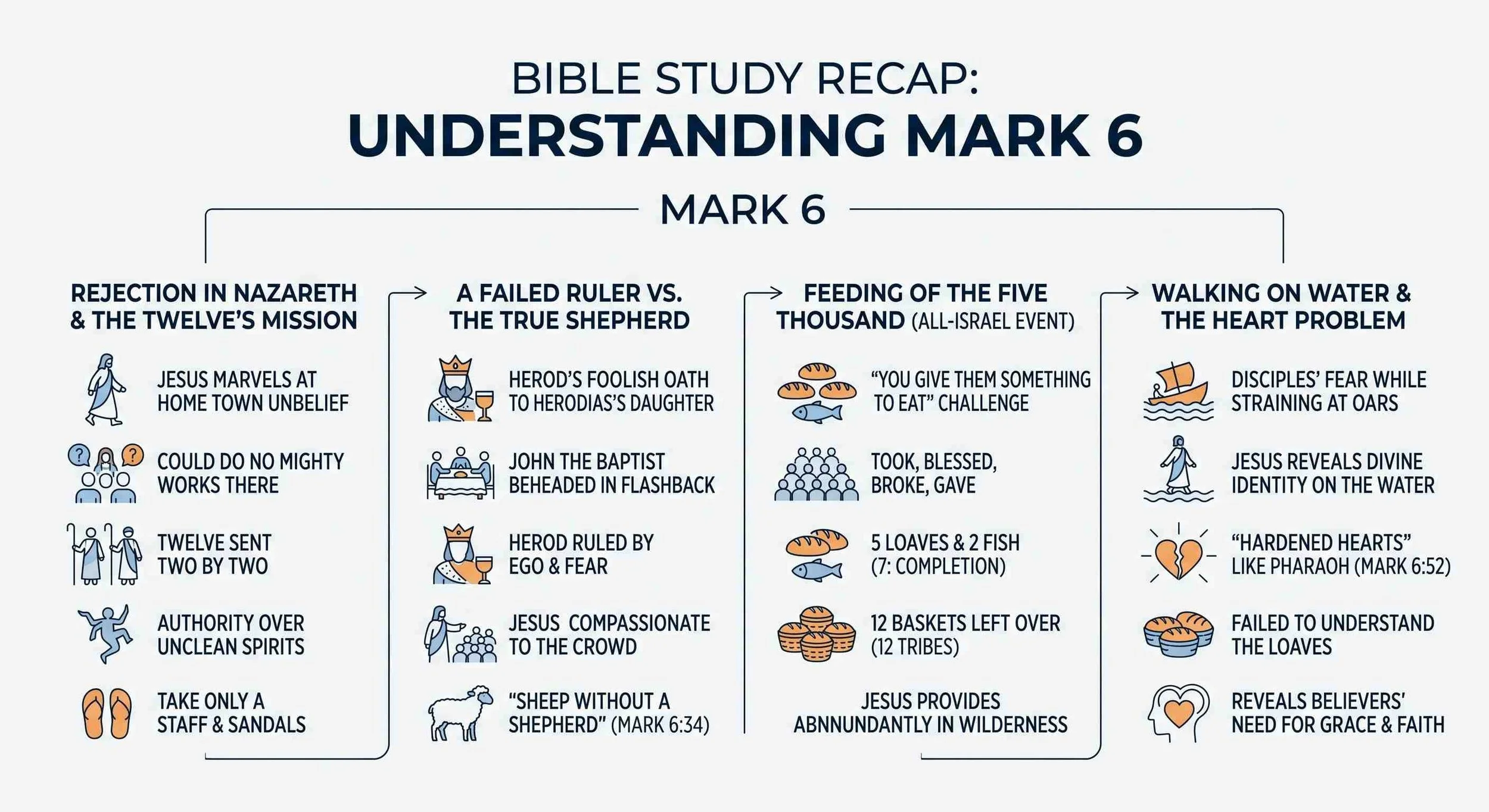
We began by reading Mark 6:1–13. Jesus returns to his hometown of Nazareth, and the people are "astonished" in a way that turns to offense, questioning his authority: "Isn’t this the carpenter… Mary’s son?" Jesus responds with the proverb, "A prophet is not without honor except in his own country." We discussed how this unbelief impacted Jesus’s ministry there; he "could do no mighty work there" and marveled at their unbelief. The class considered whether he "couldn't" or "chose not to," with a study Bible suggesting the latter. This rejection in Nazareth was seen as a microcosm of Israel’s broader rejection of its prophets.
Jesus then sends out the Twelve "two by two," giving them authority over unclean spirits. He instructs them to travel light (staff, sandals, no bread, no money), an exercise in faith showing their dependence on God and hospitality. This made them resemble itinerant preachers or prophets of old. If rejected, they were to "shake off your dirt off your feet," a powerful statement typically made by Jews leaving a Gentile region, signifying judgment. The disciples then went out, preached repentance, cast out demons, and healed the sick, acting as true representatives of God.
Summary of Section 2: Mark 6:1–13 shows the contrast between hometown rejection and faithful mission. Unbelief in Nazareth hinders Jesus’s wonders, while the disciples, sent out in dependence and with authority, multiply his work through preaching, healing, and deliverance, calling Israel to repent.
Bible Verses & Stories Mentioned:
Mark 6:1–13: Rejection at Nazareth; sending of the Twelve.
Genesis 18–19: Sodom and Gomorrah (alluded to in the judgment context).
Cross-references: Jesus's statements on prophets dying in Jerusalem (cf. Luke 13:33–34; Matthew 23:37).
Echoes of Exodus: The pattern of God's deliverers and prophets being rejected.
Section 3: The Failed Leadership of King Herod
The discussion then shifted to the flashback account of John the Baptist's beheading (Mark 6:14–29), which begins with Herod hearing of Jesus and fearing he is a resurrected John. We analyzed Herod as a "feckless ruler," a king in name only who was a slave to his ego and public image. Though he "heard [John] gladly," he made a foolish oath to his stepdaughter during a birthday feast. When she, prompted by her mother Herodias, asked for John the Baptist’s head, Herod was "exceedingly sorry" but felt compelled to follow through because of his pride. This portrayed him as a weak, self-serving leader who fails his people and is ruled by bluster rather than justice. The non-linear narrative structure was noted as a theological tool Mark uses to reveal truths about Jesus by contrasting him with such failed leadership.
Summary of Section 3: The story of John the Baptist’s beheading serves as a flashback to characterize King Herod as a weak leader. His ego and fear of losing face led him to execute a prophet he respected, showcasing a king who fails his people and is ruled by pride.
Bible Verses & Stories Mentioned:
Mark 6:14–29: The story of King Herod and the beheading of John the Baptist.
Section 4: Jesus the True Shepherd and a Miraculous Meal
Next, we connected the story of Herod to the feeding of the five thousand (Mark 6:30–44). The crowd following Jesus into the wilderness or "deserted place" was described as "sheep without a shepherd" (Mark 6:34). This statement stands in stark contrast to Herod. Where Herod hosted a feast for the powerful ending in death, Jesus acts as the true, compassionate shepherd for the leaderless flock.
The disciples' first instinct was to "send them away," a rational but uncaring response. Jesus challenged their limited perspective with the command, "You give them something to eat." He then took five loaves and two fish, and the class noted the significance of the number seven (5+2) as a symbol of completion. The language—he "took," "blessed," "broke," and "gave"—intentionally parallels the words of Communion. The twelve baskets of leftovers were a clear reference to the twelve tribes of Israel, showing God's abundant provision. The five thousand men were interpreted as representing the Pentateuch, framing this as an "all-Israel" event where Jesus, the Shepherd-King, provides for his nation.
Summary of Section 4: In direct contrast to Herod, Jesus is presented as the true shepherd. He sees the crowd with compassion and miraculously feeds them in the wilderness. This sacrament-like event is rich with symbolism, pointing to Jesus as the divine provider who fulfills the needs of his people where their earthly king had failed.
Bible Verses & Stories Mentioned:
Mark 6:30–44: The feeding of the five thousand.
Mark 6:34: Jesus's compassion for the "sheep not having a shepherd."
Mark 6:41: Jesus blesses and breaks the loaves, echoing communion language.
Psalm 23: The Lord is my Shepherd, illustrating a king's role.
The Exodus: The wilderness setting and provision of food echoes God providing manna.
Feeding of the Four Thousand: Mentioned as a future event showing provision for Gentiles.
Section 5: Walking on Water and Hardened Hearts
We then examined Jesus walking on water (Mark 6:45–52), which immediately follows the feeding. While the disciples were "straining at the oars," a metaphor for their spiritual struggle, Jesus appeared. Their reaction was terror, thinking he was a ghost. The key to this section is Mark 6:52: "for they had not understood about the loaves, because their heart was hardened." This verse, the class concluded, is Mark's central point. The disciples’ inability to comprehend the miracle of the loaves led directly to their fear on the water.
The phrase "hardened heart" explicitly links them to Pharaoh in Exodus. Just as Pharaoh witnessed God’s miracles but refused to believe, the disciples saw Jesus's divine power yet failed to understand who he was. They were still viewing him through a lens of political power, not as their divine savior.
Summary of Section 5: The disciples' fear while Jesus walked on water was a direct result of their failure to understand the feeding of the five thousand. Mark diagnoses their problem as having "hardened hearts," a term that equates their spiritual blindness with that of Pharaoh, revealing their deep-seated lack of faith.
Bible Verses & Stories Mentioned:
Mark 6:45–52: The story of Jesus walking on the water.
Mark 6:52: "...their heart was hardened." Identified as the key verse for the chapter.
Pharaoh's Hardened Heart (Exodus): The disciples' condition was directly compared to Pharaoh's.
Section 6: A Contrast in Faith and the Purpose of Failure
The chapter concludes with Jesus arriving in Gennesaret. The contrast in reception is stark. In Jewish Nazareth, unbelief limited his work. Here, in a Gentile-associated region, the people have such faith that they seek healing by merely touching the hem of his garment. This highlights a theme of "outsiders" often showing more faith than "insiders" like the disciples.
The discussion wrapped up by considering why Mark (recording Peter's account) would portray the disciples so negatively. The consensus was that their failures are relatable. We, too, forget the "loaves"—the times God has provided. We, too, have hardened hearts. The story of the disciples, from their failures to their eventual restoration, shows us that our faith journey is imperfect and that we are saved by grace in the midst of our failures, not by our own strength.
Summary of Section 6: The chapter contrasts the disciples' hardened hearts with the eager faith of the people in Gennesaret. The class concluded that the disciples’ failures are included to help us see ourselves in their story, reminding us that we all depend entirely on Jesus's grace for redemption.
Bible Verses & Stories Mentioned:
Healing of the Gerasene Demoniac (Mark 5): Referenced as a previous event in the region.
Woman who touched the hem of Jesus's garment (Mark 5:25–34): Compared to the faith of the people in Gennesaret.
Jesus's Rejection in Nazareth (Mark 6:1–6): Contrasted with his reception in Gennesaret.
The Transfiguration & The Rich Young Ruler: Mentioned as future stories that will expose the disciples' struggles.
Final Summary
In our Bible study on September 2, 2026, we conducted an in-depth analysis of Mark chapter 6, walking through its interconnected narratives. We began with Jesus's rejection in his hometown of Nazareth, which served as a microcosm of prophetic dishonor. From there, we examined the sending of the Twelve, who were commissioned to preach, heal, and act with dependence on God. The study then delved into a major theological contrast: the failed, self-serving leadership of King Herod, who beheaded John the Baptist out of pride, versus the compassionate leadership of Jesus, the true Shepherd-King.
This contrast was powerfully illustrated in the feeding of the five thousand. Where Herod hosted a fatal feast for the elite, Jesus hosted a life-giving feast for the common people, who were "like sheep without a shepherd." This miracle was laden with symbolism connecting Jesus to Israel’s history and his identity as the divine provider. However, the disciples failed to grasp its meaning. The subsequent story of Jesus walking on water exposed their core spiritual problem. Their terror was a symptom of their failure to understand the loaves, as Mark 6:52 states their hearts were "hardened," explicitly comparing them to Pharaoh in Exodus. Ultimately, the class concluded that Mark presents the disciples' flaws—contrasted with the eager faith of outsiders in Gennesaret—so that we can see our own struggles in their story and recognize that salvation comes not from our own understanding, but from the grace of Jesus, who redeems us even in our weakness.
Main Points
Mark 6 is pivotal, showcasing themes of rejection, mission, divine identity, and the nature of faith.
Jesus's rejection in Nazareth illustrates prophetic dishonor at home, where unbelief can constrain the environment for miracles.
The Twelve are sent out with authority and simplicity, modeling dependence on God and accountability for the reception of their message.
The narrative deliberately contrasts Herod, the bad shepherd, with Jesus, the good shepherd.
The feeding of the five thousand is a sacramental event filled with symbolism (the numbers 7, 12, 5000; communion language) connecting Jesus to Israel's history and his role as the divine provider.
The disciples' fear on the water was a direct consequence of their "hardened hearts" and failure to understand the miracle of the loaves, linking their unbelief to that of Pharaoh.
Genesis–Exodus patterns (rejection of prophets, deliverance, wilderness provision) form a primer for reading the Gospels.
The eager faith of Gentiles in Gennesaret stands in stark contrast to the hardened hearts of the disciples.
The disciples' failures are included in the Gospel to help us see our own weaknesses and our desperate need for Jesus's grace.
Scriptures and Stories Mentioned
Bible Scriptures:
Mark 6 (entire chapter): Particularly Mark 6:1–13, 14–29, 30–44, 45–52.
Mark 6:52: "for they had not understood about the loaves, because their heart was hardened."
Mark 6:34: Jesus's compassion for the crowd, "like sheep not having a shepherd."
Psalm 23: The Lord is my shepherd.
Genesis & Exodus (General): Creation; patriarchs (Abraham, Isaac, Jacob, Joseph); Exodus deliverance; Pharaoh's hardened heart.
Genesis 18–19: Sodom and Gomorrah.
Matthew’s infancy narrative (Matthew 2:13–18): Flight to Egypt; Herod’s slaughter of infants.
Cross-references: Luke 13:33–34; Matthew 23:37 (prophets dying in Jerusalem).
Bible Stories:
Jesus rejected in Nazareth.
The sending out of the twelve disciples.
The beheading of John the Baptist.
The feeding of the five thousand.
Jesus walking on water.
The Israelites wandering in the wilderness (Exodus) and the providing of manna.
The Creation Story (seven days).
The healing of the Gerasene demoniac (Legion).
The woman who touched the hem of Jesus's garment.
The feeding of the four thousand.
The Transfiguration.
The story of the Rich Young Ruler.
Mark Chapter 6 Class 10 - Wednesday Bible Study
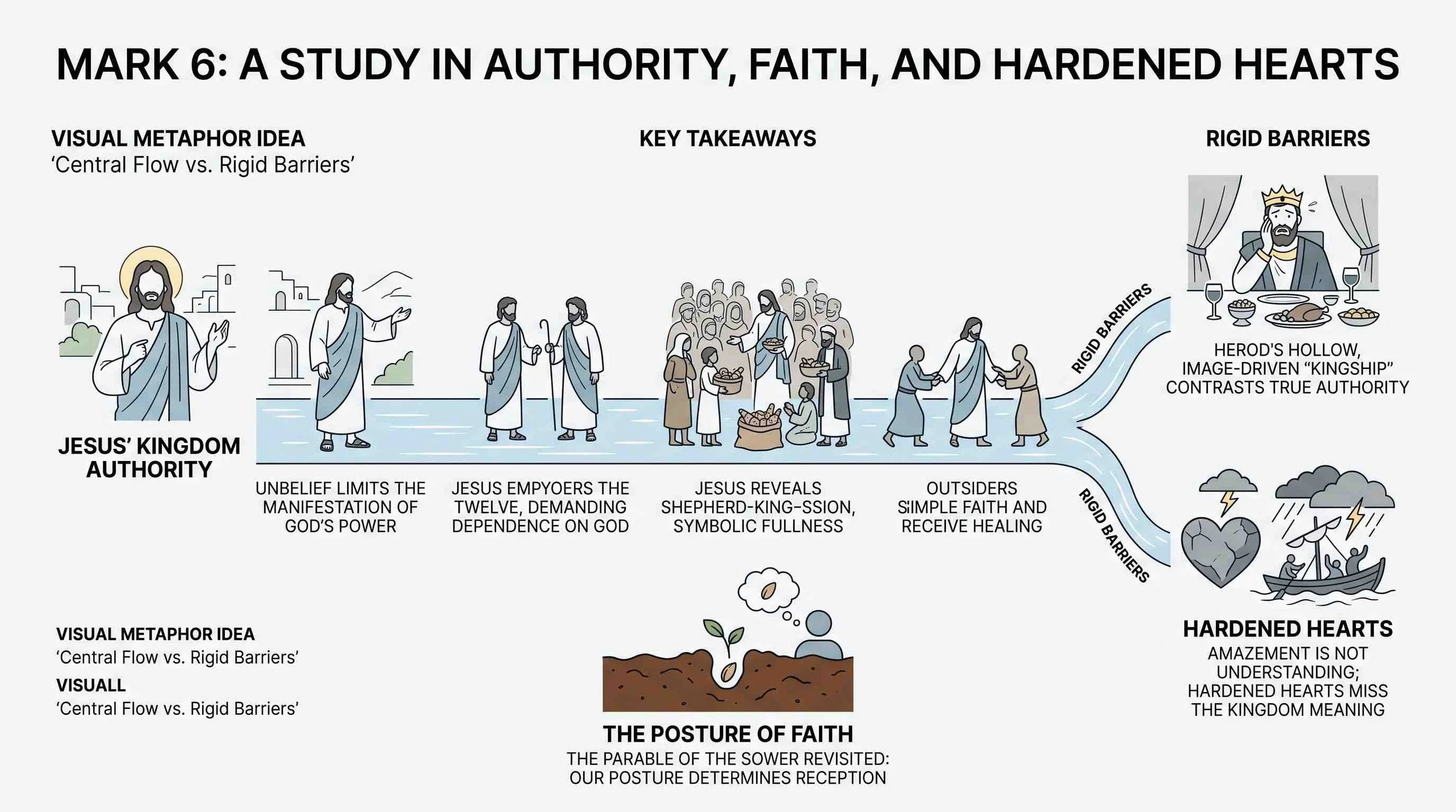
Bible study traced Mark 6 from Jesus’ rejection in Nazareth and the sending of the Twelve to Herod’s image-driven beheading of John, the feeding of the five thousand, Jesus walking on water, and widespread healings—contrasting unbelief and hollow power with Jesus’ true shepherd-king authority.
Gospel of Mark Chapter 6
This is our 10th class on Mark
This is an AI Recap of the class.
Some things may be incorrect.
Short Summary of the Whole Class
On August 19, 2026, we explored Mark 6 in a unified arc: starting with Jesus’ rejection in his hometown and his commissioning of the Twelve, then examining Herod’s corrupt “kingship” in John the Baptist’s beheading. We moved to Jesus’ compassionate provision in the wilderness feeding, his revelation of authority over nature by walking on water, and the inclusive healings in Gennesaret. Along the way, we reflected on faith versus unbelief, dependence on God, hardened hearts, and how Mark weaves theological meaning through narrative symbols and structure.
Section-by-Section Class Walkthrough
1) Class Introduction, Technology, and Mark 5 Recap
Discussion:
We opened by reviewing a new AI-powered recording/transcription tool (“Pod”) that captures audio, provides transcripts, speaker recognition, and auto-summaries—helpful for organizing class content.
Brief recap of Mark 5 set the stage: the Gerasene demoniac (Legion), the woman with the issue of blood, and Jairus’s daughter.
Scriptures mentioned:
Mark 5 (recap: 5:1–20; 5:25–34; 5:35–43)
Stories mentioned:
Legion delivered from demons.
The woman healed by touching Jesus’ garment.
Jairus’s daughter raised.
Short Summary of Section:
On August 19, 2026, we introduced our class tech tool and refreshed key miracles from Mark 5 to frame the transition into Mark 6.
2) Jesus Rejected in His Hometown (Mark 6:1–6)
Discussion:
Jesus teaches in Nazareth; familiarity breeds contempt as townspeople identify him as the local carpenter, leading to offense and unbelief.
Jesus’ saying: “A prophet is not without honor except in his own town…” (Mark 6:4).
Consequence of unbelief: Jesus “could not do any miracles there” beyond a few healings (Mark 6:5–6), contrasting with faith-driven healings in earlier stories.
Analogy: like the movie “Elf,” where belief fuels power—used humorously to illustrate faith’s role.
Scriptures mentioned:
Mark 6:1–6
Stories mentioned:
Jesus teaching in the Nazareth synagogue and being rejected.
Short Summary of Section:
Nazareth’s familiarity led to unbelief that hindered mighty works, highlighting how lack of faith can limit the manifestation of God’s power.
3) Jesus Sends Out the Twelve (Mark 6:7–13)
Discussion:
Jesus commissions the Twelve two by two, granting authority over unclean spirits.
Instructions emphasize radical dependence: take only a staff, no bag, bread, money, or extra tunic; stay in one house per town.
If rejected, shake dust from their feet as prophetic testimony—equating rejecting towns with unclean Gentile lands.
Symbolism noted: number twelve linked to Israel’s tribes; parallels to Exodus readiness (sandals on), nomadic prophets, and trusting God for daily bread.
Dependence and mission as a response to Jesus’ own rejection.
Scriptures mentioned:
Mark 6:7–13
Matthew 18:20 (referenced regarding “two or three gathered”)
Stories mentioned:
The sending and ministry of the Twelve: preaching repentance, casting out demons, healing by anointing with oil.
Short Summary of Section:
Jesus multiplies his ministry after rejection by empowering the Twelve to go in pairs, travel light, depend on God, and render judgment where the message is refused.
4) Herod’s Image-Driven Power and the Beheading of John (Mark 6:14–29)
Discussion:
Herod hears about Jesus and fears he is John raised; Mark uses a flashback to recount John’s death.
John condemned Herod’s unlawful marriage; Herod feared and liked listening to John but capitulated to a rash oath after a dance, ordering John’s beheading to save face.
Contrast between Herod’s hollow, prideful “kingship” and Jesus’ true authority.
Literary note: Mark employs non-chronological storytelling for thematic emphasis; anticipates later “Who do people say I am?” in Mark 8.
Scriptures mentioned:
Mark 6:14–29
Stories mentioned:
Herod’s banquet and John the Baptist’s beheading.
Short Summary of Section:
Mark contrasts Herod’s corrupt, image-obsessed power that kills a prophet with Jesus’ humble, faith-rooted kingdom authority.
5) Feeding the Five Thousand: Wilderness, Shepherd, and Sacrament Echoes (Mark 6:30–44)
Discussion:
Setting in a “deserted place” evokes wilderness provision; Jesus sees people as “sheep without a shepherd,” revealing true kingly compassion.
“You give them something to eat” tests disciples’ trust after their mission with minimal supplies.
Pattern: Jesus looks to heaven, blesses, breaks, and gives—echoes of Eucharistic language and the Last Supper.
Outcomes and symbolism: all are satisfied; twelve baskets remain (Israel’s fullness); five loaves and two fish (seven as completeness), and “five thousand” linked to the Pentateuch; anticipates feeding of the four thousand (Gentile inclusion).
Background contrasts with Israel’s failed shepherds (1–2 Kings).
Scriptures mentioned:
Mark 6:30–44
1–2 Kings (thematic background)
Stories mentioned:
Feeding of the five thousand.
Short Summary of Section:
In the wilderness, Jesus acts as the true shepherd-king, organizing, blessing, and feeding the people, with rich sacramental and symbolic resonances pointing to Israel’s fulfillment.
6) Walking on Water, Hardened Hearts, and Not Understanding the Loaves (Mark 6:45–52)
Discussion:
Jesus prays on the mountain; walks on the sea to aid disciples straining at the oars; calms the wind.
Disciples are terrified and amazed, but Mark diagnoses the core issue: they did not understand the loaves; their hearts were hardened.
Connections to Exodus: Pharaoh’s hard heart; earlier storm-stilling (Mark 4:35–41).
Insight: amazement isn’t the same as understanding; the disciples wrestle with power and status, missing the kingdom meaning of provision.
Scriptures mentioned:
Mark 6:45–52
Mark 4:35–41 (allusion)
Exodus themes (Pharaoh’s hardness; thematic)
Stories mentioned:
Jesus walking on water and calming the wind.
Short Summary of Section:
Despite witnessing provision and authority, the disciples’ hardened hearts keep them from grasping the significance of the loaves and Jesus’ identity.
7) Healings in Gennesaret: Gentile Faith and Simple Touch (Mark 6:53–56)
Discussion:
In Gennesaret, people recognize Jesus immediately, bring the sick, and seek to touch even the fringe of his garment.
Echoes the woman with the flow of blood; widespread healings show outsiders’ simple, effective faith.
Link to the Gerasene demoniac who spread news in the region.
Scriptures mentioned:
Mark 6:53–56
Mark 5:1–20 (Legion; referenced)
Mark 5:25–34 (woman healed; referenced)
Stories mentioned:
Widespread healings by touching Jesus’ garment.
The Gerasene demoniac’s testimony influence.
Short Summary of Section:
Outsiders respond with straightforward faith—touching Jesus’ garment—and are healed, revealing the inclusive reach of the true King’s compassion.
8) Seeds and Soil: Our Posture Toward Jesus’ Word
Discussion:
Revisited the Parable of the Sower: Are we the seed or the soil? What posture do we bring to Jesus’ word?
Mark’s literary artistry: theology conveyed through narrative symbols (wilderness, mountains, bread, numbers) rather than mere chronology.
Jesus repeatedly transforms “lost causes,” yet faces rejection—echoing Israel’s pattern with prophets.
Scriptures mentioned:
Mark 4:1–20 (Parable of the Sower)
Stories mentioned:
Parable of the Sower reflection applied to discipleship posture.
Short Summary of Section:
We examined whether our lives are receptive soil, recognizing how Mark’s narrative challenges readers to receive the kingdom with faith and humility.
Medium-Length Summary of the Class
On August 19, 2026, our study journeyed through Mark 6’s cohesive narrative that contrasts unbelief and hollow power with Jesus’ shepherd-king authority. Beginning in Nazareth, we saw how familiarity produced unbelief that constrained mighty works. Jesus responded by sending the Twelve with minimal provisions, teaching dependence on God and signaling judgment on rejection. Mark’s flashback to Herod’s banquet exposed image-driven, fearful power that murdered John, sharpening the contrast with Jesus’ kingdom. In the wilderness, Jesus fed the five thousand with sacramental echoes, satisfying Israel symbolically and revealing true compassion. Yet when he walked on water and stilled the wind, the disciples’ hardened hearts showed they hadn’t understood the loaves. In Gennesaret, outsiders’ simple faith brought widespread healings through touch, echoing earlier testimonies. We closed by revisiting the Parable of the Sower, asking whether we are receptive soil for the kingdom’s seeds. Taken together, Mark crafts a theological tapestry in which Jesus, the true King, nourishes, delivers, and heals, while human leaders and even disciples often miss the heart of God’s kingdom.
Main Points
Familiarity can breed contempt, becoming a barrier to faith (Nazareth’s rejection).
Unbelief limits the manifestation of God’s power.
Jesus responds to rejection by multiplying his mission, empowering the Twelve.
The disciples’ mission embodies radical dependence on God and includes prophetic judgment on rejection.
Herod’s image-driven “kingship” contrasts with Jesus’ true, compassionate authority.
The feeding of the five thousand reveals shepherd-king compassion, Eucharistic echoes, and symbolic fullness for Israel.
Amazement is not understanding; the disciples’ hardened hearts show failure to grasp the meaning of the loaves.
Jesus’ authority over creation (walking on water, calming wind) reveals identity, yet the call is to faith and understanding.
Outsiders demonstrate simple, trusting faith and receive healing; the kingdom’s reach is inclusive.
Mark weaves theology through narrative symbols and structure (wilderness, mountains, bread, numbers).
The Parable of the Sower challenges our posture: are we receptive soil?
Scriptures Mentioned
Mark 5:1–20 (Gerasa/Gerasene demoniac—Legion; recap/reference)
Mark 5:25–34 (Woman healed by touching Jesus’ garment; recap/reference)
Mark 5:35–43 (Jairus’s daughter raised; recap/reference)
Mark 6:1–6 (Jesus rejected in Nazareth)
Mark 6:7–13 (Sending of the Twelve; instructions; anointing with oil)
Mark 6:14–29 (Herod’s banquet and the beheading of John the Baptist; flashback)
Mark 6:30–44 (Feeding of the five thousand)
Mark 6:45–52 (Jesus walks on water; hardened hearts; not understanding the loaves)
Mark 6:53–56 (Healings in Gennesaret; touching the fringe)
Mark 4:1–20 (Parable of the Sower; revisited)
Mark 4:35–41 (Jesus stills the storm; alluded to)
Matthew 18:20 (Referenced regarding “two or three gathered…”)
Exodus themes (Pharaoh’s hardened heart; thematic connection)
1–2 Kings (failed shepherd-kings; thematic background)
Stories Discussed
Jesus teaching in Nazareth and being rejected.
The sending and ministry of the Twelve.
Herod’s banquet and the beheading of John the Baptist.
Feeding of the five thousand in the wilderness.
Jesus walking on water and calming the wind.
Widespread healings in Gennesaret through touching Jesus’ garment.
The Gerasene demoniac (Legion) spreading news in the region.
The woman healed by touching Jesus’ garment.
Jairus’s daughter raised.
Parable of the Sower and our posture as seed/soil.
Mark Chapter 5 Class 9 - Wednesday Bible Study
Bible study explored Mark 4–5’s crescendo of Jesus’ authority over chaos, demons, disease, and death—highlighting faith, compassion, bodily resurrection hope (against Gnostic ideas), cultural context, secrecy in ministry, and the symbolic resonance of “twelve.”
Gospel of Mark Chapter 5
This is our 9th class on Mark
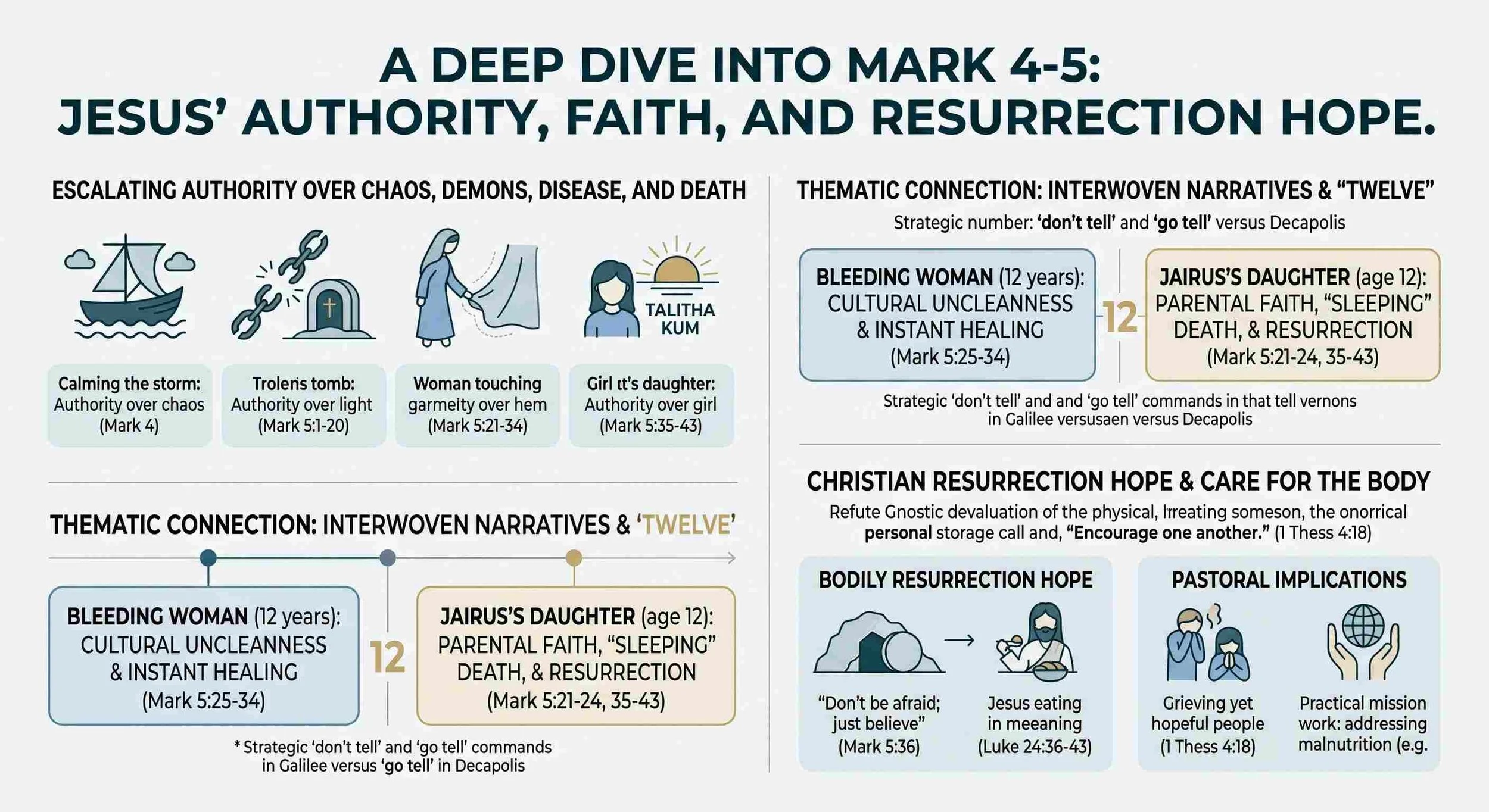
This is an AI Recap of the class.
Some things may be incorrect.
Short Summary of the Whole Class
On August 12, 2026, we studied Mark 5 (framed by Mark 4) and traced Jesus’ escalating authority: calming chaos, casting out a legion of demons, healing a woman with a 12-year hemorrhage, and raising Jairus’s 12-year-old daughter. We discussed faith over fear, Jesus’ tender compassion (calling the woman “Daughter” and telling the girl’s family to feed her), cultural contexts (uncleanness and professional mourners), and why Jesus sometimes commands silence. The class connected these narratives to Christian hope of bodily resurrection and rejected Gnostic tendencies that demean the physical, while offering pastoral reflections on grief and mission.
Section-by-Section Summary with End Notes
1) Intro, Setup, and Narrative Flow from Mark 4 into Mark 5
We settled in (tech checks, sanctuary thermostat) and recalled finishing Mark 4, preparing to continue into Mark 5 with attention to narrative flow and compounding themes.
We noted how Mark presents a mounting display of Jesus’ authority: from calming the storm (chaos) to confronting demons, healing impurity, and overcoming death.
Short Summary of Section:
We set the stage by connecting Mark 4 to Mark 5, anticipating a crescendo of Jesus’ authority across intertwined stories.
Bible Verses Mentioned:
Mark 4:35–41 (Jesus calms the storm)
Stories Mentioned:
The storm on the sea: Jesus stills chaos with “Peace, be still.”
2) The Gerasene (Gadarene) Demoniac: Authority over Legion and Mission in Gentile Territory (Mark 5:1–20)
Jesus arrives in the country of the Gerasenes/Gadarenes and confronts a man possessed by “Legion,” living among tombs, uncontrollable even by chains.
The demons acknowledge Jesus as “Son of the Most High God,” beg not to be tormented, and request entry into a herd of swine (about two thousand), which then rushes into the sea and drowns.
The delivered man is found clothed and in his right mind; locals respond with fear and ask Jesus to leave.
Jesus commissions the man: “Go home to your friends and tell them what great things the Lord has done for you and how he has had compassion on you.” He proclaims in the Decapolis, and many marvel.
Discussion emphasized Jesus’ growing demonstration of authority (building on Mark 4), the social reaction of fear, compassion shown to a marginalized man, and the strategic difference between “go tell” in Gentile regions vs. “don’t tell” in Jewish regions.
Short Summary of Section:
Mark 5:1–20 displays Jesus’ unparalleled authority over demonic powers and his compassionate restoration, sending the delivered man to witness in the Decapolis.
Bible Verses Mentioned:
Mark 5:1–20
Stories Mentioned:
Gerasene/Gadarene demoniac; demons into pigs; proclamation in the Decapolis.
3) Setting the Tone: Jesus’s Power Without Spectacle; Parable of the Soils as Backdrop
Participants reflected on Jesus’s decisive yet unsensational power—redeeming “lost causes” without spectacle (“not firing up like Dragon Ball Z”).
We connected the Parable of the Sower/Soils as background to how faith grows in unlikely places, preparing readers for the intertwined healings.
This set a framework for reading Mark in his own order rather than harmonizing across Gospels, noticing how structure invites belief.
Short Summary of Section:
Jesus works with quiet authority, steadily redeeming desperate situations; Mark’s structure guides readers toward faith.
Bible Verses Mentioned:
Mark 4:1–20 (Parable of the Sower/Soils)
Stories Mentioned:
Parable of the Sower/Soils.
4) Jairus and the Bleeding Woman: Interwoven Faith amid Uncleanness and Death (Mark 5:21–34; 5:21–24, 35–36)
Jairus, a synagogue ruler, pleads with Jesus to heal his daughter at the point of death, risking status and reputation to seek help.
On the way, a woman with a 12-year hemorrhage (who suffered under many physicians and spent all she had) pushes through the crowd to touch Jesus’ garment, believing she will be healed; immediately she is healed.
Jesus perceives power has gone out and asks, “Who touched my clothes?” Despite crowding, the woman confesses; Jesus calls her “Daughter,” saying, “Your faith has made you well. Go in peace and be healed.”
We discussed the cultural weight of ceremonial uncleanness: prolonged exclusion from worship, touch, and community amplifying her suffering.
Thematic focus on “twelve”: twelve years of bleeding and a twelve-year-old girl, signaling completeness and tying the stories together.
We empathized with Jairus’s likely frustration at the interruption and his desperation; Jesus counters fear with belief: “Don’t be afraid; just believe” (Mark 5:36).
We likened the woman’s faith to a seed growing in “bad soil,” reinforcing Jesus’s power to redeem any circumstance.
Short Summary of Section:
These interwoven narratives spotlight active faith crossing social boundaries; Jesus restores the woman’s identity (“Daughter”) and calls Jairus to believe despite fear, with “twelve” symbolically binding the stories.
Bible Verses Mentioned:
Mark 5:21–34 (woman with the issue of blood)
Mark 5:21–24, 35–36 (Jairus’s plea; “Don’t be afraid; just believe”)
Stories Mentioned:
Healing of the woman with the issue of blood
Jairus seeking Jesus’s help
5) Cultural Context: Commotion, Professional Mourners, and Jesus’s Response (Mark 5:38–40)
We unpacked the “commotion” at Jairus’s house: professional mourners in first-century Jewish culture created loud lament to cover the family’s grief.
Jesus says the child is not dead but sleeping; he is mocked, then sends the mourners out and keeps select witnesses (Peter, James, John, and the parents).
The scene highlights Jesus’s countercultural calm and authority in the face of public spectacle.
Short Summary of Section:
Understanding mourning customs clarifies the “commotion,” emphasizing Jesus’s composed authority as he prepares to restore the child.
Bible Verses Mentioned:
Mark 5:38–40
Stories Mentioned:
The house scene with mourners and Jesus dismissing the crowd.
6) Jairus’s Daughter Raised: “Talitha kum,” Faith beyond Fear, and Practical Compassion (Mark 5:41–43)
Jesus takes the girl by the hand and says, “Talitha kum” (“Little girl, I say to you, arise!”); she immediately rises and walks.
Jesus instructs them to give her something to eat and to keep quiet about the miracle (command to silence in a Jewish context), highlighting practical care and discretion.
We noted the pairing with the woman’s healing: shared “twelve,” immediate results, and intimate address.
Short Summary of Section:
Jesus raises Jairus’s daughter, affirming faith over fear and coupling miraculous authority with tender, practical care and strategic discretion.
Bible Verses Mentioned:
Mark 5:41–43
Stories Mentioned:
Raising of Jairus’s daughter; “Talitha kum”; command to feed the girl and keep silent.
7) Secrecy in Ministry: “Don’t Tell” vs. “Go Tell”—Regional Strategy and Timing
We compared Jesus’s “go tell” to the demoniac in Gentile Decapolis (Mark 5:19–20) with “don’t tell” after raising the girl in Jewish Galilee (Mark 5:43).
Discussion noted strategic reasons: avoiding premature crisis or escalation due to growing popularity and opposition from religious leaders; sensitivity to local hostility (including Jairus’s association with synagogue leadership).
We referenced the near-future rejection in Nazareth (Mark 6:1–6) to illustrate rising tensions.
Short Summary of Section:
Jesus’s commands to tell or not tell are strategic, shaped by region, audience, and timing to advance his mission without premature conflict.
Bible Verses Mentioned:
Mark 5:19–20 (Decapolis “go tell”)
Mark 5:43 (command to silence)
Mark 6:1–6 (rejection at Nazareth)
Stories Mentioned:
Demoniac commissioned to proclaim in Decapolis
Command to silence after raising Jairus’s daughter
Rejection in Jesus’s hometown.
8) The Humanity of Jesus and Refuting Gnosticism; Care for the Body
We explored Jesus’s command to feed the raised girl as a sign of his concern for physical needs and the goodness of embodied life.
This led to a discussion of early Christian heresy (Gnosticism), which devalues the physical world; Jesus’s ministry—healing bodies, eating with disciples, inviting touch—refutes Gnostic ideas.
We connected to other accounts of physical restoration: Peter’s mother-in-law immediately serving after healing (Mark 1:29–31); Jesus eating fish and inviting Thomas to touch post-resurrection.
Short Summary of Section:
Jesus’s tangible care affirms the goodness of the body, countering Gnostic tendencies that demean the physical, and underscoring embodied resurrection hope.
Bible Verses Mentioned:
Mark 1:29–31 (Peter’s mother-in-law)
Luke 24:36–43 (Jesus eats with disciples)
John 20:24–29 (Thomas touches Jesus’s wounds)
Stories Mentioned:
Feeding Jairus’s daughter after raising her
Healing of Peter’s mother-in-law
Jesus’s post-resurrection appearances: eating, inviting touch.
9) Death as the Enemy; Grief with Hope; Encouragement from 1 Thessalonians 4
We affirmed that death is the central human problem introduced by sin and not our liberation from “bad bodies”; Jesus overcomes death.
Pastoral counsel: grieve honestly, avoid platitudes (“God needed another angel”), and proclaim hope in Christ.
We read 1 Thessalonians 4:13–18: Christians do not grieve like those without hope; because Jesus died and rose, those in Christ will rise and be together with the Lord forever; “Therefore encourage one another with these words.”
We also cited Romans 8:38–39 (nothing, not even death, separates us from God’s love) and John 11 (Jesus weeps at Lazarus’s tomb and raises him).
Short Summary of Section:
Death is the enemy Christ defeats; Scripture anchors grief in resurrection hope and calls us to encourage one another with the promise of bodily resurrection.
Bible Verses Mentioned:
1 Thessalonians 4:13–18
Romans 8:38–39
John 11
Stories Mentioned:
Lazarus: Jesus’s tears and raising him.
10) Communion, One Body Across Time, and Practical Ministry Reflections
We connected resurrection hope to communion: participation in Christ’s one body across time and place, anticipating future unity and resurrection.
We referenced 1 Corinthians 10:16–17; 11:23–26 regarding communion’s theology and proclamation.
Pastoral reflections included experiences of funerals (e.g., a friend named Helga), grief over time in ministry, global concerns like infant and child mortality, and mission efforts addressing malnutrition (e.g., Haiti).
We noted how compassionate, embodied care echoes Jesus’s attention to tangible needs (like feeding the raised girl).
Short Summary of Section:
Communion embodies our shared resurrection hope and unity, while practical ministry addresses embodied suffering with compassion consistent with Jesus’s example.
Bible Verses Mentioned:
1 Corinthians 10:16–17; 11:23–26
Stories Mentioned:
Pastoral experiences of funerals and grief (e.g., Helga)
Mission work addressing infant mortality and malnutrition (e.g., Haiti).
11) The Cross and Hope Beyond Death; Mark’s Crescendo Revisited
Final reflections connected these miracles to the cross and resurrection: Jesus faces and overcomes sin and death, offering hope.
We revisited Mark’s crescendo: storm (chaos), demoniac (evil), bleeding woman (impurity/suffering), Jairus’s daughter (death), each marked by “immediately” and “amazement” that foreshadow resurrection power.
The note that the girl was twelve highlighted cultural and familial significance, intensifying the miracle’s impact.
Short Summary of Section:
Mark’s arc culminates in Jesus’s victory over death, foreshadowing the cross and resurrection and grounding Christian hope.
Bible Verses Mentioned:
Mark 4:35–41; 5:1–20; 5:25–34; 5:35–43
Mark 15–16 (thematic connection to crucifixion and resurrection)
Stories Mentioned:
Calming the storm
Gerasene demoniac
Bleeding woman
Jairus’s daughter raised
Crucifixion and resurrection (theological framework)
Medium-Length Summary of the Class
On August 12, 2026, our church Bible study traced Mark’s narrative arc from calming the storm to the climactic healings in chapter 5, presenting Jesus’s escalating authority over chaos, demons, disease, and death. We examined the Gerasene demoniac’s deliverance and mission in Gentile territory (a “go tell” moment), contrasted with Jesus’s command to silence after raising Jairus’s daughter in Jewish Galilee. Interweaving Jairus’s desperate plea with the bleeding woman’s courageous touch, we highlighted faith over fear, cultural realities of uncleanness, and the tender identity restoration in Jesus’s address, “Daughter.” We explored mourning customs to understand the “commotion” and noted Jesus’s practical care—telling the family to feed the raised girl. From there, we connected these embodied miracles to Christian hope of bodily resurrection, rejecting Gnostic tendencies that demean the physical. Reading 1 Thessalonians 4, Romans 8, and John 11, we emphasized honest grief coupled with hope in Christ’s victory. Communion was framed as participation in the one body across time, and we reflected pastorally on funerals, global child mortality, and mission efforts, all echoing Jesus’s embodied compassion. Throughout, the symbolic thread of “twelve” signaled completeness and bound the stories together, pointing to the cross and resurrection where Jesus decisively overcomes sin and death.
Main Points
Jesus’s authority is comprehensive: over chaos, demons, disease, and death.
Faith over fear: “Don’t be afraid; only believe” is central to Mark’s invitation.
Compassion and identity: Jesus publicly restores dignity (calling the woman “Daughter”) and practices practical care (“give her something to eat”).
Cultural context matters: ceremonial uncleanness and professional mourners shape the narratives’ tension.
Symbolism of “twelve”: evokes completeness and ties the bleeding woman and Jairus’s daughter together.
Secrecy vs. proclamation: Jesus’s “don’t tell” vs. “go tell” commands are strategic—shaped by region, audience, and timing.
Bodily resurrection hope: Christianity affirms the goodness of the body and rejects Gnostic devaluation of the physical.
Pastoral care: grieve honestly, avoid platitudes, encourage with resurrection hope, and serve embodied needs in mission.
Bible Scriptures Mentioned
Mark 4:1–20 (Parable of the Sower/Soils)
Mark 4:35–41 (Jesus calms the storm)
Mark 5:1–20 (Gerasene/Gadarene demoniac; Decapolis “go tell”)
Mark 5:21–34 (Healing of the bleeding woman; “Daughter, your faith has made you well”)
Mark 5:35–43 (Jairus’s daughter; “Don’t be afraid; just believe”; “Talitha kum”; command to feed and keep silent)
Mark 6:1–6 (Rejection at Nazareth; next narrative move)
Mark 1:29–31 (Healing of Peter’s mother-in-law)
Luke 24:36–43 (Post-resurrection Jesus eats; physical reality)
John 20:24–29 (Thomas invited to touch Jesus’s wounds)
1 Thessalonians 4:13–18 (Encouragement in grief; resurrection hope)
Romans 8:38–39 (Nothing separates us from God’s love)
John 11 (Jesus weeps and raises Lazarus)
1 Corinthians 10:16–17; 11:23–26 (Communion and the one body)
Mark 15–16 (Crucifixion and resurrection; thematic connection)
Stories Discussed
Calming of the storm on the sea
Gerasene/Gadarene demoniac delivered; pigs; proclamation in Decapolis
Healing of the woman with the issue of blood
Jairus’s 12-year-old daughter raised with “Talitha kum”
Parable of the Sower/Soils
Healing of Peter’s mother-in-law
Jesus’s post-resurrection appearances: eating fish; inviting Thomas’s touch
Lazarus: Jesus’s tears and raising him
Rejection at Nazareth
Crucifixion and resurrection (theological framework)
Pastoral experiences of funerals (e.g., Helga)
Mission work addressing infant and child mortality and malnutrition (e.g., Haiti)
Mark Chapter 4-5a Class 8 - Wednesday Bible Study
Bible study explored the Gospel of Mark, discussing its three-act structure, Jesus’ identity as the true Son of God, and how His upside-down kingdom—revealed through parables, miracles, and His passion—confronts evil, forgives sins, and calls us to sacrificial discipleship.
Gospel of Mark Chapter 4-5
This is our 8th class on Mark
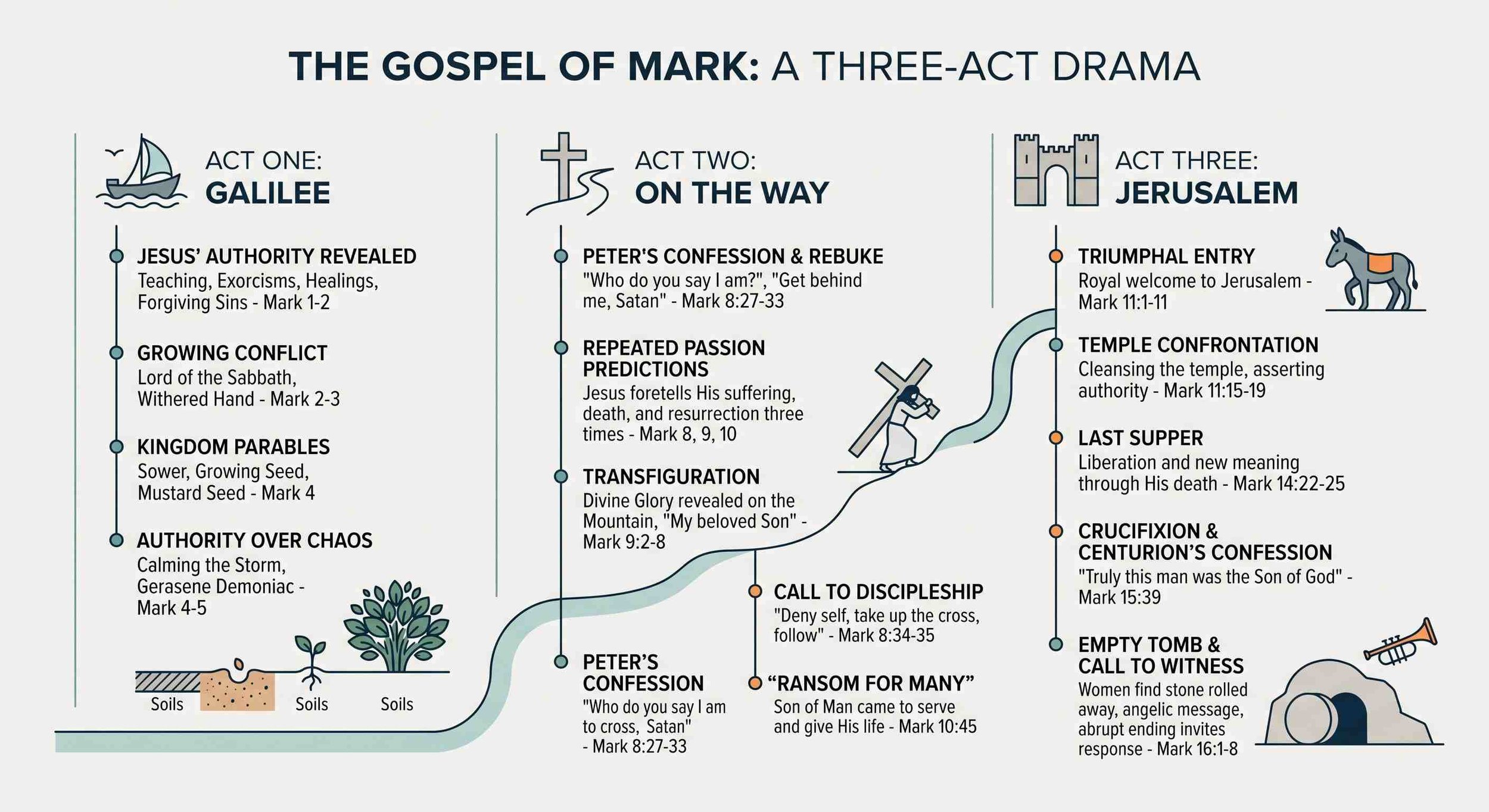
This is an AI Recap of the class.
Some things may be incorrect.
Short Summary of the Whole Class
We took a comprehensive journey through the Gospel of Mark, starting with an overview of its three-act structure and its bold claim that Jesus, not Caesar, is the true “Son of God.” In Act One, we traced Jesus' authority through healings, exorcisms, and parables like the sower, which teach that God's kingdom grows in mysterious ways and offers grace even for "bad soil." We examined the parables of the growing seed and mustard seed as illustrations of small beginnings leading to expansive shelter. This theme of authority over chaos was powerfully demonstrated in Jesus calming the storm and delivering the Gerasene demoniac, showing that no person or situation is beyond His restorative power. Act Two focused on the cross-shaped nature of discipleship, highlighted by Peter's confession, the Transfiguration, and Jesus’ repeated passion predictions. Finally, Act Three brought us to Jerusalem for the confrontation, crucifixion—marked by the centurion’s climactic confession—and the empty tomb, leaving us with a challenge to respond in faith and witness.
Session Walkthrough with Section Summaries
1) Getting Started: Community, Setup, and Study Approach
We restarted Zoom, settled tech issues, and discussed comfort levels with being on camera.
Cris outlined Bible study “house rules”: any question is welcome (even “dumb” ones can lead to good insights), and we aim to stay within the Gospel we’re studying rather than harmonizing all four.
Key approach: Each Gospel presents a distinct facet of Jesus. Mark’s stories serve his grand narrative rather than a day-by-day chronology.
Stories mentioned:
General setup and group conversation, no specific biblical narrative yet.
Verses referenced:
None explicitly in this section.
Short summary:
We set expectations for a focused study of Mark, respecting its unique voice, and prepared the group for a narrative-driven exploration.
2) Overview Video: The Gospel of Mark in Three Acts
We watched The Bible Project’s overview of Mark.
Mark’s thesis: “The beginning of the gospel about Jesus the Messiah, the Son of God” (Mark 1:1).
Structure:
Act One (Galilee): Jesus’ authority amazes crowds; questions about His identity grow.
Act Two (On the way): Disciples struggle to understand a suffering Messiah; repeated predictions of His death; call to carry the cross.
Act Three (Jerusalem): Royal entry, temple confrontation, debates, passion, crucifixion, resurrection, and the abrupt ending that challenges the reader.
Stories mentioned:
John the Baptist preparing the way.
Healings/exorcisms; forgiving sins; parables of the kingdom.
Peter’s confession; Transfiguration; passion narrative; empty tomb.
Verses referenced:
Mark 1:1; prophetic background from Isaiah/Malachi (Mark 1:2–3).
Parables (Mark 4).
Peter’s confession (Mark 8:27–30).
Transfiguration (Mark 9:2–8).
“Ransom for many” (Mark 10:45).
Triumphal entry (Mark 11).
Olivet Discourse (Mark 13).
Last Supper (Mark 14).
Crucifixion and centurion’s confession (Mark 15:39).
Empty tomb (Mark 16:1–8).
Short summary:
The video framed Mark as a carefully designed three-act drama centered on Jesus’ identity and His paradoxical kingship through suffering.
3) Mark’s Opening Claim: Son of God and Gospel as Confrontation
Discussion of Mark 1:1: “Jesus Christ, the Son of God.”
Historical lens: “Son of God” and “euangelion” (gospel/good news) were imperial titles and announcements used for Caesar.
Mark’s bold counter-claim: Jesus, not Caesar, is the true King and Son of God; His “good news” confronts Rome’s claims and ushers in God’s reign.
Stories mentioned:
Contextual background of Roman imperial proclamations; no single biblical story, but framing of Mark’s thesis.
Verses referenced:
Mark 1:1; the term euangelion throughout Mark.
Short summary:
Mark’s opening line is a theological and political shockwave, announcing Jesus as the true royal Son of God and redefining “good news.”
4) Act One Highlights: Authority, Calling, Forgiveness, and Conflict
Jesus’ authority revealed in:
Baptism and divine affirmation (Mark 1:9–11).
Announcement of God’s kingdom (Mark 1:14–15).
Calling disciples (Mark 1:16–20).
Teaching with authority and exorcisms (Mark 1:21–28).
Healings (Mark 1:29–34; 2:1–12).
The paralytic lowered through the roof (Mark 2:1–12):
Jesus forgives sins and heals; confrontation with scribes over blasphemy.
Anticipates resurrection: a “dead” man rises and walks; forgiveness tied to Jesus’ authority.
Growing conflict:
Questions about fasting (Mark 2:18–22), Sabbath (Mark 2:23–28; 3:1–6), and legalism.
Discussion in class about “withered hand” versus “deaf mute” healing clarified later in Mark (the withered hand: Mark 3:1–6; deaf-mute: Mark 7:31–37).
Stories mentioned:
Paralytic through the roof.
Lord of the Sabbath.
Healing of the man with the withered hand.
Later: healing of a deaf-mute man.
Verses referenced:
Mark 1:9–15, 1:21–34; 2:1–28; 3:1–6.
Mark 7:31–37 (deaf-mute healing, noted in discussion though later in the narrative).
Short summary:
Act One establishes Jesus’ divine authority to announce God’s kingdom, call disciples, forgive sins, and heal—sparking both faith and opposition.
5) Parables and the Hidden Kingdom (Mark 4)
Context: Mark 4 is a thematic hub. We emphasized reading from multiple translations and listening to the audio Bible to let the Scripture read us. The parable of the sower reframes expectations—the word can land on "bad soil," but Jesus' mission is for those who don't "have it all together."
Seed and soils (Mark 4:1–20): Different receptions to Jesus’ word. A friend’s question, “What if I’m just bad soil?” shifted perspective toward grace. An analogy about NASCAR illustrated how "good news" can fall on deaf ears.
Lamp under a basket (Mark 4:21–25): The kingdom's light is meant to be visible. Our receptivity ("Take heed what you hear") influences our understanding.
The seed that grows secretly (Mark 4:26–29): The kingdom grows mysteriously, in stages, even when we don't see it. We are encouraged to trust God's hidden work.
Mustard seed (Mark 4:30–32): Small beginnings lead to expansive, hospitable outcomes where birds can find shelter. God doesn't need much to work with.
Parables and private explanations (Mark 4:33–34): Jesus speaks in parables "as they were able to hear" but explains privately to disciples, highlighting that understanding is gradual and requires patient listening.
Stories mentioned:
Parable of the sower (seed and soils).
Personal anecdote about NASCAR as good news on deaf ears.
Friend's question: "What if I'm just bad soil?"
Lamp under a basket.
The growing seed.
Mustard seed.
Verses referenced:
Mark 4:1–20, 4:21–25, 4:26–29, 4:30–32, 4:33–34.
Short summary:
Jesus’ parables in Mark 4 explain that the kingdom advances amid mixed responses. Its growth is real but often hidden, starting small and becoming an expansive refuge, calling us to listen attentively and trust God’s mysterious process.
6) Authority Over Chaos: Calming the Storm and Delivering the Demoniac
Jesus Calming the Storm (Mark 4:35-41): The class connected the sea with biblical imagery of chaos and evil ("tohu vavohu"). Jesus asleep, like Jonah, is awakened by fearful disciples. His authoritative words, "Peace! Be still!" transform terror into calm, showing kingdom power. The disciples' fear shows that faith grows through crisis and encounter, even when full understanding lags.
The Gerasene Demoniac (Mark 5:1–20): Reading the story aloud, we saw how Jesus crosses into Gentile territory to confront overwhelming evil.
Demons recognize Jesus' identity and authority immediately ("Son of the Most High God") and fall before Him in an act of submission or "worship."
The name "Legion" and the 2,000 pigs underscore the scale of oppression.
Jesus’ few words bring decisive freedom, restoring the man to his right mind.
The restored man is commissioned to "Go... tell... how He has shown compassion," becoming a witness in the Decapolis. This demonstrates that no "soil" is beyond Jesus' reach and that restoration leads to mission.
Stories mentioned:
Jesus calming the storm.
Jonah asleep during the storm (Jonah 1).
Israel crossing the Red Sea (Exodus 14).
Gerasene/Gadarenes demoniac delivered and sent to testify.
Leviathan motif.
Verses referenced:
Mark 4:35–41.
Mark 5:1–20.
Genesis 1:2 ("tohu vavohu").
Thematic tie to Mark 15:39.
John 9:38 (as a comparison for "worshipped").
Implied references to Jonah 1, Exodus 14, Job 41, Psalm 74:13–14.
Short summary:
Jesus demonstrates His absolute authority over chaos and evil by calming the sea and liberating the Gerasene demoniac, proving that His mission extends to the most broken places and that His restorative power leads to worship and witness.
Main Points
Mark presents Jesus as the true Messiah and Son of God, challenging imperial claims.
The Gospel is structured in three acts: Galilee, the way, and Jerusalem.
Jesus’ authority is demonstrated through teaching, exorcism, healing, and forgiving sins.
Parables reveal the hidden, unexpected growth of God’s kingdom; its small beginnings lead to expansive refuge.
Jesus' authoritative word brings transformation, calming storms of chaos and delivering people from spiritual oppression.
No one is beyond Jesus' restorative mission; even "bad soil" can be made good, and restoration leads to witness.
Messiahship is defined by suffering service; discipleship is cross-bearing.
The passion narrative culminates in recognition of Jesus’ divine identity and the empty tomb’s call to witness.
Mark’s abrupt ending invites personal response and proclamation.
Bible Scriptures Mentioned
Genesis 1:2 (tohu vavohu—formless and void)
Exodus 14 (Israel crossing the Red Sea)
Job 41; Psalm 74:13–14 (Leviathan motif, implied in discussion)
Mark 1:1; 1:2–3 (Isaiah/Malachi quotation); 1:9–15; 1:21–34
Mark 2:1–12 (paralytic); 2:18–22 (fasting); 2:23–28 (Sabbath)
Mark 3:1–6 (withered hand)
Mark 4:1–20 (seed and soils); 4:21–25 (lamp under a basket); 4:26–29 (growing seed); 4:30–32 (mustard seed); 4:33-34 (parables and private explanations)
Mark 4:35–41 (Jesus calms the storm)
Mark 5:1–20 (Gerasene/Gadarenes demoniac; Decapolis mission)
Mark 7:31–37 (deaf-mute healing, noted in discussion)
Mark 8:27–38 (Peter’s confession; call to take up the cross)
Mark 9:2–8 (Transfiguration); 9:31 (passion prediction)
Mark 10:33–34 (passion prediction); 10:45 (ransom for many)
Mark 11:1–11 (triumphal entry); 11:15–19 (temple action); 12 (controversies)
Mark 13 (warnings/judgment)
Mark 14:22–25 (Last Supper)
Mark 15:33–39 (darkness; centurion’s confession)
Mark 16:1–8 (empty tomb)
John 9:38 (example of “worshipped him,” noted in translation discussion)
Stories Discussed
John the Baptist preparing the way
Calling of the disciples
Exorcisms and healings in Galilee
Paralytic lowered through the roof
Questions about fasting; Lord of the Sabbath
Healing of the man with the withered hand
Parables: seed and soils; lamp under a basket; the growing seed; mustard seed
NASCAR analogy for "good news" on deaf ears
"What if I'm bad soil?"—a friend's self-reflection on grace
Jesus calming the storm
Jonah asleep in the storm
Israel crossing the Red Sea
Gerasene demoniac delivered and sent to testify in the Decapolis
Peter’s confession and the call to take up the cross
The Transfiguration
“Ransom for many” teaching
Triumphal entry
Temple cleansing and debates
The Last Supper
Crucifixion and the centurion’s confession
Empty tomb and the angelic announcement
Mark Chapter 4-5 Class 7 - Wednesday Bible Study
During our Bible study on May 27, 2026, we explored Mark 4:1–34, focusing on Jesus's parables—especially the Sower—and how they reveal a deeper, hopeful message about the kingdom of God, spiritual growth, and the critical theme of truly hearing and seeing God's word to bear fruit.
Gospel of Mark Chapter 4-5
This is our 7th class on Mark
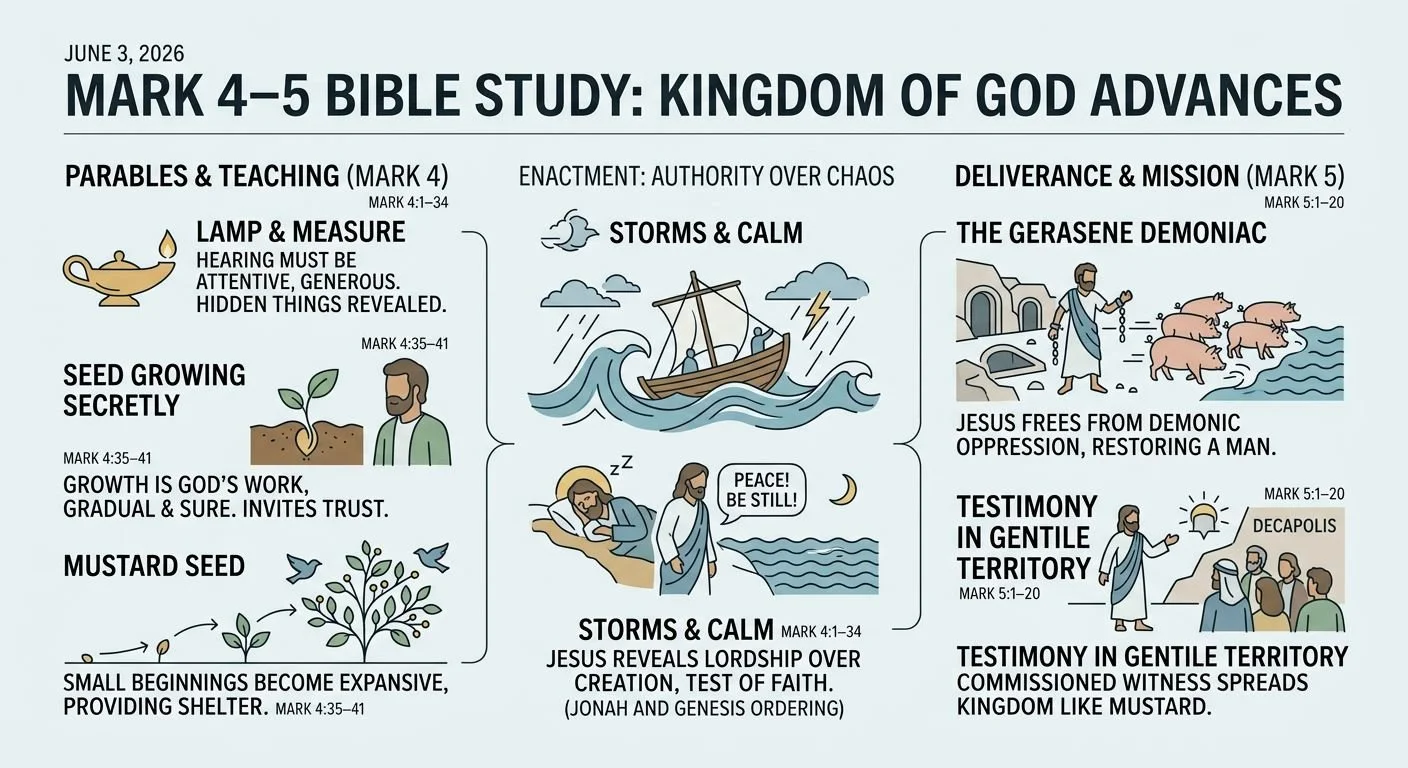
This is an AI Recap of the class.
Some things may be incorrect.
Short summary of the whole class
On June 3, 2026, we welcomed newcomers and studied Mark 4:19–5:20 (with previews of 5:21–43), revisiting the Parable of the Sower’s pastoral tension (“What if I’m bad soil?”) and connecting it to Jesus’ sayings about the lamp and the measure, the seed growing secretly, and the mustard seed. We saw these teachings enacted as Jesus calmed the storm and freed the man with “Legion,” commissioning him to witness in Gentile territory. Along the way we noted “hard” versus “soft” narrative splits, cross-referenced Isaiah, Genesis, Jonah, and Leviathan imagery, and anticipated the healing of the bleeding woman and Jairus’s daughter—concluding that God’s Kingdom advances irresistibly, turning even “bad soil” into good.
Section-by-section walkthrough
1) Setup, class method, and translations
We welcomed first-time attendees, explained our practice of reading from the NKJV dramatized audio while allowing other translations, and encouraged noting translation differences (sometimes peeking at Greek).
We framed the study of Mark with “splits”—distinguishing “hard” (new movement/scene) and “soft” (development within a theme) transitions.
We set the reading scope: Mark 4:19 through the first story of Mark 5.
Short summary of this section:
Orientation to method (NKJV focus, comparative notes), preview of Mark 4–5, and the “hard vs. soft split” lens for tracking Mark’s flow.
Bible verses mentioned:
Announced Mark 4:19–5:20 (NKJV).
Stories discussed:
None specifically expounded yet; setup for Mark 4–5.
2) Parable of the Sower revisited: “What if I’m bad soil?” (Mark 4:1–20; read 4:19–20)
We revisited last week’s topic and raised a pastoral concern: “What if I’m just bad soil?” The parable names soils without prescribing how to change soil type, which can feel unresolved.
A participant offered that faith can grow even from “cement,” emphasizing personal responsibility and resilient faith.
We recognized the tension and prepared to read onward for how Mark addresses hearing, growth, and transformation.
Short summary of this section:
We wrestled with anxiety about being “bad soil,” affirmed resilient faith, and acknowledged the parable’s limits—looking ahead to how subsequent teachings and stories speak to transformation.
Bible verses mentioned:
Mark 4:3–20 (especially 4:19–20).
Stories discussed:
Parable of the Sower.
3) Lamp under a basket and measure given (Mark 4:21–25)
“Nothing hidden… will not be revealed”; “Take heed what you hear… with the measure you use, it will be measured to you.”
We connected these sayings to the “bad soil” concern: attentive hearing and generous receptivity shape understanding. Hiddenness now doesn’t preclude future revelation—hope for anxious hearts.
Short summary of this section:
Jesus urges careful, open hearing; hidden things will come to light, and generous reception brings greater understanding.
Bible verses mentioned:
Mark 4:21–25.
Stories discussed:
Lamp under a basket; measure you use.
4) The seed growing secretly (Mark 4:26–29)
The kingdom grows “he himself does not know how,” moving from blade to full grain—God’s initiative at work beyond our control.
This encourages those worried about visible progress: growth can be real though unseen.
Short summary of this section:
The kingdom’s growth is God-driven, gradual, and sure—inviting trust when we can’t see or engineer results.
Bible verses mentioned:
Mark 4:26–29.
Stories discussed:
Parable of the growing seed.
5) The mustard seed (Mark 4:30–34)
From the smallest beginnings to a sprawling plant sheltering “birds of the air.”
We noted the expansive, even unwieldy, spread of the kingdom—small faith leading to shelter for many.
Mark notes Jesus used parables publicly and explained them privately—highlighting hearing and understanding, even amid disciples’ frequent confusion.
Short summary of this section:
The kingdom starts small but grows large enough to shelter others; Jesus tailors revelation to hearers’ capacity.
Bible verses mentioned:
Mark 4:30–34.
Stories discussed:
Mustard seed; Jesus’ use of parables and private explanations.
6) Connecting parables to the storm: structure and faith
We debated whether Jesus calming the storm is a “hard shift” or thematically continuous with the seed parables.
Conclusion: It’s connected by faith—Jesus’ question, “Why are you so afraid? Do you still have no faith?” tests whether teaching has taken root; tiny-seed faith should grow in the disciples.
Short summary of this section:
The storm narrative enacts the parable lessons: hearing must mature into trusting action; small faith is meant to grow.
Bible verses mentioned:
Mark 4:21–34 (context), Mark 4:35–41 (transition link).
Stories discussed:
Parables (lamp, growing seed, mustard seed) linked to calming the storm.
7) Calming the storm—Jesus as Lord over chaos (Mark 4:35–41)
Same day, crossing the lake; a great windstorm threatens. Jesus sleeps; the disciples panic: “Teacher, do You not care that we are perishing?”
Jesus rebukes wind and sea: “Peace! Be still!” Then: “Why are you so fearful? How is it that you have no faith?”
The class connected this to biblical chaos imagery: Genesis’ ordering of waters (tohu va-vohu), Jonah asleep in a storm, and Leviathan motifs—Jesus imposes divine order over creation.
Short summary of this section:
Teaching becomes test; Jesus reveals authority over chaos, confronting fear and calling for faith; the disciples’ awe advances revelation.
Bible verses mentioned:
Mark 4:35–41; Genesis 1:2–8; Jonah 1; Job 41; Psalm 74:14; Isaiah 27:1.
Stories discussed:
Calming the storm; Jonah in the storm; creation ordering; Leviathan imagery.
8) Crossing to the Gerasenes—deliverance in Gentile territory (Mark 5:1–20)
Arrival “on the other side”: a man living among tombs confronts Jesus; “Legion,” many demons, recognize Him as “Son of the Most High God.”
Jesus permits demons into pigs (~2,000); the herd rushes into the sea and drowns. The man is found “sitting, clothed, and in his right mind.”
Townspeople fear and plead for Jesus to leave; the delivered man begs to accompany Jesus. Instead, Jesus sends him home to testify: “Tell them what great things the Lord has done for you and how He has had compassion on you.” He proclaims in the Decapolis; “all marveled.”
We discussed purity laws, Gentile setting, economic impact, and how Jesus’ mission disrupts systems that value profit over people. We also noted a strategic “split”: while Jesus often hushes witnesses in Jewish regions, here He commissions Gentile proclamation.
Short summary of this section:
Jesus’ authority frees a tormented man; fear pushes some away, but the healed man becomes a missionary—planting mustard-seed witness in new soil.
Bible verses mentioned:
Mark 5:1–20; parallels noted: Matthew 8:28–34; Luke 8:26–39.
Stories discussed:
Gerasene/Gadarene demoniac; pigs rushing into the sea; Decapolis testimony.
9) Anticipation: unclean and death overcome (Mark 5:21–43 preview)
We previewed the woman with a 12-year hemorrhage (ceremonial impurity; Leviticus 15) and Jairus’s daughter (death as the ultimate barrier).
Thematic arc: what looks like “bad soil” (impurity, death) becomes receptive ground through Jesus’ power and the woman’s faith.
Short summary of this section:
Upcoming stories continue the pattern: Jesus meets impurity and death and brings healing and life.
Bible verses mentioned:
Mark 5:21–43 (preview); Leviticus 15; parallels Matthew 9:18–26; Luke 8:40–56.
Stories discussed:
Preview: bleeding woman; Jairus’s daughter raised.
10) Hard vs. soft splits and discipleship, understanding, and communal faith
We traced “soft” splits across sayings and parables (Mark 4:21–34) and “hard” shifts into enacted narratives (storm; Gerasenes), noting thematic continuity: hearing, faith, growth, mission.
The disciples’ partial understanding—“Who then is this?”—highlights a journey toward clarity, later empowered by the Spirit (Acts 2).
We emphasized communal faith: when personal faith is thin, the church bears one another—reflecting how the kingdom grows together.
Short summary of this section:
Mark’s structure moves from teaching to testing to mission; disciples grow from partial grasp to Spirit-shaped clarity, supported by communal faith.
Bible verses mentioned:
Mark 4:21–34; Mark 4:35–41; Mark 5:1–20; Acts 2 (implied).
Stories discussed:
Flow across parables, storm, and exorcism; early church community (conceptual).
Medium-length final summary (dated 2026-06-03 18:31:56)
On June 3, 2026, our class followed Mark’s unified arc from teaching to testing to mission. We revisited the Parable of the Sower and the pastoral worry, “What if I’m bad soil?” and then listened to Jesus’ sayings on the lamp and the measure, the seed that grows “we know not how,” and the mustard seed—learning that hearing must be attentive, growth is God’s work, and small beginnings can shelter many. The narrative moved from parables to enactment as Jesus calmed the storm, confronting fear and revealing authority over chaos with echoes of Genesis, Jonah, and Leviathan imagery. Crossing into Gentile territory, Jesus liberated the Gerasene demoniac, restoring him and commissioning him to testify—an intentional witness strategy beyond Israel that challenges economic priorities and spreads the kingdom like mustard. We previewed the healing of the bleeding woman and raising of Jairus’s daughter, seeing how Jesus overcomes impurity and death. Throughout, we tracked “soft” and “hard” splits, recognized the disciples’ partial understanding, and emphasized communal faith—arriving at the conclusion that the Kingdom advances irresistibly, turning even “bad soil” into good through Jesus’ compassionate authority.
Main points
The Parable of the Sower raises real pastoral anxiety about being “bad soil.”
Jesus’ lamp and measure sayings call for attentive, generous hearing; hidden things will be revealed.
The kingdom’s growth is God’s initiative—often unseen yet sure.
Mustard-seed beginnings become expansive and sheltering.
The storm narrative tests whether parable teaching has matured into faith; Jesus reveals authority over creation and chaos.
Deliverance in the Gerasenes shows Jesus’ power over demonic oppression, critiques profit-over-people priorities, and plants witness in Gentile territory.
Witness strategy shifts: “go tell” in Gentile regions versus frequent hush in Jewish contexts.
Upcoming healings (bleeding woman; Jairus’s daughter) reveal authority over impurity and death.
Mark’s “soft” and “hard” splits serve a continuous narrative about hearing, faith, growth, and mission.
Discipleship moves from partial understanding to Spirit-enabled clarity, sustained by communal faith.
Bible Scriptures mentioned
Mark 4:1–20 (Parable of the Sower; focus on 4:19–20)
Mark 4:21–25 (Lamp under a basket; measure you use)
Mark 4:26–29 (Seed growing secretly)
Mark 4:30–34 (Mustard seed; parables explained to disciples)
Mark 4:35–41 (Jesus calms the storm)
Mark 5:1–20 (Gerasene/Gadarene demoniac; Decapolis testimony)
Mark 5:21–43 (Preview: bleeding woman; Jairus’s daughter)
Genesis 1:2–8 (Ordering the waters; chaos to order)
Jonah 1 (Jonah asleep in the storm; awakening)
Job 41; Psalm 74:14; Isaiah 27:1 (Leviathan/sea-chaos imagery)
Leviticus 15 (Laws on ceremonial impurity)
Acts 2 (implied; Spirit’s coming)
Stories discussed
Parable of the Sower (seed on different soils)
Lamp under a basket (light meant to shine)
Seed growing secretly (mysterious, God-driven growth)
Mustard seed (small becomes expansive; shelter for many)
Jesus calming the storm (authority over wind and waves)
Jonah in the storm (sleeping, awakening, danger confronted)
Creation ordering in Genesis (God subdues the deep)
The Gerasene demoniac and “Legion” (deliverance; pigs; Decapolis witness)
Preview: the woman with a 12-year hemorrhage and Jairus’s daughter raised from the dead
Content creation date: 2026-06-03 18:31:56
Mark Chapter 4 Class 6 - Wednesday Bible Study
During our Bible study on May 27, 2026, we explored Mark 4:1–34, focusing on Jesus's parables—especially the Sower—and how they reveal a deeper, hopeful message about the kingdom of God, spiritual growth, and the critical theme of truly hearing and seeing God's word to bear fruit.
Gospel of Mark Chapter 4
This is our 6th class on Mark
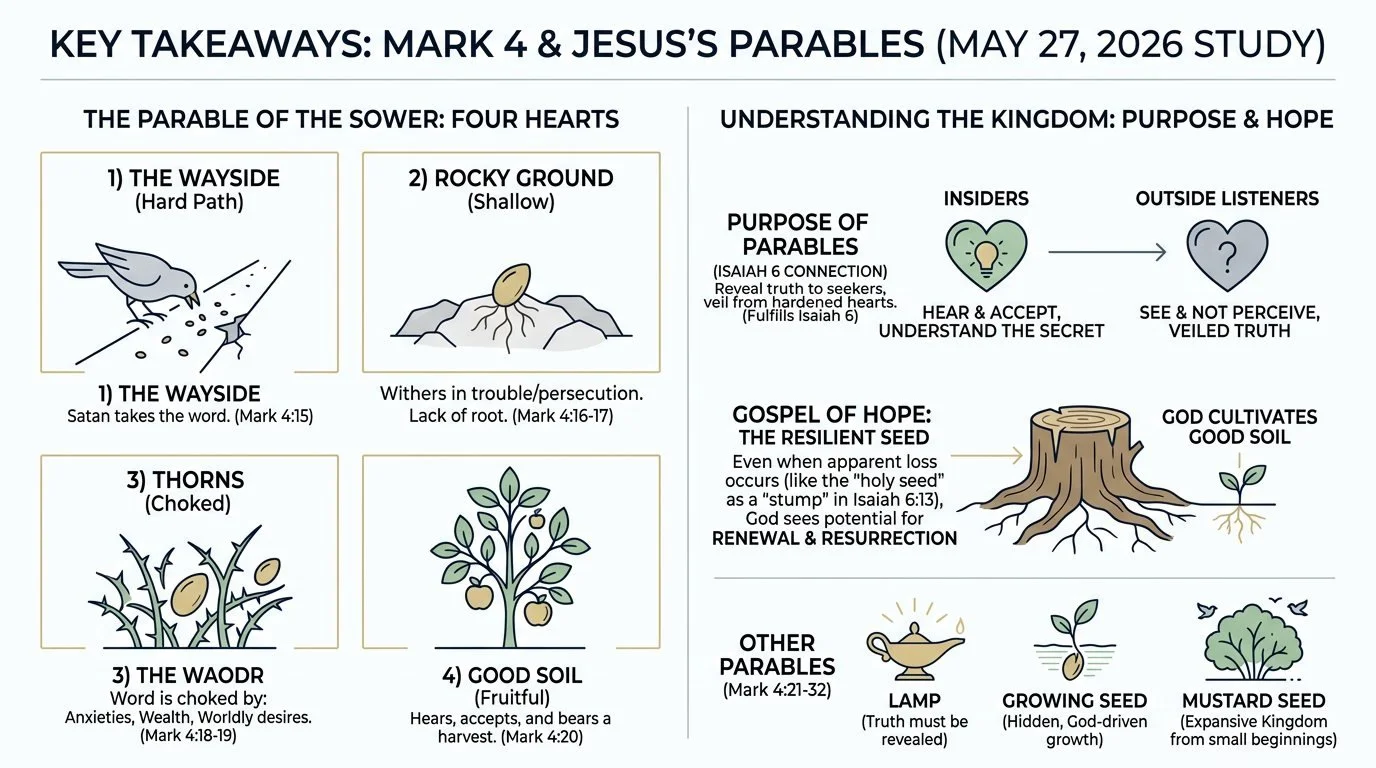
This is an AI Recap of the class.
Some things may be incorrect.
Short Summary of the Whole Class
On May 27, 2026, our class opened with housekeeping about upcoming Bible Club and "The Chosen," then delved into Mark 4:1–34. We situated the chapter within Mark's broader narrative arc (Mark 3-6) before discussing Jesus's parables: the Sower, the Lamp, the Growing Seed, and the Mustard Seed. The conversation focused on why Jesus taught in parables, connecting his methods to prophecies in Isaiah 6. We analyzed the different "soils" of the heart, the obstacles that prevent spiritual growth—like worldly anxieties and persecution—and contrasted them with the good soil that produces a harvest. The pivotal insight was how Isaiah 6 reframes the parable not as a story of failure, but one of profound hope, where the "holy seed" remains as a "stump," promising renewal even when all seems lost.
Detailed Class Summary
Here is a summary of what we talked about as we went through the lesson on May 27, 2026.
1) Housekeeping and upcoming schedule
We began with logistical updates. Cris outlined schedule changes: we have one more week in the Gospel of Mark, after which we will pause for Bible Club, which will be focused on the series “The Chosen.” Homework will be to watch episodes ahead of time. The schedule for viewing is June 10 for Episode 1 and June 17 for Episodes 2–3. The episodes are available for free on The Chosen’s website and possibly on Prime Video. The adult Bible Club will meet in a different building, and due to the logistical change, Zoom participation may not be available. After Bible Club concludes, our class will return to our study in Mark.
Stories mentioned: None from Scripture; logistical update and The Chosen viewing plan.
Summary of this section: We will pause our Mark study after one more week to engage “The Chosen” during Bible Club (with pre-watching homework on June 10 and June 17), then resume Mark afterward.
2) Framing Mark’s larger narrative arc (Mark 3–6)
Before reading Mark 4, Cris recapped the theme of Jesus’ “true family” from Mark 3 and previewed the story of "Jesus rejected in Nazareth" in Mark 6:1–6, framing it as a sister story. He highlighted a structural rhythm in this section of the gospel: the calling of the Twelve (Mark 3) leads into Jesus's teachings and miracles (Mark 4–5), which is followed by his rejection at Nazareth (Mark 6:1–6), and then the sending out of the Twelve on their own mission (Mark 6:7–13). This structure shows that Mark builds themes that bookend this entire section, helping us read the parables within a larger narrative rhythm.
Scriptures referenced: Mark 3 (true family of Jesus; calling of the Twelve), Mark 6:1–6 (rejection at Nazareth), Mark 6:7–13 (sending of the Twelve).
Stories mentioned: “True family of Jesus” in Mark 3; “Rejection at Nazareth” in Mark 6.
Summary of this section: Mark weaves a thematic arc from the calling of the Twelve through teachings and conflicts to rejection, then mission—helping us read the parables within a larger narrative rhythm.
3) The Parable of the Sower: First Impressions and Purpose
The group read portions of Mark 4, where Jesus teaches a large "multitude" by the sea using parables. We began with the Parable of the Sower (Mark 4:1–9, 13–20). Betsy pointed out that the different soils—the path, rocky ground, thorns, and good soil—reflect people we see in the church today. Some focused on the planter, noting Scott McKnight's translation of verse three which described "the planter excited to plant," adding a joyful energy. Others argued the focus is on the seed itself—the Word of God. It was noted that our job is not to force growth but simply to "throw the seeds," as God cultivates faith.
We then examined Jesus's phrase in verse 9, "He who has ears to hear, let him hear." Cris explained this challenges listeners to look beyond the surface. It’s not just about hearing words, but understanding their deeper meaning, a theme that connects to Jesus's healings of the blind and deaf. Parables act as a filter, requiring a heart that is actively seeking Jesus to be understood. For those just going through the motions, the message remains obscure. In verse 10, Jesus explains that the "mystery of the kingdom of God" has been given to his disciples, while for "outsiders," things remain in parables. Cris clarified this "secret" is not Gnosticism (secret knowledge for salvation), but an understanding of God's plan to restore creation as a "new Garden of Eden."
Scriptures referenced: Mark 4:1-20 (Parable of the Sower and its explanation).
Stories mentioned: Parable of the Sower.
Summary of this section: We started by relating the Parable of the Sower to our experiences and established that Jesus used parables to distinguish between those with receptive hearts, who were given the "secret" of the kingdom, and those who heard without truly understanding.
4) The Isaiah Connection: A Deeper Hope
The most significant part of our study came when Cris pointed out that Jesus quotes from Isaiah, chapter 6, verses 9-10 in Mark 4. When Jesus quotes a verse, he often invokes the entire passage. We read all of Isaiah 6, which details the prophet's commissioning. In a powerful vision, Isaiah sees God's glory, feels his unworthiness ("I am a man of unclean lips"), and is purified. When God asks, "Whom shall I send?" Isaiah volunteers: "Here I am; send me."
God’s instructions are startling: preach to a people who will hear but not understand, and see but not perceive. His ministry will be met with rejection. However, the chapter ends with a promise. Even after the land is desolate (alluding to the Babylonian Captivity), a remnant, a "tenth," will remain. The final verse describes this remnant with a powerful metaphor: "So the holy seed shall be its stump."
Scriptures referenced: Mark 4:10-12, Isaiah 6 (especially verses 9-10 and 13).
Stories mentioned: The Commissioning of the Prophet Isaiah.
Summary of this section: By quoting Isaiah 6, Jesus connects his ministry to the prophetic experience of Isaiah. This reveals that the kingdom message will be rejected by many, but it also introduces profound hope through the imagery of the "stump" and the "holy seed," suggesting that even when all seems lost, the potential for new life remains.
5) Finding the Gospel in Hard Soil and Other Parables
With the context from Isaiah, we revisited the Parable of the Sower. The "bad soil" no longer seemed like a final judgment. As Cassie noted, the idea of the stump and its roots suggests that even if someone leaves the faith, the seed is still there and can come back—like a stump that looks dead but can sprout new growth. We may see a dead stump, but God sees the potential for resurrection. This addresses the pastoral question: “What if I’m just bad soil?” The parable invites self-examination without despair, emphasizing God can cultivate hearts to become good soil.
Cris guided us through Jesus’s explanation of the soils:
The Wayside: Satan snatches the word away.
The Stony Ground: The word withers under trouble or persecution due to lack of root.
The Thorns: The word is choked by "the cares of this world, the deceitfulness of riches, and the desires for other things." We noted how phrases like "the era’s anxieties and wealth’s delusion" capture modern struggles, similar to the Parable of the Great Banquet where guests made excuses and missed the feast.
The Good Ground: Those who hear, accept, and bear fruit abundantly.
We concluded by briefly touching on the other parables in Mark 4: the Lamp under a basket (Mark 4:21–25), the Growing Seed (Mark 4:26–29), and the Mustard Seed (Mark 4:30–32). These reinforce the themes that truth is meant to be revealed, God causes growth in hidden stages, and the kingdom grows expansively from small beginnings. The class wrapped up with Cris pointing out Jesus's gentle "sass" in verse 13 ("Do you not understand this parable?"), highlighting the disciples' own struggle to see the deeper meaning.
Scriptures referenced: Mark 4:13–34.
Stories mentioned: Parable of the Sower, Lamp under a basket, Growing Seed, Mustard Seed, Parable of the Great Banquet.
Summary of this section: The Isaiah passage transformed our understanding of the Sower from a story about failure into one of hope. We analyzed how opposition, weakness, and worldly distractions prevent fruitfulness, and we saw how Jesus's subsequent parables expand on themes of revelation, God-driven growth, and kingdom expansion.
Overall Summary
On the evening of May 27, 2026, our Bible study centered on Jesus's methodology of teaching through parables, with a deep dive into Mark 4:1-34. After covering logistical updates for our upcoming study on "The Chosen," we situated the chapter within Mark's broader narrative structure. We explored how parables served a dual purpose: they revealed the secrets of the Kingdom of God to sincere seekers while veiling the truth from those with hardened hearts, fulfilling the prophecies of Isaiah 6.
We meticulously examined Jesus's own explanation of the Parable of the Sower, identifying the four types of soil as metaphors for how people respond to God's word. We discussed how Satan, persecution, and worldly distractions—such as anxieties and the pursuit of wealth—can prevent faith from bearing fruit. The pivotal moment was connecting the parable to Isaiah 6. This reframed the story from one of potential failure into one of profound hope, where the image of the "holy seed" as a "stump" suggests that God's word is so resilient that it holds the promise of renewal even in the most hopeless situations. We also touched on the parables of the Lamp, the Growing Seed, and the Mustard Seed, which further illustrate that God's truth is meant to be revealed and that His kingdom grows in surprising, God-driven ways.
Main Points
Upcoming schedule: One more week in Mark, then Bible Club with “The Chosen” on June 10 and June 17; return to Mark afterward; Zoom availability may be limited.
Mark’s structural rhythm: Calling of the Twelve (Mark 3), teaching and events (Mark 4–5), rejection at Nazareth (Mark 6:1–6), sending of the Twelve (Mark 6:7–13).
Purpose of parables: They fulfill prophecy (Isaiah 6), reveal the kingdom's "secret" to insiders, and distinguish true seekers from casual listeners.
Parable of the Sower: Illustrates four different heart conditions (soils) that affect the reception and fruitfulness of the word. Obstacles include Satan's opposition, lack of spiritual depth, and the "thorns" of worldly cares and riches.
The Isaiah 6 Connection: Jesus quotes Isaiah to connect His ministry to the prophet's. The passage introduces the imagery of the "holy seed" as a "stump," symbolizing hope and new life even after apparent destruction.
The Gospel of Hope: The ultimate message is not that some soils fail, but that God's word is resilient and can bring forth life even from what appears dead or lost.
Other Parables: The Lamp (truth is to be revealed), the Growing Seed (God causes hidden growth), and the Mustard Seed (the kingdom starts small but grows expansively).
Pastoral application: Address anxiety about being “bad soil” by cultivating receptive hearts, depth, endurance, and freedom from choking cares.
Bible Scriptures Mentioned
Mark 3 (true family of Jesus; calling of the Twelve)
Mark 4:1–34 (Parables: Sower; Purpose of parables; Lamp; Growing Seed; Mustard Seed)
Mark 6:1–6 (Jesus rejected in Nazareth)
Mark 6:7–13 (sending of the Twelve)
Isaiah 6 (The entire chapter, especially verses 9-10 and 13)
Stories Mentioned
True family of Jesus (Mark 3)
Jesus rejected in Nazareth (Mark 6:1–6)
The Commissioning of the Prophet Isaiah (Isaiah 6)
Parable of the Sower (Mark 4:1–20)
Lamp under a basket (Mark 4:21–25)
Growing Seed (Mark 4:26–29)
Mustard Seed (Mark 4:30–32)
The Parable of the Great Banquet (referenced as a similar story)
The concept of Gnosticism
The reunification of the Garden of Eden as the goal of God's kingdom
The Babylonian Captivity (alluded to in the discussion of Isaiah's prophecy)
Mark Chapter 3 Class 5 - Wednesday Bible Study
On May 20, 2026, our class walked through Mark 2:27–28 and Mark 3:1–35—Jesus’ authority over Sabbath, surging crowds and the boat, the naming and mission of the Twelve, accusations and the “house divided” teaching, binding the strong man, blasphemy against the Holy Spirit, and redefining true family—while reflecting on discernment, the Church’s mission, practical wisdom in Old Testament laws, and previewing the Parable of the Sower.
Gospel of Mark Chapter 3
This is our 5th class on Mark
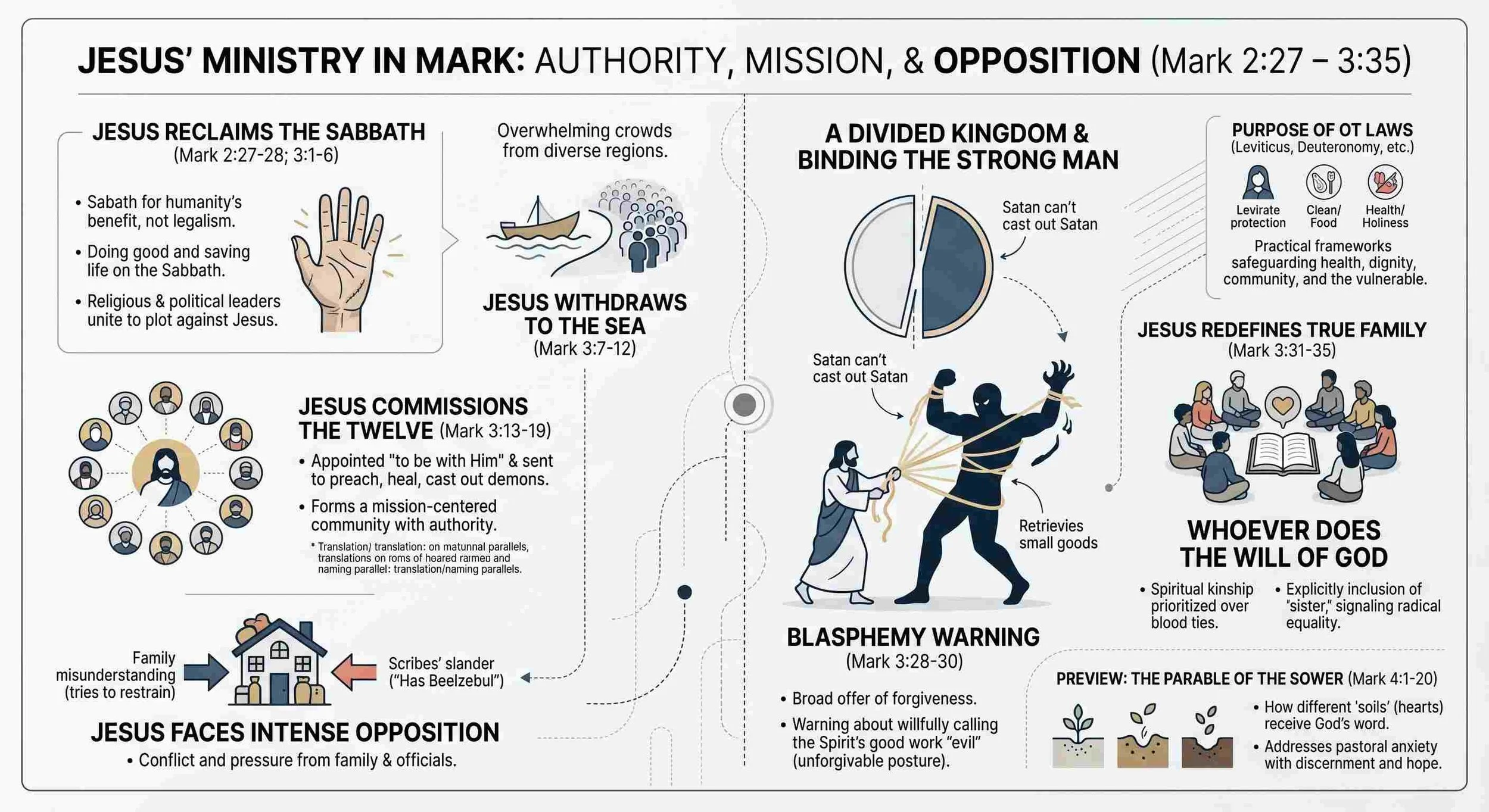
This is an AI Recap of the class.
Some things may be incorrect.
Short Summary of the Whole Class
On May 20, 2026, we traced Mark’s narrative from the Sabbath controversy into Jesus’ escalating ministry pressures: huge crowds, unclean spirits recognizing Him, and the commissioning of the Twelve. Opposition intensified—from Pharisees and Herodians plotting, scribes accusing Him of demonic power, and family misunderstanding Him. Jesus answered with the “house divided” logic and “binding the strong man,” warned about blasphemy against the Holy Spirit, and redefined true family around doing God’s will. We also discussed translation and naming, practical purposes of Old Testament laws (care for the vulnerable, health, holiness), and previewed the Parable of the Sower, engaging pastoral questions about “bad soil.”
Section-by-Section Walkthrough
1) Transition from Sabbath Conflict to Growing Opposition (Mark 2:27–28; 3:1–6)
What we discussed:
Recap: “The Sabbath was made for man, not man for the Sabbath” (Mark 2:27–28), highlighting mercy and life over legalism.
Jesus heals a man with a withered hand on the Sabbath (Mark 3:1–5), revealing God’s heart.
Pharisees and Herodians immediately conspire to destroy Jesus (Mark 3:6), aligning religious and political powers against Him.
Big idea: Mark exposes three human power spheres—religious, political, personal—and shows Jesus challenging them.
Scriptures mentioned:
Mark 2:27–28; Mark 3:1–6.
Stories referenced:
Healing of the man with the withered hand.
Short summary of this section:
Jesus restores the Sabbath’s purpose with healing and mercy; threatened leaders unite to plot His death.
2) Hard Split to Withdrawal and the Surge of the Crowds (Mark 3:7–12)
What we discussed:
A narrative “hard split” at Mark 3:7: Jesus withdraws to the sea; crowds converge from many regions (Galilee, Judea, Jerusalem, Idumea, beyond the Jordan, Tyre, Sidon).
Practical detail: Jesus asks for a small boat to avoid being crushed—“super crowded,” likely hundreds pressing in.
Unclean spirits recognize Him as the Son of God; He silences them to control revelation timing.
Scriptures mentioned:
Mark 3:7–12.
Stories referenced:
Crowds pressing; Jesus requesting a boat.
Demons declaring, “You are the Son of God.”
Short summary of this section:
Jesus’ fame explodes across regions; He heals many while managing overwhelming crowds and restraining premature acclaim.
3) Calling and Commissioning the Twelve; Translation and Names (Mark 3:13–19; Daniel 1:7)
What we discussed:
Jesus appoints twelve “to be with Him” and to be sent to preach, heal, and cast out demons (Mark 3:13–19).
Names include Simon Peter; James and John (Boanerges, “Sons of Thunder”); and Judas Iscariot.
Shift from controversy to mission: forming a sent community with kingdom authority.
Translation notes: preserving Greek/Hebrew name forms (Petros, Yakbos, Philippus, Bartholomews, Tomos); “commissioners” emphasizing mission.
Daniel parallel: Hebrew names vs. Babylonian given names (“slave names”)—Belteshazzar (Daniel), Shadrach, Meshach, Abednego (Daniel 1:7).
Scriptures mentioned:
Mark 3:13–19; Daniel 1:7.
Stories referenced:
Appointment and naming of the Twelve.
Renaming in exile (Daniel and companions).
Short summary of this section:
Jesus establishes a sent community with authority; translation and naming underscore mission and identity in God’s kingdom.
4) Crowding, Family Misunderstanding, and Scribes’ Accusation (Mark 3:20–22)
What we discussed:
The house is so crowded “they could not even eat” (Mark 3:20).
“His own people” (likely family) try to restrain Him: “He is out of his mind” (Mark 3:21).
Scribes from Jerusalem accuse Him: “He has Beelzebul… by the ruler of the demons He casts out demons” (Mark 3:22).
Thread: Opposition escalates from religious elites, political collaborators, and even family—personal power and expectations press in.
Scriptures mentioned:
Mark 3:20–22.
Stories referenced:
Family attempting to restrain Jesus; scribes’ accusation.
Short summary of this section:
Misunderstanding and slander intensify as crowding, family pressure, and official accusations converge.
5) A Divided Kingdom, Binding the Strong Man, and Blasphemy Against the Holy Spirit (Mark 3:23–30; Luke 15:11–32; Acts 2)
What we discussed:
Jesus’ parables: a kingdom/house divided cannot stand—Satan doesn’t cast out Satan (Mark 3:23–26).
“No one can enter a strong man’s house and plunder his goods unless he first binds the strong man” (Mark 3:27)—Jesus is conquering Satan, not collaborating with him.
Broad offer of forgiveness—“all sins… and whatever blasphemies”—but a grave warning: blasphemy against the Holy Spirit “never has forgiveness” (Mark 3:28–29), because some were claiming He had an unclean spirit (Mark 3:30).
Class consensus: blasphemy here is knowingly attributing the Spirit’s good work to evil—hard-hearted mislabeling.
Pastoral caution: youth-group anxiety over an “unforgivable sin”; focus on discernment rather than fear.
Analogies: elder brother in the prodigal son as self-exclusion (Luke 15:11–32); Pentecost reminder not to mislabel the Spirit’s work (Acts 2).
Scriptures mentioned:
Mark 3:23–30; Luke 15:11–32; Acts 2.
Stories referenced:
Parables of the divided kingdom and binding the strong man.
The elder brother in the prodigal son (analogy).
Pentecost and the Spirit empowering the church.
Short summary of this section:
Jesus dismantles the accusation with clear logic, asserts His victory over Satan, and warns that calling the Spirit’s work evil is a grave posture that shuts one off from forgiveness.
6) Jesus Redefines True Family and Equality (Mark 3:31–35; Matthew 12:46–50; Luke 8:19–21; Galatians 1:19)
What we discussed:
Jesus’ mother and brothers arrive, seeking Him; He points to those sitting around Him and says, “Whoever does the will of God is my brother and sister and mother” (Mark 3:31–35).
Inclusion of “sister” signals radical equality within a patriarchal culture; Jesus widens the circle of belonging.
Clarifications: Jesus had brothers (e.g., James; Galatians 1:19); traditions like Mary’s perpetual virginity were noted as differing views.
Illustrations: church cultures calling one another “brother” and “sister” (Amish country, southern fundamentalist churches) as echoes of spiritual kinship.
Scriptures mentioned:
Mark 3:31–35; Matthew 12:46–50; Luke 8:19–21; Galatians 1:19.
Stories referenced:
Family seeking Jesus; equality and inclusion in the kingdom family.
Short summary of this section:
Jesus centers obedience to God as the basis of true family, explicitly affirming women as equal “sisters” and expanding spiritual kinship beyond blood ties.
7) Old Testament Laws: Practical Purposes and Care for the Vulnerable (Deuteronomy 25:5–10; Leviticus 11; Leviticus 17:10–14)
What we discussed:
The traditional count of 613 commandments (mitzvot) in Jewish tradition—positive and negative precepts.
Practical reasons for many laws: wilderness living, sanitation, food safety, communal order, identity, and holiness.
Levirate marriage (Deuteronomy 25:5–10) as protection for widows, preserving lineage and provision in a patriarchal society.
Kosher restrictions (Leviticus 11) and prohibitions around blood (Leviticus 17:10–14) for health and sacred identity.
Emphasis: laws as protective and compassionate frameworks, not arbitrary rules.
Scriptures mentioned:
Deuteronomy 25:5–10; Leviticus 11; Leviticus 17:10–14.
Stories/illustrations referenced:
Practical examples of food safety (e.g., scavenger foods).
Short summary of this section:
Old Testament laws often function to safeguard health, dignity, and community—especially for the vulnerable—underscoring God’s compassionate order.
8) Preview: The Parable of the Sower and the Question of “Bad Soil” (Mark 4:1–20; Matthew 13:24–30)
What we discussed:
Preview of the Parable of the Sower (Mark 4:1–20): seed on the path, rocky ground, among thorns, and good soil; varied responses to God’s word.
Pastoral question: “What if you’re just bad soil?”—raised by a friend with anxiety; class balanced realism with compassion and hope.
Pragmatic note: focus effort where the word is received while caring for those who struggle.
Tangential mention: Parable of the Weeds (Matthew 13:24–30) as a similar agricultural story.
Scriptures mentioned:
Mark 4:1–20; Matthew 13:24–30.
Stories/illustrations referenced:
The Sower’s seed; agricultural analogies for spiritual growth.
Short summary of this section:
We previewed how the word meets different “soils” and addressed pastoral concerns about spiritual receptivity with grace-centered encouragement.
Medium-Length Summary of the Class
On May 20, 2026, our Bible study continued from Mark 2:27–28 into Mark 3, where Jesus’ Sabbath healing exposed the Law’s intent—mercy and life—and triggered opposition as Pharisees and Herodians plotted to destroy Him. A hard shift at Mark 3:7 showed withdrawal to the sea amid surging crowds from across the region, so intense that Jesus requested a boat. Unclean spirits recognized Him as the Son of God, but He silenced them to govern the timing and nature of His revelation. On the mountain, He appointed the Twelve to be with Him and be sent to preach, heal, and cast out demons, forming a mission-centered community. Pressure mounted: a jam-packed house, family trying to restrain Him as “out of his mind,” and scribes accusing Him of demonic power. Jesus answered with the “house divided” parable and “binding the strong man,” asserting He is overpowering Satan, not collaborating with him. He issued a sober warning about blasphemy against the Holy Spirit—willfully labeling the Spirit’s good work as evil—which closes one off from forgiveness. Finally, Jesus redefined true family around those who do God’s will, explicitly including “sister,” signaling radical equality. We reflected on translation and naming, the practical and protective purposes of Old Testament laws (care for widows, health, holiness), and previewed the Parable of the Sower, engaging pastoral questions about “bad soil” with discernment and hope.
Main Points
Jesus restores the original intent of Sabbath: mercy, life, and doing good (Mark 2:27–28; 3:1–5).
Religious and political powers unite against Jesus when He threatens their control (Mark 3:6).
A hard transition in Mark 3:7 shifts to overwhelming public response and growing fame (Mark 3:7–12).
Unclean spirits confess Jesus as the Son of God; He silences them to control revelation timing (Mark 3:11–12).
Jesus appoints the Twelve to be with Him and be sent with authority to preach, heal, and cast out demons (Mark 3:13–19).
Opposition intensifies: family misunderstanding and official slander from Jerusalem scribes (Mark 3:20–22).
“House divided” teaching refutes the Beelzebul accusation; Jesus is binding the strong man to plunder Satan’s domain (Mark 3:23–27).
Warning on blasphemy against the Holy Spirit addresses willful mislabeling of the Spirit’s work as evil (Mark 3:28–30).
True family is defined by doing God’s will, explicitly affirming women as equal “sisters” (Mark 3:31–35; parallels in Matthew 12:46–50; Luke 8:19–21).
Translation and naming highlight mission and identity (Mark 3:13–19; Daniel 1:7).
Old Testament laws often have practical, protective purposes for health and the vulnerable (Deuteronomy 25:5–10; Leviticus 11; Leviticus 17:10–14).
Preview of the Parable of the Sower raises pastoral questions about “bad soil,” inviting grace-centered discernment (Mark 4:1–20; Matthew 13:24–30).
Bible Scriptures Mentioned
Mark 2:27–28 — Sabbath made for man; Son of Man is Lord of the Sabbath.
Mark 3:1–6 — Healing of the man with the withered hand; Pharisees and Herodians plot to destroy Jesus.
Mark 3:7–12 — Crowds from many regions; boat prepared; unclean spirits confess Jesus; He silences them.
Mark 3:13–19 — Appointment and naming of the Twelve; mission and authority.
Mark 3:20–22 — Crowding; family’s attempt to restrain Him; scribes accuse Him of Beelzebul.
Mark 3:23–27 — “House divided” and “binding the strong man” parables.
Mark 3:28–30 — Warning on blasphemy against the Holy Spirit.
Mark 3:31–35 — Jesus’ true family defined; inclusion of “sister.”
Matthew 12:46–50 — Parallel account of redefining family.
Luke 8:19–21 — Parallel account of redefining family.
Galatians 1:19 — James referenced as Jesus’ brother.
Daniel 1:7 — Babylonian names: Belteshazzar (Daniel), Shadrach, Meshach, Abednego.
Deuteronomy 25:5–10 — Levirate marriage provisions.
Leviticus 11 — Clean and unclean animals (kosher laws).
Leviticus 17:10–14 — Prohibition of eating blood.
Mark 4:1–20 — Parable of the Sower (previewed).
Matthew 13:24–30 — Parable of the Weeds (referenced by analogy).
Luke 15:11–32 — Prodigal son; elder brother’s self-exclusion (analogy).
Acts 2 — Pentecost and the coming of the Holy Spirit.
Stories Mentioned
Healing on the Sabbath: the man with the withered hand.
Massive crowds pressing in; Jesus requests a boat.
Unclean spirits crying out, “You are the Son of God.”
Appointment and mission of the Twelve “commissioners.”
Parables of the divided kingdom and binding the strong man.
The elder brother in the prodigal son (as an analogy for mislabeling mercy).
Pentecost and the Spirit empowering the church.
Daniel and his friends receiving Babylonian names in exile.
Family seeking Jesus; Jesus naming doers of God’s will as true family.
Practical examples around food safety and kosher restrictions.
Preview of the Parable of the Sower and pastoral questions about “bad soil.”
Mark Chapter 2 - 3:6 Class 4 - Wednesday Bible Study
This week, our study of Mark chapters 2 and 3 explored Jesus's authority to forgive, heal, and redefine righteousness as he calls a controversial tax collector and challenges the Pharisees' traditions about the Sabbath.
Gospel of Mark Chapter 2 - 3:6
This is our 4th class on Mark
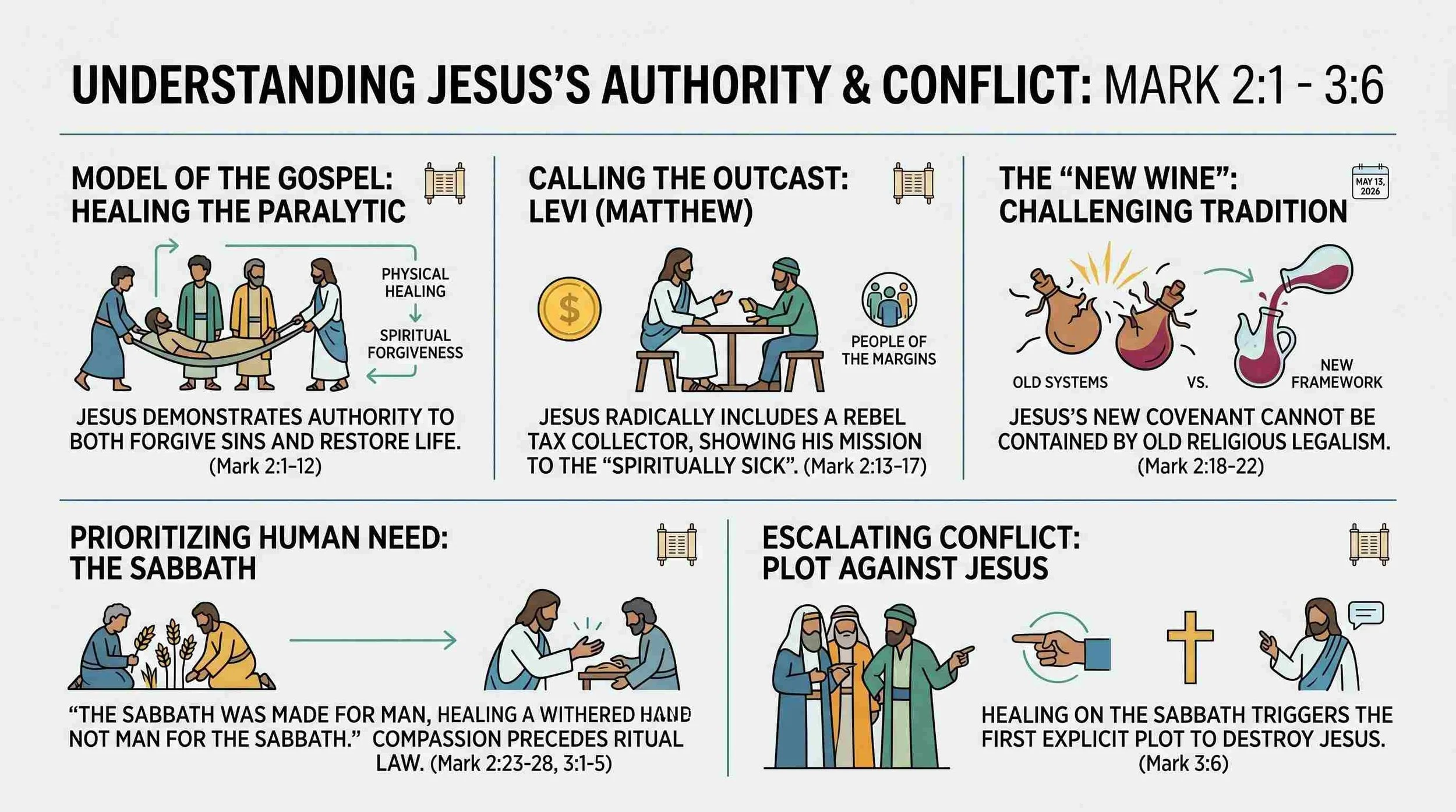
This is an AI Recap of the class.
Some things may be incorrect.
Short Summary of the Whole Class
During our Bible study on May 13, 2026, we recapped the beginning of Mark and then delved into a detailed reading and discussion of Mark chapter 2 through chapter 3, verse 6. The class focused on identifying the structure of Mark's narrative, questioning the man-made chapter breaks, and understanding the significance of the stories presented. Key topics included Jesus healing the paralytic as a model of the gospel, the controversial calling of Levi (Matthew) the tax collector, and the escalating conflict with the Pharisees over fasting and the Sabbath, culminating in a plot against Jesus's life.
Detailed Class Summary
Recap and Introduction (Mark 1 - 2:12)
The class began with a recap of the first part of Mark's Gospel. The speaker highlighted the powerful opening, which invokes the theme of a new creation with the arrival of Jesus Christ, the Son of God. This preamble sets the stage, contrasting the power of Caesar and Rome with the true authority of Jesus. We reviewed the ministry of John the Baptist, Jesus's baptism where the "heavens are ripped open," and the subsequent period of miracles and healings.
A key point of discussion was the story of the healing of the paralytic at the beginning of chapter two, which we had discussed the previous week. The speaker proposed that this miracle serves as a perfect illustration of the entire gospel message: Jesus demonstrates his authority not just to heal physically but, more importantly, to forgive sins. The man is forgiven, then healed, and the crowd's reaction is "amazement," a word the speaker suggested is a signifier of the resurrection throughout Mark's Gospel.
Section Summary: The opening of Mark establishes Jesus's divine authority, which is then demonstrated through his baptism and early ministry of healing. The story of the paralytic in Mark 2 is presented as a microcosm of the gospel itself, combining the forgiveness of sins with physical restoration, pointing toward the ultimate power of the resurrection.
Bible Verses: Mark 1, Mark 2:1-12
Stories: The ministry of John the Baptist, the Baptism of Jesus, the Healing of the Paralytic.
Questioning Structure and Calling Levi (Mark 2:13-17)
After a lively reading of Mark 2:1 through 3:6, the class shifted to a discussion about the structure of the text. The speaker challenged the group to look for "hard splits" or transitions in the narrative and questioned the chapter break between chapters 2 and 3. It was noted that these chapter and verse divisions were added in medieval times and are not part of the original text, reminding us that they are interpretive additions. The flow of the narrative, with its frequent use of "and then," suggests a continuous account of Jesus's ministry during this period.
The discussion then focused on the calling of Levi, the son of Alphaeus, who was sitting at a tax office. The class explored the significance of this act. We noted that Levi is also known as Matthew and that he came from a priestly family line (the tribe of Levi). For a man from a priestly family to be working as a tax collector for the occupying Roman Empire would have been seen as a profound betrayal. Jesus calls this man seen as a traitor and sinner to be one of his followers and then dines at his house with other "tax collectors and sinners." Jesus's response to the Pharisees' criticism, "I did not come to call the righteous, but sinners," demonstrates that his message is for everyone, especially those on the margins and aware of their spiritual sickness.
Section Summary: We learned to read Mark's Gospel with an awareness that chapter breaks are not original and can interrupt the narrative flow. The calling of Levi (Matthew), a tax collector from a priestly family, is a radical act where Jesus extends his invitation to a social and religious outcast, reinforcing his mission to seek and save the lost.
Bible Verses: Mark 2:13-17
Stories: The Calling of Levi (Matthew).
Conflict and New Ways (Mark 2:18 - 3:6)
The final part of our discussion centered on the escalating conflict between Jesus and the religious leaders, specifically the scribes and Pharisees. This conflict is highlighted through a series of confrontations.
First, Jesus is questioned about why his disciples do not fast. Jesus responds with the analogy of the bridegroom, stating that it is a time for celebration, not mourning, while he is present. He then uses the parables of the unshrunk cloth on an old garment and new wine in old wineskins to illustrate that his new covenant cannot be patched onto the old systems of religious legalism; it requires a completely new framework.
The conflict intensifies over the issue of the Sabbath. The Pharisees challenge Jesus when his disciples pluck heads of grain on the Sabbath. Jesus defends their actions by citing the story of David eating the consecrated showbread, arguing that human need can take precedence over ritual law and declaring, "The Sabbath was made for man, not man for the Sabbath." This confrontation culminates in the synagogue, where Jesus encounters a man with a withered hand on the Sabbath. He directly challenges the Pharisees: "Is it lawful on the Sabbath to do good or to do evil, to save life or to kill?" When they remain silent, Jesus, grieved by their hardness of heart, heals the man. This act of compassion is the final straw for the Pharisees, who immediately go out and begin to plot with the Herodians on how to destroy Jesus.
Section Summary: Jesus's ministry represents a radical break from the religious traditions of the day, which he illustrates with parables about new wine and new cloth. His conflicts with the Pharisees over fasting and the Sabbath demonstrate that his kingdom prioritizes people over rules. His healing of the man with the withered hand on the Sabbath solidifies the opposition against him, leading to the first explicit plot to kill him.
Bible Verses: Mark 2:18-28, Mark 3:1-6
Stories: The question about fasting (Parable of the Bridegroom, New Cloth, New Wineskins), Disciples plucking grain on the Sabbath (David and the Showbread), Healing the man with the withered hand on the Sabbath.
Medium-Length Summary
In our Bible study on May 13, 2026, we explored the rich narrative of Mark chapters 2 and 3, focusing on how Mark presents Jesus's authority and the escalating conflict his ministry provokes. We began by revisiting the healing of the paralytic, which serves as a powerful model for the entire gospel: Jesus has the power to both forgive sins and restore life. A central theme was Jesus's radical inclusivity, powerfully demonstrated in his calling of Levi (Matthew), a tax collector seen as a collaborator with the Roman enemy. By calling Levi and eating with sinners, Jesus showed that his message was for the outcasts who knew they were spiritually sick. This led to a series of confrontations with the Pharisees. Jesus defended his disciples for not fasting using the analogy of the bridegroom and explained through parables (new wine in old wineskins) that his new covenant could not be contained by old religious structures. The conflict peaked over the observance of the Sabbath, first when his disciples plucked grain and then when Jesus healed a man's withered hand in the synagogue. This definitive act of choosing compassion over legalism, framed by Jesus's declaration that "The Sabbath was made for man, not man for the Sabbath," led the Pharisees to immediately conspire with the Herodians to destroy him.
Main Points
The healing of the paralytic is a model of the gospel, combining forgiveness of sins and physical healing.
Chapter and verse divisions are not original to the text and should not limit our understanding of the narrative flow.
Jesus's calling of Levi the tax collector demonstrates his mission to society's outcasts.
Jesus's teachings represent a "new wine" that cannot be contained by the "old wineskins" of rigid religious tradition.
Conflict with the Pharisees intensifies over issues of fasting and the Sabbath.
Jesus prioritizes human need and compassion over strict adherence to religious law ("The Sabbath was made for man, not man for the Sabbath").
Jesus's healing of the man with the withered hand on the Sabbath is the event that triggers the first plot to kill him.
Scriptures and Stories Mentioned
Bible Scriptures:
Mark 1
Mark 2:1-28
Mark 3:1-6
Stories:
The Baptism of Jesus
The Healing of the Paralytic
The Calling of Levi (Matthew)
The Question About Fasting (including parables of the Bridegroom, New Cloth, and New Wineskins)
Disciples Plucking Grain on the Sabbath (referencing David and the Showbread)
The Healing of the Man with the Withered Hand
Mark Chapter 1:21-2:12 Class 3 - Wednesday Bible Study
In our study on May 6, 2026, we explored Mark 1:14-2:12, focusing on Jesus's escalating authority over spirits, sickness, and sin, and why He often commanded silence from those He healed.
Gospel of Mark Chapter 1:21-2:12
This is our 3rd class on Mark
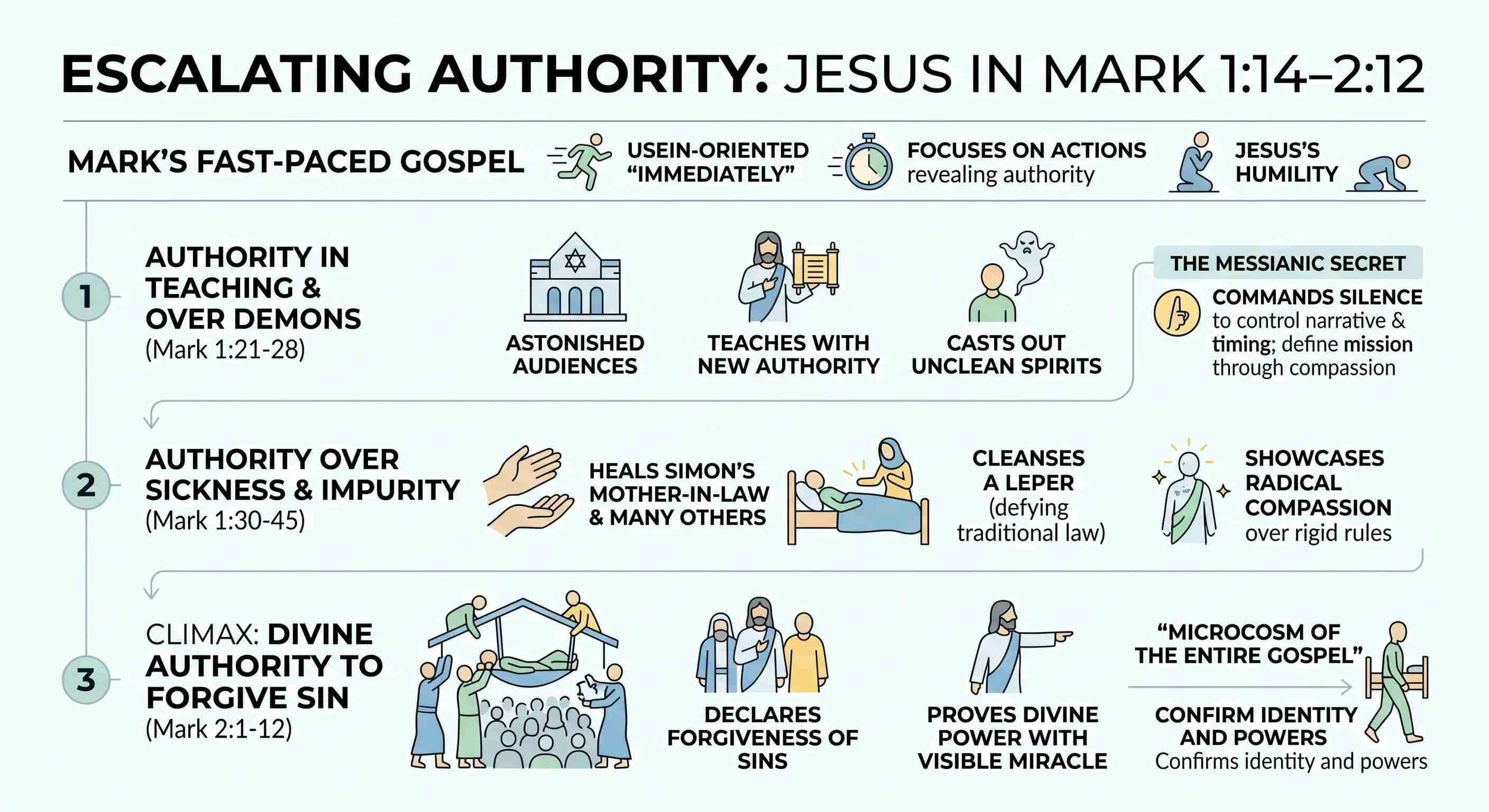
This is an AI Recap of the class.
Some things may be incorrect.
Short Summary of the Class
During our Bible study on May 6, 2026, we discussed the beginning of Jesus's public ministry as recorded in Mark 1:14-2:12. We noted Mark's rapid-fire storytelling, which emphasizes Jesus's actions and authority. A key theme was the "Messianic Secret," exploring why Jesus commanded demons and healed individuals to be silent—likely to control the timing of His ministry and define His mission through compassionate acts rather than popular messianic expectations. The class traced the escalating demonstration of Jesus's authority, from His power over demons and disease to His ultimate claim of divine authority to forgive sins. The healing of the paralytic was identified as a pivotal moment and a "microcosm of the entire gospel," as it explicitly linked His power to heal with His power to forgive, directly challenging the religious leaders.
Detailed Class Summary
Introduction: Mark's Fast-Paced Gospel and Jesus's Humble Character
The class began by summarizing the first section of Mark’s Gospel, noting its fast-paced, action-oriented style, which often uses the word "immediately" to move between events. This narrative structure focuses more on what Jesus did than what he said. We established that Jesus is presented as the true source of hope ("good news about Jesus, the Messiah, the Son of God"), contrasting with the false hope people placed in earthly powers. A key characteristic of Jesus highlighted was His profound humility. He often sought private places to pray, demonstrating that His miracles were not for self-acclaim but to draw people to His primary message of salvation. His compassionate, grassroots approach stood in stark contrast to the public, self-seeking nature of the religious leaders of the day.
Summary: We established that Mark's Gospel is an action-packed narrative presenting Jesus as the true source of hope. His ministry was characterized by humility and compassion, using miracles to gather an audience for his message rather than for personal glory.
The "Messianic Secret": Why Jesus Commanded Silence
A central question arose from the reading: why did Jesus repeatedly silence both the demons who recognized Him (Mark 1:34) and the leper He had just cleansed (Mark 1:44)? The class concluded this was a deliberate strategy, often called the "Messianic Secret." Jesus was controlling the narrative of His ministry. By commanding silence, He prevented a frenzy based on popular, political expectations of a Messiah and stopped demons from distorting His true purpose. He wanted His compassionate words and deeds to define the kind of Messiah He was, rather than allowing premature declarations to misrepresent His mission. The consequences of disobedience were seen when the healed leper talked freely, forcing Jesus out of the towns and into lonely places (Mark 1:45).
Summary: We concluded that Jesus commanded silence to control the timing and nature of His self-revelation. He aimed to define His messiahship through service and teaching, rather than allowing popular expectations or demonic declarations to misrepresent His mission.
Jesus's Escalating Authority vs. Established Powers
The discussion then focused on the overarching theme that ties the stories in Mark 1 and 2 together: the escalating authority of Jesus and the resulting tension with established powers. This authority was not just claimed but demonstrated in a sequence of powerful acts:
Authority in Teaching: In the Capernaum synagogue, the people were "astonished" because He taught "as one who had authority, and not as the religious officials taught" (Mark 1:22).
Authority over Unclean Spirits: He immediately backed up His teaching by casting out an unclean spirit, causing the crowd to marvel at His "new teaching with authority" (Mark 1:27).
Authority over Sickness: He demonstrated power over physical disease by healing Simon’s mother-in-law (Mark 1:30-31) and later, "the whole city" that brought their sick to Him (Mark 1:32-34).
Authority over Ritual Impurity: In a profound act of compassion that defied religious law, Jesus "stretched out his hand and touched" a man with leprosy, cleansing him completely (Mark 1:40-42). This act challenged social and religious barriers.
Summary: The central theme connecting these stories is Jesus’s escalating demonstration of authority. He showed power over teaching, demons, disease, and ritual impurity, which amazed the people and set the stage for conflict with the religious leaders whose own authority was being undermined.
The Climax: The Forgiveness and Healing of the Paralytic
The class identified the healing of the paralytic (Mark 2:1-12) as the climax of this section and a microcosm of the entire gospel message. In a crowded house in Capernaum, friends lowered a paralyzed man through the roof. Seeing their faith, Jesus first declared, "Son, your sins are forgiven you" (Mark 2:5). The scribes present immediately recognized the radical nature of this claim, thinking, "Who can forgive sins but God alone?" (Mark 2:7). Jesus then proved His unseen, divine authority to forgive sins by performing the visible miracle. He asked, "Which is easier...?" and then commanded the man to "Arise, take up your bed and walk" (Mark 2:9-11). The man's immediate healing left everyone amazed and proved that the Son of Man has authority on earth to forgive sins. This event masterfully connects Jesus's power to heal with His divine power to forgive, confirming His identity and foreshadowing His ultimate triumph over sin and death.
Summary: The healing of the paralytic was presented as a condensed version of the gospel. Jesus explicitly claimed the divine authority to forgive sins and then proved it with a physical miracle, demonstrating His power over both the spiritual and physical realms and leaving the crowds in awe.
Final Summary
The Bible study on May 6, 2026, provided a deep dive into Mark 1:14-2:12, exploring the explosive start to Jesus's public ministry. We began by highlighting Jesus's humble character and Mark's fast-paced, action-oriented narrative style. A key topic was the "Messianic Secret," where we concluded that Jesus's commands for silence were a deliberate strategy to define His messiahship through compassionate action rather than allowing it to be distorted by popular expectations.
The primary theme discussed was the escalating authority of Jesus. We traced how Mark strategically builds this theme through a sequence of events: His authoritative teaching, His command over unclean spirits, His power over sickness and disease, and His compassion that transcended purity laws in healing a leper. These acts directly challenged the established religious leaders. The climax of this narrative arc was identified in the story of the paralytic. Here, Jesus makes His most profound claim: the authority to forgive sins. By linking the declaration "Your sins are forgiven" to the visible, miraculous healing of the man's paralysis, Jesus proved His divine power. This single event was seen as a "microcosm of the entire gospel," encapsulating conflict with religious leaders, the demonstration of power over sin and helplessness, and the awe-inspiring reaction of the people.
Main Points
Mark’s Gospel is fast-paced and focuses on Jesus's actions to reveal His identity and authority.
Jesus's ministry was characterized by humility, using miracles to draw people to His message, not for personal glory.
Jesus commanded silence (the "Messianic Secret") to control the timing and perception of His ministry, avoiding popular misconceptions of the Messiah.
A central, unifying theme in Mark 1:14-2:12 is the escalating demonstration of Jesus's authority.
Jesus shows authority over demonic spirits, physical diseases, ritual impurity (leprosy), and ultimately, sin itself.
The healing of the paralytic serves as a thesis statement or "microcosm" for the entire Gospel of Mark.
Jesus proves his divine authority to forgive sins by performing a visible miracle (healing the paralytic), a power belonging to God alone.
Scriptures and Stories Mentioned
Bible Verses: Mark 1:14-2:12
Mark 1:22 (Teaching with authority)
Mark 1:27 (Authority over unclean spirits)
Mark 1:30-31 (Healing of Simon’s mother-in-law)
Mark 1:34 (Commanding demons to be silent)
Mark 1:35-37 (Jesus prays in a solitary place)
Mark 1:40-45 (The cleansing of a man with leprosy)
Mark 2:1-12 (The forgiveness and healing of the paralytic)
Stories Discussed:
The beginning of Jesus’s ministry in Galilee (Mark 1:14-15)
The Calling of the Four Fishermen (Mark 1:16-20)
The Man with an Unclean Spirit in the Synagogue (Mark 1:21-28)
The Healing of Simon’s Mother-in-Law (Mark 1:29-31)
Jesus Heals the Sick at Evening (Mark 1:32-34)
The Cleansing of a Man with Leprosy (Mark 1:40-45)
The Forgiveness and Healing of the Paralytic (Mark 2:1-12
Mark Chapter 1:1-20 Class 2 - Wednesday Bible Study
On April 29, 2026 at 6:36 PM, our class explored how reading the Gospel of Mark by recognizing patterns and echoes—especially in Mark 1:1–20—deepens understanding, highlighting John the Baptist, Jesus’ baptism and wilderness testing, the “at hand” kingdom, the call of fishermen, and the upside‑down kingship of Jesus.
Gospel of Mark Chapter 1:1-20
This is our 2nd class on Mark
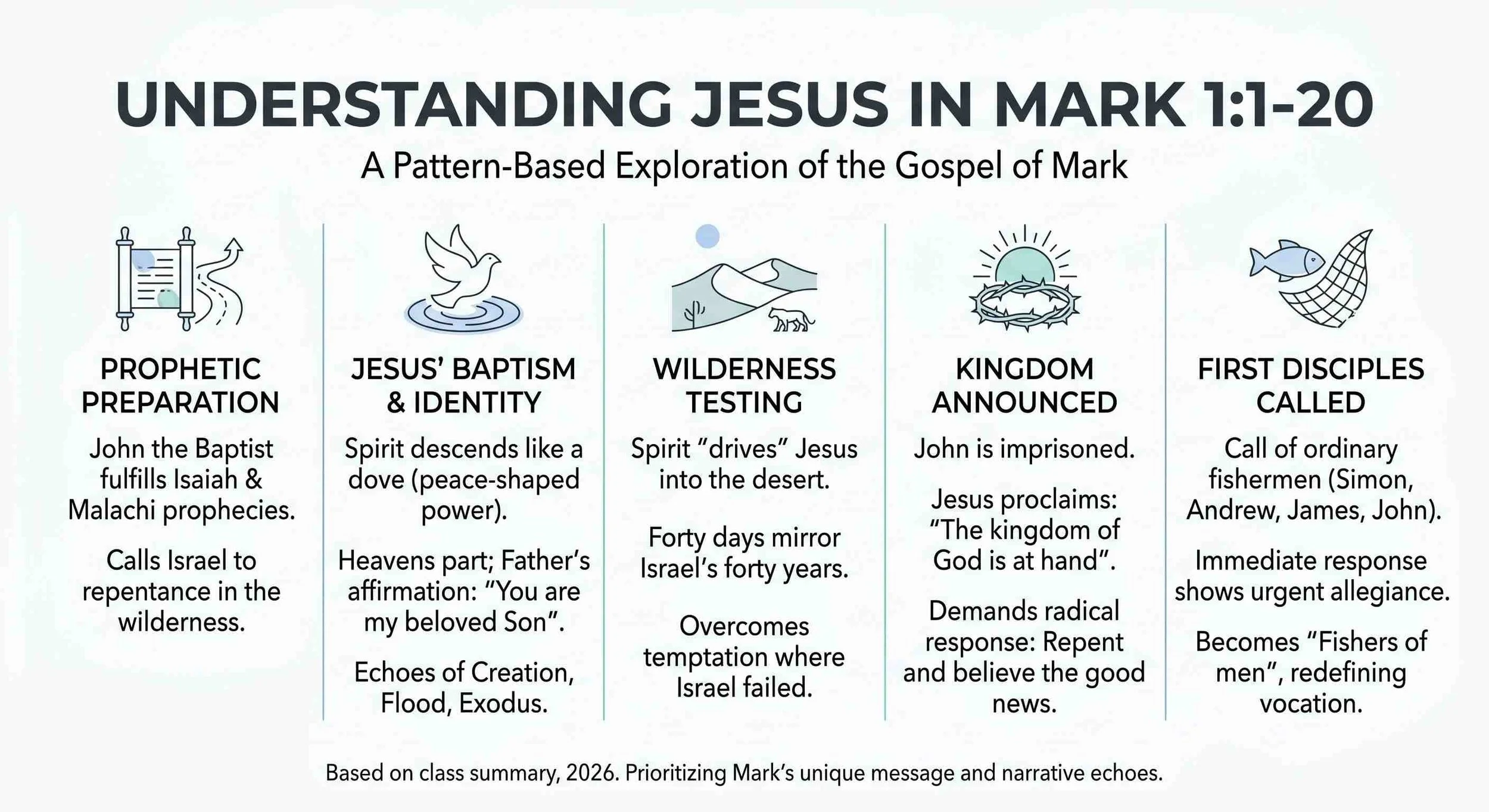
This is an AI Recap of the class.
Some things may be incorrect.
Short Summary of the Whole Class
We learned to read Scripture by noticing patterns and connections, using the Gospel of Mark as our training ground. We read Mark 1:1–20 (NKJV), discussed authorship and Mark’s three‑act design, traced Old Testament echoes (Isaiah, Malachi, Exodus, wilderness), examined Jesus’ baptism and the Spirit’s descent like a dove, considered why Mark streamlines the temptation narrative, unpacked Jesus’ kingdom announcement and the immediate call of ordinary fishermen, and reflected on how Mark communicates through urgency and “felt” experience. We also noted community insights (e.g., Revelation’s “woman” and Roman parallels) and agreed to frame our study with an overview video of Mark. Throughout, we aimed to let Mark speak on his own terms while testing ideas together.
Section-by-Section Summary with Verses, Stories, and Short Wrap-ups
1) Purpose and Approach: Training to Read by Patterns
What we discussed:
The goal is to read the Bible well by recognizing patterns, repeated themes, and familiar echoes (“this sounds like that” moments).
Connections help Scripture “open up,” strengthening memory and understanding.
Students bring prior knowledge that can illuminate the text as connections “click.”
Key ideas:
Begin with Mark; expect recognition of echoes across the biblical storyline.
Let Mark speak on his own terms, resisting cross‑gospel harmonization unless necessary.
Bible verses/stories mentioned:
Focus on the Gospel of Mark broadly; no specific verses cited in this section.
Short summary:
We set the foundation for pattern-based reading in Mark, expecting clearer, more memorable insights as echoes emerge.
2) Collaborative Insight Example: Revelation and Roman History
What we discussed:
From a prior Thursday study, commentaries gave one read on a “woman” in Revelation, but Mick’s love of Roman history surfaced a compelling Roman parallel.
Insight: Commentaries are helpful but not exhaustive; community contributions matter.
Key ideas:
Test ideas together; even tentative connections can be fruitful.
Bible verses/stories mentioned:
Revelation’s “woman” imagery (likely Revelation 12 or 17; chapter not specified).
Stories mentioned:
Class anecdote: Mick’s Roman-history parallel provided fresh perspective.
Short summary:
Community knowledge can reveal helpful contextual links that enrich understanding beyond commentary notes.
3) Plan for Today: Overview Video of Mark
What we discussed:
We decided to watch an overview video of Mark to frame our study (screen share planned on Zoom).
Key ideas:
A high-level overview sets a trajectory for recognizing patterns throughout Mark.
Bible verses/stories mentioned:
No specific verses; the focus was the whole of Mark’s narrative.
Short summary:
We chose to begin with a big-picture overview to guide our pattern-based reading of Mark.
4) Authorship, Sources, and Mark’s Design
What we discussed:
Mark (John Mark) as coworker of Paul and close to Peter; Papias reports Mark compiled Peter’s memories.
Mark states his thesis (Mark 1:1) and shows identity through actions and reactions.
Three‑act structure: Galilee (Who is Jesus?), on the way (What does Messiah mean?), Jerusalem (kingship through suffering).
Themes:
Kingdom proclamation, confronting evil, healing, forgiveness, redefined power and kingship.
Bible verses/stories mentioned:
Mark 1:1; allusions to Isaiah and Malachi prophecies.
Stories mentioned:
Papias’ testimony; Mark’s three‑act narrative framework.
Short summary:
Mark likely shapes Peter’s eyewitness testimony into a three‑act drama unveiling Jesus as Messiah and Son of God through deeds and the path of suffering service.
5) Staying within Mark’s Narrative
What we discussed:
Read Mark as Mark; avoid importing details from Luke/John (e.g., Mary and Elizabeth, cousins; foot‑washing).
Aim to hear Mark’s unique theological emphasis.
Bible verses/stories mentioned:
Mark 1:1–8 implicitly (John’s proclamation).
Noted but set aside: Luke’s infancy narratives; John 13 foot‑washing.
Stories mentioned:
Brief references to non‑Mark details as examples of what to avoid harmonizing.
Short summary:
We committed to Mark’s own voice to preserve his message and patterns.
6) Prophetic Preparation: Isaiah, Malachi, and John the Baptist
What we discussed:
Mark cites prophets about the forerunner; John appears in wilderness garb calling for repentance.
Prophetic imagery and types; light humor about a “John the Baptist diet,” while underscoring his serious call.
Bible verses/stories mentioned:
Mark 1:2–6; quotations of Isaiah/Malachi in Mark 1:2–3.
Stories mentioned:
Crowds from Judea and Jerusalem; John’s wilderness ministry.
Short summary:
John fulfills prophetic expectation, preparing Israel for God’s approaching reign.
7) Jesus’ Baptism: Sonship, the Dove, and Humble Origins
What we discussed:
Jesus comes “from Nazareth of Galilee”; heavens part; Spirit descends like a dove; the Father affirms the Son.
Peace-shaped power: the dove contrasts with conquest expectations.
Echoes of creation (Genesis 1) and the flood’s dove (Genesis 8); “parting” evokes Exodus.
Bible verses/stories mentioned:
Mark 1:9–11; Genesis 1; Genesis 8; Exodus 14 (typological echo).
Stories mentioned:
Creation and flood imagery; Red Sea parting as baptismal type.
Short summary:
Jesus’ baptism reveals his identity and inaugurates a Spirit-empowered mission marked by peace, not domination, amid rich creation‑Exodus echoes.
8) Exodus Motifs and the Wilderness Testing
What we discussed:
Spirit “drives” Jesus into the wilderness; forty days mirror Israel’s forty years.
Mark’s brevity evokes the larger story rather than listing three temptations (as in Matthew/Luke).
Bible verses/stories mentioned:
Mark 1:12–13; allusions to Numbers/Deuteronomy (Israel’s wilderness testing).
Stories mentioned:
Israel’s post‑Exodus journey; angels ministering; wild beasts motif.
Short summary:
Mark compresses the temptation narrative to signal Jesus reenacting Israel’s story and overcoming where Israel failed.
9) “The Kingdom Is at Hand”: Repent and Believe
What we discussed:
After John is imprisoned, Jesus proclaims the nearness of God’s kingdom and calls for repentance and faith.
“At hand” means near, accessible; turn from power-seeking to trust in the Son of God.
Mark 1:1–15 functions as a preamble: identity, fulfillment, announcement.
Bible verses/stories mentioned:
Mark 1:14–15; Isaiah 11:1 alluded (root/shoot of David).
Stories mentioned:
Nazareth as “the sticks”; fulfillment of Israel’s story in Jesus.
Short summary:
The long-awaited moment arrives: God’s reign draws near, demanding a decisive personal response.
10) Calling the First Disciples: Ordinary Fishermen, Urgent Allegiance
What we discussed:
Jesus calls Simon (Peter) and Andrew, then James and John; they immediately leave nets, boats, even father and hired hands.
Let the text stay “weird”: ordinary workers instantly follow an uncredentialed rabbi.
Emphasis on radical allegiance and redefined vocation (“fishers of men”).
Bible verses/stories mentioned:
Mark 1:16–20.
Stories mentioned:
Contrast between families’ resources; rabbinic disciple‑gathering versus Jesus’ surprising choices.
Short summary:
The kingdom advances through ordinary people responding with urgent, costly obedience.
11) Peter’s Confession and the Suffering Messiah (Q&A Preview of Later Mark)
What we discussed:
Differences across Gospels in Peter’s confession; in Mark, “You are the Messiah.”
Immediate clash with Jesus’ teaching on suffering; “Get behind me, Satan.”
Expectations of a political/military Messiah versus the suffering Servant (Isaiah 53).
Bible verses/stories mentioned:
Mark 8:27–33; Isaiah 53.
Stories mentioned:
Anticipation of Mark’s later arc: Transfiguration, passion, centurion’s confession, empty tomb (references).
Short summary:
Mark reveals messiahship through suffering and service, overturning triumphalist expectations.
12) Humility and Service: Sandal Straps and Servant Leadership
What we discussed:
John’s statement about not being worthy to untie Jesus’ sandals underscores humility.
A participant connected this to foot‑washing (John 13), noted as outside Mark but thematically aligned with servant authority.
Bible verses/stories mentioned:
Mark 1:7; John 13 referenced in discussion (acknowledged not in Mark).
Stories mentioned:
Everyday imagery of untying sandals; rabbinic training and memorization; echoes of Micah’s prophetic themes (justice, humility).
Short summary:
John’s humility anticipates Jesus’ servant‑king identity central to Mark’s message.
Medium-Length Overall Summary (April 29, 2026, 18:36:15)
On April 29, 2026 at 6:36 PM, our class set out to read Mark by recognizing patterns and echoes that make Scripture come alive. We framed Mark’s authorship and three‑act design (drawing on Papias’ note about Peter’s memories) and committed to letting Mark speak without cross‑gospel blending. In Mark 1:1–20 (NKJV), John the Baptist fulfills prophetic promises (Isaiah/Malachi), calling Israel to repent as Jesus arrives from humble Nazareth. At Jesus’ baptism, the heavens part, the Spirit descends like a dove, and the Father affirms the Son—imagery echoing creation, the flood’s dove, and a new Exodus. Mark compresses the wilderness temptation to evoke Israel’s story: forty days for forty years, signaling Jesus’ faithful obedience. With John imprisoned, Jesus declares the kingdom “at hand,” summoning repentance and trust. He calls ordinary fishermen, who immediately follow, modeling urgent, costly allegiance. We noted how Mark’s pace and “felt” atmosphere communicate the gospel’s movement. Along the way, we highlighted community learning (e.g., a Revelation/Roman parallel), previewed Peter’s confession and the suffering‑Messiah theme in Mark 8, and planned to watch an overview video to guide our study. The session emphasized pattern recognition, collaborative discovery, and Mark’s portrayal of Jesus’ upside‑down kingship expressed through service and suffering.
Main Points
Read Scripture by recognizing patterns, echoes, and thematic connections.
Let Mark speak on his own terms; avoid unnecessary cross‑gospel harmonization.
Mark likely shapes Peter’s eyewitness memories into a three‑act narrative revealing Jesus as Messiah and Son of God.
John the Baptist fulfills prophetic preparation, calling Israel to repentance (Mark 1:2–6).
Jesus’ baptism reveals divine Sonship and peace‑shaped power, with creation, flood, and Exodus echoes (Mark 1:9–11).
The wilderness testing compresses details to evoke Israel’s story and highlight Jesus’ faithfulness (Mark 1:12–13).
The kingdom is “at hand”: repent and believe the good news (Mark 1:14–15).
Jesus calls ordinary fishermen to radical, immediate discipleship (Mark 1:16–20).
Mark communicates through urgency and atmosphere to draw readers into the gospel’s movement.
Community insights can complement commentaries, enriching interpretation (Revelation “woman” example).
In Mark, messianic authority is revealed through suffering and service (previewed in Mark 8:27–33; Isaiah 53).
Bible Scriptures Mentioned
Mark 1:1–20 (thesis; prophetic citations; John’s ministry; Jesus’ baptism; wilderness testing; proclamation; calling disciples)
Mark 1:1–8 (John’s proclamation)
Mark 1:2–6 (Isaiah/Malachi quotations; John’s description)
Mark 1:7 (John’s humility; sandal‑strap remark)
Mark 1:9–11 (baptism; Spirit as a dove; heavenly voice)
Mark 1:12–13 (wilderness testing; angels; wild beasts)
Mark 1:14–15 (imprisonment of John; kingdom “at hand”; repent and believe)
Mark 1:16–20 (calling Simon Peter, Andrew, James, John)
Mark 6:17–29 (John the Baptist’s beheading; referenced)
Mark 8:27–33 (Peter’s confession; Jesus’ rebuke; previewed)
Isaiah 11:1 (root/shoot imagery; alluded)
Isaiah 53 (suffering servant; discussed)
Malachi (quoted in Mark 1:2–3)
Genesis 1 (creation Spirit imagery; alluded)
Genesis 8 (flood’s dove; alluded)
Exodus 14 (Red Sea parting; typological echo)
Numbers/Deuteronomy (Israel’s forty years; alluded)
Revelation 12 or 17 (the “woman”; exact chapter not specified; referenced)
John 13 (foot‑washing; referenced but noted as outside Mark)
Stories Talked About
John the Baptist’s wilderness ministry and call to repentance
Jesus’ baptism, divine Sonship, and the Spirit descending like a dove
Jesus’ forty days in the wilderness mirroring Israel’s forty years
Jesus’ proclamation of the kingdom’s nearness and call to repent and believe
Calling of Simon (Peter), Andrew, James, and John—ordinary fishermen—who follow immediately
Papias’ testimony about Mark drawing on Peter’s memories
Revelation study anecdote: class member connected the “woman” to Roman history
Creation and flood (dove) imagery; Exodus and the Red Sea as baptismal type
John the Baptist’s imprisonment and later beheading by Herod (referenced)
Peter’s confession and the suffering‑Messiah theme (previewed), plus later Mark arc references (Transfiguration, passion, centurion’s confession, empty tomb)
Mark Chapter 1:1-8 Class 1 - Wednesday Bible Study
A fast-moving, beginner-friendly study launched our journey through Mark 1:1–28—framing the Bible as literature from an oral tradition, exploring John the Baptist, Jesus’ baptism and temptation, the first disciples’ call, and Jesus’ authoritative teaching and exorcism.
Gospel of Mark Intro and Chapter 1:1-8
This is our 1st class on Mark
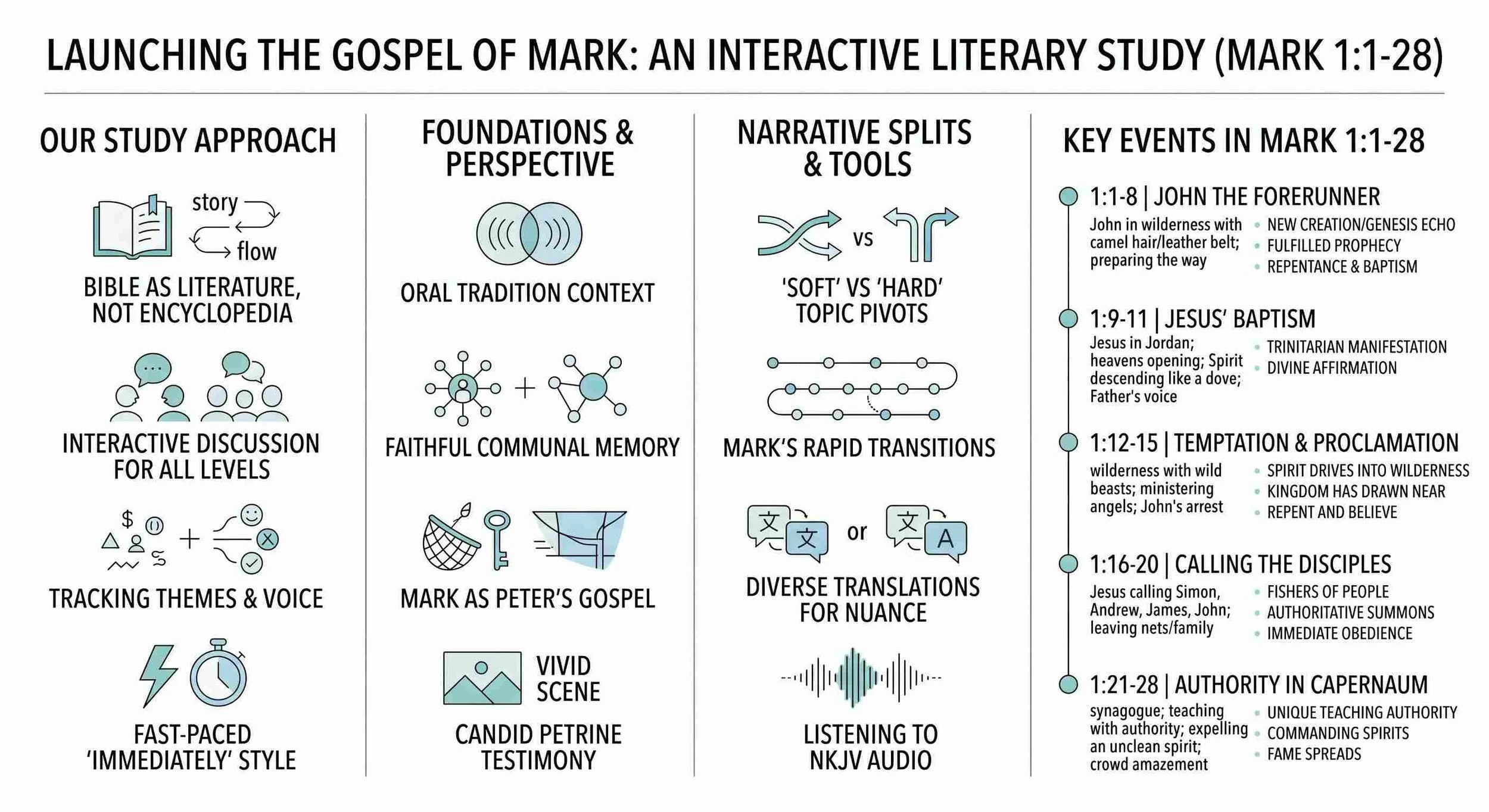
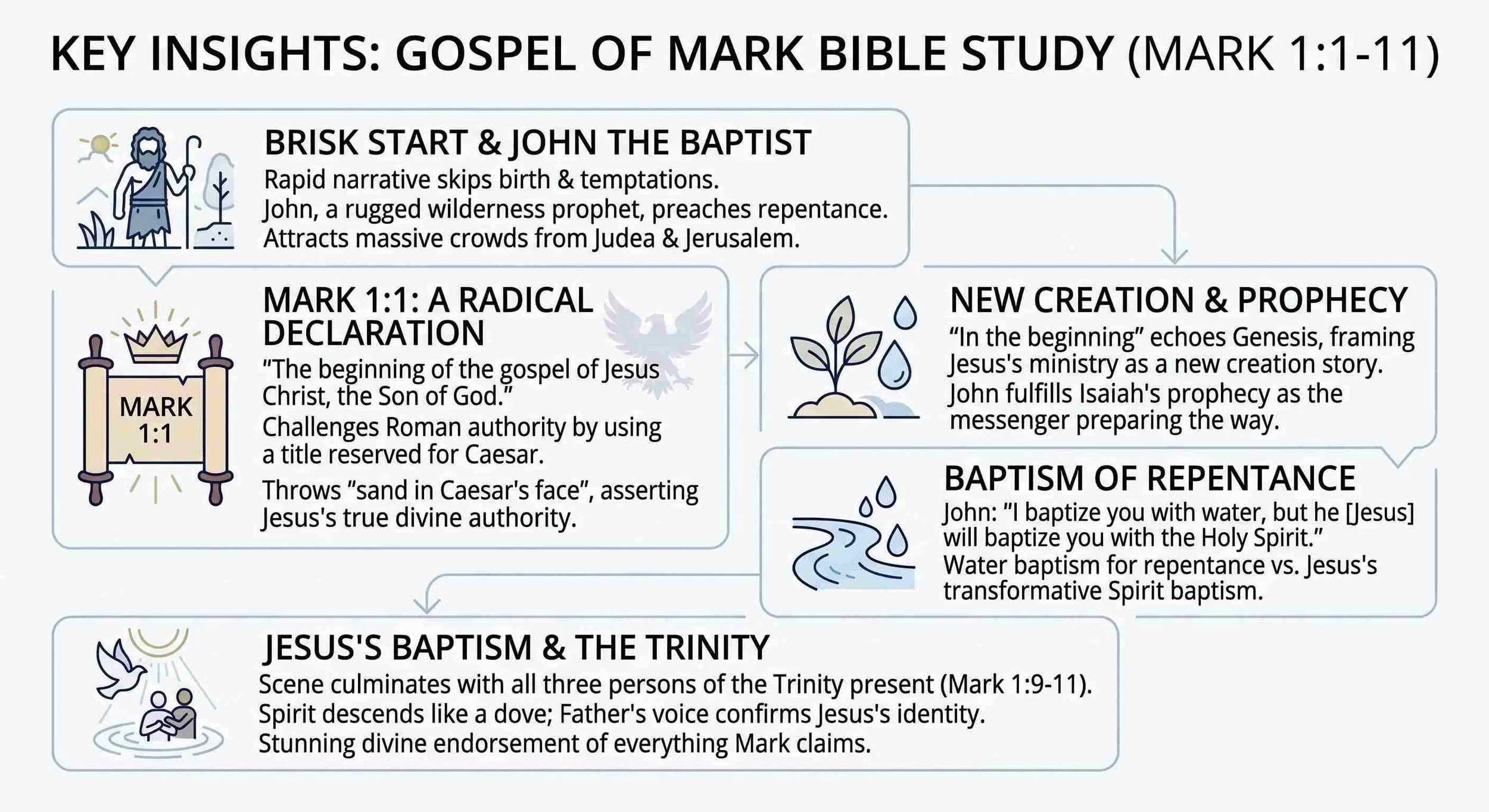
This is an AI Recap of the class.
Some things may be incorrect.
Short summary of the whole class
On 2026-04-22 at 18:32:01, we opened an interactive Gospel of Mark study that treats Scripture as inspired literature shaped by human voices within an oral tradition. We then read Mark 1:1–28, noting fulfilled prophecy in John the Baptist’s wilderness ministry, the Trinitarian revelation at Jesus’ baptism, the brief but urgent temptation account, the immediate call of the first disciples, and Jesus’ authoritative teaching and deliverance in Capernaum. Along the way we tracked Mark’s rapid “immediately” pace, soft and hard narrative splits, translation nuances, and themes of authority, repentance, and the Kingdom’s nearness.
Class walkthrough with section-by-section summaries, verses, and stories
1) Welcome, ground rules, and study approach
What we discussed:
Questions are encouraged; discussion is for newcomers and experienced readers alike.
Read the Bible as literature, not an encyclopedia; learn a practical framework for reading.
Mark is fast-paced; we’ll watch for themes and narrative breaks (“soft” vs “hard” splits).
Stories/examples:
Class context and Chris’s prior experience leading Mark.
Bible scriptures mentioned:
None directly cited.
Short section summary:
We set an interactive, theme-driven approach to reading Mark that welcomes all levels of experience.
2) What is the Bible? Literature, not an encyclopedia
What we discussed:
The Bible is a diverse, inspired library shaped by human authors and contexts.
Expect authorial voice; we’ll learn to “hear” Mark and later assess whether Mark’s traditional ending fits his voice.
Stories/examples:
Literary analogy: loaded phrases gain meaning from the whole story.
Bible scriptures mentioned:
None directly cited.
Short section summary:
We will read Scripture as narrative literature where context and authorial voice shape meaning.
3) Literary themes and the “Boy Who Lived” analogy
What we discussed:
Themes accumulate significance across a narrative; single phrases carry weight because of the whole.
Our study lets themes—not isolated proof texts—drive interpretation.
Stories/examples:
Harry Potter’s “the boy who lived” as a motif analogy.
Bible scriptures mentioned:
None directly cited.
Short section summary:
Meaning in Mark emerges from recurring themes and the unfolding story rather than isolated verses.
4) The Bible in an oral tradition versus our written (and changing) culture
What we discussed:
Gospels arose in communal oral tradition; variations reflect faithful memory, not error.
Our era is shifting again (digital/AI) from purely written conventions.
Stories/examples:
Player piano donation that caught fire (community memory/retelling).
Joke-telling as a living oral tradition.
Bible scriptures mentioned:
None directly cited.
Short section summary:
Understanding oral tradition helps us read Gospel differences as faithful communal memory.
5) Reading Mark with “soft splits” and “hard splits”
What we discussed:
Soft split: same topic with shifting anecdotes; hard split: pivot to a new topic.
Mark’s hallmark pace (“immediately”) requires attention to transitions.
Stories/examples:
Roller coaster marathon (82 rides) and pivot to hotels—illustrating split types.
Bible scriptures mentioned:
None directly cited (preparing to read Mark).
Short section summary:
We will track Mark’s rapid transitions to see how scenes connect or pivot to new themes.
6) Authorship and perspective: Mark as Peter’s gospel
What we discussed:
Traditional view: Mark (John Mark) captures Peter’s preaching.
Mark’s tough portrayal of Peter may reflect Peter’s own self-critical testimony.
Stories/examples:
Broad references to Peter’s denials.
Bible scriptures mentioned:
Anticipation of Peter narratives in Mark; no verses read yet.
Short section summary:
Expect a Petrine flavor: vivid, urgent storytelling and candid treatment of Peter.
7) Translations, versions, and why we’ll listen to NKJV
What we discussed:
Plan: hear dramatized NKJV while participants follow in various translations (NIV, ESV, NRSV, NASB, Complete Jewish Study Bible).
Interlinear demo shows why translation isn’t one-to-one; wording choices matter.
Stories/examples:
Panama “caliente” nuance—language differences can mislead.
Bible scriptures mentioned:
Interlinear preview for Mark 1:1.
Short section summary:
Diverse translations and NKJV audio will sharpen attention to wording, flow, and nuance.
8) Housekeeping and launch into Mark 1
What we discussed:
Flag significant translation differences.
Light humor about tests and AI notes; begin reading Mark 1:1–(TBD).
Stories/examples:
Class logistics and humor.
Bible scriptures mentioned:
Plan to read Mark 1:1–(TBD).
Short section summary:
With expectations set, we launched into reading Mark 1 together.
9) Mark’s opening and prologue themes (Mark 1:1–8)
What we discussed:
Mark 1:1 echoes Genesis 1 (“beginning”), framing Jesus’ story as new creation.
“Gospel” (euangelion) as real good news; subverts Roman imperial “good news” of Caesar, the so‑called “son of god.”
Textual note: some manuscripts omit “Son of God,” but the tradition is strong.
Prophetic setup (Isaiah/Malachi): a forerunner prepares the Lord’s way; John appears in the wilderness preaching repentance and baptizing.
John’s attire and diet (camel’s hair, leather belt, locusts, wild honey) evoke Elijah and prophetic austerity.
“Baptize” as “plunge/immerse”; John contrasts his water baptism with Jesus’ Spirit baptism.
Stories/examples:
Roman imperial announcements (“good news” of Caesar).
Dead Sea Scrolls reference (textual reliability).
Jokes about honey-dipped locusts; John’s rugged lifestyle.
Bible scriptures mentioned:
Mark 1:1–8; Isaiah 40:3; Malachi 3:1; Genesis 1:1 (echo); Isaiah 44:3 (Spirit poured out).
Short section summary:
Mark inaugurates a new-creation good news centered on Jesus, fulfills prophecy through John’s wilderness call, and anticipates Jesus’ Spirit baptism.
10) Jesus’ baptism and Trinitarian manifestation (Mark 1:9–11)
What we discussed:
Jesus is baptized; heavens open; Spirit descends like a dove; Father declares, “You are my beloved Son.”
All three Persons of the Trinity are present.
Stories/examples:
The baptism scene and divine affirmation.
Bible scriptures mentioned:
Mark 1:9–11.
Short section summary:
The Father and Spirit publicly affirm Jesus’ identity at the launch of His ministry.
11) Temptation and Kingdom proclamation (Mark 1:12–15)
What we discussed:
“Immediately” the Spirit drives Jesus into the wilderness for forty days; tempted by Satan; wild beasts; angels minister.
After John’s arrest, Jesus proclaims: “The time is fulfilled… repent and believe in the gospel.”
Contrast between Jesus’ hopeful call and Pharisaic condemnations.
Stories/examples:
Wilderness testing and ministering angels.
Bible scriptures mentioned:
Mark 1:12–15.
Short section summary:
Tested yet sustained, Jesus begins with an urgent call to repentance and faith because God’s Kingdom has drawn near.
12) Calling the first disciples (Mark 1:16–20)
What we discussed:
Jesus calls Simon (Peter) and Andrew; then James and John; they immediately leave nets and family business.
“Fishers of men/people”: inclusive sense (anthrōpōn).
Mark’s repeated “immediately” underscores Jesus’ authority and their decisive obedience.
Stories/examples:
Fishermen abandoning their work to follow Jesus.
Bible scriptures mentioned:
Mark 1:16–20; Mark 1:17 (inclusive “people” note).
Short section summary:
Ordinary workers respond at once to Jesus’ authoritative summons, reoriented toward gathering people.
13) Teaching with authority and casting out an unclean spirit (Mark 1:21–28)
What we discussed:
In Capernaum’s synagogue, Jesus teaches with authority—unlike the scribes.
An unclean spirit recognizes Him; Jesus rebukes and expels the demon.
Crowd marvels: a new teaching with authority; fame spreads quickly.
Stories/examples:
Synagogue exorcism; public amazement at Jesus’ words and works.
Bible scriptures mentioned:
Mark 1:21–28.
Short section summary:
Jesus’ authority appears in both word and deed, confronting evil and signaling the inbreaking Kingdom.
Medium-length final summary of the class
On 2026-04-22 at 18:32:01, we launched an interactive study of the Gospel of Mark built on reading Scripture as inspired literature emerging from an oral tradition. We introduced tools for tracking Mark’s rapid pace, including “soft” and “hard” narrative splits, and discussed authorship with a likely Petrine voice. After previewing translation nuances and listening to NKJV audio alongside various translations, we read Mark 1:1–28. Mark’s opening echoed Genesis and subverted Roman “good news,” proclaiming Jesus as the true Son of God. Prophecy set the stage for John the Baptist’s wilderness ministry of repentance, whose ascetic profile evoked Elijah. Jesus’ baptism revealed the Trinity together, followed by His brief but urgent temptation account and His inaugural proclamation that the Kingdom has drawn near, calling for repentance and belief. Jesus’ authority compelled immediate obedience from the first disciples and astonished crowds in Capernaum as His teaching and exorcism demonstrated power over unclean spirits. Throughout, we emphasized themes of authority, urgency, repentance, fulfillment, and Spirit outpouring, preparing to continue reading Mark with careful attention to voice, themes, and transitions.
Main points
The Bible is an inspired, humanly authored library to be read as literature within its oral-tradition context.
Mark’s Gospel moves with urgency (“immediately”) and requires attention to soft/hard narrative splits.
Mark 1:1 echoes Genesis and subverts Roman imperial “good news,” proclaiming Jesus as the true Son of God.
Prophetic promises (Isaiah/Malachi) frame John the Baptist as the wilderness forerunner calling Israel to repent.
Jesus’ baptism publicly reveals the Trinity; His identity is affirmed by the Father and Spirit.
The temptation account is brief but shows testing and God’s care; Jesus begins with a concise Kingdom proclamation.
Jesus’ authoritative call reorients ordinary people into mission (“fishers of people”).
Jesus teaches with unique authority and commands unclean spirits, signaling the inbreaking Kingdom.
Translation nuances matter; hearing NKJV dramatized while reading various translations clarifies wording and flow.
We will later evaluate whether Mark’s traditional ending aligns with his established voice.
Bible scriptures mentioned
Mark 1:1–28 (primary passage)
Mark 1:1 (interlinear preview; textual variant “Son of God”)
Mark 1:2–3 (prophetic citation)
Mark 1:4–8 (John’s ministry; baptism of repentance)
Mark 1:9–11 (Jesus’ baptism; Trinitarian manifestation)
Mark 1:12–13 (temptation; wilderness; angels)
Mark 1:14–15 (Kingdom proclamation)
Mark 1:16–20 (call of the first disciples; “fishers of people”)
Mark 1:21–28 (teaching with authority; exorcism in Capernaum)
Genesis 1:1 (echoed in Mark’s opening)
Isaiah 40:3 (voice in the wilderness; prepare the way)
Malachi 3:1 (messenger prepares the Lord’s way)
Isaiah 44:3 (Spirit poured out)
Stories and illustrations mentioned
Harry Potter’s “the boy who lived” (theme analogy)
Player piano donation that caught fire (oral memory/retelling)
Joke-telling as an example of oral tradition
Roller coaster marathon (82 rides) and hotel pivot (soft vs hard splits)
Panama “caliente” translation mishap (language nuance)
Roman imperial “good news” of Caesar, the “son of god”
John the Baptist’s wilderness lifestyle (camel’s hair, leather belt, locusts, wild honey)
Jesus’ baptism in the Jordan and divine affirmation
Jesus’ temptation with wild beasts and ministering angels
Fishermen leaving nets and family business to follow Jesus
Synagogue exorcism in Capernaum; crowd astonishment at Jesus’ authority
Content creation date for this summary: 2026-04-22 18:32:01