

The Great Divorce Conclusion Overview - Thursday Bible Study
Our Bible study concluded C.S. Lewis's The Great Divorce, exploring how our present-day choices regarding forgiveness, attachments, and community shape our eternal reality, contrasting the misery of Hell (a self-imposed prison locked from the inside) with the joyful, solid reality of Heaven.
Great Divorce Conclusion overview
This is our 9th class on The Book
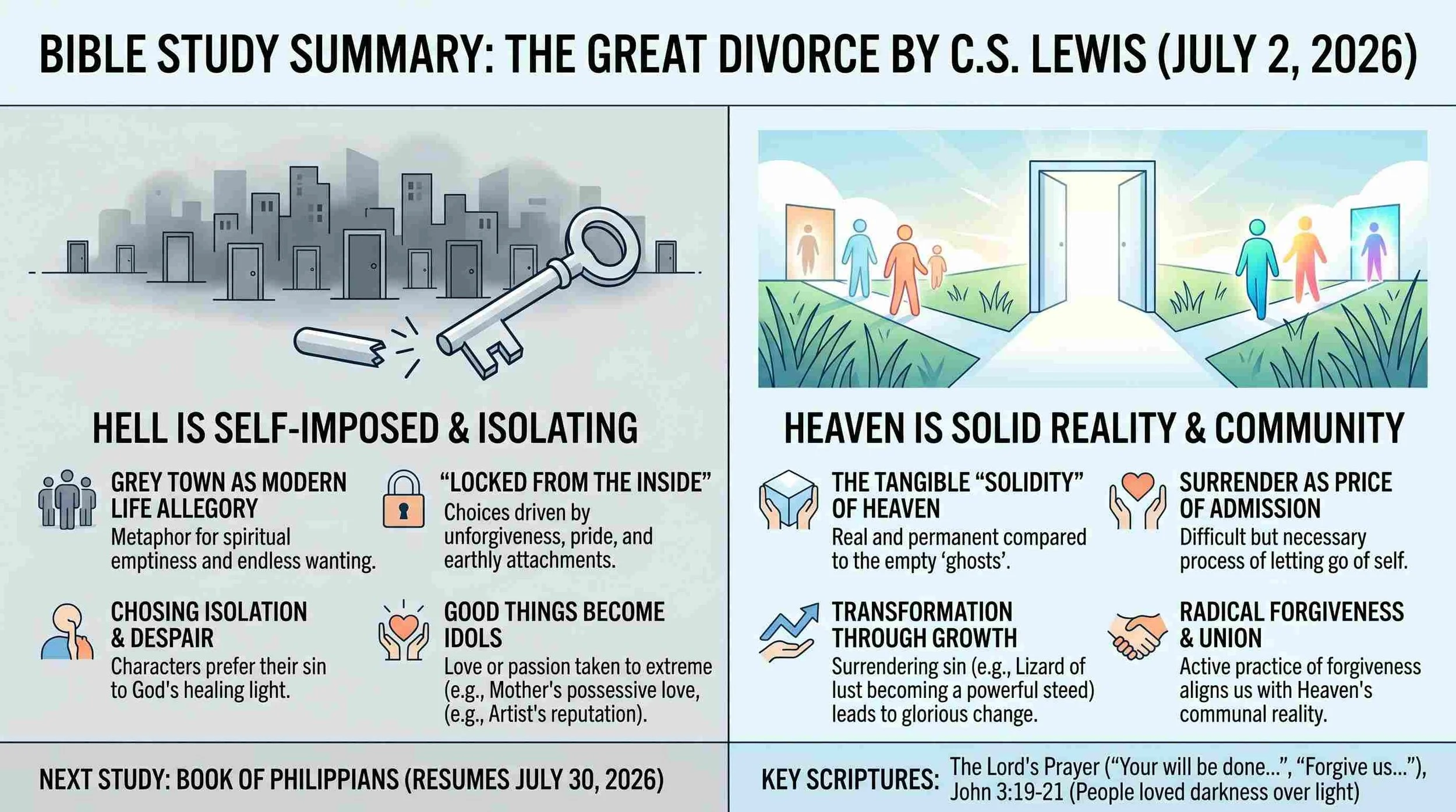
This is an AI Recap of the class.
Some things may be incorrect.
Short Summary of the Whole Class
On July 2, 2026, the class held its final discussion on C.S. Lewis's The Great Divorce before a summer break, with plans to reconvene on July 30, 2026, to study the book of Philippians. The session was dedicated to reflecting on the book’s major themes, interpreting the "Grey Town" as a metaphor for our current world, filled with loneliness and unforgiveness. We discussed how free will, earthly attachments, and preconceived notions can prevent us from embracing God's kingdom. Participants shared that the book served as a mirror for recognizing personal flaws and the necessity of radical forgiveness, as taught in the Lord's Prayer. The group concluded that true spiritual growth is a process, found in tangible community and the difficult but freeing surrender of sin, which transforms us from isolated "ghosts" into "solid" citizens of Heaven.
Detailed Class Summary
Here is a breakdown of the topics we discussed during our class on July 2, 2026.
Housekeeping and Future Plans
The class began with some housekeeping announcements. It was noted that this would be the last Thursday class until July 30, 2026, when the group will reconvene. The instructor, Cris, mentioned he would be traveling to Phoenix and Las Vegas during the break. After some discussion, the group decided that upon their return, they would begin a new study on the book of Philippians.
Section Summary: The class announced a summer hiatus, with the final meeting being on July 2, 2026. The group will resume on July 30, 2026, and will begin studying the book of Philippians.
Opening Reflections: The Book as a Modern Parable
Cris opened the main discussion by framing it as a final reflection on C.S. Lewis's The Great Divorce. He shared that the book reinforced a key concept for him, rooted in the Lord’s Prayer: "Your will be done on earth as it is in heaven." He explained that Christianity isn’t just about securing a spot in a "good place" after death, but about actively participating in making our current world reflect the values and reality of heaven.
This led to the perspective that the "Grey Town" in the book isn't just a depiction of Hell, but a powerful allegory for our current world. In our society, there is a relentless pressure to always want more and achieve more, which can drive people away from God, creating a spiritual "Grey Town" characterized by dissatisfaction. The choices the characters, or "ghosts," make are symbolic of decisions we make in our daily lives—whether we choose to live in the fullness of God’s forgiveness or cling to our own brokenness.
Section Summary: The discussion began by linking the book's core message to the Lord's Prayer, emphasizing that our faith is about bringing Heaven's reality to Earth now. The book's "Grey Town" was interpreted as a metaphor for modern life, where societal pressures for constant improvement create a spiritual emptiness that distances people from God.
Bible Scripture: The Lord's Prayer, specifically "Your will be done on earth as it is in heaven."
Free Will, Sin, and Recognizing Our Flaws
A class member pointed out that a major focus of the book is free will. The ghosts from the grey town consistently had the choice to stay in heaven or return to their misery. They could choose to let go of their defining sin or remain attached to it. Cris expanded on this, noting that many of the sins depicted were good things taken to an extreme. For example, a mother’s love for her son or an artist’s passion for his craft became idols that blocked them from God.
This discussion highlighted how the book makes us aware of our own faults, as we can see parts of ourselves in the "ghosts." This self-recognition is the first step toward change. Stories were shared illustrating how people are often trapped by negative labels and past experiences. For instance, a man from Jamaica whose negative perception of white people was changed by a single act of kindness, and a "Little Brother" who believed he was "stupid" because his father constantly told him so, becoming a self-fulfilling prophecy.
Section Summary: The group discussed the central theme of free will, where each character's destiny is their own choice. Sin is often a good thing elevated above God, becoming an idol. The book acts as a mirror, helping us recognize our own flaws, and personal stories were shared about how ingrained prejudices and negative self-perceptions can be overcome.
Stories Mentioned:
* The mother's possessive love for her son.
* The artist more concerned with his reputation than with experiencing the light.
* A man from Jamaica whose prejudice was overcome by a tourist's kindness.
* A boy in the Big Brothers program who internalized his father's negative label of being "stupid."
The Tangible Reality of Heaven vs. The "Easy" Emptiness of Hell
One participant expressed a concern that the book makes Heaven seem unappealingly difficult, with imagery of grass too hard to walk on. This might discourage a reader, making the journey seem like "a mess."
Other members countered that this difficulty is purposeful. The "grey town" was deceptively easy—a place where you could have anything you imagined, leading to isolation and emptiness. In contrast, Heaven is "solid" and has a "price of admission": the difficult but necessary act of surrendering one's self. The journey towards spiritual maturity was compared to a new Christian's walk, moving from the "milk" to the "meat" of the word. Faith isn't instant perfection but a continuous process. This journey of self-confrontation was compared to literary works like Charles Dickens’s A Christmas Carol, John Bunyan’s Pilgrim’s Progress, and Alice in Wonderland—all dream-like journeys forcing a choice upon "waking up." This was connected to John 3:19-21, which states that people love darkness because their deeds are evil and they fear exposure by the light.
Section Summary: A critique was raised that Heaven seems harsh, but the response was that its "solidity" contrasts with the easy emptiness of Hell. This difficulty represents the real, sometimes painful, process of spiritual growth, moving from "milk" to "meat." The story was compared to allegorical works like A Christmas Carol and linked to the biblical idea that people who love darkness avoid the light.
Bible Scriptures:
* **John 3:19-21**: "People loved darkness instead of light because their deeds were evil..."
* The concept of needing "milk of the word" before "meat," alluding to **1 Corinthians 3:2** and **Hebrews 5:12-14**.
Stories Mentioned:
* ***A Christmas Carol*** by Charles Dickens
* ***Pilgrim’s Progress*** by John Bunyan
* ***Alice in Wonderland*** by Lewis Carroll
Hell Locked from the Inside and the Power of Community
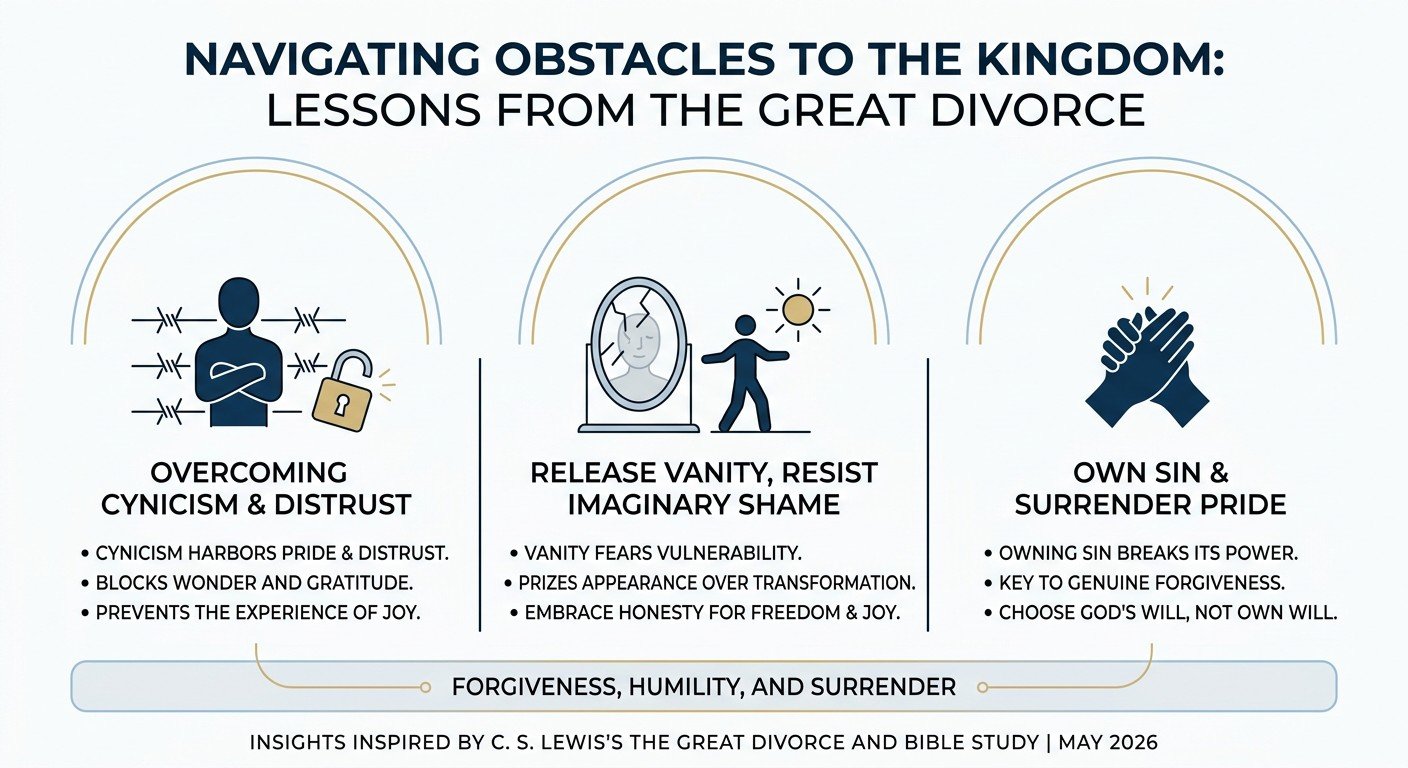
The discussion shifted to the idea that Hell is a place "locked from the inside." Cris explained that people choose Hell because they love their darkness—their grudges, pride, and self-pity—more than the light of God, which would expose and heal them. This led to a conversation about the necessity of forgiveness and community. If Heaven includes people we despise, our inability to forgive them now reveals an unwillingness to accept Heaven's reality.
The danger of demanding strict adherence and creating division was described as the fastest way to kill a church, mirroring how the residents of Grey Town move farther apart into deeper loneliness. To illustrate the power of community, the "Rat Park" experiment was mentioned, where rats in a vibrant community chose plain water over morphine-laced water, suggesting connection is an antidote to self-destructive habits. Our church aims to foster this community to combat loneliness.
Section Summary: The group explored the concept of Hell as a self-imposed prison chosen by those who refuse God's light. This highlighted the importance of forgiveness and community, as unforgiveness is incompatible with Heaven. Demanding perfection leads to isolation, the essence of the Grey Town. In contrast, a healthy community, like in the "Rat Park" experiment, can help people overcome destructive behaviors.
Stories Mentioned:
* The "Rat Park" experiment from the 1970s.
* ***Dante's Inferno*** was contrasted with Lewis's idea of Heaven.
* The character of Scrooge from *A Christmas Carol* and his isolating house.
Transformation and Encouraging Growth
A key difference between Heaven's "solid people" and the "ghosts" is how they handle misery. The solid people are compassionate but are not blackmailed by the ghosts' self-pity. They sit with them and gently encourage them to let go of what holds them back. This is exemplified by the ghost with the lizard of lust on his shoulder. He is encouraged to let an angel kill it. The act is painful, but the lizard is transformed into a magnificent steed, and the man becomes solid. This shows that surrendering sin, though difficult, brings sudden and glorious transformation.
This imagery of transformation led to a brief discussion of different faith traditions, such as the Baptist declaration of being "saved" and the Lutheran balance of law and gospel. The ultimate call is to practice forgiveness in all aspects of life—from minor annoyances like a neighbor mowing late to deep hurts. By forgiving, we align with God's will, move out of the "Grey Town," and experience a more heavenly life now.
Section Summary: The "solid people" model compassionate encouragement without enabling self-pity. The story of the man with the lizard illustrates that surrendering sin, though hard, leads to glorious transformation. This call to change connects to our need to practice radical forgiveness in daily life, fulfilling the Lord's Prayer and moving from the "Grey Town" to a heavenly reality.
Bible Scripture: The Lord’s Prayer, specifically "Forgive us our sins, as we forgive others."
Stories Mentioned:
* The man with the lizard on his shoulder.
* Hypothetical examples of forgiving daily frustrations (late-night mowing, slow self-checkout lines).
Final Medium-Length Summary
In our final session on C.S. Lewis's The Great Divorce on July 2, 2026, our church group engaged in a deep reflection on the book's allegorical portrayal of Heaven, Hell, and the human condition. We saw the "Grey Town" not just as an afterlife, but as a metaphor for our modern world, defined by loneliness, constant striving, and unforgiveness. The discussion heavily emphasized that Hell is "locked from the inside"—a state of being chosen by those who, as described in John 3, love darkness more than light because they refuse to let go of earthly attachments and sins.
We affirmed that true faith is found not in demanding perfection, which leads to isolation, but in building a supportive community that helps us overcome our self-destructive tendencies. The central theme of free will was a major point of discussion, alongside the necessity of practicing radical forgiveness, as taught in the Lord's Prayer. While the "hardness" of Heaven represents the challenging but necessary surrender of self, the book's ultimate message is one of hope. As modeled by the "bright spirits" and the story of the man with the lizard, letting go of our sins leads to a glorious and liberating transformation, allowing us to move from being an isolated "ghost" to a "solid" citizen of God's kingdom, here and now.
Main Points
The class will take a summer break and resume on July 30, 2026, to study the Book of Philippians.
The Great Divorce is an allegory for our present spiritual choices and our modern world, not just the afterlife.
The "Grey Town" represents a state of loneliness, dissatisfaction, and unforgiveness driven by worldly pressures.
Free will is central: characters choose their own eternal destiny by either clinging to or surrendering their sins.
Sin is often a good thing (like love or art) that has been distorted into an "ultimate thing."
Heaven is depicted as "hard" or "solid" because it is more real, requiring us to become more real through surrender and growth (moving from "milk" to "meat").
Hell is "locked from the inside"; it is a choice made by those who refuse to let go of their darkness.
Community is a powerful tool against loneliness and self-destructive behaviors.
A forgiving heart is essential, as holding grudges is incompatible with the communal reality of Heaven.
Surrendering our sins to God, though difficult, leads to glorious and immediate transformation.
Scriptures and Stories Mentioned
Bible Scriptures:
The Lord's Prayer: Specifically the lines, "Your will be done on earth as it is in heaven" and "Forgive us our sins, as we forgive others."
John 3:19-21: "This is the verdict: Light has come into the world, but people loved darkness instead of light because their deeds were evil..."
1 Corinthians 3:2 and Hebrews 5:12-14: Alluded to in the discussion of moving from the "milk" to the "meat" of the word.
Stories and Analogies:
The Man with the Lizard: The character with a lizard of lust on his shoulder who must allow an angel to kill it, after which it is transformed into a magnificent horse.
The Mother's Love: The story of the mother whose possessive love for her son becomes an idol.
The Artist: The artist who is more concerned with his reputation and painting the light than in experiencing it.
A man from Jamaica: His prejudice against white people was changed by a tourist giving him a dollar.
A boy in the Big Brothers program: He believed he was stupid because his father constantly told him so.
The "Rat Park" experiment: Rats in a community setting overcame morphine addiction, highlighting the power of connection.
A Christmas Carol by Charles Dickens: Compared to The Great Divorce as a story of redemption from a "Greytown" of despair to light and joy.
Pilgrim's Progress by John Bunyan: Mentioned as another allegorical journey of spiritual struggle and redemption.
Alice in Wonderland by Lewis Carroll: Used as an example of a dream-like journey that leads to self-discovery.
Dante's Inferno: The sign "Abandon all hope, ye who enter here" was contrasted with Lewis's ideas.
Hypothetical modern-day stories: Practicing forgiveness for a neighbor mowing late or for a person slow at self-checkout.
The Great Divorce Chapters 12-13 - Thursday Bible Study
On June 18, 2026, our class explored sin’s inward curve, creation’s praise, and the redemptive power of Christ through C. S. Lewis’s imagery in The Great Divorce, discussing how unresolved grief and lust can become idolatry and how surrendering our deepest attachments leads to glorious transformation.
Great Divorce Chapters 12-13
This is our 8th class on The Book
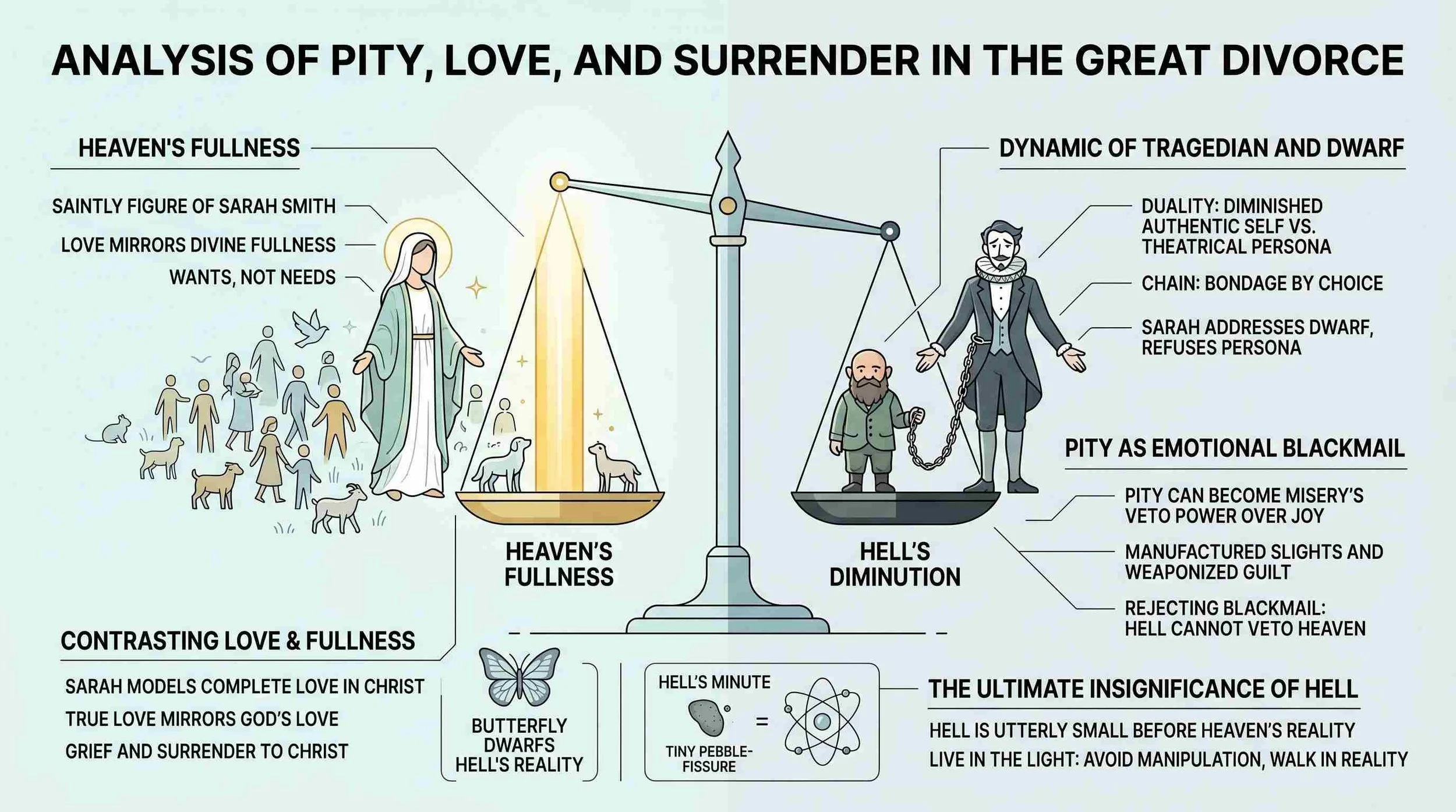
This is an AI Recap of the class.
Some things may be incorrect.
Short Summary of the Class
On June 25, 2026, our class delved into chapters 12 and 13 of C.S. Lewis's "The Great Divorce," focusing on the characters of Sarah Smith and her husband, the Dwarf/Tragedian. We discussed the contrast between Sarah's radiant, non-possessive love and her husband's manipulative self-pity, which functions as a self-forged chain reminiscent of Marley in A Christmas Carol. We explored how his behavior exemplifies "emotional blackmail" and how true, selfless love, like God's, comes from fullness, not neediness. The conversation highlighted the immense difficulty of surrendering our earthly griefs to God, the necessity of setting boundaries so that "hell cannot veto heaven," and the striking image of hell's ultimate smallness. We concluded that God’s will is not a formula but a reality to be lived, with our hope resting firmly in Christ's victory over darkness.
Detailed Class Summary
Here is a breakdown of the topics we covered during our discussion.
1) Setting the Study: Continuing The Great Divorce (Chs. 12–13)
Our discussion began by noting we were likely finishing the study of The Great Divorce and that chapters 12 and 13 are deeply intertwined. We acknowledged the difficulty of Lewis’s euphemistic, layered language, especially for newer readers, and how his interwoven poetry, while "not epic," is "quite lovely" and enhances the metaphorical narrative. The group reflected on the central question posed by the story: Is it tolerable that the woman in heaven (Sarah Smith) remains untouched by her husband's self-made misery? The consensus was that love in heaven must not be subject to manipulation from hell.
Summary: We framed the session around the connected narrative of chapters 12–13, set expectations for Lewis’s dense, poetic style, and affirmed that heaven’s love cannot be ruled by another’s self-chosen misery.
Bible Verses Mentioned: None cited in this opening frame.
Stories Mentioned: Class logistics and reading challenges.
2) Sarah Smith’s Quiet Sainthood and Expansive Love
We identified Sarah Smith as a figure of quiet, unnoticed sainthood. This resonated with a participant's childhood memory of a kind church woman who welcomed children. Cris shared a story from Texas about an unassuming youth leader whose massive funeral revealed his hidden, widespread impact, highlighting how true holiness is often humble and recognized late. We observed that Lewis’s choice of a common name, "Sarah Smith," signals that great saints are often ordinary in worldly terms. Her sainthood is expressed through expansive, non-possessive love. Her motherhood doesn't "steal" children but enlarges their capacity to love their own families more, a model of investing in people without controlling them. This love overflows to creation itself; as the text says, every beast and bird "in her became themselves," which we connected to the Franciscan tradition of care for all creatures.
Summary: We recognized Sarah Smith as a type of unnoticed, ordinary saint whose humble, non-possessive love multiplies affection, restores creation, and shapes many lives, echoing real-world experiences of hidden, impactful servants.
Bible Verses Mentioned:
Matthew 6:1–4 (giving in secret; hidden righteousness)
Matthew 23:11–12 (the greatest is the servant)
Hebrews 13:2 (hospitality to strangers)
1 Peter 5:5–6 (humility exalted by God)
1 Samuel 16:7 (God looks on the heart)
1 Corinthians 1:26–29 (God chooses the lowly)
Philippians 2:3–4 (looking to others’ interests)
1 Thessalonians 2:7–8 (gentle, sharing life)
Galatians 6:2 (bearing burdens)
Genesis 1:28; 2:15 (care for creation)
Romans 8:19–22 (creation longing for restoration)
Proverbs 12:10 (the righteous care for animals)
Stories Mentioned:
Texas youth leader’s funeral revealing wide impact.
St. Francis of Assisi’s care for animals.
Personal anecdotes about the commonness of the name "Smith."
3) Radiance and Edenic Innocence
Reading the description of Sarah Smith's appearance, we noted the question, "Is she naked? Is she clothed?" Cris connected this to the Edenic state of being "naked without shame," where one's presence is no longer about fear or concealment but about glory. Her robe and crown are as natural as lips or eyes, embodying a restored, shame-free existence in the kingdom.
Summary: Sarah’s radiance evokes Eden restored—a shame-free, glory-clothed presence that embodies life in the kingdom.
Bible Verses Mentioned:
Genesis 2:25 (naked and not ashamed)
Psalm 8:5 (crowned with glory and honor)
Revelation 19:7–8 (the bride’s fine linen—righteous acts)
Stories Mentioned: Eden imagery.
4) The Dwarf and the Tragedian: Emotional Blackmail vs. Authentic Love
We analyzed the character of Sarah’s husband, who appears as both the Dwarf (the true self) and the Tragedian (a theatrical persona). His pouting and emotional neediness were identified as a form of manipulation, which someone aptly called "emotional blackmail." This lifelong tool for control started in his childhood, where he would sulk to make his sisters feel sorry for him. The Dwarf holds the chain of this self-pity, while the Tragedian wears the collar, performing to avoid genuine engagement. Sarah addresses the Dwarf, the true self, ignoring the persona. We contrasted this manipulative "love" with the true, selfless love his wife now possesses. On page 126, she explains she is "full now," "in love itself," no longer needing him but freely wanting him to share her joy. This mirrors God’s love for us: He is already completely full but still desires a relationship.
Summary: The scene contrasts Sarah’s genuine, "full" love with her husband’s manipulative performance. We identified his behavior as "emotional blackmail"—a destructive tactic rooted in neediness that stands in opposition to the selfless, giving nature of God's love.
Bible Verses Mentioned:
Ephesians 4:22–24 (put off the old self; put on the new)
Matthew 5:37 (simple truth without theatrics)
John 1:39 (The wife's invitation to "Come and see" was compared to Jesus's invitation to His disciples).
Stories Mentioned: The story of the Tragedian's childhood manipulation of his sisters.
5) Chains We Forge: Self-Pity, Grief, and Surrender
The discussion turned to the chain the Dwarf carries, representing his self-pity. We drew a parallel to Marley's self-forged chains of greed in Charles Dickens’s A Christmas Carol. The Dwarf clings to his chain, using pity to manipulate and control, shrinking as he rejects heaven. This led to a vulnerable conversation about the difficulty of surrender, especially in the face of profound loss, like the death of a child or spouse. We acknowledged that true peace comes only through Christ, which requires surrendering what we hold tightly. Personal testimonies were shared about how faith provides comfort, knowing a loved one is with the Lord. We also noted how the pressure to grieve "perfectly" can feel like being forced to be an actor, just like the Tragedian.
Summary: Self-pity and a ledger of grievances become self-forged chains that pull us from grace. Surrendering these attachments and our deepest griefs to God is incredibly difficult but essential, and faith in Christ is the only source of true comfort and freedom.
Bible Verses Mentioned:
Galatians 5:1 (Christ sets us free; do not be entangled again)
2 Corinthians 7:10 (godly sorrow vs. worldly sorrow)
James 3:14–16 (selfish ambition breeds disorder)
1 Corinthians 13:5 (love keeps no record of wrongs)
Stories Mentioned:
Charles Dickens’s A Christmas Carol (Marley’s chains).
A woman grieving the loss of her child (referenced from another part of "The Great Divorce").
Personal stories of losing family members and finding comfort in faith.
6) Resisting Hell's Veto: Pity, Boundaries, and Coercion
We explored how the Tragedian uses pity to hold others' joy for ransom. The class noted how guilt and self-pity are used to force conformity in relationships, which was compared to historical lobotomy practices—a metaphor for coercive change rather than invited transformation. Sarah Smith establishes a firm boundary, declaring she "cannot bring hell into me." This resonated with Lewis's larger point that hell cannot be allowed to "veto heaven." True Christian service was distinguished from enabling dysfunction; enabling is not love. The Tragedian ultimately chooses his self-pity, and the Dwarf disappears, swallowed by the persona.
Summary: We defined pity as a chain the Tragedian used for emotional blackmail. Sarah’s refusal to let his misery corrupt her joy served as a powerful lesson on setting boundaries and distinguishing true love from enabling or coercion.
Bible Verses Mentioned:
Colossians 3:12–14 (compassion bound with love)
Romans 12:2 (transformation by renewal, not coercion)
Stories Mentioned:
One Flew Over the Cuckoo’s Nest (lobotomy reference).
General historical notes on lobotomy practices.
7) The Smallness of Hell and the Power of Light
The class was moved by Lewis's striking image of hell's true size. The guide reveals that the bus from hell came through a fissure in the soil "no bigger than" a blade of grass, and that "all hell is smaller than one pebble" of the earthly world. This underscored heaven’s vastness and hell’s impotence, which we connected to the biblical truth that "the darkness cannot overcome the light." Cris shared a pastoral story of comforting a grieving friend, illustrating that even a tiny light (a Bic lighter in a dark field) pierces overwhelming darkness. The takeaway was that light doesn't strain to overcome darkness; it simply shines.
Summary: Lewis’s vision portrays hell as infinitesimally small before heaven’s reality, reinforcing the biblical truth that light inevitably overcomes darkness; a pastoral story made this hope concrete.
Bible Verses Mentioned:
John 1:5 (the light shines in the darkness, and the darkness has not overcome it) — referenced conceptually.
Stories Mentioned:
Cris’s pastoral visit to a grieving friend; the "field and Bic lighter" illustration.
8) Living God's Will in Reality
Finally, we discussed Lewis’s caution against defining eternal reality, quoting from the end of p. 141: “it must be lived.” Lewis isn't focusing on universalism or predestination but on lived obedience and love. Cris emphasized a “live life” theology: we discern God’s will through faithful living and hindsight more than abstract certainty. This was illustrated with a participant's career path from chemical engineering to firefighting and the quip, “man plans and God laughs.” We concluded that perfection isn’t the requirement for our assurance, which rests solely in Jesus’ death and resurrection. The session ended with an agreement to continue with a full debrief next week.
Summary: Lewis reframes debates about eternal destiny, calling us to live reality with God. The class affirmed that God’s will is discerned through faithful living, with our ultimate confidence rooted in Christ’s finished work.
Bible Verses Mentioned (Implied/Alluded to):
Romans 8:28 (God works all things for good)
John 11:25 or 1 Corinthians 15 (Christ’s death and resurrection)
Psalm 37:23 (steps ordered by the Lord)
Stories Mentioned:
Speaker 4’s vocational journey (engineering to firefighting).
Class quip: “man plans and God laughs.”
Final Summary
Our study session on June 25, 2026, was a profound exploration of C. S. Lewis’s The Great Divorce (chapters 12–13), focusing on love, manipulation, and surrender. We dissected the character of the Tragedian, identifying his behavior as "emotional blackmail"—a toxic form of control rooted in manufactured neediness and self-pity. This was contrasted with Sarah Smith, a figure of radiant, Eden-like innocence whose ordinary name belies an extraordinary holiness expressed through expansive, non-possessive love. Her love comes from a place of fullness, modeling God's own selfless love for us. The discussion led to a vulnerable look at the difficulty of surrendering our earthly attachments and griefs, with members sharing how faith in Christ is the only true way to find peace. We were moved by Lewis’s breathtaking image of hell as a minuscule crack set against the immeasurable reality of heaven, reinforcing the gospel truth that light overcomes darkness. We concluded with Lewis’s call to live out God’s will rather than merely defining it, recognizing that our assurance rests not in our perfection but in Christ’s death and resurrection.
Main Points
Lewis’s language in The Great Divorce is dense and poetic; chapters 12–13 are tightly connected.
Sarah Smith exemplifies humble, radiant sainthood; her expansive love multiplies affection and restores creation.
Emotional manipulation, or "emotional blackmail," is a destructive tool that creates unhealthy relationships.
True love, like God’s, comes from fullness, not neediness, and gives freely.
Chains of self-pity are self-forged through manipulation and keeping ledgers of slights.
Surrendering our deepest pains and griefs to God is difficult but necessary for true peace.
We must set boundaries to prevent misery from corrupting God-given joy; hell cannot be allowed to veto heaven.
Hell is unimaginably small before heaven’s reality; light overcomes darkness.
God’s will is a reality to be lived and is often discerned in hindsight.
Our assurance rests in Jesus’ death and resurrection, not in human perfection.
Bible Scriptures Mentioned
Genesis 1:28; 2:15 — Care for creation.
Genesis 2:25 — Naked and not ashamed.
1 Samuel 16:7 — God looks at the heart.
Psalm 8:5 — Crowned with glory and honor.
Proverbs 12:10 — The righteous care for animals.
Matthew 5:37 — Let your “Yes” be yes.
Matthew 6:1–4 — Giving in secret; hidden righteousness.
Matthew 23:11–12 — The greatest is the servant.
John 1:5 — The light shines in the darkness, and the darkness has not overcome it (referenced conceptually).
John 1:39 — Referenced in the context of the invitation to "Come and see."
Romans 8:19–22 — Creation’s longing for restoration.
Romans 12:2 — Transformation by renewing the mind.
1 Corinthians 1:26–29 — God chooses the lowly.
1 Corinthians 13:5 — Love keeps no record of wrongs.
2 Corinthians 7:10 — Godly sorrow versus worldly sorrow.
Galatians 5:1 — Freedom in Christ; do not be entangled again.
Galatians 6:2 — Bearing burdens.
Ephesians 4:22–24 — Put off the old self; put on the new.
Philippians 2:3–4 — Looking to others’ interests.
Colossians 3:12–14 — Compassion bound in love.
1 Thessalonians 2:7–8 — Gentle, sharing life.
Hebrews 13:2 — Hospitality to strangers.
James 3:14–16 — Selfish ambition and disorder.
1 Peter 5:5–6 — Humility and exaltation.
Resurrection assurance (allusions to passages like John 11:25; 1 Corinthians 15).
Providence and guidance themes (conceptual allusions such as Romans 8:28; Psalm 37:23).
Stories Referenced
C. S. Lewis, The Great Divorce (chapters 12–13): The primary text, focusing on Sarah Smith, the Dwarf, and the Tragedian.
Texas story: A quiet youth leader with a large funeral due to his hidden investments in people.
St. Francis of Assisi: Referenced for his care for animals.
Charles Dickens, A Christmas Carol: Used as an analogy for self-forged chains (Marley’s chains).
One Flew Over the Cuckoo’s Nest and historical lobotomy: Used as a metaphor for coercive conformity.
Cris’s pastoral story: An illustration of light overcoming darkness using a Bic lighter in a field.
A woman grieving her child: Referenced from another part of The Great Divorce to discuss surrendering loss.
Vocational journey story: A class member's path from studying chemical engineering to becoming a firefighter.
Personal Stories: Members shared experiences of losing loved ones and finding comfort in their faith.
Class quip: “Man plans and God laughs,” highlighting God’s providence.
The Great Divorce Chapters 11 - Thursday Bible Study
On June 18, 2026, our class explored sin’s inward curve, creation’s praise, and the redemptive power of Christ through C. S. Lewis’s imagery in The Great Divorce, discussing how unresolved grief and lust can become idolatry and how surrendering our deepest attachments leads to glorious transformation.
Great Divorce Chapters 11
This is our 7th class on The Book
This is an AI Recap of the class.
Some things may be incorrect.
Short Summary of the Whole Class
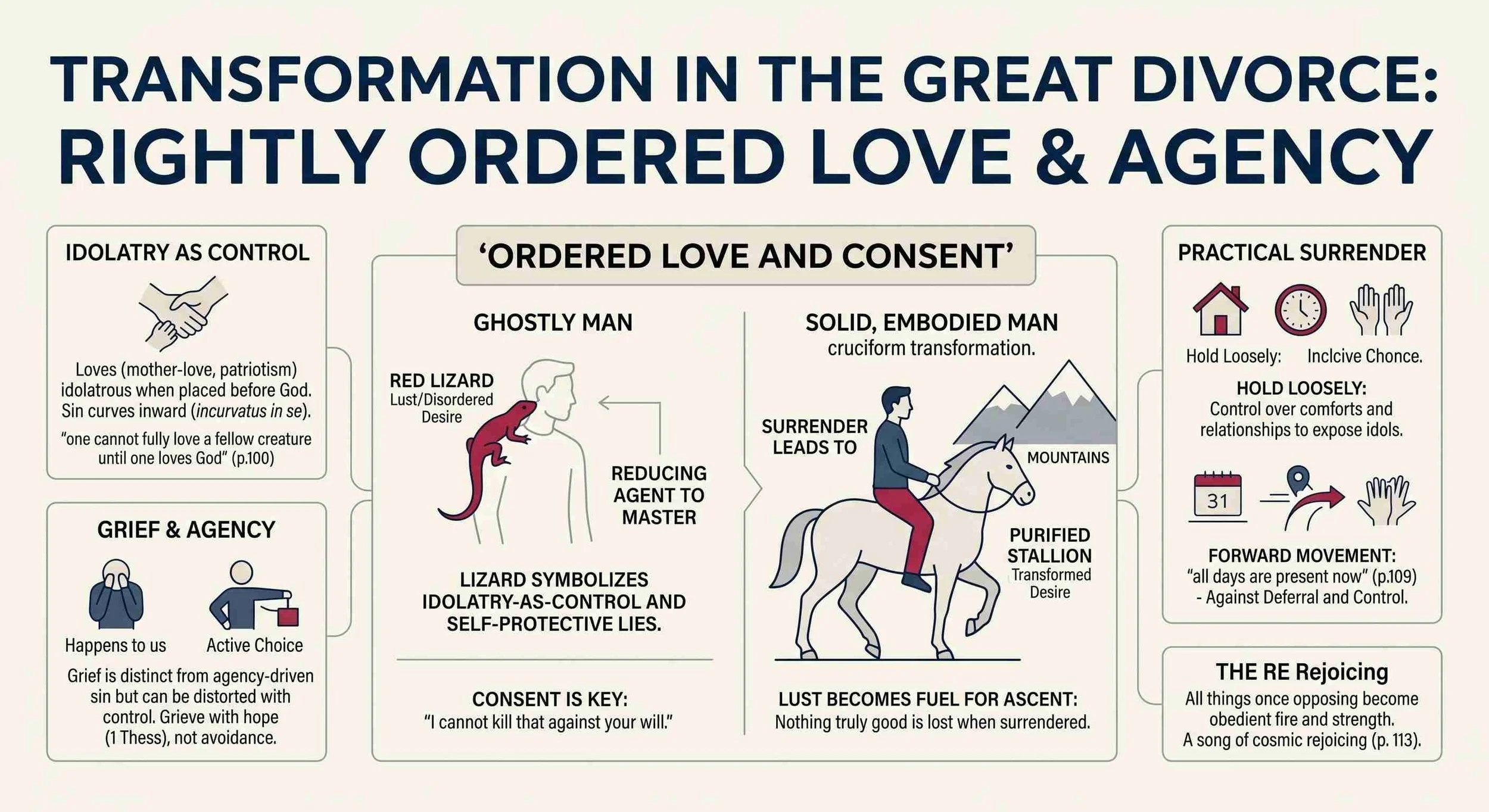
During our Bible study session on June 18, 2026, we delved into the latter half of chapter 11 of C. S. Lewis’s The Great Divorce. The conversation centered on the difficult themes of grief, lust, and idolatry, connecting the story of a grieving mother with a man carrying a red lizard on his shoulder. We discussed Martin Luther's concept of sin as "curving inward" and how this self-absorption creates isolation. The central idea was the necessity of "letting go" and surrendering our controlling desires to God, as symbolized by the painful but liberating killing of the lizard, which ultimately transforms into a magnificent stallion. We reflected on how redeemed desire is not erased but made new and powerful, why we must hold earthly loves loosely, and how creation itself rejoices in God's redemptive work.
Section-by-Section Walkthrough
Here is a breakdown of the discussion from our class on June 18, 2026.
1. The Dangers of Misguided Love and Grief
We began by revisiting the story of the mother whose love for her deceased son has become an all-consuming, controlling force. The key quote framing our discussion was, "You cannot love a fellow creature, fully until you love God." This led to a debate about the nature of her grief. It was argued that the issue was not the grief itself, but that it had become misguided and possessive, a "deficit" of true love that would drag a loved one into misery. Her sorrow stemmed from a loss of control over her son’s life rather than simply his absence. She wanted him back to satisfy her own need to possess and manage him, turning her love into a form of idolatry. This was contrasted with the upward call of discipleship, where love relinquishes control and trusts Christ’s transforming work. We noted the Christian call is to grieve, but to do so "with hope."
Section Summary: The mother’s story illustrates that even a powerful, natural love can become corrupt when it isn’t centered on God. Her grief was less about her son’s well-being and more about her loss of control, highlighting the danger of allowing our attachments to become idols that consume us.
Bible Verses Mentioned: 1 Thessalonians 4:13, Colossians 3:1-3, Matthew 10:37-39.
Stories Mentioned: The story of the grieving mother in The Great Divorce.
2. Sin as Curving Inward: Agency, Grief, and Idolatry
A significant portion of our discussion revolved around the concept of sin as "curving inward," a theme from Luther and Augustine that creates isolation and self-focus. This was linked to the "gray town" image where people, by grasping for themselves, breed loneliness. We questioned whether grief, which often feels passive, has "agency" like active sins such as lust. The conversation shifted to how grief can become a sin when we refuse to move forward and instead use it as a tool, turning it into our entire identity. Lewis’s point is that any good thing—a mother's love, patriotism, art—can become demonic if it turns away from God. The root of all these struggles is the fundamental human sin: the desire to be God, controlling our own lives and those of others. This desire is a violation of the first commandment. We also touched on the intellectual idolatry of making certainty itself an idol, rather than trusting in Jesus.
Section Summary: Sin curves us inward, creating isolation. While grief is a natural response, it becomes sinful when we actively choose to let it define us, placing our sorrow and desire for control above God. This rebellion, making something other than God our ultimate focus, is where sin's agency lies, stemming from a desire to be our own god.
Bible Verses Mentioned: Exodus 20:3 (The Ten Commandments), Luke 14:26-27, Philippians 3:7-8, Romans 7 (thematic connection).
Stories Mentioned: The "gray town" imagery; Pete Enns's "The Sin of Certainty."
3. Letting Go: The Story of the Man and the Lizard
The discussion then moved to the second story in the chapter: the man with the chattering red lizard on his shoulder, which represents lust. This serves as a powerful metaphor for surrendering sin. The man is hesitant to let the angel kill the lizard, fearing the pain and loss of his identity. This echoes Christian discipleship: taking up the cross and dying to self to follow Jesus. The angel's statement, "I cannot kill that against your will," emphasizes that our transformation requires consent. We drew a parallel to addiction recovery, where confession—like AA’s “I am an alcoholic”—is the honest naming that opens the door to change, and the lizard’s lie, “It’ll be different this time,” mirrors the cycle of addiction.
Section Summary: The man and the lizard illustrate that sanctification requires our willing participation. True freedom begins with honest confession and courageous surrender, echoing the gospel call to die to self rather than live enslaved by sin.
Bible Verses Mentioned: Genesis 3, Luke 9:23, Romans 6:6-11, Galatians 2:20.
Stories Mentioned: The man with the red lizard; addiction and recovery narratives (AA).
4. The Crimson Grip and Transformed Desire
We explored the imagery of the angel seizing the lizard with a "crimson grip." We discussed whether "crimson" evokes Christ’s blood, cleansing, and sacrificial love, connecting it to hymns about the "crimson flow" and scriptural imagery of the Lamb who was slain. The man’s eventual permission leads to a painful "death" of the lizard, which is then resurrected into a magnificent, white stallion. The man becomes a "new-made man"—solid and whole. This symbolizes that when we surrender our twisted desires, they are not merely destroyed but are transformed into something powerful and glorious that carries us closer to Him. We noted Lewis’s contrast: lust is a “poor, weak, whispering thing” compared to the richness of true desire that arises when lust is killed and raised.
Section Summary: The "crimson" language points to Christ’s costly, purifying work. When we surrender our sin to God, it is not just destroyed but is redeemed and transformed—lizard to stallion—into a strength that propels us toward holiness.
Bible Verses Mentioned: Revelation 5:6, Revelation 19:13, Hebrews 9:14, Romans 12:1-2, 1 Corinthians 6:19-20, 2 Corinthians 5:17.
Stories Mentioned: The "crimson grip" imagery; Mary Magdalene’s line from The Chosen: “I was one thing, but now I am another.”
5. Death, Resurrection, and Creation's Song
The lizard-to-horse image illustrates the principle of death and resurrection. Cris read a passage describing how "nothing—not even the lowest—will not be raised if it submits to death." We clarified that choosing "death" (separation from God) can be final, but death in Christ leads to resurrection. This connects to Paul’s teaching: "It is sown a natural body; it is raised a spiritual body." This transformation is not just personal; Cris also read a passage describing creation itself rejoicing with a song "too large to hear," shaking with praise. This echoes the biblical theme that all creation celebrates God. The "song" speaks of mastery and rest, where what once opposed becomes "obedient fire," tying to the biblical promise to "the one who overcomes."
Section Summary: True spiritual strength emerges through death and resurrection. When disordered desires die, they are raised into powerful, holy desires. This redemptive pattern is celebrated by all of creation, which joins in a song of praise, echoing the biblical promise that those who overcome share in Christ's reign.
Bible Verses Mentioned: 1 Corinthians 15:42-44, 1 Corinthians 15:50, Luke 19:40, Revelation 2-3.
Stories Mentioned: Lewis’s lizard-to-horse transformation; Lewis’s descriptive scene of creation singing; mentions of the Narnia series.
6. Holding Gifts Loosely and Closing
We turned to practical application: hold blessings—people, possessions, ministries—loosely. We referenced Luther’s hymn "A Mighty Fortress" ("should they take our house, goods, honor, child, or spouse… they cannot win the day"), emphasizing that Christ’s victory stands even when earthly things are lost. A seminary professor’s illustration of hurricanes as "mighty winds" reframes fear, reminding us that not all loss is ultimate defeat. This applies to parenting ("If you love someone, set them free") and avoiding the temptation to clutch our homes or ministries too tightly. The call to repentance is always in the present moment. We concluded by acknowledging the chapter's depth and planned to continue with the "Sarah Smith" episode next time.
Section Summary: We applied Lewis’s insights to daily discipleship: trusting Christ’s victory, releasing our grip on people and possessions, and practicing vigilant, non-possessive love. We must act in the "now" and prepare to continue our study next session.
Bible Verses Mentioned: Psalm 46 (themes in "A Mighty Fortress").
Stories Mentioned: Luther’s hymn "A Mighty Fortress"; a seminary professor’s "mighty wind" metaphor; anecdotes about parenting and ministry; anticipation of the "Sarah Smith" episode.
Medium-Length Summary of the Class
On June 18, 2026, our Bible study traced the spiritual arc in C. S. Lewis's The Great Divorce from sin’s self-curving isolation to liberating surrender. Beginning with Luther’s insight, we connected inward-turning sin to loneliness and the “gray town” of grasping selves. We examined how even a noble emotion like a mother's love can become a "false religion" when it turns into a selfish desire for control. Reading Lewis’s vivid scene of the angel and the lizard, we confronted the fear that killing our lusts will kill us, recognizing the gospel truth that it is better to die to sin than live enslaved. The "crimson grip" led us into Scripture’s blood imagery, seeing Christ’s costly purification at the heart of transformation. We rejoiced that redeemed desire doesn’t vanish but is transfigured—lizard to stallion—carrying the new-made person toward the mountains. Practically, we emphasized holding blessings and relationships loosely, trusting Christ’s victory even when earthly things are shaken, echoing themes from Luther’s “A Mighty Fortress.” The class closed by noting the chapter’s intensity and preparing to study the “Sarah Smith” episode next.
Main Points
Sin curves us inward, producing isolation and self-absorption.
Any created thing or natural love can become a source of evil if not centered on God.
True transformation and freedom from sin require our active consent and willingness to "let go."
Discipleship involves death to self; surrender may feel like death but leads to true life.
Christ’s “crimson” work (His blood) purifies and empowers transformation.
Desire is redeemed, not erased—transformed from a weak lust into a powerful strength for the journey toward God.
Good loves become idols when absolutized; we must trust Christ over certainty and control.
True love follows Christ upward, relinquishing possessive demands and embracing transformation.
The call to repentance is always in the present moment.
Bible Scriptures Mentioned
Genesis 3: The serpent’s temptation in the Garden of Eden.
Exodus 20:3: The first commandment: no other gods before Me.
Psalm 46: Themes reflected in “A Mighty Fortress.”
1 Thessalonians 4:13: Grieving with hope.
Matthew 10:37-39: Lose your life for Christ to find it.
Luke 9:23: Take up the cross and follow Jesus.
Luke 14:26-27: Allegiance to Christ above all.
Luke 19:40: "The stones will cry out."
Romans 6:6-11: Die to sin, live to God in Christ.
Romans 12:1-2: Be transformed by the renewing of the mind.
1 Corinthians 6:19-20: Glorify God in your body.
1 Corinthians 15:42-44: "Sown a natural body, raised a spiritual body."
1 Corinthians 15:50: "Flesh and blood cannot inherit the kingdom of God."
2 Corinthians 5:17: New creation in Christ.
Galatians 2:20: Crucified with Christ; Christ lives in me.
Philippians 3:7-8: Counting all as loss for the sake of Christ.
Colossians 3:1-3: Seek the things that are above.
Hebrews 9:14: The blood of Christ purifies our conscience.
Revelation 2-3: Promises to "the one who overcomes."
Revelation 5:6: The Lamb who was slain.
Revelation 19:13: Christ’s robe dipped in blood.
Stories and References Discussed
C. S. Lewis Imagery: The grieving mother, the man with the red lizard, the "gray town," the "crimson grip," and the lizard’s transformation into a stallion.
Narnia series: Mentioned as an example of Lewis’s creativity.
The Chosen: Mary Magdalene’s testimony, “I was one thing, but now I am another.”
AA/Recovery narratives: The role of confession (“I am an alcoholic”) and long-term sobriety.
Martin Luther's hymn "A Mighty Fortress": Referenced for its theme of trusting God amid loss.
Pete Enns’s “The Sin of Certainty”: A warning against making certainty an idol.
A seminary professor's "mighty wind" illustration: A metaphor for reframing fear and loss.
Westerns and Far Side humor: Playful images of riding into the sunset.
Anticipation of the "Sarah Smith" episode: For the next class session.

The Great Divorce Chapters 10-11 - Thursday Bible Study
On June 4, 2026, our church Bible study used C. S. Lewis’s The Great Divorce and the Lord’s Prayer to confront self-will, grumbling, and identity—asking how heaven’s life breaks into our daily choices, relationships, and walk with Christ.
Great Divorce Chapters 10-11a
This is our 6th class on The Book
This is an AI Recap of the class.
Some things may be incorrect.
Discussion of Chapter 10: The Controlling Wife
Description:
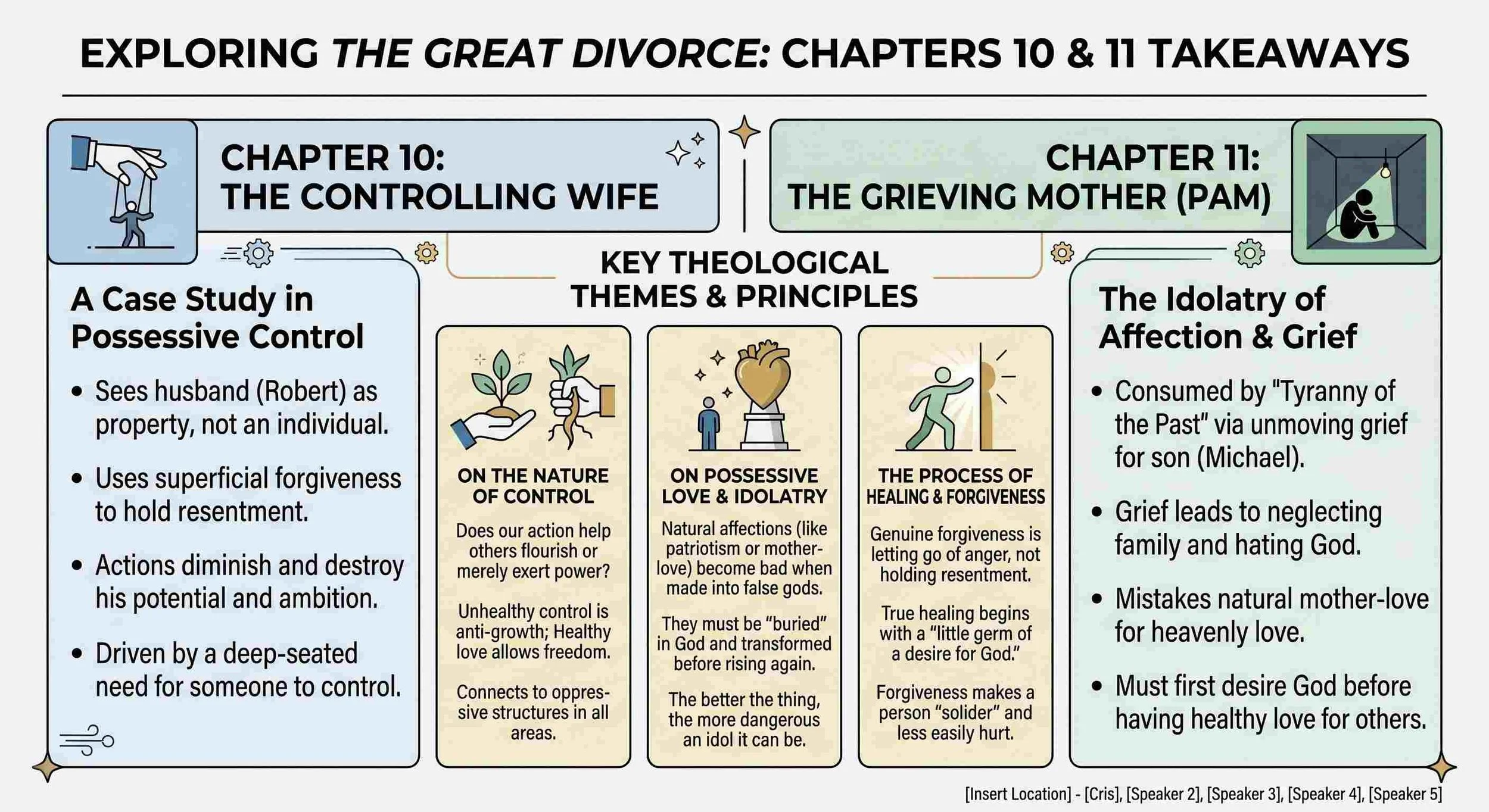
The group analyzed the character of the controlling wife, describing her as hypocritical, depressing, critical, and self-centered.
Her identity was completely centered on managing her husband, Robert, whom she treated as property.
Her phrase, "I forgive him as a Christian," was seen as a way to hold onto resentment while appearing righteous.
The group discussed that genuine forgiveness means letting go of anger, even if one doesn't forget. An analogy was made to a sober alcoholic who turns their past struggle into a strength.
The wife's actions, such as destroying her husband's ambition, were seen as diminishing him. Her final statement, "I am so miserable. I must have someone to do things to," revealed her motivation was control, not service.
Discussion of Chapter 11: The Grieving Mother (Pam)
Description:
The discussion shifted to Pam, a mother grieving her son, Michael. Participants debated the son's age at his death.
Her grief led her to neglect her family and hate God. Her ten-year ritual of keeping her son's room unchanged was cited as an example of being consumed by the "tyranny of the past."
The group compared this "grieving ghost" to the controlling wife, noting the different approaches to handling them.
Key passages were highlighted:
"You cannot love a fellow creature fully till you love God."
"You'll become solid enough for Michael to perceive you when you learn to want someone else besides Michael."
It was emphasized that one must first exist as God's creature before being Michael's mother. The healing process begins with a "little germ of a desire for God," not using God as a means to an end.
Theological Themes: Love, Control, and Idolatry
The Nature of Control vs. Allowing Flourishing:
The group connected the theme of control to real-world examples, like parents pushing children for their own ambitions or churches clinging to traditions that prevent growth.
A parallel was drawn between the book's themes and unhealthy structures in churches, HOAs, and businesses where power and control become central. Healthy structures were described as a "taste of heaven."
The key takeaway was the need for self-honesty to determine if one's actions are about helping others flourish or simply about control, posing the question: "Are they flourishing when they are doing exactly what I told them to do?"
The Nature of Love, Loss, and Forgiveness:
The group discussed that the ghost's state might be rooted in anger at God, which prevents healing. This led to a conversation on empathy and seeing others' perspectives.
The destructive nature of possessive love was a central theme. Natural affection can be mistaken for heavenly love and must be "buried" (a theology of the cross) before it can rise again, transformed.
A key quote was discussed: "No natural feelings are high or low... They are all holy when God's hand is on the reign. They all go bad when we... make them into false gods."
A reference was made to an interview between Stephen Colbert and Anderson Cooper, highlighting the value of having loved despite the pain of grief.
Forgiveness was linked to becoming "solider," where others lose the power to hurt you.
The Idolatry of Good Things:
It was noted that good things, like mother-love or patriotism, are easier to turn into idols than more obvious passions. Demons are made from fallen archangels, not lesser things.
Examples of "good things" becoming idols included: "family-friendly" branding, unquestioning patriotism, specific forms of masculinity, and intense sports fandom amplified by betting.
Biblical References and Connections:
The discussion touched on biblical stories involving Naaman and Elisha, though participants needed to review the details. This was connected to a sermon series where Elisha repeats Elijah's actions in a gentler, more spiritual way, moving from past violence toward something new.
The group also briefly mentioned biblical structures like alphabetical psalms, symmetrical patterns in the Sermon on the Mount, and numerological codes in the Torah.
The Great Divorce Chapters 9b - Thursday Bible Study
On June 4, 2026, our church Bible study used C. S. Lewis’s The Great Divorce and the Lord’s Prayer to confront self-will, grumbling, and identity—asking how heaven’s life breaks into our daily choices, relationships, and walk with Christ.
Great Divorce Chapters 9b
This is our 5th class on The Book
This is an AI Recap of the class.
Some things may be incorrect.
Short summary of the whole class
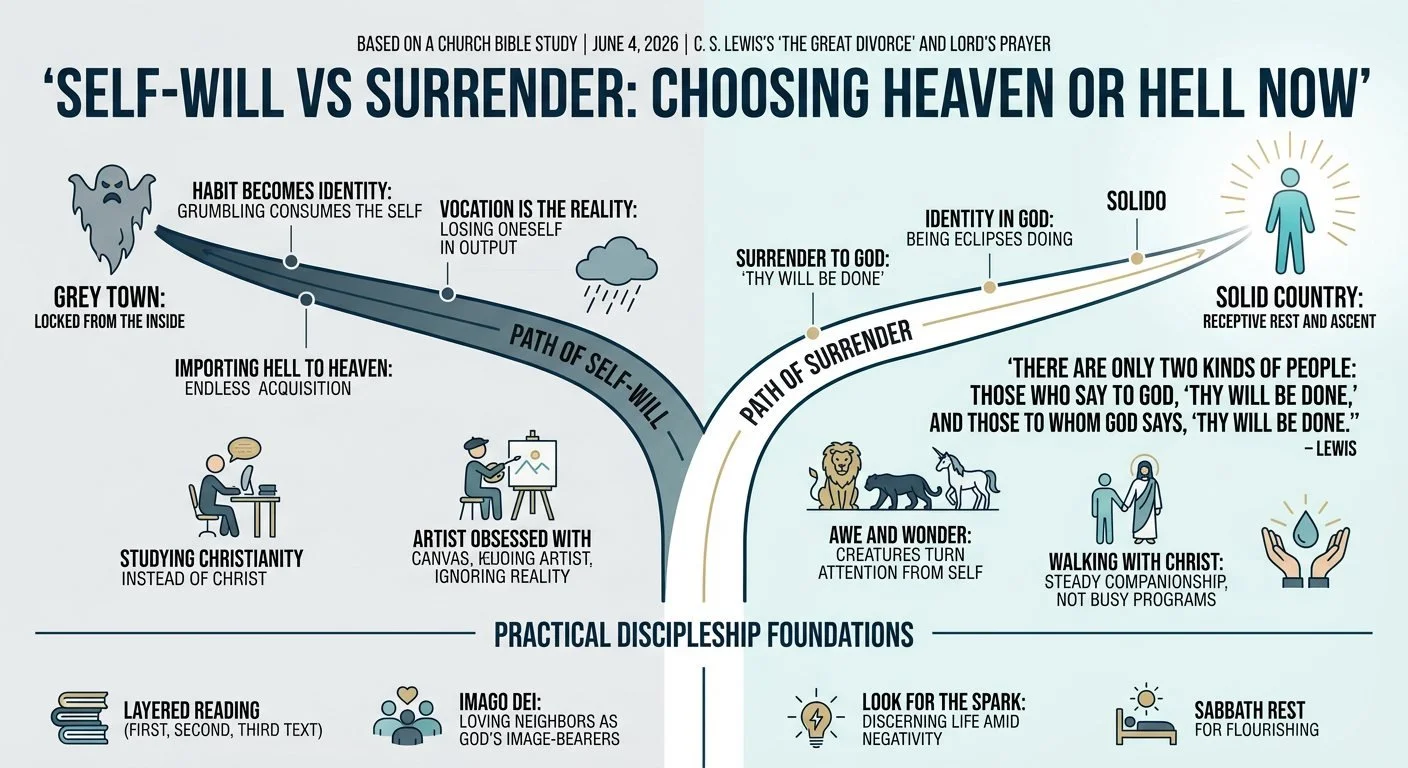
On June 4, 2026 at 11:01:41, we revisited chapter nine (and pages 79–84) of C. S. Lewis’s The Great Divorce, centering on the stark choice of “Thy will be done”—either to God or, finally, from God to us. We explored how heaven and hell are shaped by our present loves and habits, how grumbling can become identity, and how religious busyness can eclipse a living walk with Christ. George MacDonald’s influence on Lewis framed a discussion about the finality of choice, while Lewis’s imagery (lions, panthers, unicorns, solid people, and the painter) taught selflessness, awe, and identity in God rather than vocation. Scriptures from the Lord’s Prayer, Jesus’ table fellowship, burden-bearing, Sabbath rest, and the call to avoid grumbling grounded the conversation in practical discipleship.
Section-by-section walkthrough and summaries
1) Re-orienting in The Great Divorce: the heart of chapter nine and “Thy will be done”
What we talked about:
We located ourselves mid–chapter nine and anchored the class in Lewis’s central quote: “There are only two kinds of people in the end: Those who say to God, ‘Thy will be done,’ and to those whom God says in the end, ‘Thy will be done.’”
We framed heaven and hell as the outworking of self-will versus surrender, noting Lewis’s image that “the door to Hell is locked from the inside.”
We considered characters like the grumbling woman and the frightened ghost as case studies in our daily, formative choices.
Bible verses mentioned:
Matthew 6:9–13; Luke 11:2–4 — The Lord’s Prayer (“Your will be done, on earth as it is in heaven”).
Stories/books mentioned:
C. S. Lewis, The Great Divorce (chapter nine).
Short summary:
We grounded our study in Lewis’s core thesis: eternity flows from our will—either surrender to God or commitment to self—and that choice has real, present consequences.
2) Reading deeply: first text, second text, and intention
What we talked about:
We adopted a layered reading method: the first text (words), the second text (author’s purpose), and a third layer (underlying realities/emotions).
This approach prepared us to engage Lewis beyond narrative, attending to spiritual dynamics and intention.
Bible verses mentioned:
None directly cited.
Stories/books mentioned:
C. S. Lewis, The Great Divorce.
Short summary:
Reading with layered attention helps us discern Lewis’s purpose and the spiritual heart beneath his words.
3) The Great Divorce invites repeated, transformative reading
What we talked about:
Participants noted that rereading reveals new depths; the book’s simplicity masks profound spiritual insight.
Bible verses mentioned:
None directly cited.
Stories/books mentioned:
The Great Divorce.
Short summary:
Lewis’s work rewards rereading, continually opening fresh areas for spiritual growth.
4) “On earth as it is in heaven”: rethinking the Lord’s Prayer in daily life
What we talked about:
We challenged “fire insurance” Christianity by asking how to embody heaven’s will now.
Practical self-examination: Are we choosing hell today by refusing forgiveness, seeking control, or nursing grievances?
Bible verses mentioned:
Matthew 6:9–13; Luke 11:2–4 — The Lord’s Prayer.
Stories/books mentioned:
The Great Divorce (heaven/hell as present choices).
Short summary:
The Lord’s Prayer calls us into present obedience that mirrors heaven, not mere future escape.
5) Who eats at the table? Jesus with tax collectors and sinners
What we talked about:
We asked whether we would accept sharing heaven with people we struggle to forgive—would we remove ourselves?
This pressed our willingness to embrace God’s radical hospitality.
Bible verses mentioned:
Matthew 9:10–13; Mark 2:15–17; Luke 5:29–32 — Jesus dining with tax collectors and sinners.
Stories/books mentioned:
The Great Divorce — imagined reactions to who is “in” heaven.
Short summary:
Jesus’ table fellowship confronts our exclusionary instincts and invites us into grace toward those we resist.
6) Studying Christianity vs. loving Christ
What we talked about:
Around page 74, Lewis warns against becoming absorbed in studying Christianity while forgetting Christ Himself.
Parallels were drawn to the artist, the grumbling woman, and other ghosts whose good desires get swallowed by lesser pursuits.
Bible verses mentioned:
None directly cited.
Stories/books mentioned:
The Great Divorce, page ~74 (conversation with George MacDonald).
Short summary:
We cautioned against replacing a living love for Jesus with religious analysis or activity.
7) Walking with Christ vs. running for Christ
What we talked about:
A shared refrain: people often “run for Christ” (programs, busyness) rather than “walk with Him.”
The practical check: “How goes your walk with Christ today?”
Bible verses mentioned:
Matthew 11:28–30 — Rest in Christ (later explicitly connected).
Stories/books mentioned:
Personal wisdom shared; The Great Divorce themes of presence vs. performance.
Short summary:
Slow down to walk with Jesus; resist performance-driven religiosity.
8) Imago Dei and a simple creed of love and service
What we talked about:
A personal creed: Jesus saves people; God loves people; therefore we love and serve whom God loves.
Recognizing every person as God’s image-bearer grounds faith in tangible care.
Bible verses mentioned:
Genesis 1:26–27 — Humanity made in God’s image (alluded to).
Stories/books mentioned:
Applied in community and church life.
Short summary:
Seeing neighbors as image-bearers keeps our discipleship concrete and guards against self-will.
9) “Thy will be done” means “not my will”
What we talked about:
A pastoral reminder reframed the prayer: asking God’s will means relinquishing our own agendas.
Confronted “fire-and-brimstone” and “fire insurance” distortions of the gospel.
Bible verses mentioned:
Matthew 6:10 — “Your will be done.”
Stories/books mentioned:
The Great Divorce — surrender vs. self-will.
Short summary:
Submitting to God’s will displaces self-rule and reframes salvation as obedient trust.
10) The grumbling woman: when habit becomes identity
What we talked about:
Pages 76–77: Is she a person who grumbles, or has she become “a grumble”?
If there’s a spark under the ashes, it can be fanned back to life; if only ashes remain, they must be swept away.
We applied this to personal tendencies, church culture, and local frustrations.
Bible verses mentioned:
Philippians 2:14 — Do all things without grumbling (alluded to throughout).
Stories/books mentioned:
The Great Divorce, pages 76–77 (the grumbling woman).
Short summary:
Occasional complaint can be honest; habitual grumbling can consume us until it defines who we are.
11) Clarifying grumble vs. grumbler
What we talked about:
We distinguished constructive critique (naming issues with hope) from identity-level negativity.
Bible verses mentioned:
Philippians 2:14 — Do all things without grumbling (implicit).
Stories/books mentioned:
The Great Divorce principle applied to everyday discernment.
Short summary:
Discern the difference between situational complaint and a corrosive habit that erodes the self.
12) Everyday examples: community complaints and church assessment
What we talked about:
Local Facebook negativity, traffic and construction frustrations, and a Bethel church assessment where initial impressions of decline were corrected by discovering genuine life—“spark under the ashes.”
Bible verses mentioned:
None directly cited here.
Stories/books mentioned:
Bethel church assessment; social media examples; The Great Divorce principle.
Short summary:
Patience and deeper look can uncover embers worth fanning into flame amid dominant negativity.
13) George MacDonald’s influence and the finality of choice
What we talked about:
Lewis discovered MacDonald’s Phantastes as a teen; MacDonald shaped Lewis’s imagination and theology.
In The Great Divorce, Lewis puts his own views into MacDonald’s mouth: Lewis rejects universalism, insisting the choice for hell is final, whereas MacDonald believed hell was purgative.
Influences noted on Narnia (wardrobe motif) and Tolkien.
Bible verses mentioned:
None directly cited.
Stories/books mentioned:
George MacDonald, Phantastes; The Great Divorce (MacDonald as guide); The Chronicles of Narnia; J. R. R. Tolkien.
Short summary:
Lewis honors MacDonald while diverging theologically, using MacDonald’s character to articulate the permanence of our choices.
14) Social media, negativity, and grumbling (opening discussion of pp. 79–84)
What we talked about:
Cultural megaphones reward complaint and self-promotion; this mirrors Lewis’s “grumble” motif.
Bible verses mentioned:
Philippians 2:14 — Do all things without grumbling (anticipated).
Stories/books mentioned:
Reddit Polestar forum complaints; local restaurant posts; disengagement from social media.
Short summary:
Our mediascape amplifies grumbling, which can train hearts toward negativity rather than gratitude.
15) Unicorns, lions, and panthers—attention and awe (page 79)
What we talked about:
These creatures act like “jumper cables,” jolting ghosts out of self-preoccupation toward majesty—fear (lions/panthers) and wonder (unicorns).
Awe can break cycles of self-focus.
Bible verses mentioned:
Psalm 19:1 — Creation declares God’s glory (implicit).
Job 38–41 — God teaches through creation (implicit).
Stories/books mentioned:
The Great Divorce, page 79; Narnia-like resonance.
Short summary:
Heaven’s creatures teach by awakening fear and wonder, turning attention from self to glory.
16) Teachers in the solid country; selflessness vs. selfishness
What we talked about:
Solid people, and even creatures, function as teachers of self-giving; “rest on me” invites burden-sharing and ascent toward the mountains.
Bible verses mentioned:
Galatians 6:2 — Bear one another’s burdens.
Matthew 11:28–30 — Rest in Christ.
Stories/books mentioned:
The Great Divorce — guidance from solid people.
Short summary:
Heaven’s pedagogy trains us in selflessness and grace, moving us from isolation to shared strength.
17) Narrow views vs. totality—“teachers who return with lectures” (pp. 79–80)
What we talked about:
The temptation to reduce Jesus to maps, stats, or lectures; the hammer-and-nail metaphor cautions against single-angle faith.
Bible verses mentioned:
Colossians 1:15–20 — The fullness of Christ (implicit).
Stories/books mentioned:
The Great Divorce, pages 79–80.
Short summary:
Partial perspectives can eclipse the whole Christ; heaven invites comprehensive vision over fragmented expertise.
18) Importing hell into heaven—paving over the grasslands (page 80)
What we talked about:
Ghosts who want to asphalt heaven with Gray Town’s ethic—endless acquisition and self-will—cannot coexist with glory’s gift economy.
Bible verses mentioned:
Matthew 6:19–21 — Treasures in heaven.
Mark 8:36 — Gain the world, lose your soul.
Stories/books mentioned:
The Great Divorce, page 80; Peggy Lee’s “Is That All There Is?” as cultural critique.
Short summary:
Hell’s logic of self-assertion can’t be imported into heaven’s surrender; greed cannot pave over grace.
19) Community, service, and changing capacity to serve
What we talked about:
From volunteer fire departments to paid service; small-town neighborliness vs. modern concerns; the enduring call to serve.
Bible verses mentioned:
Luke 10:25–37 — The Good Samaritan (resonant theme).
Stories/books mentioned:
California hills fires; small-town memories; differing community cultures.
Short summary:
Contexts change, but love of neighbor remains; heaven’s selflessness critiques our drift toward comfort and self-protection.
20) The pull of complaint—venting at the “haves” (page 82)
What we talked about:
Making complaint a vocation—score-settling with “prigs and snobs”—distorts the heart.
Bible verses mentioned:
James 3:5–10 — The tongue’s power.
Philippians 2:14 — Do all things without grumbling (implicit).
Stories/books mentioned:
The Great Divorce, page 82; humorous text interruption.
Short summary:
A life organized around complaint shrinks the soul; heaven invites humility and praise instead.
21) The painter—identity beyond vocation (pages 83–84)
What we talked about:
Earthly vocations are signs pointing to Reality; in heaven, identity in God eclipses output. If we are what we do, we are nothing next to the Real.
Reflections on retirement, storm imagery, and Sabbath reoriented toward human flourishing.
Bible verses mentioned:
Mark 2:27 — The Sabbath was made for man.
Matthew 6:33 — Seek first the kingdom.
1 Corinthians 13:12 — From partial sight to face-to-face.
Psalm 90:17 — Work established by God (implicitly contrasted).
Stories/books mentioned:
The Great Divorce, pages 83–84; hurricane/wind and “glorious fire” imagery.
Short summary:
Our calling points to God but cannot carry our identity; in heaven, the Sign yields to the Reality and we rest our selves in Him.
22) Rest, zeal, and simply being
What we talked about:
Holiness isn’t achieved by zeal; readiness for heaven is receptive rest under grace.
Bible verses mentioned:
Luke 10:38–42 — Mary and Martha.
Hebrews 4:9–11 — Enter God’s rest.
Stories/books mentioned:
Recent sermon: “Why are you here?”; laying down frantic rule-keeping.
Short summary:
Heaven trains us to receive rather than strive; presence with Christ precedes performance for Christ.
Medium-length summary of the class (June 4, 2026)
On June 4, 2026, our Bible study used C. S. Lewis’s The Great Divorce to explore how the Lord’s Prayer reshapes daily discipleship. We centered on chapter nine’s thesis—either we say “Thy will be done” to God or He says it to us—framing heaven and hell as the fruit of our present loves and habits. A layered reading approach helped us attend to Lewis’s intention, while Jesus’ table fellowship confronted our readiness to share heaven with those we resist. We warned against studying Christianity while neglecting Christ, and emphasized walking with Him over running programs for Him. Affirming the imago Dei grounded a simple creed of loving whom God loves. Lewis’s “grumbling woman” pressed us to distinguish situational complaint from becoming “a grumble,” with everyday examples in social media negativity and church assessments where deeper patience found sparks of life. We traced George MacDonald’s influence and Lewis’s divergence from universalism, then turned to pages 79–84: unicorns, lions, and panthers as teachers of awe; solid people bearing burdens; the folly of importing Gray Town’s self-will into heaven; and the painter’s lesson that identity rests in God, not vocation. Scripture on rest, Sabbath, bearing burdens, and the tongue’s power framed a call to surrender self-will, practice grace, and let heaven’s life break into our present through humility, forgiveness, and steady companionship with Christ.
Main points
The core choice: “Thy will be done” to God vs. God saying it to us—self-will vs. surrender.
Heaven and hell are shaped by present loves, habits, and daily decisions.
Read spiritually with layered attention: words, purpose, and underlying realities.
The Great Divorce rewards rereading and ongoing transformation.
The Lord’s Prayer calls us to embody heaven’s will now, not treat faith as fire insurance.
Jesus’ table fellowship challenges our boundaries and invites radical grace.
Beware letting study or ministry eclipse love for Christ Himself.
Walk with Christ daily rather than merely “run” for Him.
Every person bears God’s image; love and serve whom God loves.
“Thy will be done” requires relinquishing our own agendas.
Distinguish constructive critique from becoming defined by grumbling.
Look for the spark under the ashes—in people, churches, and communities—and fan it into flame.
Heaven’s creatures and solid people teach awe, burden-bearing, and selflessness.
You cannot import hell’s acquisitive ethic into heaven’s gift economy.
Identity rests in God, not vocation or output; holiness is received in restful presence.
Bible Scriptures mentioned
Matthew 6:9–13; Luke 11:2–4 — The Lord’s Prayer (“Your will be done”).
Matthew 9:10–13; Mark 2:15–17; Luke 5:29–32 — Jesus with tax collectors and sinners.
Genesis 1:26–27 — Humanity in God’s image (imago Dei).
Philippians 2:14 — Do all things without grumbling.
Galatians 6:2 — Bear one another’s burdens.
Matthew 11:28–30 — Rest in Christ.
Colossians 1:15–20 — The fullness of Christ.
Matthew 6:19–21 — Treasures in heaven.
Mark 8:36 — Gain the world, lose your soul.
Luke 10:25–37 — The Good Samaritan.
James 3:5–10 — The tongue’s power.
Mark 2:27 — The Sabbath was made for man.
Matthew 6:33 — Seek first the kingdom.
1 Corinthians 13:12 — From partial sight to face-to-face.
Psalm 19:1 — Creation declares God’s glory.
Job 38–41 — God teaches through creation’s majesty.
Luke 10:38–42 — Mary and Martha.
Hebrews 4:9–11 — Enter God’s rest.
Stories and books referenced
C. S. Lewis, The Great Divorce:
Chapter nine — “There are only two kinds of people…”
Pages ~74 — Studying Christianity vs. loving Christ (conversation with George MacDonald).
Pages 76–77 — The grumbling woman (“becoming a grumble”).
Page 79 — Unicorns, lions, panthers as attention-getters.
Pages 79–80 — Narrow lectures vs. the totality of Christ.
Page 80 — Ghosts wanting to pave heaven’s grasslands (importing Gray Town).
Page 82 — Complaint as vocation and score-settling.
Pages 83–84 — The painter and identity beyond vocation.
George MacDonald, Phantastes — formative influence on Lewis; wardrobe motif echoed in Narnia.
The Chronicles of Narnia — influence from MacDonald’s fantasy; wardrobe concept.
J. R. R. Tolkien — influenced by MacDonald and Lewis’s fantasy lineage.
Bethel church assessment — initial reports of decline corrected by discovered signs of life (“spark under the ashes”).
Social media examples — local Facebook negativity; Reddit Polestar forum complaints; restaurant posts.
Peggy Lee’s “Is That All There Is?” — cultural critique of acquisitive futility.
Content creation date: 2026-06-04 11:01:41.

The Great Divorce Chapters 7-9 - Thursday Bible Study
During our Bible study on May 27, 2026, we explored Mark 4:1–34, focusing on Jesus's parables—especially the Sower—and how they reveal a deeper, hopeful message about the kingdom of God, spiritual growth, and the critical theme of truly hearing and seeing God's word to bear fruit.
Great Divorce Chapters 7-9
This is our 4th class on The Book
This is an AI Recap of the class.
Some things may be incorrect.
Short Summary of the Whole Class
On May 27, 2026, our class opened with housekeeping about upcoming Bible Club and "The Chosen," then delved into Mark 4:1–34. We situated the chapter within Mark's broader narrative arc (Mark 3-6) before discussing Jesus's parables: the Sower, the Lamp, the Growing Seed, and the Mustard Seed. The conversation focused on why Jesus taught in parables, connecting his methods to prophecies in Isaiah 6. We analyzed the different "soils" of the heart, the obstacles that prevent spiritual growth—like worldly anxieties and persecution—and contrasted them with the good soil that produces a harvest. The pivotal insight was how Isaiah 6 reframes the parable not as a story of failure, but one of profound hope, where the "holy seed" remains as a "stump," promising renewal even when all seems lost.
Detailed Class Summary
Here is a summary of what we talked about as we went through the lesson on May 27, 2026.
1) Housekeeping and upcoming schedule
We began with logistical updates. Cris outlined schedule changes: we have one more week in the Gospel of Mark, after which we will pause for Bible Club, which will be focused on the series “The Chosen.” Homework will be to watch episodes ahead of time. The schedule for viewing is June 10 for Episode 1 and June 17 for Episodes 2–3. The episodes are available for free on The Chosen’s website and possibly on Prime Video. The adult Bible Club will meet in a different building, and due to the logistical change, Zoom participation may not be available. After Bible Club concludes, our class will return to our study in Mark.
Stories mentioned: None from Scripture; logistical update and The Chosen viewing plan.
Summary of this section: We will pause our Mark study after one more week to engage “The Chosen” during Bible Club (with pre-watching homework on June 10 and June 17), then resume Mark afterward.
2) Framing Mark’s larger narrative arc (Mark 3–6)
Before reading Mark 4, Cris recapped the theme of Jesus’ “true family” from Mark 3 and previewed the story of "Jesus rejected in Nazareth" in Mark 6:1–6, framing it as a sister story. He highlighted a structural rhythm in this section of the gospel: the calling of the Twelve (Mark 3) leads into Jesus's teachings and miracles (Mark 4–5), which is followed by his rejection at Nazareth (Mark 6:1–6), and then the sending out of the Twelve on their own mission (Mark 6:7–13). This structure shows that Mark builds themes that bookend this entire section, helping us read the parables within a larger narrative rhythm.
Scriptures referenced: Mark 3 (true family of Jesus; calling of the Twelve), Mark 6:1–6 (rejection at Nazareth), Mark 6:7–13 (sending of the Twelve).
Stories mentioned: “True family of Jesus” in Mark 3; “Rejection at Nazareth” in Mark 6.
Summary of this section: Mark weaves a thematic arc from the calling of the Twelve through teachings and conflicts to rejection, then mission—helping us read the parables within a larger narrative rhythm.
3) The Parable of the Sower: First Impressions and Purpose
The group read portions of Mark 4, where Jesus teaches a large "multitude" by the sea using parables. We began with the Parable of the Sower (Mark 4:1–9, 13–20). Betsy pointed out that the different soils—the path, rocky ground, thorns, and good soil—reflect people we see in the church today. Some focused on the planter, noting Scott McKnight's translation of verse three which described "the planter excited to plant," adding a joyful energy. Others argued the focus is on the seed itself—the Word of God. It was noted that our job is not to force growth but simply to "throw the seeds," as God cultivates faith.
We then examined Jesus's phrase in verse 9, "He who has ears to hear, let him hear." Cris explained this challenges listeners to look beyond the surface. It’s not just about hearing words, but understanding their deeper meaning, a theme that connects to Jesus's healings of the blind and deaf. Parables act as a filter, requiring a heart that is actively seeking Jesus to be understood. For those just going through the motions, the message remains obscure. In verse 10, Jesus explains that the "mystery of the kingdom of God" has been given to his disciples, while for "outsiders," things remain in parables. Cris clarified this "secret" is not Gnosticism (secret knowledge for salvation), but an understanding of God's plan to restore creation as a "new Garden of Eden."
Scriptures referenced: Mark 4:1-20 (Parable of the Sower and its explanation).
Stories mentioned: Parable of the Sower.
Summary of this section: We started by relating the Parable of the Sower to our experiences and established that Jesus used parables to distinguish between those with receptive hearts, who were given the "secret" of the kingdom, and those who heard without truly understanding.
4) The Isaiah Connection: A Deeper Hope
The most significant part of our study came when Cris pointed out that Jesus quotes from Isaiah, chapter 6, verses 9-10 in Mark 4. When Jesus quotes a verse, he often invokes the entire passage. We read all of Isaiah 6, which details the prophet's commissioning. In a powerful vision, Isaiah sees God's glory, feels his unworthiness ("I am a man of unclean lips"), and is purified. When God asks, "Whom shall I send?" Isaiah volunteers: "Here I am; send me."
God’s instructions are startling: preach to a people who will hear but not understand, and see but not perceive. His ministry will be met with rejection. However, the chapter ends with a promise. Even after the land is desolate (alluding to the Babylonian Captivity), a remnant, a "tenth," will remain. The final verse describes this remnant with a powerful metaphor: "So the holy seed shall be its stump."
Scriptures referenced: Mark 4:10-12, Isaiah 6 (especially verses 9-10 and 13).
Stories mentioned: The Commissioning of the Prophet Isaiah.
Summary of this section: By quoting Isaiah 6, Jesus connects his ministry to the prophetic experience of Isaiah. This reveals that the kingdom message will be rejected by many, but it also introduces profound hope through the imagery of the "stump" and the "holy seed," suggesting that even when all seems lost, the potential for new life remains.
5) Finding the Gospel in Hard Soil and Other Parables
With the context from Isaiah, we revisited the Parable of the Sower. The "bad soil" no longer seemed like a final judgment. As Cassie noted, the idea of the stump and its roots suggests that even if someone leaves the faith, the seed is still there and can come back—like a stump that looks dead but can sprout new growth. We may see a dead stump, but God sees the potential for resurrection. This addresses the pastoral question: “What if I’m just bad soil?” The parable invites self-examination without despair, emphasizing God can cultivate hearts to become good soil.
Cris guided us through Jesus’s explanation of the soils:
The Wayside: Satan snatches the word away.
The Stony Ground: The word withers under trouble or persecution due to lack of root.
The Thorns: The word is choked by "the cares of this world, the deceitfulness of riches, and the desires for other things." We noted how phrases like "the era’s anxieties and wealth’s delusion" capture modern struggles, similar to the Parable of the Great Banquet where guests made excuses and missed the feast.
The Good Ground: Those who hear, accept, and bear fruit abundantly.
We concluded by briefly touching on the other parables in Mark 4: the Lamp under a basket (Mark 4:21–25), the Growing Seed (Mark 4:26–29), and the Mustard Seed (Mark 4:30–32). These reinforce the themes that truth is meant to be revealed, God causes growth in hidden stages, and the kingdom grows expansively from small beginnings. The class wrapped up with Cris pointing out Jesus's gentle "sass" in verse 13 ("Do you not understand this parable?"), highlighting the disciples' own struggle to see the deeper meaning.
Scriptures referenced: Mark 4:13–34.
Stories mentioned: Parable of the Sower, Lamp under a basket, Growing Seed, Mustard Seed, Parable of the Great Banquet.
Summary of this section: The Isaiah passage transformed our understanding of the Sower from a story about failure into one of hope. We analyzed how opposition, weakness, and worldly distractions prevent fruitfulness, and we saw how Jesus's subsequent parables expand on themes of revelation, God-driven growth, and kingdom expansion.
Overall Summary
On the evening of May 27, 2026, our Bible study centered on Jesus's methodology of teaching through parables, with a deep dive into Mark 4:1-34. After covering logistical updates for our upcoming study on "The Chosen," we situated the chapter within Mark's broader narrative structure. We explored how parables served a dual purpose: they revealed the secrets of the Kingdom of God to sincere seekers while veiling the truth from those with hardened hearts, fulfilling the prophecies of Isaiah 6.
We meticulously examined Jesus's own explanation of the Parable of the Sower, identifying the four types of soil as metaphors for how people respond to God's word. We discussed how Satan, persecution, and worldly distractions—such as anxieties and the pursuit of wealth—can prevent faith from bearing fruit. The pivotal moment was connecting the parable to Isaiah 6. This reframed the story from one of potential failure into one of profound hope, where the image of the "holy seed" as a "stump" suggests that God's word is so resilient that it holds the promise of renewal even in the most hopeless situations. We also touched on the parables of the Lamp, the Growing Seed, and the Mustard Seed, which further illustrate that God's truth is meant to be revealed and that His kingdom grows in surprising, God-driven ways.
Main Points
Upcoming schedule: One more week in Mark, then Bible Club with “The Chosen” on June 10 and June 17; return to Mark afterward; Zoom availability may be limited.
Mark’s structural rhythm: Calling of the Twelve (Mark 3), teaching and events (Mark 4–5), rejection at Nazareth (Mark 6:1–6), sending of the Twelve (Mark 6:7–13).
Purpose of parables: They fulfill prophecy (Isaiah 6), reveal the kingdom's "secret" to insiders, and distinguish true seekers from casual listeners.
Parable of the Sower: Illustrates four different heart conditions (soils) that affect the reception and fruitfulness of the word. Obstacles include Satan's opposition, lack of spiritual depth, and the "thorns" of worldly cares and riches.
The Isaiah 6 Connection: Jesus quotes Isaiah to connect His ministry to the prophet's. The passage introduces the imagery of the "holy seed" as a "stump," symbolizing hope and new life even after apparent destruction.
The Gospel of Hope: The ultimate message is not that some soils fail, but that God's word is resilient and can bring forth life even from what appears dead or lost.
Other Parables: The Lamp (truth is to be revealed), the Growing Seed (God causes hidden growth), and the Mustard Seed (the kingdom starts small but grows expansively).
Pastoral application: Address anxiety about being “bad soil” by cultivating receptive hearts, depth, endurance, and freedom from choking cares.
Bible Scriptures Mentioned
Mark 3 (true family of Jesus; calling of the Twelve)
Mark 4:1–34 (Parables: Sower; Purpose of parables; Lamp; Growing Seed; Mustard Seed)
Mark 6:1–6 (Jesus rejected in Nazareth)
Mark 6:7–13 (sending of the Twelve)
Isaiah 6 (The entire chapter, especially verses 9-10 and 13)
Stories Mentioned
True family of Jesus (Mark 3)
Jesus rejected in Nazareth (Mark 6:1–6)
The Commissioning of the Prophet Isaiah (Isaiah 6)
Parable of the Sower (Mark 4:1–20)
Lamp under a basket (Mark 4:21–25)
Growing Seed (Mark 4:26–29)
Mustard Seed (Mark 4:30–32)
The Parable of the Great Banquet (referenced as a similar story)
The concept of Gnosticism
The reunification of the Garden of Eden as the goal of God's kingdom
The Babylonian Captivity (alluded to in the discussion of Isaiah's prophecy)
The Great Divorce Chapters 5-6 - Thursday Bible Study
On May 14, 2026, our church Bible study used C. S. Lewis’s The Great Divorce to explore repentance, forgiveness, heaven’s “solid” reality versus hell’s insubstantial self-absorption, the dangers of intellectual pride (the “bishop”), and a Christ-centered faith shaped by the cross, resurrection, and ascension.
Great Divorce Chapters 5-6
This is our 3rd class on The Book
This is an AI Recap of the class.
Some things may be incorrect.
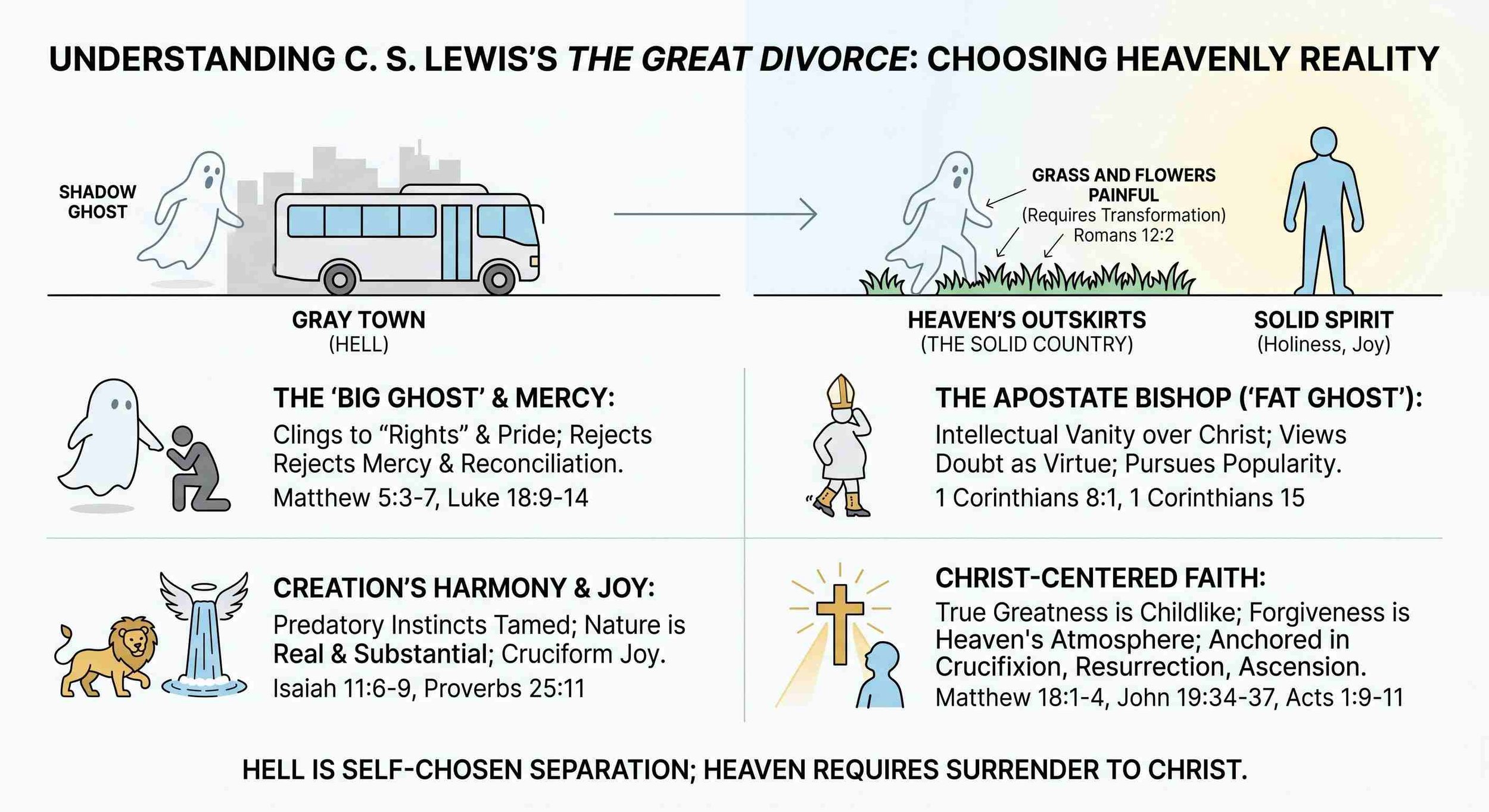
Short Summary of the Whole Class
On May 14, 2026, we surveyed key scenes from The Great Divorce—ghosts traveling from the gray town to the outskirts of heaven—highlighting heaven’s greater “solid” reality and the choice to receive grace or return to self. We revisited the “big ghost” who clings to his rights instead of mercy and the “fat ghost” (an apostate bishop) whose intellectual vanity and popularity eclipse the cross. We connected Lewis’s imagery (playful lions, lilies, golden apples, and the waterfall-angel “like one crucified”) to Scripture, contrasted a theology of glory with the theology of the cross, and emphasized forgiveness, humility, discernment, and Christ-centered reality—timely on Ascension Day.
Walkthrough and Section Summaries
1) Introduction: C. S. Lewis, The Great Divorce, and Our Aim
What we discussed:
C. S. Lewis’s background as an apologist and storyteller and the premise of The Great Divorce: a bus ride from the gray town (a hell-like state) to the outskirts of heaven.
The book’s purpose: an allegory that invites introspection rather than delivering rigid doctrinal formulas.
Stories mentioned:
The bus ride from the gray town to heaven’s outskirts (The Great Divorce).
Bible verses discussed:
None explicitly cited in this segment.
Short summary of section:
We framed The Great Divorce as an introspective allegory calling readers to self-examination before God’s reality.
2) The Bus and the “Solid” Country: Reality That Hurts (at First)
What we discussed:
Heaven’s “solidness” makes grass and flowers painful to the ghosts’ feet, signaling that heaven is more real than their current state and requires transformation.
The existential choice: move toward solidity (holiness, joy) or return to the bus.
Stories mentioned:
A ghost trying to pick a daisy that tears his fingers due to heaven’s solidity (The Great Divorce).
Bible verses discussed (thematic echoes):
Romans 12:2 (transformation into God’s reality).
Short summary of section:
Heaven’s greater reality invites transformation; ghosts must become solid or retreat to familiar shadowlands.
3) Chapter 4: The “Big Ghost”—Rights vs. Mercy
What we discussed:
The “big ghost,” focused on his rights, meets a redeemed murderer who humbly offers lifelong service; grace is offered, but pride refuses it.
The emotional tone: grumbling, self-pity, and the tragic turning away from mercy.
Stories mentioned:
The encounter between the big ghost and the redeemed murderer who offers reconciliation (The Great Divorce).
Bible verses discussed (echoed themes):
Matthew 5:3–7 (humility and mercy).
Luke 18:9–14 (Pharisee vs. tax collector—pride vs. humble repentance).
Ephesians 4:32; Colossians 3:13 (forgiveness and reconciliation).
Short summary of section:
Prideful insistence on “rights” can block mercy; grace is offered, but self-assertion turns away.
4) Chapter 5: The Apostate Bishop (“Fat Ghost”)—Intellectual Vanity and a Theology of Glory
What we discussed:
The “fat ghost,” a cultured bishop with spats/gaiters, personifies intellectual pride, popularity, and self-importance.
He reframes the gray town as “hopeful” progress, calls denial of the resurrection “honest opinion,” and treats doubt as virtue.
Contrast: theology of glory (chasing modern acclaim) vs. theology of the cross (Christ crucified and risen).
Stories mentioned:
The bishop’s cultured conversation with a bright spirit; his vanity signaled by spats/gaiters (The Great Divorce).
Bible verses discussed (themes and references):
1 Corinthians 8:1 (“Knowledge puffs up, but love builds up”).
1 Corinthians 15 (centrality of the resurrection).
Genesis 3:1–5 (the serpent’s “Did God really say?”—roots of deceptive doubt).
Acts 1:9–11 (Ascension—mentioned conceptually).
Short summary of section:
Sincerity and popularity cannot sanctify error; true faith clings to Christ crucified and risen, not intellectual vanity or cultural applause.
5) Lions at the Edge of Heaven: Harmony of New Creation vs. Fear
What we discussed:
Two playful, velvet-footed lions signal creation’s restored harmony; the ghost’s fear contrasts with faith’s calm.
Echoes of Narnia and biblical promises of peace in creation.
Stories mentioned:
The playful lions under cedar trees (The Great Divorce).
Bible verses discussed (echoes):
Isaiah 11:6–9; Isaiah 65:25 (predator and prey at peace).
Short summary of section:
The lions picture heaven’s harmonious creation; pride’s fear shrinks before the gentle strength of redeemed reality.
6) From Speculation to Eternal Fact: Christ-Centered Reality
What we discussed:
“We know nothing of religion here. We think only of Christ.” The solid spirit invites the ghost to “eternal fact.”
The ghost prefers to return and finish a paper—speculation over surrender—calling the crucifixion a “tragic waste.”
Stories mentioned:
The ghost declining the invitation to the mountains to pursue academic work (The Great Divorce).
Bible verses discussed:
1 Corinthians 15 (the crucifixion and resurrection as non-negotiable gospel facts).
Short summary of section:
Speculative religion can eclipse Christ himself; heaven calls us to the embodied, eternal fact of the crucified and risen Lord.
7) Chapter 6: Creation’s Joy—Lilies, Golden Apples, and the Waterfall-Angel “Like One Crucified”
What we discussed:
Heaven’s substance: lilies and water more solid than ghosts; a colossal waterfall revealed as a bright angel “like one crucified,” pouring joy into creation.
The ghost tries to carry a golden apple back to hell but learns there’s “no room” for heaven’s substance in hell.
Stories mentioned:
Walking on water that resists the ghost; lilies that cannot be bent; the basket of golden apples dwindling to one; the waterfall-angel proclaiming, “You cannot take it back” (The Great Divorce).
Bible verses discussed (motifs and echoes):
Proverbs 25:11 (“apples of gold in pictures of silver”).
Baptismal overtones and cruciform imagery tied to Christ’s self-giving (no single verse cited).
Short summary of section:
Heaven overflows with cruciform joy and substance; it cannot be smuggled into hell or bent to self-centered ends.
8) Misplaced Zeal, Ambition, and Childlike Greatness
What we discussed:
The danger of zeal untethered from Christ; the ghost seeks guarantees and recognition rather than repentance and forgiveness.
Jesus redefines greatness through childlike humility and servant leadership.
Stories mentioned:
The ghost insisting on “scope for talents” versus the guide offering forgiveness (The Great Divorce).
Bible verses discussed:
Matthew 18:1–4 (childlike greatness).
Mark 10:35–45; Matthew 20:20–28 (ambition vs. servant leadership).
Short summary of section:
True greatness is humble and Christ-centered; zeal must serve repentance and mercy, not self-importance.
9) Discernment in Teaching: Influence, Trends, and Responsibility
What we discussed:
Teachers’ influence can amplify error; popularity and fashionable currents can sideline the cross.
Modern parallels: feel-good or prosperity-style messages contrasted with cross-centered proclamation.
Two ditches: progressive skepticism that dissolves doctrine and rigid literalism that misses a text’s purpose; Scripture is read to know Christ.
Stories mentioned:
References to Communion debates (Zwingli’s symbolic view vs. “This is my body”); Jonah debates as a case of missing purpose (contextual discussion).
Bible verses discussed (themes):
Warnings about false teaching (conceptual).
Short summary of section:
Discernment resists trends and extremes; Scripture’s aim is to reveal Christ, not to feed skepticism or win literalist contests.
10) Forgiveness as Heaven’s Atmosphere and Rethinking Hell
What we discussed:
“There is nothing but forgiveness in heaven.” Jesus calls us to forgive without limit; we asked whether resenters could be happy in such a realm.
Lewis’s hell: a vast gray sprawl that is finally only a tiny crack outside heaven—self-chosen separation rather than overt flames.
Stories mentioned:
The gray town as self-chosen isolation; book cover fire imagery vs. Lewis’s subtler depiction (The Great Divorce).
Bible verses discussed:
Matthew 18:21–22 (forgiveness “seventy times seven”).
Short summary of section:
Heaven’s life is unending forgiveness; hell is the end of self-absorption—insubstantial, joyless, and chosen against grace.
11) Crucifixion, Resurrection, Witness, and Ascension Day
What we discussed:
We affirmed the historic crucifixion and resurrection over speculative alternatives; mentioned traditional stories about the centurion and the spear.
Marked Ascension Day (May 14, 2026), centering hope on the risen and reigning Christ.
Stories mentioned:
The centurion and the spear at Jesus’ crucifixion (John 19:34–37; traditional repentance story discussed).
Bible verses discussed:
John 19:34–37 (spear in Christ’s side—conceptual reference).
Acts 1:9–11 (Ascension—conceptual reference).
Short summary of section:
Christian hope rests on the apostolic witness to Christ’s death, resurrection, and ascension; our zeal is rightly ordered to him.
Medium-Length Summary of the Class (May 14, 2026, 11:04:08)
Our Bible study on May 14, 2026, used C. S. Lewis’s The Great Divorce to probe the contrast between heaven’s “solid” reality and hell’s insubstantial self-focus, the call to repentance and forgiveness, and the danger of intellectual pride that talks about religion while avoiding surrender to Christ. We revisited the “big ghost” who clings to rights rather than receive mercy and the “fat ghost” (apostate bishop) who mistakes doubt and popularity for virtue, even reframing the gray town as hopeful progress and treating denial of the resurrection as “honest.” We connected Lewis’s scenes—playful lions, lilies tougher than ghosts, golden apples that cannot be smuggled into hell, and the waterfall-angel “like one crucified”—to Scripture: creation’s peace (Isaiah 11; 65), humility and mercy (Matthew 5; Matthew 18; Mark 10), forgiveness without limit (Matthew 18), the perils of puffed-up knowledge (1 Corinthians 8:1), and the centrality of Christ’s crucifixion, resurrection, and ascension (1 Corinthians 15; John 19:34–37; Acts 1:9–11). We emphasized discernment against both fashionable skepticism and rigid literalism, insisting that Scripture’s aim is to reveal Christ. Marking Ascension Day, we concluded that true zeal is Christ-centered, that heaven’s atmosphere is forgiveness, and that hell is a self-chosen, joyless separation that cannot contain the substance of heaven.
Main Points
The Great Divorce depicts a choice between heaven’s solid reality and hell’s self-absorption.
Pride—whether “rights”-driven or intellectual—blocks mercy; humility receives grace.
The “bishop” caricature warns against a theology of glory, popularity, and doubt that eclipses the cross and resurrection.
Heaven’s creation is harmonious and substantial; its joy is cruciform and cannot be smuggled into hell.
True greatness is childlike humility; zeal must be Christ-centered, not trend-driven.
Discernment resists both progressive skepticism and rigid literalism; Scripture’s purpose is to reveal Christ.
Heaven’s atmosphere is unending forgiveness; hell is self-chosen separation from joy.
The apostolic witness to Christ’s crucifixion, resurrection, and ascension anchors Christian hope.
Bible Scriptures Mentioned or Echoed
Isaiah 11:6–9; Isaiah 65:25 (peace in creation)
Matthew 5:3–7 (humility and mercy)
Matthew 18:1–4 (childlike greatness)
Matthew 18:21–22 (forgiveness “seventy times seven”)
Mark 10:35–45; Matthew 20:20–28 (servant leadership vs. ambition)
Luke 18:9–14 (Pharisee and tax collector)
Romans 12:2 (transformation)
1 Corinthians 8:1 (“Knowledge puffs up, love builds up”)
1 Corinthians 15 (centrality of the resurrection)
Genesis 3:1–5 (the serpent’s question—doubt)
John 19:34–37 (spear in Christ’s side; crucifixion detail)
Acts 1:9–11 (Ascension)
Stories and Scenes Discussed
The bus ride from the gray town to the outskirts of heaven (The Great Divorce)
The “solid” grass and the daisy that hurts a ghost’s fingers (The Great Divorce)
Chapter 4: the “big ghost” vs. the redeemed murderer who offers service and reconciliation (The Great Divorce)
Chapter 5: the apostate bishop (“fat ghost”) in conversation with a bright spirit; vanity signaled by spats/gaiters (The Great Divorce)
The playful lions under cedar trees, signaling creation’s harmony (The Great Divorce)
The ghost preferring academic papers to repentance—“eternal fact” vs. speculation (The Great Divorce)
Chapter 6: lilies, walking on resistant water, the golden apples that cannot be taken to hell, and the waterfall revealed as an angel “like one crucified” (The Great Divorce)
Background references: Narnia echoes; Communion debates (Zwingli vs. “This is my body”); Jonah debates about interpretation; the centurion and the spear at the crucifixion (traditional repentance story noted)
The Great Divorce Chapters 2-4 - Thursday Bible Study
A lively Bible study on May 7, 2026 explored C. S. Lewis’s The Great Divorce (Chs. 1–3), tracing the contrast between ghostly insubstantiality and heavenly solidity, the challenge of pride versus grace, and the costly journey of repentance and becoming “solid” in Christ in light of Scripture.
Great Divorce Chapters 2-4
This is our 2nd class on The Book
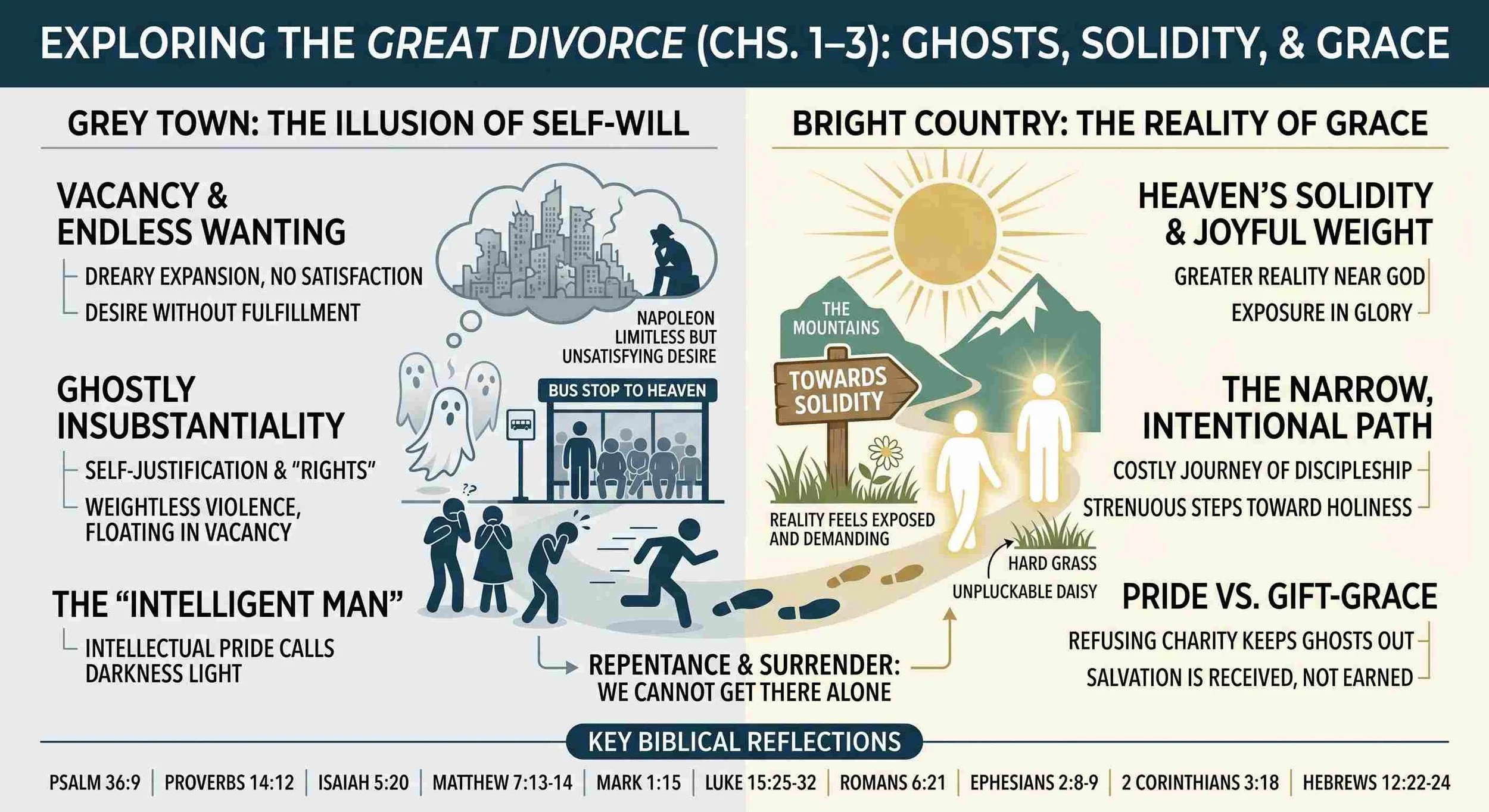
This is an AI Recap of the class.
Some things may be incorrect.
Short summary of the whole class
Our class revisited key scenes from The Great Divorce—life in the Grey Town, the bus ride, and arrival in the bright country—using them to examine desire, dissatisfaction, humility, and the hard, intentional path of discipleship. We contrasted ghosts’ self-justifying “rights” with heaven’s gift-grace, discussed fear-driven retreats and huddled hesitancy, and reflected on transformation as God makes us real. Scripture guided us through themes of wisdom, repentance, forgiveness, and the weight of glory.
Walk-through summary with sections, verses, stories, and end-of-section summaries
1) Setting the stage: where we left off
Discussion: We picked up from last week’s progress through page 14 (most of Chapter 2), choosing to revisit Chapter 2 before moving into Chapter 3. Handouts included character studies and an AI-generated overview/graphic to track figures (noting AI’s limitations).
Themes: Orientation to characters and motifs; careful reengagement with the text.
Scripture connections: None explicitly read in this opening segment.
Stories/literary references: The Great Divorce (Chs. 1–2); mention of the handouts and overview graphic.
End-of-section summary: We reoriented to Chapters 1–2 with tools to clarify characters and themes, preparing to engage the text thoughtfully.
2) Grey Town overview: “hell” as vacancy and endless wanting
Discussion: Grey Town appears as a place where one can have anything by mere thought yet never be satisfied—houses don’t keep out weather; even Napoleon broods alone. We contrasted cultural images of hell (Dante-like flames) with Lewis’s drab, ever-expanding vacancy. Some noted how Catholics might see the bus stop region as purgatory; Lewis plays with that notion.
Themes: Desire without fulfillment; emptiness rather than fiery torment; modern parallels (raises that quickly lose charm).
Scripture connections: Later tied to biblical themes of desire and dissatisfaction; no specific verses cited in this section.
Stories/literary references: The Great Divorce; Dante’s Inferno; workplace raises analogy.
End-of-section summary: Lewis’s “hell” is restless emptiness—always wanting, never satisfied—setting up the contrast with the solid joy of heaven.
3) Are the ghosts lost-lost? The shrinking Grey Town and widening mountains
Discussion: We previewed Lewis’s end-of-book reveal: hell/Gray Town is tiny from heaven’s vantage—a “fissure in the soil”—though it seems vast from below. As the bus rises toward the mountains (the outskirts of heaven), reality grows more spacious and solid.
Themes: Perspective shift; nearness to God increases reality and exposure; hope for change.
Scripture connections: Anticipated themes later tied to Psalm 36:9 and 1 Corinthians 15:49.
Stories/literary references: The Great Divorce imagery of rising to the bright country.
End-of-section summary: From below, hell looks vast; from above, it’s small. Near the mountains, things grow more real, hinting that moving toward God is an increase of reality.
4) Flickers of solidity and the problem of self-justification (end of Chapter 2)
Discussion: Characters display brief clarity—“solid thoughts”—then slide back into self-absorption (e.g., the “big ghost” fixated on rights). The narrator glimpses his own ghostly reflection. The chapter closes with a fight and gunshot that feel harmless, underscoring their insubstantiality—“floating in pure vacancy.”
Themes: Self-deception, rights-obsession, weightless violence in unreality.
Scripture connections: Proverbs 14:12; Jeremiah 17:9; Romans 6:21.
Stories/literary references: The Great Divorce scenes of the bus stop quarrel and the narrator’s mirror moment.
End-of-section summary: Moments of self-recognition fade as ghosts revert to self-justifying patterns; ego and violence look big in Grey Town but prove weightless in reality.
5) Opening the window: first signs of longing for the mountains
Discussion: On the bus, the narrator opens a window to fresh air; others scold him for risking a “cold.” We asked why the ghosts were at the bus stop: dim openness to correction, herd behavior, or curiosity. Some ride and later retreat when faced with the cost of becoming solid.
Themes: Desire for reality versus fear-driven conformity; will tested by exposure to the solid.
Scripture connections: Proverbs 1:20–23; Proverbs 9:4–6; Matthew 7:13–14.
Stories/literary references: The Great Divorce bus scene; Lady Wisdom’s call as biblical parallel.
End-of-section summary: Desire for reality flickers, but fear and groupthink pull many back; the will must consent to be changed.
6) Arrival in Chapter 3: bright country, hard grass, and ghostly hands
Discussion: The bus hovers over a bright, level land with river and birdsong. Disembarking brings chaos, then stillness. The grass is so solid it hurts ghostly feet; a daisy stem won’t twist and nearly peels skin. The country feels freeing yet exposing.
Themes: Heaven’s solidity; our transparency; exposure in glory.
Scripture connections: Psalm 36:9; 2 Corinthians 3:18; 1 Corinthians 15:42–49; 2 Corinthians 4:17–18.
Stories/literary references: The Great Divorce; note on Hans Christian Andersen (The Little Mermaid) as an image for painful steps in a more real world.
End-of-section summary: Heaven’s outskirts are startlingly solid; compared to it, the ghosts are unreal. The more real the world, the more our unreality feels exposed.
7) The “intelligent man” and the comfort of clever error
Discussion: The “intelligent man” reframes Grey Town as enlightened dawn, dismissing longing for “real commodities” as retrograde materialism—while fearing a fresh breeze. Cleverness rationalizes emptiness, preferring safe theories to unsafe reality.
Themes: Intellectual pride; calling darkness light; abstractions over tangible grace.
Scripture connections: Isaiah 5:20; 2 Timothy 3:7; 1 Corinthians 8:1.
Stories/literary references: The Great Divorce “intelligent man” vignette.
End-of-section summary: Intellectual pride can rename emptiness “progress,” turning from tangible grace to safe ideas.
8) “The road to heaven is harder”: intentional steps and the narrow way
Discussion: Participants noted every step in the bright country must be intentional; becoming solid initially feels strenuous—like straining to lift a leaf. Discipleship is deliberate and costly.
Themes: Narrow path; sanctification’s early resistance; purposeful growth.
Scripture connections: Matthew 7:13–14; Luke 9:23.
Stories/literary references: The Great Divorce leaf-lifting image; a bear-chase joke illustrating the trap of comparative righteousness (contrasted with humility).
End-of-section summary: The way to life requires purposeful, often painful steps as grace strengthens us for glory.
9) Fear and flight: “It gives me the pip”—running back to the bus
Discussion: A ghost panics—“It gives me the pip”—and flees back to the bus. We compared this to addiction: outsiders see hollowness, yet sufferers return to the familiar. Grey Town’s “ease” contrasts with heaven’s demanded capacities and desires.
Themes: Fear of change; addiction to comfort/control; relapse.
Scripture connections: 2 Peter 2:22; Proverbs 26:11.
Stories/literary references: The Great Divorce fleeing ghost; real-life addiction parallels.
End-of-section summary: When holiness confronts our attachments, fear can drive us back to comfort; freedom requires staying to be changed.
10) The Big Man and “my rights”: refusing the charity of heaven
Discussion: The Big Man asks, “When have we got to be back?”—a control posture. He is obsessed with rights and refuses heaven’s charity, wanting merit-based entry. Anticipation of his encounter with a Solid Person highlighted the offense of gift-grace.
Themes: Pride versus grace; entitlement versus gratitude; elder-brother resentment.
Scripture connections: Ephesians 2:8–9; Luke 15:25–32; Matthew 20:1–16.
Stories/literary references: The Great Divorce Big Man; vineyard workers; elder brother.
End-of-section summary: Heaven is received, not earned; insisting on “rights” keeps us ghostly outside the gates of gift.
11) The approach of the Solid People: bright, weighty, and from the mountains
Discussion: Those coming from the mountains are ageless and bright; the earth shakes under their tread; dew rises from crushed grass. Two ghosts flee; others huddle. We pondered degrees of reality and fear in the presence of holiness.
Themes: Holiness as joyful weight; exposure; invitation to transformation.
Scripture connections: 2 Corinthians 3:18; Exodus 34:29–35; Hebrews 12:22–24.
Stories/literary references: The Great Divorce Solid People descending.
End-of-section summary: True holiness has joyful weight; its approach exposes fear yet invites us to stand and be made new.
12) “Solid thoughts” and mixed motives: why get on the bus at all?
Discussion: We debated whether ghosts had “solid thoughts”—glimpses of heaven’s values—mixed with old motives (e.g., trying to profit by bringing back something solid). Huddling may be an early, hesitant communal step.
Themes: Prevenient grace; conflicted desires; early stages of repentance-in-community.
Scripture connections: Mark 9:24; Philippians 2:12–13.
Stories/literary references: The Great Divorce salesman-like impulse; huddling behavior.
End-of-section summary: Early grace often looks like mixed motives and trembling steps; God can use even hesitant huddling to move us toward the mountains.
13) “The Big Man” meets a redeemed murderer: forgiveness vs. rights
Discussion: A redeemed solid man (who had murdered “Jack”) seeks out the Big Ghost, confessing long hatred, asking forgiveness, offering service, and inviting him to come. The Big Ghost fixates on fairness, classifies sins, insists he’s a “decent chap,” and rejects “bleeding charity.”
Themes: Forgiveness that transforms; repentance and discipleship; the offense of grace to pride.
Scripture connections: Mark 1:15 (repent and believe the good news).
Stories/literary references: The Great Divorce confrontation over “poor Jack”; Hans Christian Andersen reference noted earlier for painful steps imagery.
End-of-section summary: Humble repentance welcomes grace and offers reconciliation; pride clinging to “rights” refuses charity and remains ghostly.
14) Repentance, discipleship, and the tragic refusal
Discussion: The solid man pleads, “You can never get there alone. I was sent to you.” The Big Ghost prefers independence and “being right,” choosing to “go home” rather than accept charity—almost happy to have something to refuse.
Themes: Surrender and trust versus self-will; the perverse satisfaction of refusal.
Scripture connections: Mark 1:15 (call to repent and believe).
Stories/literary references: The Great Divorce decision point; ghosts huddling or fleeing.
End-of-section summary: Salvation involves surrender and being led; pride can find satisfaction in refusal, choosing isolation over joy.
Medium-length final summary of the class
On May 7, 2026 (11:01:06), our Bible study revisited C. S. Lewis’s The Great Divorce, rereading Chapter 2 and moving into Chapter 3 to deepen our grasp of Lewis’s contrast between the Grey Town and the bright country. We considered hell as vacancy—ceaseless wanting without satisfaction—and noted how what seems vast below proves tiny from heaven’s view. As the bus rises toward the mountains, reality becomes more solid and exposing: grass pierces ghostly feet, flowers resist being plucked, and the narrator recognizes his own ghostliness. We traced flickers of “solid thoughts” that often dissolve back into rights-obsession, intellectual pride, or fear-driven retreats to the familiar. The “intelligent man” rationalizes emptiness; the Big Ghost insists on merit and refuses charity. The approach of the Solid People, weighty with joy, provokes both fear and hope, inviting transformation through surrender. In the poignant encounter between the Big Ghost and a redeemed murderer, we saw the gospel’s shape: grace exposes and forgives, reorienting the past in love, while pride clings to “rights” and refuses to be led. In conversation with Scripture, we reflected on wisdom, humility, repentance, and the weight of glory—the costly journey toward becoming truly solid in Christ.
Main points
Hell as vacancy: Grey Town offers anything on demand yet never satisfies.
Heaven’s solidity: the bright country is more real than the ghosts; exposure in glory hurts until grace makes us solid.
Perspective shift: hell shrinks from heaven’s vantage; reality expands near God.
Flickers of desire: brief clarity competes with rights-obsession, self-justification, and clever rationalizations.
Narrow, intentional path: discipleship entails strenuous, purposeful steps.
Fear and relapse: attachment to comfort can send us back to the bus.
Pride versus grace: heaven is received, not earned; “rights” block mercy.
Holiness has joyful weight: Solid People embody transformative goodness.
Early grace often looks mixed: hesitant, communal steps can move us toward God.
Repentance and surrender: we cannot get there alone; we must be led and let go.
Bible Scriptures mentioned
Psalm 36:9
Proverbs 1:20–23
Proverbs 9:4–6
Proverbs 14:12
Proverbs 26:11
Isaiah 5:20
Matthew 7:1–5
Matthew 7:13–14
Mark 1:15
Mark 8:34–36
Mark 9:24
Luke 9:23
Luke 14:28–33
Luke 15:25–32
Romans 6:21
1 Corinthians 8:1
1 Corinthians 13
1 Corinthians 15:42–49
1 Corinthians 15:53–54
2 Corinthians 3:18
2 Corinthians 4:17–18
Philippians 2:12–13
Philippians 3:20–21
Ephesians 2:8–9
Hebrews 12:22–24
Stories and literary references discussed
C. S. Lewis, The Great Divorce (Chs. 1–3): Grey Town, bus ride, Napoleon’s isolation, the “intelligent man,” the big ghost obsessed with rights, solid people descending, hard grass and unpluckable flowers, ghosts huddling and fleeing, the Big Ghost’s encounter with the redeemed murderer of “Jack.”
Dante’s Inferno: contrasted imagery of hell.
Hans Christian Andersen, The Little Mermaid: painful steps as a metaphor for walking in a more solid world.
Workplace raises analogy: modern parallel to endless wanting without satisfaction.
Bear-chase joke: illustrates the trap of comparative righteousness.
Personal addiction conversation: highlights relapse into familiar bondage.
Content creation date: 2026-05-07 11:01:06.
The Great Divorce Intro + Chapter 1 - Thursday Bible Study
In our Bible study on April 29, 2026, we began our journey into C.S. Lewis's "The Great Divorce," exploring the book's themes of Hell as self-imposed isolation, the choice between Heaven and Hell, and how the story serves as a mirror for our own spiritual lives.
Great Divorce Prologue & Chapter 1
This is our 1st class on The Book
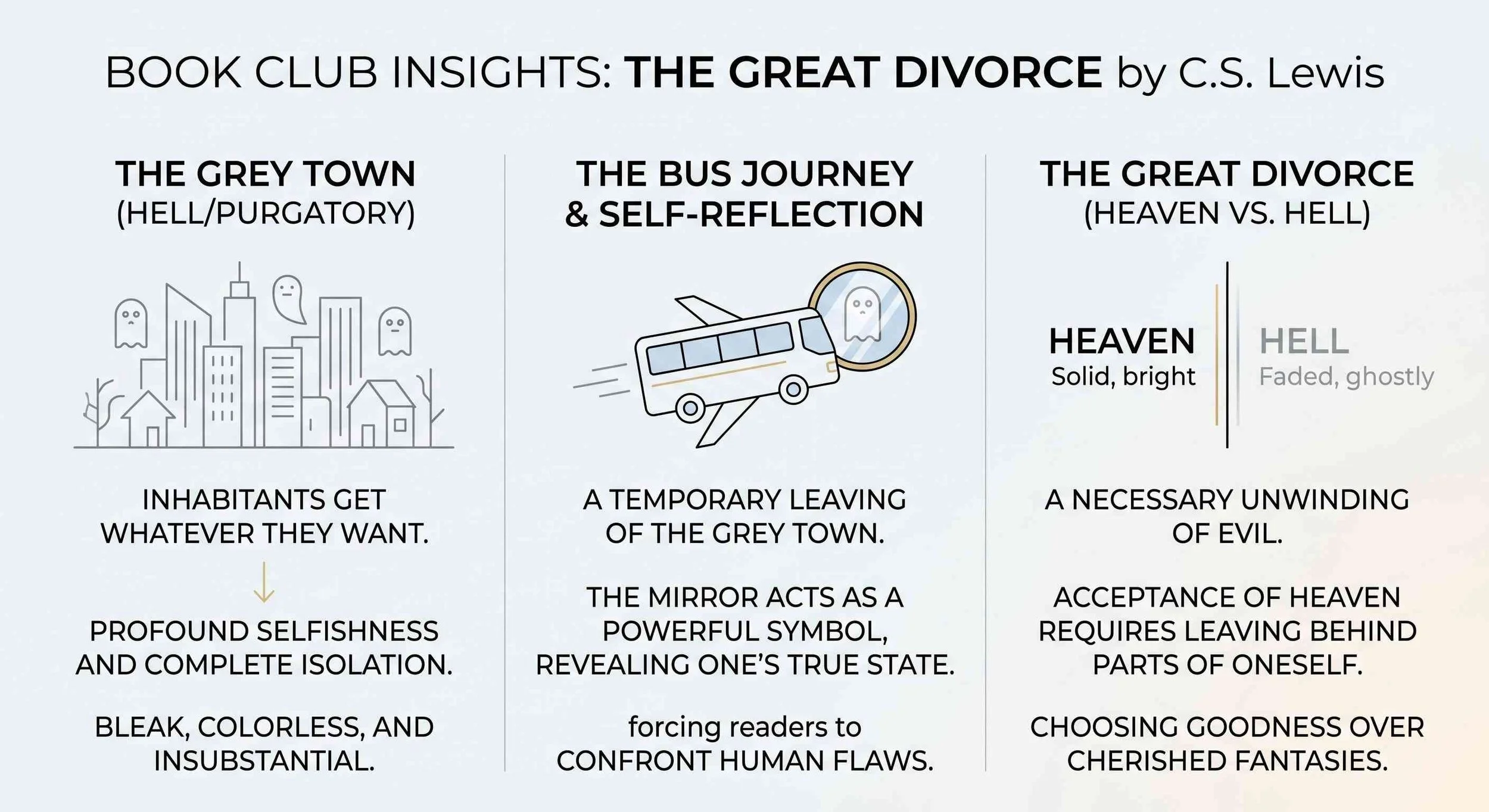
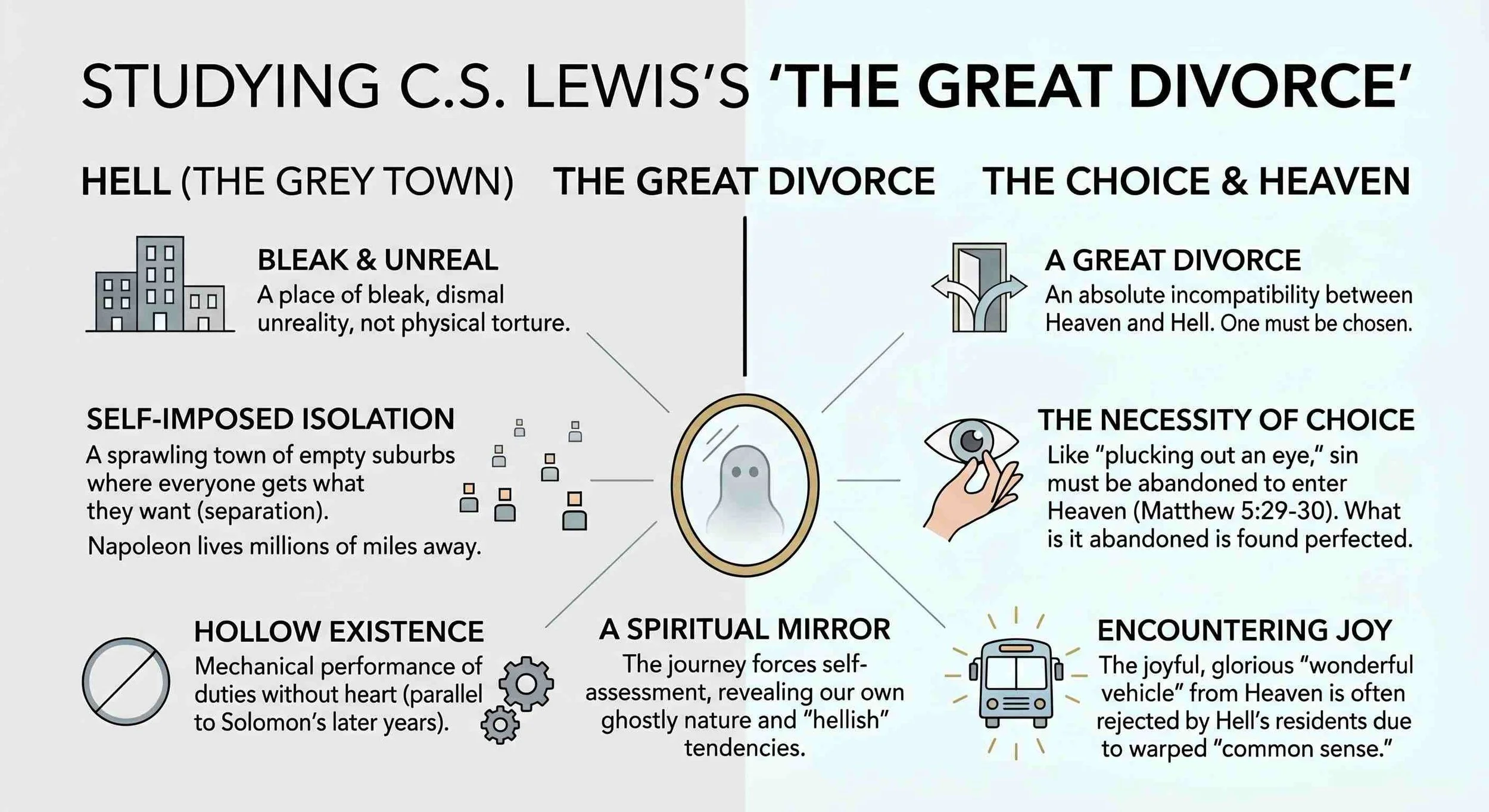
This is an AI Recap of the class.
Some things may be incorrect.
Short Summary of the Class
On April 29, 2026, our group started a new study on C.S. Lewis's classic allegory, "The Great Divorce." We began by discussing Lewis's life and his conversion from atheism, framing the book as his response to the idea that Heaven and Hell can coexist. We explored the setting of the "grey town," a depiction of Hell as a bleak, unreal place of self-imposed isolation where everyone gets what they want, leading to endless separation. The discussion highlighted the residents' petty, self-absorbed nature, which is on full display as they wait for a bus. Their negative reaction to the glorious, light-filled bus from Heaven reveals how their "common sense" has been warped by misery, making them reject goodness itself. The book challenges us to confront the parts of ourselves we must leave behind—like plucking out an eye—to draw closer to God.
Detailed Class Summary
Here is a summary of what we talked about as we went through the class on April 29, 2026.
Introduction to C.S. Lewis and "The Great Divorce"
We kicked off our new study by introducing C.S. Lewis's "The Great Divorce." For some, it was a revisit, and for others, a brand new read, with the acknowledgment that the book reveals new insights depending on one's life experiences. We then discussed the author, C.S. Lewis, noting he was an Oxford professor and a friend of J.R.R. Tolkien. It was highlighted that Lewis was once a committed atheist, and his conversion to Christianity was significantly influenced by friends like Tolkien and by reading George MacDonald.
The central theme of the book's preface was established: the impossibility of merging Heaven and Hell. The book's title is a direct response to William Blake’s "The Marriage of Heaven and Hell." Lewis argues that you must choose one or the other, a concept he connects to Jesus's teaching about being willing to "pluck out your right eye" if it causes you to sin. He uses this imagery to explain that what we abandon for Heaven is not truly lost but is found perfected.
Bible Verses: The teaching about plucking out your right eye or cutting off your right hand if it causes you to sin (Matthew 5:29-30, Mark 9:43-48).
Section Summary: We introduced the book "The Great Divorce" and its author, C.S. Lewis, discussing his background as an Oxford scholar, a former atheist, and his friendship with J.R.R. Tolkien. We established the book's core argument from its preface: that one must make a "great divorce" from sin, a painful but necessary choice likened to the biblical call to "pluck out an eye" to enter Heaven.
The Grey Town: A Picture of Hell
We began our analysis of the story by identifying the setting of the first chapter: the "grey town." We agreed it represents Hell, a place characterized not by fire, but by a bleak, dismal, and unreal atmosphere. A key feature of this Hell is that everyone gets what they want. This desire for isolation, stemming from petty arguments and selfishness, causes the inhabitants to move farther and farther apart, creating endless, empty suburbs. This concept was illustrated by the story of a man who can only see Napoleon, who lives millions of miles away, through a telescope. This self-imposed distance raised the question of whether someone can be "too far" for redemption. We concluded that while the distance is a choice and the journey back is always possible, the tragedy is that many lose the desire to be reached.
We also discussed a parallel to the story of King Solomon. Despite his wisdom, Solomon fell into performing his religious duties mechanically, merely to "complete his duty" without heart. This was likened to the hollow, self-serving existence of the ghosts, who are stuck in destructive patterns without awareness of the damage they are doing.
Bible Scriptures: 1 Kings, 2 Kings
Stories Mentioned:
The story of Napoleon living millions of miles away in the grey town.
King Solomon's later years, where he performed temple duties mechanically.
Section Summary: The opening setting is a bleak, grey town representing Hell as a place of unreality and self-imposed isolation. Its core rule—that everyone gets what they want—paradoxically leads to infinite separation. This was compared to King Solomon's heartless religious duties, illustrating a life lived without genuine spiritual connection.
The Bus Stop and the Journey
Our focus then shifted to the contentious crowd waiting at a bus stop. Their behavior is marked by fault-finding and selfishness, as seen in the character who was pleased when someone else was pushed out of line. Their motivation for boarding the bus seems to be more about conformity and competition than a genuine desire for Heaven. The arrival of the bus—a "wonderful vehicle, blazing with golden light"—provides a stark contrast. The residents, however, react with disdain, criticizing the radiant driver for not behaving "naturally." This led to a discussion on how one's environment defines "common sense." For the people in Hell, misery and cynicism are natural, making the joy and goodness of Heaven alien and offensive.
We analyzed the characters on the bus, such as the "tousle-haired poet" who seeks validation for his cynical worldview. A bizarre fight breaks out with knives and pistols, yet it is "strangely innocuous," highlighting that even conflict in this place is illusory and meaningless. The session ended by looking at the pivotal moment when the "cruel light" on the bus reveals the passengers, including the narrator, as ghostly, insubstantial figures. Catching his own reflection forces the narrator into a moment of honest self-assessment.
Section Summary: The scene at the bus stop reveals the inhabitants' selfish and competitive nature. Their contempt for the beautiful, light-filled bus shows how their perception of reality has been warped, making them reject goodness. The journey itself, including an illusory fight, emphasizes the unreality of this state, culminating in the narrator's shocking realization of his own ghostly nature, which serves as a mirror for the reader.
Overall Summary
In our Bible study on April 29, 2026, we embarked on C.S. Lewis's "The Great Divorce." We began by discussing the author's life, including his conversion from atheism, and the book's central thesis: the absolute incompatibility of Heaven and Hell. The title itself is a rebuttal to the idea that the two can be married, arguing instead for a "great divorce" from sin, a concept Lewis ties to the biblical command to "pluck out your eye."
Our discussion then moved into the book's allegorical world, characterizing Hell as a dismal "grey town." We explored its unique nature not as a place of external torture, but of self-imposed isolation where getting everything one wants leads to endless, empty separation. The inhabitants are portrayed as petty, self-absorbed "ghosts," a nature revealed in their behavior at a bus stop where they jockey for position out of mindless conformity. A powerful biblical parallel was drawn to King Solomon, whose later life of performing religious duties without heart mirrored the empty existence of the ghosts.
The climax of our discussion focused on the residents' reaction to the glorious, light-filled bus from Heaven. Their contempt for its goodness highlighted a key theme: their sense of "normal" has been so warped by misery that they reject the light. This showed that they are not trapped in Hell but have condemned themselves to it through a consistent rejection of joy. The book's role as a spiritual mirror became clear, especially in the final moment where the narrator sees his own ghostly reflection, forcing him (and us) to confront our own failings and the choice we all face.
Main Points
We are starting a new study of C.S. Lewis's "The Great Divorce."
C.S. Lewis was an Oxford scholar who converted from atheism to Christianity, influenced by friends like J.R.R. Tolkien.
The book's central argument is that Heaven and Hell are incompatible; you must choose one over the other.
Hell is portrayed as a "grey town" of self-imposed isolation, where everyone getting what they want leads to endless separation and unreality.
The necessity of abandoning sin is likened to the biblical command to "pluck out an eye."
The characters ("ghosts") are self-absorbed and act out of conformity and petty competition rather than a genuine desire for good.
The actions of the ghosts were compared to the heartless, mechanical religious duties of King Solomon in his later years.
The book serves as a mirror, challenging readers to recognize and confront their own "hellish" tendencies.
Scriptures and Stories Mentioned
Bible Scriptures
Matthew 5:29-30, Mark 9:43-48: Jesus's teaching about cutting off a hand or plucking out an eye if it causes you to sin.
1 Kings & 2 Kings: The story of King Solomon.
Stories
C.S. Lewis's Conversion: His journey from atheism to Christianity, influenced by friends and authors.
The Bus Ride from Hell to Heaven: The book's main allegorical plot where ghosts travel to the outskirts of Heaven.
The Big Ghost: The story of a self-righteous man who would rather be "correct" in Hell than forgive someone in Heaven.
Napoleon in the Grey Town: The story illustrating extreme self-isolation, where a character lives millions of miles away and can only be seen with a telescope.
King Solomon's later years: His story was used as a parallel for performing religious duties mechanically and without heart.
![The Great Divorce [Thursday Bible Study]](https://images.squarespace-cdn.com/content/v1/5852f18a20099e30cd2c01dc/ec755559-0a12-48d7-a2e8-1ccec8e2fca7/Great+divorce.png)
The Great Divorce [Thursday Bible Study]
The Great Divorce is my favorite C.S. Lewis book. It truly forces us to look in the mirror and decide if we are actually willing to lay down our demons and walk toward the light.
The Great Divorce is my favorite C.S. Lewis book. It truly forces us to look in the mirror and decide if we are actually willing to lay down our demons and walk toward the light.

Our Bible study concluded C.S. Lewis's The Great Divorce, exploring how our present-day choices regarding forgiveness, attachments, and community shape our eternal reality, contrasting the misery of Hell (a self-imposed prison locked from the inside) with the joyful, solid reality of Heaven.