


All Carols Sing and Storys
Wednesday! 6:15pm
Share your Favorite Christmas Story.
Coli will share one of her’s
Pastor Cris Will share a few.
Wednesday! 6:15pm
Share your Favorite Christmas Story.
Coli will share one of her’s
Pastor Cris Will share a few.
Live Stream https://youtu.be/FBOj8UMSqgw


O Bad Little Town of Bethlehem
The early biblical stories about Bethlehem are dark and violent. They wreck us. They frighten us. In this little town, we see a microcosm of the vast and mangled mass of humanity, each individual thirsty for even a single bead of light to be dropped into the blackened depths of their souls. He who is born in Bethlehem is that Light.
Read original Article at https://www.1517.org/articles/o-bad-little-town-of-bethlehem
Mention the city of Waco, Texas, to most people today and they associate it with Chip and Joanna Gaines of “Fixer Upper” fame. That is a positive image, of course, and has brought the community popularity and economic prosperity.
But it wasn’t always so.
Beginning in 1993, and for many years thereafter, Waco was pejoratively known as “Wacko.” It had a bad reputation nationally and even internationally. Why? In April of 1993, the Branch Davidian compound, headed up by David Koresh, was raided by ATF agents. The resultant gun battle and fire left not only adults but many children dead.
The compound was located outside Waco.
That infamous incident, while not the fault of the city, soiled Waco’s reputation. The mere mention of its name, for many years, caused people to cringe, shake their heads, or engage in gallows humor.
Chip and Joanna greatly helped to change all that. The city that once was associated with a cult, bloodshed, and violence, was “fixed up,” we might say. It received a much-needed makeover.
And, in that way, it is similar to the bad little town of Bethlehem.
Two Repugnant Stories about Bethlehem
Bethlehem is mentioned a handful of times in the first six books of the Bible, but only in passing. With Judges, however, that changes—and not in a good way. In the final section of this Rated-R-for-Violence book, we have two stories, both repugnant, both associated with Bethlehem.
In the first, we meet Mr. Priest-for-Hire. He’s a Levite. And no less than three times we are told that he hailed “from Bethlehem in Judah” (17:7-9). What does this Bethlehemite do? Nothing good. He’s hired first by a real “pillar of society,” a fellow named Micah. This man had stolen a boatload of silver from his own mother, later confessed to the crime, and his mom had the silver melted down and made into idolatrous images that her son then placed in his family’s shrine.
When the Levite from Bethlehem happened to mosey by one day, looking for work, Micah hired him on the spot to be his personal priest.
Later, when some ruffians from the tribe of Dan, like a horde of Israelite Vikings, stomped in and pillaged the silver images and other religious paraphernalia from Micah, they offered the Levite a job being their priest. He jumped at the deal and joined their entourage, bidding adieu to his former employer, who barely escaped with his life.
Only at the end of the story does the hammer really come down. This priest-for-hire? This Levite? He was none other than the grandson of Moses himself, Jonathan by name (18:30). And his hometown, let us not forget, was Bethlehem.
But we’re not done. The second story from Judges makes the first seem like playground antics (Judges 19-21). In this story, we meet another Levite, along with his concubine. The girl’s hometown was Bethlehem. At some point, she is sexually unfaithful to him and skedaddles to her father’s home. Four months later, the Levite shows up on her doorstep in Bethlehem. After a few days of wooing and feasting, he succeeds in convincing the girl to come home with him.
Dear God, would that she’d have stayed in Bethlehem.
Along the way, one of the most horrific stories in the Bible takes place. The Levite, the girl, and a servant opt to spend the night with an old man in the town of Gibeah. Under cover of darkness, a mob of men from the city surround the house and demand the old man send the Levite outside so they can sexually abuse him. Instead, the Levite seized his concubine and handed her over to them. Gang rape ensued. All night.
The next morning, the Levite found this poor, ravaged woman from Bethlehem, motionless on the porch, her hand on the threshold, reaching, as it were, for the haven that was not to be.
The Levite loaded her on his donkey, took her home, and dismembered her corpse into twelve pieces. These gruesome body parts he sent all over Israel to deliver the message of what had happened to her.
There’s more to this nightmarish story, but you get the point. If the first narrative was about a cult, idolatry, theft, and the actions of a corrupt priest, this second is about a Levite with a heart of ice, a beastly mob of murderous rapists, and a poor girl without hope or life or even a decent burial.
And both stories, each in their own way, begin in Bethlehem.
A New Lease on Bethlehem’s Life
Both of these Bethlehem stories happened in the book of Judges, but there’s another Bethlehem story that happened, not in the book of Judges but in the time of the Judges. It’s the narrative about Naomi, Boaz, and Ruth, recorded in the book that bears the latter’s name.
In the book of Ruth, the evil and sinister themes of the other two Bethlehem stories are replaced by their opposites. We find here not a horde of Danites on the way to conquer some unsuspecting city, pillaging along the way, but old and widowed Naomi, coming back to her hometown of Bethlehem. We find not a sexually unfaithful concubine whose life ends violently and tragically, so that even her dismembered body bespeaks disunity, but a faithful woman named Ruth, who gets married and bears a son who will be the grandfather of the king who unites all Israel. And we find, in this story, not a Levitical priest-for-hire or a stone-hearted butcher, but a redeemer named Boaz who will make the sacrifices necessary to save Ruth and Naomi.
In other words, in Ruth’s story, Bethlehem’s story too begins to be retold. The bad little town of Bethlehem, with such a soiled and stained reputation, gets a much-needed makeover. And once the eighth and youngest son of Jesse, the boy David, is anointed king of Israel, the town that once seemed shackled to an unsavory past is given a new lease on life.
A Single Drop of Light
Long before the Messiah was born, the prophet Micah had told us that the Ruler of Israel would have his nativity in Bethlehem (5:2). Since he was the promised Son of David, this made perfect sense. David’s Son, David’s Lord, David’s hometown.
But I can’t help but marvel at how utterly appropriate his birthplace was in light of the other, darker stories about Bethlehem. The story of spiritual and sexual infidelity. The story of rape and murder. The story of cults and robbery and dysfunctional families and all the shrapnel from bombed-out souls that litters the landscape of our sad and forlorn world.
Jesus was not born just for the Naomi’s and Ruth’s and Boaz’s of the world. He was born for the forgotten, who sleep cold and scabbed in the trash-strewn alleys of our cities. He was born for the refugees, who have seen the underbelly of a world that would make most of us vomit from horror. He was born for the repeat offender, the stripper and prostitute, the preacher hooked on porn and the politician hooked on an ideology concocted in the mad mind of hell itself.
He was born for them all. He was born for us all.
In the little town of Bethlehem, which itself was neither good nor bad, we see a microcosm of the vast and mangled mass of humanity, each individual, perhaps known to them, perhaps not, thirsty for even a single bead of light to be dropped into the blackened depths of their souls.
See there in that manger, the boy swaddled, the child fresh-born: he is that light. And in him there is no darkness.
Jesus is the Light of the world. Our hope. Our Life. Our Everything.
Oh come, let us worship him.
![[Sunday] Await the Christmas Ham](https://images.squarespace-cdn.com/content/v1/5852f18a20099e30cd2c01dc/1639149545618-L5PE1GGD1ICPLYK0PY6K/Await+3a.jpg)
[Sunday] Await the Christmas Ham
Oh the humble Christmas ham. It’s easier to cook than a turkey, but it's still tasty. In the nation of Israel the ham would never have been accepted as a gift. And yet the glory of the “ham nations” was given at the birth of the Hebrew messiah.

Questions for the week
Describe a time when you messed up preparing a holiday dinner.
Read Isaiah 19:16-25. What do you find surprising about Egypt and Assyria? Why would they be able to worship just like Israel?
Think of a group of people that you dislike; how would it make you feel if they were part of God’s promise?
Through Christ, how does God make all the nations part of his promise? In regards to Christ, how are you no different than all the other nations?

What Had happened at Grace this week.
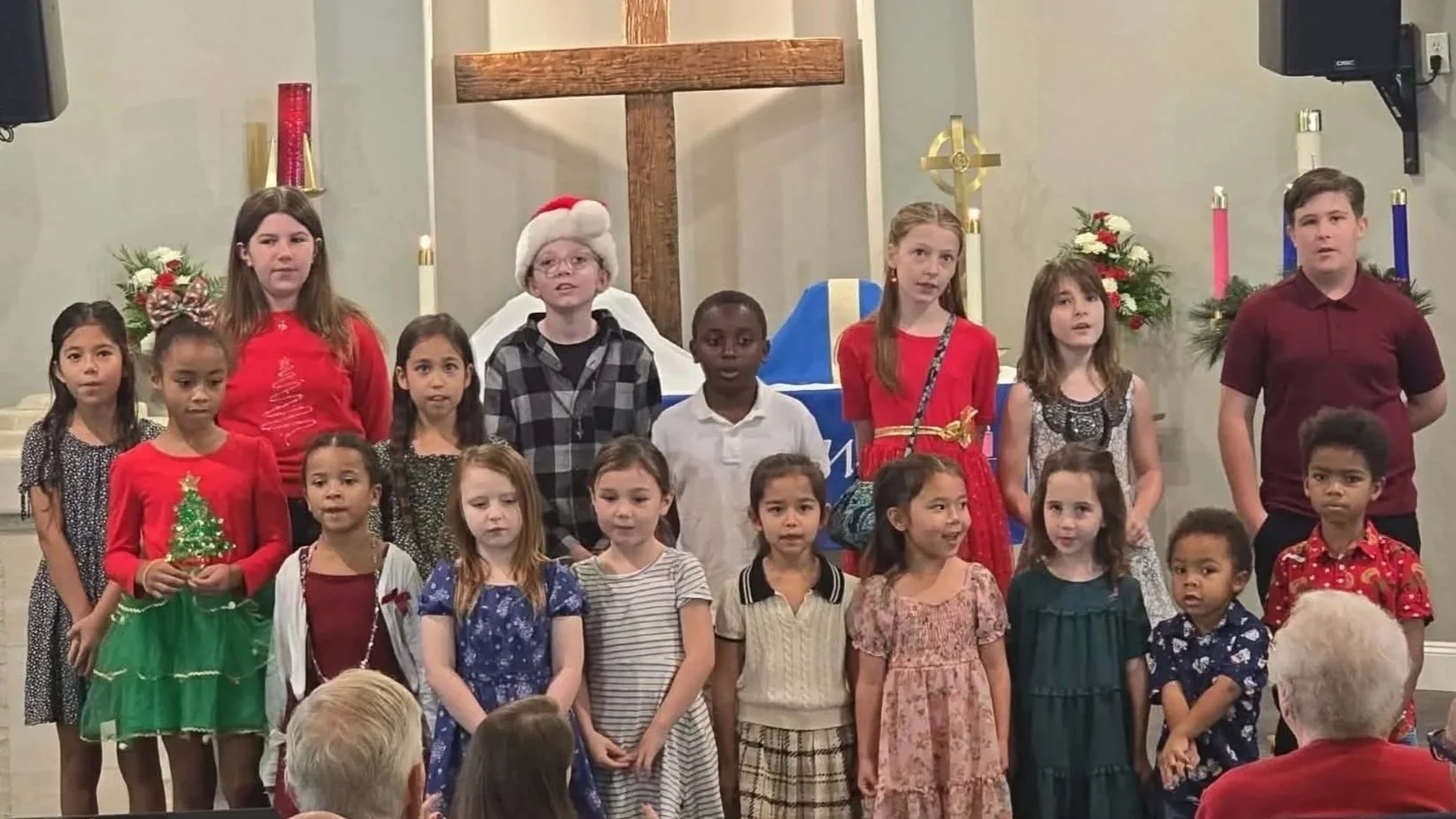
![[Sunday] A Song of Christmas Light - Know Me Better Man Stave 3](https://images.squarespace-cdn.com/content/v1/5852f18a20099e30cd2c01dc/1765482111687-AQYCM4FZQV9BO7JIPL02/Christmas+light+3a.jpg)
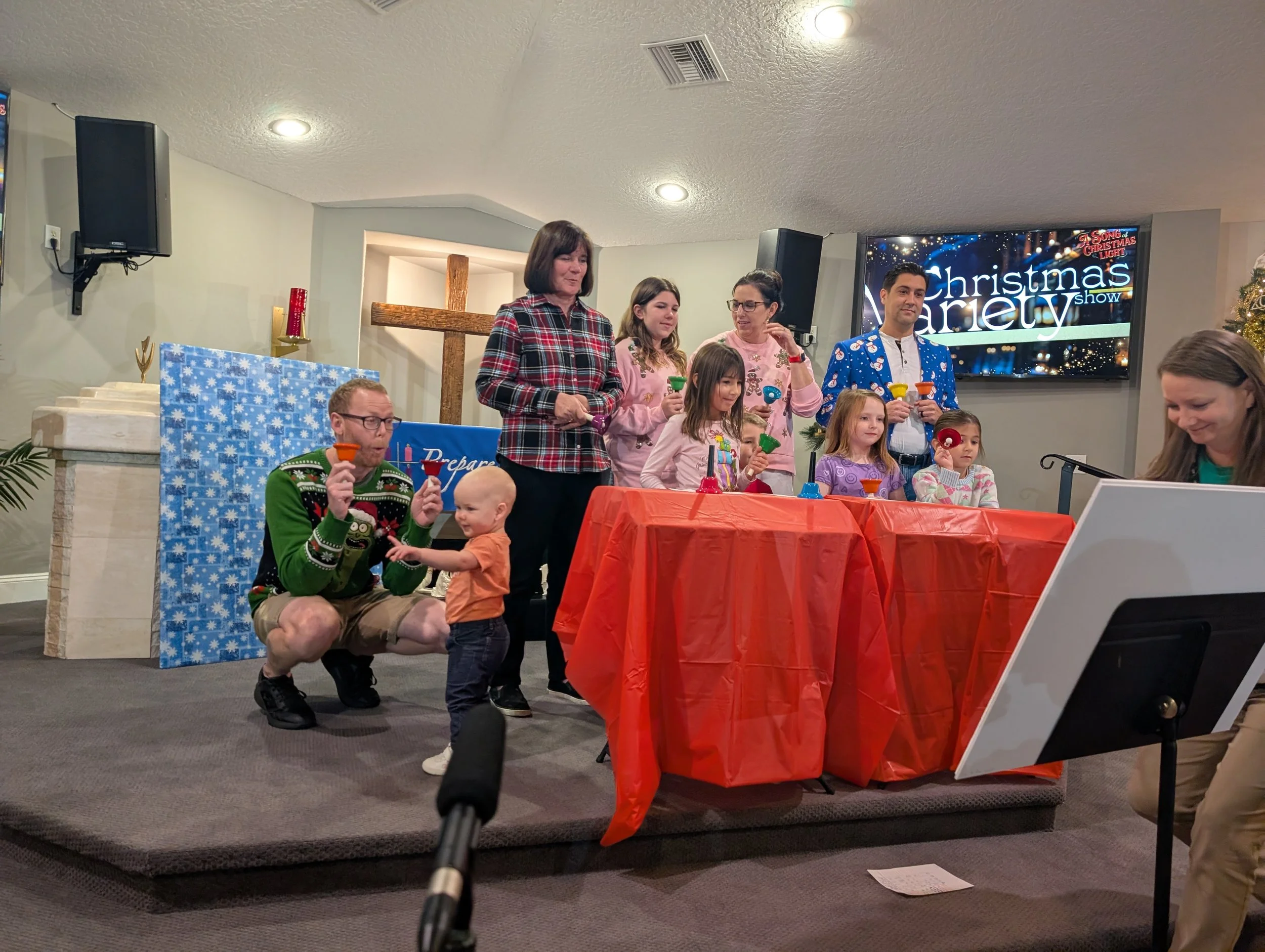




![[Wednesday] - Mid-week Advent - Christmas Variety Show](https://images.squarespace-cdn.com/content/v1/5852f18a20099e30cd2c01dc/9bbb3ea9-ae2f-4317-a416-e9a3b6aa13ce/Variety+show25a.jpg)
![[Sunday] A Song of Christmas Light - Flickering Past Stave 2](https://images.squarespace-cdn.com/content/v1/5852f18a20099e30cd2c01dc/1764904771417-1ODC6N70IDWFLRDHDLYP/Christmas+light+2a.jpg)


A CHRISTMAS CAROL AND GRACE IN PRACTICE
Scrooge did it all, and infinitely more
I will make you a light for the Gentiles, that you may bring my salvation to the ends of the earth. Isa 49:6
“I’m getting to the airport at 5 am, I don’t think I’ll hit bad wait times,” I thought to myself. Seeing curbside drop off caused me to reconsider. I was greeted by a line of cars with flashing lights, and weary passengers weighed down with suitcases waiting in line. So I stood in line waiting, waiting to print my boarding pass, waiting to drop off my suitcase. Everyone around me seemed to be forgetting how to move through an airport properly, and I found my own patience pretty scarce at 5am sans coffee. “Yes, you need to have your ID out and ready,” I muttered, tapping my foot. The security lines were even longer, with more confusion, more forgetting to remove shoes, more foot tapping from me. These long lines were encroaching on my precious “sit-at-the-gate-reading-books-and-people-watching” time. Even when I got to the gate it was pretty packed. I had my coat resting on the seat next to me, and then, glancing at the crowds, I resentfully moved my coat to the ground, to open up the seat. All these fellow humans were really encroaching on my personal comfort and happiness.
As I waited (and waited) for the boarding process to begin, I stopped aimlessly scrolling on my phone and looked up, taking out my headphones, mostly to listen for boarding announcements but also letting in some of the clamor around me. And then I made eye contact with a smiley little toddler who was staggering around. She was the most chipper person at the gate, just content to be walking around with her dad. I saw an elderly couple, talking about how big their grandkids would be and how eager they were to see them. Every person in those long lines was eager to be going somewhere or see loved ones, not nuisances, fellow sojourners. And I’d been viewing their journeys as lesser than my own. I am constantly struck by my own myopia. How easily I get caught in the snare of my own comforts and emotions! I pulled out A Christmas Carol sitting at my gate and was struck (again) when I read the lament of Jacob Marley:
Business! Mankind was my business; charity, mercy, forbearance, benevolence, were all my business. The dealings of my trade were but a drop of water in the comprehensive ocean of my business! At this time of the rolling year I suffer most. Why did I walk through crowds of fellow-beings with my eyes turned down, and never raise them to that blessed Star which led the Wise Men to a poor abode! Were there no poor homes to which its light would have conducted me!
I set the book down and did another glance around the airport. Everyone in that gate was my business, a fellow passenger. I don’t want to be Scrooge, I really don’t, but I saw my own ugly Scrooge-ness as I stood waiting in those lines. You can’t help but feel that Dickens wrote A Christmas Carol for the Christian, reminding us that our gaze should be fixed on a blessed star and the first founder of this season. It’s in following the star the wise men were led to Christ, and so it is in our journey. We are pointed to Christ, and after that we see newfound opportunities to love those around us.
Dickens was trying to show us, indirectly, that we are capable of great selfishness but also of great compassion. That a cantankerous morning in the airport doesn’t have to have the final say on how I treat other people for the rest of the day. Even a life of selfishness can be redeemed in Christ. This little Christmas tale pushes all of us to consider what to do with the time we’ve been given and to learn there is something far greater beyond our own desires and pride. We can open up our hearts to those around us, and what better time to do so than the season of Advent.
In Advent we wait; we wait as sojourners standing in a TSA line, but with far more hope. I have about as much control over my life as I do making sure the plane safely lands, but I can soak in the beauty of the sunrise from the plane window. I can help get an overhead bag down for the elderly couple in front of me. In my little row I might just have the potential to make a little difference, even if it’s just viewing my fellow travelers as humans.
The short speech Scrooge’s nephew, Fred, gives after his uncle chastises him for his celebratory spirit captures well the theme of the season:
I am sure I have always thought of Christmas time, when it has come round, as a good time; a kind, forgiving, charitable, pleasant time; the only time I know of, in the long calendar of the year, when men and women seem by one consent to open their shut-up hearts freely, and to think of people below them as if they were really fellow-passengers to the grave, and not another race of creatures bound on other journeys.
I’m not much of a crier, but I do cry reading A Christmas Carol every year, and I’ve choked through every performance of it, this year was no exception. The message of it doesn’t change and always compels me to be kinder and gentler to my fellow sojourners. We are all of us continuing to wait, but our time here isn’t forever. And when we look at our own lives as the gift they are, a spark of gratitude kindles a fire of generosity. When we realize the founder of Christmas came for all of us while still in our Scrooge-ness, our hearts change. It’s a miracle that Christ came to us, loving the unlovable. He came to a world of sheep desperately needing a shepherd, to selfish humans reluctant to share a seat, and to be light in great darkness. With Him we our selfishness gives way to see our neighbors as individuals to be loved and served.
In the last few lines of A Christmas Carol, we see a transformed Scrooge, a redeemed Christian living a life of joy and peace. We see the miracle of what happens when an embittered miser is met by divine grace:
Scrooge was better than his word. He did it all, and infinitely more; and to Tiny Tim, who did NOT die, he was a second father. He became as good a friend, as good a master, and as good a man as the good old city ever knew, or any other good old city, town, or borough, in the good old world… It was always said of him that he knew how to keep Christmas well, if any man alive possessed the knowledge. May that truly be said of us, and all of us!
![[Bible Study] Chapter 7+8 | 2Corinthians](https://images.squarespace-cdn.com/content/v1/5852f18a20099e30cd2c01dc/1639147122218-4WBOGZVMZMAUCSEZ4KJU/cor+78.jpg)
![[Sunday] Await the Nativity](https://images.squarespace-cdn.com/content/v1/5852f18a20099e30cd2c01dc/1638495832421-GE6I616E0YQQ1RHNDQH4/Await+2a.jpg)
[Sunday] Await the Nativity
The prophet Isaiah is warning us of our proclivity to build foundations upon the power of Babylon rather than the kingdom of God. The gift of the nativity is the place where the world's power structures are completely upended and the original creation is put back to rights.

Questions for the week
Describe a time when you were so focused on perfection but were actually just shallowly covering up your faults?
Read 2 Kings 20:12-19. Why is Isaiah upset with Hezekiah? What have they tried too hard to be like?
In what ways have you sought pride, power, and prestige trying to be like Babylon?
Read Isaiah 13:6-16, 14:1. The day of the Lord comes to call us from pride, power, and prestige. How does the day of the Lord bring about God’s wrath as well as his compassion (hint: connect this to Jesus on the cross)?
What Had happened at Grace this week.


What if We Are The Unfaithful Ones?
Facing the Darkness We Are in Now
This article is by Taylor Mertins:
How the faithful city has become a whore! She that was full of justice, righteousness lodged in her — but now murderers! (Isa 1:21)
There’s a reason that Isaiah 1:21 doesn’t appear in the Revised Common Lectionary. When we think of Advent we conjure up in our minds the Chrismon trees and the lights surrounding the altar. We remember the purple and pink Advent candles and the red plumage of the poinsettias. We consider the plight of Mary and Joseph to the small town of bread knowing not at all what their future would hold. We like our religious observances to be orderly and helpful and we don’t even mind a sermon that steps lightly on our toes because we know that everyone has room for improvement. But then when we hear these words from what some call the “5th gospel,” we experience some painful theological whiplash.
The faithful city has become a whore!
She was once full of justice but now she is full of murderers!
Who wants to hear about that kind of stuff in church?
In her book Advent: The Once & Future Coming of Jesus Christ, Fleming Rutledge writes:………………………………………..
Read the whole article at https://mbird.com/bible/what-if-we-are-the-unfaithful-ones/
![[Bible Study] Chapter 6 | 2Corinthians](https://images.squarespace-cdn.com/content/v1/5852f18a20099e30cd2c01dc/1638494872876-TWWETOEMHDR6S3S94S1I/cor+6.jpg)

Wednesday Advent Christmas Time Carols + Photos Dec 1st
Join us and sing Christmas Carols.


![[Sunday] Await the Ornament](https://images.squarespace-cdn.com/content/v1/5852f18a20099e30cd2c01dc/1637891860017-5349YN5DBWRW8JE8NPYS/Await+1a.jpg)
[Sunday] Await the Ornament
The beginning of advent can be a rough time for a young boy. All hyped up from the fun of Thanksgiving, school can be a reality check making him feel like Christmas will never come. For the children of Israel, a bloviating Assyrian makes very real threats, causing them to doubt if the Father is really there. However, a loving father gives us gifts to sustain us until Christmas morning.

Questions for the week
Describe a time when you’ve been tempted to listen to voices to doubt God’s love for you.
In Isaiah, the King of Assyria is trying to convince God’s people to doubt God’s power and presence. What prayer does the king of God’s people pray? Read Isaiah 37:14-20.
What does he remember about God, even in this dark time?
Read Isaiah 37:21-38. How does God deliver his people from the King of Assyria?
Ultimately, how does God deliver you from the dark times in your life?
What Had happened at Grace this week.

Everett John McWhorter Baptism
Watch Everett John McWhorter Baptism
Everett John McWhorter Baptism
November 26th 2021; 11am

Click to watch the live stream.

An Ever Widening Future
The many lives of the ancient Israel — and you.
The many lives of the ancient Israel — and you.
This morning’s devotion comes from Daily Grace, the latest 365-day devotional from Mockingbird.
Sing, O barren one who did not bear; burst into song and shout, you who have not been in labor!
For the children of the desolate woman will be more than the children of her that is married, says the LORD.
Enlarge the site of your tent, and let the curtains of your habitations be stretched out; do not hold back; lengthen your cords and strengthen your stakes.
For you will spread out to the right and to the left, and your descendants will possess the nations and will settle the desolate towns. (Isaiah 54:1-3)
You’ve known those people who, like cats, seem to have at least nine lives. They’ve survived illnesses and accidents and really toxic relationships, and they are, miraculously, still standing. The Israel that Isaiah addresses here is like that cat — possessing, at the very least, four lives.
• She is the barren woman of the exile in Babylon, fearing that Israel’s family tree is in danger of being uprooted (v. 1).
• She is the widowed woman of that same exile, feeling at times like God, her husband, has died (v. 4).
• She is the momentarily deserted wife (vv. 6-7), whom God walked out on in anger over her flagrant unfaithfulness.
Yet somehow, in God’s plan, Isaiah prophesies that all those past and tragic lives will be swallowed up in a new “covenant of peace” (v. 10). And her new identity will be that of the reunited wife of God and beloved mother of God’s growing brood. In fact, verse 2 suggests that she will need to keep patching that tent, keep widening those stakes in all directions, in order to hold all the children God will bring into her home.
I don’t know you, so I don’t know how many lives you’ve had nor which life you are currently living. I do pray, however, that God’s presence in your life will enlarge your tent to shelter an ever-widening future.


Await: Daily Gifts From a Loving Father
Remember being little and excitedly waiting for Christmas to come. As we await the coming messiah, its like we are moving on a grand advent calendar moving closer to the coming Christ. But waiting is hard and can feel like there is nothing good for us. In that struggle of waiting God leaves us daily gifts, a foretaste of what is to come.
Remember being little and excitedly waiting for Christmas to come. As we await the coming messiah, its like we are moving on a grand advent calendar moving closer to the coming Christ. But waiting is hard and can feel like there is nothing good for us. In that struggle of waiting God leaves us daily gifts, a foretaste of what is to come.
![[Sunday] Await Epiphany](https://images.squarespace-cdn.com/content/v1/5852f18a20099e30cd2c01dc/1640701470511-JW1U7GVOJZGZ5EGTWN8F/await+epiphanya.jpg)
![[Sunday] Await Holy Night](https://images.squarespace-cdn.com/content/v1/5852f18a20099e30cd2c01dc/1640274898409-HRS2H9CH8NZA5G7B0FT0/Await+5a.jpg)


![[Sunday] Await the Empty Tomb](https://images.squarespace-cdn.com/content/v1/5852f18a20099e30cd2c01dc/1639758127214-0JWS87ILEHZ44BP3W3Z5/Await+4a.jpg)


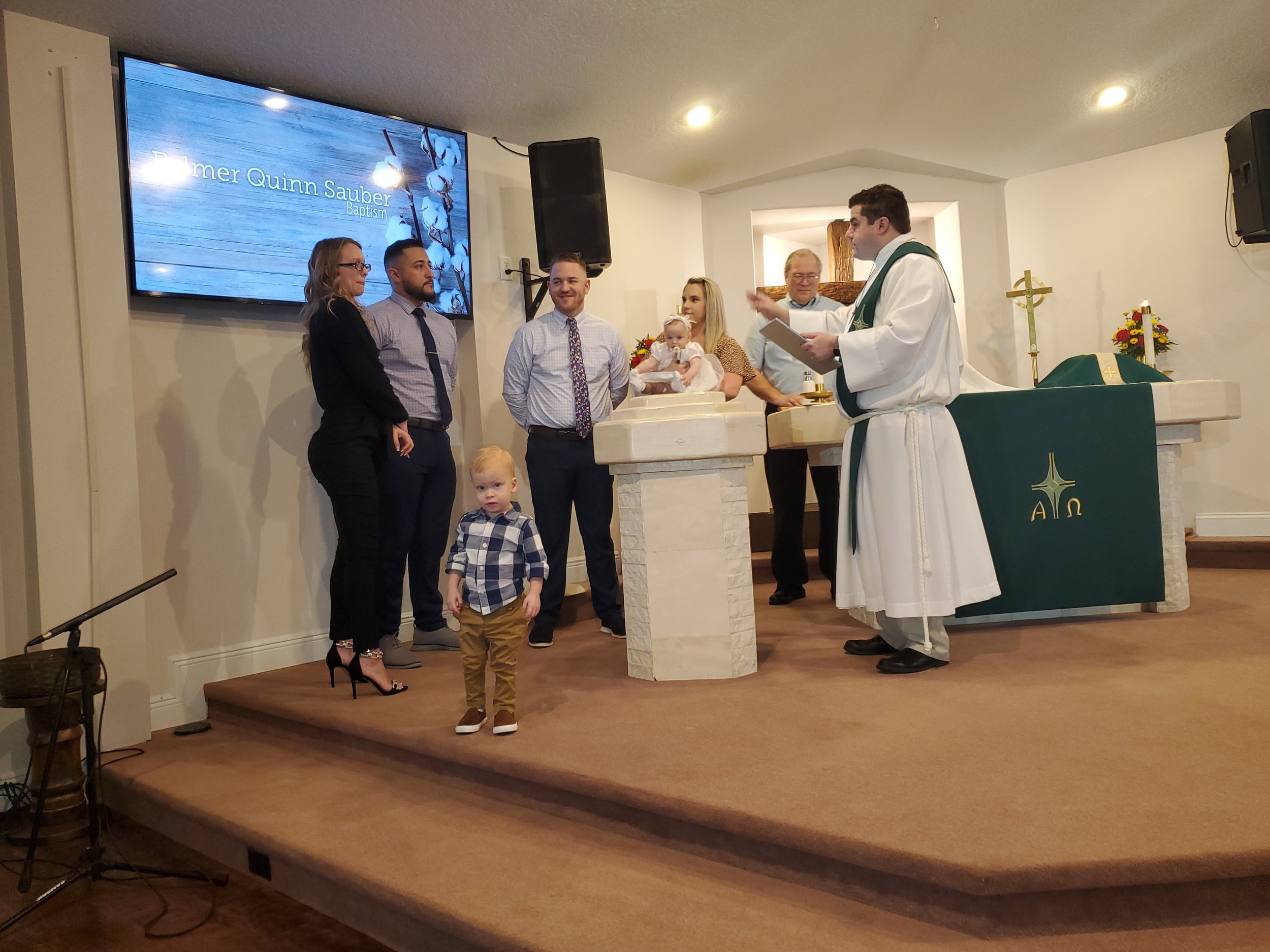


![[Sunday] Christ the King Sunday 2021](https://images.squarespace-cdn.com/content/v1/5852f18a20099e30cd2c01dc/1637337391706-RFGQNEMC1L5ACOOKG6N8/CTK+21a.jpg)
[Sunday] Christ the King Sunday 2021
Just as Christ is “the Alpha and the Omega, the beginning and the end,” at the close of every liturgical year, we look forward with a renewed hope in Christ’s coming again in glory to reign as Lord forever. In the same way, we look forward to our own resurrection and the time of a new earth — an earth that is no longer broken by sin and groaning. Christ will come again in glory just as surely as He came the first time — when He was born. So we have “transition” at the end of the “long green season” into the Advent Season, the new beginning of the liturgical year.

Questions for the week
What does it mean to be a king?
Read John 10:22-30. What did it mean for the disciples to ask if Jesus was the Christ?
Read John 18:33-40. How does Jesus define his kingdom?
How is Jesus different from the kings, political leaders, and rulers of our world? How does Jesus rule in a different way?
When you see problems in the world, what comfort do you get, knowing that Jesus is king?

What Had happened at Grace this week.
John the Baptist comes to our Whoville churches and rains on our Christmas parades.