

![[Sunday] All things Good - 2 Kings 9-10 & Romans 8:28 - Foolish Wisdom](https://images.squarespace-cdn.com/content/v1/5852f18a20099e30cd2c01dc/1782425800701-ZKA0ZIGTYXT03KWDYE7E/FW10a.jpg)
[Sunday] All things Good - 2 Kings 9-10 & Romans 8:28 - Foolish Wisdom
"All things work together for good." What does this famous promise actually mean? God brings true good, not through our overzealous striving, but through the empty tomb.
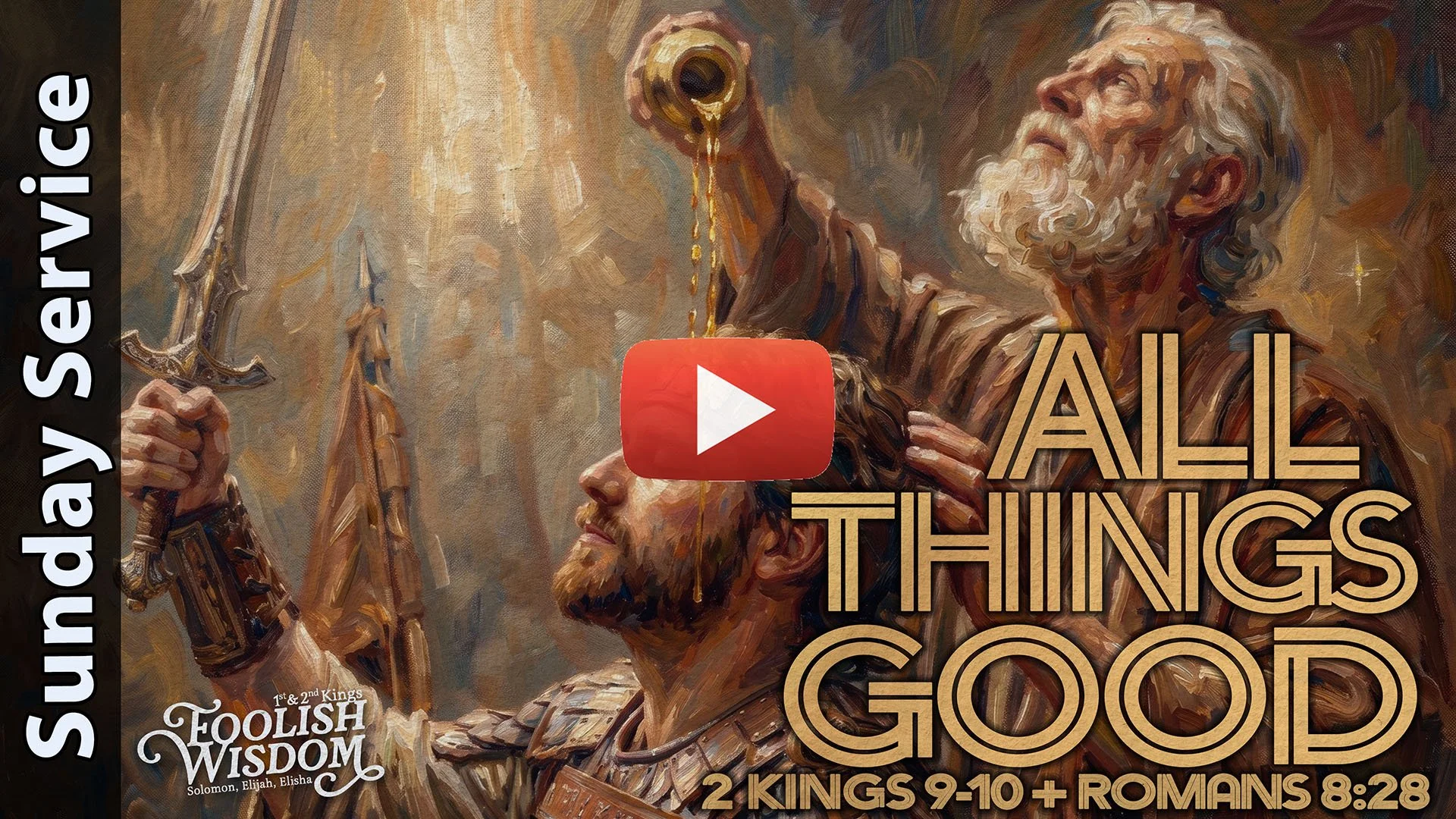
"All things work together for good." What does this famous promise actually mean? God brings true good, not through our overzealous striving, but through the empty tomb.
Questions for the Week: Naaman: All Things Good
Read Romans 8:18-39. We often think Romans 8:28 means "everything will work out good" or "if I do good, God will bless me." How does reading this verse in the context of suffering and human failure change how you understand God's promise?
Read 2 Kings Chapters 9 and 10. Jehu was incredibly proud of his violent zeal for the Lord, but it ended up destroying his own people. Where have you seen "righteous zeal" (in parenting, marriage, or politics) go too far and end up damaging relationships?
When Elisha's servant anointed Jehu, he added his own angry words to God's command, which fueled Jehu's rampage. How much of our own "zealous" action is actually driven by God's Word, and how much is driven by the angry, polarized voices we surround ourselves with?
Our human zeal is so destructive that it literally crucified Jesus. Yet, God used that exact moment of darkness to bring good to you and the world. How does knowing that God can bring life out of our worst messes give you peace in your current struggles?



What Had happened at Grace this week.
![New Members and 10 Anniversary [Photos]](https://images.squarespace-cdn.com/content/v1/5852f18a20099e30cd2c01dc/1792787357308-T1OPOZQZ4TID8CEXQ969/PXL_20261018_144108765.jpg)
![Genesis [Tuesday Bible Study] 10:00am](https://images.squarespace-cdn.com/content/v1/5852f18a20099e30cd2c01dc/a502215c-0fa5-4f83-9cbd-7605b5239368/Bible+Study+2+%2848%29.png)
![[Sunday] The Seed Sprouts - Uproot & Plant - The Book of Jeremiah Ch52](https://images.squarespace-cdn.com/content/v1/5852f18a20099e30cd2c01dc/1792092642677-KD8F9NU9SFMPONI6LCG4/uproot+6a.jpg)
![[Sunday] Treasure In The Pit - Uproot & Plant - The Book of Jeremiah Ch38](https://images.squarespace-cdn.com/content/v1/5852f18a20099e30cd2c01dc/1791510365268-D3ZBJES5THWDRRFX642V/uproot+5a.jpg)
![Grace At The FLGA President’s Equip Conference [Photos]](https://images.squarespace-cdn.com/content/v1/5852f18a20099e30cd2c01dc/1791512993810-VGZR7F6BTGBK49JQXAJP/PXL_20260930_231025258.jpg)
![[Sunday] I Will - Uproot & Plant - The Book of Jeremiah Ch31](https://images.squarespace-cdn.com/content/v1/5852f18a20099e30cd2c01dc/1790717808062-CSTXC8PAW44RX5SEXPHA/uproot+4a.jpg)
![[Sunday] Naaman, The Mighty Leper - 2 Kings 5 - Foolish Wisdom](https://images.squarespace-cdn.com/content/v1/5852f18a20099e30cd2c01dc/1781838581516-H86L5TX0CZW62SNK9OIL/FW9a.jpg)
[Sunday] Naaman, The Mighty Leper - 2 Kings 5 - Foolish Wisdom
Naaman the mighty man of war has leprosy, but his story shows us how human pride expects a show while God brings true healing through the small, ordinary, and unimpressive things.
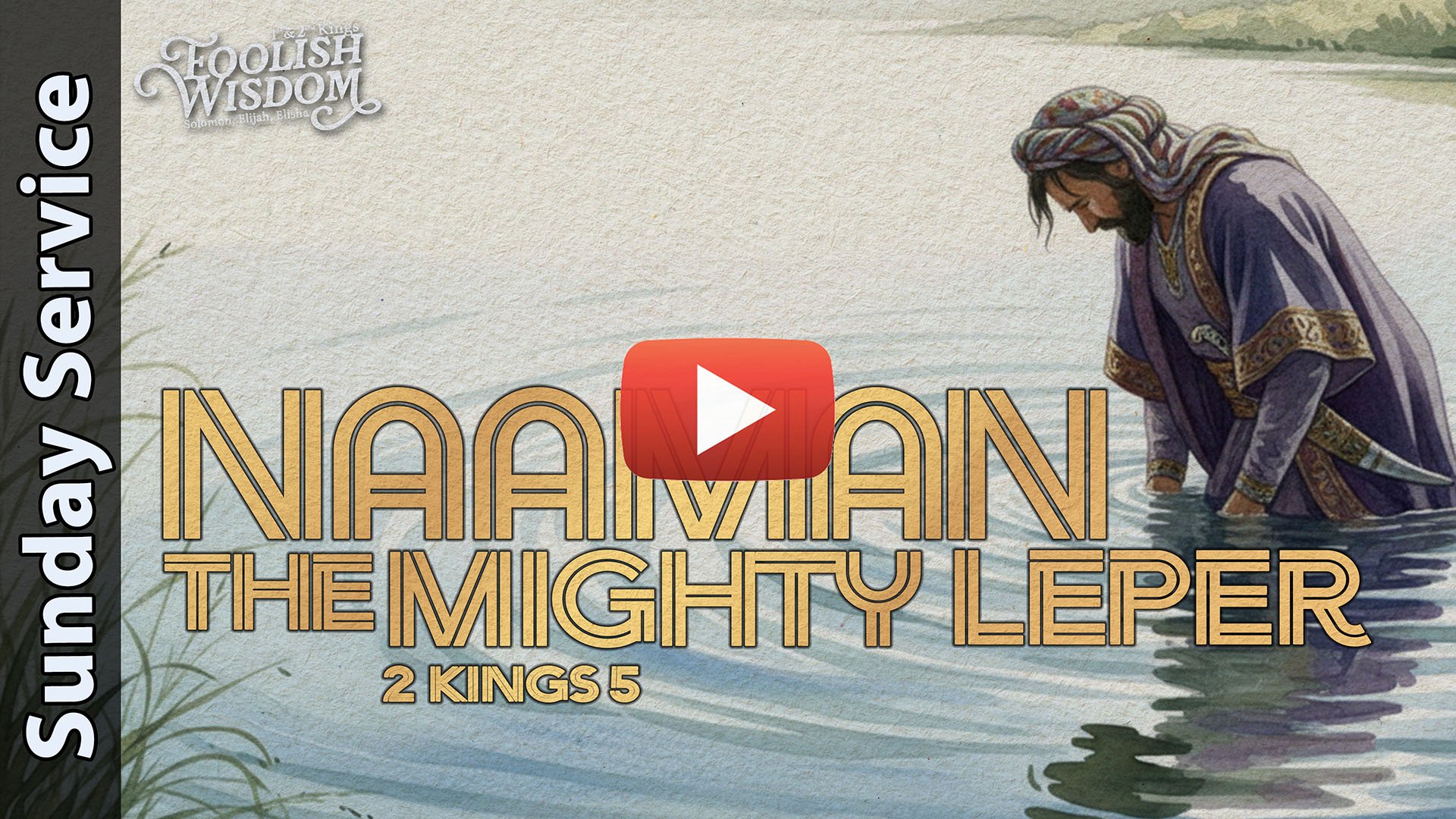
Naaman the mighty man of war has leprosy, but his story shows us how human pride expects a show while God brings true healing through the small, ordinary, and unimpressive things.
Questions for the Week: Naaman: The Mighty Leper.
Describe a time when your ego got in the way of God working.
Read 2 Kings 5:1-19. Naaman scoffed at the Jordan River because it wasn't impressive enough. Why does human pride struggle so much with God using simple, ordinary things (like regular water in baptism or bread and wine) to deliver His grace?
Naaman tried to buy his healing with gold and political letters. Even though we know salvation is free, in what subtle ways do we still try to "pay" God for His blessings?
When Naaman worried about having to work in a pagan environment, Elisha didn't tell him to quit his job or start a culture war; he just said, "Go in peace." How does knowing you are a secure, new creation in Christ’s resurrection free you to calmly love and serve the people in your secular workplace or neighborhood?
What Had happened at Grace this week.
![[Sunday] The Mask of the Maker - Use The Gifts](https://images.squarespace-cdn.com/content/v1/5852f18a20099e30cd2c01dc/1792847374083-D44QVQGSIX2NX9SPDEOF/UTG+1a.jpg)
![[Sunday] The Lord is My Shepherd - Psalm 23 - Foolish Wisdom](https://images.squarespace-cdn.com/content/v1/5852f18a20099e30cd2c01dc/1781221669135-RXD6QONVXVWRHXC34MS0/FW8a.jpg)
[Sunday] The Lord is My Shepherd - Psalm 23 - Foolish Wisdom
A more in depth look at the most popular psalm in the Bible, and also one that you have probably never heard discussed in a sermon.
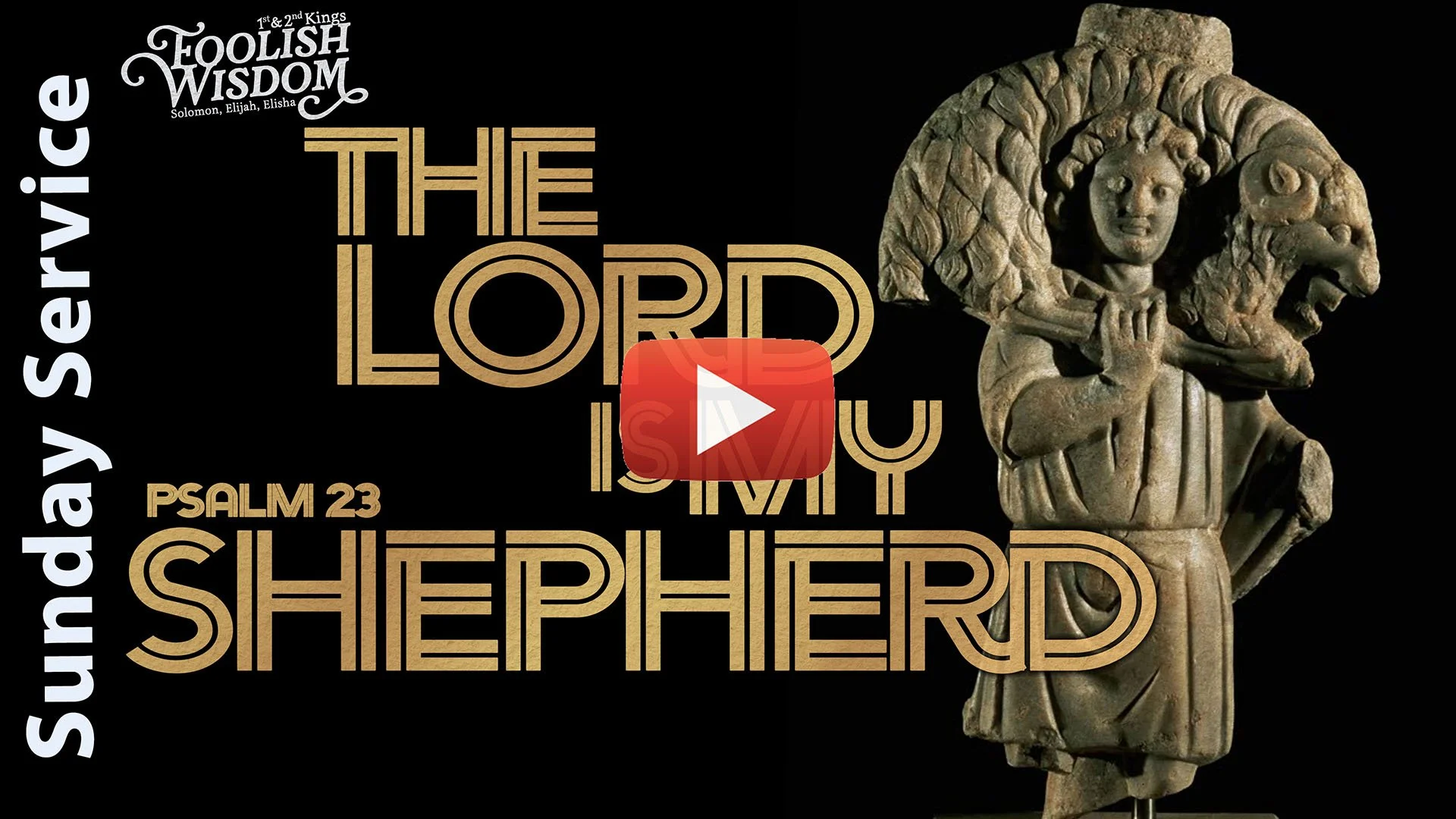
A more in depth look at the most popular psalm in the Bible, and also one that you have probably never heard discussed in a sermon.
What Had happened at Grace this week.
![[Sunday] Through The Water - 2 Kings 2 - Foolish Wisdom](https://images.squarespace-cdn.com/content/v1/5852f18a20099e30cd2c01dc/1780667663134-EX5V86ZA8ERAX8JAYMIS/FW7a.jpg)
[Sunday] Through The Water - 2 Kings 2 - Foolish Wisdom
While the "glory days" of the past are tempting, Elijah passing the mantle to Elisha reminds us to put down our swords and walk forward by His Spirit.
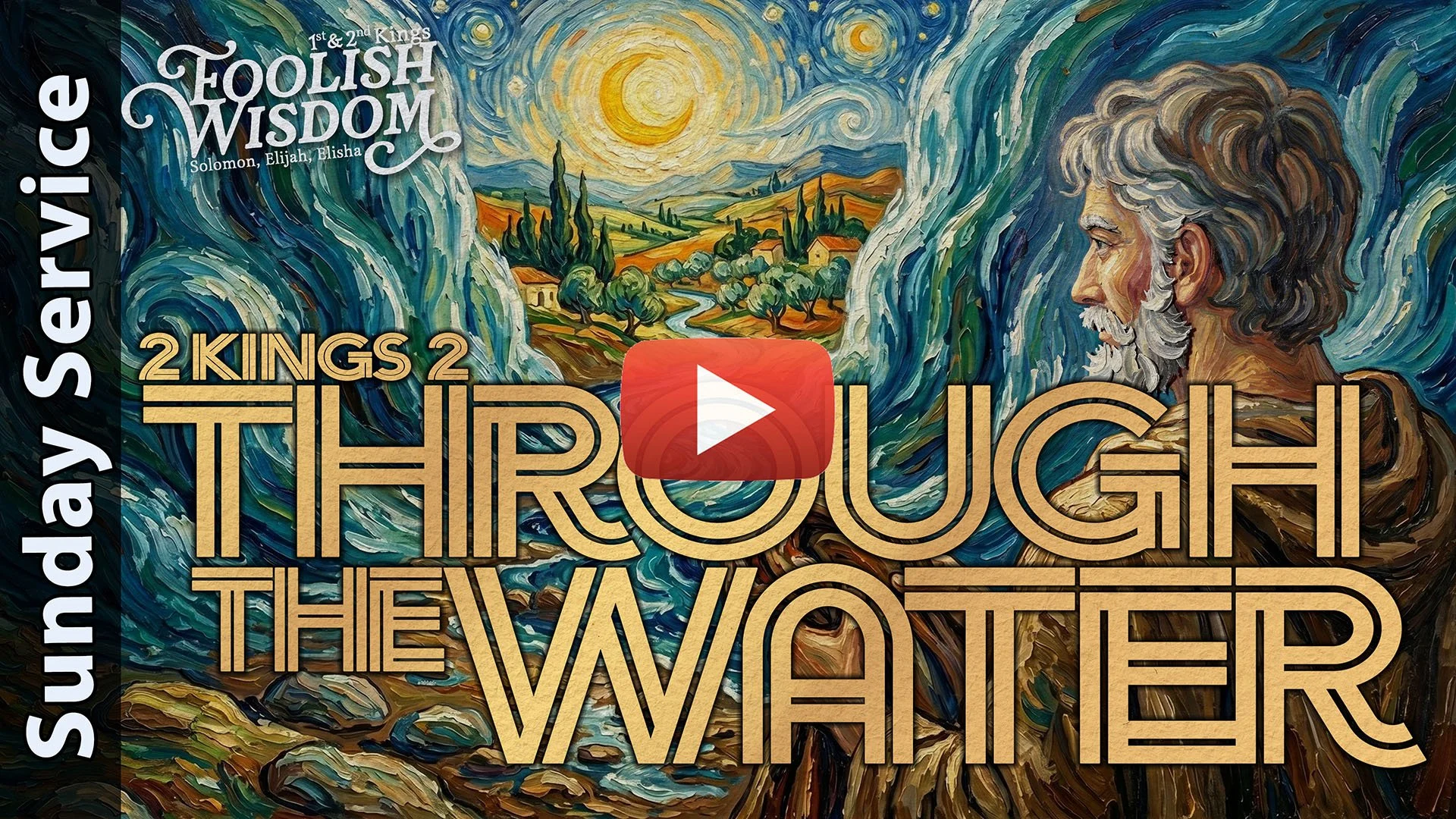
While the "glory days" of the past are tempting, Elijah passing the mantle to Elisha reminds us to put down our swords and walk forward by His Spirit.
What Had happened at Grace this week.
![[Sunday] Why Are You Here - 1 Kings 19 - Foolish Wisdom](https://images.squarespace-cdn.com/content/v1/5852f18a20099e30cd2c01dc/1780022833293-0FAQMDQIQKRA7MFIU3HC/FW6a.jpg)
[Sunday] Why Are You Here - 1 Kings 19 - Foolish Wisdom
Burnout happens when we think it's entirely up to us to fix the world. Elijah flees into the wilderness and discovers how God meets us in our exhaustion, speaking in a still small voice, and freeing us from the pressure of having to do it all.
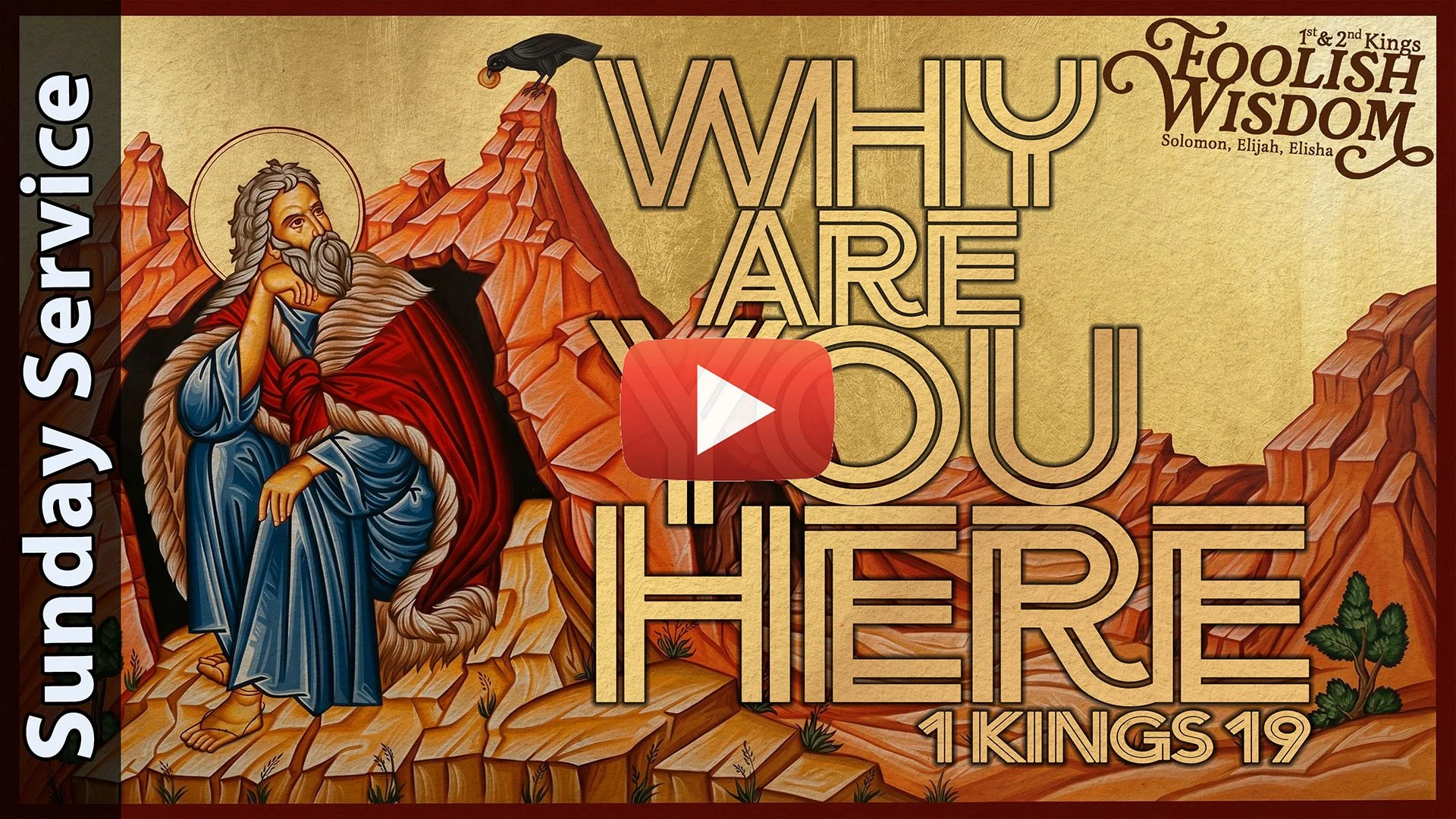
Burnout happens when we think it's entirely up to us to fix the world. Elijah flees into the wilderness and discovers how God meets us in our exhaustion, speaking in a still small voice, and freeing us from the pressure of having to do it all.
What Had happened at Grace this week.
![[Sunday] Battle of Baal Bluff - 1 Kings 18 - Foolish Wisdom](https://images.squarespace-cdn.com/content/v1/5852f18a20099e30cd2c01dc/1779384414021-PFBH69DRFJOGBE0TKDTC/FW5a.jpg)
[Sunday] Battle of Baal Bluff - 1 Kings 18 - Foolish Wisdom
Stop exhausting yourself trying to earn God's favor through frantic human religion, and learn from Mount Carmel what it means to simply trust in what Christ has already bought.
Stop exhausting yourself trying to earn God's favor through frantic human religion, and learn from Mount Carmel what it means to simply trust in what Christ has already bought.
What Had happened at Grace this week.
![[Sunday] Blockbuster - 1 Kings 17 - Foolish Wisdom](https://images.squarespace-cdn.com/content/v1/5852f18a20099e30cd2c01dc/1778782728451-F5ZMPPUUSQ6TLUTWLFCC/FW4a.jpg)
[Sunday] Blockbuster - 1 Kings 17 - Foolish Wisdom
God doesn’t need you to be a blockbuster Christian. The big story of Elijah and the Widow of Zarephath shows we don't need a massive spiritual resume for God to love and rescue us.
-
Overview
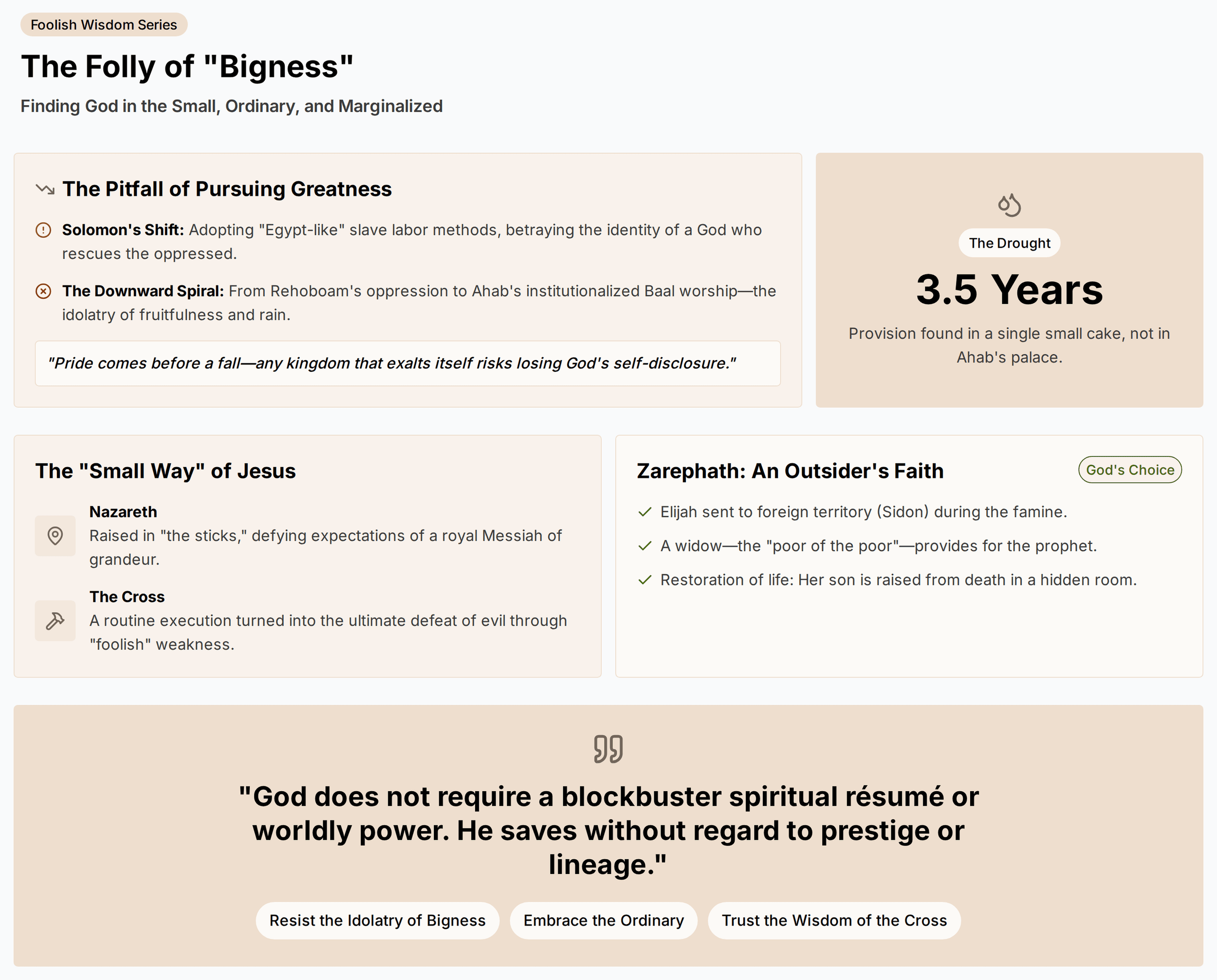
The sermon, part of an ongoing “Foolish Wisdom” series, confronts the widespread human impulse to equate God’s power with “bigness”—grand narratives, worldly prestige, and visible dominance. Through an arc spanning Solomon, the divided kingdom, Ahab and Jezebel, and the episode of Elijah with the widow of Zarephath, the speaker argues that God’s saving work often appears in humble places among outsiders. The message culminates in Jesus’s ministry and the cross, where divine victory arrives through what the world calls weakness. The sermon maintains a strong emphasis on faithfulness to biblical texts, careful preservation of historical details, and a clear call to resist idolatry of power and status in modern life.
The Pitfall of Pursuing Greatness
The sermon situates itself in the “Foolish Wisdom” series, continuing a multi-year trajectory of biblical exploration. About four years ago, the community studied “Rise and Fall” (First and Second Samuel, focusing on King Saul and David). A year later, they examined Judges, noted humorously for having “nothing but cheerful stories.” This year’s focus is First and Second Kings through the lives of Solomon, Elijah, and Elisha.
Solomon’s reign serves as the initial cautionary tale. Although he sought to honor God by building the temple, he adopted methods that mirrored Egypt—using slave labor—thereby betraying the founding identity of Israel’s God, who rescued His people out of Egypt. The speaker stresses that Solomon’s pursuit of ever-greater power marked a departure from God’s self-disclosure and intent, which prioritizes service to those under a king’s authority. The principle “Pride comes before a fall” is applied to Solomon’s trajectory and to any kingdom that exalts itself.
The narrative proceeds to Solomon’s death and the ascent of Rehoboam, who is offered the chance to be a servant king. He refuses, choosing deeper oppression, triggering the split of the kingdom—likened to the social backlash epitomized by the “let them eat cake” moment in the French Revolution. Following the split, the nation endures “nothing but warfare at bad times.” This downward spiral sets the stage for King Ahab, a ruler described in Scripture as doing “more evil than all of the kings before him,” notably through instituting the worship of Baal.
The speaker observes that stories of Elijah (including the widow of Zarephath) function like “blockbuster stories” in the biblical imagination—well-known and grand—yet emphasizes that their true weight lies not in spectacle but in the people through whom God works. Ahab, married to Jezebel of Sidon, aligns Israel with Baal worship. Baal—correctly pronounced “Baal”—was a fertility deity associated with fruitfulness and rain, not the devil as sometimes assumed. Elijah’s announcement that the God of Abraham, Isaac, and Jacob would halt the rain directly confronts Ahab’s reliance on Baal. Against this backdrop of murderous royal power, God’s action begins to reposition the story away from “bigness.”
God’s Counterintuitive Salvation for Outsiders
After Elijah confronts Ahab, God instructs him to hide. Provision comes first through a small brook and ravens delivering food; when the brook dries up, the word of the Lord sends Elijah “at once” to Zarephath in Sidon—Jezebel’s homeland. The speaker notes that a Jewish reader would “clutch their pearls” at this instruction, because Zarephath sits at the heart of foreign, Baal-oriented territory and outside of Israel’s covenant community.
There Elijah meets a widow—the “poor of the poor”—who, amid the drought and famine, has only enough flour and oil to make one small cake for herself and her son before expecting death. Elijah asks for water and bread and declares God’s promise that the flour and oil will not run out. The famine continues, yet her supplies never fail, day after day, by God’s provision.
Tragedy strikes when the widow’s son falls ill and dies. In anguish, she confronts Elijah, asking, “What do you have against me, man of God?”—a phrase the speaker interprets as possibly sarcastic in her grief. Elijah carries the child to his room, prays, and stretches himself upon the boy three times. God hears the prayer: the child breathes again; his life is restored. This miracle—occurring in an outsider’s home, far from Israel’s centers of power—confirms God’s pattern of working where human expectations least anticipate it. The sermon underscores that during the famine God did not turn to Ahab’s palace and power, but to a foreign widow in Jezebel’s town, providing both food and life.
This narrative establishes the sermon's thesis: God does not require anyone to be a “big blockbuster Christian” with a massive spiritual résumé, perfect family, or worldly power. He loves and saves without regard to prestige or lineage. Evil manipulates anxieties and imperfections, tempting people to believe that being part of a “grand story” or the “right family” is necessary for divine notice. The widow’s story refutes that lie.
Jesus’s Affirmation of the “Small Way”
The sermon connects Elijah’s episode to Jesus’s ministry. In the gospel reading, Jesus references the widow of Zarephath while in his hometown (described colloquially as “the sticks”), where familiarity breeds skepticism. He reads from Isaiah: “I’ve come to proclaim liberty to the captives, the recovery of sight to the blind,” identifying himself as the fulfillment—“Today all of this has been fulfilled in your ears.” The hometown crowd, who knew his family and upbringing, struggle with his claim, expecting a Messiah of royal grandeur, triumph, and conspicuous power through the line of David.
Jesus underscores God’s counterintuitive pattern: “There were many widows in Israel during Elijah’s time when the sky was shut… for three and a half years… yet Elijah was not sent to any of them but to the widow in Zarephath”—Jezebel’s region. This statement challenges local expectations, signaling that God’s salvation reaches outsiders and the marginalized rather than confirming human ambitions for civic or national glory. The sermon emphasizes that this moment exposes the crowd’s bias toward “big” messianic acts while Jesus claims the small way—bringing good news in humility, not domination.
Embracing “Foolish Wisdom” in Modern Faith
Applying these truths today, the sermon warns against “worshipping bigness”—substituting money, power, prestige, and greatness for trust in God. The modern idolatry of control promises that if we achieve enough, the drought of the soul will end. Yet this fixation enslaves us to anxieties and imperfections, rendering hidden struggles controlling forces rather than places where grace meets us. God does not save because we belong to the right people group, hail from the right land, or bear an impeccable pedigree. He saves.
The pattern of Jesus’s life displays this truth. He enters the world through humble circumstances—born to a young woman under social suspicion, announced among shepherds (outcasts at that time), raised in Nazareth (“the stick”). When the time came to save, he did not summon a grand army; he allowed himself to be stripped, beaten, and nailed to wood. For Rome, the cross functioned like the guillotine of the French Revolution—an instrument of routine execution, a small, ignominious end for “getting rid of somebody.” In the “foolish” smallness of the cross, God crushed the head of Satan, defeated evil, paid the price for everyone, and brought people from death to life—echoing the resurrection of the widow’s son.
The sermon invites believers to discern God’s glory in the ordinary—a grass blade, even unwanted weeds among flowers—the Creator bringing unexpected life where we assumed only death. It urges the community to renounce the search for worldly greatness and serve the people God saves, near and far, through humble means that reflect the wisdom of the cross.
God doesn’t need you to be a blockbuster Christian. The big story of Elijah and the Widow of Zarephath shows we don't need a massive spiritual resume for God to love and rescue us.

What Had happened at Grace this week.
![[Sunday] Rey and Jerry 1 Kings 11-13 - Foolish Wisdom](https://images.squarespace-cdn.com/content/v1/5852f18a20099e30cd2c01dc/1778183687256-MPOFXGYMB60MTLI79AU0/FW3a.jpg)
[Sunday] Rey and Jerry 1 Kings 11-13 - Foolish Wisdom
When the kingdom splits, Kings Rehoboam and Jeroboam desperately grasp for power and control, but God uses Elijah, a nobody from the sticks, to show us that true freedom comes not from controlling our circumstances but from trusting the King who went to the cross for us.
When the kingdom splits, Kings Rehoboam and Jeroboam desperately grasp for power and control, but God uses Elijah, a nobody from the sticks, to show us that true freedom comes not from controlling our circumstances but from trusting the King who went to the cross for us.
What Had happened at Grace this week.
![[Sunday] Loud Lips & Far Hearts - Foolish Wisdom](https://images.squarespace-cdn.com/content/v1/5852f18a20099e30cd2c01dc/1777585193440-H27BJHBXN2C272DK4Q5Z/FW2a.jpg)
[Sunday] Loud Lips & Far Hearts - Foolish Wisdom
We look at Solomon's tragic fall into pride and power, reminding us that true wisdom isn't found in building our own empires, but in the self-emptying love of Jesus.
-
Series Context
Sermon series: “Foolish Wisdom,” walking through First and Second Kings by focusing on Solomon, Elijah, and Elisha.
Narrative arc:
Solomon: precipitates the kingdom’s downfall.
Elijah: ministers as the kingdom collapses.
Elisha: serves among the ashes after the fall.
Aim: To expose “foolish wisdom”—the contrast between human displays of power and God’s way of humble service.
Opening Illustration: LCMS History and Power
LCMS congregational identity noted; origin story used as a parallel to Solomon’s trajectory.
Martin Stephan:
Charismatic leader in Germany amid 19th-century nationalization.
Organized migration to America in 1838 on five ships; declared himself bishop en route.
Settled in St. Louis, then directed many settlers to Perry County, MO, to maintain control.
Reports of exploitation emerged—“honoring with lips while heart is far”—used as a modern example of the temptation to power.
Theme introduced: When leaders seek control, honor God outwardly but their hearts drift toward self-glory and domination.
Main Texts and Biblical Context
Focus: Solomon’s fall as the pattern of choosing empire power over covenant faithfulness.
1. Solomon’s Forced Labor
Scripture: First Kings 9:14 (NIV paraphrase noted)
“Here is the account of the forced labor Solomon conscripted to build the Lord’s temple…”
Context and emphasis:
“Forced labor” exposes slavery-like practices reminiscent of Egypt.
God’s identity statement to Israel: “I am the God who brought you out of Egypt”—don’t return to Egypt’s ways.
The author subtly critiques Solomon’s “Egypt-like” rule even while praising his grandeur.
2. Solomon’s Wealth and Throne
Scripture: First Kings 10:14
“The weight of the gold that Solomon received yearly was six hundred and sixty-six talents…”
Number significance:
“6” symbolizes incompleteness; “666” evokes anti-God patterns of power (cf. Revelation).
Scripture: First Kings 10:18–20
Solomon’s throne: ivory and gold, six steps, twelve lions—hyperbolic claims of unmatched greatness.
Historical illustration:
King Tut’s throne (c. 300 years earlier) shows Solomon is emulating Egyptian grandeur; the “nothing like it” boast mirrors despot rhetoric.
Scripture: First Kings 10:27–29
“Silver as common as stones… Solomon’s horses were imported from Egypt… chariots from Egypt for six hundred shekels…”
Application:
The repeated “Egypt” connection highlights Solomon’s desire to be Pharaoh—a pursuit of power antithetical to God’s covenant call.
3. Solomon’s Loves and Idolatry
Scripture: First Kings 11:1–2
“King Solomon… loved many foreign women… [from nations] about which the Lord told the Israelites ‘You must not intermarry with them, because they will surely turn your hearts after their gods.’”
Correction of common misreading:
The sermon challenges the tendency to blame the women.
Deeper cause: Solomon’s heart already set on empire power—wives were a symptom, not the core problem.
Pastoral application:
We scapegoat “weak” or obvious targets to avoid confronting our own worship of power.
Lip-service to God can mask a heart enthralled by glory, dominance, and self-justification.
4. God’s Judgment on Solomon
Scripture: First Kings 11:9–11
“The Lord became angry with Solomon because his heart had turned away… ‘Since this is your attitude… I will most certainly tear the kingdom away from you and give it to one of your subordinates.’”
Theological point:
God judges covenant unfaithfulness, especially when leaders reinstate bondage God already broke.
Solomon’s attempt to be Pharaoh leads to loss—God resists proud rulers and defends the oppressed.
LCMS Case Study Continued: Accountability over Personality
St. Louis pastors feared confronting Stephan; chose the youngest pastor, C. F. W. Walther, to investigate.
Walther:
Rode to Perry County, verified abuses.
Removed Stephan, sent him across the Mississippi.
Established lasting accountability: “No bishops”; authority in the Word and local congregations; pastors accountable to congregation and district president.
Became first LCMS president, seminary professor, and championed “sola deo gloria” (Glory to God alone).
Fruit of humble leadership:
LCMS helped found a historically Black university during Reconstruction to uplift those oppressed by “pharaohs.”
Note of lament: the university closed five years ago; a call to recover mission focus.
Jesus: The Greater-than-Solomon Way
Scripture: Matthew 12 (Queen of the South/Sheba and judgment)
“The queen of the south… will rise at the judgment… for she came from the ends of the earth to listen to all of Solomon’s wisdom; and now one greater than Solomon is here.”
Interpretation:
Jesus contrasts with Solomon’s power model.
Pharisees with long robes and devouring of widows exemplify self-glorification; Jesus confronts them.
Temptation narrative:
The devil offered Jesus “all power, gold, wisdom, greatness”; Jesus refused, embracing humility.
Pastoral assurance:
If salvation were based on our daily performance, we’d be lost.
Jesus “went to the bottom”—His cross and self-emptying place salvation under us, sustaining us amid doubt and failure.
Christ’s Humble Exaltation
Scripture: Philippians 2:5–11 (paraphrased in sermon)
Jesus emptied Himself, became a servant unto death on a cross; therefore God exalted Him, so every knee bows and every tongue confesses Jesus Christ is Lord—to the glory of God the Father.
Revelation image:
In the throne room, John hears glory and power—but when he looks, he sees “a Lamb that is slain.”
God’s throne is the crucified Lamb—power expressed as sacrificial love so God is never out of our grasp.
Who God Is, Who You Are, and How to Live
Who God is:
The Redeemer who brings His people out of Egypt; He opposes oppressive power and judges idolatry.
He exalts the humble Christ, whose throne is the slain Lamb—power as self-giving love.
Who God says you are:
Beloved, upheld by Christ’s salvation “underneath” you; not defined by performance but by grace.
Called away from empire-seeking identity to servant-hearted, covenant faithfulness.
How to live:
Renounce pursuits of power and self-glory; embrace accountability and humble service.
Guard against honoring God with lips while hearts chase influence and status.
Refuse scapegoating; examine the heart’s idols—especially the idol of power.
Live “sola deo gloria”—direct all glory to God alone; organize church life around the Word, communal accountability, and care for the marginalized.
Application and Examples
Biblical application:
Resist building “Egypt” in our homes, churches, and institutions: avoid systems that exploit or dehumanize.
Read First and Second Kings with an eye for the authors’ “truth bombs”—praise of grandeur paired with subtle critiques.
LCMS application:
Build structures that check charismatic personality power.
Recover missional commitments to uplift those historically oppressed.
Personal spiritual practice:
Regularly ask: Are my fruits revealing a heart seeking power?
In seasons of doubt and failure, remember Christ’s salvation is beneath you, ready to lift you.
Pursue servant leadership; seek accountability; give glory to God alone.
Key Points
God rescued Israel from Egypt so His people would not imitate empire power; Solomon tragically re-imported “Egypt” through slavery, wealth, and military alliances.
Blaming “foreign wives” misses the deeper issue: Solomon’s heart loved power and self-glory, turning from God.
God resists proud rulers and tears down oppressive structures; He calls His people to humble accountability.
Jesus is greater than Solomon: He rejected worldly power, embraced the cross, and reigns as the slain Lamb—God’s true throne of love.
Our identity and endurance rest in Christ’s self-emptying grace, not in our performance; therefore, we live “sola deo gloria,” serving rather than dominating.
Scriptures Referenced
First Kings 9:14
First Kings 10:14, 18–20, 27–29
First Kings 11:1–2, 9–11
Matthew 12 (Queen of the South/Sheba and judgment)
Philippians 2:5–11
Revelation (Lamb that is slain in the throne room)
Closing Exhortation
Pursuits of power are frivolous; Christ alone brings you near.
Embrace “foolish wisdom”: humble service, accountability, and glory to God alone.
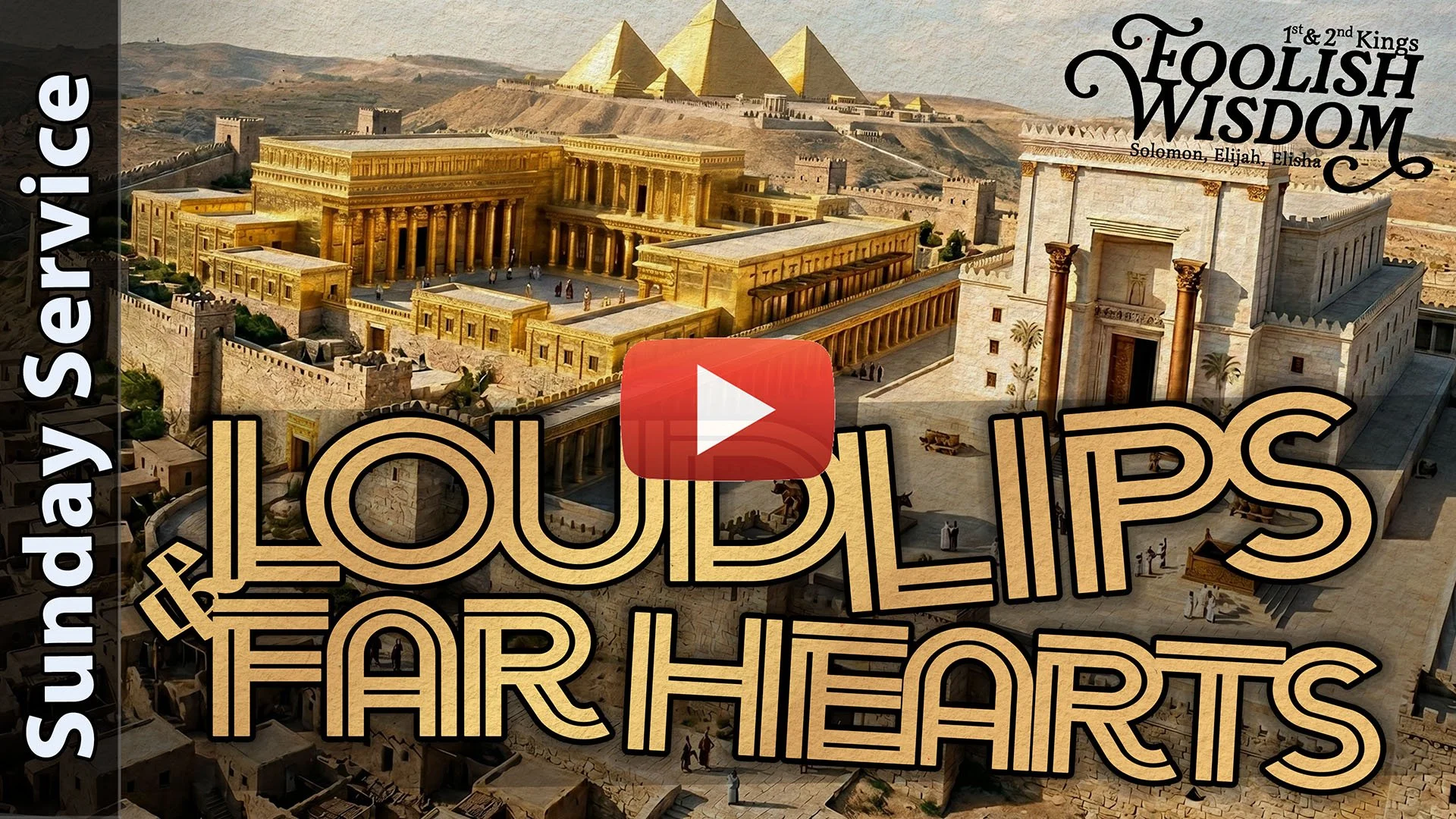
We look at Solomon's tragic fall into pride and power, reminding us that true wisdom isn't found in building our own empires, but in the self-emptying love of Jesus.
What Had happened at Grace this week.
![[Sunday] Temple Traps - Foolish Wisdom](https://images.squarespace-cdn.com/content/v1/5852f18a20099e30cd2c01dc/1777044373355-XL9DK44J8X46BSP6Z03N/FW1a.jpg)
[Sunday] Temple Traps - Foolish Wisdom
It’s easy to get distracted by building grand things, forgetting that God's true work is simply rescuing broken people right where they are.
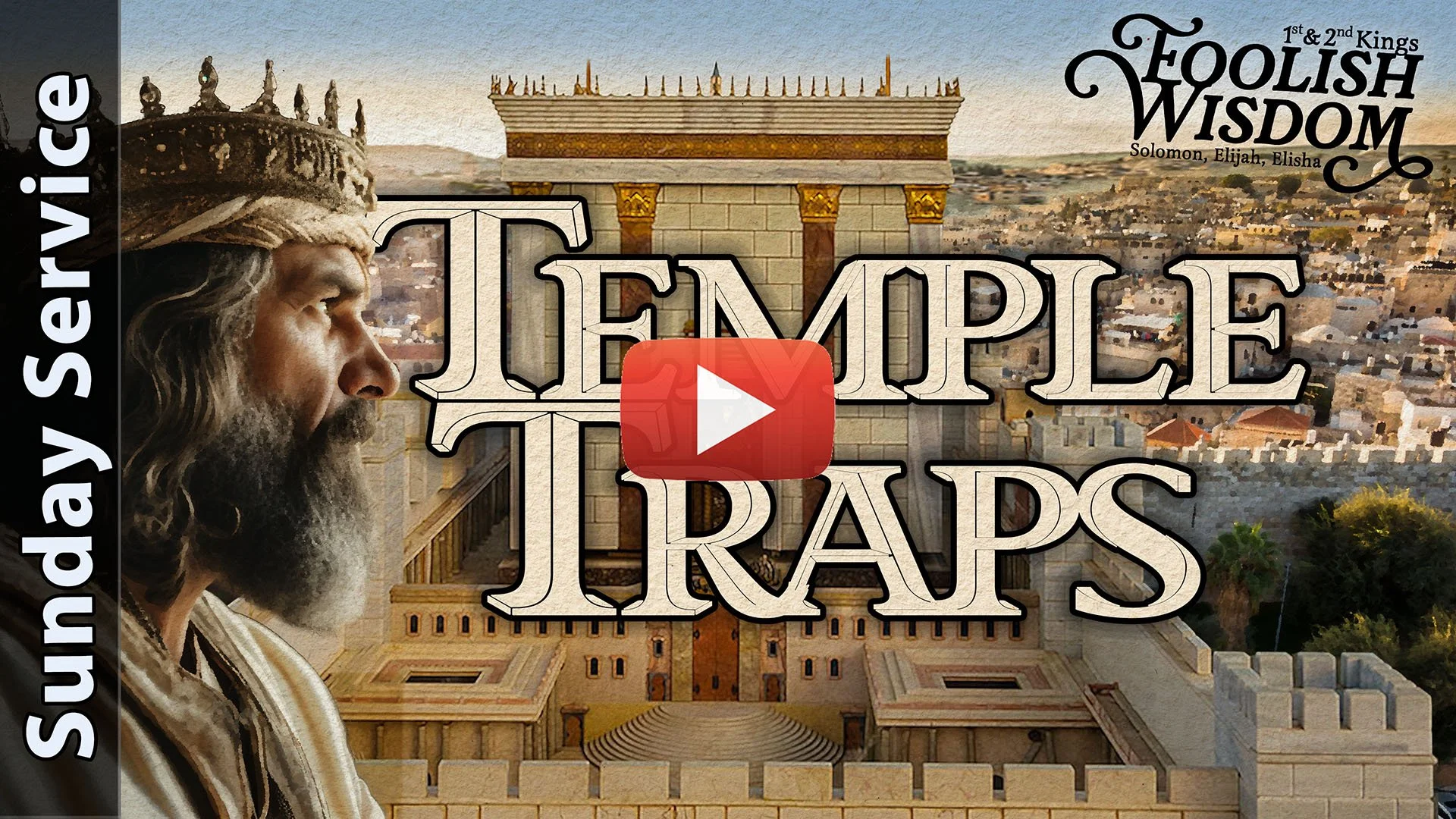
It’s easy to get distracted by building grand things, forgetting that God's true work is simply rescuing broken people right where they are.
What Had happened at Grace this week.
Foolish Wisdom | Teaching Series
Exploring the stories of Solomon, Elijah, and Elisha in 1st and 2nd Kings, our new "Foolish Wisdom" series reveals that God's truest wisdom is found not in human achievements but in rescuing everyday people right where they are.
Exploring the stories of Solomon, Elijah, and Elisha in 1st and 2nd Kings, our new "Foolish Wisdom" series reveals that God's truest wisdom is found not in human achievements but in rescuing everyday people right where they are.
Reading Plan
Read around the readings for Sunday
2/14/26/26 - Soloman and the Temple
1 Kings 8:12-21
1 Kings 9:1-9
Mark 13:1-10
5/3/26 - Soloman's Downfal
1 Kings 11:1-10
Romans 5:12-19
Mark 12:38-44
5/10/26 - Drought/Fed by Ravens-- Jeroboam and Rehoboam 1 Kings 11-15
1 Kings 17:1-7
1 Corinthains 10:1-13
Matthew 4:1-11
5/17/26 - Widow of Zarepath Call to repentance Evil Ahab
1 Kings 17:8-24
Galatians 3:6-9
Luke 4:16-26
5/24/26 - Mt Carmel and showdown with Prophets of Baal
1 Kings 18:20-39
Galatians 1:6-10
Luke 7:1-10
5/31/26 - Elijah flees running from Jezebel
1 Kings 19:2-3, 9-18
Romans 10:5-15
Matthew 14:22-33
6/7/26 - Elisha takes over as Elijah goes to heaven
2 Kings 2:1-15
2 Corinthians 4:3-6
Mark 9:2-9
6/14/26 - Naaman
2 Kings 5:1-14
2 Timothy 2:8-15
Luke 17:11-19
6/21/26 - Elisha annoints Jehu, yet Jehu still does Evil
(2 Kings 9-10)2 Kings 9:1-7
Romans 7:14-20
Matthew 11:1-19
The shoes you put on every day when you work or shop are actually a mask of God, they are the very way He walks into the world to provide for His creation.