
Mark Chapter 6 Class 10 - Wednesday Bible Study
Gospel of Mark Chapter 6
This is our 10th class on Mark
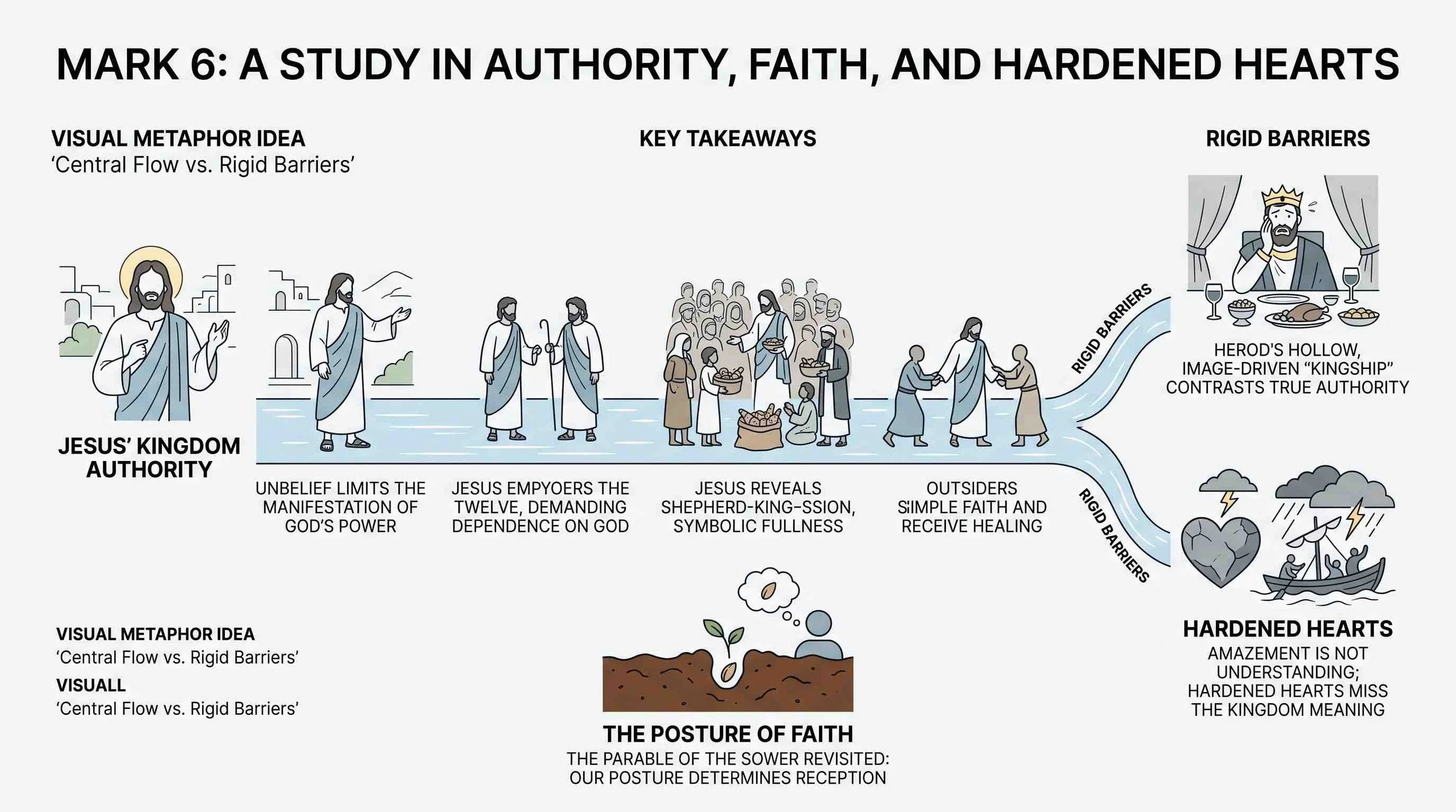
This is an AI Recap of the class.
Some things may be incorrect.
Short Summary of the Whole Class
On August 19, 2026, we explored Mark 6 in a unified arc: starting with Jesus’ rejection in his hometown and his commissioning of the Twelve, then examining Herod’s corrupt “kingship” in John the Baptist’s beheading. We moved to Jesus’ compassionate provision in the wilderness feeding, his revelation of authority over nature by walking on water, and the inclusive healings in Gennesaret. Along the way, we reflected on faith versus unbelief, dependence on God, hardened hearts, and how Mark weaves theological meaning through narrative symbols and structure.
Section-by-Section Class Walkthrough
1) Class Introduction, Technology, and Mark 5 Recap
Discussion:
We opened by reviewing a new AI-powered recording/transcription tool (“Pod”) that captures audio, provides transcripts, speaker recognition, and auto-summaries—helpful for organizing class content.
Brief recap of Mark 5 set the stage: the Gerasene demoniac (Legion), the woman with the issue of blood, and Jairus’s daughter.
Scriptures mentioned:
Mark 5 (recap: 5:1–20; 5:25–34; 5:35–43)
Stories mentioned:
Legion delivered from demons.
The woman healed by touching Jesus’ garment.
Jairus’s daughter raised.
Short Summary of Section:
On August 19, 2026, we introduced our class tech tool and refreshed key miracles from Mark 5 to frame the transition into Mark 6.
2) Jesus Rejected in His Hometown (Mark 6:1–6)
Discussion:
Jesus teaches in Nazareth; familiarity breeds contempt as townspeople identify him as the local carpenter, leading to offense and unbelief.
Jesus’ saying: “A prophet is not without honor except in his own town…” (Mark 6:4).
Consequence of unbelief: Jesus “could not do any miracles there” beyond a few healings (Mark 6:5–6), contrasting with faith-driven healings in earlier stories.
Analogy: like the movie “Elf,” where belief fuels power—used humorously to illustrate faith’s role.
Scriptures mentioned:
Mark 6:1–6
Stories mentioned:
Jesus teaching in the Nazareth synagogue and being rejected.
Short Summary of Section:
Nazareth’s familiarity led to unbelief that hindered mighty works, highlighting how lack of faith can limit the manifestation of God’s power.
3) Jesus Sends Out the Twelve (Mark 6:7–13)
Discussion:
Jesus commissions the Twelve two by two, granting authority over unclean spirits.
Instructions emphasize radical dependence: take only a staff, no bag, bread, money, or extra tunic; stay in one house per town.
If rejected, shake dust from their feet as prophetic testimony—equating rejecting towns with unclean Gentile lands.
Symbolism noted: number twelve linked to Israel’s tribes; parallels to Exodus readiness (sandals on), nomadic prophets, and trusting God for daily bread.
Dependence and mission as a response to Jesus’ own rejection.
Scriptures mentioned:
Mark 6:7–13
Matthew 18:20 (referenced regarding “two or three gathered”)
Stories mentioned:
The sending and ministry of the Twelve: preaching repentance, casting out demons, healing by anointing with oil.
Short Summary of Section:
Jesus multiplies his ministry after rejection by empowering the Twelve to go in pairs, travel light, depend on God, and render judgment where the message is refused.
4) Herod’s Image-Driven Power and the Beheading of John (Mark 6:14–29)
Discussion:
Herod hears about Jesus and fears he is John raised; Mark uses a flashback to recount John’s death.
John condemned Herod’s unlawful marriage; Herod feared and liked listening to John but capitulated to a rash oath after a dance, ordering John’s beheading to save face.
Contrast between Herod’s hollow, prideful “kingship” and Jesus’ true authority.
Literary note: Mark employs non-chronological storytelling for thematic emphasis; anticipates later “Who do people say I am?” in Mark 8.
Scriptures mentioned:
Mark 6:14–29
Stories mentioned:
Herod’s banquet and John the Baptist’s beheading.
Short Summary of Section:
Mark contrasts Herod’s corrupt, image-obsessed power that kills a prophet with Jesus’ humble, faith-rooted kingdom authority.
5) Feeding the Five Thousand: Wilderness, Shepherd, and Sacrament Echoes (Mark 6:30–44)
Discussion:
Setting in a “deserted place” evokes wilderness provision; Jesus sees people as “sheep without a shepherd,” revealing true kingly compassion.
“You give them something to eat” tests disciples’ trust after their mission with minimal supplies.
Pattern: Jesus looks to heaven, blesses, breaks, and gives—echoes of Eucharistic language and the Last Supper.
Outcomes and symbolism: all are satisfied; twelve baskets remain (Israel’s fullness); five loaves and two fish (seven as completeness), and “five thousand” linked to the Pentateuch; anticipates feeding of the four thousand (Gentile inclusion).
Background contrasts with Israel’s failed shepherds (1–2 Kings).
Scriptures mentioned:
Mark 6:30–44
1–2 Kings (thematic background)
Stories mentioned:
Feeding of the five thousand.
Short Summary of Section:
In the wilderness, Jesus acts as the true shepherd-king, organizing, blessing, and feeding the people, with rich sacramental and symbolic resonances pointing to Israel’s fulfillment.
6) Walking on Water, Hardened Hearts, and Not Understanding the Loaves (Mark 6:45–52)
Discussion:
Jesus prays on the mountain; walks on the sea to aid disciples straining at the oars; calms the wind.
Disciples are terrified and amazed, but Mark diagnoses the core issue: they did not understand the loaves; their hearts were hardened.
Connections to Exodus: Pharaoh’s hard heart; earlier storm-stilling (Mark 4:35–41).
Insight: amazement isn’t the same as understanding; the disciples wrestle with power and status, missing the kingdom meaning of provision.
Scriptures mentioned:
Mark 6:45–52
Mark 4:35–41 (allusion)
Exodus themes (Pharaoh’s hardness; thematic)
Stories mentioned:
Jesus walking on water and calming the wind.
Short Summary of Section:
Despite witnessing provision and authority, the disciples’ hardened hearts keep them from grasping the significance of the loaves and Jesus’ identity.
7) Healings in Gennesaret: Gentile Faith and Simple Touch (Mark 6:53–56)
Discussion:
In Gennesaret, people recognize Jesus immediately, bring the sick, and seek to touch even the fringe of his garment.
Echoes the woman with the flow of blood; widespread healings show outsiders’ simple, effective faith.
Link to the Gerasene demoniac who spread news in the region.
Scriptures mentioned:
Mark 6:53–56
Mark 5:1–20 (Legion; referenced)
Mark 5:25–34 (woman healed; referenced)
Stories mentioned:
Widespread healings by touching Jesus’ garment.
The Gerasene demoniac’s testimony influence.
Short Summary of Section:
Outsiders respond with straightforward faith—touching Jesus’ garment—and are healed, revealing the inclusive reach of the true King’s compassion.
8) Seeds and Soil: Our Posture Toward Jesus’ Word
Discussion:
Revisited the Parable of the Sower: Are we the seed or the soil? What posture do we bring to Jesus’ word?
Mark’s literary artistry: theology conveyed through narrative symbols (wilderness, mountains, bread, numbers) rather than mere chronology.
Jesus repeatedly transforms “lost causes,” yet faces rejection—echoing Israel’s pattern with prophets.
Scriptures mentioned:
Mark 4:1–20 (Parable of the Sower)
Stories mentioned:
Parable of the Sower reflection applied to discipleship posture.
Short Summary of Section:
We examined whether our lives are receptive soil, recognizing how Mark’s narrative challenges readers to receive the kingdom with faith and humility.
Medium-Length Summary of the Class
On August 19, 2026, our study journeyed through Mark 6’s cohesive narrative that contrasts unbelief and hollow power with Jesus’ shepherd-king authority. Beginning in Nazareth, we saw how familiarity produced unbelief that constrained mighty works. Jesus responded by sending the Twelve with minimal provisions, teaching dependence on God and signaling judgment on rejection. Mark’s flashback to Herod’s banquet exposed image-driven, fearful power that murdered John, sharpening the contrast with Jesus’ kingdom. In the wilderness, Jesus fed the five thousand with sacramental echoes, satisfying Israel symbolically and revealing true compassion. Yet when he walked on water and stilled the wind, the disciples’ hardened hearts showed they hadn’t understood the loaves. In Gennesaret, outsiders’ simple faith brought widespread healings through touch, echoing earlier testimonies. We closed by revisiting the Parable of the Sower, asking whether we are receptive soil for the kingdom’s seeds. Taken together, Mark crafts a theological tapestry in which Jesus, the true King, nourishes, delivers, and heals, while human leaders and even disciples often miss the heart of God’s kingdom.
Main Points
Familiarity can breed contempt, becoming a barrier to faith (Nazareth’s rejection).
Unbelief limits the manifestation of God’s power.
Jesus responds to rejection by multiplying his mission, empowering the Twelve.
The disciples’ mission embodies radical dependence on God and includes prophetic judgment on rejection.
Herod’s image-driven “kingship” contrasts with Jesus’ true, compassionate authority.
The feeding of the five thousand reveals shepherd-king compassion, Eucharistic echoes, and symbolic fullness for Israel.
Amazement is not understanding; the disciples’ hardened hearts show failure to grasp the meaning of the loaves.
Jesus’ authority over creation (walking on water, calming wind) reveals identity, yet the call is to faith and understanding.
Outsiders demonstrate simple, trusting faith and receive healing; the kingdom’s reach is inclusive.
Mark weaves theology through narrative symbols and structure (wilderness, mountains, bread, numbers).
The Parable of the Sower challenges our posture: are we receptive soil?
Scriptures Mentioned
Mark 5:1–20 (Gerasa/Gerasene demoniac—Legion; recap/reference)
Mark 5:25–34 (Woman healed by touching Jesus’ garment; recap/reference)
Mark 5:35–43 (Jairus’s daughter raised; recap/reference)
Mark 6:1–6 (Jesus rejected in Nazareth)
Mark 6:7–13 (Sending of the Twelve; instructions; anointing with oil)
Mark 6:14–29 (Herod’s banquet and the beheading of John the Baptist; flashback)
Mark 6:30–44 (Feeding of the five thousand)
Mark 6:45–52 (Jesus walks on water; hardened hearts; not understanding the loaves)
Mark 6:53–56 (Healings in Gennesaret; touching the fringe)
Mark 4:1–20 (Parable of the Sower; revisited)
Mark 4:35–41 (Jesus stills the storm; alluded to)
Matthew 18:20 (Referenced regarding “two or three gathered…”)
Exodus themes (Pharaoh’s hardened heart; thematic connection)
1–2 Kings (failed shepherd-kings; thematic background)
Stories Discussed
Jesus teaching in Nazareth and being rejected.
The sending and ministry of the Twelve.
Herod’s banquet and the beheading of John the Baptist.
Feeding of the five thousand in the wilderness.
Jesus walking on water and calming the wind.
Widespread healings in Gennesaret through touching Jesus’ garment.
The Gerasene demoniac (Legion) spreading news in the region.
The woman healed by touching Jesus’ garment.
Jairus’s daughter raised.
Parable of the Sower and our posture as seed/soil.