
Mark Chapter 5 Class 9 - Wednesday Bible Study
Gospel of Mark Chapter 5
This is our 9th class on Mark
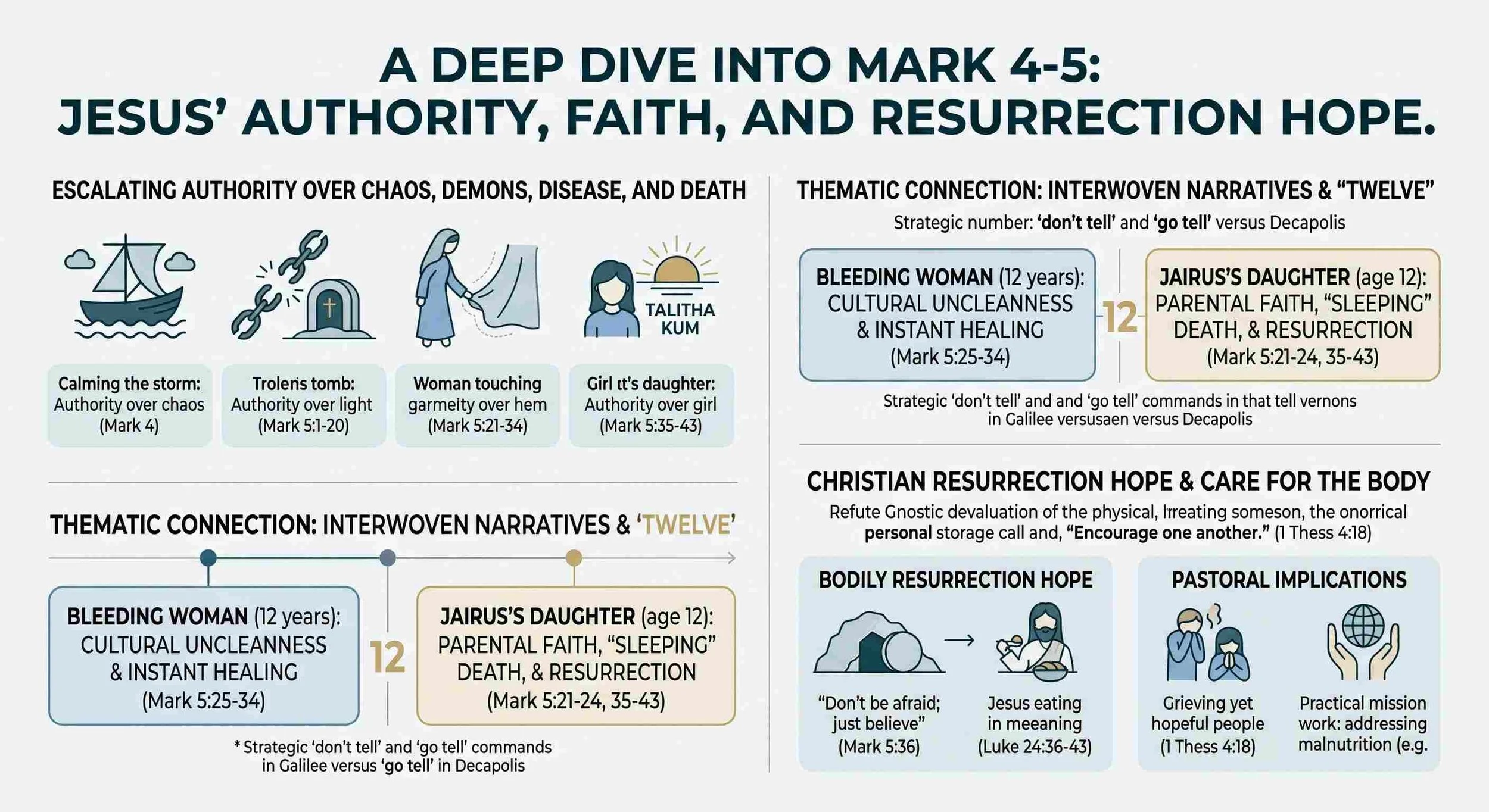
This is an AI Recap of the class.
Some things may be incorrect.
Short Summary of the Whole Class
On August 12, 2026, we studied Mark 5 (framed by Mark 4) and traced Jesus’ escalating authority: calming chaos, casting out a legion of demons, healing a woman with a 12-year hemorrhage, and raising Jairus’s 12-year-old daughter. We discussed faith over fear, Jesus’ tender compassion (calling the woman “Daughter” and telling the girl’s family to feed her), cultural contexts (uncleanness and professional mourners), and why Jesus sometimes commands silence. The class connected these narratives to Christian hope of bodily resurrection and rejected Gnostic tendencies that demean the physical, while offering pastoral reflections on grief and mission.
Section-by-Section Summary with End Notes
1) Intro, Setup, and Narrative Flow from Mark 4 into Mark 5
We settled in (tech checks, sanctuary thermostat) and recalled finishing Mark 4, preparing to continue into Mark 5 with attention to narrative flow and compounding themes.
We noted how Mark presents a mounting display of Jesus’ authority: from calming the storm (chaos) to confronting demons, healing impurity, and overcoming death.
Short Summary of Section:
We set the stage by connecting Mark 4 to Mark 5, anticipating a crescendo of Jesus’ authority across intertwined stories.
Bible Verses Mentioned:
Mark 4:35–41 (Jesus calms the storm)
Stories Mentioned:
The storm on the sea: Jesus stills chaos with “Peace, be still.”
2) The Gerasene (Gadarene) Demoniac: Authority over Legion and Mission in Gentile Territory (Mark 5:1–20)
Jesus arrives in the country of the Gerasenes/Gadarenes and confronts a man possessed by “Legion,” living among tombs, uncontrollable even by chains.
The demons acknowledge Jesus as “Son of the Most High God,” beg not to be tormented, and request entry into a herd of swine (about two thousand), which then rushes into the sea and drowns.
The delivered man is found clothed and in his right mind; locals respond with fear and ask Jesus to leave.
Jesus commissions the man: “Go home to your friends and tell them what great things the Lord has done for you and how he has had compassion on you.” He proclaims in the Decapolis, and many marvel.
Discussion emphasized Jesus’ growing demonstration of authority (building on Mark 4), the social reaction of fear, compassion shown to a marginalized man, and the strategic difference between “go tell” in Gentile regions vs. “don’t tell” in Jewish regions.
Short Summary of Section:
Mark 5:1–20 displays Jesus’ unparalleled authority over demonic powers and his compassionate restoration, sending the delivered man to witness in the Decapolis.
Bible Verses Mentioned:
Mark 5:1–20
Stories Mentioned:
Gerasene/Gadarene demoniac; demons into pigs; proclamation in the Decapolis.
3) Setting the Tone: Jesus’s Power Without Spectacle; Parable of the Soils as Backdrop
Participants reflected on Jesus’s decisive yet unsensational power—redeeming “lost causes” without spectacle (“not firing up like Dragon Ball Z”).
We connected the Parable of the Sower/Soils as background to how faith grows in unlikely places, preparing readers for the intertwined healings.
This set a framework for reading Mark in his own order rather than harmonizing across Gospels, noticing how structure invites belief.
Short Summary of Section:
Jesus works with quiet authority, steadily redeeming desperate situations; Mark’s structure guides readers toward faith.
Bible Verses Mentioned:
Mark 4:1–20 (Parable of the Sower/Soils)
Stories Mentioned:
Parable of the Sower/Soils.
4) Jairus and the Bleeding Woman: Interwoven Faith amid Uncleanness and Death (Mark 5:21–34; 5:21–24, 35–36)
Jairus, a synagogue ruler, pleads with Jesus to heal his daughter at the point of death, risking status and reputation to seek help.
On the way, a woman with a 12-year hemorrhage (who suffered under many physicians and spent all she had) pushes through the crowd to touch Jesus’ garment, believing she will be healed; immediately she is healed.
Jesus perceives power has gone out and asks, “Who touched my clothes?” Despite crowding, the woman confesses; Jesus calls her “Daughter,” saying, “Your faith has made you well. Go in peace and be healed.”
We discussed the cultural weight of ceremonial uncleanness: prolonged exclusion from worship, touch, and community amplifying her suffering.
Thematic focus on “twelve”: twelve years of bleeding and a twelve-year-old girl, signaling completeness and tying the stories together.
We empathized with Jairus’s likely frustration at the interruption and his desperation; Jesus counters fear with belief: “Don’t be afraid; just believe” (Mark 5:36).
We likened the woman’s faith to a seed growing in “bad soil,” reinforcing Jesus’s power to redeem any circumstance.
Short Summary of Section:
These interwoven narratives spotlight active faith crossing social boundaries; Jesus restores the woman’s identity (“Daughter”) and calls Jairus to believe despite fear, with “twelve” symbolically binding the stories.
Bible Verses Mentioned:
Mark 5:21–34 (woman with the issue of blood)
Mark 5:21–24, 35–36 (Jairus’s plea; “Don’t be afraid; just believe”)
Stories Mentioned:
Healing of the woman with the issue of blood
Jairus seeking Jesus’s help
5) Cultural Context: Commotion, Professional Mourners, and Jesus’s Response (Mark 5:38–40)
We unpacked the “commotion” at Jairus’s house: professional mourners in first-century Jewish culture created loud lament to cover the family’s grief.
Jesus says the child is not dead but sleeping; he is mocked, then sends the mourners out and keeps select witnesses (Peter, James, John, and the parents).
The scene highlights Jesus’s countercultural calm and authority in the face of public spectacle.
Short Summary of Section:
Understanding mourning customs clarifies the “commotion,” emphasizing Jesus’s composed authority as he prepares to restore the child.
Bible Verses Mentioned:
Mark 5:38–40
Stories Mentioned:
The house scene with mourners and Jesus dismissing the crowd.
6) Jairus’s Daughter Raised: “Talitha kum,” Faith beyond Fear, and Practical Compassion (Mark 5:41–43)
Jesus takes the girl by the hand and says, “Talitha kum” (“Little girl, I say to you, arise!”); she immediately rises and walks.
Jesus instructs them to give her something to eat and to keep quiet about the miracle (command to silence in a Jewish context), highlighting practical care and discretion.
We noted the pairing with the woman’s healing: shared “twelve,” immediate results, and intimate address.
Short Summary of Section:
Jesus raises Jairus’s daughter, affirming faith over fear and coupling miraculous authority with tender, practical care and strategic discretion.
Bible Verses Mentioned:
Mark 5:41–43
Stories Mentioned:
Raising of Jairus’s daughter; “Talitha kum”; command to feed the girl and keep silent.
7) Secrecy in Ministry: “Don’t Tell” vs. “Go Tell”—Regional Strategy and Timing
We compared Jesus’s “go tell” to the demoniac in Gentile Decapolis (Mark 5:19–20) with “don’t tell” after raising the girl in Jewish Galilee (Mark 5:43).
Discussion noted strategic reasons: avoiding premature crisis or escalation due to growing popularity and opposition from religious leaders; sensitivity to local hostility (including Jairus’s association with synagogue leadership).
We referenced the near-future rejection in Nazareth (Mark 6:1–6) to illustrate rising tensions.
Short Summary of Section:
Jesus’s commands to tell or not tell are strategic, shaped by region, audience, and timing to advance his mission without premature conflict.
Bible Verses Mentioned:
Mark 5:19–20 (Decapolis “go tell”)
Mark 5:43 (command to silence)
Mark 6:1–6 (rejection at Nazareth)
Stories Mentioned:
Demoniac commissioned to proclaim in Decapolis
Command to silence after raising Jairus’s daughter
Rejection in Jesus’s hometown.
8) The Humanity of Jesus and Refuting Gnosticism; Care for the Body
We explored Jesus’s command to feed the raised girl as a sign of his concern for physical needs and the goodness of embodied life.
This led to a discussion of early Christian heresy (Gnosticism), which devalues the physical world; Jesus’s ministry—healing bodies, eating with disciples, inviting touch—refutes Gnostic ideas.
We connected to other accounts of physical restoration: Peter’s mother-in-law immediately serving after healing (Mark 1:29–31); Jesus eating fish and inviting Thomas to touch post-resurrection.
Short Summary of Section:
Jesus’s tangible care affirms the goodness of the body, countering Gnostic tendencies that demean the physical, and underscoring embodied resurrection hope.
Bible Verses Mentioned:
Mark 1:29–31 (Peter’s mother-in-law)
Luke 24:36–43 (Jesus eats with disciples)
John 20:24–29 (Thomas touches Jesus’s wounds)
Stories Mentioned:
Feeding Jairus’s daughter after raising her
Healing of Peter’s mother-in-law
Jesus’s post-resurrection appearances: eating, inviting touch.
9) Death as the Enemy; Grief with Hope; Encouragement from 1 Thessalonians 4
We affirmed that death is the central human problem introduced by sin and not our liberation from “bad bodies”; Jesus overcomes death.
Pastoral counsel: grieve honestly, avoid platitudes (“God needed another angel”), and proclaim hope in Christ.
We read 1 Thessalonians 4:13–18: Christians do not grieve like those without hope; because Jesus died and rose, those in Christ will rise and be together with the Lord forever; “Therefore encourage one another with these words.”
We also cited Romans 8:38–39 (nothing, not even death, separates us from God’s love) and John 11 (Jesus weeps at Lazarus’s tomb and raises him).
Short Summary of Section:
Death is the enemy Christ defeats; Scripture anchors grief in resurrection hope and calls us to encourage one another with the promise of bodily resurrection.
Bible Verses Mentioned:
1 Thessalonians 4:13–18
Romans 8:38–39
John 11
Stories Mentioned:
Lazarus: Jesus’s tears and raising him.
10) Communion, One Body Across Time, and Practical Ministry Reflections
We connected resurrection hope to communion: participation in Christ’s one body across time and place, anticipating future unity and resurrection.
We referenced 1 Corinthians 10:16–17; 11:23–26 regarding communion’s theology and proclamation.
Pastoral reflections included experiences of funerals (e.g., a friend named Helga), grief over time in ministry, global concerns like infant and child mortality, and mission efforts addressing malnutrition (e.g., Haiti).
We noted how compassionate, embodied care echoes Jesus’s attention to tangible needs (like feeding the raised girl).
Short Summary of Section:
Communion embodies our shared resurrection hope and unity, while practical ministry addresses embodied suffering with compassion consistent with Jesus’s example.
Bible Verses Mentioned:
1 Corinthians 10:16–17; 11:23–26
Stories Mentioned:
Pastoral experiences of funerals and grief (e.g., Helga)
Mission work addressing infant mortality and malnutrition (e.g., Haiti).
11) The Cross and Hope Beyond Death; Mark’s Crescendo Revisited
Final reflections connected these miracles to the cross and resurrection: Jesus faces and overcomes sin and death, offering hope.
We revisited Mark’s crescendo: storm (chaos), demoniac (evil), bleeding woman (impurity/suffering), Jairus’s daughter (death), each marked by “immediately” and “amazement” that foreshadow resurrection power.
The note that the girl was twelve highlighted cultural and familial significance, intensifying the miracle’s impact.
Short Summary of Section:
Mark’s arc culminates in Jesus’s victory over death, foreshadowing the cross and resurrection and grounding Christian hope.
Bible Verses Mentioned:
Mark 4:35–41; 5:1–20; 5:25–34; 5:35–43
Mark 15–16 (thematic connection to crucifixion and resurrection)
Stories Mentioned:
Calming the storm
Gerasene demoniac
Bleeding woman
Jairus’s daughter raised
Crucifixion and resurrection (theological framework)
Medium-Length Summary of the Class
On August 12, 2026, our church Bible study traced Mark’s narrative arc from calming the storm to the climactic healings in chapter 5, presenting Jesus’s escalating authority over chaos, demons, disease, and death. We examined the Gerasene demoniac’s deliverance and mission in Gentile territory (a “go tell” moment), contrasted with Jesus’s command to silence after raising Jairus’s daughter in Jewish Galilee. Interweaving Jairus’s desperate plea with the bleeding woman’s courageous touch, we highlighted faith over fear, cultural realities of uncleanness, and the tender identity restoration in Jesus’s address, “Daughter.” We explored mourning customs to understand the “commotion” and noted Jesus’s practical care—telling the family to feed the raised girl. From there, we connected these embodied miracles to Christian hope of bodily resurrection, rejecting Gnostic tendencies that demean the physical. Reading 1 Thessalonians 4, Romans 8, and John 11, we emphasized honest grief coupled with hope in Christ’s victory. Communion was framed as participation in the one body across time, and we reflected pastorally on funerals, global child mortality, and mission efforts, all echoing Jesus’s embodied compassion. Throughout, the symbolic thread of “twelve” signaled completeness and bound the stories together, pointing to the cross and resurrection where Jesus decisively overcomes sin and death.
Main Points
Jesus’s authority is comprehensive: over chaos, demons, disease, and death.
Faith over fear: “Don’t be afraid; only believe” is central to Mark’s invitation.
Compassion and identity: Jesus publicly restores dignity (calling the woman “Daughter”) and practices practical care (“give her something to eat”).
Cultural context matters: ceremonial uncleanness and professional mourners shape the narratives’ tension.
Symbolism of “twelve”: evokes completeness and ties the bleeding woman and Jairus’s daughter together.
Secrecy vs. proclamation: Jesus’s “don’t tell” vs. “go tell” commands are strategic—shaped by region, audience, and timing.
Bodily resurrection hope: Christianity affirms the goodness of the body and rejects Gnostic devaluation of the physical.
Pastoral care: grieve honestly, avoid platitudes, encourage with resurrection hope, and serve embodied needs in mission.
Bible Scriptures Mentioned
Mark 4:1–20 (Parable of the Sower/Soils)
Mark 4:35–41 (Jesus calms the storm)
Mark 5:1–20 (Gerasene/Gadarene demoniac; Decapolis “go tell”)
Mark 5:21–34 (Healing of the bleeding woman; “Daughter, your faith has made you well”)
Mark 5:35–43 (Jairus’s daughter; “Don’t be afraid; just believe”; “Talitha kum”; command to feed and keep silent)
Mark 6:1–6 (Rejection at Nazareth; next narrative move)
Mark 1:29–31 (Healing of Peter’s mother-in-law)
Luke 24:36–43 (Post-resurrection Jesus eats; physical reality)
John 20:24–29 (Thomas invited to touch Jesus’s wounds)
1 Thessalonians 4:13–18 (Encouragement in grief; resurrection hope)
Romans 8:38–39 (Nothing separates us from God’s love)
John 11 (Jesus weeps and raises Lazarus)
1 Corinthians 10:16–17; 11:23–26 (Communion and the one body)
Mark 15–16 (Crucifixion and resurrection; thematic connection)
Stories Discussed
Calming of the storm on the sea
Gerasene/Gadarene demoniac delivered; pigs; proclamation in Decapolis
Healing of the woman with the issue of blood
Jairus’s 12-year-old daughter raised with “Talitha kum”
Parable of the Sower/Soils
Healing of Peter’s mother-in-law
Jesus’s post-resurrection appearances: eating fish; inviting Thomas’s touch
Lazarus: Jesus’s tears and raising him
Rejection at Nazareth
Crucifixion and resurrection (theological framework)
Pastoral experiences of funerals (e.g., Helga)
Mission work addressing infant and child mortality and malnutrition (e.g., Haiti)