
Jonah Chapter 1 Class 1 - Bible Study
Jonah Chapter 1
This is our 1st class on Jonah
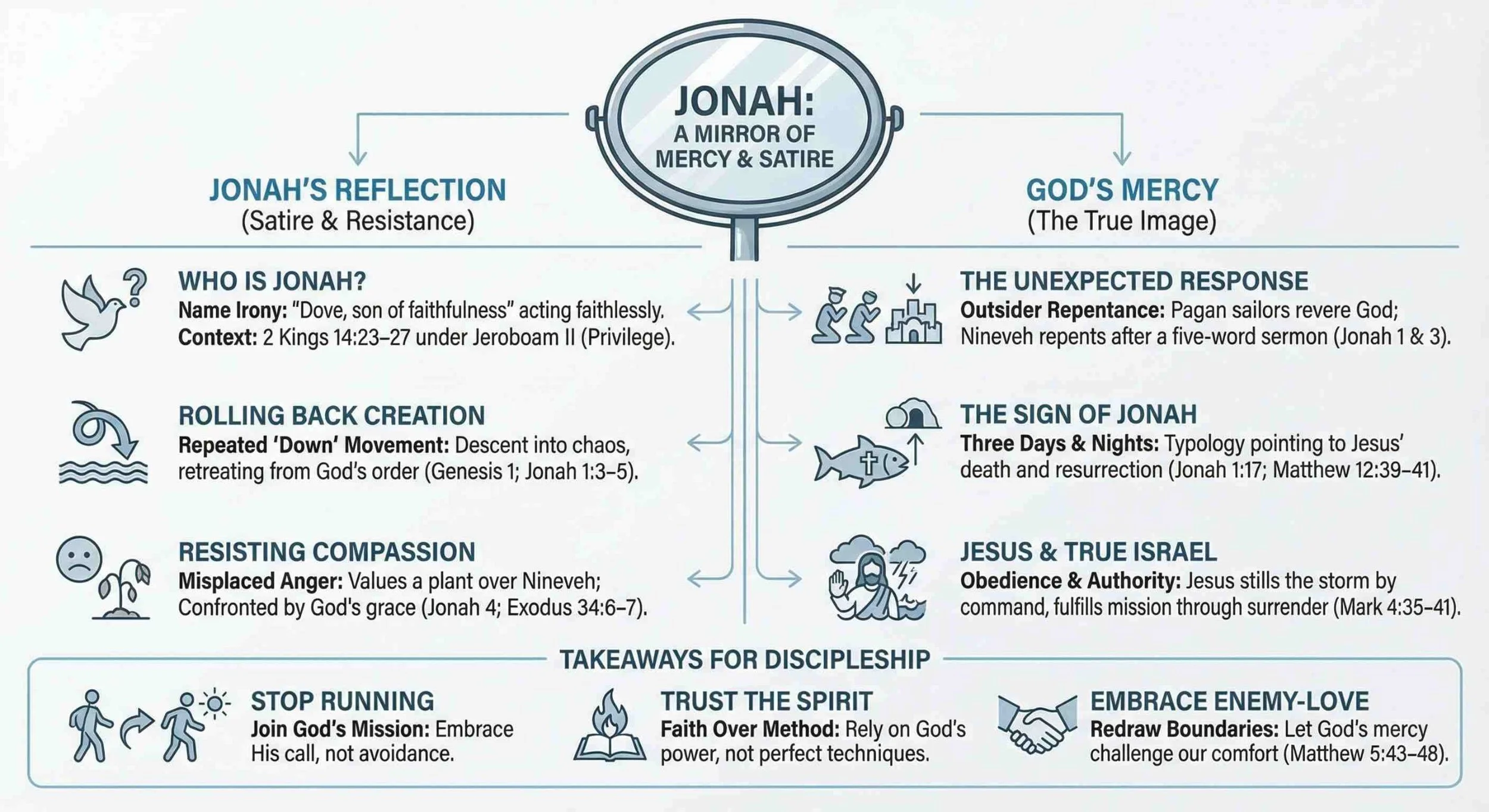
This is an AI Recap of the class.
Some things may be incorrect.
Short summary of the whole class
On March 5, 2026 at 12:03:15, we walked through Jonah (especially chapter 1), situating the prophet in Israel’s history, unpacking satire and literary symmetry, and following themes of creation, chaos, descent, and mercy for enemies. We compared Jonah’s reluctance with the sailors’ reverence, linked the three-days motif to Jesus’ “sign of Jonah,” and drew applications to mission, evangelism fears, and method debates. We concluded that Jonah is a mirror asking whether we will accept God’s compassion for our enemies and join His mission rather than run from it.
Walk-through and sectional summaries
1) Setting the stage: Why Jonah?
Discussion highlights:
Jonah is a favorite precisely because many were told a fish-focused version, then discovered deep satire and heart-level challenge when reading closely.
Parallels with Genesis creation narratives and the Gospels: texts often reveal new layers when revisited.
Comparison with Job: Job wished for death amid suffering; Jonah would rather die than obey—similar despair, different causes.
Open-ended ending likened to Jesus’ Prodigal Son, where the Father’s compassion confronts the elder brother’s resentment—mirroring Jonah’s anger.
Name meanings and satire:
Jonah means “dove”; Amittai relates to “faithfulness.” The “dove, son of faithfulness” behaves faithlessly—signaling satire.
Historical anchor:
2 Kings 14:23–27 places Jonah in Jeroboam II’s time; he prophesied under a wicked king, raising questions about privilege and character.
Stories/illustrations mentioned:
Jesus’ Prodigal Son ending.
Light pop-culture nod to satire (e.g., a Naked Gun-style comedic edge).
Scriptures mentioned:
2 Kings 14:23–27.
Section summary:
Jonah introduces a credentialed prophet whose context under Jeroboam II contrasts with his calling, signaling a satirical critique of self-righteous religiosity and resistance to God’s mercy.
2) The BibleProject overview and the mirror
Key points:
Jonah is a narrative about a prophet rather than a collection of prophecies.
Literary symmetry: chapters 1 and 3 feature pagans (sailors/Ninevites); chapters 2 and 4 feature Jonah’s prayers.
Comic reversals: pagan sailors and the king of Nineveh repent; Jonah resists; even the cattle are included in Nineveh’s repentance.
The five-word sermon’s “overturn” can mean overthrow or transform—fulfilled by Nineveh’s repentance.
The plant and worm expose Jonah’s misplaced compassion; the ending asks if we are okay with God loving our enemies (and their cattle).
Scriptures mentioned:
Jonah 1–4 (overview).
Section summary:
The video frames Jonah as satire designed to expose our reluctance to extend God’s mercy, turning the story into a mirror for our own hearts.
3) Creation motifs, “rolling back creation,” and Jonah’s flight
Discussion:
Jonah’s worldview reflects Genesis themes—sea, air, dry land; his flight to Tarshish symbolizes going to “the end of the line.”
Sea as chaos; Jonah’s descent “down” (to Joppa, into the ship, into sleep, into the sea) dramatizes spiritual retreat, a “rolling back” of creation’s order.
Three days motif and Jesus’ “sign of Jonah”:
“Three days and three nights” in the fish parallels Jesus’ three days in the tomb and His explicit “sign of Jonah” reference.
Scriptures mentioned:
Genesis 1; Jonah 1:1–5, 1:17; Matthew 12:39–41.
Stories mentioned:
Creation narrative motifs.
Section summary:
Jonah’s flight is cast as a reversal of creation—descending into chaos—and his three days in the fish prefigure Jesus’ burial and resurrection.
4) Reading Jonah 1 together: Running from God, waking the world (Jonah 1:1–17)
Text covered aloud:
Jonah 1:1–17 (call to Nineveh; flight to Tarshish; storm; lots; sailors’ prayer; Jonah overboard; great fish).
Observations:
Jonah runs without stated reason in chapter 1; motives appear later.
Tarshish functions as “as far as possible,” symbolizing maximum avoidance.
Irony: pagan sailors discern, pray, show compassion; Jonah sleeps and resists.
Jonah’s “throw me overboard” skews toward escape—better death than obedience—while sailors try to spare him and ultimately fear the Lord.
The fish becomes a “watery tomb” and rescue, foiling Jonah’s escape.
Stories/themes:
Sea as chaos; fish as paradoxical rescue.
Scriptures mentioned:
Jonah 1:1–17.
Section summary:
Chapter 1 contrasts Jonah’s hardened flight with the sailors’ soft hearts, showing that God’s mercy reaches outsiders even through a reluctant prophet.
5) The sailors’ interrogation, prayer, and reverence (Jonah 1:8–16)
Discussion:
Sailors interrogate Jonah about identity and guilt; Jonah confesses the Creator God of sea and land.
Jonah proposes, “Throw me into the sea,” while the sailors initially try to row back, reluctant to harm him.
The sailors pray to the Lord, cast Jonah overboard, the sea calms; they fear the Lord, offer sacrifice, and make vows.
New Testament echo:
Calming of the sea with the disciples’ awe provides a typological line toward Christ.
Scriptures mentioned:
Jonah 1:8–16; Mark 4:35–41 (echo).
Stories mentioned:
Jesus calming the storm.
Section summary:
Outsiders model humility, compassion, and reverence—contrasting Jonah’s avoidance—and respond to God with worship when the sea calms.
6) Anticipating chapters 2–4: Prayer, repentance, anger, and the plant
Chapter 2:
Jonah’s prayer thanks God but lacks full confession; he promises obedience; the fish vomits him out.
Chapter 3:
The five-word sermon triggers citywide repentance, including the king and animals; God relents.
Chapter 4:
Jonah admits he ran because God is gracious and merciful (echoing Exodus 34:6–7).
The plant and worm reveal Jonah’s misplaced compassion; God asks if He may care for Nineveh (and their cattle).
Scriptures mentioned:
Jonah 2–4; Exodus 34:6–7.
Stories mentioned:
Prodigal Son’s open ending (as a parallel to Jonah 4).
Section summary:
The heart of Jonah is God’s scandalous compassion and Jonah’s exposed heart, culminating in God’s unanswered question to readers.
7) Amos, justice, and continuity with Jesus
Discussion:
Amos rebukes Israel’s injustice; mercy and justice in the Old Testament align with Jesus’ ethic.
Jonah’s mission extends beyond Israel, reinforcing God’s global compassion.
Scriptures mentioned:
Amos 2; Amos 5.
Stories mentioned:
Prophetic critiques of injustice in Amos.
Section summary:
The Testaments are unified in justice and mercy; Jonah fits the prophetic pattern God later amplifies through Jesus.
8) Enemy love, discipleship, and costly grace
Discussion:
Assyria/Nineveh as Israel’s oppressor explains Jonah’s resistance but does not excuse it.
Discipleship demands forgiveness and love toward adversaries—“bringing the word to people you hate.”
C. S. Lewis’ The Great Divorce illustrates pride’s refusal to enter forgiveness; Lord’s Prayer underscores reciprocity of mercy.
Scriptures mentioned:
Jonah 1:2; Jonah 3; Matthew 5:43–48; Matthew 6:12.
Stories mentioned:
The Great Divorce; themes in the Lord’s Prayer.
Section summary:
Jonah surfaces how offensive enemy-love feels and how central forgiveness is to entering God’s kingdom.
9) Jonah and Jesus: storm narratives, Gethsemane, and true Israel
Discussion:
Jonah stills the sea by surrender; Jesus calms it by command, revealing His authority.
Jonah’s avoidance contrasts with Jesus’ Gethsemane prayer, “Your will be done,” embodying salvation in the cross.
Satirical “Israel” in Jonah versus Jesus as faithful Israel fulfilling the vocation rightly.
Scriptures mentioned:
Jonah 1:12–15; Mark 4:35–41; Matthew 26:39; Luke 22:42; John 19 (thematic).
Stories mentioned:
Calming the storm; Gethsemane; crucifixion.
Section summary:
Where Jonah dramatizes Israel’s failure, Jesus embodies faithful obedience, fulfilling Israel’s mission and conquering chaos by His word and cross.
Medium-length final summary (class held on 2026-03-05 at 12:03:15)
On March 5, 2026 at 12:03:15, we studied Jonah as holy satire and a mirror of mercy. We situated Jonah under Jeroboam II (2 Kings 14:23–27), noting his privileged context and how that primes skepticism about his “righteousness.” The BibleProject overview highlighted symmetrical structure, comic reversals, and the book’s final question. Reading Jonah 1, we followed Jonah’s flight to Tarshish—“rolling back creation” with repeated descent language—while pagan sailors displayed compassion, prayed to the Lord, and vowed after the sea calmed. We connected Jonah’s three days in the fish to Jesus’ “sign of Jonah” (Matthew 12:39–41) and contrasted Jonah’s avoidance with Jesus’ Gethsemane obedience. Anticipating chapters 2–4, we saw Jonah’s half-hearted prayer, Nineveh’s wholesale repentance from a minimal sermon, and Jonah’s fury at God’s grace, exposed through the plant and worm. Drawing on Amos, we affirmed that justice and mercy are consistent across Scripture. For application, we named our fears about evangelism, warned against an overfocus on methods, and asked whether we are okay with God loving those we dislike. Jonah’s final question stands: Will we accept God’s compassion for our enemies and join His mission?
Main points
Jonah functions as satire, exposing pseudo-righteousness and resistance to God’s mercy.
Historical context (2 Kings 14:23–27) places Jonah under Jeroboam II, prompting suspicion of his privileged stance.
Literary symmetry contrasts Jonah’s hardness with outsiders’ repentance (sailors and Ninevites).
Jonah’s flight “rolls back creation” with a downward descent into chaos.
God’s mission succeeds even through minimal, imperfect obedience (five-word sermon).
The fish is both rescue and rebuke—God pursues runaways and turns death toward deliverance.
Jesus’ “sign of Jonah” connects the prophet’s three days to Christ’s death and resurrection.
Amos’ justice and Jesus’ ethic show a unified biblical call to mercy and righteousness.
Discipleship demands forgiveness and enemy-love, confronting legitimate grievances.
The book ends with God’s question: Will we accept His compassion and participate in His mission?
Bible Scriptures mentioned
Jonah 1:1–17; Jonah 1:8–16; Jonah 1:17
Jonah 2–4
2 Kings 14:23–27
Exodus 34:6–7
Genesis 1
Matthew 12:39–41; Matthew 5:43–48; Matthew 6:12; Matthew 26:39; Matthew 21 (Palm Sunday and fig tree events referenced)
Mark 4:35–41; Mark 15 (thematic passion reference)
Luke 22:42; Luke 10:25–37 (Good Samaritan)
John 19 (crucifixion, thematic)
Stories and illustrations talked about
Jonah’s call, flight to Tarshish, storm at sea, sailors’ interrogation, prayer, vows, and the great fish
Nineveh’s citywide repentance, including king and animals
Jesus calming the storm; disciples’ awe
Gethsemane prayer and crucifixion
Jesus’ Prodigal Son’s open-ended conclusion (parallel to Jonah 4)
The Good Samaritan (as a contrast in self-giving)
Creation motifs (sea/chaos, “let there be light”)
C. S. Lewis’ The Great Divorce (forgiveness and pride)
Light pop-culture satire analogy (Naked Gun tone)
VeggieTales’ Jonah scene illustrating immediate calm (humorous echo)