
Amos Chapters 9 & Obadiah Class 5 - Bible Study
Our class closed Amos with chapter 9’s sweeping judgment and surprising hope, then turned to Obadiah’s focus on Edom and all nations, tracing themes of justice, restoration, and God’s kingship with messianic echoes.
Amos Chapters 9 - Obadiah
This is our 5th class on Amos
This is an AI Recap of the class.
Some things may be incorrect.
Short summary of the whole class
On 2026-02-26, we listened to and discussed Amos 9, moving from temple-toppling judgment and inescapable justice to the restoration of the “booth of David” overflowing to the nations. We explored translation nuances (Sheol vs. “hell,” “in/on” the land), water/chaos imagery, Eden-like abundance, and intertextual ties in the Gospels and Revelation. We then read Obadiah, examining Edom’s pride and betrayal during Babylon’s conquest, the Day of the Lord widening judgment to all nations, and the closing affirmation that “the kingdom shall be the Lord’s,” while comparing themes with Joel and Amos and discussing the debated location of “Sepharad.” We concluded by planning to study Jonah next and likely read C. S. Lewis’s The Great Divorce after Easter.
Walkthrough and sectional summaries
1) Setting goals and lighthearted opener (Amos 9 and Obadiah)
Plan: finish Amos with chapter 9; begin Obadiah.
Framing: Amos’s consistent indictment of exploitation of the poor and resonance with the Gospels and Revelation.
Personal anecdote: two childhood cats named Oba (for Obadiah) and Bob—“Bob was the best cat.”
Short summary of section:
We set goals to complete Amos 9 and start Obadiah, recalling Amos’s justice theme and sharing a light personal story.
Bible verses mentioned:
General reference to Amos (no specific verse cited here).
Stories mentioned:
Childhood cats: Oba and Bob.
2) Listening to Amos 9 (reading and first impressions)
Read/heard Amos 9:1–15.
Noted the stark arc from judgment to a “glimmer of hope” in verse 11.
Short summary of section:
We heard Amos 9 in full, recognizing its shift from total judgment to promised restoration.
Bible verses mentioned:
Amos 9:1–15 (highlighted v. 11).
Stories mentioned:
None.
3) Initial observations: judgment, humility, and false security
Israel is not exempt from justice (Amos 9:7–10).
Amos 9:10 challenges complacency: “calamity shall not overtake us.”
Short summary of section:
Amos confronts Israel’s moral complacency: being God’s people does not shield unrepentant injustice from judgment.
Bible verses mentioned:
Amos 9:7–10.
Stories mentioned:
None.
4) Promise of restoration and Eden imagery
Reversal of earlier deprivation: abundance, rebuilt cities, vineyards (Amos 9:13–15).
“The plowman shall overtake the reaper” signals overflowing fruitfulness.
Short summary of section:
Amos pivots to Eden-like renewal, where God replaces deprivation with abundant delight.
Bible verses mentioned:
Amos 9:13–15.
Stories mentioned:
None.
5) Temple-pillar language and the scope of judgment (Amos 9:1)
“Strike the tops of the pillars/doorposts/capitals” to collapse the sanctuary.
Emphasis on judgment reaching even sacred spaces.
Short summary of section:
God topples the sanctuary from its highest points, signaling comprehensive judgment.
Bible verses mentioned:
Amos 9:1.
Stories mentioned:
None.
6) Sheol, the sea, and the inescapability of God (Amos 9:2–6)
Translation note: prefer “Sheol” over “hell.”
No escape: heights, depths, Carmel, sea—God finds them (Amos 9:2–3).
Chaos-water motifs: serpent in the sea, Nile swelling, God summoning waters (Amos 9:5–6).
Intertext: creation waters, Noah’s flood, Revelation’s abyss/sea.
Short summary of section:
Amos portrays God’s searching judgment using Sheol and chaos-water imagery to show there’s no hiding place.
Bible verses mentioned:
Amos 9:2–6.
Allusions: Genesis 1; Genesis 6–9; Revelation (abyss/sea).
Stories mentioned:
None (intertextual themes noted).
7) “On that day” and the Booth of David (Amos 9:11–12)
“On that day” marks restoration.
“Booth/tabernacle of David” restored—messianic resonance.
Nations included: remnant of Edom and “all the Gentiles who are called by my name.”
Short summary of section:
Restoration is messianic and expansive: God rebuilds David’s booth and gathers Israel and the nations.
Bible verses mentioned:
Amos 9:11–12.
Stories mentioned:
Gospel theme: Jesus as true temple (veil imagery referenced).
8) Abundance fulfilled and Garden imagery carried into the Gospels
Overflowing wine, gardens, rebuilt cities (Amos 9:13–15).
John 20: Mary mistakes the risen Jesus for a gardener—Eden echo.
Short summary of section:
Amos’s restoration imagery flavors the resurrection garden scene, signaling new creation.
Bible verses mentioned:
Amos 9:13–15.
John 20 (Mary and the gardener).
Stories mentioned:
Mary Magdalene at the tomb.
9) Translation nuance: “in” vs. “on,” and spirit/wind/breath
Amos 9:15: “in/on their land” reflects Hebrew preposition range.
Note on single Hebrew/Greek terms for spirit/wind/breath.
Short summary of section:
We observed how translation choices shape meaning, especially with prepositions and key theological terms.
Bible verses mentioned:
Amos 9:15.
Stories mentioned:
None.
10) Amos’s core indictment and a pastoral reflection
Amos critiques showy religion alongside exploitation of the poor.
Practical reflection: caution against performative religiosity (e.g., public fasting) without justice and mercy.
Short summary of section:
Amos calls for authentic obedience—justice for the poor over religious performance.
Bible verses mentioned:
Thematic reference to Amos’s broader critique (no single verse cited here).
Stories mentioned:
Practical note related to public religious displays.
11) Obadiah overview: setting the stage
Positioned Obadiah in the crisis of Babylon’s conquest (background: 2 Kings 25).
Watched a short overview video to frame reading.
Short summary of section:
We located Obadiah within the Babylonian crisis and prepped to read the book with an overview.
Bible verses mentioned:
Historical backdrop: 2 Kings 25 (not read aloud).
Stories mentioned:
None.
12) Public reading of Obadiah 1:1–9 (Pride and downfall)
Edom’s pride deceived them; God will bring them down (1:3–4).
Thorough searching out; failed alliances; end of Teman’s wisdom (1:5–9).
Short summary of section:
God indicts Edom’s arrogance and announces comprehensive collapse, even among their allies and sages.
Bible verses mentioned:
Obadiah 1:1–9.
Stories mentioned:
None.
13) Obadiah 1:10–14 (Betrayal of a brother)
“Violence against your brother Jacob” (1:10).
Charges: gloating, looting, ambushing refugees, handing survivors over (1:12–14).
Short summary of section:
Edom’s guilt centers on fraternal betrayal—gloating and harming Judah at its most vulnerable.
Bible verses mentioned:
Obadiah 1:10–14.
Background: Genesis (Jacob and Esau).
Stories mentioned:
Jacob and Esau as ancestral backdrop.
14) Class reflections: family, pride, and internal strife
Betrayal is worse when done by those who “know better.”
Parallels to Judges’ intra-Israel conflict; teacher recalled a sermon titled “Don’t Look Away.”
Pride and gloating as spiritual decay.
Short summary of section:
We reflected on the moral weight of harming kin and how pride corrodes communities.
Bible verses mentioned:
Judges (theme of internal conflict; no specific verse cited).
Stories mentioned:
Sermon: “Don’t Look Away.”
15) Obadiah 1:15–18 (The Day of the Lord and recompense)
Hinge to all nations: “The day of the Lord… is near” (1:15).
Principle: “As you have done, it shall be done to you” (1:15).
Zion’s deliverance; Jacob and Joseph as fire, Esau as stubble (1:17–18).
Short summary of section:
Judgment widens to all nations with measure-for-measure justice; Zion becomes the locus of deliverance.
Bible verses mentioned:
Obadiah 1:15–18.
Stories mentioned:
None.
16) Obadiah 1:19–21 (Restoration and the Lord’s kingdom)
Restoration geography and return of exiles (1:19–20).
“Saviors shall come to Mount Zion… And the kingdom shall be the Lord’s” (1:21).
Short summary of section:
Obadiah closes with restoration for Zion’s remnant and the universal claim of God’s kingship.
Bible verses mentioned:
Obadiah 1:19–21.
Stories mentioned:
None.
17) Comparing Obadiah with Amos and Joel
Tension: Amos 9:11–12 includes “remnant of Edom and all nations”; Obadiah 1:18 stresses severe judgment on Esau.
Harmonizing lens: Edom as a historical nation and a type of human pride; prophetic hope still envisions nations called by God’s name.
Joel contributes post-judgment deliverance from Zion.
Short summary of section:
We contrasted Obadiah’s sharp judgments with Amos’s and Joel’s inclusive restoration, seeing Edom as both concrete and symbolic.
Bible verses mentioned:
Amos 9:11–12.
Joel 2–3.
Stories mentioned:
None.
18) Notes on terms and places: Sepharad and later identity
Obadiah 1:20 mentions “Sepharad”—debated identifications: Sardis (Asia Minor), Spain (Sephardim), Western Media, others.
Recognized long-standing Jewish association with Spain shaping diaspora identity.
Short summary of section:
“Sepharad” has multiple scholarly proposals, with the Spanish association shaping the identity of Sephardic Jews.
Bible verses mentioned:
Obadiah 1:20.
Stories mentioned:
Historical-cultural note on Sephardic Jews.
19) Obadiah’s ending and God’s kingship
Translation nuance: “the kingdom/kingship will be the Lord’s” (Obadiah 1:21).
Obadiah centers God’s direct kingship without explicitly foregrounding a Davidic messiah.
Resonances with Deuteronomic/Joshua themes of covenantal justice and conquest.
Short summary of section:
Obadiah climaxes with God’s kingship, emphasizing covenantal justice more than royal messianism.
Bible verses mentioned:
Obadiah 1:21.
Thematic references: Deuteronomy, Joshua (no specific verses cited).
Stories mentioned:
None.
20) Concluding plans: Jonah next; The Great Divorce after Easter
Next study: Jonah (2–3 weeks).
Likely post-Easter reading: C. S. Lewis’s The Great Divorce.
Short summary of section:
We wrapped Obadiah and set plans to study Jonah next, with a likely return to The Great Divorce after Easter.
Bible verses mentioned:
None (future study preview).
Stories mentioned:
Literary work: C. S. Lewis’s The Great Divorce.
Medium-length summary of the class
On 2026-02-26, we concluded Amos with chapter 9, tracing its movement from God’s temple-toppling judgment and inescapable justice (Amos 9:1–10) to the restoration of the “booth of David” that embraces the remnant of Edom and all Gentiles called by God’s name (9:11–12), culminating in Eden-like abundance (9:13–15). We noted translation nuances (Sheol vs. “hell,” “in/on” the land) and water/chaos motifs linking creation, flood, and Revelation. Turning to Obadiah, we read the whole book and examined Edom’s pride and fraternal betrayal (1:1–14), the hinge to a universal Day of the Lord with measure-for-measure justice (1:15–18), and the restoration culminating in “the kingdom shall be the Lord’s” (1:19–21). We discussed the debated location of “Sepharad” (1:20), thematic comparisons with Joel and Amos on judgment and inclusion, and how Obadiah foregrounds God’s kingship with Deuteronomic/Joshua resonances. We closed by planning to study Jonah next and likely read The Great Divorce after Easter.
Main points
God’s judgment is comprehensive and inescapable (Amos 9:1–10).
Chaos-water imagery underscores divine sovereignty and judgment (Amos 9:2–6).
Translation matters: Sheol vs. “hell,” “in/on” the land, spirit/wind/breath.
Restoration follows judgment: God rebuilds the “booth of David,” including the nations (Amos 9:11–12).
Eden-like abundance symbolizes renewal (Amos 9:13–15).
Obadiah indicts Edom’s pride and betrayal, then widens judgment to all nations (Obadiah 1:1–18).
Measure-for-measure justice: “As you have done, it shall be done to you” (Obadiah 1:15).
Obadiah ends with God’s universal kingship: “the kingdom shall be the Lord’s” (Obadiah 1:21).
“Sepharad” (Obadiah 1:20) has debated identifications; Spanish association shaped Sephardic identity.
Comparative theme: Amos and Joel highlight post-judgment inclusion; Obadiah stresses severe judgment but shares Zion-centered hope.
Next steps: Study Jonah; likely read The Great Divorce after Easter.
Scriptures mentioned
Amos 9:1–15 (focus on 9:1; 9:2–6; 9:7–10; 9:11–12; 9:13–15)
Obadiah 1:1–21 (focus on 1:1–9; 1:10–14; 1:15–18; 1:19–21)
Genesis 1 (creation waters/Spirit)
Genesis 6–9 (Noah’s flood)
Genesis (Jacob and Esau background)
2 Kings 25 (Babylon’s conquest context)
Joel 2–3 (Day of the Lord; Zion deliverance)
Judges (theme of internal conflict)
John 20 (Mary and the “gardener”)
Revelation (abyss/sea imagery)
Stories and works mentioned
Childhood cats: Oba (Obadiah) and Bob.
Mary Magdalene mistaking the risen Jesus for the gardener (John 20).
Sermon reference: “Don’t Look Away.”
Historical-cultural: Sephardic Jews (Sephardim) and association with Spain.
Upcoming/related: C. S. Lewis’s The Great Divorce.
Content creation date: 2026-02-26 12:04:06.
Amos Chapters 6-8 Class 4 - Bible Study
This week, our study of Amos 6-8 revealed God's unwavering standard of justice, showing how complacency, social injustice, and the rejection of His word lead to inescapable judgment, symbolized by a plumb line and a basket of summer fruit.
Amos Chapters 4-8
This is our 4th class on Amos
This is an AI Recap of the class.
Some things may be incorrect.
Short Summary of the Whole Class
In our Bible study on February 19, 2026, we delved into chapters six through eight of the book of Amos. We explored the prophet's powerful rebukes against the wealthy and complacent elite of Israel who lived in luxury while perverting justice and exploiting the poor. The class discussed Amos's visions of the locusts, fire, and the plumb line, noting the shift from God's patience to a fixed and final judgment. We examined the dramatic confrontation between Amos and Amaziah, the priest of Bethel, which highlighted the conflict between divine prophecy and corrupt human authority. Finally, we studied the vision of the basket of summer fruit, symbolizing that Israel was ripe for judgment, and the dire prophecy of a "famine for hearing the words of the Lord" as a consequence of their sin.
Detailed Class Summary
Section 1: The Woe to the Complacent (Amos 6:1-7)
Our class began by recapping the book of Amos, noting its core theme: the condemnation of social injustice and hollow religiosity that contradicted God's command to "let justice flow like a river." This hypocrisy, where religious displays masked a lack of genuine faith, was compared to the teachings of James.
We then read the first half of Amos chapter 6, which pronounces "Woe" upon those "at ease in Zion." The discussion focused on how these verses target the comfortable and wealthy elite who believed they were immune to the coming "day of doom." They indulged in luxury—lying on ivory beds, anointing themselves with expensive oils, and inventing new musical instruments—all while being completely indifferent to the suffering of the poor, described as the "affliction of Joseph." We explored the dual meaning of "Joseph" as both a historical reference to their ancestors' slavery and a metaphor for the current oppression within their own nation. The prophecy is clear: because they did not grieve for the oppressed, they would be the "first of the captives" to be led into exile.
Summary of Section 1
This section set the stage by reviewing the core themes of Amos. In Amos 6:1-7, we saw a direct confrontation with Israel's ruling class, who are condemned for their luxurious, self-absorbed lifestyles and their failure to care for the poor. God's judgment is that their comfort will be stripped away, and they will be the first to suffer the consequences.
Bible Verses: Amos 5:24, Amos 6:1-7
Stories/References: The openings of Revelation, Joel, and Romans; James's teaching on faith and works; the affliction of Joseph in Egypt.
Section 2: The Perversion of Justice and Inescapable Judgment (Amos 6:8-14)
Continuing in Amos 6, we discussed God's oath to "abhor the pride of Jacob" and "hate his palaces." The class noted the use of the name "Jacob" instead of "Israel," suggesting the nation had spiritually regressed to its old, deceitful character before Jacob wrestled with God. The imagery in verses 9-11 depicts a devastating plague where death is so widespread that survivors "dare not mention the name of the Lord," fearing it might bring more destruction.
We then examined verse 12: "Do horses run on rocks? Does one plow there with oxen?" The class saw this as a metaphor for common sense. Just as a farmer knows not to do these things, Israel should have known that their perversion of justice went against the natural and moral order. They had turned "justice into gall and the fruit of righteousness into wormwood," making what should be good into something bitter and poisonous. The chapter ends with God's explicit threat to raise up a nation to afflict them.
Summary of Section 2
In this part of the study, we focused on the finality of God's judgment in Amos 6. The "pride of Jacob" is condemned, and the destruction will be so total it silences even prayer. The discussion highlighted how Israel's injustice was a violation of common sense and the created order, leading to the inevitable consequence of being overthrown by a foreign nation.
Bible Verses: Amos 6:8-14, Amos 8:7
Stories/References: Jacob wrestling with God; Jesus's warning of two men in a field (Matthew 24:40).
Section 3: The Visions of Mercy and the Point of No Return (Amos 7:1-9)
We moved into Amos 7, which presents a series of three visions. The first is a swarm of locusts, and the second is a devouring fire. In both instances, Amos intercedes, pleading, "O Lord God, forgive, I pray... for Jacob is small!" This was compared to Abraham's negotiation with God over Sodom. In response to Amos's plea, God relents.
The third vision, however, marks a significant shift. God is shown standing by a wall with a plumb line, a tool used to measure if a structure is perfectly vertical. God declares, "Behold, I am setting a plumb line in the midst of my people Israel; I will not pass by them anymore." The class understood this to mean God had measured Israel against His perfect standard of righteousness and found them hopelessly "crooked." Unlike the first two visions, there is no more intercession and no more relenting. Judgment is now fixed.
Summary of Section 3
This section covered the three visions in Amos 7. The first two (locusts and fire) show God's mercy as He responds to Amos's intercession. The third vision (the plumb line) signifies a point of no return. God has measured His people, found them irredeemably corrupt, and declared that judgment is now unavoidable.
Bible Verses: Amos 7:1-9
Stories/References: The visions of Amos (locusts, fire, plumb line); Abraham negotiating with God for Sodom (Genesis 18).
Section 4: The Prophet vs. The Priest (Amos 7:10-17)
The final part of our discussion on chapter 7 focused on the narrative confrontation between Amos and Amaziah, the priest of the royal sanctuary at Bethel. Amaziah reports Amos to King Jeroboam as a traitor and then tells Amos to flee and stop prophesying, dismissing Bethel as "the king's sanctuary."
Amos's powerful response defines his prophetic calling. He declares, "I was no prophet, nor was I a son of a prophet, but I was a sheep breeder... and the Lord took me... and the Lord said to me, 'Go, prophesy to my people Israel.'" He clarifies he is not a professional speaking for money but is delivering a direct word from God. Because Amaziah tried to silence God's word, Amos pronounces a specific judgment upon him: his family will be destroyed, his land seized, and he will die in a foreign, "defiled land," a personal example of the national collapse to come.
Summary of Section 4
This section explored the conflict between God's prophet and the corrupt religious establishment. Amaziah tries to silence Amos to protect the status quo. Amos defends his divine calling, showing his authority comes directly from God. The confrontation ends with a harsh curse on Amaziah, demonstrating the severe consequences of obstructing God's message.
Bible Verses: Amos 7:10-17
Stories/References: The confrontation between Amos and Amaziah, the priest of Bethel.
Section 5: The Ripe Fruit and the Spiritual Famine (Amos 8)
Our class concluded with Amos chapter 8, which opens with the vision of a basket of ripe summer fruit. This image symbolizes that Israel is "ripe" for judgment and the end has come. The reason for this judgment is again social injustice. The wealthy are condemned for "swallowing up the needy" by "making the ephah small and the shekel large" and falsifying scales to exploit the vulnerable. This was connected to the imagery of the Four Horsemen in Revelation.
The prophecy then describes the consequences in apocalyptic terms: the sun will go down at noon and feasts will turn to mourning. Most strikingly, there will be a famine—not for bread or water, but for "hearing the words of the Lord." The people will search desperately for a word from God but will not find it, a punishment of divine silence. We noted how Jesus uses similar themes when offering "living water" and declaring that man does not live by "bread alone."
Summary of Section 5
This section focused on the vision of summer fruit, signifying that Israel's time was up. We discussed how their downfall was directly linked to their economic exploitation of the poor. The resulting judgment would be a cosmic disruption and a spiritual famine for God's word, where the people would be met with divine silence.
Bible Verses: Amos 8, Jeremiah 4:23
Stories/Imagery: Vision of the basket of summer fruit; the famine for the word of the Lord; merchants falsifying scales.
Overall Class Summary
Our Bible study on February 19, 2026, provided a deep dive into Amos chapters 6 through 8, exploring the prophet's searing indictment of Israel. We began with Amos 6, where the wealthy elite are condemned for living in decadent luxury while ignoring the poor and perverting justice. The class discussed the powerful language used to describe their sin and the significance of God abhorring the "pride of Jacob."
We then transitioned to the visions in Amos 7. We saw God's patience in the visions of locusts and fire, where He relents after Amos intercedes. However, the vision of the plumb line marked a crucial turning point, symbolizing that Israel had been measured against God's perfect standard and found deficient; judgment was now inevitable. This led to the dramatic confrontation between Amos and Amaziah, the priest of Bethel, highlighting the tension between true prophetic authority and a corrupt religious establishment serving human power.
Finally, we explored the vision of the basket of summer fruit in chapter 8, a metaphor indicating Israel was ripe for judgment. This judgment was a direct result of rampant social injustice, particularly the economic exploitation of the poor. The prophesied consequences were dire, including cosmic upheaval and a unique "famine for hearing the word of the Lord," where God would withdraw His guidance completely. Throughout the study, we saw the enduring relevance of Amos's call for justice and true righteousness.
Main Points
Israel's elite were condemned for their luxurious lifestyle, complacency, and indifference to social injustice.
Religious activity without a foundation of justice and righteousness is meaningless to God.
The plumb line represents God's perfect, unchangeable standard of righteousness, which revealed Israel's corruption.
God's judgment, while patient, is not infinite; the plumb line vision signifies that a final verdict has been passed.
The vision of summer fruit symbolizes that Israel is ripe for judgment, and the end is near.
True prophets receive their authority directly from God and cannot be silenced by human institutions.
The primary reason for God's judgment is social injustice and the economic exploitation of the poor.
The ultimate punishment would be a spiritual famine for the word of the Lord, where the people would seek God's guidance but be met with silence.
Scriptures and Stories Mentioned
Bible Scriptures
Amos 5:24 ("let justice flow like a river")
Amos 6:1-14 (Woe to the complacent, judgment on the proud)
Amos 7:1-17 (Visions of locusts, fire, plumb line; Amos and Amaziah)
Amos 8:1-14 (Vision of summer fruit, famine for the word)
Book of Joel (Comparison of prophetic openings)
Book of Revelation (Comparison of prophetic openings; the Four Horsemen)
Book of Romans (Chapters 1-2) (Comparison of listing sins)
Book of James (Teaching on faith and works)
Jeremiah 4:23 (Reference to creation undone)
Matthew 24:40 (Reference to two men in a field)
Book of Daniel (General reference to Jesus's trial)
Stories and Key References
The affliction of Joseph and slavery in Egypt.
Abraham negotiating with God for Sodom (Genesis 18).
Jacob wrestling with God and being renamed Israel.
The visions of Amos: locusts, fire, the plumb line, and the basket of summer fruit.
The confrontation between Amos and Amaziah, the priest of Bethel.
Jesus cursing the barren fig tree.
Jesus overturning the tables of the money changers in the Temple.
The darkness over the land during Jesus's crucifixion.
Amos Chapters 3-5 Class 3 - Bible Study
During our February 11, 2026, study, we explored Amos chapters 3-5, where God challenges Israel's hypocrisy, condemning their social injustice and empty religious rituals while calling them to let justice and righteousness flow like a mighty stream.
Amos Chapters 3-5
This is our 3rd class on Amos
This is an AI Recap of the class.
Some things may be incorrect.
Short Summary of the Whole Class
On February 11, 2026, our Bible study covered Amos chapters 3-5, exploring God's profound disappointment with Israel. We discussed how their special covenant relationship led to greater accountability, not immunity, as God condemned their social injustice, oppression of the poor, and idolatry. The group analyzed the prophet's sharp critique of Israel's empty religious performances, noting how God sent a series of escalating calamities as warnings, all of which were ignored. We concluded by focusing on God's ultimate desire, expressed in the powerful call to "let justice run down like water, and righteousness like a mighty stream," contrasting it with the solemn final warning: "Prepare to meet your God."
Detailed Class Summary
Here is a breakdown of our discussion from the Bible study on February 11, 2026.
A Message to Israel: Accountability and Consequences (Amos 3)
We began our study in Amos chapter 3, which establishes why God is judging Israel so harshly. Recapping chapters 1 and 2, we noted how the focus narrows from the surrounding nations to God's own chosen people. Cris pointed out the principle that a great calling brings great responsibility and, therefore, great consequences. God reminds Israel of their unique covenant, established at the Exodus, which holds them to a higher standard. They had become as corrupt as the nations around them and could not expect to escape judgment.
Amos then uses a series of cause-and-effect questions (vv. 3-8) to show that God's judgment is the logical and obvious result of their sin. Just as a lion's roar signals danger, the prophet's words signal impending divine doom. We discussed how Israel was ignoring these clear warnings. The chapter ends with a stark vision of their destruction, symbolized by a shepherd rescuing only "two legs or a piece of an ear" from a lion—a meager, useless remnant serving only as a token of what was lost. Their great wealth and false altars at Bethel would be utterly destroyed.
Summary of This Section: We discussed how God, in Amos 3, establishes that Israel's special covenant relationship meant greater accountability for their sins. Using self-evident truths, Amos declares that God's judgment is an unavoidable consequence of their rebellion, prophesying a near-total destruction where only useless fragments would remain.
Bible Verses: Amos 1-2 (Recap), Amos 3.
Stories/Themes: The Exodus from Egypt; comparisons to Romans 1-2 and the book of Job.
The Cows of Bashan and Ignored Warnings (Amos 4)
Moving to chapter 4, the tone becomes even more direct. We examined the shocking address, "Hear this word, you cows of Bashan," aimed at the wealthy, complacent women of Samaria who oppressed the poor to fund their luxurious lifestyles. Their punishment is described as being led away into exile with fishhooks. The conversation then shifted to the powerful sarcasm in Amos 4:4-5, where the prophet mockingly invites the Israelites to "Come to Bethel and transgress," condemning their hypocritical, performative worship. They made a great public show of their piety, boasting about sacrifices and tithes, while their hearts were far from God.
God then lists the escalating calamities He sent to warn them: famine, drought, blight, plague, and war. After each disaster, the heartbreaking refrain is repeated: "Yet you have not returned to me." Because they ignored every warning, the chapter culminates in one of the most sobering lines in Scripture: "Prepare to meet your God, O Israel." This was no longer a call for attention but a final, solemn declaration that judgment was unavoidable.
Summary of This Section: We analyzed Amos 4's harsh condemnation of the wealthy elite ("cows of Bashan") and their empty religious rituals. God recounts a series of disasters sent as warnings, each ignored by Israel. Having exhausted all warnings, God summons them to a final, unavoidable confrontation, telling them to "prepare to meet your God."
Bible Verses: Amos 4:4-5, Amos 4:10, Amos 4:12-13.
Stories/Themes: The Plagues of Egypt during the Exodus; Moses and the golden calf incident.
True Worship vs. Empty Rituals (Amos 5)
Our discussion concluded with Amos chapter 5, where God pleads with Israel, "Seek me and live," but warns them against their corrupt religious centers. God expresses his hatred for their religious festivals and songs because they are a hypocritical cover for systemic injustice. Their worship was rejected because it was detached from righteousness. We compared this to Paul's frustration with the Corinthian church's abuse of communion and Jesus cleansing the temple, where religious systems were used to exploit the marginalized.
The core message, we concluded, is found in Amos 5:24: "But let justice run down like water, and righteousness like a mighty stream." This is the true purpose of the worship that God desires. Genuine faith must result in a community defined by justice and compassion. We contrasted this with Israel's self-serving attitude, which had twisted its divine mission. The chapter serves as a powerful call to choose Christ's way of justice and servant leadership over the world's systems of oppressive power.
Summary of This Section: We concluded that in Amos 5, God desires justice and righteousness above hollow religious performance. The core problem identified was the human tendency to build systems of exploitation and then sanctify them with religious language. The solution is found in the call to let justice and righteousness flow, which is the true fruit of genuine worship.
Bible Verses: Amos 5:4-6, Amos 5:14, Amos 5:21-24.
Stories/Themes: Paul's rebuke of the Corinthian church; Jesus cleansing the temple; Jesus at Caesarea Philippi.
Final Summary
In our Bible study on February 11, 2026, we delved into Amos chapters 3-5, examining God's case against the northern kingdom of Israel. We began with chapter 3, where God reminds Israel of their unique, chosen status, which brings a higher level of accountability. Their covenant relationship meant their sins of injustice and idolatry were a deep betrayal. Amos uses a series of rhetorical questions to illustrate that the coming judgment is an inevitable consequence of their rebellion.
In chapter 4, the prophecy intensifies with a provocative attack on the wealthy women of Samaria, the "cows of Bashan," who live in luxury sustained by oppression. God then recounts the series of corrective judgments He sent—famine, drought, and war—each one failing to bring repentance, underscored by the haunting refrain, "Yet you have not returned to me." Since all warnings were ignored, the prophecy climaxes with the solemn command to "prepare to meet your God."
Finally, in chapter 5, God rejects their empty religious rituals, declaring, "I hate, I despise your feast days." Their worship is meaningless because it is divorced from social justice. The study culminated in identifying the heart of God's desire in Amos 5:24: "But let justice run down like water, and righteousness like a mighty stream." This powerful verse encapsulates the true worship God seeks—a faith demonstrated through active compassion and justice for all.
Main Points
Greater Calling, Greater Accountability: Israel’s special covenant with God meant they were held to a higher standard than other nations.
Cause and Effect: God's judgment is not random but a direct and logical consequence of Israel's sin.
Condemnation of Social Injustice: Amos fiercely condemns the wealthy elite for oppressing the poor to fund their lavish lifestyles.
Failure of Empty Religion: God rejects Israel’s religious rituals (sacrifices, festivals, songs) because they are not accompanied by justice and true repentance.
Ignored Warnings: God sent escalating disasters to call Israel back, but they stubbornly refused to return to Him.
The Final Summons vs. True Worship: Having exhausted all warnings, God calls Israel to a final confrontation, while also revealing that what He truly desires is a society where justice and righteousness flow freely.
Scriptures and Stories Mentioned
Bible Scriptures:
Amos 1-5
Romans 1-2
Genesis (mentioned as foundational)
Exodus (mentioned as foundational)
Job (thematic reference)
The book of Joel (thematic reference)
The book of James (thematic reference)
Biblical Stories and Events:
The Creation Story
The Exodus from Egypt
The stories of Abraham, Isaac, Jacob, and Joseph
The destruction of Sodom and Gomorrah
The Plagues of Egypt
Moses and the Golden Calf
Paul's rebuke of the Corinthian church's handling of the Lord's Supper
Jesus cleansing the temple
Jesus at Caesarea Philippi asking, "Who do you say I am?"
Amos Chapters 1-2 Class 2 - Bible Study
In our study of Amos, we explored God's judgment against nations for their social injustices and lack of compassion, revealing the timeless warning against seeking security in worldly power ("becoming Babylon") and the call to find our true identity in God's kingdom rather than in tribalism.
Amos Chapters 1-2
This is our 2nd class on Amos
This is an AI Recap of the class.
Some things may be incorrect.
Short Summary of the Class
Our class explored the prophecies of Amos, focusing on God's structured judgments against Israel and its neighbors. We discussed how each nation's specific sin—from breaking covenants to horrific violence—was met with a fitting punishment. The core theme was that Amos builds a case against other nations to ultimately turn the focus on Judah and Israel, whose sins of social injustice and rejecting God's law were even greater because they should have known better. We connected this to the recurring biblical temptation to "become Babylon"—relying on worldly power instead of God—and how this leads to hypocrisy and moral decay, a warning echoed by the Apostle Paul in Romans.
Detailed Class Summary
Who Was Amos?
We began our session by exploring the identity of the prophet Amos. The text describes him as a "sheep breeder of Tekoa," leading to two possible interpretations. One view portrays him as a humble shepherd who came "out of the hills" to deliver a radical message against the establishment. The other, suggested by sources like the Jewish Study Bible, is that "sheep breeder" implies he was a wealthy landowner, giving him an insider's perspective on the very systems he was critiquing. This dual possibility is interesting to hold in mind while reading, as it could mean he was either a simple farmer connected to the sacrificial system or a wealthy man witnessing the corruption of that system firsthand. We made a humorous comparison to a joke from our study of Joel about "rending your garments," imagining a special room in the temple with pre-ripped clothes for official mourning, highlighting how religious practices can become institutionalized and lose their meaning.
Summary: The class discussed the background of Amos, considering that he could have been either a simple shepherd or a wealthy landowner. This distinction changes how we might interpret his prophetic critique of the nation's social and religious corruption.
Bible Verses: Joel (mentioned in comparison)
Stories/Connections: The background of Amos as a shepherd/sheep breeder.
Judgment on the Nations: Violence and Betrayal
After our introduction, we read through the powerful, repetitive formula in Amos chapters 1 and 2: "For three transgressions of [a nation], and for four, I will not turn away its punishment." We observed God's judgment falling upon Damascus, Gaza, Tyre, Edom, Ammon, and Moab for their specific sins. A key theme we identified was that the punishment often fit the crime—a principle of reaping what you sow.
We focused on several examples. Edom was condemned for pursuing its "brother" (Israel, descended from Jacob) with the sword and "stifling all compassion," a violation of their shared ancestry. Tyre was condemned for breaking a "covenant of brotherhood" and selling entire communities into slavery, an act especially egregious since God's foundational act for Israel was freeing them from slavery in Egypt. The charge against Ammon was particularly disturbing: they "ripped open the women with child... that they might enlarge their territory," showcasing extreme violence for the sake of expansion. Finally, Moab was judged for burning "the bones of the king of Edom to lime," an act of ultimate desecration. These judgments highlighted that God holds nations accountable for their violence, inhumanity, and betrayal of relationships.
Summary: We analyzed the structure of judgment in Amos 1, where God condemns the surrounding nations for their specific crimes, including brutal violence, breaking covenants, and slave trading. We noted that the punishments often mirrored the transgressions, establishing a theme of divine justice against inhumanity.
Bible Verses: Amos 1
Stories/Connections: The brotherhood of Jacob and Esau, The Exodus from Egypt, the covenant between Hiram and David.
The Turn to Judah and Israel: Hypocrisy and Social Injustice
With the judgment on Judah, we saw the purpose of Amos's prophetic strategy. After listing the sins of the surrounding nations, he turns the lens on God's own people. Judah's sin was that they "rejected the law of the Lord," and a participant powerfully stated God's message: "Of all people, you should know better." Possessing the law made them more accountable, not superior.
This culminated in the climactic judgment on Israel. Their sins were deeply social and economic: they sold the "righteous for silver," trampled on "the heads of the poor," and denied "justice to the oppressed." We connected this to the story of Joseph, a righteous man sold for silver by his own brothers. Israel was perpetrating the very kinds of oppression from which God had saved them. Furthermore, they actively resisted God's correction. When God raised up prophets and Nazarites, Israel commanded the prophets, "Do not prophesy," and corrupted the Nazarites with wine. They silenced the truth because they were comfortable. Consequently, God declared that their earthly strength—their warriors and swift runners—would utterly fail them.
Summary: The prophecy pivots to Judah and Israel, whose sins are judged more harshly because they had received God's law. Israel, in particular, was condemned for deep-seated social injustice—oppressing the poor and valuing profit over people—and for actively silencing the prophets God sent to guide them.
Bible Verses: Amos 2
Stories/Connections: The story of Joseph being sold into slavery.
The Danger of "Becoming Babylon" and Tribalism
Our discussion broadened to a central theme: the danger of God's people trying to "become Babylon"—that is, seeking security and identity through worldly power, wealth, and might. This temptation was traced from the Tower of Babel, where humanity tried to make a name for itself, to the Roman Empire that crucified Jesus. When God’s people desire to be like these oppressive empires, they risk being consumed by the same corruption.
This "Babylon" mindset manifests today in tribalism. We discussed the "second slap" concept: a person, disillusioned with their own flawed "tribe," flees to an opposing one, only to find it is the other side of the same coin, full of the same exclusionary behavior. This reveals that true righteousness isn't found in human groups but in rejecting the pursuit of power and embracing the values of God's kingdom: love and seeing the image of God in everyone. We drew a powerful parallel between Amos's strategy and the Apostle Paul's in Romans 1-2. Both begin by listing the sins of "outsiders" before turning to God's people to expose their hypocrisy: "You who pass judgment do the same things."
Summary: We framed the lesson around the warning to not "become Babylon" by adopting the world's methods of power and control. We connected this to modern tribalism and the hypocrisy, highlighted by both Amos and Paul, of judging others for sins we also commit, reminding us to seek our identity in God's kingdom, not flawed human groups.
Bible Verses: Romans 1-2, Genesis 3 (Adam and Eve), Genesis 11 (Tower of Babel), John 19:15 ("We have no king but Caesar"), Matthew 11 / Luke 7 (John the Baptist's doubts), Joel 3:10.
Stories/Connections: The story of the Tower of Babel, Adam and Eve, John the Baptist questioning Jesus.
Overall Summary
Our Bible study on Amos delved into the prophet's fiery warnings, which we framed around the central theme of avoiding the temptation to "become Babylon"—a metaphor for seeking ultimate security and power in worldly systems and tribal identities. We began by analyzing the structured judgments against Israel's neighbors, noting how sins of brutality, betrayal, and inhumanity were met with fitting divine justice. It became clear that Amos was building a rhetorical case to get his audience to agree with these condemnations before masterfully turning the focus inward.
The lesson’s core was the judgment against Judah and, most pointedly, Israel. Their sin was not just idolatry but a profound societal sickness. They had rejected God's law, which was fundamentally about justice and compassion, and instead oppressed the poor in a way that mirrored the very slavery God had rescued them from in Egypt. We discussed how they compounded their sin by actively silencing God's messengers. Drawing a powerful parallel to Paul's argument in Romans, we emphasized that possessing God's law made them more responsible, and their hypocrisy in judging others was a grave offense. The ultimate message was a call to reject the world's currency of power and embrace the economy of God's kingdom, founded on love, mercy, and recognizing the inherent worth of all people.
Main Points
Amos's background as either a humble shepherd or a wealthy landowner provides two different lenses for understanding his prophecy.
God judges nations for specific sins related to injustice and inhumanity, such as extreme violence, breaking covenants, and especially enslaving others.
A key theme is that the punishment fits the crime; those who live by violence and oppression will be destroyed by it.
Amos's prophecy is structured to condemn surrounding nations before turning the focus on Judah and Israel to show they are not superior and, in fact, more accountable.
Israel's primary sins were internal and social: oppressing the poor, perverting justice, and commodifying human life.
Israel compounded its sin by actively silencing God's messengers, telling prophets not to prophesy and corrupting the Nazarites.
It is a recurring human temptation to seek security in worldly empires ("Babylon"), a path that leads to corruption and self-destruction.
The Bible, through prophets like Amos and apostles like Paul, warns sharply against hypocrisy, especially judging others for the same sins we commit.
The kingdom of God operates on a different currency than the world: love for others, including our enemies, rather than the pursuit of power.
Scriptures and Stories Mentioned
Bible Scriptures:
Amos 1
Amos 2
Romans 1-2
Genesis 3 (Adam and Eve)
Genesis 11 (Tower of Babel)
Joel (mentioned in comparison)
Matthew 11 / Luke 7 (John the Baptist's Doubts)
John 19:15 ("We have no king but Caesar")
1 & 2 Kings (mentioned in reference to Solomon)
Stories:
Amos's background as a shepherd/sheep breeder from Tekoa.
The judgment against the nations (Damascus, Gaza, Tyre, Edom, Ammon, Moab).
The relationship between Jacob (Israel) and Esau (Edom).
The covenant between King Hiram of Tyre and King David.
God bringing Israel out of slavery in Egypt.
The story of Joseph being sold into slavery by his brothers.
The Tower of Babel.
The story of Adam and Eve in the garden.
Solomon building the temple with slave labor.
Jesus's teaching to "turn the other cheek."
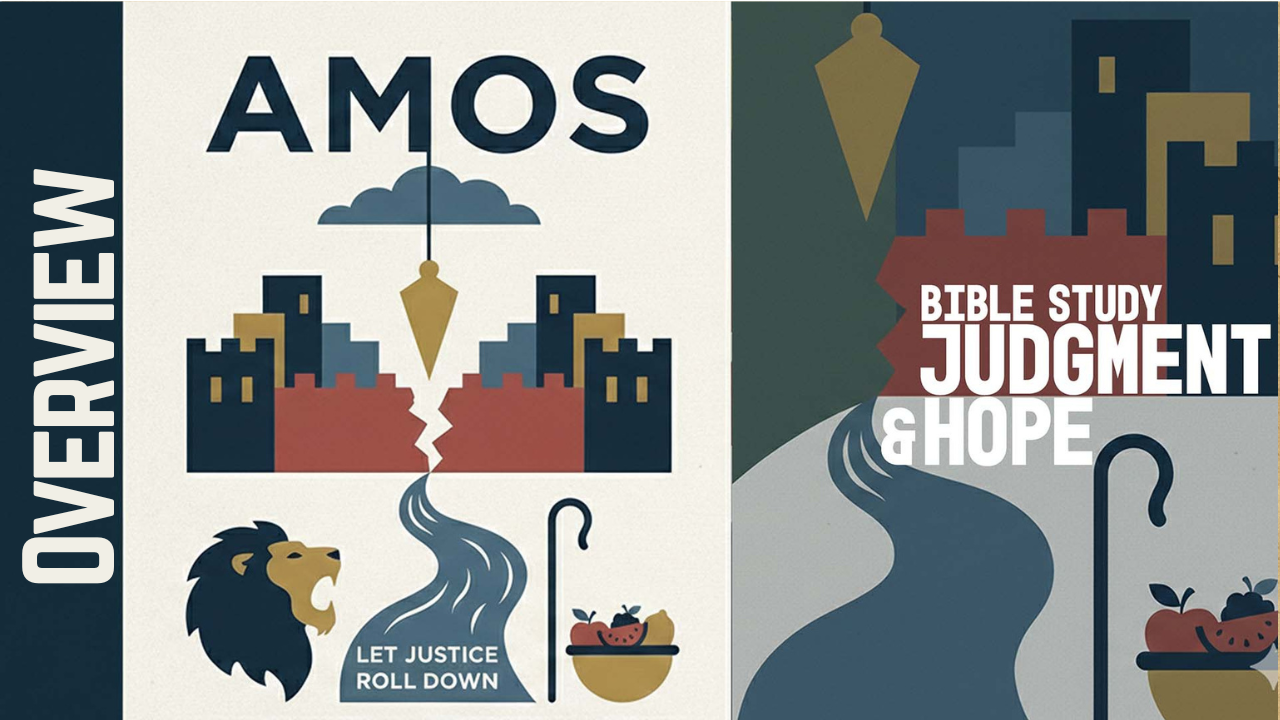
Amos Overview Class 1 - Bible Study
We launched our study of Amos with an overview, read the book aloud, and discussed true worship expressed through justice and righteousness, Israel’s hypocrisy and idolatry, God’s judgment, and hope of restoration.
Amos Overview
This is our 1st class on Amos
This is an AI Recap of the class.
Some things may be incorrect.
Short Summary of the Whole Class
We previewed Amos’s themes with a BibleProject overview, then read through the book, pausing to discuss judgments on surrounding nations and Israel, the critique of social injustice and hollow religion, visions of impending judgment, and a closing promise of restoration that includes the nations. We connected Amos’s call for justice and righteousness to Jesus’s cleansing of the temple and noted the historical setting under Jeroboam II and Uzziah.
Section-by-Section Walkthrough and Summaries
Opening Setup and Goals
We introduced Amos as the next study after Joel, planned to watch the BibleProject summary, and read the entire book of Amos in one sitting (~30 minutes).
Amos was framed as a countryside shepherd-fig farmer confronting urban complacency, well-known for “Let justice roll like waters” (Amos 5:24).
We connected the prophetic emphasis to the Kingdom of God’s priority of people over wealth or ritual.
Short summary:
We set the plan to watch an overview, read Amos fully, and focus on its timeless call to prioritize people through justice and righteousness.
Stories/Scriptures mentioned:
Amos 5:24.
Broader themes referenced: Joel; Revelation; Kingdom of God.
BibleProject Video Overview
Amos’s identity: shepherd and fig farmer from Tekoa near Judah/Israel border.
Historical context: Northern Kingdom under Jeroboam II; prosperity, idolatry, neglect of the poor; links to 1 Kings 12.
Structure:
Amos 1–2: oracles against nations, culminating with Israel.
Amos 3–6: poems exposing religious hypocrisy, social injustice, idolatry; call for justice and righteousness.
Amos 7–9: visions of judgment; final hope to restore David’s house and include the nations.
Key themes: religious hypocrisy, justice (mishpat) and righteousness (tzedakah), idolatry, Day of the Lord, hope of restoration.
Short summary:
The overview highlighted Amos’s background, structure, and central message: true worship must include justice and righteousness; idolatry and injustice bring judgment, yet God promises restoration.
Stories/Scriptures mentioned:
Amos 1; Jeroboam II; Uzziah.
1 Kings 12.
Amos 5:24; Amos 5; Amos 8–9; Amos 9:11–15.
Connection to Jesus and Temple Cleansing
We drew parallels between Amos’s critique of ritual without justice and Jesus overturning temple tables.
After cleansing, Jesus welcomes the poor and the lame, restoring the temple’s purpose.
Warning against treating worship like transactional penance rather than covenant faithfulness.
Short summary:
Amos’s indictment of hollow worship aligns with Jesus’s temple cleansing, emphasizing mercy, justice, and inclusion of the marginalized.
Stories/Scriptures mentioned:
Matthew 21:12–14; Mark 11:15–17; Luke 19:45–46.
Amos 5:21–24.
Reading Amos: Oracles Against the Nations (Amos 1–2)
Time markers: “days of Uzziah king of Judah” and “Jeroboam son of Joash king of Israel,” “two years before the earthquake” (Amos 1:1).
Opening image: “The Lord roars from Zion” (Amos 1:2).
Refrain: “For three transgressions … and for four, I will not revoke the punishment.”
Nations indicted:
Damascus/Aram (Amos 1:3–5).
Gaza/Philistia (Amos 1:6–8).
Tyre (Amos 1:9–10).
Edom (Amos 1:11–12).
Ammon (Amos 1:13–15).
The sequence circles Israel to set up Israel as the central target.
Short summary:
God’s judgments begin with neighboring nations for their atrocities, signaling His universal justice and preparing the confrontation with Israel.
Stories/Scriptures mentioned:
Amos 1:1–15 (Damascus, Gaza, Tyre, Edom, Ammon).
Israel in the Crosshairs and Covenant Responsibility (Amos 2–6)
Israel’s indictment:
Selling the righteous for silver, needy for sandals; trampling the poor; corrupt courts (Amos 2:6–7).
Sexual exploitation and profaning God’s name (Amos 2:7).
Idolatry and luxurious worship disconnected from justice (Amos 4–5).
Covenant reminder: chosen to bless the nations; greater responsibility (Amos 3:1–2; echo Genesis 12).
God rejects festivals and sacrifices when injustice persists (Amos 5:21–23).
Central call: “Let justice roll like waters, and righteousness like an ever-flowing stream” (Amos 5:24).
“Seek me and live” and “Seek good, not evil” (Amos 5:4, 6, 14).
Warning of the Day of the Lord as darkness (Amos 5:18–27); exile fulfilled later by Assyria.
Short summary:
Amos confronts Israel’s systemic injustice and hollow worship, urging them to seek God through justice and righteousness, lest the Day of the Lord bring judgment.
Stories/Scriptures mentioned:
Amos 2:6–8; Amos 3:1–2; Amos 4–5; Amos 5:4, 14, 18–27.
Genesis 12 (alluded).
1 Kings 12.
Visions of Judgment and Final Hope (Amos 7–9)
Visions:
Locusts (Amos 7:1–3).
Fire (Amos 7:4–6).
Plumb line (Amos 7:7–9).
Basket of summer fruit (Amos 8:1–3).
Striking the temple; none escape (Amos 9:1–4).
Amaziah’s opposition (Amos 7:10–17).
Final hope: restoration of David’s house; inclusion of the nations; renewal of land (Amos 9:11–15).
Short summary:
Amos’s visions depict imminent judgment yet end with hope: God will restore David’s house and gather a renewed, multi-nation people under His mercy.
Stories/Scriptures mentioned:
Amos 7:1–17; Amos 8:1–3; Amos 9:1–4, 11–15.
Amaziah confronting Amos (Amos 7:10–17).
Expanded Readings: Moab, Judah, and Israel (Amos 2:1–16)
Charges against Moab for desecrating Edom’s king’s bones; Judah for despising God’s law; Israel for exploiting the poor and embracing immorality and idolatry.
God recalls past grace: defeat of the Amorites, deliverance from Egypt, prophets and Nazarites; Israel silenced His messengers.
Judgment will be inescapable; even the strong won’t survive.
Short summary:
Past grace intensifies present accountability; Moab, Judah, and especially Israel are indicted for moral corruption and oppression.
Stories/Scriptures mentioned:
Amos 2:1–16.
Amorites; Exodus; prophets; Nazarites.
Agreement with God and Prophetic Inevitability (Amos 3:1–15)
“Can two walk together unless they are agreed?” emphasizes covenant responsibility.
Images of lion, snares, trumpets: judgment has a cause—Israel’s injustice.
God reveals plans to prophets; prophetic word compels proclamation.
Witness against Samaria’s violence; adversary will plunder palaces.
Bethel’s altars destroyed; luxury homes—winter, summer, ivory—ended.
Shepherd rescuing scraps illustrates a remnant.
Short summary:
Israel’s special calling brings stricter judgment; prophetic warning is compelled by God’s word; idolatry and luxury will be torn down.
Stories/Scriptures mentioned:
Amos 3:1–15.
Palace proclamations to Ashdod and Egypt; remnant image.
“Cows of Bashan” and Counterfeit Worship (Amos 4:1–13)
Wealthy oppressors warned of exile.
God catalogues corrective judgments—famine, drought, blight, mildew, locusts, plague, warfare, near-destruction like Sodom and Gomorrah—yet Israel did not return.
Climactic call: “Prepare to meet your God,” asserting His sovereignty over creation.
Short summary:
Despite repeated corrective judgments, Israel refused to return; God summons them to meet Him, the Creator and Judge.
Stories/Scriptures mentioned:
Amos 4:1–13.
Droughts; echoes of Egypt’s plagues; Sodom and Gomorrah.
Seek the Lord and Live; Justice vs. Empty Religion (Amos 5:1–27)
Lament over Israel’s fall; call to seek the Lord, not sanctuaries (Bethel, Gilgal, Beersheba).
Condemnation of social sins: trampling the poor, taking bribes, perverting justice.
Commands: “Seek good, not evil,” “Hate evil, love good,” “Establish justice in the gate.”
Warning: the Day of the Lord is darkness for the unrepentant.
God rejects hollow worship; demands justice to roll down and righteousness to flow.
Short summary:
Life is found in seeking God with justice; the Day of the Lord brings doom for the unrepentant; God despises worship without righteousness.
Stories/Scriptures mentioned:
Amos 5:1–27.
Images of fleeing lion then bear; serpent bite at home.
Woe to Complacent Luxury; Certainty of Judgment (Amos 6:1–14)
Critique of indulgence—beds of ivory, music, bowls of wine, fine ointments—paired with indifference to “the affliction of Joseph.”
God swears to deliver the city; devastation will be comprehensive.
Parables: horses running on rocks; plowing rock—exposing the absurdity of turning justice into gall and righteousness into wormwood.
Human boasting rebuked; God will raise a nation to humble Israel.
Short summary:
Arrogant ease blinds Israel to injustice; God will overturn pride and bring pervasive judgment.
Stories/Scriptures mentioned:
Amos 6:1–14.
Calneh, Hamath, Gath; funerary scenes of silent dread.
Visions: Intercession and Conflict with Amaziah (Amos 7:1–17)
Locusts and fire visions lead Amos to intercede; God relents.
Plumb line: God measures moral straightness; declares He will no longer pass by.
Sanctuaries and house of Jeroboam face the sword.
Amaziah accuses Amos; Amos recounts his calling as shepherd and sycamore dresser; prophesies judgment on Amaziah’s household and Israel’s exile.
Short summary:
God hears intercession but ultimately judges; true prophetic calling stands firm against religious and political pressure.
Stories/Scriptures mentioned:
Amos 7:1–17.
Amos’s rural vocation; royal and priestly opposition.
Vision of Summer Fruit and a “Famine” of God’s Word (Amos 8:1–14)
Basket of summer fruit signals “the end.”
Economic exploitation: dishonest scales, selling bad wheat, buying the needy for sandals.
Cosmic signs: midday darkness; universal mourning.
A unique judgment: famine of hearing God’s word; seekers won’t find it.
Idol-swearers will fall.
Short summary:
Exploitation brings physical and spiritual catastrophe; the worst famine is the silence of God’s word.
Stories/Scriptures mentioned:
Amos 8:1–14.
Marketplace deceit; noon-day darkness; spiritual drought.
Final Vision: Inescapable Judgment and Promised Restoration (Amos 9:1–15)
God stands by the altar and commands judgment—no escape by depth, height, mountain, sea, or captivity.
God’s sovereignty over nations noted; sifting comes: sinful kingdom destroyed, but house of Jacob not utterly destroyed.
Hope: raise the fallen “booth/tabernacle of David,” include Gentiles called by His name, era of abundance—plowman overtaking reaper, mountains dripping sweet wine.
Exiles return; cities rebuilt; vineyards planted; people planted permanently.
Short summary:
Judgment is thorough yet not total; God preserves a remnant and promises messianic restoration that embraces the nations and renews the land.
Stories/Scriptures mentioned:
Amos 9:1–15.
Thresholds shaken; cosmic pursuit; agricultural overflow; rebuilding cities.
Additional Thematic Links and Notes
Amos’s humble origins (Amos 7:14); God uses unexpected people.
Parallels with Isaiah and Joel’s “Day of the Lord” imagery; Revelation’s patterns (seven churches; scales).
Amos and Job connections: creation tour rhetoric (Job 38–41).
Intercession parallels: Abraham for Sodom (Genesis 18).
Textual note flagged: “days” vs. “years” in Amos 4:4 (to be studied further).
Zacchaeus (Luke 19) referenced as an example of unexpected people God uses.
Contemporary analogy: Hunger Games’ Capitol excess illustrating exploitative luxury.
Short summary:
We noted cross-canonical echoes, Amos’s humble calling, intercessory patterns, a translation nuance, and used modern imagery to illuminate prophetic critique.
Stories/Scriptures mentioned:
Amos 7:14.
Isaiah (unspecified), Joel (unspecified).
Job 38–41.
Genesis 18.
Revelation 2–3; Revelation 6.
Luke 19.
Amos 4:4.
Medium-Length Summary of the Class
Our study journeyed through Amos’s oracles and visions, revealing a God who holds both the nations and His covenant people accountable for injustice, idolatry, and hypocrisy. After a BibleProject overview, we read the book aloud, noting the opening judgments on surrounding nations that crescendo into a focused indictment of Israel’s exploitation of the poor, corrupt courts, and luxury cloaked in religious ritual. Amos insists that true worship is inseparable from justice and righteousness, calling the people to “seek the Lord and live” and warning that the Day of the Lord will be darkness for the unrepentant. We traced the visions—from intercession and relenting (locusts, fire) to measurement and inescapable judgment (plumb line, collapsing temple)—and observed resistance from Amaziah. The study closed with hope: God will raise the fallen house of David, include the nations, and bring abundant renewal. Throughout, we connected Amos’s critique to Jesus’s cleansing of the temple, explored cross-links with Job, Joel, and Revelation, and highlighted that covenant privilege increases responsibility. Genuine faith, we concluded, is measured by how we treat people.
Main Points
Amos confronts social injustice and religious hypocrisy, especially among Israel’s wealthy and leaders.
True worship demands justice (mishpat) and righteousness (tzedakah) flowing through community life.
Israel’s covenant calling carries greater responsibility; betrayal invites judgment.
Idolatry corrodes moral life and leads to oppression and empty ritual.
The Day of the Lord brings real consequences for the unrepentant, yet God’s long-term purpose is restoration.
Jesus’s temple cleansing echoes Amos’s concern: worship must serve people and reflect God’s justice.
Prophetic visions move from intercession and relenting to measurement and certain judgment, ending with hope.
Silencing God’s word leads to a spiritual famine more devastating than physical lack.
Restoration includes the nations under the restored “house/tabernacle of David.”
Scriptures Mentioned
Amos 1:1–2
Amos 1:3–15
Amos 2:1–16
Amos 2:6–8
Amos 3:1–15
Amos 4:1–13
Amos 4:4
Amos 5:1–27
Amos 5:4, 6, 14
Amos 5:18–27
Amos 5:21–24
Amos 5:24
Amos 6:1–14
Amos 7:1–17
Amos 7:14
Amos 8:1–14
Amos 9:1–4
Amos 9:11–15
1 Kings 12
Genesis 12 (alluded)
Genesis 18
Matthew 21:12–14
Mark 11:15–17
Luke 19:45–46
Luke 19
Job 38–41 (implied parallels)
Isaiah (unspecified passages)
Joel (unspecified passages)
Revelation 2–3
Revelation 6
Stories Mentioned
Amos’s background as a shepherd and fig farmer from Tekoa (Amos 7:14).
Surrounding nations’ injustices and God’s judgments against them.
Israel’s systemic exploitation of the poor and legal corruption.
Jesus overturning the money changers’ tables and welcoming the needy into the temple.
Amos’s confrontations and visions (locusts, fire, plumb line, summer fruit, collapsing temple).
Amaziah opposing Amos.
The defeat of the Amorites and the Exodus from Egypt; prophets and Nazarites resisted.
“Cows of Bashan” (wealthy oppressors); repeated corrective calamities; echoes of Sodom and Gomorrah.
Lament imagery: fleeing a lion, meeting a bear; serpent bite at home.
Luxury and complacency—beds of ivory, music, bowls of wine—ignoring Joseph’s affliction.
Famine of hearing God’s word; marketplace deceit; noon-day darkness.
Restoration promises: raising the “house/tabernacle of David”; inclusion of the nations; agricultural abundance; rebuilding cities.
Zacchaeus (Luke 19) as an example of unexpected people God uses.
Contemporary illustration: Hunger Games’ Capitol excess as a mirror of exploitative luxury.