
Mark Chapter 9-10 Class 16 - Wednesday Bible Study
Gospel of Mark Chapter 9-10
This is our 16th class on Mark
This is an AI Recap of the class.
Some things may be incorrect.
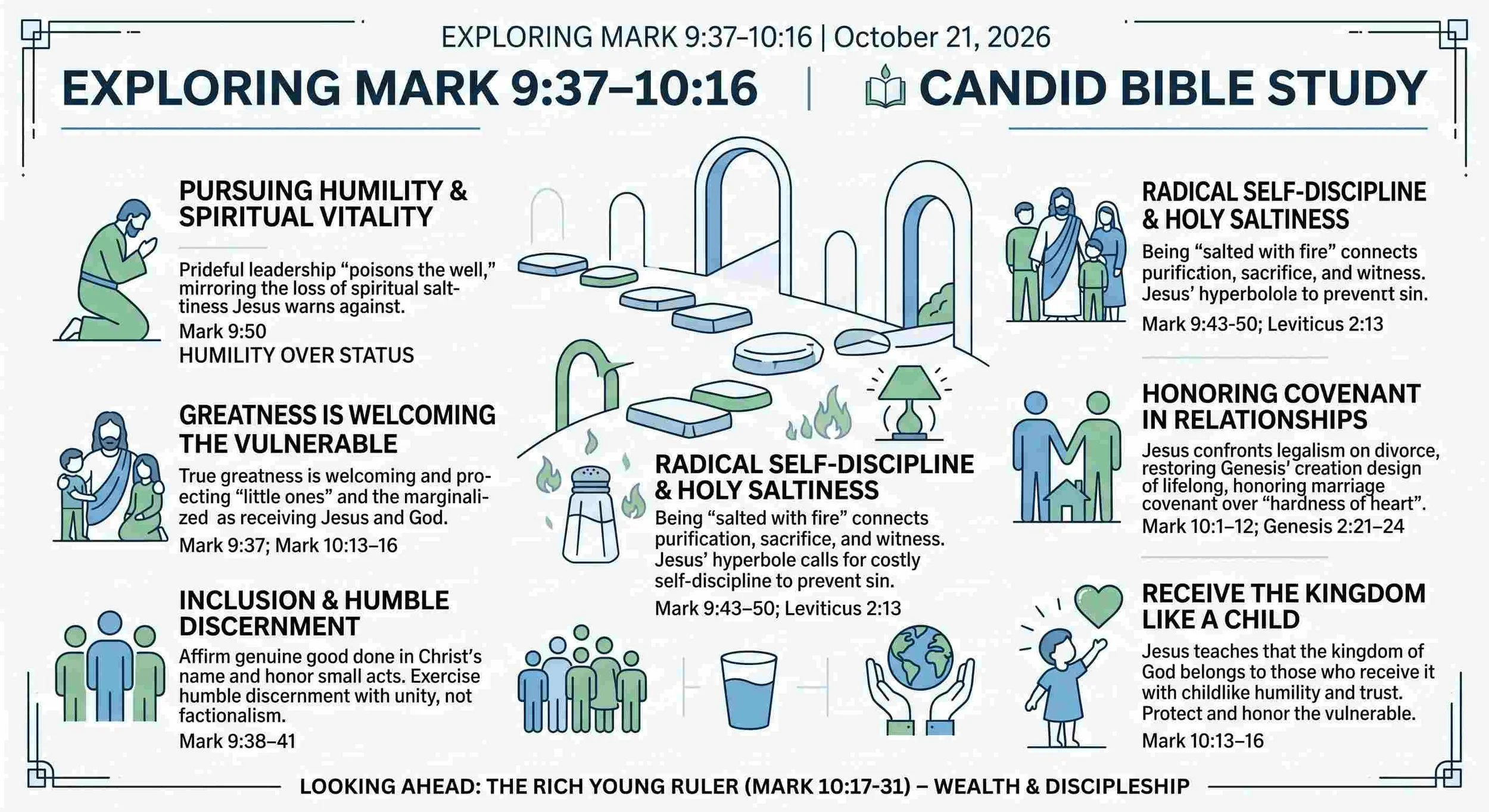
Short summary of the whole class
Beginning at 6:40:11 PM local time on October 21, 2026, the class traced Mark 9:37–50 into Mark 10:1–16, emphasizing humility over status, prayer and fasting, welcoming the vulnerable, and maintaining Christian “saltiness.” We examined warnings against causing “little ones” to stumble, Jesus’ hyperbolic calls to radical self-discipline, sacrificial salt imagery, and peacemaking in community. Then we connected these themes to Jesus’ teaching on marriage and divorce, grounding it in Genesis’ creation design, and to receiving the kingdom like children. The group also discussed discerning ministries done “in Jesus’ name” outside our circle, honoring sincere good while rejecting deceit, and previewed the rich young ruler.
Section-by-section walkthrough with timestamps, summaries, verses, and stories
1) “Poisoning the well” and losing saltiness (18:40–18:48, October 21, 2026)
Discussion: The class opened by talking about harmful leadership behaviors that “poison the well,” linking this to Jesus’ warning about losing saltiness. Pride and pursuit of status were identified as corrosive to community health and witness.
Key ideas: Saltiness as moral distinctiveness and communal preservation; ambition and pride undermine care for others.
Bible verses: Mark 9:50 (“Have salt among yourselves, and be at peace with one another.”).
Stories: General image of harmful leadership in religious contexts.
Short summary: Prideful leadership “poisons the well,” mirroring the loss of saltiness Jesus warns against.
2) Context recap: the demon-possessed boy and prayer/fasting (around 18:48–18:53)
Discussion: We recalled Mark 9:14–29—Jesus heals a demon-possessed boy after the disciples fail; Jesus says this kind only comes out by prayer (and fasting). The group contrasted expectations of a political/military messiah with Jesus’ way of humble dependence and suffering.
Themes: Humility; dependence on God; prayer and fasting as posture of trust rather than force.
Bible verses: Mark 9:14–29 (esp. 9:28–29); Mark 9:30–32 (death and resurrection predictions).
Stories: The healing of the boy; disciples’ failure and question.
Short summary: Prayer and fasting frame Jesus’ mission and ours—victory comes through humble dependence, not status or force.
3) Who is the greatest? Welcoming children equals welcoming Jesus (around 18:53–18:58)
Discussion: The disciples ask who is greatest; Jesus sets a child among them and teaches that welcoming a child in his name is welcoming Jesus and the Father. We noted the disciples’ shame and Jesus’ reframing of greatness.
Themes: True greatness through humble welcome; honoring the least.
Bible verses: Mark 9:33–37 (esp. 9:37).
Stories: Jesus placing a child in the midst as a living parable.
Short summary: Greatness in God’s kingdom is measured by welcoming the least—receiving a child is receiving God.
4) Jesus welcomes children; church analogies (18:53–18:58)
Discussion: In light of Jesus welcoming children, the class examined church-life analogies: would a congregation shoo away needy people during an event? Members shared candid observations of how their church (Grace) might respond—some would bring food, others might turn away after repeated requests.
Themes: Guarding against “busy, important” attitudes; practical compassion.
Bible verses: Mark 10:13–16.
Stories: Hypothetical scenario of homeless visitors during a church anniversary (responses by “Kevin” and “Betsy”).
Short summary: Communities must resist busyness that excludes the vulnerable; welcoming the least is central to discipleship.
5) “They’re not part of us”: Inclusion, small acts, and discernment (18:58–19:08)
Discussion: The disciples complain about others casting out demons who aren’t “with us.” Jesus affirms that anyone doing good in his name is not against him and honors even small acts like giving a cup of water. The group broadened this to discerning ministries done “in Jesus’ name” today—affirm sincere, fruitful works and reject scams and harm, trusting God to judge intentions.
Themes: Unity, generosity, rejecting factionalism; humility; fruit and intention as discernment criteria.
Bible verses: Mark 9:38–41; Mark 3:22–27 (“a kingdom divided cannot stand”); Mark 9:14–29 (disciples’ prior failure as context).
Stories: Outsiders casting out demons; the “cup of water” image; weekly prayers for neighboring churches (e.g., Sunlight) and for the president as practices of humility.
Short summary: Don’t gatekeep God’s work—affirm genuine good done in Christ’s name, honor small acts, and exercise humble discernment.
6) Causing “little ones” to stumble, millstones, and the sea as chaos (around 19:08–19:10 and earlier within Mark 9 discussion)
Discussion: Jesus warns that causing “little ones” who believe in him to stumble merits severe judgment—better a millstone and drowning. We explored the biblical symbolism of the sea as chaos and danger, drawing from creation’s “formless and void” and references to Leviathan, and noted Jesus walking on the sea as mastery over chaos.
Themes: Seriousness of harming the vulnerable; the gravity of scandal; Jesus’ authority over chaos.
Bible verses: Mark 9:42; Genesis 1:2; Job 41; Psalm 74:13–14; Isaiah 27:1.
Stories: Millstone imagery; personal anecdotes about fear of deep water while water skiing; Jesus walking on the sea.
Short summary: Leading the vulnerable into sin is gravely serious; sea imagery underscores the danger that Jesus overcomes.
7) “If your hand causes you to sin…” Hyperbole, humility, and Gehenna (within the Mark 9 sequence)
Discussion: We examined Jesus’ drastic language—cutting off hand/foot, plucking out eye—and asked what sins he has in view, connecting it to pride and harming “little ones.” We noted Gehenna’s background and that lowering one’s “station” (even becoming maimed) is preferable to causing others to stumble.
Themes: Radical self-examination; costly self-discipline; humility over status; protecting the vulnerable.
Bible verses: Mark 9:43–48; Gehenna references; immediate context around stumbling blocks.
Stories: Cultural punishments; community applications about work and “station.”
Short summary: Jesus’ hyperbole calls for costly self-discipline—better to lose status or privilege than lead others astray.
8) Textual notes: “Where their worm does not die…” repetitions (within the Mark 9 sequence)
Discussion: We compared translations—KJV repeats “where their worm does not die and the fire is not quenched” three times, while many modern translations include it once due to manuscript traditions. We discussed verse numbering quirks and pastoral reasons for repetition.
Themes: Trustworthy Scripture despite textual variants; pastoral communication.
Bible verses: Mark 9:44, 46, 48 (textual variants).
Stories: Translation history and manuscript practice notes.
Short summary: Variations in repetition and numbering reflect manuscript practices and pastoral emphasis, not unreliability.
9) “Salted with fire” and sacrificial salt (within the Mark 9 sequence, bridging to Mark 10)
Discussion: “Everyone will be salted with fire” and “every sacrifice will be salted with salt” were explored via Greek terms and sacrificial requirements in Leviticus 2:13. We discussed salt’s roles (preservation, value; “salary” from salt in Roman pay) and evocative OT imagery like Lot’s wife. We noted Jesus’ provocative style that shakes listeners awake and connected salt to Christian witness.
Themes: Purification, preservation, costliness of discipleship; communal faithfulness; witness and moral distinctiveness.
Bible verses: Mark 9:49–50; Leviticus 2:13; Genesis 19:24–26; Matthew 5:13–14.
Stories: Roman soldiers paid in salt; Lot’s wife turning into a pillar of salt; a preacher compromising witness at a nightclub.
Short summary: Being “salted with fire” blends purification and sacrifice—disciples preserve holiness and witness within the community.
10) Marriage, divorce, and the “two become one” lens (approximately 18:48–18:53; expanded in Mark 10:1–12)
Discussion: The class connected saltiness to how relationships are treated, warning against exploiting and discarding people. In Mark 10:1–12, the Pharisees test Jesus about divorce. Jesus points back to Genesis, showing Moses permitted certificates of divorce due to hardness of heart, often as protection for vulnerable women. We compared this misuse to the Corban loophole that neglected parents.
Themes: Hardness of heart vs. God’s design; honoring covenant; rejecting legalistic loopholes; protecting the vulnerable.
Bible verses: Mark 10:1–12; Deuteronomy 24:1–4; Mark 7:9–13 (Corban); Exodus 7–11 (Pharaoh’s hardened heart).
Stories: Moses granting certificates of divorce; cultural obligations regarding widows and family support.
Short summary: Jesus confronts legalism that weaponizes the law—God’s design aims at lifelong, honoring covenant; hardness of heart exploits people.
11) Genesis, God’s design, and the creation of woman (within the Mark 10 discussion)
Discussion: We explored Genesis 2, which Jesus quotes, noting the Hebrew word “tsela” meaning “side,” not simply “rib.” Across translations (Hebrew to Greek to Latin to KJV), “rib” gained popularity, but the imagery is of two equal halves becoming one whole. Flippant divorce tears apart what God joined, serving status rather than covenant.
Themes: Sacred union; equality and partnership; theological grounding for marriage.
Bible verses: Genesis 2:21–24; Mark 10:6–9.
Stories: The creation of Adam and Eve; references to the sides of the Ark of the Covenant and the tabernacle; pop-culture nod to Indiana Jones finding the Ark.
Short summary: Genesis portrays marriage as a sacred union of equal halves; Jesus restores God’s intent against status-driven disposal.
12) Little children and church discipline (Mark 10:13–16; around 18:53–18:58)
Discussion: The disciples rebuke families bringing children; Jesus becomes indignant and insists the kingdom belongs to those who receive it like a child. We linked children, women, and the marginalized, discussing modern applications of church discipline aimed at protecting vulnerable family members rather than controlling them.
Themes: Childlike humility; protecting and honoring the vulnerable; dismantling religious hypocrisy.
Bible verses: Mark 10:13–16.
Stories: Jesus welcoming and blessing the children; a hypothetical pastoral scenario involving church discipline and care for a divorced family.
Short summary: The kingdom belongs to the humble and vulnerable; churches must practice discipline and care that protects rather than weaponizes doctrine.
13) Looking ahead: The rich young ruler and Mark’s momentum (19:08–19:10)
Discussion: The next session will cover the rich young ruler (Mark 10:17–31), a culmination of themes—wealth, discipleship, and what hinders following Jesus—as Mark’s narrative moves swiftly toward Jesus’ passion.
Themes: Costly discipleship; obstacles of wealth; narrative momentum toward the cross.
Bible verses: Mark 10:17–31 (preview).
Stories: Preview only.
Short summary: We set up next week’s focus on wealth and discipleship as Mark accelerates toward Jesus’ arrest.
Medium-length summary of the class
On October 21, 2026, starting at 6:40:11 PM local time, the class moved through Mark 9:37–50 into Mark 10:1–16, tying humility, prayer, fasting, and “saltiness” to discipleship and community life. We began by warning against prideful leadership that “poisons the well,” then revisited the demon-possessed boy to highlight dependence on God through prayer and fasting. Jesus redefined greatness by welcoming children and approving outsiders who act in his name, urging discernment that honors genuine good while rejecting deceit. Severe warnings against causing “little ones” to stumble led to rich biblical imagery—the sea as chaos, Leviathan, and Gehenna—and Jesus’ hyperbolic calls to radical self-discipline. “Everyone will be salted with fire” connected sacrificial purity, preservation, and witness, reinforced by Leviticus and evocative stories like Lot’s wife. Turning to Mark 10, we examined marriage and divorce through Genesis’ design: Moses’ concession addressed hardness of heart, but Jesus restores the sacred union of equal halves and denounces legalistic loopholes, akin to Corban. Finally, Jesus’ welcome of little children anchored the call to receive the kingdom with humility and to protect the vulnerable. We closed by previewing the rich young ruler, anticipating deeper exploration of wealth and costly discipleship.
Main points
Prayer and fasting express humble dependence and are essential for spiritual victory.
True greatness is measured by welcoming and protecting “little ones,” not by status.
Don’t exclude those doing good in Jesus’ name; honor even small acts of service done sincerely.
Causing believers to stumble is gravely serious; resist pride that harms the vulnerable.
Jesus’ hyperbolic language calls for costly self-discipline to prevent sin and scandal.
Scriptural textual variants (Mark 9) reflect manuscript practices without undermining trust.
“Salted with fire” connects to purification, sacrifice, witness, and communal peace.
Jesus’ teaching on marriage confronts hardness of heart and restores Genesis’ design.
The kingdom belongs to those who receive it like children; protect and honor the vulnerable.
Practice humility by praying for other churches and leaders; evaluate fruit and intentions, not status.
Mark’s narrative is moving toward the cross; the rich young ruler will spotlight costly discipleship.
Bible Scriptures mentioned
Mark 9:14–32 — Healing the demon-possessed boy; prayer/fasting; death and resurrection prediction.
Mark 9:33–41 — Greatness; welcoming children; outsiders casting out demons; cup of water.
Mark 9:42–50 — Stumbling blocks; millstone; sea; Gehenna; worm/fire; salted with fire; peace.
Mark 9:44, 46, 48 — Textual variants on “their worm does not die and the fire is not quenched.”
Mark 3:22–27 — A kingdom divided against itself cannot stand.
Mark 10:1–12 — Pharisees testing Jesus about divorce.
Mark 10:6–9 — Genesis quoted on creation and marriage.
Mark 10:13–16 — Jesus welcomes and blesses little children.
Mark 10:17–31 — Rich young ruler (preview).
Genesis 1:2 — Formless and void; sea as primordial chaos.
Genesis 2:21–24 — Creation of woman from man’s “side”; two become one flesh.
Genesis 19:24–26 — Sodom and Gomorrah; Lot’s wife as pillar of salt.
Deuteronomy 24:1–4 — Certificates of divorce.
Leviticus 2:13 — Every sacrifice seasoned with salt.
Matthew 5:13–14 — Salt of the earth; light of the world.
Mark 7:9–13 — Corban tradition overriding care for parents.
Exodus 7–11 — Pharaoh’s hardened heart.
Job 41; Psalm 74:13–14; Isaiah 27:1 — Leviathan references.
Stories and examples discussed
Healing of the demon-possessed boy in Mark 9; disciples’ failure and Jesus’ instruction on prayer/fasting.
Jesus welcoming a child as the model of greatness.
Outsiders casting out demons in Jesus’ name; “cup of water” image.
Millstone and the sea imagery as severe warning; Jesus walking on the sea and mastery over chaos.
Personal anecdote about fear of deep water while water skiing.
Roman soldiers paid in salt (origin of “salary”); Lot’s wife turning into a pillar of salt; a preacher at a nightclub compromising witness.
Moses permitting certificates of divorce; cultural obligations regarding widows and family support.
Creation of Adam and Eve; “tsela” as “side”; references to the Ark and tabernacle sides; Indiana Jones finding the Ark (pop-culture nod).
Hypothetical church scenarios: homeless visitors during an anniversary; differing responses (e.g., “Kevin” and “Betsy”).
Weekly prayers for neighboring churches (e.g., Sunlight) and for the president as acts of humility.
Preview of the rich young ruler as a case study in wealth and discipleship.