
Mark Chapter 8 Class 13 - Wednesday Bible Study
Gospel of Mark Chapter 8
This is our 13th class on Mark
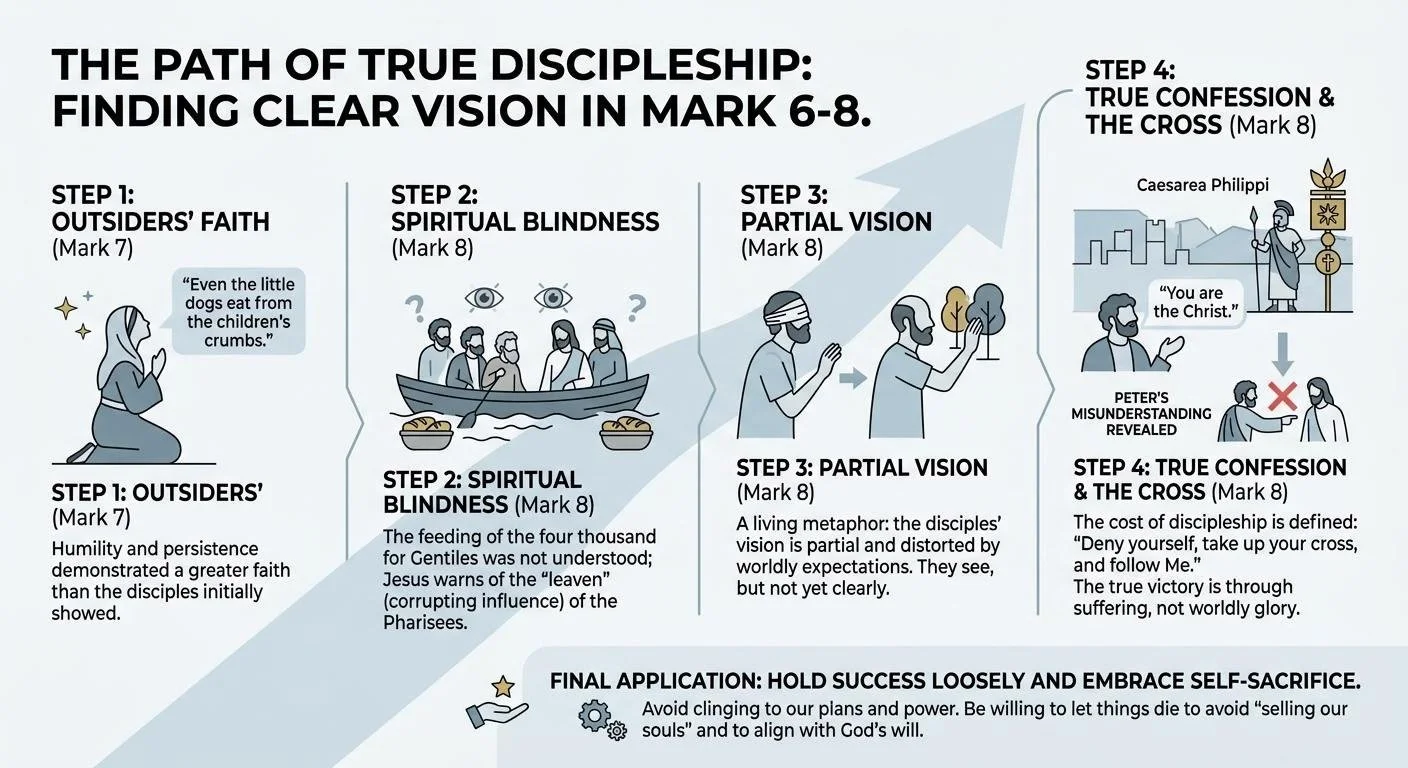
This is an AI Recap of the class.
Some things may be incorrect.
Short Summary of the Class
During our Bible study on September 17, 2026, we traced the theme of spiritual blindness and gradual revelation through Mark chapters 6-8. We began with stories of Gentiles, like the Syrophoenician woman, who showed greater insight than the disciples. The discussion then moved to the feeding of the four thousand, a miracle for the Gentile world that the disciples failed to comprehend, prompting Jesus's warning about the "leaven of the Pharisees." This spiritual dullness was paralleled in the two-stage healing of the blind man at Bethsaida, a metaphor for the disciples' own partial understanding. The lesson culminated at Caesarea Philippi, where Peter correctly identified Jesus as the Christ but immediately rejected the idea of a suffering Messiah, revealing his worldly mindset. This led Jesus to teach the true cost of discipleship: to deny oneself, take up one's cross, and follow Him.
Detailed Class Summary
Reviewing Mark 6 & 7: Outsiders Begin to See
The class began by contextualizing the upcoming passages, recapping the events following the beheading of John the Baptist in Mark 6. We noted the sequence: the feeding of the five thousand in a Jewish region, followed by Jesus walking on the sea and chastising the disciples for their hardened hearts. This led into a review of Jesus’s teaching on defilement coming from within, not from what is consumed.
We then reread the story of the Syrophoenician woman from Mark 7:24-30. This was a crucial moment in Mark's narrative. The discussion highlighted that Jesus's interaction with her, where he refers to Gentiles as "little dogs," sets up a powerful contrast. Her humble and witty response—"Yet even the little dogs under the table eat from the children's crumbs"—demonstrated a faith and understanding that the disciples lacked. It was pointed out that in Mark's Gospel, there are three types of power at play: personal (the disciples trying to send people away), religious (the Pharisees), and political (Herod). This woman, possessing none of these, subverts them all by simply accepting her position and petitioning Jesus in faith. Her story serves as a metaphor for the spiritually "deaf and mute" Gentiles who are beginning to hear and speak righteousness, while those who should understand remain blind. This idea was reinforced by the subsequent healing of the deaf man with a speech impediment (Mark 7:31-37), where the crowd is "astonished beyond measure"—a word often linked in Mark to the awe of the resurrection. We also connected her persistence to the Old Testament story of Jacob wrestling with God, arguing that faith often involves struggle and angst to receive a blessing.
Summary of Section: This section revisited key events in Mark to establish a theme: those considered outsiders, like the Syrophoenician woman, are demonstrating greater spiritual insight than Jesus's own disciples. Their stories illustrate that faith, not status or power, is what matters, and the spiritually "deaf" are beginning to hear.
Bible Verses: Mark 7:24-30, Mark 7:31-37
Bible Stories: The Syrophoenician Woman, Jesus Heals a Deaf and Mute Man, Beheading of John the Baptist (Mark 6), Feeding of the Five Thousand (Mark 6), Jacob wrestling with God (Genesis 32)
Mark 8: Feeding the Four Thousand and the Leaven of the Pharisees
Moving into Mark chapter 8, we read the account of the feeding of the four thousand (Mark 8:1-10). The class discussed the significance of this second feeding miracle. While the feeding of the five thousand took place in a Jewish region and likely symbolized the Pentateuch (the first five books of the law), this feeding of four thousand took place in a Gentile region. The number four was interpreted as representing the "four corners of the world," symbolizing that Jesus's provision is for everyone, not just the Jews. Similarly, the seven loaves used were seen as a symbol of completion and creation, further underscoring the universal scope of this miracle.
Despite witnessing this second incredible act of provision, the disciples immediately worry about having no bread in the boat. Their forgetfulness and hardened hearts are a recurring theme, and we noted their persistent need for a sign, similar to the Pharisees. We discussed that faith is a prerequisite for miracles to take root, like seed needing good soil. Jesus uses their anxiety to warn them, "Beware of the leaven of the Pharisees and the leaven of Herod" (Mark 8:15). He isn't talking about literal bread but about the corrupting influence of religious and political power structures that seek signs yet remain blind. The class found humor in the disciples' literal interpretation: "Is it because we have no bread?" (Mark 8:16). Jesus explicitly rebuked them for their spiritual dullness, reminding them of the twelve and seven baskets of leftovers from the two feedings and asking, "Do you have eyes but fail to see, and ears but fail to hear?" (Mark 8:18).
Summary of Section: The feeding of the four thousand symbolizes Jesus's ministry extending to the Gentiles. The disciples’ failure to understand this, focusing instead on physical bread, reveals their spiritual blindness and prompts Jesus's warning against the corrupting "leaven" (influence) of the Pharisees and Herod.
Bible Verses: Mark 8:1-10, Mark 8:11-21, Mark 8:15, Mark 8:16, Mark 8:18
Bible Stories: The Feeding of the Four Thousand, The Pharisees Demand a Sign, The Leaven of the Pharisees and Herod
The Blind Man at Bethsaida: A Metaphor for the Disciples
The final passage discussed was the unique healing of the blind man at Bethsaida (Mark 8:22-26). Unlike other miracles, this healing happens in two stages. After Jesus's first touch, the man sees people who look "like trees walking" (Mark 8:24). Only after a second touch is his sight fully restored. The class interpreted this two-stage healing as a direct metaphor for the disciples' own spiritual condition. Just as the blind man first saw things unclearly, the disciples were beginning to see who Jesus was, but their vision was still blurry and distorted by worldly expectations. Their understanding, like the blind man's sight, needs a second touch before it is complete. This story perfectly illustrates the disciples' partial-but-not-yet-complete grasp of who Jesus is, setting the stage for Peter's upcoming confession.
Summary of Section: The two-stage healing of the blind man serves as a powerful metaphor for the disciples' partial spiritual sight. They are no longer completely blind, but they do not yet see clearly. It required a second touch, or further revelation, for them to see Jesus and His mission clearly, moving from partial belief to full clarity.
Bible Verses: Mark 8:22-26, Mark 8:24
Bible Stories: Jesus Heals a Blind Man at Bethsaida
Peter's Confession and the Revelation of the Cross
The climax of our discussion was Peter’s great confession at Caesarea Philippi (Mark 8:27-38). The setting was significant; a city named for Caesar, a symbol of earthly power. In this context, Jesus asked his disciples, "Who do people say that I am?" Their answers—"John the Baptist," "Elijah," or "one of the prophets"—were a direct quote from what Herod's court had said (Mark 6:14-15), linking their view to the perspective of worldly rulers.
Against this backdrop, Peter boldly declared, "You are the Christ" (Mark 8:29). However, his vision was still blurry. The moment Jesus began to teach "openly" that He must suffer, be rejected, and be killed, Peter's dream of a political Messiah crumbled. He rebuked Jesus, essentially telling Him to stop talking that way. Jesus’ sharp response, "Get behind me, Satan! For you are not mindful of the things of God, but the things of men" (Mark 8:33), revealed that Peter’s idea of a king was a worldly one. He saw the title but rejected the suffering. The term "Satan" was identified as meaning "adversary," showing Peter’s perspective was adversarial to God’s plan.
Jesus then taught the crowd and his disciples the true meaning of following him: to deny oneself, take up one's cross, and lose one's life for the sake of the gospel to truly save it (Mark 8:34-38). We noted the irony that Peter, who would later deny Jesus to save his own life, is the one whose Gospel records these words, and whose eventual restoration proves their ultimate truth.
Summary of Section: At Caesarea Philippi, Peter correctly identified Jesus as the Christ but immediately failed to understand the nature of His kingship, rejecting the idea of a suffering Messiah. Jesus corrected this by teaching that true discipleship involves embracing sacrifice and the cross, not seeking worldly glory.
Bible Verses: Mark 8:29, Mark 8:32, Mark 8:33, Mark 8:34, Mark 8:34-38, Mark 6:14-15 (referenced), Matthew 16:18 (referenced)
Bible Stories: Peter's Confession at Caesarea Philippi, Jesus' first prediction of his death and resurrection, Peter's Denial of Jesus (referenced)
Applying the Lesson to Our Lives
Finally, we discussed how to apply this lesson. The core principle is that nothing—not even the church or its programs—is "above death." We can become so focused on preserving what is "working" that we act in un-Christlike ways to protect it. Sometimes, for new things to grow, other things must be allowed to die. Holding on too tightly to our plans, traditions, or successes can suffocate them. This reflects Peter's error: he was holding so tightly to his vision of a victorious kingdom that he tried to prevent the very act—the crucifixion—that would bring about God’s true victory.
Summary of Section: The lesson from Peter's failure teaches us to hold our plans, successes, and even our lives loosely. We must be willing to let things "die" to align with God's will, ensuring our actions are motivated by service rather than a desire to preserve power or control.
Final Summary
Our Bible study on September 17, 2026, focused on a pivotal section in Mark's Gospel (chapters 6-8) where the theme of spiritual blindness and dawning revelation is central. We began by reviewing stories of Gentiles, like the Syrophoenician woman, who demonstrated a profound understanding of Jesus that eluded the disciples. The primary focus then shifted to the feeding of the four thousand in a Gentile region, a clear sign that Jesus’s kingdom was for all people. However, the disciples immediately forgot the lesson and worried about their lack of bread, prompting Jesus to warn them against the "leaven of the Pharisees and Herod"—the corrupting influence of power that blinds people to God's work.
This theme was powerfully illustrated by the two-stage healing of the blind man at Bethsaida, presented as a living parable for the disciples’ own partial, distorted vision of Jesus and his mission. The narrative culminated at Caesarea Philippi, where Peter made his monumental confession, "You are the Christ." While correct in title, Peter’s understanding was proven partial when he rebuked Jesus for predicting His passion and death, revealing his worldly expectations. Jesus’ subsequent teaching on the necessity of taking up one’s cross defined true discipleship not as a path to earthly power, but as a journey of self-denial and sacrifice. We concluded by applying this to our own lives, recognizing the danger of holding too tightly to our own ambitions and the necessity of letting things die so that God’s will can be done.
Main Points
The Syrophoenician woman, a Gentile, shows greater faith and understanding than the disciples.
The feeding of the five thousand was primarily for the Jews (symbolized by 5), while the feeding of the four thousand was for the Gentiles/the world (symbolized by 4).
The disciples repeatedly demonstrate spiritual blindness, failing to understand the significance of the miracles and focusing on physical concerns over spiritual truths.
Jesus's warning about "leaven" refers to the corrupting influence of religious and political powers (Pharisees and Herod).
The two-stage healing of the blind man at Bethsaida is a metaphor for the disciples' partial and incomplete spiritual understanding.
Peter’s confession of Jesus as "the Christ" is a pivotal moment, yet his understanding is incomplete, as he rejects the idea of a suffering Messiah in favor of a political one.
True discipleship requires denying oneself, taking up the cross, and following Jesus' path of suffering, not seeking personal gain or power.
True faith can involve "wrestling" with God, and in our lives, we must be willing to let things die to avoid "selling our souls" to maintain success or control.
Scriptures and Stories Mentioned
Main Scriptures: Mark 6, Mark 7, Mark 8
Bible Verses Mentioned:
Mark 6:14-15
Mark 7:24-30
Mark 7:31-37
Mark 8:1-10
Mark 8:11-21
Mark 8:15
Mark 8:16
Mark 8:18
Mark 8:22-26
Mark 8:24
Mark 8:29
Mark 8:32
Mark 8:33
Mark 8:34-38
Mark 9:1
Matthew 16:18
Genesis 32
Bible Stories Discussed:
Beheading of John the Baptist
Feeding of the Five Thousand
Jesus Walks on Water
The Syrophoenician Woman
Jesus Heals a Deaf and Mute Man
The Feeding of the Four Thousand
The Pharisees Demand a Sign & The Leaven of the Pharisees and Herod
Jesus Heals a Blind Man at Bethsaida
Peter's Confession at Caesarea Philippi
Jesus' First Prediction of His Death and Resurrection
Jacob wrestling with God (Book of Exodus)
Pharaoh's Hardened Heart (Book of Exodus)
The Rich Young Ruler (Mark 10)
Peter's Denial of Jesus (Mark 14)
Jesus' Restoration of Peter (John 21)