
Mark Chapter 4-5a Class 8 - Wednesday Bible Study
Gospel of Mark Chapter 4-5
This is our 8th class on Mark
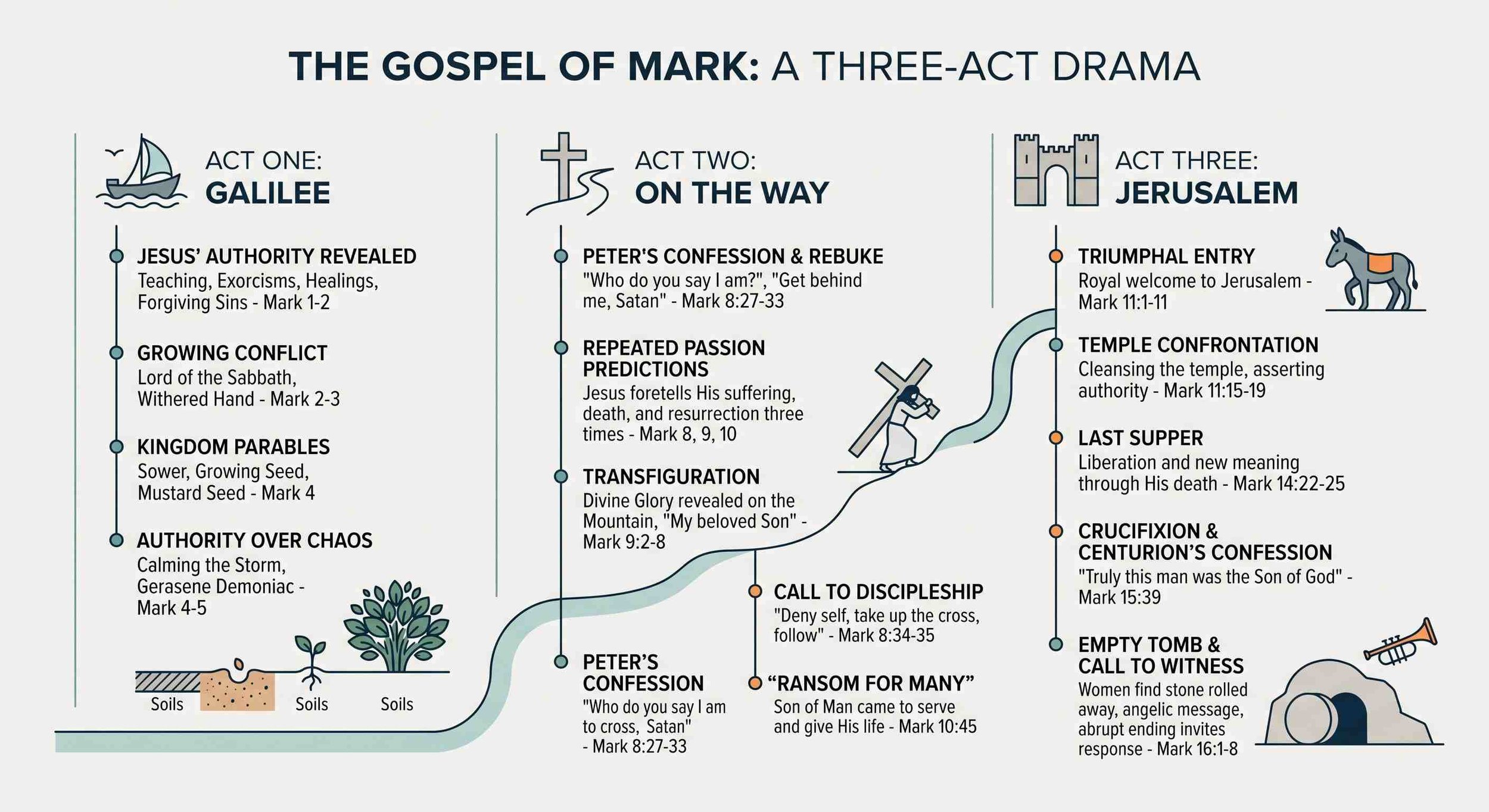
This is an AI Recap of the class.
Some things may be incorrect.
Short Summary of the Whole Class
We took a comprehensive journey through the Gospel of Mark, starting with an overview of its three-act structure and its bold claim that Jesus, not Caesar, is the true “Son of God.” In Act One, we traced Jesus' authority through healings, exorcisms, and parables like the sower, which teach that God's kingdom grows in mysterious ways and offers grace even for "bad soil." We examined the parables of the growing seed and mustard seed as illustrations of small beginnings leading to expansive shelter. This theme of authority over chaos was powerfully demonstrated in Jesus calming the storm and delivering the Gerasene demoniac, showing that no person or situation is beyond His restorative power. Act Two focused on the cross-shaped nature of discipleship, highlighted by Peter's confession, the Transfiguration, and Jesus’ repeated passion predictions. Finally, Act Three brought us to Jerusalem for the confrontation, crucifixion—marked by the centurion’s climactic confession—and the empty tomb, leaving us with a challenge to respond in faith and witness.
Session Walkthrough with Section Summaries
1) Getting Started: Community, Setup, and Study Approach
We restarted Zoom, settled tech issues, and discussed comfort levels with being on camera.
Cris outlined Bible study “house rules”: any question is welcome (even “dumb” ones can lead to good insights), and we aim to stay within the Gospel we’re studying rather than harmonizing all four.
Key approach: Each Gospel presents a distinct facet of Jesus. Mark’s stories serve his grand narrative rather than a day-by-day chronology.
Stories mentioned:
General setup and group conversation, no specific biblical narrative yet.
Verses referenced:
None explicitly in this section.
Short summary:
We set expectations for a focused study of Mark, respecting its unique voice, and prepared the group for a narrative-driven exploration.
2) Overview Video: The Gospel of Mark in Three Acts
We watched The Bible Project’s overview of Mark.
Mark’s thesis: “The beginning of the gospel about Jesus the Messiah, the Son of God” (Mark 1:1).
Structure:
Act One (Galilee): Jesus’ authority amazes crowds; questions about His identity grow.
Act Two (On the way): Disciples struggle to understand a suffering Messiah; repeated predictions of His death; call to carry the cross.
Act Three (Jerusalem): Royal entry, temple confrontation, debates, passion, crucifixion, resurrection, and the abrupt ending that challenges the reader.
Stories mentioned:
John the Baptist preparing the way.
Healings/exorcisms; forgiving sins; parables of the kingdom.
Peter’s confession; Transfiguration; passion narrative; empty tomb.
Verses referenced:
Mark 1:1; prophetic background from Isaiah/Malachi (Mark 1:2–3).
Parables (Mark 4).
Peter’s confession (Mark 8:27–30).
Transfiguration (Mark 9:2–8).
“Ransom for many” (Mark 10:45).
Triumphal entry (Mark 11).
Olivet Discourse (Mark 13).
Last Supper (Mark 14).
Crucifixion and centurion’s confession (Mark 15:39).
Empty tomb (Mark 16:1–8).
Short summary:
The video framed Mark as a carefully designed three-act drama centered on Jesus’ identity and His paradoxical kingship through suffering.
3) Mark’s Opening Claim: Son of God and Gospel as Confrontation
Discussion of Mark 1:1: “Jesus Christ, the Son of God.”
Historical lens: “Son of God” and “euangelion” (gospel/good news) were imperial titles and announcements used for Caesar.
Mark’s bold counter-claim: Jesus, not Caesar, is the true King and Son of God; His “good news” confronts Rome’s claims and ushers in God’s reign.
Stories mentioned:
Contextual background of Roman imperial proclamations; no single biblical story, but framing of Mark’s thesis.
Verses referenced:
Mark 1:1; the term euangelion throughout Mark.
Short summary:
Mark’s opening line is a theological and political shockwave, announcing Jesus as the true royal Son of God and redefining “good news.”
4) Act One Highlights: Authority, Calling, Forgiveness, and Conflict
Jesus’ authority revealed in:
Baptism and divine affirmation (Mark 1:9–11).
Announcement of God’s kingdom (Mark 1:14–15).
Calling disciples (Mark 1:16–20).
Teaching with authority and exorcisms (Mark 1:21–28).
Healings (Mark 1:29–34; 2:1–12).
The paralytic lowered through the roof (Mark 2:1–12):
Jesus forgives sins and heals; confrontation with scribes over blasphemy.
Anticipates resurrection: a “dead” man rises and walks; forgiveness tied to Jesus’ authority.
Growing conflict:
Questions about fasting (Mark 2:18–22), Sabbath (Mark 2:23–28; 3:1–6), and legalism.
Discussion in class about “withered hand” versus “deaf mute” healing clarified later in Mark (the withered hand: Mark 3:1–6; deaf-mute: Mark 7:31–37).
Stories mentioned:
Paralytic through the roof.
Lord of the Sabbath.
Healing of the man with the withered hand.
Later: healing of a deaf-mute man.
Verses referenced:
Mark 1:9–15, 1:21–34; 2:1–28; 3:1–6.
Mark 7:31–37 (deaf-mute healing, noted in discussion though later in the narrative).
Short summary:
Act One establishes Jesus’ divine authority to announce God’s kingdom, call disciples, forgive sins, and heal—sparking both faith and opposition.
5) Parables and the Hidden Kingdom (Mark 4)
Context: Mark 4 is a thematic hub. We emphasized reading from multiple translations and listening to the audio Bible to let the Scripture read us. The parable of the sower reframes expectations—the word can land on "bad soil," but Jesus' mission is for those who don't "have it all together."
Seed and soils (Mark 4:1–20): Different receptions to Jesus’ word. A friend’s question, “What if I’m just bad soil?” shifted perspective toward grace. An analogy about NASCAR illustrated how "good news" can fall on deaf ears.
Lamp under a basket (Mark 4:21–25): The kingdom's light is meant to be visible. Our receptivity ("Take heed what you hear") influences our understanding.
The seed that grows secretly (Mark 4:26–29): The kingdom grows mysteriously, in stages, even when we don't see it. We are encouraged to trust God's hidden work.
Mustard seed (Mark 4:30–32): Small beginnings lead to expansive, hospitable outcomes where birds can find shelter. God doesn't need much to work with.
Parables and private explanations (Mark 4:33–34): Jesus speaks in parables "as they were able to hear" but explains privately to disciples, highlighting that understanding is gradual and requires patient listening.
Stories mentioned:
Parable of the sower (seed and soils).
Personal anecdote about NASCAR as good news on deaf ears.
Friend's question: "What if I'm just bad soil?"
Lamp under a basket.
The growing seed.
Mustard seed.
Verses referenced:
Mark 4:1–20, 4:21–25, 4:26–29, 4:30–32, 4:33–34.
Short summary:
Jesus’ parables in Mark 4 explain that the kingdom advances amid mixed responses. Its growth is real but often hidden, starting small and becoming an expansive refuge, calling us to listen attentively and trust God’s mysterious process.
6) Authority Over Chaos: Calming the Storm and Delivering the Demoniac
Jesus Calming the Storm (Mark 4:35-41): The class connected the sea with biblical imagery of chaos and evil ("tohu vavohu"). Jesus asleep, like Jonah, is awakened by fearful disciples. His authoritative words, "Peace! Be still!" transform terror into calm, showing kingdom power. The disciples' fear shows that faith grows through crisis and encounter, even when full understanding lags.
The Gerasene Demoniac (Mark 5:1–20): Reading the story aloud, we saw how Jesus crosses into Gentile territory to confront overwhelming evil.
Demons recognize Jesus' identity and authority immediately ("Son of the Most High God") and fall before Him in an act of submission or "worship."
The name "Legion" and the 2,000 pigs underscore the scale of oppression.
Jesus’ few words bring decisive freedom, restoring the man to his right mind.
The restored man is commissioned to "Go... tell... how He has shown compassion," becoming a witness in the Decapolis. This demonstrates that no "soil" is beyond Jesus' reach and that restoration leads to mission.
Stories mentioned:
Jesus calming the storm.
Jonah asleep during the storm (Jonah 1).
Israel crossing the Red Sea (Exodus 14).
Gerasene/Gadarenes demoniac delivered and sent to testify.
Leviathan motif.
Verses referenced:
Mark 4:35–41.
Mark 5:1–20.
Genesis 1:2 ("tohu vavohu").
Thematic tie to Mark 15:39.
John 9:38 (as a comparison for "worshipped").
Implied references to Jonah 1, Exodus 14, Job 41, Psalm 74:13–14.
Short summary:
Jesus demonstrates His absolute authority over chaos and evil by calming the sea and liberating the Gerasene demoniac, proving that His mission extends to the most broken places and that His restorative power leads to worship and witness.
Main Points
Mark presents Jesus as the true Messiah and Son of God, challenging imperial claims.
The Gospel is structured in three acts: Galilee, the way, and Jerusalem.
Jesus’ authority is demonstrated through teaching, exorcism, healing, and forgiving sins.
Parables reveal the hidden, unexpected growth of God’s kingdom; its small beginnings lead to expansive refuge.
Jesus' authoritative word brings transformation, calming storms of chaos and delivering people from spiritual oppression.
No one is beyond Jesus' restorative mission; even "bad soil" can be made good, and restoration leads to witness.
Messiahship is defined by suffering service; discipleship is cross-bearing.
The passion narrative culminates in recognition of Jesus’ divine identity and the empty tomb’s call to witness.
Mark’s abrupt ending invites personal response and proclamation.
Bible Scriptures Mentioned
Genesis 1:2 (tohu vavohu—formless and void)
Exodus 14 (Israel crossing the Red Sea)
Job 41; Psalm 74:13–14 (Leviathan motif, implied in discussion)
Mark 1:1; 1:2–3 (Isaiah/Malachi quotation); 1:9–15; 1:21–34
Mark 2:1–12 (paralytic); 2:18–22 (fasting); 2:23–28 (Sabbath)
Mark 3:1–6 (withered hand)
Mark 4:1–20 (seed and soils); 4:21–25 (lamp under a basket); 4:26–29 (growing seed); 4:30–32 (mustard seed); 4:33-34 (parables and private explanations)
Mark 4:35–41 (Jesus calms the storm)
Mark 5:1–20 (Gerasene/Gadarenes demoniac; Decapolis mission)
Mark 7:31–37 (deaf-mute healing, noted in discussion)
Mark 8:27–38 (Peter’s confession; call to take up the cross)
Mark 9:2–8 (Transfiguration); 9:31 (passion prediction)
Mark 10:33–34 (passion prediction); 10:45 (ransom for many)
Mark 11:1–11 (triumphal entry); 11:15–19 (temple action); 12 (controversies)
Mark 13 (warnings/judgment)
Mark 14:22–25 (Last Supper)
Mark 15:33–39 (darkness; centurion’s confession)
Mark 16:1–8 (empty tomb)
John 9:38 (example of “worshipped him,” noted in translation discussion)
Stories Discussed
John the Baptist preparing the way
Calling of the disciples
Exorcisms and healings in Galilee
Paralytic lowered through the roof
Questions about fasting; Lord of the Sabbath
Healing of the man with the withered hand
Parables: seed and soils; lamp under a basket; the growing seed; mustard seed
NASCAR analogy for "good news" on deaf ears
"What if I'm bad soil?"—a friend's self-reflection on grace
Jesus calming the storm
Jonah asleep in the storm
Israel crossing the Red Sea
Gerasene demoniac delivered and sent to testify in the Decapolis
Peter’s confession and the call to take up the cross
The Transfiguration
“Ransom for many” teaching
Triumphal entry
Temple cleansing and debates
The Last Supper
Crucifixion and the centurion’s confession
Empty tomb and the angelic announcement