Gospel of Mark Chapter 11a
This is our 19th class on Mark
This is an AI Recap of the class.
Some things may be incorrect.
Short Summary of the Class
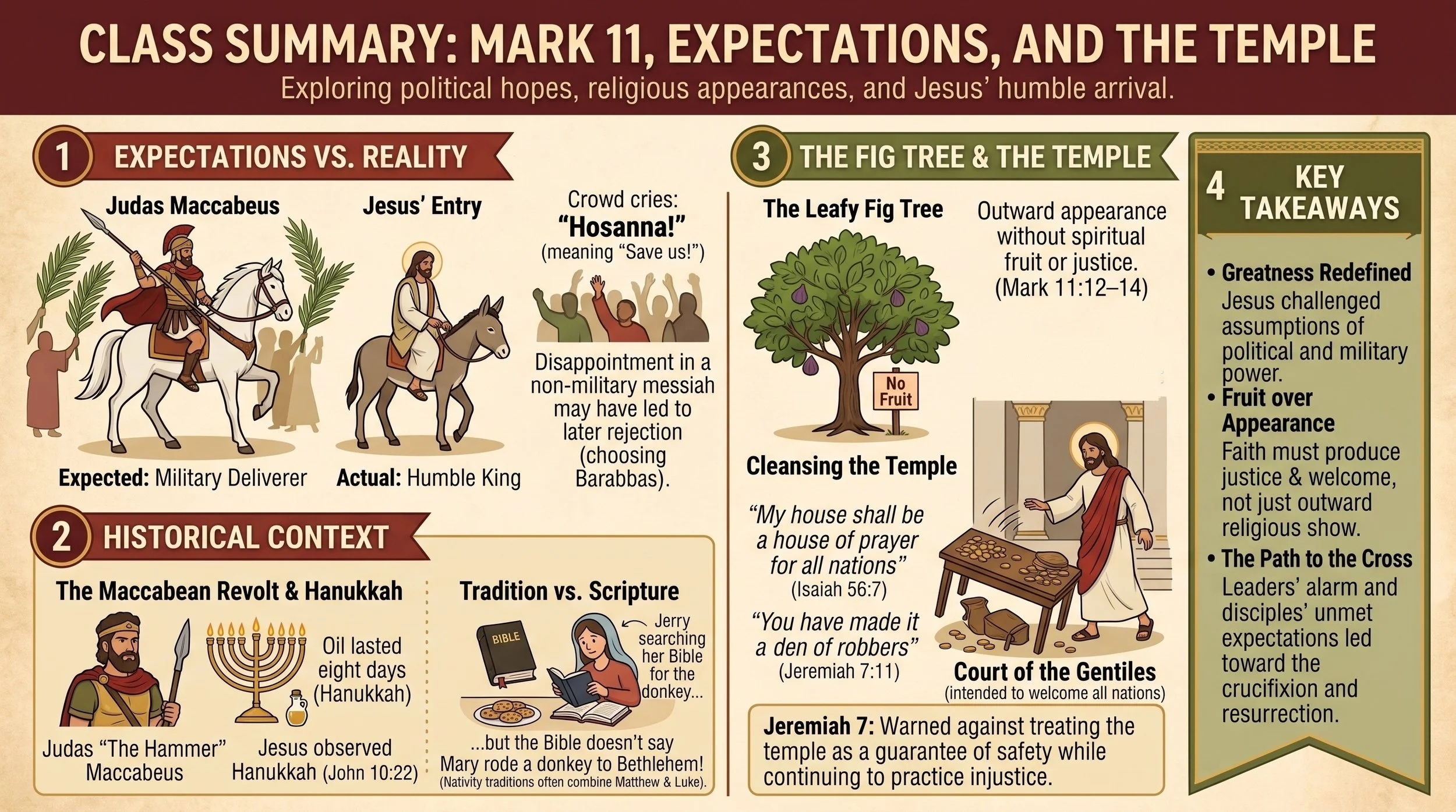
The class explored Mark 11, from Jesus' entry into Jerusalem on an unridden colt to his cursing of the fig tree and cleansing of the temple. The discussion used the Maccabean revolt and Hanukkah to illuminate the political hopes surrounding Jesus, then connected the fig tree and temple scenes to biblical warnings about outward religious appearances without justice or spiritual fruit. The class also considered why people hoping for a military deliverer might welcome Jesus and later turn against him.
Class Walk-Through
1. Mark 11, the Unridden Colt, and the Crowd's Expectations
The class began studying Mark 11, which the teacher described as a fast-moving chapter that continues Mark's earlier discussion of people seeking greatness. One participant noticed that the colt Jesus' followers were sent to find had never been ridden or used for work. The group considered whether its being unused might carry symbolic meaning; one participant compared it to the idea of virginity, and the teacher welcomed the observation while noting that the class would return to the colt's significance.
The followers found the colt as Jesus had said they would and explained that "the Lord needs it." The class connected Jesus' entry to earlier discussion of the crowd's "Hosanna" cries and the possibility that people expected a powerful political or military deliverer.
Bible verses and references discussed: Mark 11; the account of the colt and the words "the Lord needs it" (Mark 11:1–7).
Stories discussed: Jesus' followers finding the previously unridden colt; Jesus' entry into Jerusalem and the crowd's "Hosanna" cries.
Section summary: The class began Mark 11 by considering the meaning of the unused colt and the hopes that may have shaped the crowd's welcome of Jesus.
2. Mary, the Donkey, and Nativity Traditions
The teacher challenged the familiar nativity image of Mary riding a donkey to Bethlehem, noting that the Gospels do not say that she did. The class discussed how nativity plays often combine details from separate Gospel accounts: the shepherds appear in Luke, while the wise men appear in Matthew.
The teacher told a humorous story about Jerry, who disagreed that the Bible did not mention Mary riding a donkey. Jerry searched through her Bible to prove her point, eventually gave up, and offered the teacher a cookie. The class also considered the idea that the donkey in nativity traditions may echo the humble animal Jesus rides into Jerusalem. One participant suggested that the colt’s being unridden could add to the association. The teacher presented this as a possible way a nativity play might communicate humility, not as a detail stated in the Gospel accounts.
Bible verses and references discussed: Matthew’s account of the wise men; Luke’s account of the shepherds. No specific chapter or verse was cited.
Stories discussed: The traditional image of Mary traveling to Bethlehem on a donkey; the separate Gospel accounts of the shepherds and the wise men; Jerry searching her Bible to prove that Mary rode a donkey and offering the teacher a cookie.
Section summary: The class distinguished Gospel accounts from later nativity traditions and considered how the donkey might symbolize humility.
3. The Apocrypha, the Maccabees, and Hanukkah
The teacher introduced the Apocrypha, also referred to in the discussion as the intertestamental books. The books of Maccabees were presented as useful historical background for the period between the Old and New Testaments. The teacher said that these books are not included in Protestant Bibles but are included in Catholic Bibles, and described them as helpful for understanding the world around Jesus’ time.
The discussion broadened to how Christians interpret different biblical books and their relative importance. The teacher named the Pentateuch—Genesis, Exodus, Leviticus, Numbers, and Deuteronomy—and also mentioned Joshua, Samuel, and Song of Solomon in discussing biblical interpretation.
The class heard about Judas Maccabeus, nicknamed “the Hammer.” As described in class, Greek rule had brought worship of Zeus and the sacrifice of pigs into the Jerusalem temple. Judas led a revolt, defeated the Greeks, and restored Jewish worship there. The Hanukkah tradition says that oil sufficient for one day lasted eight days. The teacher also noted that Jesus observed Hanukkah, referring to its mention in John.
Bible verses and references discussed: John 10:22–23, in connection with Jesus observing Hanukkah; the books of Maccabees, with no specific passage cited. Genesis, Exodus, Leviticus, Numbers, Deuteronomy, Joshua, Samuel, and Song of Solomon were named during the discussion of biblical books.
Stories discussed: Judas Maccabeus’ revolt against Greek rule; the restoration and rededication of the temple; the Hanukkah tradition of the oil lasting eight days.
Section summary: The class explored the Maccabean period and Hanukkah as historical context for the political tensions and religious hopes present in Jesus’ time.
4. Judas Maccabeus and Jesus’ Entry into Jerusalem
The teacher compared Judas Maccabeus’ return to Jerusalem with Jesus’ entry. In the account presented in class, Judas returned after a military victory on a large white warhorse. People called out for salvation and waved palm branches, and he went to the temple to remove foreign worship.
Jesus also entered Jerusalem to cries of “Hosanna” and went to the temple, but he rode a colt rather than a warhorse. The teacher emphasized that the crowd could have understood its words and actions as expressing hope for a military deliverer, while Jesus’ humble arrival presented a different kind of kingship. The class noted that many people are unfamiliar with the Maccabean background, even though it can make the Palm Sunday story more meaningful.
The class also discussed the crowd’s later role in Jesus’ trial. The teacher noted that some textual traditions use the name “Jesus Barabbas” and suggested that the choice between Barabbas and Jesus raises the question of what kind of deliverer the crowd wanted. This was connected to hopes for a leader who would resist Rome.
Bible verses and references discussed: Mark 11; Mark 15:6, concerning the custom of releasing a prisoner at the festival; Matthew was mentioned in connection with the “Jesus Barabbas” wording, without a specific reference.
Stories discussed: Judas Maccabeus’ victorious return to Jerusalem and restoration of the temple; Jesus’ entry into Jerusalem; the crowd’s choice between Jesus and Barabbas during the events leading to the crucifixion.
Section summary: The Maccabean story helped explain the political resonance of Jesus’ entry and the crowd’s hopes, while highlighting the contrast between a military triumph and Jesus’ humble arrival.
5. “Hosanna,” Barabbas, and Disappointment
The class connected the crowd’s hopes with Mark’s earlier theme of people seeking greatness. The teacher explained that “Hosanna” can be understood as a plea for salvation and argued that the crowd’s cries carried strong expectations of liberation from foreign rule. Jesus knew what the crowd was expressing but did not fulfill those expectations in the way people anticipated.
This discussion addressed how people could welcome Jesus with “Hosanna” and later call for his crucifixion. The class considered whether the welcome depended on the hope that Jesus would be a political or military deliverer, and whether disappointment could help explain the change in the crowd’s response.
Bible verses and references discussed: Mark 15:6, in connection with the prisoner-release custom and Barabbas; the entry into Jerusalem in Mark 11. The teacher also mentioned a saying in Matthew about faith moving a mountain, but no chapter or verse was specified.
Stories discussed: The crowd welcoming Jesus with “Hosanna” and later calling for his crucifixion; the choice between Jesus and Barabbas.
Section summary: The class considered how unmet hopes for political deliverance may have contributed to the crowd’s later rejection of Jesus.
6. The Fig Tree and the Temple
After entering Jerusalem, Jesus looked around the temple and returned to Bethany. The next day he found a fig tree in leaf but without fruit and cursed it. The class discussed the possibility that the tree was not yet in season and considered what the episode might mean in the wider passage.
The teacher explained that fruitfulness is a recurring biblical image: God’s people are meant to bear spiritual fruit. The class connected the leafy fig tree with the idea of outward religious appearance without fruit, and considered the possibility that the fig tree symbolized Israel.
The class then connected the fig tree to Jesus’ actions in the temple. Jesus drove out buyers and sellers, overturned tables, and did not allow people to carry merchandise through the temple. He quoted Isaiah 56:7, describing God’s house as “a house of prayer for all nations,” and also used the phrase “den of robbers” from Jeremiah 7.
The teacher connected “den of robbers” to Jeremiah 7, where Jeremiah warns people not to trust in the repeated claim that “the temple of the Lord” would keep them safe. They could not worship at the temple while continuing to oppress foreigners, orphans, and widows, shed innocent blood, and worship other gods. God would not protect them if they continued to act unjustly.
The class discussed the Court of the Gentiles, where buying and selling took place. The teacher explained that this area was intended for people from all nations and said that the phrase “the boy who lived,” from Harry Potter, illustrates how a familiar phrase can evoke a larger story: “the temple of the Lord” would have had a similarly recognizable resonance.
Bible verses and references discussed:
Mark 11:11 — Jesus looks around the temple before returning to Bethany.
Mark 11:12–14 — Jesus finds the fig tree without fruit and curses it.
Mark 11:15–17 — Jesus drives out buyers and sellers and quotes Scripture about the temple.
Jeremiah 7:3–11 — Jeremiah’s warning against trusting in the temple while practicing injustice; verse 11 includes the phrase “den of robbers.”
Isaiah 56:7 — God’s house as “a house of prayer for all nations.”
Stories discussed: Jesus inspecting the temple and returning to Bethany; the leafy but fruitless fig tree; Jesus overturning tables and driving out buyers and sellers; the use of the Court of the Gentiles for buying and selling; Jeremiah warning the people not to use the temple as a guarantee of safety while mistreating others.
Section summary: The class connected the fruitless fig tree with the temple, interpreting both as challenges to religious appearances without justice or fruit.
7. The Leaders’ Response, Mark’s Wider Story, and the Temple Today
The class noted that the religious leaders were alarmed by Jesus’ teaching and began looking for a way to kill him. The class discussed Mark 2, in which Jesus heals a paralyzed man, noting that Jesus’ words and actions could threaten established religious roles. The crowd was amazed by Jesus’ teaching, in contrast to the leaders’ response.
The discussion returned to the Maccabean revolt. One participant observed that the disciples’ ambitions and hopes for power could reflect the same expectations as those of the crowd, including hopes for political restoration. The class considered whether Jesus was preparing his followers for a different kind of leadership and service.
The class briefly discussed the remains of the Jerusalem temple, including the Western Wall, and concluded with a note about a break before the next meetings. The upcoming class dates mentioned were the sixth and twentieth, without specifying the month.
Bible verses and references discussed: Mark 11:18, concerning the leaders seeking a way to kill Jesus; Mark 2, concerning Jesus healing a paralyzed man.
Stories discussed: Jesus healing a paralyzed man in Mark 2; the Maccabean revolt as a model for hopes of political restoration; the temple’s destruction and the surviving Western Wall.
Section summary: The class connected the leaders’ response and the disciples’ expectations to Mark’s wider themes, then noted the temple’s remaining ruins and the upcoming break.
Medium-Length Summary
The class studied the opening events of Mark 11, beginning with Jesus’ instructions to find a colt that had never been ridden. The class considered what the unused colt might signify and connected Jesus’ entry into Jerusalem with the crowd’s “Hosanna” cries and their hopes for a deliverer. The discussion also distinguished the Gospel accounts from nativity traditions: the Gospels do not say that Mary rode a donkey to Bethlehem, although nativity scenes often combine the shepherds from Luke and the wise men from Matthew.
The class explored the Apocrypha and the Maccabean period as historical context for Jesus’ world. The Maccabean revolt and the Hanukkah tradition of oil lasting eight days were discussed, along with Judas Maccabeus’ victorious entry into Jerusalem. His return on a warhorse, greeted with calls for salvation and palm branches, was contrasted with Jesus’ humble entry on a colt. The class considered how this background illuminates the crowd’s hopes for a political deliverer and the later choice between Jesus and Barabbas.
The class then examined the fig tree and temple scenes in Mark 11. The leafy but fruitless tree was connected to a temple that appeared religious but lacked justice and spiritual fruit. The class discussed Jeremiah 7, Isaiah 56, and the Court of the Gentiles, emphasizing that the temple was meant to be a house of prayer for all nations. Jesus’ cleansing of the temple was presented as a challenge to outward religious appearances and unjust practices.
Finally, the class considered the leaders’ response, the crowd’s amazement, and the disciples’ possible hopes for power. The discussion connected these themes to Mark’s wider story and noted the surviving Western Wall. The class ended with a break before the next meetings, with class dates mentioned as the sixth and twentieth, without specifying the month.
Main Points
Mark 11 continues the Gospel’s discussion of greatness and moves quickly through connected events.
Jesus’ colt had never been ridden; the class considered whether this detail carried symbolic meaning.
The Gospels do not say that Mary rode a donkey to Bethlehem; familiar nativity scenes may combine details from separate Gospel accounts.
The books of Maccabees provide historical context for the religious and political world of Jesus’ time.
Judas Maccabeus’ revolt and temple restoration offer a point of comparison with Jesus’ entry into Jerusalem.
Jesus entered humbly on a colt, unlike a conquering ruler arriving on a warhorse.
The crowd’s “Hosanna” may have expressed hopes for political or military deliverance.
Disappointment when Jesus did not meet those expectations may help explain the crowd’s later rejection of him.
The fig tree and temple scenes were connected as signs of outward appearance without spiritual fruit or justice.
Jeremiah’s warning challenged the idea that the temple guaranteed safety while people continued to act unjustly.
The Court of the Gentiles was intended to welcome people from all nations.
Jesus’ actions in the temple challenged a religious system that had lost sight of justice, welcome, and faithful living.
The leaders’ response, the crowd’s amazement, and the disciples’ ambitions contribute to Mark’s wider story of Jesus’ path toward crucifixion and resurrection.
The temple’s remains, including the Western Wall, were briefly discussed.
Bible Scriptures Mentioned
Mark 11 — Jesus’ entry into Jerusalem, the colt, the fig tree, and the temple events.
Mark 11:11 — Jesus looks around the temple and returns to Bethany.
Mark 11:12–14 — Jesus finds and curses the fruitless fig tree.
Mark 11:15–17 — Jesus drives out buyers and sellers and speaks about the temple.
Mark 11:18 — The chief priests and teachers of the law seek a way to kill Jesus.
Mark 2 — Jesus heals a paralyzed man; the teacher connected this episode with Mark’s wider themes, especially resurrection.
Mark 15:6 — The custom of releasing a prisoner at the festival, discussed in connection with Barabbas.
John 10:22–23 — Mentioned in connection with Jesus observing Hanukkah.
Jeremiah 7:3–11 — Jeremiah’s warning against trusting in the temple while practicing injustice; verse 11 includes the “den of robbers” phrase.
Isaiah 56:7 — God’s house as “a house of prayer for all nations.”
Matthew — Mentioned for the wise men, the “Jesus Barabbas” wording in some textual traditions, the saying about faith moving a mountain, and themes associated with the Exodus story. No specific chapter or verse was identified for these references.
Luke — Mentioned for the birth narrative and the shepherds; no specific chapter or verse was cited.
Exodus — Named as part of the Pentateuch and mentioned in connection with themes echoed in Matthew.
Genesis, Leviticus, Numbers, and Deuteronomy — Named as books of the Pentateuch, along with Exodus.
Joshua, First and Second Samuel, and Song of Solomon — Mentioned during discussion of biblical interpretation and the relative importance of biblical books.
Maccabees — Discussed as intertestamental books recounting the Maccabean period; no specific chapter or verse was cited.
Stories and Historical Events Discussed
Jesus’ followers finding the colt that had never been ridden.
The traditional—but not Gospel-stated—image of Mary riding a donkey to Bethlehem.
The separate nativity accounts of the shepherds and the wise men.
Jerry searching her Bible for the donkey detail and eventually offering the teacher a cookie.
Judas Maccabeus, “the Hammer,” leading a revolt against Greek rule and restoring Jewish worship in the temple.
The Hanukkah tradition of oil lasting eight days.
Judas Maccabeus’ victorious entry into Jerusalem on a warhorse, compared with Jesus’ entry on a colt.
Jesus entering Jerusalem, visiting the temple, and being welcomed with cries of “Hosanna.”
The crowd’s later call for Jesus to be crucified.
The crowd’s choice between Jesus and Barabbas.
Jesus inspecting the temple and returning to Bethany.
Jesus cursing the leafy fig tree that had no fruit.
Jesus cleansing the temple, overturning tables, and driving out buyers and sellers.
Jeremiah warning the people not to use the temple as a guarantee of safety while mistreating others.
The Harry Potter phrase “the boy who lived,” used to illustrate how a familiar phrase can evoke a larger story.
Jesus healing a paralyzed man in Mark 2.
The destruction of the Jerusalem temple and the surviving Western Wall.