
Gospel of Mark Chapter 10b
This is our 18th class on Mark
This is an AI Recap of the class.
Some things may be incorrect.
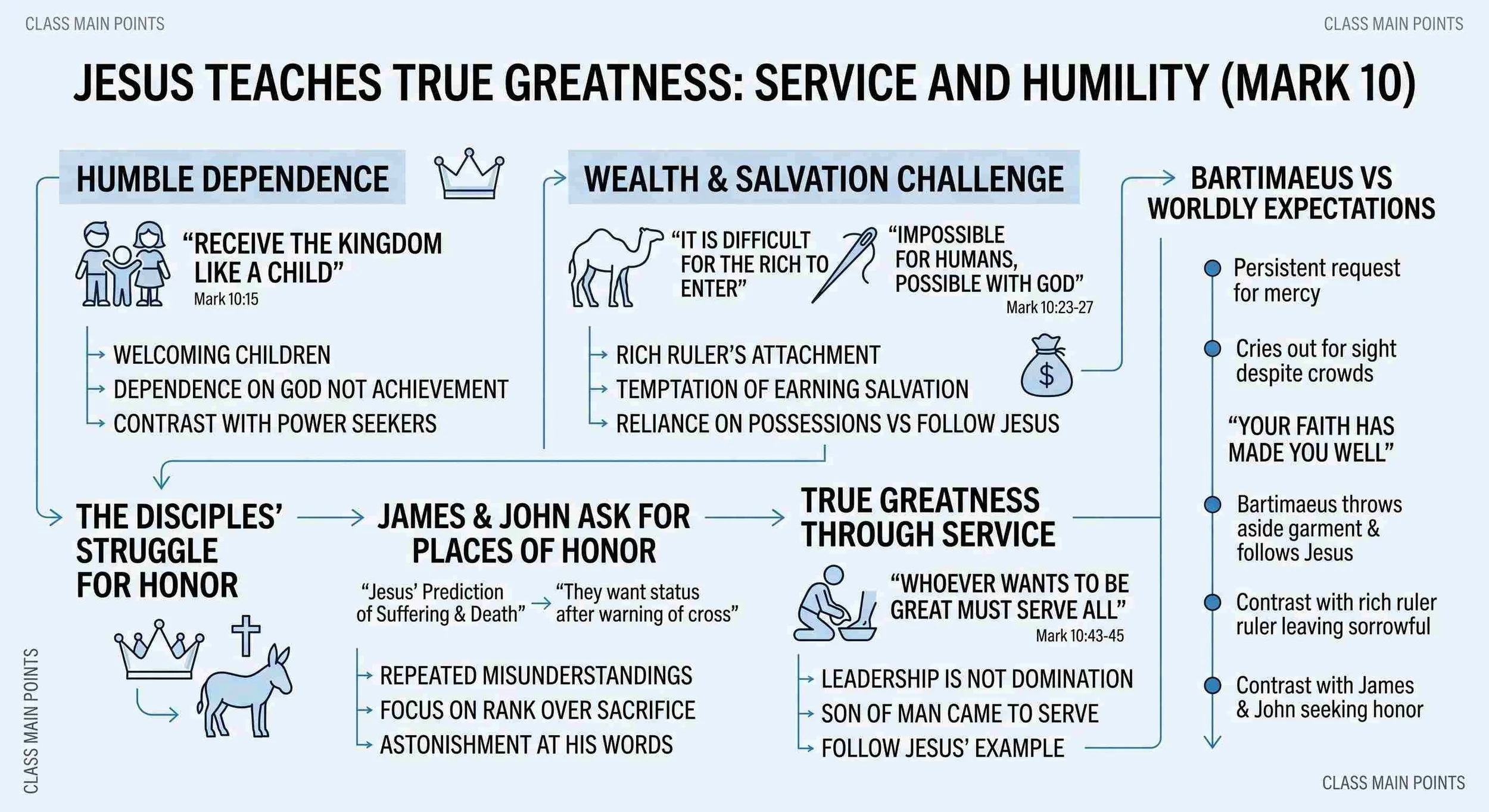
Short Summary of the Class
The class welcomed participants, reviewed the Bible study format and upcoming church activities, and studied Mark 10. The discussion traced Jesus’ welcome of children, the rich ruler’s difficulty letting go of possessions, the disciples’ pursuit of honor, and Bartimaeus’ faith. Together, these stories highlighted Jesus’ call to humble dependence on God and service rather than status or power. The class also looked ahead to Jesus’ entry into Jerusalem and the crowd’s expectations of a deliverer.
Class Walk-Through
1. Welcome, Bible Study Format, and Upcoming Events
Cris welcomed the group and joked with a participant who had trouble finding the room. Cris explained that it can take a few meetings to get comfortable with the study format: the group listens to Scripture and then discusses it. Participants were encouraged to ask questions, including questions that might lead to more meaningful ones.
The group reviewed its schedule. It planned to meet again on November 18, 2026, and then take a break until the beginning of 2027. The class also heard about upcoming church activities: a Thanksgiving vicar service at 11 a.m.; an Advent gathering with Christmas carols and a discussion of the symbolism of the church’s Chrismon ornaments; a traditional Advent service; and a variety show. Participants were invited to suggest talents, performances, or games. Past variety-show activities included a debate about Christmas traditions, a Christmas-lights activity, music, and games. A Christmas-themed activity was also mentioned for the Tuesday before Christmas.
Bible verses and stories: No specific Bible verses or biblical stories were discussed in this section. The class recalled past variety-show activities.
Section summary: The group reviewed how the Bible study works, encouraged questions, and shared schedule and event information for the coming holiday season.
2. Jesus Welcomes Children
Cris introduced Mark 10 within the Gospel’s movement toward Jesus’ entry into Jerusalem. Cris connected the passage’s children with the disciples’ interest in greatness: while the disciples try to keep children away, Jesus welcomes and blesses them. The class read the account of people bringing children to Jesus, the disciples rebuking them, and Jesus teaching that God’s kingdom must be received with childlike humility and dependence.
The discussion later returned to the children as an example of approaching God without relying on status or achievement. Their story was also compared with Bartimaeus, whom people likewise tried to keep from reaching Jesus.
Bible verses and stories: Mark 10:13–16, especially Mark 10:15, where Jesus speaks of receiving the kingdom of God like a child. The class discussed Jesus welcoming and blessing the children.
Section summary: Jesus welcomes the children and presents humble, dependent reception of God’s kingdom as essential.
3. The Rich Ruler, Wealth, and the Possibility of Salvation
The class read about a man who asked Jesus how to inherit eternal life. Jesus named commandments, and the man said he had kept them from his youth. Jesus loved him and told him to sell his possessions, give to the poor, and follow him. The man went away sorrowful because he had great possessions.
The group discussed the temptation to treat salvation as something earned through good deeds or accumulated achievement. Jesus’ teaching about the difficulty of the rich entering God’s kingdom—including the image of a camel passing through the eye of a needle—was understood as expressing human impossibility, rather than as referring to a small Jerusalem gate. The disciples were astonished, and Jesus said that what is impossible for people is possible with God.
The discussion also considered how wealth and success can seem to provide worth or security, and how people may try to add good deeds to the “good side of the scale.” The teacher spoke about the challenge of being willing to lose possessions, status, or control in order to serve Christ, including the danger of becoming possessive about what one has built in church leadership.
Peter pointed out that the disciples had left things behind to follow Jesus. The class considered how his remark might sound like a claim to greater deservingness or righteousness. Jesus spoke of receiving much in return, along with persecutions and eternal life, and said that many who are first will be last and the last first. The group connected this teaching with the broader warning against spiritual scorekeeping and reliance on human achievement.
Bible verses and stories: Mark 10:17–31, especially Mark 10:23–27 and Mark 10:27–31. The stories include the rich ruler asking about eternal life and leaving sorrowful, Jesus teaching about riches and the kingdom, and Peter noting what the disciples have left behind. Mark 9 was recalled through the story of the disciples’ inability to cast out a demon and Jesus’ teaching about prayer.
Section summary: The rich ruler’s story challenges reliance on possessions and personal achievement; Jesus teaches that salvation is impossible through human effort alone but possible with God.
4. Jesus Predicts His Suffering; James and John Seek Honor
The class discussed Jesus and the disciples traveling toward Jerusalem. Jesus tells the Twelve that he will be betrayed, condemned, mocked, scourged, killed, and rise again on the third day. James and John then ask to sit at Jesus’ right and left in his glory. Jesus says they do not understand what they are asking and speaks of sharing his cup and baptism. They confidently say they can, though they do not understand what that commitment will involve.
The other ten disciples become upset, and the class noted the irony of James and John seeking positions of honor just after Jesus has predicted his suffering and death. The request illustrates the disciples’ continuing tendency to understand greatness as rank or recognition. The class also recalled that the two people at Jesus’ right and left at the crucifixion are criminals crucified beside him.
The teacher noted that Mark repeatedly uses words such as “astonished,” “amazed,” and “afraid.” The class connected these reactions with Mark’s presentation of the resurrection and recalled other examples, including the disciples’ astonishment at Jesus’ words, Jesus walking on the water, and healings involving demons. The placement of James and John’s request after Jesus’ teaching about wealth and following him was also noted as another sign of how slowly the disciples understand.
Bible verses and stories: Mark 10:32–40 recounts Jesus’ prediction and James and John’s request. Mark 15:27 was referenced in connection with the two criminals crucified beside Jesus. The class also recalled Jesus walking on the water and healings involving demons as examples of astonishment in Mark.
Section summary: Jesus’ prediction of suffering contrasts with James and John’s desire for honor, showing that they have not yet grasped the cost or meaning of following him.
5. Greatness Means Serving
After the other disciples become indignant with James and John, Jesus teaches that his followers must not imitate rulers who dominate others. Whoever wants to be great must become a servant, and whoever wants to be first must become a servant of all. Jesus points to himself as the example: the Son of Man came not to be served but to serve and give his life as a ransom for many.
The class connected this teaching with Jesus washing the disciples’ feet. It also considered how the desire to control others can show up in everyday settings, including churches and homeowners’ associations. The teacher recalled Samuel’s warning to Israel about the consequences of having a king who would take from and dominate the people. The feedings of the five thousand and four thousand were also mentioned as examples connected with leadership and care, along with the description of people as sheep without a shepherd.
Bible verses and stories: Mark 10:41–45; John 13:1–17, Jesus washing the disciples’ feet; 1 Samuel 8:10–18, Samuel’s warning about a king; Mark 6:30–44 and Mark 8:1–10, the feedings of the five thousand and four thousand; and Mark 6:34, where the people are described as sheep without a shepherd.
Section summary: Jesus rejects domination as a model for leadership and defines greatness through service and self-sacrifice.
6. Bartimaeus: Persistence, Sight, and Following Jesus
The class discussed blind Bartimaeus, who calls Jesus the “Son of David” and asks for mercy. When people tell him to be quiet, he cries out even more. Jesus calls him, and Bartimaeus throws aside his garment, comes to Jesus, and asks to receive his sight. Jesus tells him his faith has made him well; Bartimaeus receives his sight and follows Jesus on the road.
The group compared Bartimaeus with the children, since people try to keep both from reaching Jesus but Jesus welcomes them. Bartimaeus’ response was also contrasted with the rich ruler’s: Bartimaeus leaves his garment behind and follows, while the rich man cannot let go of his possessions and departs sorrowful. His garment was discussed as a vivid sign of readiness to respond to Jesus.
The class compared Bartimaeus’ request for sight with James and John’s request for places of honor. Both requests are bold, but the discussion contrasted the disciples’ desire for status and power with Bartimaeus’ desire for healing. Jesus asks Bartimaeus what he wants even though his need seems obvious. The teacher connected Bartimaeus’ restored sight to the question of whether readers themselves “see” what Mark is showing about following Jesus as he approaches Jerusalem and Holy Week.
Bible verses and stories: Mark 10:46–52, including Mark 10:50, where Bartimaeus throws aside his garment. Mark 10:36 was also referenced for Jesus’ question to James and John, “What do you want me to do for you?” The class discussed Bartimaeus calling out to Jesus, receiving his sight, and following him.
Section summary: Bartimaeus approaches Jesus persistently and in faith, leaves his garment behind, receives his sight, and follows—the opposite of holding tightly to status or possessions.
7. Looking Ahead to Jerusalem
The class reflected on how Jesus’ ministry challenges the pursuit of power and how the cross stands against the expectation that victory comes through domination. The discussion looked ahead to Jesus’ entry into Jerusalem. The crowd’s “Hosanna” was connected with the words of Psalm 118 and with historical memories of Judas Maccabeus entering Jerusalem after a military victory. The class considered that some people may have expected Jesus to drive out Rome. In contrast, Jesus enters riding a donkey rather than a warhorse, signaling a different kind of kingdom.
The class planned to continue the discussion at its next session on November 18, 2026. The phrase tohu va-vohu was also briefly alluded to in connection with Genesis.
Bible verses and stories: Mark 11:9–10 and Psalm 118:25–26, the words associated with the crowd’s welcome; Genesis 1:2, briefly alluded to through tohu va-vohu. The class discussed Jesus’ entry into Jerusalem and the historical example of Judas Maccabeus entering the city after a military victory, in connection with Hanukkah.
Section summary: The crowd may hope for a military or political liberator, but Jesus’ humble entry on a donkey points to a kingdom unlike worldly power.
Medium-Length Summary
The class began with a welcome and an explanation of the Bible study’s read-and-discuss format, encouraging participants to ask questions. The group reviewed its schedule, including its next meeting on November 18, 2026, and discussed upcoming Thanksgiving, Advent, and Christmas activities, including a variety show.
The Bible study followed Mark 10 as Jesus’ disciples struggled to understand what it means to follow him. Jesus welcomes children and teaches that God’s kingdom is received with humility. The rich ruler, however, finds it difficult to give up his possessions, prompting Jesus to teach that human beings cannot achieve salvation on their own, but that all things are possible with God. Peter’s mention of what the disciples have left behind leads to Jesus’ reminder that the first and last will be reversed.
The disciples’ pursuit of status continues when James and John ask for places of honor, despite Jesus’ prediction of his suffering and death. Jesus responds by defining greatness as service, modeled by his own willingness to give his life for others. Bartimaeus offers a contrasting picture: he persistently asks Jesus for mercy, leaves his garment behind, receives his sight, and follows. The class connected these stories to the question of whether people truly see what following Jesus means. Finally, the discussion looked ahead to Jerusalem, where the crowd’s hopes for a political or military deliverer differ from the humble way Jesus enters the city.
Main Points
The Bible study welcomes questions and follows a pattern of reading Scripture and discussing it.
The group planned to meet again on November 18, 2026, before a break until early 2027.
The class discussed upcoming Thanksgiving, Advent, and Christmas activities, including a variety show.
Jesus welcomes children and presents humble dependence as the way to receive God’s kingdom.
The rich ruler’s attachment to possessions makes it difficult for him to follow Jesus.
Salvation does not come from human achievement; what is impossible for people is possible with God.
Peter’s mention of the disciples’ sacrifices is followed by Jesus’ teaching that the first will be last and the last first.
James and John’s request for honor shows the disciples’ continued misunderstanding of greatness.
Bartimaeus’ request for healing and willingness to follow contrasts with the disciples’ pursuit of status and the ruler’s attachment to possessions.
Jesus defines greatness as serving others and gives his own life as the example.
Jesus’ humble entry into Jerusalem differs from expectations of a political or military deliverer.
The class considered whether readers truly see what following Jesus requires.
Bible Scriptures Mentioned
Mark 9 — The disciples’ inability to cast out a demon and Jesus’ teaching about prayer were recalled.
Mark 10:13–16 — Jesus welcomes and blesses the children.
Mark 10:15 — Jesus teaches that the kingdom of God must be received like a child.
Mark 10:17–31 — The rich ruler, Jesus’ teaching about possessions and riches, Peter’s response, and the saying that the first will be last.
Mark 10:23–27 — Jesus teaches about the difficulty of the rich entering the kingdom and the disciples’ astonishment.
Mark 10:27–31 — What is impossible for people is possible with God; Jesus speaks of reward, persecution, eternal life, and the first and last.
Mark 10:32–34 — Jesus predicts his betrayal, suffering, death, and resurrection.
Mark 10:35–40 — James and John ask for places of honor.
Mark 10:36 — Jesus asks James and John what they want him to do for them.
Mark 10:41–45 — Jesus teaches servant leadership and says he gives his life as a ransom for many.
Mark 10:46–52 — Bartimaeus calls out to Jesus, receives his sight, and follows him.
Mark 10:50 — Bartimaeus throws aside his garment before going to Jesus.
Mark 11:9–10 — The crowd welcomes Jesus as he enters Jerusalem.
Mark 15:27 — The two criminals crucified beside Jesus were recalled in connection with James and John’s request for places at Jesus’ right and left.
Mark 6:30–44 — Jesus feeds five thousand people.
Mark 6:34 — The people are described as sheep without a shepherd.
Mark 8:1–10 — Jesus feeds four thousand people.
John 13:1–17 — Jesus washes the disciples’ feet.
1 Samuel 8:10–18 — Samuel warns Israel about the demands and abuses of a king.
Psalm 118:25–26 — The words “Hosanna” and “Blessed is he who comes in the name of the Lord.”
Genesis 1:2 — Briefly alluded to through the phrase tohu va-vohu.
Stories and Historical Events Discussed
Cris’s lighthearted exchange with a participant who had trouble finding the room.
Past variety-show activities, including a debate about Christmas traditions, a Christmas-lights activity, music, and games.
Jesus welcomes and blesses the children.
The rich ruler asks about eternal life, is told to give his possessions to the poor and follow Jesus, and leaves sorrowful.
Jesus teaches about wealth, the camel and the eye of a needle, and the possibility of salvation with God.
Peter says the disciples have left things behind to follow Jesus.
The disciples’ inability to cast out a demon in Mark 9.
Jesus predicts his suffering, death, and resurrection.
James and John ask to sit at Jesus’ right and left in glory.
Two criminals are crucified beside Jesus.
Jesus teaches that greatness means serving others and giving one’s life for others.
Jesus washes the disciples’ feet.
Samuel warns Israel about a king who would rule over and take from the people.
Jesus feeds five thousand people and later four thousand people.
Bartimaeus calls out to Jesus, throws aside his garment, receives his sight, and follows.
Other examples of astonishment in Mark, including Jesus walking on the water and healings involving demons.
Judas Maccabeus enters Jerusalem after a military victory, discussed in connection with the historical background of Hanukkah.
Jesus enters Jerusalem riding a donkey while the crowd welcomes him with “Hosanna.”