
Gospel of Mark Chapter 9-10
This is our 17th class on Mark
This is an AI Recap of the class.
Some things may be incorrect.
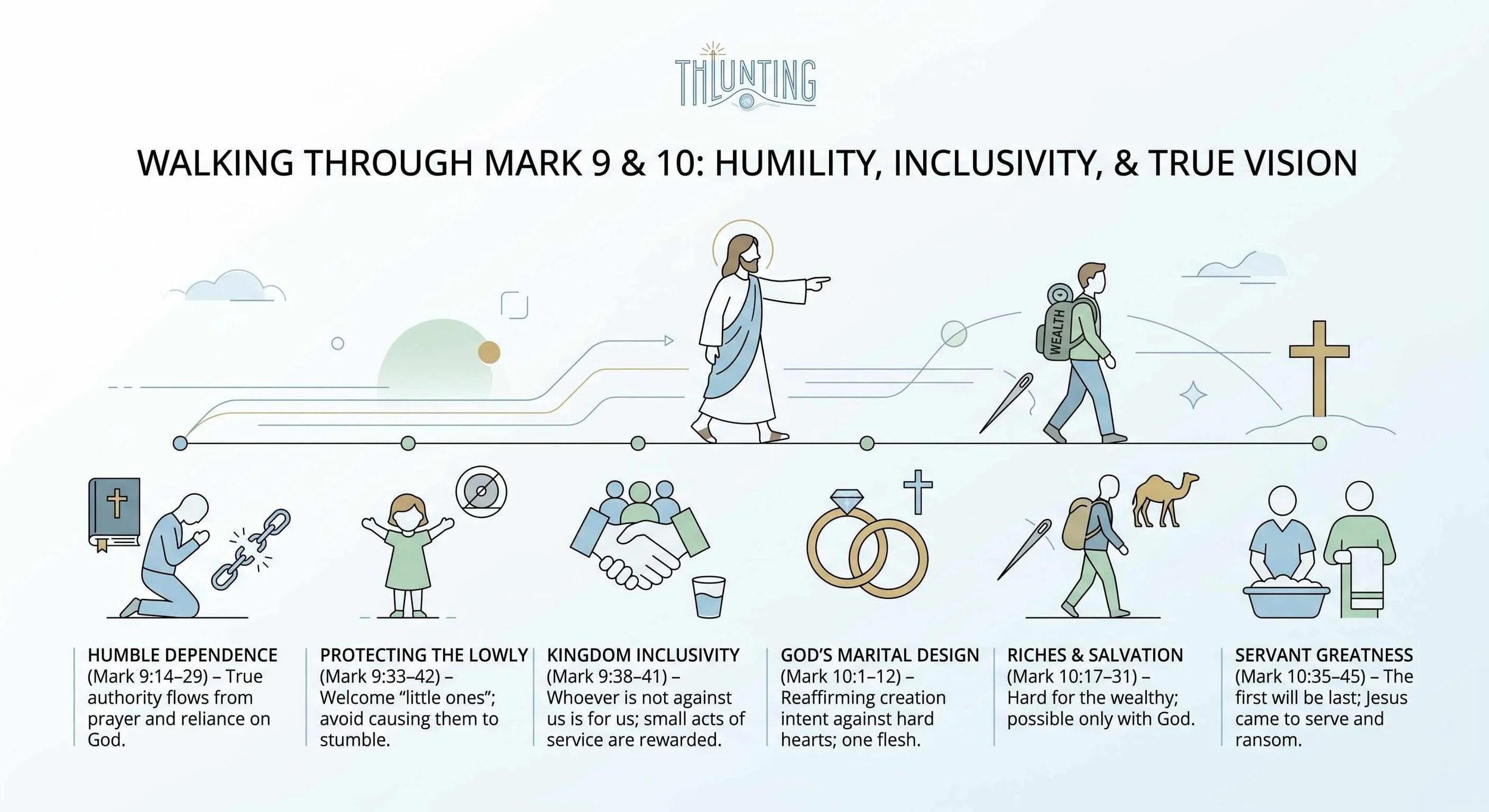
Short Summary of the Whole Class
Starting at 2026-10-28 18:36:02 (local time), the class reviewed Mark 9’s themes of humility, kingdom inclusivity, and warnings about causing “little ones” to stumble, then followed Mark’s flow into teachings on salt and peace. From there, the study moved through Mark 10:1–52—Jesus’ response to the Pharisees on divorce, welcoming children, the rich young ruler, His third passion prediction, James and John’s request for prestige, and the healing of Bartimaeus—highlighting the consistent call to lower status, guard the vulnerable, serve, and rely wholly on God.
Section-by-Section Walkthrough with Summaries
Opening Conversation and Group Check-In
Time: Begins shortly after 2026-10-28 18:36:02 (local time).
Participants: Cris, Speaker 2, Speaker 3, Speaker 4, Speaker 5 (noting Margo’s absence).
Content:
Lighthearted chat about sneezing habits and personal anecdotes.
Attendance note: Margo was absent.
Short Summary:
The class opened with friendly banter and catching up before the study began.
Scriptures: None.
Stories: Sneezing habits; attendee update on Margo.
Review of Mark 9: The Transfiguration, Exorcism, and True Greatness
Scriptures: Mark 9:2–13 (Transfiguration), Mark 9:14–29 (exorcism and prayer), Mark 9:33–37 (who is greatest; welcoming a child).
Content:
Transfiguration: Jesus revealed in glory on the mountain.
Disciples failed to cast out a demon; Jesus taught that this kind comes out only by prayer—framed by Cris as humble dependence, not ritual technique.
Dispute over greatness: Jesus placed a child among them to redefine greatness by welcoming the lowly; children in the first-century held minimal status, analogous to today’s marginalized or panhandling individuals.
Stories/Illustrations:
The mountain Transfiguration.
The demon-possessed boy healed by Jesus.
Welcoming a child as an object lesson on humility and low status.
Modern panhandler analogy for social lowliness.
Short Summary:
Jesus contrasted divine glory with the disciples’ weakness and pride, teaching that true kingdom authority and greatness come through humble dependence and welcoming the least.
Mark 9:38–41 — Kingdom Cooperation and Inclusivity
Scriptures: Mark 9:38–41.
Content:
John reported stopping an outsider casting out demons in Jesus’ name.
Jesus corrected sectarian pride: “Whoever is not against us is for us.”
Even a simple act like offering a cup of water in His name will be rewarded.
Stories/Illustrations:
John’s attempt to forbid the outside exorcist.
Short Summary:
Jesus rejected exclusivity, affirming kingdom cooperation and honoring small acts done in His name.
Mark 9:42–48 — Little Ones, Stumbling, and Cutting Off Hand/Foot/Eye
Scriptures: Mark 9:42–48.
Content:
Severe warning against causing “little ones” (children, marginalized, those with fragile faith) to stumble—better to be drowned with a millstone than to harm them.
Drastic sayings: cut off the hand/foot, pluck out the eye if they cause sin; better to enter life maimed than be cast into Gehenna.
Class linkage: These warnings connect directly to status-driven harm; our “members” symbolize how we may cause harm to vulnerable others.
Social status lens: Losing a hand/foot/eye lowers status and employability—better to lower one’s station than cause harm.
Gehenna imagery: “Where their worm does not die and the fire is not quenched.”
Stories/Illustrations:
Cultural punitive practices affecting livelihood and status.
Modern anecdote: A pastor’s stroke illustrating how loss changes capacity and standing.
Pop culture touch: Beetlejuice sandworms as a humorous parallel to “the worm.”
Millstone analogy likened to mob “concrete shoes.”
Short Summary:
Jesus calls for radical humility and self-limitation to prevent harm to the vulnerable, warning of grave consequences for causing others to stumble.
Textual Note — Mark 9:44 and 9:46
Scriptures: Mark 9:44, 46 (textual variants), Mark 9:48 (present in earliest manuscripts).
Content:
Some translations include verses 44 and 46 repeating “where their worm does not die and the fire is not quenched,” but many modern editions omit them as later repetitions.
The leader framed them as pastoral emphases for memorization, not doctrinal changes; verse 48 anchors the message.
Stories/Illustrations:
Textual history explanation; none beyond this.
Short Summary:
The repeated worm/fire lines likely reflect later scribal emphasis; the core warning remains unchanged.
Gehenna, Worms, and Fire — Vivid Imagery and Meaning (Mark 9:43–48)
Scriptures: Mark 9:43–48; conceptual allusion to C.S. Lewis’s “The Great Divorce.”
Content:
Gehenna viewed as a real valley/dump associated with judgment and refuse—smoldering fire and decay explain the imagery.
Theological reflections: the “worm” as relentless, consuming desires/sins that never satisfy; some choose separation due to unyielding resentments.
Tie-back: Pride and harm corrode communities; humility protects “little ones.”
Stories/Illustrations:
Guatemala City dump: constant smoldering fires producing smoke and sickness.
Household maggots in trash as a visceral image of decay.
Conceptual reference to The Great Divorce—choosing separation.
Short Summary:
Gehenna’s dump imagery intensifies Jesus’ warning: unchecked pride breeds relentless ruin, urging status-lowering care for the vulnerable.
Mark 9:49–50 — Salt, Fire, and Peace
Scriptures: Mark 9:49–50.
Content:
“Everyone will be salted with fire”; “Salt is good… Have salt in yourselves, and be at peace with one another.”
Emphasis: Trials (fire) produce distinctiveness (saltiness); status competitions make us lose our salt and damage community.
Commanded peace ties back to humility and unity.
Stories/Illustrations:
“Out-salting” metaphor—competing to be more “salty” diminishes witness.
Short Summary:
Jesus calls for tested distinctiveness that preserves community peace, not status rivalry.
Transition into Mark 10:1–12 — Pharisees Test Jesus on Divorce
Time Note: Reading began at 2026-10-28 18:36:02 (local time) and proceeded into Mark 10 as the class continued.
Scriptures: Mark 10:1–12; Genesis 1:27; Genesis 2:24; echoes of Exodus (Pharaoh’s hardened heart).
Content:
Pharisees “test” Jesus: “Is it lawful for a man to divorce his wife?”
Jesus asks about Moses’ command; reveals hardness of heart behind permissive divorce.
Jesus points back to creation: “male and female”; “two shall become one flesh”; “What God has joined together, let not man separate.”
Class insights: The question was a trap; modern parallels to contentious divorces and polarized opinions.
Continuity with status theme: Legal manipulations for power harm vulnerable parties (often women and children).
Stories/Illustrations:
Discussion of Pharaoh’s hardened heart as a background to “hardness of heart.”
Genesis creation narrative; Eve from Adam’s “side” (not merely “rib”), a term used for Ark/Temple sides, emphasizing equal halves.
Short Summary:
Jesus redirects legalistic traps to God’s creation intent, confronting hard hearts and protecting the vulnerable.
Mark 10:13–16 — Let the Children Come
Scriptures: Mark 10:13–16.
Content:
Disciples rebuke those bringing children; Jesus welcomes and blesses them.
Kingdom belongs to such as these; receive it like a child—trustful humility.
Narrative arc coherence: status debates, warning against harming the vulnerable, marriage fidelity, culminating in welcoming children.
Stories/Illustrations:
Comparison to church staff protecting offices—children seen as “interruptions.”
Short Summary:
Jesus crowns the humility theme: true greatness welcomes the lowly, receiving the kingdom as a child.
Mark 10:17–31 — The Rich Young Ruler, Wealth, and Salvation
Scriptures: Mark 10:17–31.
Content:
A wealthy man kneels to ask about eternal life; claims commandment-keeping from youth.
Jesus loves him and calls him to sell possessions, give to the poor, take up his cross, and follow; he departs sorrowful due to great wealth.
Teachings: Hard for the rich to enter; camel through the eye of a needle; with man salvation is impossible, with God all things are possible.
Peter’s “we left everything” remark; Jesus promises rewards with persecutions; “many who are first will be last.”
Class reflections: Disciples viewed the wealthy as ideal candidates; righteousness misread as achievement; link to earlier failure at exorcism due to self-reliance.
Stories/Illustrations:
Indiana Jones and the Last Crusade: choosing the humble cup vs. ornate prestige.
Prior disciples’ healing failure (Mark 9:14–29) used contextually to show self-reliance undermines spiritual authority.
Short Summary:
Wealth and self-achievement hinder discipleship; salvation rests solely on God’s grace, not human merit.
Mark 10:32–45 — Passion Prediction and Servant Greatness
Scriptures: Mark 10:32–45 (with 10:32–34 the third passion prediction).
Content:
Jesus predicts betrayal, condemnation, death, and resurrection.
James and John request seats of honor; the ten become indignant.
Jesus teaches kingdom greatness through servanthood: rulers lord it over others, but in His kingdom the greatest serves all.
Jesus as exemplar: the Son of Man came to serve and give His life as a ransom for many.
Stories/Illustrations:
The disciples’ dispute over greatness following the prestige request.
Short Summary:
Right after foretelling His suffering, Jesus defines greatness as servanthood, modeling sacrificial love and ransom.
Mark 10:46–52 — The Healing of Blind Bartimaeus
Scriptures: Mark 10:46–52.
Content:
Bartimaeus, a blind beggar, cries out to “Son of David” for mercy; crowd tells him to be quiet; he persists.
Jesus restores his sight; “your faith has made you well”; Bartimaeus follows Jesus on the road to Jerusalem.
Class note: A transition to the Triumphal Entry; spiritual sight vs. the disciples’ ongoing misunderstanding.
Stories/Illustrations:
Bartimaeus throws off his cloak and follows—symbol of leaving the old life.
Short Summary:
Bartimaeus’ persistent faith leads to healing and discipleship, showcasing true spiritual vision.
Medium-Length Summary of the Class
Beginning at 2026-10-28 18:36:02 (local time), the church Bible study journeyed from Mark 9 into Mark 10, threading a consistent call to humility, protection of the vulnerable, and peace. Mark 9 set the stage with the Transfiguration, the disciples’ prayerless failure at exorcism, and Jesus’ correction of their status rivalry by welcoming a child. Jesus dismantled sectarian pride when the disciples tried to stop an outsider ministering in His name, then issued severe warnings against causing “little ones” to stumble and urged radical self-limitation rather than perpetuating harm. The group explored Gehenna’s imagery—smoldering dumps, worms that don’t die—and noted textual variants around repeated warnings, affirming the passage’s gravity. In Mark 9:49–50, Jesus called for salt, fire, and communal peace.
Flowing into Mark 10, Jesus confronted a Pharisaic trap about divorce by returning to creation’s design and softening hard hearts. Immediately, He welcomed children, insisting the kingdom must be received like a child. The rich young ruler exposed the spiritual danger of wealth and the impossibility of self-salvation, corrected by Jesus’ insistence that with God all things are possible. As Jesus predicted His passion, James and John sought prestige, prompting Christ’s definitive teaching that greatness is servanthood, culminating in His own ransom. The class closed with Bartimaeus, whose persistent faith yielded sight and discipleship, a living picture of true vision and humble following.
Main Points
True dependence through prayer: spiritual authority flows from humble reliance on God, not ritual or self-reliance.
Redefining greatness: welcome and serve the lowly; receive the kingdom like a child.
Kingdom inclusivity: do not hinder those working in Jesus’ name outside our circle.
Protecting “little ones”: severe warnings against causing vulnerable believers to stumble.
Radical measures against sin: better to lower status than harm others; remove stumbling blocks.
Salt, fire, and peace: tested distinctiveness preserves unity; status rivalry erodes witness.
Marriage and creation intent: divorce allowances reflect hard hearts; God joins equal halves into one flesh.
Wealth and salvation: riches hinder; salvation is impossible by human effort but possible with God.
Servant greatness: the first will be last; Jesus models serving and giving His life as a ransom.
True spiritual vision: Bartimaeus’ faith and clarity contrast with status-seeking blindness.
Bible Scriptures Mentioned
Mark 9:2–13 — Transfiguration.
Mark 9:14–29 — Disciples’ inability to cast out a spirit; prayer and dependence.
Mark 9:33–37 — Dispute over greatness; welcoming a child.
Mark 9:38–41 — Outsider exorcist; reward for a cup of water.
Mark 9:42–48 — Warnings about causing “little ones” to stumble; cutting off hand/foot/eye; Gehenna; “worm” and “fire.”
Mark 9:44, 46 (textual notes) — Repeated worm/fire line likely later additions.
Mark 9:49–50 — Salted with fire; peace with one another.
Mark 10:1–12 — Pharisees’ test on divorce; Jesus appeals to creation intent and addresses hardness of heart.
Mark 10:13–16 — Let the children come; receive the kingdom like a child.
Mark 10:17–31 — Rich young ruler; camel and needle; with God all things are possible; first last, last first.
Mark 10:32–34 — Third prediction of Jesus’ death and resurrection.
Mark 10:35–45 — James and John’s request; servant leadership; ransom for many.
Mark 10:46–52 — Healing of Bartimaeus; faith and following.
Genesis 1:27; 2:24 — Creation of male and female; one flesh.
Exodus references — Pharaoh’s hardened heart (conceptual background to “hardness of heart”).
Stories and Illustrations Talked About
Opening banter: sneezing habits; attendance note (Margo absent).
Transfiguration on the mountain; disciples failing to heal the demon-possessed boy.
Welcoming the child as an object lesson; modern panhandler analogy for low status.
John forbidding the outside exorcist.
Millstone drowning analogy compared to mob “concrete shoes.”
Beetlejuice sandworms as a humorous nod to “the worm.”
Cultural punitive practices (hand/foot/eye) affecting status and livelihood.
Pastor’s stroke anecdote illustrating loss and lowered station.
Guatemala City dump: smoldering fires producing smoke and sickness.
Household maggots in trash as vivid “worm” imagery.
“Out-salting” metaphor about status competition.
Genesis “side” (not just “rib”) as equal halves; Ark/Temple sides.
Pharisaic trap dynamics and modern parallels to contentious divorces.
Church office protection analogy—children seen as interruptions.
Rich young ruler kneeling; camel and needle; Peter’s “we left everything.”
Disciples’ prior healing failure (Mark 9:14–29) as context for self-reliance critique.
Indiana Jones and the Last Crusade: choosing the humble grail.
James and John seeking seats of honor; disciples’ indignation.
Bartimaeus throwing off his cloak; persistent faith; following Jesus.