
Jonah Chapter 4 Class 3 - Bible Study
Jonah Chapter 4
This is our 3rd class on Jonah
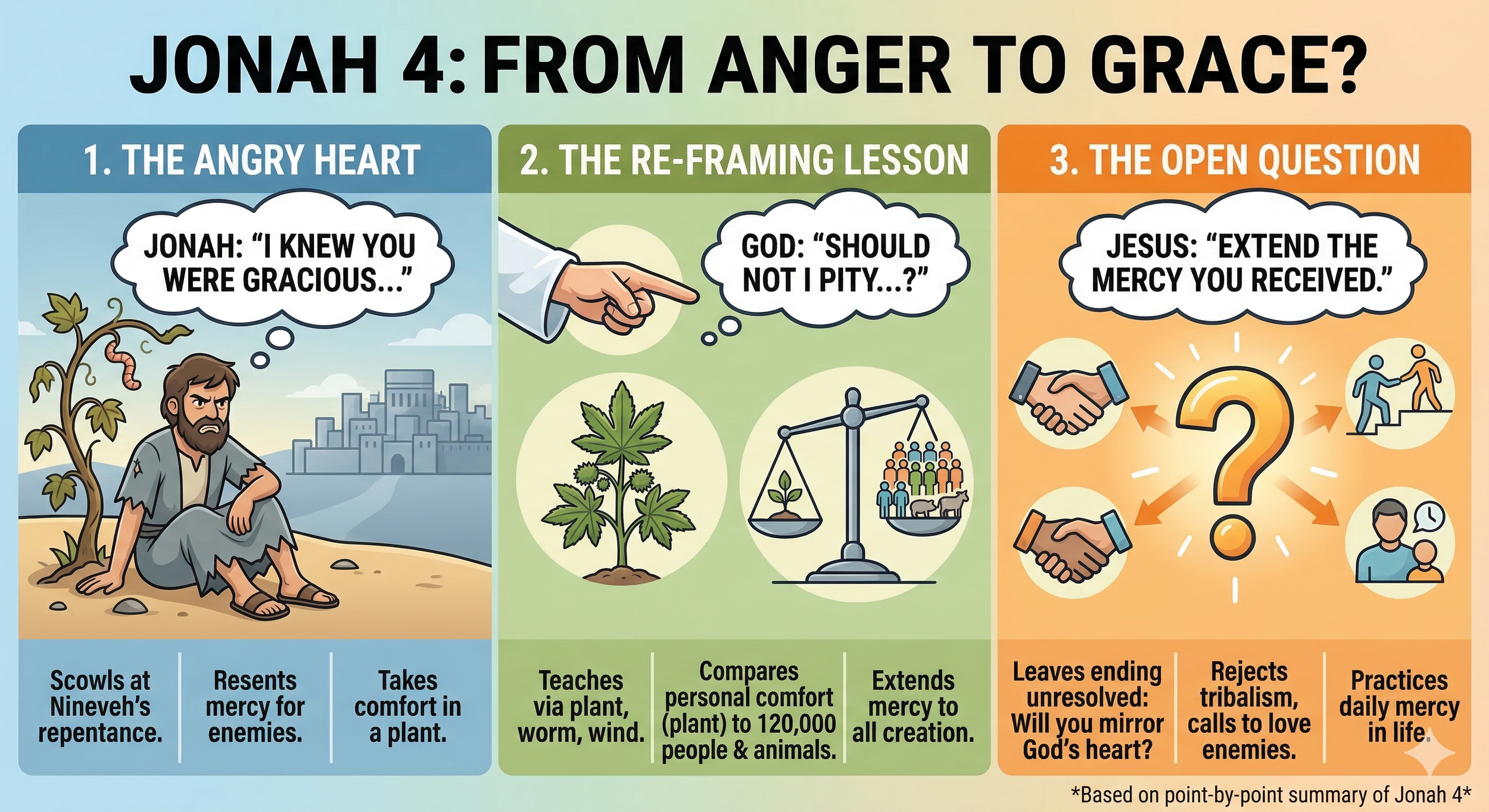
This is an AI Recap of the class.
Some things may be incorrect.
Short summary of the whole class
On March 19, 2026, our class read Jonah 4 and examined Jonah’s anger when God spared Nineveh after its repentance. We traced God’s object lesson through the plant, worm, and east wind, and considered how Jonah’s complaint weaponizes Israel’s creed about God’s mercy. We connected Jonah’s open-ended finish to Job’s probing questions and Mark 16:8, explored links to Jesus’ welcome of outsiders, and paralleled Jonah with the elder brother in the Prodigal Son. The conversation turned to modern mirrors—politics, “God is on our side” rhetoric, daily frustrations (traffic, lines), and church life—asking what we do when God loves our enemy. We concluded that Scripture calls us to share God’s pity for all creation and practice humble, enemy-loving mercy.
Walkthrough of the class with section-by-section summaries
1) Setting the stage: Jonah 3’s outcome and the pivot to Jonah 4
What we discussed:
Jonah’s reluctant warning to Nineveh (“Yet forty days…”) surprisingly worked; the city repented in a way Israel often didn’t under prophets like Amos and Joel.
God relented from disaster because Nineveh turned from evil, setting up the tension in Jonah 4.
Scriptures and stories mentioned:
Jonah 3:4–10
Prophets referenced: Amos; Joel
Short wrap-up:
Nineveh’s dramatic repentance prepares us for Jonah 4’s central conflict: a merciful God and a prophet who dislikes mercy for enemies.
2) Reading Jonah 4 and first reactions: anger and a divine question
What we discussed:
Jonah is “exceedingly displeased and angry,” praying that he knew God is “gracious and merciful, slow to anger, abounding in steadfast love,” and asking to die.
God asks, “Is it right for you to be angry?” Jonah camps east of the city to see what will happen.
God appoints a plant to shade Jonah, a worm to kill it, and a scorching east wind—Jonah again wants to die.
God contrasts Jonah’s pity for the plant with His pity for 120,000 people who “do not know their right hand from their left—and much livestock.”
Scriptures and stories mentioned:
Jonah 4:1–11
Short wrap-up:
Jonah’s anger collides with God’s compassion; the plant becomes a spiritual mirror exposing Jonah’s misplaced values.
3) Abrupt endings and literary echoes: Jonah, Job, and Mark
What we discussed:
Jonah’s open ending (God’s unanswered question) recalls Job’s conclusion with divine questions and the Gospel of Mark’s shorter ending (Mark 16:8), where the women flee in fear and amazement.
These unresolved finales function as invitations rather than tidy conclusions.
Scriptures and stories mentioned:
Jonah 4:10–11
Job (chs. 38–42 referenced for God’s questioning)
Mark 16:8
Short wrap-up:
Like Job and early Mark, Jonah leaves a question hanging—pushing readers to examine their hearts.
4) Why is Jonah so angry? Enemies, identity, and the scandal of mercy
What we discussed:
Jonah may fear Israel’s reaction if he “saves” Assyrian enemies, functioning as a stand-in for national sentiment.
He recites Israel’s creed (Exod 34:6) but uses it as a complaint—mercy for “us” is fine, not for “them.”
Scriptures and stories mentioned:
Jonah 4:2 (echoing Exodus 34:6)
Broad OT backdrop: Israel and Assyria/Nineveh
Short wrap-up:
Jonah reveals the hypocrisy of celebrating grace for ourselves while resenting it for our enemies.
5) Jonah’s anger: the plant and the people
What we discussed:
Jonah stands in for Israel’s calling to bless the nations yet resents mercy to outsiders.
God asks twice, “Is it right for you to be angry?”—about Nineveh and the plant—placing Jonah’s self-interest beside God’s care for people.
Zeal alone doesn’t make a cause righteous; intensity isn’t legitimacy.
Scriptures and stories mentioned:
Jonah 4:4, 4:9
Illustration: the “willing to die for a brownie” quip highlighting that passion doesn’t guarantee righteousness.
Short wrap-up:
Jonah’s grief over a plant outweighs compassion for a city—his values are misaligned.
6) Jonah and Job: learning humility before God
What we discussed:
Job eventually confesses, “I have spoken too much,” while Jonah never explicitly reaches that humility in the text.
God’s “creation tour” in Job reframes suffering; in Jonah, God widens perspective to encompass people and animals.
Anger often grows in “small stuff” when we lose sight of God’s big picture.
Scriptures and stories mentioned:
Job 38–42
Jonah 4:10–11
Illustration: “middle school drama” image for how small irritations eclipse larger truths.
Short wrap-up:
Wisdom and humility come from seeing beyond ourselves to God’s vast purposes.
7) God’s compassion for Nineveh—and the “holy” number
What we discussed:
“More than 120,000 persons” who don’t know right from left underscores Nineveh’s size and God’s pity, challenging tribal boundaries.
Echoes to Israel’s symbolic numbers and Jesus’ ministry: welcoming outsiders and refusing sectarian control.
Parallels: Jesus weeping over Jerusalem’s rejection of peace; disciples upset about others acting in Jesus’ name.
Scriptures and stories mentioned:
Jonah 4:11
Luke 19:41–44; Luke 19:39–40
Mark 9:38–41 or Luke 9:49–50
Short wrap-up:
God’s mercy stretches beyond our lines; the question is whether we will rejoice when “outsiders” turn to God.
8) “Much cattle”: God’s care for creation
What we discussed:
The ESV’s closing phrase (“and also much cattle”) sparked reflection on God’s care for animals and the vulnerable.
In Jonah 3 even animals donned sackcloth—playful imagery (hamsters, cockroaches) made a serious point: mercy extends to all God made.
Scriptures and stories mentioned:
Jonah 3:7–8; Jonah 4:11
Short wrap-up:
Jonah widens our horizon: God’s compassion embraces humans and beasts.
9) Modern mirrors: politics, “God is on our side,” and public witness
What we discussed:
Jonah’s posture connects to contemporary “takedown” culture and drafting God to our side.
Outsiders often perceive Christians as unloving; while we can’t fix every perception, we can embody hope, humility, and mercy locally.
Scriptures and stories mentioned:
No additional verses beyond Jonah 4 in this segment
Stories: media/political “takedown” culture; church’s public reputation
Short wrap-up:
Resist tribal victory narratives; recover a witness marked by mercy.
10) “What do you do when God loves your enemy?”—The gospel’s call
What we discussed:
Jesus commands us to love enemies; Scripture offends when it confronts our preferences.
Confined mercy—only for “our side”—distorts the gospel.
Scriptures and stories mentioned:
Matthew 5:43–48; Luke 6:27–36
Short wrap-up:
The gospel demands we extend to others the mercy we receive.
11) C. S. Lewis’ “The Great Divorce” and choosing separation
What we discussed:
Some would rather reject heaven than share it with those they despise—mirroring Jonah’s “better for me to die” than coexist with forgiven Ninevites.
Scriptures and stories mentioned:
Story: C. S. Lewis’ The Great Divorce
Short wrap-up:
Grievance can isolate us from grace; God calls us back into shared joy.
12) The older brother pattern: forgiveness resisted
What we discussed:
Jonah and the elder brother both resent mercy shown to “the other.”
The Gospels crescendo in forgiveness and invite us to inhabit that goodness rather than cling to anger.
Scriptures and stories mentioned:
Luke 15:11–32
Short wrap-up:
Mercy for me but judgment for you is a heart disease both Jonah and the elder brother expose.
13) Violence, cycles of hate, and the prophetic critique
What we discussed:
Warfare narratives (Joshua, Judges, 1–2 Maccabees) show escalating hostility—even within Israel.
Jonah subverts the cycle with repentance and divine pity for a violent city.
Scriptures and stories mentioned:
Joshua; Judges; 1–2 Maccabees
Short wrap-up:
God prefers repentance and life over endless reprisals.
14) God’s object lesson: plant, worm, wind—and Jonah’s heart
What we discussed:
Possible ID of the plant (castor oil plant) with large leaves; God appoints plant, worm, and scorching east wind.
Jonah mourns the plant but not Nineveh; God’s question reframes pity to include 120,000 people and animals.
A personal windburn anecdote highlighted the east wind’s harshness.
Scriptures and stories mentioned:
Jonah 4:4–11
Study note: castor oil plant as a candidate
Story: windburn experience
Short wrap-up:
The object lesson exposes compassion skewed toward comfort rather than human life and creation.
15) Everyday application: anger, traffic, and gratitude
What we discussed:
Practicing patience in traffic and lines by seeing each person as God’s image-bearer.
Church-life vignettes: some take extra pain meds to attend; some argue and still show up—prompting gratitude over harshness.
Scriptures and stories mentioned:
Thematic tie to Jonah 4; no specific verse cited beyond earlier references
Stories: Arkansas congregation moments; pastoral shift toward gratitude during offering
Short wrap-up:
Slow down, see people, and choose mercy; life already gives enough “law.”
16) Open-ended endings: Jonah, the Prodigal’s elder brother, and Mark’s women
What we discussed:
Jonah’s abrupt close parallels the elder brother left outside the party and Mark 16:8’s fearful women.
“The Lady or the Tiger?” illustrates how open endings force reader response.
Historical backdrop: the Roman world’s harshness in which early Christianity grew.
Scriptures and stories mentioned:
Jonah 4; Luke 15:25–32; Mark 16:8
Stories: “The Lady or the Tiger?”; Roman Colosseum context
Short wrap-up:
Scripture declares God’s mercy and leaves the next move to us: will we join the celebration?
17) God’s desire for life, not death
What we discussed:
God preserves man and beast, takes no pleasure in the death of the wicked, and desires all to be saved.
Our posture should be humble gratitude for grace given to us and available to all.
Scriptures and stories mentioned:
Ezekiel 18:23; Ezekiel 33:11; 1 Timothy 2:3–4; Psalm 36:6; Jonah 4:11
Short wrap-up:
God’s heart is restorative; we’re invited to mirror that heart.
Medium-length final summary of the class
On March 19, 2026, we explored Jonah 4, where Jonah is furious that God spares Nineveh after its repentance. He recites Israel’s creed—God is gracious, merciful, slow to anger—yet wields it as a complaint when mercy reaches enemies. God stages an object lesson with a plant, a worm, and a scorching wind to expose Jonah’s compassion for comfort over people. We compared Jonah’s open ending to Job’s divine questions and Mark 16:8, seeing how Scripture sometimes leaves us with a question to answer. We linked Jonah’s themes to Jesus’ welcome of outsiders, the elder brother’s resentment in Luke 15, and modern tribal politics and media “takedowns.” The class also pressed practical discipleship: patience in traffic, gentleness in church life, gratitude for others’ sacrifices, and a commitment to love enemies. We noted God’s pity for “more than 120,000 persons … and also much cattle,” widening our view to include all creation. Jonah 4 ultimately asks: What do we do when God loves our enemy? God’s final word is pity; the invitation is to align our hearts with His.
Main points
Jonah 4 reveals a prophet angered by God’s mercy to enemies, exposing hypocrisy about grace.
The book’s abrupt ending functions like Job and Mark 16:8—leaving a divine question that aims at the reader’s heart.
God’s plant–worm–wind lesson uncovers Jonah’s misplaced compassion: comfort over human lives and creation.
Zeal or willingness to die doesn’t make a cause righteous; alignment with God’s mercy does.
Scripture consistently calls God’s people to love enemies; Jonah mirrors the elder brother’s resentment.
Modern parallels abound: partisan “takedown” culture and the impulse to conscript God to our side.
God’s pity extends to all—even animals—and invites us to share His compassion rather than cling to anger.
Practical discipleship means humility, patience, and gratitude in daily life and church community.
Scriptures mentioned
Jonah 3:4–10
Jonah 4:1–11; Jonah 4:2; Jonah 4:4; Jonah 4:9–11
Exodus 34:6 (echoed in Jonah 4:2)
Amos; Joel (prophetic backdrop)
Job 38–42
Mark 16:8
Matthew 5:43–48; Luke 6:27–36
Luke 15:11–32; Luke 15:25–32
Luke 19:39–44; Luke 19:41–44
Mark 9:38–41; Luke 9:49–50
Ezekiel 18:23; Ezekiel 33:11
1 Timothy 2:3–4
Psalm 36:6
Joshua; Judges; 1–2 Maccabees (contextual references)
Stories and works referenced
Nineveh’s repentance in Jonah
The elder brother in the Prodigal Son
Contemporary media/political “takedown” culture and the church’s public witness
C. S. Lewis’ The Great Divorce (choosing separation rather than shared grace)
“The Lady or the Tiger?” (open-ended narrative)
Roman Colosseum context (harsh backdrop for early Christianity)
Everyday life: traffic jams, checkout lines, impatience and tribalism
Church-life vignettes: congregants’ sacrifices to attend; pastoral move toward gratitude
Anecdote illustrating the east wind’s harshness (windburn)
Note on the plant (possible castor oil plant)