
Jonah Chapter 2-3 Class 2 - Bible Study
Jonah Chapter 2-3
This is our 2nd class on Jonah
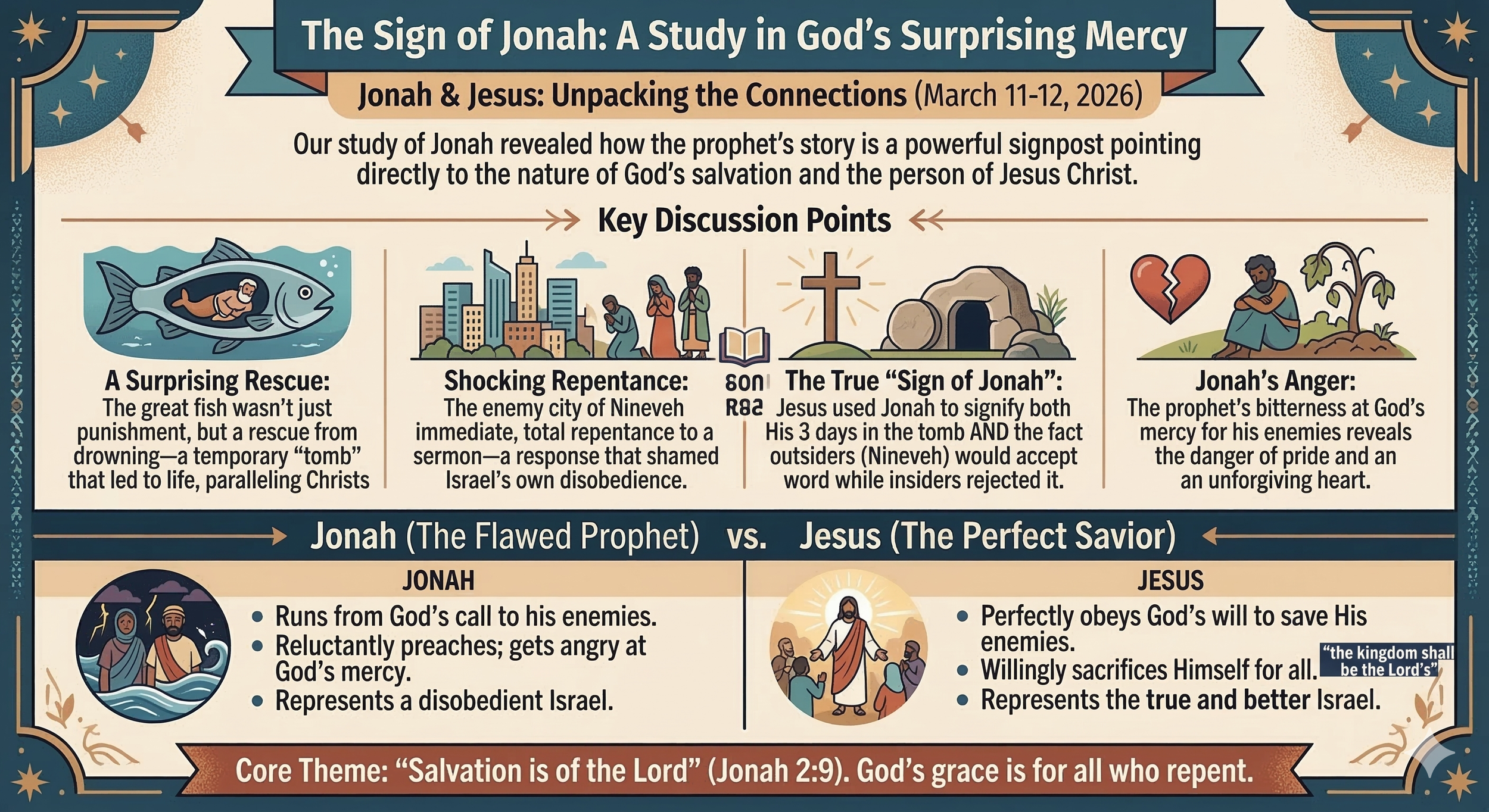
This is an AI Recap of the class.
Some things may be incorrect.
Short Summary of the Whole Class
During our Bible study sessions, we delved into the profound theological depths of the book of Jonah, particularly chapters 2, 3, and 4. We began with Jonah's prayer from the belly of the fish, seeing it as a picture of Israel's pattern of crying out to God only in distress. The discussion then moved to the shocking, widespread repentance of Nineveh in response to Jonah's reluctant preaching, a stark contrast to Israel's own disobedience. We explored how Jonah's anger at God's mercy reveals the dangers of spiritual pride and an unforgiving heart. Ultimately, we connected the entire story to Jesus' teachings on the "sign of Jonah," concluding that the book demonstrates that salvation is a sovereign act of God, whose grace extends to all who repent, even His enemies.
Detailed Class Summary
Church Announcements and Jonah's Prayer in the Deep
Our class began with a brief recap of Jonah chapter 1 and some church announcements. There was a discussion about potentially starting a new Bible study on Wednesday nights to accommodate more people, though our current Thursday study is expected to remain.
We then read Jonah chapter 2, analyzing Jonah's prayer from the belly of the fish. The group noted that the prayer is rich with language from the Psalms, showing Jonah's scriptural knowledge. However, the irony was not lost on us: he only cried out to God in desperation, not when he was causing the trouble on the ship. This was seen as symbolic of Israel's own pattern of rebellion followed by cries for help only when in deep distress. A key insight shared was viewing the fish not merely as a punishment but as a "rescue," saving Jonah from drowning. This provided a powerful parallel to Christ's time in the tomb, which seemed like the end but was ultimately the rescue for all humanity. The section concluded by focusing on the core truth from Jonah's prayer: "Salvation is of the Lord" (Jonah 2:9), highlighting that his rescue was due to God's sovereign will, not his own merit.
Section Summary: We discussed potential new Bible study times before analyzing Jonah's prayer in chapter 2. We saw his prayer as a model of Israel's crisis-driven faith and reframed the fish as a "rescue," underscoring the theme that salvation is a sovereign act of God.
Bible Verses Mentioned: Jonah 1, Jonah 2, Jonah 2:9.
Stories Mentioned: Jonah and the storm at sea, Jonah being swallowed by the great fish, Jesus calming the storm.
The Second Chance and the Shocking Repentance of Nineveh
Transitioning to chapter 3, we saw Jonah get a second chance to obey God's command. He travels to the great city of Nineveh and delivers a stark, eight-word message: "Yet forty days and Nineveh shall be overthrown." The class was astonished by the city's immediate and universal repentance. Jonah was only one day into his journey when the entire city, from the "greatest to the least," responded. The king himself humbled himself, trading his royal robe for sackcloth and ashes. The most striking detail was the decree for even the animals to fast and wear sackcloth, which we interpreted as a sign of the extreme sincerity of Nineveh's plea for God's mercy. This profound repentance from Israel's brutal enemy stood in stark contrast to Israel's own repeated failure to repent despite countless warnings from numerous prophets.
Section Summary: Given a second chance, Jonah delivers a brief sermon. In response, Nineveh undertakes an immediate and profound city-wide act of repentance, involving everyone from the king down to the animals, demonstrating a sincere desire for God's mercy that shames Israel's own history of disobedience.
Bible Verses Mentioned: Jonah 3:4-9.
Stories Mentioned: Jonah preaching to Nineveh.
The "Sign of Jonah," Pride, and Forgiveness
The final part of our discussion tied these events together, focusing on the "sign of Jonah" as referenced by Jesus. We read Matthew 12:38-42, where Jesus explicitly compares Jonah's three days in the fish to His three days in the earth. More importantly, Jesus states, "The men of Nineveh will stand up at the judgment with this generation and condemn it; for they repented at the preaching of Jonah, and now something greater than Jonah is here." We concluded that the "sign of Jonah" is not just about the three days, but about God's power to bring repentance to Gentiles (Nineveh).
This highlighted the danger of spiritual pride, as seen in Jonah, who was angry at God's mercy. He didn't flee out of fear, but because he knew God was gracious and he wanted his enemies to be destroyed. This unwillingness to see his enemies forgiven was connected to the Lord's Prayer ("forgive us as we forgive others") and the idea from C.S. Lewis that we might choose our own damnation if we cannot stand to be in heaven with those we refuse to forgive. The story shows that salvation is God's initiative, not dependent on the messenger, a truth ultimately fulfilled in Jesus, whose sacrifice opened salvation to all nations.
Section Summary: We examined how Jesus uses Nineveh's repentance as the "sign of Jonah" to condemn the unbelief of his generation. We discussed how Jonah's anger at God's mercy reveals the danger of spiritual pride and an unforgiving heart, concluding that the story points to the gospel, where Jesus opens God's grace to all people.
Bible Verses Mentioned: Matthew 12:38-42, Luke 11:29, Matthew 16:4, Matthew 6:12 (The Lord's Prayer), Revelation 21.
Stories Mentioned: The Queen of the South visiting Solomon, the Parable of the Good Samaritan, the tearing of the temple curtain.
Final Medium-Length Summary
Our Bible study on March 11-12, 2026, focused on the book of Jonah, revealing its deep connections to the person and work of Jesus. We began with Jonah's prayer from the belly of the fish (Jonah 2), seeing it not just as a personal lament but as a reflection of Israel's tendency to cry out to God only in desperation. A key insight was reframing the fish as an act of "rescue," a powerful parallel to Christ's tomb experience being the ultimate rescue for humanity. We then contrasted Jonah’s reluctant obedience with the shocking and complete repentance of Nineveh in chapter 3. The pagan city responded with more humility to a brief, hostile sermon than Israel did to generations of prophetic warnings. This led to our core discussion on the "sign of Jonah" from Matthew 12. We concluded the true sign was twofold: the three days in the fish/tomb, and, more significantly, the repentance of the Gentiles (Nineveh), which condemns the hard-heartedness of those who should know better. Jonah’s anger at God’s mercy for his enemies served as a stark warning against spiritual pride and an unforgiving spirit, showing that salvation is from the Lord and His grace extends far beyond our prejudices.
Main Points
Jonah's prayer in chapter 2 is a compilation of scripture, but it highlights a reactive faith, mirroring Israel's pattern of crying out only in crisis.
The great fish can be interpreted as a "rescue" for Jonah, providing a parallel to Christ's tomb experience being a rescue for humanity.
The "sign of Jonah" referenced by Jesus includes both the three days/nights and, crucially, the repentance of the pagan Ninevites in response to God's word.
Nineveh's sincere, universal repentance stands in stark contrast to Jonah's bitterness and Israel's own history of disobedience.
Jonah's anger at God's mercy reveals the danger of spiritual pride and an unforgiving heart.
The story of Jonah demonstrates that "salvation is from the Lord" and prefigures the gospel, where Jesus's sacrifice opens God's mercy to all nations.
Scriptures and Stories
Bible Scriptures:
Jonah 1, 2, 3, 4
Matthew 12:38-42
Matthew 16:4
Luke 11:29
Luke 19:40
Matthew 6:12 (The Lord's Prayer)
Revelation 21
The Book of Judges
Bible Stories:
Jonah and the storm at sea.
Jonah being swallowed by the great fish.
Jonah preaching in Nineveh.
The city-wide repentance of Nineveh.
Jesus calming the storm.
The Queen of the South visiting King Solomon.
The Parable of the Good Samaritan.
Jesus' death and resurrection.