
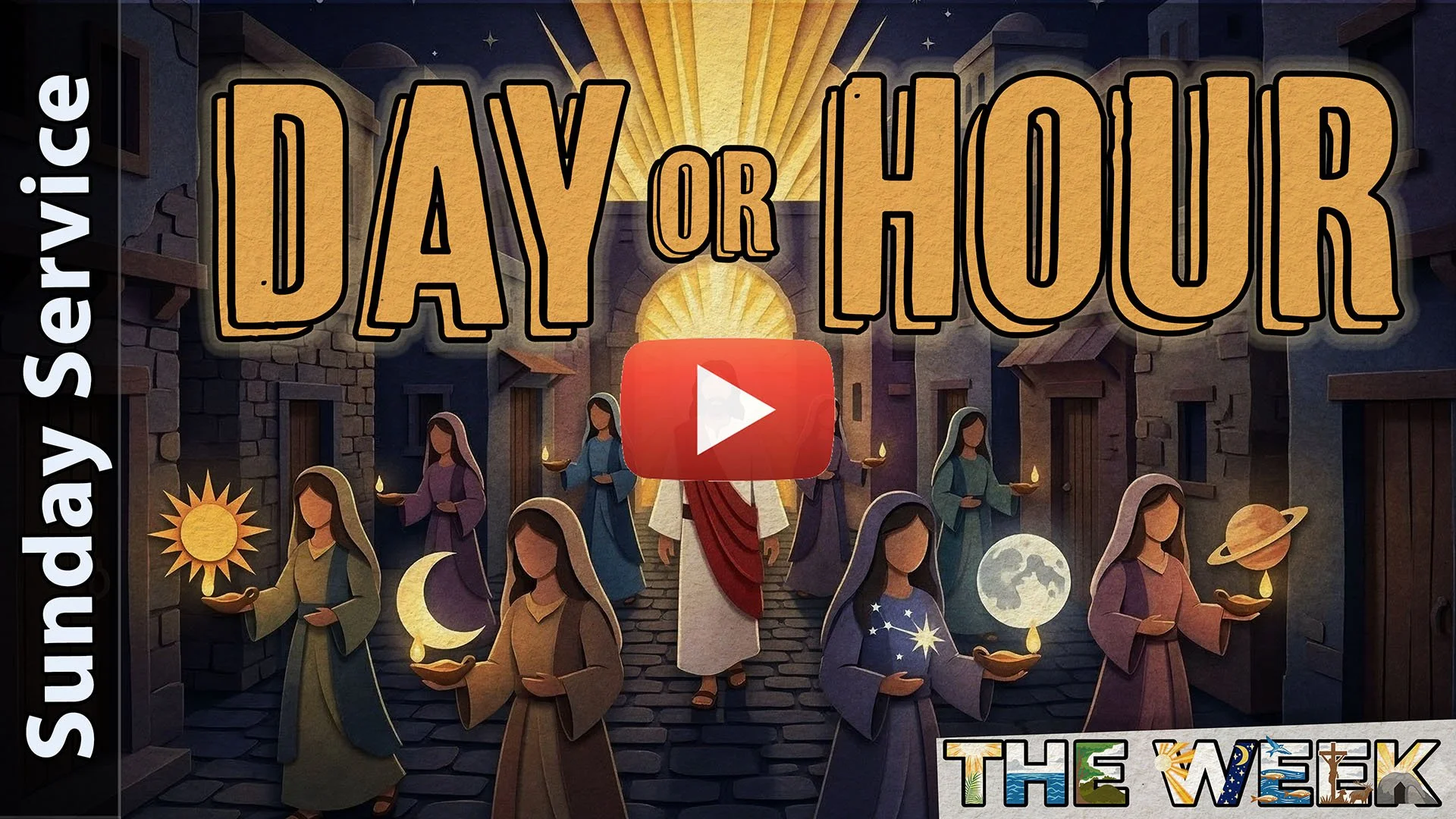
God created the Sun, Moon, and Stars on Day 4 to bring order. But the sun went dark as the Creator took our chaos. You don't have to fix your life in the dark; the Lamb is your light.
-
Sermon Series: The Week
Content Creation Date
March 15, 2026, 10:43:18
Sermon Context
Series concept: Interweaving Holy Week with the seven days of Creation to reveal God’s redemptive arc in the Old Testament and its fulfillment in Jesus.
This sermon focuses on Day Four of Creation and its resonance with Jesus’ apocalyptic teachings in Matthew 22–25, the cross, and the hope of new creation.
Opening Prayer
Gratitude for God’s goodness, holiness, and presence amid chaos and distress.
Request that the sermon reflect God’s will for His people.
Review of Previous Weeks: Days 1–3 of Creation
God’s creative acts counter the “tohu vavohu” (formless and void; wild and waste) by bringing order and life.
Connections to Holy Week:
Day 1: “Let there be light” corresponds to Jesus’ entry into dark Jerusalem on Palm Sunday.
Day 2: Separation of waters corresponds to Jesus overturning the tables, opening the temple to the blind, hurting, and outsiders.
Day 3: Emergence of dry ground and fruitfulness corresponds to the fig tree incident, revealing the danger of appearing healthy without true fruit.
Day Four of Creation: Filling the Order with Lights
Scripture: Genesis Day Four.
“And God said, ‘Let there be lights in the vault of the sky to separate the day from the night. Let them serve as signs to mark the sacred times, days, and years…’” — Highlighting cosmic order and governance by sun, moon, and stars.
Theological observation:
Days 4–6 “fill” the form placed in Days 1–3. Day Four “fills” Day One’s light with governing lights that establish order and sacred times.
These lights provide rhythm, breathability, and stability to human life.
The Question of Disorder: When Governance Breaks Down
Pastoral application:
Even small disruptions (e.g., time change) can unsettle us; how much more when cosmic order collapses?
Cultural anecdote: Floridians’ dependence on sunlight; Seattle’s low-light environment as an example of emotional impact.
Spiritual implication:
The apocalyptic teachings of Jesus in Matthew 22–25 warn of times when the cosmic order fails and chaos returns.
Jesus’ Apocalyptic Teaching: Matthew 22–25
Scripture: Matthew 24:29–31.
“Immediately after the distress of those days, the sun will be darkened, and the moon will not give its light, and the stars will fall from the sky… Then will appear the sign of the Son of Man… and he will send his angels… and they will gather his elect…”
Key points:
The language of cosmic collapse echoes the creation themes and signals profound judgment and transition.
Jesus situates Himself within the prophetic tradition, not inventing apocalyptic imagery but fulfilling it.
Prophetic Background: Amos and the Day of the Lord
Scripture: Amos 8:9–10.
“‘In that day,’ declares the Sovereign Lord, ‘I will make the sun go down at noon and darken the earth in broad daylight… I will turn your religious festivals into mourning… like mourning for an only son.’”
Interpretation:
Amos frames darkness as judgment tied to sin and rebellion. The “Day of the Lord” is a reversal of Day Four’s order—lights fail, sacred times turn to mourning.
Historical Fulfillment: The Temple and Judgment
Jesus’ fig tree teaching and mountain/temple saying:
“If you have faith… you can say to this mountain… be thrown into the sea.” Interpreted as a prophetic sign regarding the temple’s fate.
Historical note:
The destruction of the temple (c. AD 70) occurred within a generation of Jesus’ words.
For the Jewish people, this felt like cosmic darkness—the collapse of the center of worship and order.
Personal Chaos: Modern Applications
Examples:
Medical diagnoses that plunge us into fear.
Relationship trauma that reawakens pain.
Temptations:
To fight in our strength (“war paint”).
To mislabel darkness as light—especially in politicized or militarized narratives.
Pastoral Warning on Calling Darkness Light
Contemporary note:
Social media giddiness about war or temple-related geopolitics as “signals” for Jesus’ return.
Caution:
We do not know the day or hour; beware of voices that monetize apocalyptic predictions.
Do not baptize destruction as light; remain grounded in the Gospel’s true hope.
The Cross as the Great and Glorious Day of the Lord
Scripture: Matthew 27:45; Psalm 22:1 (echoed by Jesus).
“From noon until three in the afternoon darkness came over all the land.”
“My God, My God, why have You forsaken Me?”
Theological claim:
On the cross, creation “rolls back” into “tohu vavohu”—the lights fail, the clock stops.
Yet God the Father is not far from the Son. Jesus embraces chaos, dies for us, and descends into the darkness.
Resurrection: “Let There Be Lights” Again
Creation echoes:
The Spirit still hovers; the Father’s call renews the light.
Easter is the new dawn—Jesus rises as the true Light, reestablishing order and peace.
Identity and calling:
Who God is: Holy, present, sovereign over chaos, faithful to redeem.
Who you are: Beloved, carried by God’s Spirit, called to trust and be prepared.
How to live: Breathe, do not manufacture light, wait on God’s governance and grace.
Parable of the Ten Maidens: Preparedness in Darkness
Scripture: Matthew 25:1–13.
Ten maidens await the bridegroom; five wise bring oil and are ready for the delay and the night, five foolish assume perpetual daylight and are unprepared.
Clarification:
“Virgin” as a translation of “young maiden.”
Application:
Wisdom is readiness for darkness—trusting God’s provision when rhythms fail.
Foolishness is presuming endless daylight—neglecting serious engagement with faith and discipleship.
Final Hope: New Creation and the Seventh Day
Scripture: Revelation 21:22–23.
“I did not see a temple in the city, because the Lord God Almighty and the Lamb are its temple. The city does not need the sun or the moon… for the glory of God gives it light, and the Lamb is its lamp.”
Eschatological vision:
The temple is fulfilled in God and the Lamb.
Sun and moon become unnecessary—Jesus is the Light, establishing eternal order and peace.
Applications for Today
When your life feels like “tohu vavohu”:
Breathe. God’s Spirit gives breath.
Do not try to manufacture your own light or baptize darkness as light.
Prepare your faith-life for seasons of darkness—practice trust, prayer, community, and Scripture now.
Remember: Jesus took the chaos upon Himself and rose to govern your days with His peace.
Key Points
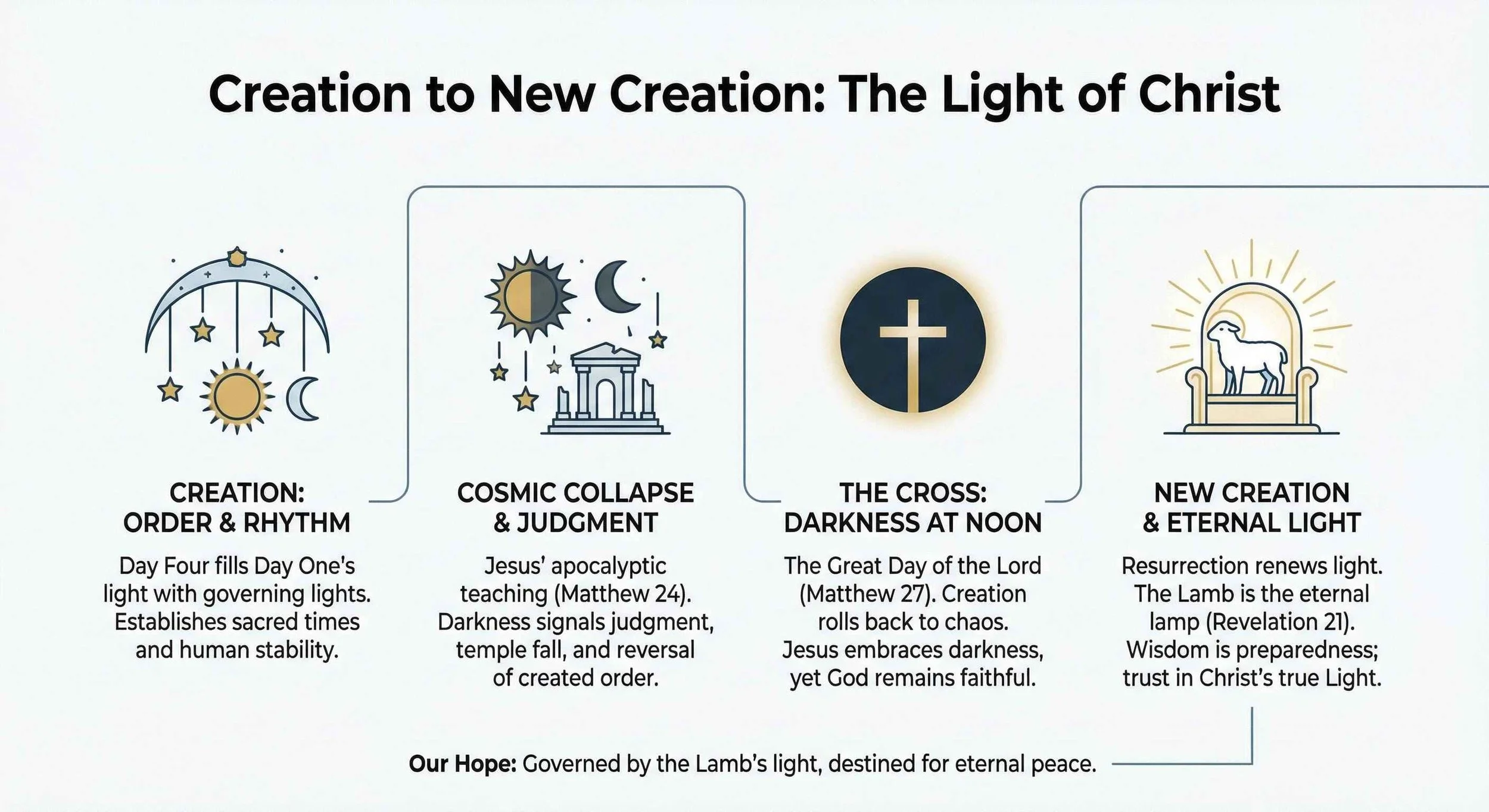
God’s creation brings ordered light into chaos; Day Four fills Day One’s light with governing lights and sacred rhythms.
Jesus’ apocalyptic teaching echoes the prophets: the Day of the Lord is a reversal of created order, revealing judgment and the need to be ready.
The cross is the great Day of the Lord: darkness at noon signifies creation’s rollback; yet God remains faithful, and resurrection renews light.
Do not call darkness light—avoid apocalyptic speculation and politicized “giddiness” over conflict; cling to the true Light, Jesus.
Wisdom is preparedness: like the five maidens with oil, cultivate a faith that can endure the night, trusting God to say again, “Let there be lights.”
Our identity and hope: We are carried by the Spirit, governed by the Lamb’s light, and destined for a new creation where Jesus Himself is our lamp.
Closing Exhortation and Prayer
Exhortation:
“Breathe; He will carry you through. Everything’s going to be okay, even when it doesn’t seem like it is. Just breathe because He will say, ‘Let there be lights.’”
Prayer:
Thanksgiving for God’s abiding presence.
Petition for readiness in darkness and trust that God will lead us through by His light.
Questions for the Week: The Week: The Week: Day 4 - Day or Hour
A one-hour time change at Daylight Savings Time throws us off. Why do you think human beings are so deeply dependent on rhythm, routine, and the "governors" of our time to feel at peace?
Read Matthew 24:29-31. Jesus warned of a time when the sun and moon would go dark, times when life feels completely chaotic and time seems to stand still. Can you share a time in your life (like a sudden phone call or crisis) when it felt like the "clocks stopped" and everything went dark?
When we hit times of darkness, our temptation is to try and "fix it" by finding or creating our own light, which often just brings more chaos. What does "manufacturing your own light" look like in your life when you are stressed or afraid?
On the cross, Jesus took the total darkness of our sin upon Himself (Matthew 27:45) so that He could be our eternal light (Revelation 21:22-27). How does knowing that Jesus has already conquered the ultimate darkness change how you handle the "dark days" in your current life?

What Had happened at Grace this week.






The Gospel overturns our anxiety about wealth and shows how God's grace transforms us from anxious hoarders into hilaron givers.